
Few questions invite quick comparisons like Genesis and the Big Bang. Genesis opens with God creating heaven and earth. Modern cosmology describes a universe with a deep physical history: early hot conditions, expansion, cooling, and the later formation of stars and galaxies. It is reasonable to ask whether the two accounts are describing the same reality from different angles.
They are not doing the same job. Genesis was not written as a compressed astronomy textbook, and the Big Bang model was not developed as an interpretation of Genesis 1. Scripture reveals the Creator and the meaning of creation; cosmology investigates aspects of the universe’s physical history through observation, mathematics, and testable models. For the wider discussion of creation, time, Genesis’s days, the CMB, and relativity, see Genesis Creation and Time: What Scripture and Science Can—and Cannot—Say.
Article Guide10 sections
Does Genesis 1 Describe the Big Bang? The Short Answer
No—not as a technical prediction of modern cosmology. Genesis 1 does not mention expanding spacetime, cosmological redshift, inflation, radiation fields, subatomic particles, or the processes studied by astrophysicists. The Big Bang model does not identify the God of Scripture, establish the Trinity, prove the resurrection, or explain the theological meaning of Genesis.
Still, Genesis is not irrelevant to origins. Genesis 1:1–5 presents heaven and earth as dependent on God’s command. Creation is not self-made, ownerless, or ultimate; it belongs to its Maker. Cosmology can trace expansion, radiation, matter, stars, and galaxies within the physical universe. It cannot, by its methods alone, tell us why a universe exists, why it possesses intelligible laws, or why reality is contingent rather than self-existent.
Christians may therefore see a measured point of resonance. A universe with a physical history does not prove Genesis, but it fits naturally with the biblical confession that the world is creation rather than an ultimate reality that explains itself. That is a philosophical and theological inference, not a laboratory result.
Genesis 1 does not decode the Big Bang, and the Big Bang does not prove Genesis. Yet cosmology can sharpen the question Genesis answers first: Why is there a universe at all, and to whom does it belong?
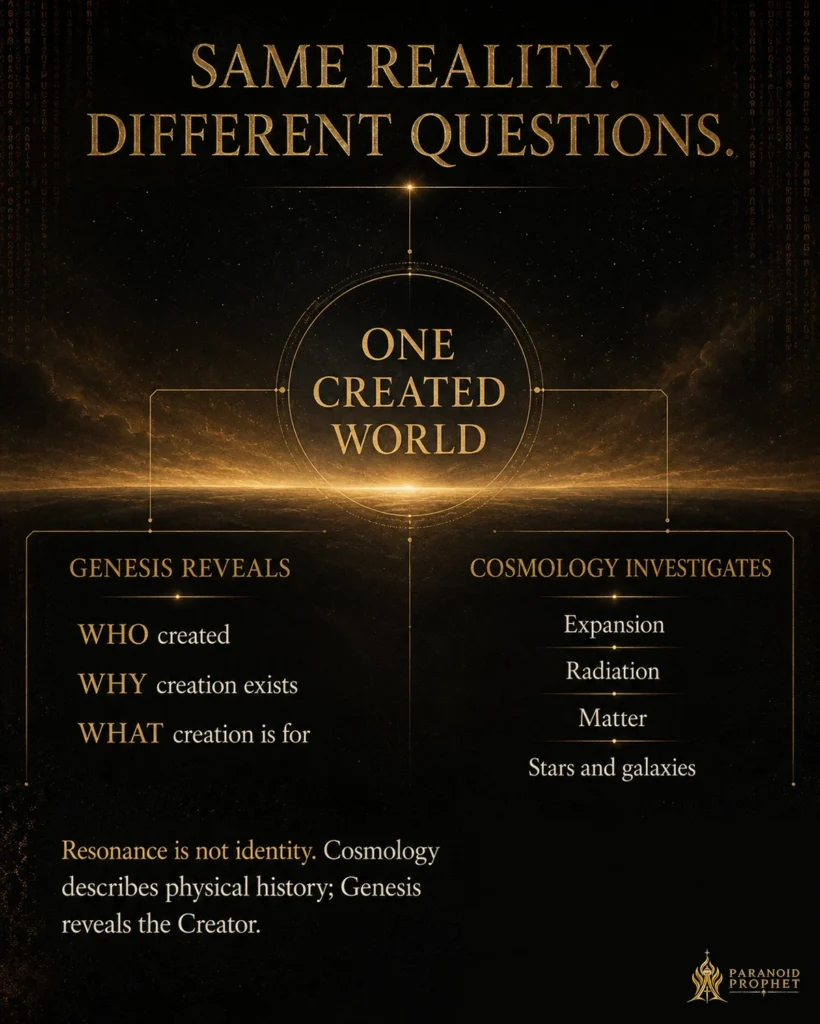
Weak arguments damage strong truth. “The Big Bang proves the Bible” asks science to do more than it can do. “Genesis must be false because it is not written like modern cosmology” asks Scripture to do something it never claims to do. The better approach is to hear Genesis as Scripture and cosmology as science, then consider the questions each one leaves before us.
The Big Bang also cannot settle the length of Genesis’s days, determine the best reading of the Hebrew text, or provide a complete chronology of creation. Those questions require their own close reading of Scripture. This article addresses the narrower issue of whether Genesis 1 should be identified with the Big Bang model.
What the Big Bang Model Actually Claims
Before comparing Genesis with cosmology, it helps to clear away a common misconception. The Big Bang is not best pictured as a bomb exploding at one point into otherwise empty space. In NASA’s explanation, the universe has no central blast point in that sense; the model describes an expanding universe in which galaxies move away from one another as space expands.
Cosmic Expansion and an Early Hot Universe
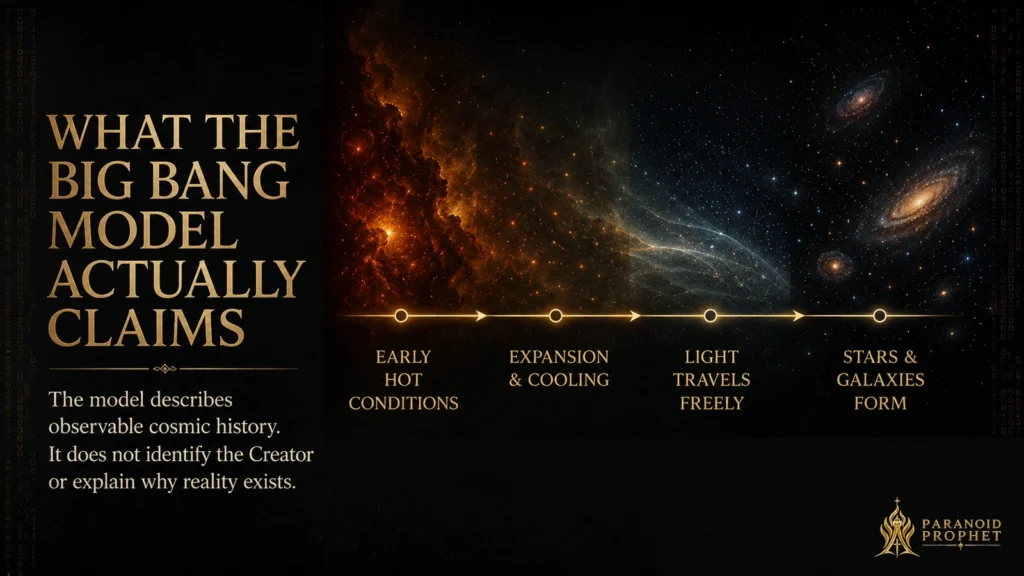
The Big Bang model describes the early history of a universe that expanded and cooled. In the standard cosmological account, the early universe was extraordinarily hot and dense. As conditions changed, the lightest elements formed, the universe later became transparent to light, and stars, galaxies, and larger structures developed over time.
One major line of evidence is cosmological redshift. Light from distant galaxies is stretched toward longer, redder wavelengths as it travels through an expanding universe. The farther away a galaxy is, the more pronounced this effect generally becomes. NASA explains the observation and its connection with cosmic expansion in its overview of cosmological redshift.
Scientists have not watched an absolute first moment of reality from outside the universe. They have gathered evidence from light, radiation, motion, and large-scale structure, then developed and tested models of cosmic history. NASA’s overview of cosmic history describes an early expanding universe, nucleosynthesis, recombination, the CMB, and the later development of stars and galaxies.
Christians can acknowledge that scientific picture without forcing Genesis into it. The Bible does not claim that Moses anticipated measurements of galactic light. It claims that heaven and earth exist because God created them. Cosmological discovery can deepen wonder, but wonder is not proof.
What the Model Does Not Explain
The Big Bang model is powerful because it accounts for much about the universe’s observable development. It is not, however, a complete explanation of reality itself. It does not identify a Creator, establish human purpose or moral obligation, or explain why physical laws exist and can be described mathematically.
Those are not failures of science. They are questions beyond the scope of a physical model. Science investigates how the universe behaves and reconstructs aspects of its history. Questions about why there is any universe at all, why its laws exist, and whether its existence has an ultimate ground move into philosophy and theology.
Two opposite conclusions should therefore be avoided. The first turns cosmology into a substitute gospel: the universe expanded, so God has been scientifically proved. The second treats physical explanation as though it removed the need for a Creator: the universe has a history we can model, so creation is unnecessary. Neither conclusion follows simply from the model.
The next question is biblical rather than astronomical: what do Genesis 1:1–3 actually say about God, creation, darkness, light, and the dependence of all things upon Him?
What Genesis 1:1–3 Actually Says
Genesis gives readers something more foundational than an early-universe mechanism: the Creator. It begins with God, not an autonomous universe, impersonal matter, or a self-explaining cosmic process. Before the chapter describes a world of land, seas, vegetation, animals, and human beings, it identifies the One upon whom all creation depends.
That opening establishes the frame of the biblical account. Creation is not divine, self-owned, or ultimate. God speaks, separates, names, orders, and calls His work good. The repeated movement of the chapter is not that the world appeared by its own necessity, but that God commanded and it came to be.
“In the Beginning” and the Creator
The familiar translation of Genesis 1:1 reads, “In the beginning, God created the heavens and the earth.” That reading has shaped Jewish and Christian faith for centuries and rightly emphasizes that God stands before and above the world He made.
The opening Hebrew grammar is nevertheless debated. Some interpreters understand verse 1 as an independent declaration: God created the heavens and the earth. Others connect it more closely with what follows: “When God began to create,” the earth was unformed, darkness covered the deep, and then God said, “Let there be light.” The debate concerns how the clauses relate; it does not remove God from the role of active Creator or make the world independent of His will.
Genesis does not portray God as one power among other eternal forces, struggling against a rival deity. He rules by His word. That truth reaches farther than any single cosmological model. Scientific theories can describe early hot conditions, radiation, expansion, and the later formation of galaxies. Genesis asks the prior question: Who is the God before whom heaven and earth stand?
Genesis 1 does not reduce creation to a mechanism. It reveals creation as the work of the living God, ordered by His word and sustained under His authority.
Does Genesis Teach Creation From Nothing?
Christians have historically confessed creatio ex nihilo: God created all things without depending on preexisting, independent matter. No eternal material realm stands beside Him as a rival. “Nothing” in that confession does not mean an empty region of space, a vacuum, or unorganized raw material; those would already be parts of creation. It means that God did not require a preexisting created reality in order to create. That confession should be preserved, but it should not rest on the careless claim that every aspect of the doctrine is settled by one disputed grammatical decision in Genesis 1:1.
Genesis 1 clearly identifies God as Creator and presents the world as owing its existence and order to Him. The wider biblical witness deepens that confession. John 1:1–5 says that all things came into being through the eternal Word. Hebrews 1:1–4 presents the Son as the One through whom God made the world and the One who upholds all things. Colossians 1:15–17 adds that all things were created through Christ and for Christ, and that in Him all things hold together.
Hebrews 11:3 teaches that the visible world was formed by God’s word and was not made from what is visible. The verse should not be turned into a complete philosophical formula by itself, but it belongs to the wider biblical witness that creation is not an independent reality existing beyond God’s authority.
The doctrine is therefore a whole-canon Christian confession: all created reality depends on God. In Christian theology, creation is more than the claim that the universe once had a first physical moment. It is the claim that the universe is never self-grounding. Even a model proposing a longer or more complex cosmic history would still leave the Creator-creature distinction intact. A cosmological model may trace the universe back to extremely early physical conditions, but it cannot establish by scientific measurement alone why anything exists, why laws exist, or why the world depends on God rather than itself.
Why “Let There Be Light” Is Not a Physics Formula
The most common forced parallel says that Genesis 1:3 must describe the Big Bang because Genesis says, “Let there be light,” and modern cosmology involves an early luminous universe. That conclusion moves too quickly.
In Genesis 1:3–5, God brings light into being, separates light from darkness, and names day and night. The focus is divine authority and the ordering of creation. Light is not presented as a technical label for a radiation field, primordial photons, the CMB, or any known stage in particle physics.
The chapter later speaks of the lights in the expanse, which mark signs, seasons, days, and years (Genesis 1:14–19). Whatever interpretive questions readers raise about day one and day four, Genesis is not arranging its claims around the categories of modern astrophysics.
Christians should reject both shallow harmonization and shallow dismissal. The fact that Genesis and cosmology both use the idea of light does not make them the same event. Yet Genesis has not become meaningless because it does not use vocabulary that would not exist for millennia. It tells readers that light is not ultimate, darkness is not beyond God’s rule, and the world’s order is established by its Creator.
Real Resonance or Forced Parallel?
Is there any meaningful relationship between Genesis and the Big Bang once forced parallels are rejected? Yes, but it must be described carefully. There can be resonance without identity. Genesis and cosmology concern the real universe, but they address it at different levels and with different purposes.
A Universe With a Physical History
Modern cosmology describes a dynamic universe with a measurable physical history. It expands, cools, and develops; its present structure is connected to earlier conditions. Genesis does not supply the measurements behind that account. It does, however, present the world not as self-originating or ultimate, but as creation whose history begins under the sovereign command of God.
That is the first legitimate point of resonance. A universe with a physical history fits naturally with the biblical confession that creation depends upon God. It does not mean Genesis anticipated every feature of standard cosmology or provides a scientific timeline that can be laid over one. It means cosmology does not require Christians to abandon the Creator-centered vision of Genesis.
Creation, Contingency, and Ultimate Explanation
The Christian claim is not merely that the universe had an early hot phase. It is that the universe is contingent: it does not contain the final reason for its own existence within itself. Physics can describe relations among energy, matter, gravity, time, and cosmic development. Even a complete physical description, however, would still describe a universe rather than establish why a lawful universe exists at all.
This is not a complaint against science. It is a distinction about kinds of questions. Science studies measurable processes and tests models against evidence. Philosophy and theology ask about ultimate explanation: why there is something rather than nothing, why there are laws capable of describing the universe, and why minds within the universe can discover its structure.
Genesis directs readers to God as the ultimate ground of creation. Christians may reasonably argue that a contingent and intelligible universe is more coherent within a worldview of creation than within one that simply treats reality as brute fact. That conclusion is an apologetic inference, not a result announced by NASA or measured through a telescope.
Why Genesis Does Not Predict Modern Cosmology
Forced concordism treats every phrase in Genesis 1 as a prediction of modern science: light becomes the Big Bang, the waters become primordial matter, the firmament becomes a scientific layer of the atmosphere, and each creation day becomes a coded phase of cosmic history. Such comparisons may sound impressive, but they make Scripture depend on provisional scientific matches that can weaken or change.
The opposite error is to assume that Genesis makes no real claim about the world because it is not written in technical modern language. Ancient Scripture can make true claims without being a modern physics manual. Genesis tells readers who made the world, what kind of world it is, why it has order, and why humanity stands accountable to its Creator.
The physical history of the universe is not an enemy of Christian faith. It is part of the created order God made. Christians do not need to identify Genesis with every scientific model in order to receive both Scripture and careful scientific observation as meaningful.
The CMB, Inflation, and the Limits of Scientific Comparison
Popular Genesis-and-Big-Bang discussions often pull in the cosmic microwave background and cosmic inflation. Both are important within standard cosmology. Neither gives Christians a shortcut for claiming that Genesis 1 predicted modern science.
What the CMB Is
The cosmic microwave background, or CMB, is relic radiation from the early universe. In the standard cosmological account, the universe was once so hot and dense that free electrons scattered photons, leaving it opaque. As expansion and cooling continued, nuclei captured electrons. Around 380,000 years after the expansion began, the cosmic fog cleared enough for light to travel freely over great distances.
The radiation associated with that era is still detectable today. NASA calls it the oldest light we can observe. That phrase does not mean scientists have photographed the absolute first moment of reality. It means the CMB is the earliest observable electromagnetic window into standard cosmic history. Its subtle temperature variations help cosmologists study early conditions and the density differences that later contributed to galaxies and larger structures.
That makes the CMB important evidence within standard cosmology, not merely a colorful illustration. But evidence can be highly significant without being exhaustive. The CMB gives a window into an early observable era; it does not directly observe an absolute beginning, explain the ultimate origin of reality, or supply a theological interpretation of itself.
Why the CMB Is Not Genesis 1:3
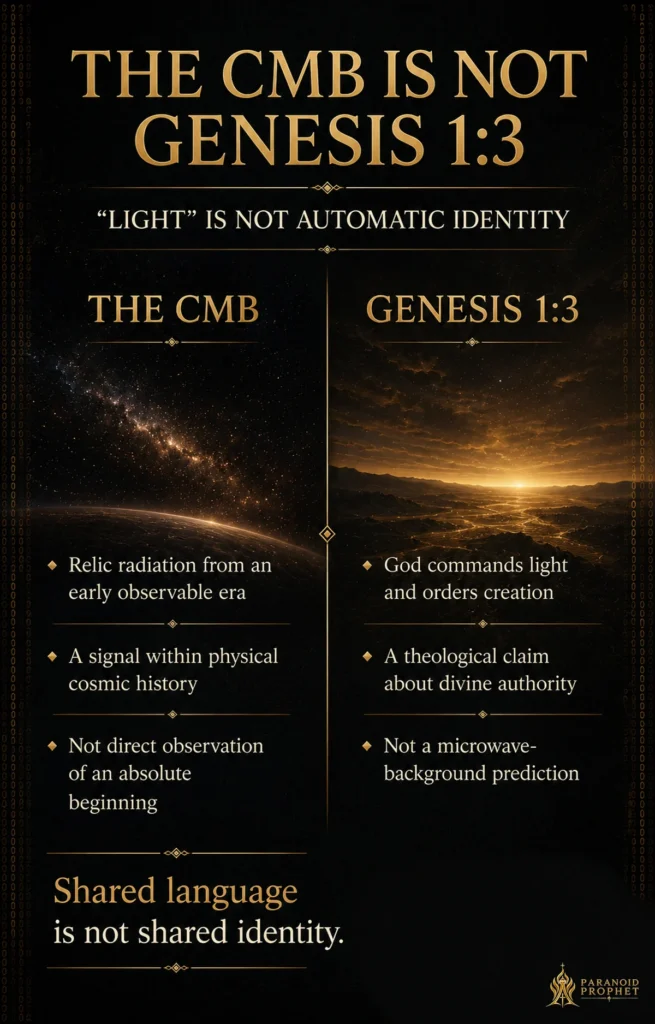
Some Christians suggest that the CMB is the light of Genesis 1:3. The comparison is understandable but does not hold. Genesis describes God speaking light into being, separating light from darkness, and naming day and night. The CMB is relic radiation associated with a later phase in standard cosmology, when the universe became transparent enough for photons to travel freely.
Genesis does not describe radiation cooling, electrons binding to nuclei, or photons traveling through an expanding universe. Cosmology does not claim to identify the biblical moment when God divided light from darkness. Both discussions involve light, but verbal overlap is not identity.
The CMB is not biblical “first light.” It is relic radiation from the early universe. Genesis 1:3 is not a microwave-background prediction; it reveals God’s command bringing light and order within creation.
Inflation, Open Questions, and Intellectual Humility
Cosmic inflation is a major proposal in contemporary cosmology: a period of extraordinarily rapid expansion proposed for the earliest fraction of a second in the universe’s history. It is used to address features such as large-scale flatness and the density variations that later contributed to cosmic structure.
Inflation is important, but it is not a finished answer to every question. NASA notes that scientists do not know what came before inflation or what powered it. That is not a defect to mock; it is an honest reminder that cosmology remains a field of active inquiry.
Christians should not baptize inflation into Genesis. Genesis does not name it, give its mechanism, or assign it to a creation day. Scientific models may explain features of the cosmos, but they are not biblical doctrine. Christians need not fear scientific revision, and scientists should not be asked to supply answers their methods were never designed to settle.
Does the Big Bang Point to God?
The Big Bang does not produce a laboratory result that reads, “Therefore God exists.” It does not identify the God of Abraham, Isaac, and Jacob; establish the Trinity; prove the incarnation; or create saving faith. Christian faith does not rest on forcing a telescope to say more than a telescope can say.
Yet the limits of cosmology do not make the question of God irrelevant. They clarify the kind of question being asked. Cosmology studies expansion, radiation, matter, gravity, and cosmic structure. A description of physical history is not automatically an ultimate explanation for why physical reality—with laws, order, and intelligibility—exists in the first place.
This distinction also protects Christian faith from being tied to a single version of cosmology. A revised model may change how scientists reconstruct early cosmic history. It would not make created reality self-explanatory. The Christian confession is not that God is merely the first event before all other events; it is that every event, law, and created thing depends upon Him. That claim remains in place whether cosmologists refine current models or propose new ones.
More Than a God-of-the-Gaps Argument
Christians should not use scientific uncertainty as proof of God. A weak argument says, “Scientists cannot yet explain this detail, therefore God is the explanation.” That turns God into a placeholder for temporary ignorance.
The biblical doctrine of creation makes a different claim. God is Creator of every part of reality, including the parts science explains well. He does not compete with natural causes as though every successful scientific explanation removes one more place where He can act. From a Christian view, physical laws and regular patterns describe the created order He sustains.
Isaiah 40:12–28 places the Creator above every creaturely measure. The universe remains creaturely no matter how vast, ancient, or mathematically elegant it appears. Better cosmology therefore does not explain away creation; it reveals more of the world God made.
Scientific explanation does not compete with the Creator. It describes the order of a universe that, according to Scripture, never existed independently of Him.
What Science Can Describe and What Philosophy Must Ask
Science can measure redshift, test models against observations, estimate the abundance of light elements, and study radiation from the early universe. These are genuine achievements. But science examines an already-existing reality with stable patterns, measurable quantities, and intelligible regularities.
Why is there something rather than nothing? Why do physical laws exist? Why does mathematics map onto the world so effectively? Why is the universe contingent rather than self-existent? Those are questions about ultimate explanation. They are not evidence that science has failed; they require philosophical reasoning because they concern the grounds of reality, not merely the behavior of things within it.
Job 38:1–18 confronts human pride with the Creator’s wisdom and authority over a world no human being has mastered. Romans 1:18–23 teaches that creation bears witness to God’s power and divine nature, while also exposing humanity’s refusal to honor Him. Neither passage is a modern cosmological model. Both insist that creation points beyond itself to the Creator.
A telescope can show that the universe is expanding. It cannot produce repentance, worship, or faith. Scripture does more than tell us that reality has a cause; it calls us to recognize the God to whom we belong.
What Christians Can Say With Confidence
Christians can say that Genesis 1 does not give the Big Bang in advance as a technical scientific prediction. “Let there be light” should not be relabeled as inflation, primordial radiation, or the CMB. The Bible does not need those forced parallels in order to speak truthfully about creation.
Christians can also say that Big Bang cosmology does not disprove Genesis. It describes aspects of the universe’s physical history; Scripture reveals the Creator whose word stands behind all created reality. A universe that is contingent, ordered, and open to rational investigation may carry philosophical significance, but that significance is an inference, not a scientific proof.
Finally, Christians should not make allegiance to one cosmological chart a test of faithfulness. The gospel does not rest on whether someone can solve every question about cosmic expansion. It rests on the God who made all things and has made Himself known in His Son.
Frequently Asked Questions About Genesis and the Big Bang
Does Genesis 1 describe the Big Bang?
No. Genesis does not provide a technical account of expansion, redshift, inflation, or early-universe physics. It identifies God as Creator and presents the universe as dependent on His word. The Big Bang model describes aspects of physical history. Christians may see resonance between a created universe and a universe with a measurable history, but resonance is neither proof nor identity.
Does the Big Bang prove God?
No. It does not identify the God of Scripture, establish the Trinity, prove the resurrection, or produce saving faith. It can raise philosophical questions about why reality and physical laws exist, but the move from cosmic history to an ultimate explanation is philosophical and theological—not a laboratory result.
Does Genesis 1:1 teach creation from nothing?
Genesis clearly identifies God as Creator. Its opening grammar is debated, so Christians should not claim that the whole doctrine of creation from nothing rests on one clause. The wider biblical witness teaches that all created reality depends on God and that no created thing stands beside Him as an eternal rival.
Is “Let there be light” the Big Bang?
No. Genesis 1:3 reveals God bringing light and order by His command. It is not a technical description of primordial radiation, particles, inflation, or the CMB. Genesis and cosmology both concern the real universe, but the word “light” alone does not make their claims identical.
Is the CMB the light of Genesis 1:3?
No. The CMB is relic radiation associated with a later stage of standard early-universe history, when the universe became transparent enough for light to travel freely. Genesis 1:3 does not describe that process; it reveals God’s authority over light and darkness.
Does inflation appear in Genesis?
No. Inflation is a scientific proposal for an extremely rapid early phase of expansion. Genesis does not name it, explain its mechanism, or assign it to a creation day. Christians should not make a scientific model into biblical doctrine.
Is this a God-of-the-gaps argument?
It should not be. God is not a temporary answer for what science has not yet explained. Christian creation says that God is Creator and sustainer of all reality, including the parts science explains well. A fuller physical account would still describe a universe rather than explain why one exists.
Does the Big Bang settle the days or age of Genesis?
No. The Big Bang does not determine the meaning of yom, decide whether Genesis’s days are ordinary days, or settle biblical chronology. Those questions require close interpretation of Scripture. For the broader framework of creation, time, Genesis’s days, cosmology, and relativity, read Genesis Creation and Time: What Scripture and Science Can—and Cannot—Say.
Sources and Further Reading
Source discipline: Scripture is the final authority for Christian doctrine and biblical interpretation. Scientific sources help explain current observations and models of the physical universe. Biblical scholarship clarifies language, genre, and interpretive debate. Philosophical conclusions about ultimate explanation are reasoned inferences, not laboratory results. For the site’s wider standards on research, evidence, and correction, read Sources & Verification.
Primary Scripture
- Genesis 1:1–5, 14–19
- Psalm 19:1–4; Isaiah 40:12–28
- John 1:1–5; Colossians 1:15–20
- Hebrews 1:1–4; 11:3
- Romans 1:18–23; Revelation 21:1–5
Scientific Background
- NASA, “Cosmic History” — early expansion, nucleosynthesis, recombination, the CMB, inflation, and later cosmic development.
- NASA, “Webb Telescope & the Big Bang” — what modern astronomy can and cannot observe about early cosmic history.
- NASA, “Hubble Cosmological Redshift” — redshift and cosmic expansion.
- European Space Agency, “The Cosmic Microwave Background and Inflation” — CMB, inflation, and early density variations.
Biblical and Theological Further Reading
- Gordon J. Wenham, Genesis 1–15.
- C. John Collins, Genesis 1–4: A Linguistic, Literary, and Theological Commentary.
- John H. Walton, The Lost World of Genesis One. An influential functional and cosmic-temple proposal; useful for understanding one serious alternative reading, not as a settled consensus.
- John C. Lennox, Seven Days That Divide the World.
- Paul Copan and William Lane Craig, Creation Out of Nothing: A Biblical, Philosophical, and Scientific Exploration.
The Creator Revealed Through Jesus Christ
The question of cosmic origins finally leads beyond an unnamed first cause. Genesis identifies the Creator as the sovereign God who speaks, orders, and gives life. The New Testament reveals that all things were created through and for Jesus Christ.
The eternal Son did not remain distant from the world He made. He entered the created order in the incarnation, bore sin and death at the cross, and rose bodily from the grave. Scripture’s final vision is not the abandonment of creation but its renewal: God making all things new.
Cosmology can describe a universe with a physical history. Scripture reveals the One through whom and for whom that history exists. The universe is not merely the aftermath of an early expansion. It is creation, and its Creator has made Himself known in Jesus Christ.
For the wider case that Jesus is not merely a teacher or religious symbol, but the eternal Son, crucified Savior, risen Lord, and coming King, read Is Jesus the Son of God? Evidence from History, Prophecy, Resurrection, and Scripture.