
GUIDED ARTICLE EXPERIENCE
Is God Outside Time? What the Bible Really Says About Eternity
Read along as the narration moves through the article.
Private device narration · No hosted audio or tracking
CONTINUE GUIDED TOUR
Continue where you left off.
GUIDED TOUR COMPLETE
You have reached the end of this study.
Study record saved on this device.
GUIDED TOUR
Is God Outside Time? What the Bible Really Says About Eternity
Narrator: Paranoid Prophet Recommended Voice Native device narration
Prepare to follow the article as it is narrated.
VOICE & TOUR OPTIONS
Voice & Listening
NARRATOR
Finding a narrator…
Checking the best narrator available on this device.
Restores the best curated narrator available on this device.
Narrator choices are curated for clear, long-form listening on this device.
Screen-awake support will be checked when narration starts.
CHOOSE A NARRATOR
Curated for this device
Choose a verified narrator for this browser, or use System Narrator. Automatic mode uses the best reliable route exposed by this device; your chosen narrator is preserved even if this device needs a temporary fallback.
Preparing the guided article experience…
RESUME GUIDED TOUR?
Continue where you left off.
GUIDED TOUR COMPLETE
You have reached the end of this study.
When Christians say that God is “outside time,” they usually mean something important: God is not a finite creature whose life is measured by birthdays, decay, waiting, exhaustion, and death. He is the Creator of the world and Lord over its whole story.
Yet the phrase can also confuse. It may make God sound distant, frozen, or unable to act in the real history Scripture tells. The Bible presents no such God. The everlasting Lord creates, speaks, judges, hears prayer, makes covenant, sends His Son, and brings history toward its appointed end.
This article examines what Scripture actually says about God’s eternity, what Christians may reasonably infer from it, and where serious Christians have disagreed. For the broader framework of Genesis, creation, time, and science, see Genesis Creation and Time: What Scripture and Science Can—and Cannot—Say.
Article Guide10 sections
Is God Outside Time? The Short Answer
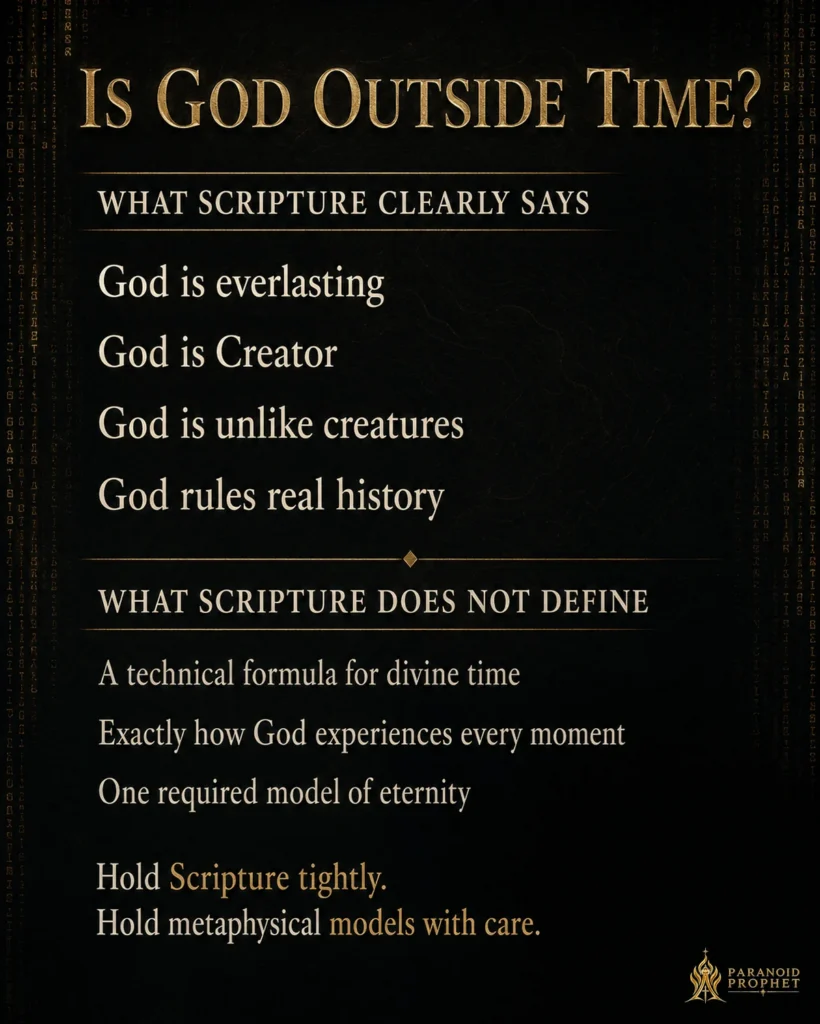
The Bible does not use the exact technical phrase “God is outside time.” It does teach that God is everlasting, Creator, and unlike creatures whose lives are marked by weakness, mortality, and passing years.
Christians may therefore reasonably say that God is not dependent on created time as we are. He is not one more being inside the universe, carried helplessly from yesterday to today and then toward tomorrow. Before the mountains were formed and before the world was brought forth, God was God. Nothing in history exceeds His knowledge, wisdom, or sovereign rule.
At the same time, Scripture insists that God truly acts in history. He creates the world, calls Abraham, delivers Israel, judges evil, hears His people, sends prophets, and fulfills His promises. In the fullness of time, the eternal Son takes human flesh, lives among us, dies for sinners, rises bodily from the grave, and reigns as Lord.
That means Christians should avoid two opposite mistakes. One treats God as though He were merely a very old being inside a larger universe. The other turns Him into an abstract principle so remote from history that His actions, promises, and covenant dealings become little more than appearances.
God’s eternity does not make Him remote from history. It establishes that history belongs to Him.
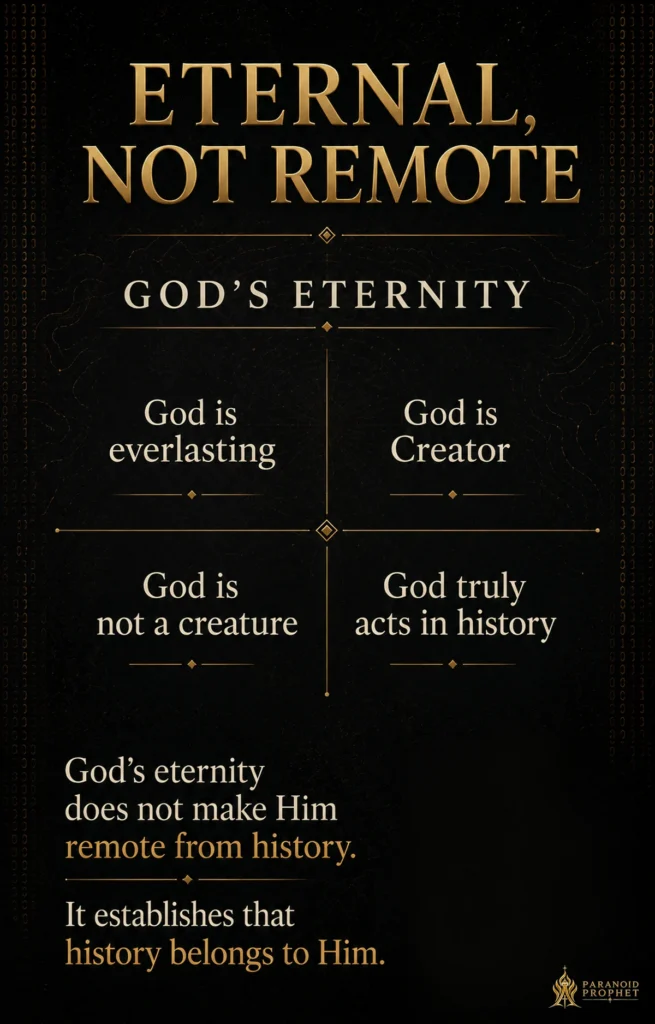
The precise philosophical question remains debated. Some Christians argue that God exists timelessly, without a succession of past, present, and future moments. Others argue that God has no beginning or end but genuinely experiences a real sequence in His relation to the world. Both views attempt to account for truths Scripture clearly teaches: God is eternal, God is not a creature, and God truly acts within the history He made.
The Bible gives Christians greater confidence about those foundations than it does about every metaphysical detail. It teaches us to worship the everlasting Creator before it asks us to diagram how divine eternity works.
What Scripture Clearly Says About God’s Eternity
Scripture does not begin with an abstract theory of time. It begins with God. From Genesis to Revelation, the biblical pattern is consistent: the Lord is everlasting, sovereign, holy, and unlike creatures who come into being, grow weak, die, and are forgotten.
This distinction is not philosophical decoration. It protects the heart of biblical faith. The God of Scripture is not one force among many, not a temporary ruler inside a larger cosmic system, and not dependent on the world for His identity or existence. He is the Creator to whom all things belong.
God Is Everlasting and Creator
Psalm 90:1–4 gives one of Scripture’s clearest contrasts between God’s permanence and human frailty. Before the mountains were brought forth and before the earth and world were formed, God was God “from everlasting to everlasting.” Human beings, by contrast, return to dust. Our years pass quickly. Our strength fades. Our lives are brief before the One who made us.
The psalm is not a mathematical equation for divine time. Its comparison between a thousand years and yesterday is not a conversion chart for prophecy, Genesis chronology, or physics. It magnifies the Creator’s eternity over against the fragile and passing character of human life.
Isaiah 40:25–28 adds another vital truth. The Lord is “the everlasting God, the Creator of the ends of the earth.” Unlike His creatures, He does not faint or grow weary. His understanding cannot be measured.
Divine eternity, then, is more than endless duration. A person who lived forever but remained subject to weakness, dependence, ignorance, or decay would still be a creature. Scripture presents God differently. His life does not arise from another source, wear down with time, or depend upon the world He made.
The Creator Is Not a Creature
Genesis 1:1 begins with God, not with a universe that contains Him: “In the beginning, God created the heavens and the earth.” The verse does not offer a technical philosophical theory of time. It establishes something more basic: the Creator-creature distinction.
Heaven and earth are created. God is not. The world depends on Him; He does not depend on the world.
Christians may reasonably infer that God is not dependent on created time as creatures are. Our lives unfold in a world we did not make. We remember a past we cannot recover, wait for a future we cannot control, and move through days that carry us toward death. God is not presented as another vulnerable inhabitant of that order.
That inference needs care. Scripture does not describe God as physically standing somewhere beyond a giant clock or timeline. Time is not a container in which God needs to find a location. The Bible’s primary claim is that God is the uncreated Creator, and the world with all its passing years belongs to Him.
The Eternal Son Before All Things
The New Testament gives this doctrine its fullest center in Jesus Christ. Divine eternity is not merely an idea about an unnamed first cause. It is revealed in the Son.
John 1:1–3 begins with creation language: “In the beginning was the Word.” Before anything created came into being, the Word already was. The Word was with God, and the Word was God. John then says that all things came into being through Him.
John 17:5 records Jesus speaking of the glory He shared with the Father before the world existed. Colossians 1:15–17 says that all things were created through Christ and for Christ, that He is before all things, and that in Him all things hold together. Hebrews 1:1–4 likewise presents the Son as the One through whom God made the world and who upholds all things by His powerful word.
These passages do not hand readers a complete philosophical diagram of timelessness. They reveal something more important: the Son is not part of creation. He is before all things, the agent of creation, and the sustainer of all things.
Then comes the wonder at the center of the gospel. The eternal Word became flesh. The One through whom all things were made entered the world He made without ceasing to be who He is. He came near within history—not as a symbol, but as Jesus Christ: truly God, truly man, crucified Savior, risen Lord, and coming King.
Does the Bible Say God Is “Outside Time”?
Christians often use the phrase “outside time” because it attempts to express an important biblical conviction: God is not dependent on created reality as finite creatures are. But it is theological shorthand, not a direct quotation from Scripture.
The Bible more often speaks of God as everlasting, Creator, sovereign over history, and unlike creatures whose lives are marked by passing years. Those are the claims Christians must hold with confidence. The phrase “outside time” is useful only when it serves those claims rather than replacing them.
Biblical Teaching and Theological Shorthand
Isaiah 46:9–10 declares that God makes known the end from the beginning and accomplishes His purpose. The text strongly affirms God’s sovereign rule over history. It does not, by itself, settle whether God knows history from a timeless eternal present or through an everlasting divine life.
Isaiah 57:15 speaks of the high and exalted One who inhabits eternity while also dwelling with the contrite and lowly. God’s transcendence does not make Him inaccessible to His people. The One exalted above all creation also draws near to revive the humble.
To say that God is “outside time” is to confess that He is not dependent on created time as finite creatures are—not to imagine Him as a distant object floating beyond a cosmic clock.
That conclusion is an inference from Scripture’s Creator-creature distinction. God made heaven and earth. He is not one being inside the world He made. Created time does not sustain Him, contain Him, or establish the limits of His life.
Neither does that conclusion deny God’s real action. The Lord is free, sovereign, and present to His creation without becoming dependent on it. His acts are not the desperate reactions of a creature trying to catch up with events.
What Scripture Does Not Define
The Bible does not give a technical philosophical formula for divine eternity. It does not say, “God experiences all moments simultaneously,” nor does it say, “God moves through an endless sequence of divine moments.” Those are later attempts to explain how the eternal Creator relates to time.
Revelation 1:8 describes the Lord God as “the Alpha and the Omega,” the One “who is and who was and who is to come.” Revelation 22:13 again uses the language of beginning and end. These passages declare God’s sovereign identity and lordship over the entire sweep of history.
They are not metaphysical diagrams. Their purpose is to proclaim that no beginning stands before God as though He were absent from it, and no ending lies beyond His authority. He is Lord over creation, redemption, judgment, and renewal.
God’s eternity should not become a shortcut for debates Scripture addresses elsewhere. It does not settle the meaning of the days in Genesis 1, convert Psalm 90 or 2 Peter 3 into a chronology formula, or allow modern physics to decide divine timelessness. Those questions require careful interpretation on their own terms.
Christians agree that God is eternal. They have not all explained His eternity in the same way. Does God possess eternity without any succession of moments, or does He live eternally through a real sequence of divine life and action? That question has shaped centuries of Christian reflection.
Two Major Christian Views of Divine Eternity
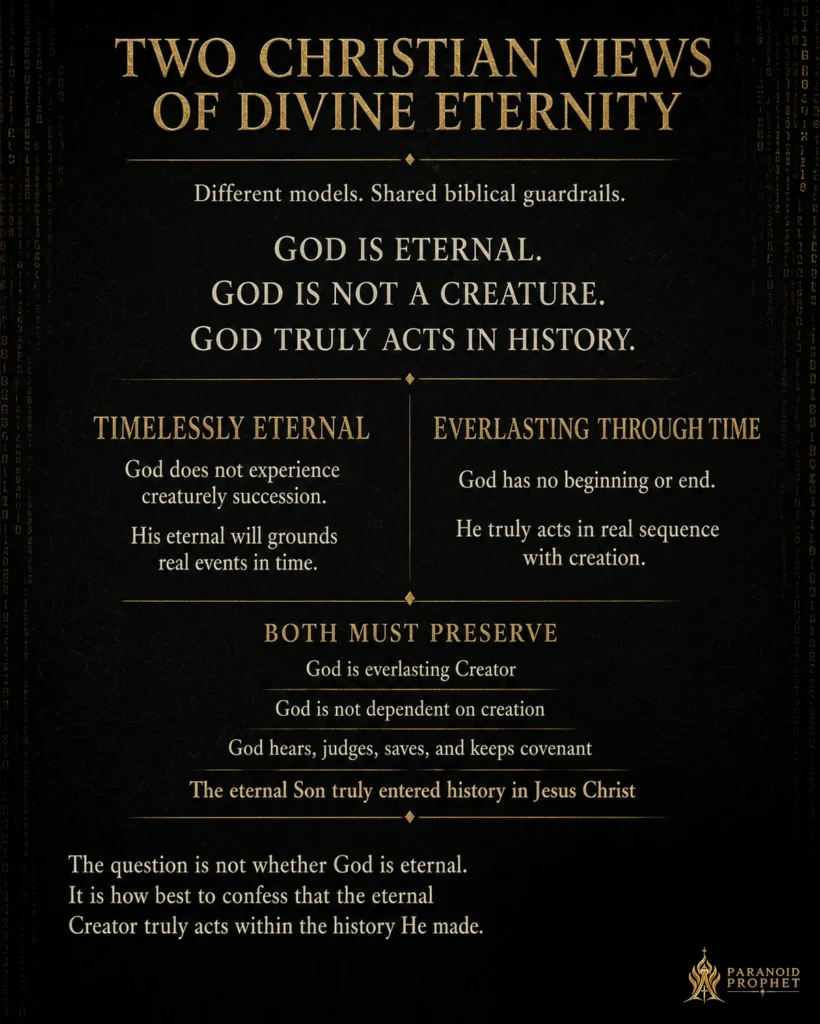
Christians have long agreed that God is eternal. The deeper disagreement concerns how to describe that eternity.
Does God possess His life without succession, so that past, present, and future do not divide His eternal being? Or does God have no beginning and no end while still living through a real order of divine action and relationship?
Scripture does not answer those questions with one technical formula. The debate arises because Christians are trying to account for the whole biblical witness: God is everlasting and Creator; He is not a finite creature; He rules history; He hears prayer; and the eternal Son truly entered history in Jesus Christ.
The question, then, is not whether God is eternal. It is how best to confess that the eternal Creator relates to a world where events genuinely happen in sequence.
Timelessly Eternal: The Classical View
The classical view of divine eternity holds that God does not experience time as creatures do. He does not move from a past that is gone into a present that slips away and then toward a future that has not yet arrived. His life is not divided into changing moments.
On this view, eternity is not merely endless duration. God does not simply have more years than the universe. He possesses the fullness of divine life without the succession, waiting, loss, and change that mark creaturely existence.
Augustine reflected on this contrast in Confessions, especially when considering the passing character of human time. Boethius described eternity as the complete and undivided possession of endless life. Thomas Aquinas likewise distinguished time, which involves succession, from divine eternity, which does not.
The purpose of this tradition is not to make God less alive or less personal. Classical theologians argue the opposite. God does not become wiser, holier, or more complete with time because He is already perfect. He does not decay, lose, or become subject to forces outside Himself.
Classical timelessness also does not deny that God acts in history. Its defenders argue that God’s eternal will grounds real temporal events. Creation happens. Covenants are made. Prayers are heard. Christ is born. The cross occurs. The tomb is empty. The final judgment will come.
Those events are not unreal because God is eternal. They are real effects within created history. On this account, God’s providence includes both the real prayers of His people and the real answers He gives through them.
The difficulty is also real. Readers may reasonably ask how a timeless God can know that an event is happening now, respond to a prayer offered today, or relate personally to creatures whose lives unfold moment by moment. Classical thinkers have offered answers, but Christians should not pretend the question is easy or unimportant.
The strength of the classical view is its insistence that God is not merely a larger creature. Its pressure point is explaining how timeless divine life relates personally and dynamically to temporal creatures.
Everlasting Through Time: The Temporal View
Other Christians argue that God is eternal not because He lacks all succession, but because His life has no beginning and will have no end. On this view, God genuinely experiences a real order of divine action: He creates, speaks, promises, responds, judges, saves, and brings His purposes to completion.
This position is often called divine temporality or everlasting divine life. It does not mean that God is trapped inside the universe, subject to biological aging, or dependent on a clock that existed before Him. It means that God’s life includes real sequence in His relationship with the world He freely made.
Those who defend this view often emphasize Scripture’s personal and historical language. God speaks to Abraham, hears Israel’s cries, sends Moses, responds to repentance, gives promises, fulfills them, and sends His Son “when the fullness of time had come.” They argue that this language should not be reduced too quickly to the appearance of divine action.
The temporal view also seeks to take the incarnation with full seriousness. The Son did not merely appear at a point in history while divine life remained untouched by every historical relation. He truly took human nature, was conceived, born, suffered, died, rose, and ascended. The gospel is not a timeless idea projected onto history. It is God’s saving action within history.
Yet this view faces difficult questions of its own. If God experiences succession, does He gain new knowledge? Does He change in ways that compromise His perfection? Does time become something God depends on? Does divine life become vulnerable to surprise, limitation, or development?
Christian defenders of divine temporality answer those questions in different ways. The article does not need to settle each answer. It is enough to recognize that this view exists because Christians want to preserve both God’s eternity and Scripture’s language of real divine relationship.
A temporal view of God should not be confused automatically with open theism. Open theism is a separate position about divine foreknowledge and the status of future free choices. A Christian may believe that God experiences real succession and still affirm that He knows all things perfectly and accomplishes His purposes without failure.
The strength of the temporal view is its emphasis on God’s genuine action and relational involvement in history. Its pressure point is explaining how God remains fully uncreated, sovereign, and unlike finite creatures while experiencing real sequence.
Some Christians propose a hybrid account. They argue that God exists timelessly apart from creation but enters a temporal relation once He creates a temporal world. This approach seeks to preserve both divine transcendence and the reality of God’s action in history. It also raises a serious question of its own: what would it mean for a timeless God to enter a temporal relation without introducing a before-and-after into the explanation?
What Both Views Must Preserve
It is easy to become absorbed in diagrams, timelines, and philosophical labels. But the most important issue is whether a view preserves the truths Scripture actually gives.
Any faithful Christian account of divine eternity must confess that God has no beginning and no end. He is everlasting Creator, not a finite being brought into existence by another cause. He is not subject to creaturely death, decay, ignorance, or exhaustion.
It must also confess that God is not one object inside creation. He made heaven and earth. The world depends on Him; He does not depend on the world. No physical law, cosmic clock, or created process stands over Him as though it were more ultimate than the Creator.
At the same time, any faithful view must preserve God’s real action in history. He creates, judges, delivers, makes covenant, commands prayer, responds to repentance, sends His Son, raises Christ from the dead, and will judge the world and make all things new.
Most importantly, every account must preserve the reality of Jesus Christ. The Son existed before all things. Through Him all things were made. Yet He truly entered human history, took flesh, bore suffering, died under Pontius Pilate, rose bodily, and reigns as Lord.
The question is not whether God is eternal. The question is how best to confess that the eternal Creator truly acts within the history He made.
Christians may disagree about timelessness, everlastingness, or a hybrid account. They may not make God a finite creature, turn prayer into theater, empty the incarnation of history, or treat the gospel as a detached philosophical theory.
How Can the Eternal God Act in History?
God’s eternity raises a personal question: if He is not limited as creatures are, can He truly hear, respond, act, and draw near?
Scripture answers yes. The God who is everlasting is not absent. He creates, commands, judges, saves, makes covenant, hears His people, and brings His purposes to completion. His eternity does not turn biblical history into a theater of appearances. It establishes that history unfolds under the rule of the living God.
Creation, Covenant, Prayer, and Providence
The Bible treats God’s actions as meaningful and personal. He calls Abraham, hears Israel’s groaning, gives His law, raises up prophets, judges rebellion, preserves His people, and fulfills His promises. Scripture does not describe a God who merely observes history from a distance.
Prayer belongs within that reality. Jesus teaches His disciples to pray for daily bread, forgiveness, protection, and the coming of God’s kingdom. He also tells them to ask, seek, and knock. Matthew 6:9–13 and Matthew 7:7–11 present prayer as real communion with the Father.
James 5:13–18 calls suffering believers to pray and instructs the church to pray for the sick. James does not explain every philosophical detail of divine action. He tells Christians to pray because God hears and works.
Prayer is neither a way to inform God of facts He did not know nor an attempt to pressure Him into becoming more generous than He is. It is a commanded means of fellowship, dependence, obedience, and real participation in God’s work.
Prayer is not a loophole around God’s sovereignty. It is one of the means through which the sovereign God draws His people into His work.
Christians who affirm timeless eternity often say that God eternally wills both the ends He accomplishes and the means through which He accomplishes them. On that account, His providence includes real prayers and real answers without implying that He learns new information or revises an uninformed plan.
Christians who understand God as everlasting through real sequence emphasize that Scripture’s language of prayer and covenant describes genuine divine responsiveness within history. On that account, believers truly pray, God truly hears, and God truly acts in relation to their petitions.
The views differ in how they explain the relationship between eternity and providence. They should not differ about the biblical reality of prayer. God commands His people to pray, hears them, and works through real means.
Does God “Change His Mind” in Scripture?
Some passages describe God as relenting or responding in relation to human action. Others emphasize His unchanging character. Faithful interpretation must not flatten either truth.
Jeremiah 18:7–10 presents announced judgment and blessing in covenantal terms connected to a nation’s response. Jonah 3:1–10 says that Nineveh turned from violence and God relented from the disaster He had announced. Exodus 32:7–14 describes Moses interceding for Israel after its idolatry, followed by the Lord relenting from the announced disaster.
Those passages should not be dismissed as though God’s covenant dealings are only pretend. Human rebellion, repentance, obedience, and intercession have real significance before God. The announced outcome can change because the people involved have changed in relation to the holy and faithful Lord.
Yet Malachi 3:6 says, “I the Lord do not change.” God is not fickle, dishonest, morally unstable, or forced to abandon His character because new facts have surprised Him.
First Samuel 15:10–31 places the tension close together. The Lord “regretted” making Saul king, yet the chapter also says that the Glory of Israel is not like a man who lies or changes his mind in the unstable human sense.
Classical views often distinguish God’s unchanging character and eternal purpose from changing historical effects and covenant situations. Temporal views more readily describe God as genuinely responding within a real sequence of events while maintaining that His holiness and faithfulness do not change.
The article does not need to settle that longstanding debate. It does need to preserve what the texts say: God is not caught off guard, morally changeable, or unreliable. Yet neither is He indifferent to repentance, prayer, rebellion, obedience, or the cries of His people.
The Incarnation: The Eternal Son Entered Our History
The incarnation is the decisive guardrail for every Christian discussion about God and time. Any theory that makes the eternal God too distant to act in history has not done justice to Jesus Christ.
John 1:1–14 holds together truths that philosophy often struggles to keep together. The Word was with God. The Word was God. All things came into being through Him. Then “the Word became flesh and dwelt among us.”
The Son did not become less divine when He entered our world. He did not cease to be the eternal Word through whom all things were made. But He also did not merely appear in history as a symbol. He truly took human nature. He was conceived, born, grew in wisdom and stature, suffered, prayed, wept, bled, died, and rose.
Galatians 4:4–5 says that “when the fullness of time had come,” God sent forth His Son, born of woman, born under the law, to redeem those under the law. Hebrews 2:14–18 says that because the children share in flesh and blood, He Himself likewise partook of the same things so that through death He might destroy the one who has the power of death and help those who are tempted.
This is not a timeless idea projected onto the world. It is God’s saving action in real history. Jesus was crucified under a Roman governor. He died. He was buried. He rose bodily. The gospel concerns events that happened within time, in a world the eternal Son created and came to redeem.
God’s eternity therefore does not make Him distant. The One who was before all things entered our years. The Creator drew near to creatures. The Lord of history carried the curse of sin and death within history so that those bound by death might receive eternal life.
God’s eternity does not erase the reality of His actions. It magnifies their grace. The final sections now need to establish how this doctrine should—and should not—be used in debates about Psalm 90, 2 Peter 3, relativity, Genesis chronology, and other questions about time.
Texts Commonly Misused in Time Debates
God’s eternity is a rich biblical doctrine, but it is often used as a shortcut for questions the relevant passages are not trying to answer. Scripture should not be turned into a codebook for physics, a formula for biblical chronology, or a diagram of the mechanics of heaven.
Psalm 90 and 2 Peter 3
Psalm 90:1–4 contrasts the everlasting God with the short and fragile life of human beings. Second Peter 3:8–9 echoes that contrast while addressing believers who wondered why Christ’s promised return seemed delayed.
Neither passage gives a conversion equation between divine and human time. “A thousand years” is not a biblical stopwatch. Psalm 90 humbles mortal people before their Creator. Peter reassures the church that God has not forgotten His promise and that His patience has a redemptive purpose.
These texts do not prove that Genesis 1 describes long ages. They do not predict Einstein, explain relativity, or provide a hidden calculation for prophecy. Their point is theological and pastoral: God is not impatient, frail, or limited as human beings are.
John 8:58 and Divine Identity
When Jesus says, “Before Abraham was, I am,” in John 8:58, He reveals more than unusual age. In John’s Gospel, the statement points to His preexistence and divine identity. It belongs with John 1, John 17, Colossians 1, and Hebrews 1 in the New Testament’s witness that the Son existed before creation and that all things were made through Him.
But John 8:58 is not a technical philosophical formula explaining timelessness. It reveals who Jesus is. Christians should not weaken that confession by treating the verse as merely a clue in a modern debate about temporal succession.
Why Relativity Does Not Settle Theology
Relativity concerns physical clocks, motion, gravity, and spacetime within the created universe. Its discoveries are important for understanding the physical world. They do not prove that God is timeless, disprove that God is everlasting, or settle the relation between divine eternity and biblical history.
God’s relation to time is a theological question rooted in Scripture’s teaching about Creator and creature. Physics can help us understand created time more carefully. It cannot make a final metaphysical ruling about the eternal God.
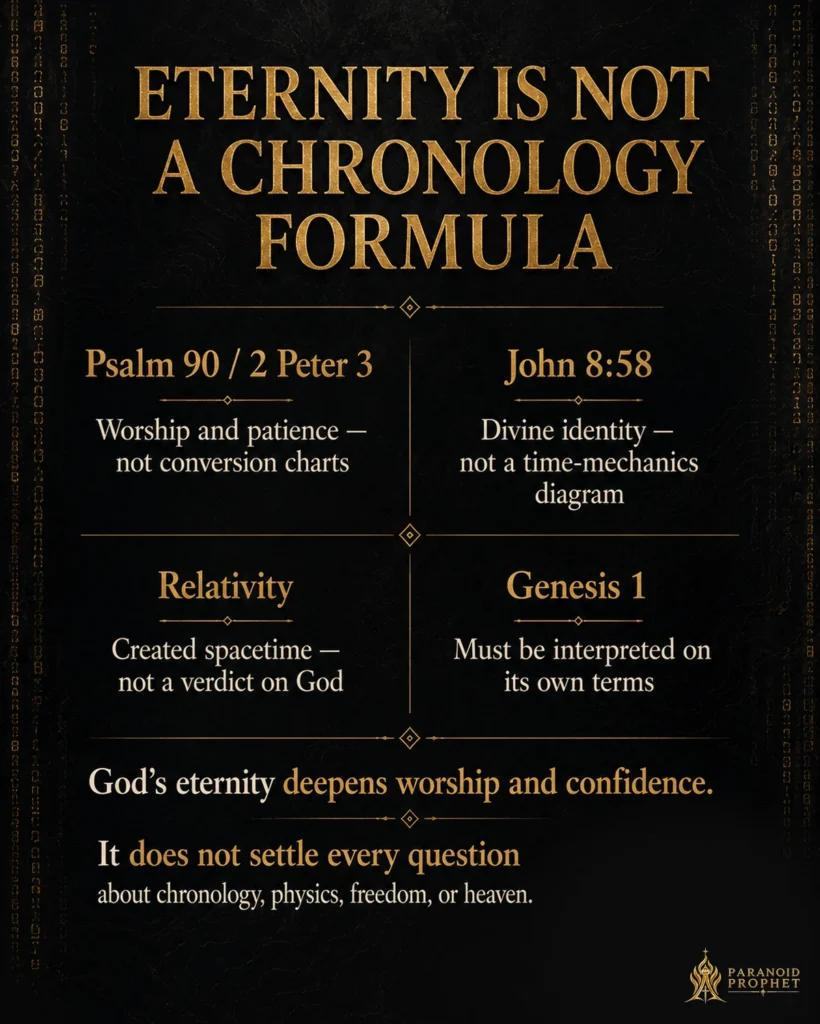
What God’s Eternity Does—and Does Not—Settle
God’s eternity gives Christians solid ground for worship, confidence, and hope. The Lord is not a temporary ruler, a creaturely force, or a being who may fail because history overwhelms Him. He is everlasting Creator, faithful in His promises, and sovereign over the beginning and end of all things.
Yet this doctrine does not automatically settle the meaning of the days in Genesis 1, the age of the earth, the details of cosmology, or every question concerning divine foreknowledge and human freedom. Individual texts still require careful interpretation in their own literary and canonical contexts.
Psalm 90 must be read as Psalm 90. Second Peter 3 must be read in light of Christ’s promised return. Genesis 1 must be read carefully on its own terms. Scientific claims must be weighed through evidence and responsible scientific reasoning.
For a focused study of whether Genesis 1 describes the Big Bang, read Does Genesis 1 Describe the Big Bang? What Scripture and Cosmology Can—and Cannot—Say.
God’s eternity is a doctrine about the Creator’s identity. It should deepen worship and confidence, not become a shortcut for settling every difficult question about chronology, physics, freedom, or heaven.
Frequently Asked Questions About God and Time
Does the Bible actually say God is outside time?
Not in that exact phrase. Scripture calls God everlasting, identifies Him as Creator, and distinguishes Him from finite creatures whose lives are marked by passing years, weakness, and death. “God outside time” is theological shorthand for the conviction that God is not dependent on created time as we are. It should be used carefully, without pretending that the Bible gives a full philosophical diagram of divine eternity.
Is God timeless or everlasting through time?
Christians have differed on that question. Classical theology often says that God is timelessly eternal and does not experience succession as creatures do. Other Christians argue that God has no beginning or end but genuinely experiences sequence in His relation to the world. Both views seek to preserve God’s eternity, His distinction from creation, His faithfulness, and His real action in history.
Does “one day is like a thousand years” mean time works differently for God?
No. Psalm 90 and 2 Peter 3 do not provide a calculation for converting divine time into human time. They contrast God’s eternity and patience with human frailty and impatience. Peter’s concern is not physics or Genesis chronology. He is assuring believers that Christ’s promise has not failed and that God’s patience gives people time to repent.
If God is eternal, can He really answer prayer?
Yes. Scripture commands believers to pray and presents prayer as real communion with God. Christians disagree about the philosophical mechanism: some say God eternally wills both prayers and their answers, while others emphasize God’s real response within sequence. But the biblical conclusion is clear. Prayer is not meaningless. God hears His people and works through real means in history.
Does God change His mind when people repent or pray?
Scripture includes passages where God relents from announced judgment when people repent, while also affirming His unchanging faithfulness, holiness, and truthfulness. Christians debate how best to explain the relationship between those truths. A faithful reading should not make God unstable or caught off guard, but neither should it treat repentance, intercession, and obedience as meaningless before Him.
Does believing God is temporal mean someone is an open theist?
No. Divine temporality and open theism are distinct debates. A temporal view says God may experience real sequence in His relation to creation. Open theism concerns a particular view of divine foreknowledge and future free choices. A Christian may believe that God acts through real succession while still affirming that He knows all things perfectly and accomplishes His purposes without failure.
Does relativity prove God is outside time?
No. Relativity describes aspects of time, motion, gravity, and clocks within created spacetime. It does not prove timelessness, disprove divine temporality, or explain the eternal life of God. The doctrine of divine eternity rests on Scripture’s Creator-creature distinction, not on a physics argument.
Does God’s eternity prove that Genesis days were long ages?
No. God’s eternity does not determine the meaning of yom, the evening-and-morning pattern, or the Sabbath structure in Genesis 1. The question of the creation days must be addressed through close interpretation of Genesis itself. Divine eternity should not be used as a shortcut around the actual biblical questions.
Sources and Further Reading
Source discipline: Scripture is final authority for Christian doctrine. Historical theology helps readers understand how major Christian thinkers have reasoned about divine eternity. Philosophy can clarify questions and test coherence, but it does not outrank Scripture. Physics can describe created spacetime, but it cannot settle the eternal God’s nature. Where this article draws theological inference rather than quoting Scripture directly, it identifies that inference as such. For the site’s wider standards on research, evidence, and correction, read Sources & Verification.
Primary Scripture
- Genesis 1:1; Psalm 90:1–4; Isaiah 40:28; Isaiah 46:9–10; Isaiah 57:15
- Jeremiah 18:7–10; Jonah 3:10–4:2; Malachi 3:6; 1 Samuel 15:10–31
- John 1:1–14; John 8:58; John 17:5; Colossians 1:15–17; Hebrews 1:1–4
- Matthew 6:9–13; James 5:13–18; 2 Peter 3:8–9; Revelation 1:8; Revelation 22:13
Historical Theology
- Augustine, Confessions, Book XI.
- Boethius, The Consolation of Philosophy, Book V.
- Thomas Aquinas, Summa Theologiae, I.10, “The Eternity of God”.
Modern Discussion
- Paul Helm, Eternal God: A Study of God Without Time, 2nd ed.
- William Lane Craig, Time and Eternity: Exploring God’s Relationship to Time.
- Stanford Encyclopedia of Philosophy, “Eternity, in Christian Thought”.
- Internet Encyclopedia of Philosophy, “God and Time”.
The Eternal Word Made Flesh
God’s eternity is not a distant idea for people who enjoy abstract questions. It magnifies the grace of the gospel.
The Word was with God in the beginning. The Word was God. All things were made through Him. Yet the eternal Son did not remain remote from the world He made. He entered our years in Jesus Christ.
He took flesh, lived under the law, carried human sorrow, and bore sin and death at the cross. He rose bodily from the grave. The Creator entered history, not because He was trapped by it, but because in mercy He came to redeem those trapped by sin and death within it.
God’s eternity does not make Him distant. The One who was before all things came near to us in Christ. He is not worn down by the years, yet He entered our years to save sinners, defeat death, and bring creation to its appointed renewal.
For the wider case that Jesus is not merely a teacher or religious symbol, but the eternal Son, crucified Savior, risen Lord, and coming King, read Is Jesus the Son of God? Evidence from History, Prophecy, Resurrection, and Scripture.