
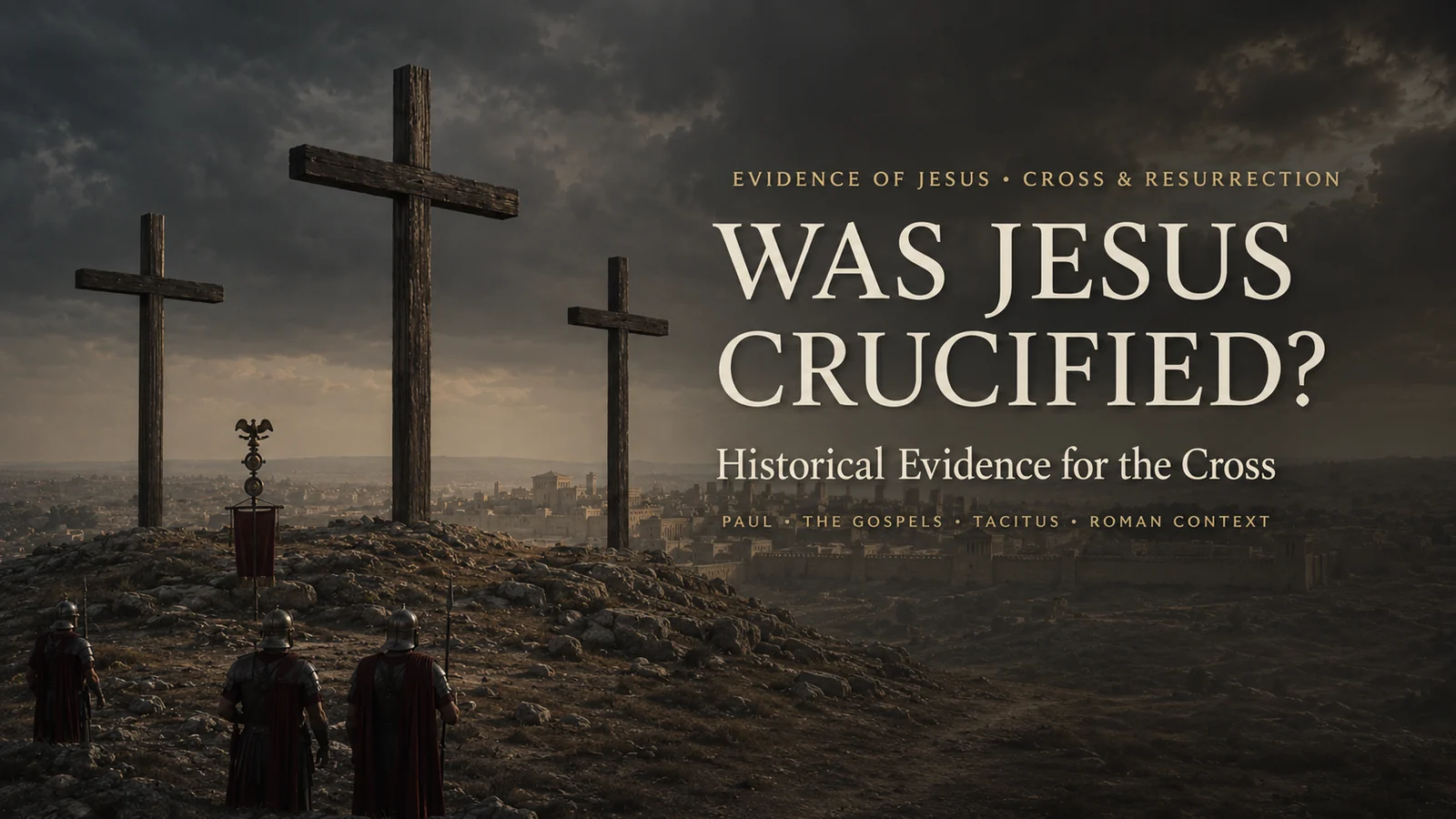

Was Jesus crucified? Yes. Jesus’ execution under Pontius Pilate is one of the strongest historical conclusions about His life. The evidence does not make every detail of every Passion narrative equally certain, and it does not allow us to reconstruct every moment medically. But the central claim is exceptionally firm: Jesus of Nazareth was publicly executed by Roman crucifixion.
That conclusion matters far beyond an ancient detail. Christianity does not begin with a vague claim that a teacher inspired people after his death. It begins with the proclamation that the crucified Jesus died, was buried, and was raised by God. Before anyone asks whether the resurrection happened, there is a more basic historical question: Was Jesus actually put to death on a cross?
GUIDED ARTICLE EXPERIENCE
Was Jesus Crucified? Historical Evidence for the Cross
Read along as the narration moves through the article.
Private device narration · No hosted audio or tracking
CONTINUE GUIDED TOUR
Continue where you left off.
GUIDED TOUR COMPLETE
You have reached the end of this study.
Study record saved on this device.
GUIDED TOUR
Was Jesus Crucified? Historical Evidence for the Cross
Narrator: Paranoid Prophet Recommended Voice Native device narration
Prepare to follow the article as it is narrated.
VOICE & TOUR OPTIONS
Voice & Listening
NARRATOR
Finding a narrator…
Checking the best narrator available on this device.
Restores the best curated narrator available on this device.
Narrator choices are curated for clear, long-form listening on this device.
Screen-awake support will be checked when narration starts.
CHOOSE A NARRATOR
Curated for this device
Choose a verified narrator for this browser, or use System Narrator. Automatic mode uses the best reliable route exposed by this device; your chosen narrator is preserved even if this device needs a temporary fallback.
Preparing the guided article experience…
RESUME GUIDED TOUR?
Continue where you left off.
GUIDED TOUR COMPLETE
You have reached the end of this study.
Article Guide12 sections
Was Jesus Crucified? The Short Answer
The best historical answer is yes. Paul’s letters place the cross at the center of the earliest Christian proclamation. All four canonical Gospels narrate Jesus’ execution. The Roman historian Tacitus later reports that Christus suffered the death penalty under Pontius Pilate during the reign of Tiberius. Roman crucifixion itself is well established as a brutal public punishment, and archaeology confirms that it was practiced in first-century Judea.
That does not mean historians can prove every Gospel detail with the same confidence. It means the broad conclusion is secure: Jesus was not merely threatened, symbolically rejected, or remembered as a martyr-like figure. He was crucified under Roman authority.
Source discipline: Scripture is the final authority for what Christ’s death means. Historical investigation asks narrower questions: what the earliest sources claim, how early they are, whether independent sources support the central event, and what objections remain. This article argues strongly for Jesus’ crucifixion while avoiding claims the evidence cannot carry.
Why the Cross Must Be Treated as History Before Theology
The cross is not a detachable religious symbol added to Christianity later. It stands at the center of the New Testament’s earliest message. Paul repeatedly speaks of “Christ crucified,” not as an embarrassing footnote but as the heart of the gospel he proclaimed.
In 1 Corinthians 1:18–25, Paul acknowledges that the message of a crucified Messiah sounded foolish or offensive to many people. In 1 Corinthians 2:1–5, he summarizes his preaching around Jesus Christ and Him crucified. In 1 Corinthians 15:1–4, he preserves the proclamation that Christ died for sins, was buried, and was raised.
Paul’s letters are especially important because they were written before the canonical Gospels. They do not give a cinematic account of Good Friday, but they show that the cross was not a late legend created after Christianity had become socially respectable. The earliest Christian message was built around a Messiah who had been executed.
That does not by itself prove the theological meaning Christians assigned to Jesus’ death. It does establish the historical starting point: the cross was already central when our earliest Christian writings appeared.
The Earliest Christian Sources Put Jesus’ Crucifixion at the Center
Paul did not speak of Jesus as a teacher whose message survived his death. He spoke of a crucified Lord. His letters refer to Christ being crucified, dying, shedding His blood, and bearing the curse. See Galatians 3:10–14, Romans 3:21–26, and Philippians 2:5–11.
Paul’s theological conviction does not make his testimony useless historically. Ancient sources nearly always have interests, loyalties, and purposes. The real question is whether the source is early, connected to the movement it describes, and consistent with other evidence. Paul meets those tests unusually well. He was not writing centuries later about an unknown figure. He was a first-generation Christian leader whose letters preserve the conviction that Jesus’ death by crucifixion stood at the center of the movement from the beginning.
The canonical Gospels provide fuller Passion narratives. Mark 15, Matthew 27, Luke 23, and John 19 differ in emphasis and arrangement, as ancient biographies often do. Yet they agree on the central public event: Jesus was condemned, crucified, died, and was buried.
A responsible historical case does not force every narrative difference into artificial harmony. It recognizes a stable core without pretending that all narrative details carry identical evidential weight.
Tacitus and the Roman Anchor Under Pontius Pilate
The Christian sources are not alone. The Roman historian Tacitus refers to Christus while explaining Nero’s persecution of Christians after the fire of Rome. In Annals 15.44, Tacitus says that Christus suffered the death penalty during Tiberius’s reign at the hands of Pontius Pilate.
Tacitus was not writing as a Christian defender. His hostile tone toward Christianity makes clear that he did not admire the movement. That does not make him an eyewitness, and the passage does not tell us every detail of Jesus’ final hours. It does, however, provide non-Christian confirmation that the movement traced its name to a man executed under Pontius Pilate.
This is exactly the kind of claim Tacitus can support: Jesus was executed, the execution occurred under Pilate, and the movement associated with Him continued afterward. Tacitus does not establish the resurrection, explain the meaning of the cross, or independently verify every Gospel detail. The source is valuable because it confirms the public historical frame without carrying more weight than it should.
What Roman Crucifixion Was Designed to Do
Crucifixion was not a ceremonial punishment. Rome used it to punish, humiliate, and warn. It was public violence designed to demonstrate Roman power over slaves, rebels, prisoners, and those judged dangerous to imperial order.
That historical setting helps explain why the cross was such a stumbling block. A crucified Messiah did not naturally fit popular expectations of victory. The earliest Christian proclamation did not invent a noble death that sounded impressive to ancient listeners. It announced that God’s Messiah had been publicly executed in one of Rome’s most degrading forms of punishment.
The archaeological remains of a man known as Yehohanan provide important context. His heel bone was discovered with an iron nail still embedded, confirming that Roman crucifixion in Judea could involve nailing through the feet. His remains also show that a crucified person could, under some circumstances, be taken down and buried. For the evidence concerning Jesus’ own burial and Joseph of Arimathea, see our study of the burial of Jesus.
That discovery does not prove that Jesus was crucified. Yehohanan was a different man, and archaeology has not recovered Jesus’ body or His cross. What the find does show is that the Gospel setting is historically intelligible. Roman crucifixion was real, brutal, and present in the world Jesus inhabited.
Did Jesus Really Die? The Swoon Theory Examined
Some modern alternatives argue that Jesus was crucified but did not actually die. In this view, He survived the execution, later appeared to His followers, and was interpreted as risen.
The problem is not that history can give a modern medical autopsy of Jesus. It cannot. Ancient sources do not provide the kind of clinical record a contemporary physician would want. The problem is that the swoon theory asks us to replace the earliest and most natural reading of the evidence with a much more complicated reconstruction.
The earliest Christian proclamation says Jesus died, was buried, and was raised. The Gospel narratives present Roman execution, death, and burial—not an escape from execution. The Roman context also matters: crucifixion was designed to kill and terrorize, not to leave victims capable of recovering privately and inspiring a worldwide proclamation of resurrection.
Even if someone imagines that Jesus survived in an extreme state of injury, that would still not match the earliest Christian claim. The first Christians did not preach that Jesus barely escaped death. They proclaimed that God had raised the crucified Jesus in victory over death.
The swoon theory may avoid a miracle in principle, but historically it introduces more difficulties than it solves. It must explain why the earliest sources unanimously center Jesus’ death, why His followers proclaimed resurrection rather than recovery, and why no early Christian source presents Him as a wounded survivor who escaped Roman execution.
Are the Gospels Too Biased to Count as Historical Sources?
The Gospels were written by believers or within believing communities. They proclaim good news about Jesus. That should be acknowledged plainly. But a source’s theological purpose does not automatically make it historically useless.
Ancient historians, biographers, court writers, political opponents, and religious communities all wrote with interests. Historical investigation does not discard every interested source. It asks what the author claims, how close the source is to the events, whether the material connects with earlier tradition, and whether the claim fits the broader historical setting.
The Gospels are theological testimony rooted in history. They do more than list facts, but they also make public claims: Jesus was arrested in Jerusalem, condemned under Pilate, crucified, died, and was buried. Those claims can be assessed alongside Paul, Tacitus, Roman practice, and the historical rise of the Christian movement.
It is fair to debate individual scenes, sayings, chronology, and literary shaping. It is not fair to treat the theological character of the Gospels as though it erases the execution they consistently report.
What History Can Confirm—and What It Cannot
A careful Christian case is stronger when it names its limits.
- History strongly supports: Jesus was crucified under Roman authority; Pontius Pilate belongs to the historical setting; the cross stood at the center of the earliest Christian message; and Roman crucifixion was a real public form of execution.
- History supports with more caution: many individual details of the Passion narratives, the precise sequence of Jesus’ trials, the exact medical mechanism of death, and the details surrounding His burial.
- Scripture teaches: Jesus gave Himself willingly, died for sinners, bore the curse, reconciles His people to God, and rose in victory.
- Apologetic inference argues: the cross is the necessary historical foundation of the resurrection claim. A resurrection argument cannot begin with an empty symbol or a survivor of execution. It begins with a crucified Messiah who truly died.
That distinction does not weaken Christian faith. It keeps the argument honest. The evidence for Jesus’ crucifixion is strong precisely because it does not depend on pretending every question has been settled beyond discussion.
Why Jesus’ Crucifixion Matters
Jesus’ crucifixion is not merely the tragic ending of a great teacher. The New Testament presents it as the center of God’s saving purpose. Jesus Himself spoke of giving His life as a ransom, and the apostles proclaimed forgiveness, reconciliation, redemption, and peace with God through His death.
That theological meaning deserves its own focused investigation. For now, the historical point must remain clear: Christianity stands or falls in part on the claim that Jesus truly died. The cross was not a metaphor for hardship. It was a Roman execution in history.
For a deeper study of the biblical meaning and prophetic context of Christ’s suffering, see Jesus’ Crucifixion Prophecies Fulfilled in Scripture. For the larger cumulative case concerning Jesus’ identity, see Is Jesus the Son of God? Evidence from History, Prophecy, Resurrection, and Scripture. You can also explore the broader historical foundation in Historical Evidence for Jesus: Why Jesus Was Not a Myth or Legend.
Frequently Asked Questions
Is Jesus’ crucifixion accepted by historians?
Yes. Scholars disagree sharply about Jesus’ identity, miracles, resurrection, and the reliability of particular Gospel details. But Jesus’ crucifixion under Pontius Pilate is widely regarded as one of the strongest historical facts about His life.
Does Tacitus say that Jesus was crucified?
Tacitus says that Christus suffered the death penalty during Tiberius’s reign by the sentence of Pontius Pilate. He does not give a detailed Passion narrative, but his reference independently supports the basic historical setting of Jesus’ execution.
Did archaeologists find proof that Jesus was crucified?
No archaeological discovery directly proves Jesus’ crucifixion. The remains of Yehohanan do not concern Jesus. They matter because they confirm that Roman crucifixion was practiced in first-century Judea and could involve nailing through the feet.
Could Jesus have survived the cross?
The swoon theory is historically weak. It must overturn the unanimous early proclamation that Jesus died and explain why followers announced resurrection rather than survival. It also must account for Roman execution practices and the fact that no early source presents Jesus as a wounded escapee.
Are the Gospel accounts too biased to be useful?
The Gospels are written from faith, but historical sources do not become worthless simply because their authors care deeply about the events they describe. Their claims should be tested carefully, not dismissed automatically. In this case, their shared crucifixion claim is reinforced by Paul, Tacitus, and the known Roman context.
Sources and Further Reading
- Primary biblical texts: Mark 15; Matthew 27; Luke 23; John 19; 1 Corinthians 1:18–25; 1 Corinthians 15:1–4; Galatians 3:10–14.
- Tacitus: Annals 15.44.
- Raymond E. Brown: The Death of the Messiah, 2 volumes.
- Martin Hengel: Crucifixion: In the Ancient World and the Folly of the Message of the Cross.
- John Granger Cook: Crucifixion in the Mediterranean World.
- David W. Chapman: Ancient Jewish and Christian Perceptions of Crucifixion.
- M. W. Maslen and P. D. Mitchell: “Medical Theories on the Cause of Death in Crucifixion”. Useful for medical cautions, especially because it warns against overconfident reconstructions of a crucified person’s exact physiological cause of death.
The Cross Was Not the End of Jesus’ Story
Jesus was crucified. History does not allow that claim to be dismissed as late religious imagination, symbolic poetry, or a convenient invention. The earliest Christian sources place the cross at the center. The Gospel narratives describe it. Tacitus anchors it under Pontius Pilate. Roman history and archaeology make the setting recognizably real.
But Christians do not stop at the cross as a bare historical fact. Scripture declares that the crucified Jesus gave Himself for sinners and that God raised Him from the dead. The cross tells us that Jesus truly entered the judgment, violence, and death of this world. The resurrection declares that death did not have the final word.
CONTINUE THE INVESTIGATION
Recommended continuation
Why Did Jesus Die? What Scripture Says the Cross Accomplished
After establishing the historical event, turn to Scripture’s explanation of what Jesus’ death accomplished.