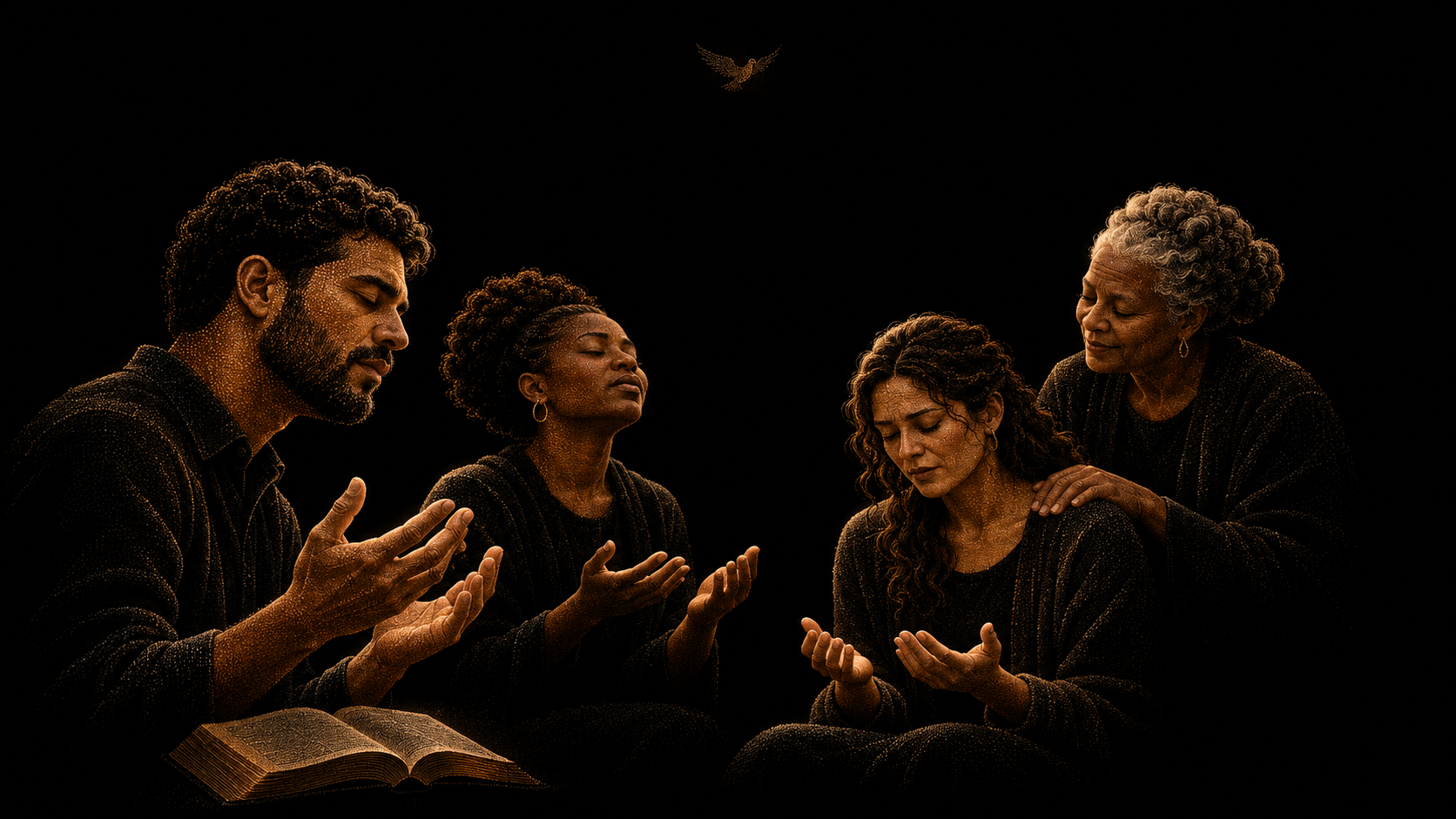

What do Pentecostals believe? A useful answer begins with more than speaking in tongues. Pentecostal churches emphasize the Holy Spirit’s activity in Christian life, including empowerment for witness, spiritual gifts, prayer, and holiness. Yet the label covers churches with important differences, including a major disagreement about the Trinity.
For someone visiting a church, that makes two questions especially helpful: What does this congregation teach about Jesus and salvation? And how does it understand the Spirit’s work in practice? Music, enthusiasm, or a preacher’s confidence cannot answer those questions by themselves.
This guide explains representative teachings, distinguishes Pentecostal denominations from wider charismatic renewal, and offers a Christ-centered framework for discernment.
GUIDED ARTICLE EXPERIENCE
Pentecostal Beliefs Explained: The Holy Spirit, Gifts, and Christian Life
Read along as the narration moves through the article.
Browser narration · No stored audio or site tracking
CONTINUE GUIDED TOUR
Continue where you left off.
GUIDED TOUR COMPLETE
You have reached the end of this study.
Study record saved on this device.
GUIDED TOUR
Pentecostal Beliefs Explained: The Holy Spirit, Gifts, and Christian Life
Narrator: Paranoid Prophet Recommended Voice Native device narration
Prepare to follow the article as it is narrated.
VOICE & TOUR OPTIONS
Voice & Listening
NARRATOR
Finding a narrator…
Checking the best narrator available on this device.
Restores the site recommendations available in this browser.
Our listening picks lead when available; other voices are ranked for narration. Known novelty voices are hidden. Browser-provided voices may use an online voice service.
Screen-awake support will be checked when narration starts.
Optional: improve your device voices
Listening works with the voices already available here. Your device may offer additional free voices through its own settings.
iPhone or iPad: Settings → Accessibility → Read & Speak (or Spoken Content) → Voices → English. Look for Premium or Enhanced choices, then return here.
If offered, preview Ava or Zoe for U.S. English, or Serena or Jamie for British English. An explicit Premium or Enhanced version can improve on its compact version.
Mac: System Settings → Accessibility → Read & Speak → System voice. Open the voice list to preview or download additional choices.
Windows: Settings → Accessibility → Narrator → Add natural voices. Browser availability varies; a Narrator voice may not appear on websites. Edge may also expose online Natural voices without a model download.
Android: Open Accessibility → Text-to-speech output (the location varies by device). In the preferred engine settings, look for voice data and English choices.
Download sizes vary; some enhanced voices exceed 100 MB. This website cannot install system voices, and an installed voice appears here only if your browser exposes it.
Apple voice guide · Windows voice guide · Android voice guide
CHOOSE A NARRATOR
Recommended on this device
Our listening picks: Aaron, Martha, then Daniel, when available here. Otherwise, automatic uses the highest-ranked suitable voice. Preview alternatives or save your own choice.
Preparing the guided article experience…
RESUME GUIDED TOUR?
Continue where you left off.
GUIDED TOUR COMPLETE
You have reached the end of this study.
Article Guide10 sections
The short answer: a movement, not one denomination
Classical Trinitarian Pentecostal churches belong within Protestant Christianity. The Assemblies of God and the Church of God in Christ are examples. The Church of God in Christ’s confession affirms one God in three persons, Scripture’s authority, repentance and faith in Christ, spiritual rebirth, and the Spirit’s sanctifying work. Its Pentecostal emphasis exists within that larger Christian confession. Church of God in Christ statement of faith
“Pentecostal” does not identify a single governing body. Nor does every congregation using the term hold the same account of conversion, Spirit baptism, church leadership, or holy living.
The practical map has three useful categories:
Classical Trinitarian Pentecostal
Examples include Assemblies of God and Church of God in Christ: Trinitarian confession and continuing spiritual gifts.
Oneness Pentecostal
United Pentecostal Church International rejects a Trinity of distinct divine persons and practices baptism in Jesus’ name.
Charismatic renewal
Renewal emphasizing spiritual gifts within existing Christian traditions, not a single new denomination.
These labels are not equivalent boxes in a rigid historical tree. Read a named community’s own teaching, especially on the identity of God and baptism.
These categories clarify questions to ask. They are not interchangeable labels or an exhaustive directory of every church.
Where did Pentecostalism come from?
The movement’s name points to Pentecost in Acts 2, where the Spirit comes upon Jesus’ followers and they speak in other tongues. Modern Pentecostal churches understand their emphasis through that biblical account.
Historically, the modern movement developed in the early twentieth century. The Azusa Street revival in Los Angeles, beginning in 1906 under African American preacher William J. Seymour, was a major center of its spread. The Assemblies of God’s history describes Azusa as one focal point of a developing movement, rather than its only beginning. It also identifies racial reconciliation as part of Seymour’s preaching. Assemblies of God history
That distinction matters. A movement’s historical emergence and its claim to recover New Testament Christianity are different kinds of statements. A reader can examine the history while separately evaluating the biblical interpretation.
What is baptism in the Holy Spirit?
In Assemblies of God teaching, Spirit baptism is an empowering experience distinguishable from conversion. Its official explanation says that the Spirit already dwells in believers; the later experience is not the moment a Christian first becomes eligible for God’s presence. The emphasis is empowerment for witness and service. Assemblies of God position on Spirit baptism
Keep three questions distinct:
- Salvation: How does a person become reconciled to God?
- Water baptism: What does the church teach about the baptism Jesus commanded?
- Spirit baptism: What does the church mean by this phrase, and how does it relate to conversion?
Collapsing them into one vague phrase makes comparison difficult. A church may use familiar biblical words while organizing their relationship differently.
Christians should also distinguish the biblical passages from a denomination’s interpretation of them. Acts 1:8 connects the Spirit’s coming with witness. Acts 2, 10, and 19 describe striking events involving the Spirit. The further question is how those accounts establish a pattern for every believer. That is where the doctrinal discussion belongs, rather than in assumptions about who has had a sufficiently dramatic experience.
Why do Pentecostals speak in tongues?
The Assemblies of God teaches that speaking in tongues is the initial physical evidence of Spirit baptism. Its fundamental truths distinguish this evidence from the congregational gift of tongues in purpose and use. That is a representative denominational position, not a claim that every church associated with charismatic worship teaches the same requirement. Assemblies of God fundamental truths, sections 7–8
A fair discussion must also read the surrounding New Testament teaching. In 1 Corinthians 12, gifts serve the community and are distributed by the Spirit. Chapter 13 makes love indispensable. Chapter 14 addresses intelligibility, interpretation, and orderly participation. Those chapters belong together. Read 1 Corinthians 12–14
This gives a visitor better questions than “Was the service exciting?” Ask whether people understand what is happening, whether public claims can be evaluated, and whether participants are treated with patience rather than pressure.
Never manufacture an experience to fit in. Repeating sounds because someone insists you must do so is not an honest substitute for conviction. A church’s willingness to explain its teaching calmly is more helpful than its ability to create urgency.
Trinitarian and Oneness Pentecostals: a central difference
This is the distinction most likely to disappear in a superficial overview.
The United Pentecostal Church International describes one God revealed as Father, through the Son in redemption, and as the Holy Spirit. It affirms Jesus as both God and man and explicitly teaches salvation by grace through faith on the basis of Christ’s atoning sacrifice. Its presentation of obedience to the gospel joins repentance, baptism in Jesus Christ’s name, and Spirit baptism evidenced by tongues. These teachings should be described in the organization’s own terms rather than replaced with a hostile shorthand. UPCI beliefs
That position differs from the historic Trinitarian confession of one God eternally existing as Father, Son, and Holy Spirit, with real personal distinctions. The Assemblies of God’s statement explicitly affirms those distinctions. Assemblies of God teaching on the Godhead
Both groups speak strongly about Jesus. The disagreement concerns who God is and how Father, Son, and Spirit relate, not merely which words a minister prefers during a baptism.
From this site’s historic Trinitarian Christian perspective, that difference is doctrinally substantial. Respectful explanation does not require pretending the positions say the same thing. Equally, identifying the disagreement does not justify caricaturing individual believers or claiming to know their motives.
When comparing a particular church, request its actual statement of faith. Do not infer its theology from the word “Apostolic,” the volume of its worship, or a short social-media clip.
Pentecostal and charismatic: are they the same?
The terms overlap, but they are not synonyms.
Catholic charismatic renewal provides a clear example. CHARIS publishes an explanation that relates baptism in the Spirit to Catholic sacramental initiation. That is a different theological setting from the Assemblies of God’s account of a distinct experience following conversion. A Catholic charismatic does not become a Protestant Pentecostal simply by praying for spiritual gifts. CHARIS on Spirit baptism and initiation
The lesson is straightforward: shared worship practices do not erase differences concerning the church, sacraments, authority, or doctrine. Start with the congregation’s beliefs, then interpret its practices in that setting.
For the wider Christian landscape, see our Catholic, Orthodox, and Protestant comparison. Our Baptist beliefs guide offers another example of why denominational comparisons need more than surface impressions.
Healing, faith, and the danger of exaggerated promises
Prayer for healing is an important Pentecostal emphasis. It should not be confused with a universal rejection of medicine. The Assemblies of God’s official healing paper explicitly says belief in divine healing does not oppose or compete with medical doctors. Assemblies of God position on divine healing
Nor should every Pentecostal church be assigned the claim that enough faith guarantees wealth. The Assemblies of God has published criticism of extreme positive-confession teachings that treat spoken declarations as a way to secure desired circumstances. The Believer and Positive Confession
These distinctions protect both accuracy and people. Theological hope, a personal testimony, and a verified medical outcome are different things. A compelling story should not be presented as documentation it does not possess. Someone who remains ill deserves care, not automatic blame for insufficient faith.
As an editorial standard, this site does not treat a request for money, a promised breakthrough, or a dramatic platform moment as evidence that God has endorsed a ministry. Claims need examination regardless of the speaker’s denominational label.
Gifts, fruit, and everyday discipleship
An account of Pentecostal life focused entirely on unusual experiences misses the question of character. The Church of God in Christ’s confession includes the Spirit’s power to enable holy living. That emphasis concerns the Christian’s continuing life, not only a memorable service. COGIC statement of faith
Galatians 5:22–23 identifies the Spirit’s fruit through qualities such as love, patience, gentleness, and self-control. Jesus’ teaching in John 16:14 connects the Spirit’s work with glorifying Him. Together with 1 Corinthians 12–14, these passages provide a practical framework: service, character, order, and the centrality of Christ. Galatians 5; John 16
Consider the person who is disappointed, confused, grieving, or new to faith. Can that person ask questions without embarrassment? Is patient discipleship available after the meeting ends? Can leaders acknowledge error? These are useful tests of church health in any tradition.
A spiritual vocabulary must never become a shield against accountability. An appeal to divine authority deserves careful examination, especially when it pressures someone to ignore conscience, conceal misconduct, or accept a leader’s demand without question.
Gifts
Do gifts serve others? Read 1 Corinthians 12.
Fruit
Does the community cultivate Christlike character? Read Galatians 5.
Order
Are intelligibility and discernment taken seriously? Read 1 Corinthians 14.
Christ
Is Christ honored at the center? Read John 16:14.
An editorial biblical reading framework, not a scorecard for judging people by outward excitement or a substitute for evaluating particular claims.
Questions to ask before joining a Pentecostal church
Bring these to a pastor or membership discussion:
- Who is God? Does the church confess the Trinity, or teach Oneness theology?
- What is the gospel? How are grace, faith, repentance, baptism, and tongues related in its teaching?
- What does Spirit baptism mean here? Is it distinguished from conversion?
- How are gifts evaluated? What happens when a prophecy or interpretation is questioned?
- How are vulnerable people protected? Are there clear safeguarding and complaint procedures?
- What happens when someone is not healed? Does the congregation continue offering compassion and practical help?
- Who holds leaders accountable? Can members see how decisions and finances are overseen?
These questions are not a demand that every church feel identical. They help distinguish theological convictions from personality, atmosphere, and institutional habits.
Frequently asked questions
Are Pentecostals Christians?
Classical Trinitarian Pentecostal churches are part of Protestant Christianity. Oneness Pentecostal groups also identify as Christian, but their understanding of God differs substantially from historic Trinitarian doctrine. Specify which body you mean rather than giving one undifferentiated answer.
Do Pentecostals think everyone must speak in tongues to be saved?
Do not assume one answer across the movement. The Assemblies of God distinguishes salvation from Spirit baptism and associates tongues with the latter. UPCI presents tongues within its account of Spirit baptism and obedience to the gospel. Read the specific church’s explanation.
Is emotional worship proof that a church is unhealthy?
No. Neither emotion nor quietness proves spiritual maturity. Evaluate teaching, conduct, accountability, and treatment of people. An expressive service can be orderly; a calm institution can still avoid scrutiny.
What should be central when comparing churches?
Jesus Christ: His identity, His death and resurrection, and faithful discipleship. Pentecostal distinctives deserve serious examination, but a denominational brand cannot replace the Savior it claims to proclaim. Begin with our guide to the evidence for Jesus and use our fair-comparison framework as you explore further.