
GUIDED ARTICLE EXPERIENCE
Did First Christians Suffer for the Resurrection?
A narrated path through Scripture, evidence, and the article’s central conclusion.
Narrated chapter by chapter · No hosted audio or tracking
CONTINUE GUIDED TOUR
Continue where you left off.
GUIDED TOUR COMPLETE
You have reached the end of this study.
Study record saved on this device.
NOW GUIDING YOU
Did First Christians Suffer for the Resurrection?
Paranoid Prophet Recommended Voice Native device narration
Prepare to follow the article as it is narrated.
VOICE & TOUR OPTIONS
Voice & Listening
NARRATOR
Finding a narrator…
Checking the best narrator available on this device.
Restores the best curated narrator available on this device.
Narrator choices are curated for clear, long-form listening on this device.
CHOOSE A NARRATOR
Curated for this device
Choose a verified narrator for this browser, or use System Narrator. Automatic mode uses the best reliable route exposed by this device; your chosen narrator is preserved even if this device needs a temporary fallback.
Preparing the guided article experience…
RESUME GUIDED TOUR?
Continue where you left off.
GUIDED TOUR COMPLETE
You have reached the end of this study.
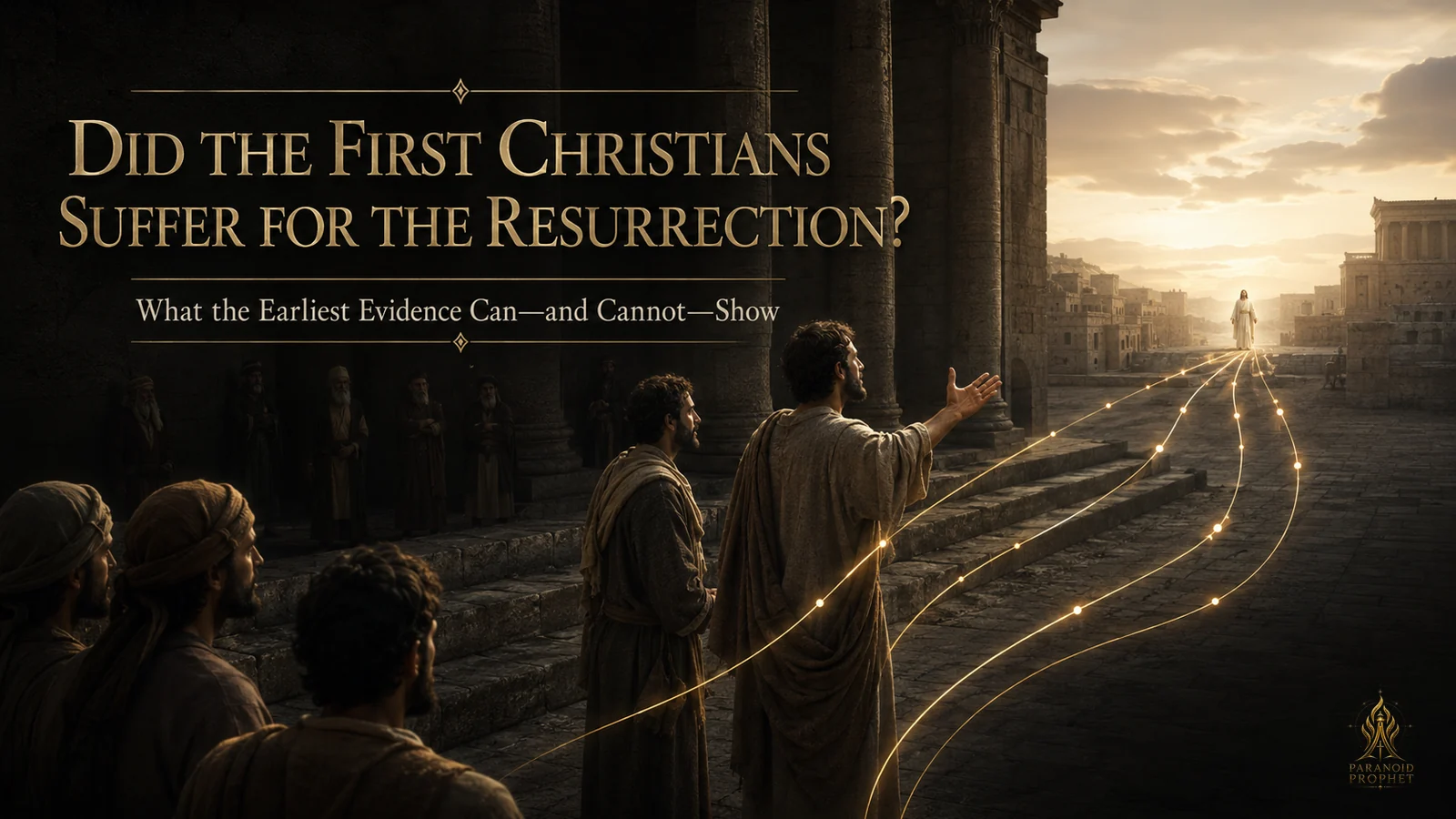
Did the first Christians suffer for proclaiming the resurrection? The strongest answer begins with the earliest Christian texts themselves.
Acts presents the first Christian proclamation as public, specific, and costly. The apostles did not merely speak about Jesus as a wise teacher whose influence continued after death. They announced that God had raised and exalted Him. That message was preached in public places, attached to named witnesses, and soon met arrest, warnings, flogging, imprisonment, and, in some cases, violence.
This does not mean every early Christian suffered in the same way, or that Christians faced one continuous empire-wide persecution system from the beginning. The surviving evidence concerns particular places, authorities, and episodes. Yet it does show that the resurrection message was not carried forward only because it was safe, private, or socially useful.
Costly proclamation does not prove that Jesus rose from the dead. People can endure hardship for beliefs that are false. But it does matter when considering whether the first witnesses were knowingly inventing the message they proclaimed. Public pressure, continued testimony, and real personal loss make deliberate fabrication less persuasive. They belong within the larger biblical and historical case for the risen Christ.
For the earliest evidence concerning the resurrection proclamation itself, see How Early Is the Resurrection Claim?.
Article Guide11 sections
Short Answer: Did the First Christians Suffer for Proclaiming the Resurrection?
Yes. Acts directly connects early official opposition with public proclamation that God raised and exalted Jesus. It records arrest, interrogation, commands to stop speaking in Jesus’ name, flogging, imprisonment, violence, and continued witness.
Paul’s letters add firsthand testimony that his Gospel ministry involved repeated danger, beating, imprisonment, deprivation, and social pressure. Later Roman sources show that Christians could also face severe cruelty or official coercion in particular Roman settings.
But the conclusion must remain careful. The evidence does not establish that every Christian suffered identically, that every apostle faced the same legal procedure, or that every hardship was caused by one spoken resurrection formula. It establishes something substantial: the first Christian movement publicly proclaimed the risen Jesus in circumstances where that testimony could bring real cost.
The Resurrection Was a Public Claim
The earliest Christian proclamation was not framed as a private spiritual comfort or a secret teaching for an inner circle. It was a public announcement about Jesus of Nazareth: He had been crucified, God had raised Him, and He was now the exalted Messiah and Lord.
That public character matters. A message shared only in private can avoid scrutiny, conflict, and official attention. The message in Acts does not remain private. It appears in the temple, before crowds, before rulers, and before councils. The apostles identify themselves as witnesses and speak openly about what they believe God has done in Jesus.
After Jesus’ ascension, the apostles define their role in relation to the resurrection. When they seek a replacement for Judas, they state that one of the men who had accompanied Jesus must become “with us a witness to his resurrection.” Acts 1:21–22
That does not mean every apostle left behind an equally documented death account. It does mean that the earliest Christian message was tied to identifiable people who publicly claimed continuity with Jesus’ ministry, death, resurrection, and ascension.
Peter’s sermon at Pentecost carries the same pattern. He does not present the resurrection as an inward experience detached from history. He announces that Jesus was crucified, that God raised Him, and that the apostles are witnesses. Acts 2:22–36
The public claim of resurrection therefore had public consequences. It challenged existing authority, called hearers to repentance, and identified Jesus as the One God had vindicated and exalted. The conflict that follows in Acts is not generic hostility toward religion. It arises in connection with what the apostles publicly say about Jesus.
Acts: Resurrection Proclamation Brought Arrests, Threats, and Violence
Acts 4 provides the clearest early example. Peter and John are speaking publicly after the healing of a man at the temple. The text identifies the immediate concern of the priests, the captain of the temple, and the Sadducees: the apostles were teaching the people and “proclaiming in Jesus the resurrection from the dead.” Acts 4:1–4
Peter and John are arrested, held overnight, questioned before rulers, elders, and scribes, and later commanded not to speak or teach at all in the name of Jesus. Their response is not a call to violence or a retreat into secrecy. They state that they cannot stop speaking about what they have seen and heard. Acts 4:18–20
The narrative should be used accurately. Acts is Scripture’s direct canonical account of the earliest Christian movement; it is not a modern court transcript that independently answers every historical question about later Christian trials. Yet its portrayal is unmistakable: public proclamation of Jesus’ resurrection produced defined conflict with particular authorities in Jerusalem.
Acts 5 intensifies that pattern. The apostles are arrested again and brought before the council. The high priest charges them with continuing to teach in Jesus’ name. Peter’s response again centers on Jesus’ death, resurrection, and exaltation: “The God of our fathers raised Jesus, whom you killed by hanging him on a tree. God exalted him at his right hand as Leader and Savior.” Acts 5:27–32
The sequence is important. Arrest, interrogation, resurrection testimony, flogging, a command not to speak in Jesus’ name, and continued proclamation all appear together in the same account. The apostles are beaten and then ordered not to speak in Jesus’ name. Yet Acts says they leave rejoicing that they were counted worthy to suffer dishonor for the name, and that they continue teaching and preaching Jesus as the Christ. Acts 5:40–42
This is stronger than a vague claim that early Christians were unpopular. It is a direct canonical record of public resurrection witness meeting official resistance and physical punishment. It does not prove that every apostle later received the same treatment. It does establish that the first witnesses were not carrying a message insulated from cost.
The pattern continues beyond Peter and John. Stephen publicly testifies to Jesus and becomes the first named Christian witness in Acts whose death is described at length. He was not one of the Twelve, and his death should not be used as though it proves a uniform apostolic experience. But it does show that conflict around early Christian witness could become lethal. Acts 6:8–15; 7:54–60
Acts 8 then describes a persecution that scattered many believers from Jerusalem. The result is striking: those who were scattered did not abandon the message. They went about preaching the word. Acts 8:1–4
Again, this should not be inflated into a claim that every Christian in every place was hunted by the Roman Empire. Acts describes particular conflict in a particular early setting. But it does show that pressure did not make the resurrection proclamation disappear into private devotion. The message continued to move outward.
Later episodes reinforce the same point. Acts records that Herod Agrippa executed James, the brother of John, and imprisoned Peter. Acts 12:1–5 It also records that Paul was attacked and stoned at Lystra, then continued the mission after surviving. Acts 14:19–22
These episodes should not become a death-count argument. James’s execution belongs to the separate source-method discussion of individual apostolic claims. Here, the point is broader: the early Christian proclamation of Jesus was public enough to provoke opposition, and resilient enough to continue through it.
Acts therefore establishes the article’s foundation. The resurrection was preached in public. It was tied to named witnesses. It encountered arrest, warning, flogging, violence, and imprisonment in defined settings. The next question is whether Paul’s own letters confirm that this public Gospel mission remained costly beyond the earliest Jerusalem episodes.
Paul: The Gospel Mission Carried a Real Cost
Acts shows the public proclamation of the risen Jesus meeting opposition in Jerusalem and along the expanding mission. Paul’s letters add another form of evidence: firsthand testimony from a missionary who describes the cost of carrying the Gospel from city to city.
Paul does not write as someone whose message brought ease, social advantage, or public security. His letters describe hunger, thirst, poor treatment, homelessness, reviling, persecution, slander, imprisonment, beatings, danger, and the continuing burden of concern for churches. The details come from Paul himself, not from a much later account attempting to turn him into a heroic figure.
In 1 Corinthians 4:9–13, Paul describes the apostles as exposed to hardship and public disgrace. They hunger and thirst, are poorly dressed, beaten, and without a settled home. When reviled, they bless; when persecuted, they endure; when slandered, they answer kindly. The passage does not assign every hardship to one courtroom hearing or one spoken resurrection formula. It does show that apostolic ministry was not socially safe or personally convenient.
Second Corinthians gives the same picture with even greater intensity. Paul describes himself and his fellow workers as afflicted, perplexed, persecuted, and struck down—yet not abandoned or destroyed. He connects this pattern to the public life of Jesus’ servants, who carry “in the body the death of Jesus” so that the life of Jesus may also be displayed. 2 Corinthians 4:7–12
That language is theological, but it is not detached from real experience. In 2 Corinthians 6:3–10, Paul lists afflictions, hardships, calamities, beatings, imprisonments, riots, sleepless nights, hunger, dishonor, and ill repute. His ministry is presented as a public vocation carried out amid pressure rather than a private spiritual practice protected from the world.
Paul’s most detailed hardship catalog appears in 2 Corinthians 11:23–28. He speaks of imprisonments, countless beatings, repeated danger of death, lashes, beatings with rods, stoning, shipwrecks, travel dangers, hunger, thirst, cold, exposure, and anxiety for the churches.
The passage should not be turned into an overly simple argument. Paul does not provide a complete chronology for every incident, and he does not state that every hardship resulted from one identical charge. Some dangers arose from travel, hostility, poverty, public disorder, or the instability of ancient life. Yet the cumulative force of the passage is clear. Paul’s public Gospel mission carried repeated physical, legal, social, and economic cost.
That firsthand evidence is especially important for this article. Paul was not merely repeating a distant rumor about a risen teacher. His own letters place him within the earliest Christian witness network and show that he continued a public mission despite suffering that made the message costly to carry.
Paul’s imprisonment could even become part of his witness. Writing to the Philippians, he explains that what had happened to him had served “to advance the gospel.” His confinement had become known throughout the imperial guard and beyond, and other believers had become more bold to speak the word without fear. Philippians 1:12–14
This does not mean Paul enjoyed suffering or treated persecution as a goal. His letters contain grief, exhaustion, pleas for prayer, concern for churches, and appeals for justice. But they also show that danger did not lead him to withdraw the central proclamation. He continued to announce Jesus Christ as crucified and risen, even when that mission brought visible cost.
The historical conclusion should remain modest but real. Paul’s letters do not prove that every first Christian suffered to the same degree. They do not document the death of every apostle. They do provide direct firsthand evidence that public Gospel ministry was not a path to safety, wealth, or approval.
For the careful method needed when evaluating individual apostolic death traditions, see Did the Apostles Die for the Resurrection? What We Can Honestly Say once that article is public. The question here is narrower: what do Acts and Paul show about the cost of carrying the resurrection proclamation into public life?
What Tacitus and Pliny Can Actually Show
Scripture remains the article’s central source for the earliest proclamation and the pressure it faced. Tacitus and Pliny do not replace Acts or Paul. They provide narrower non-Christian context: one Roman episode of brutal scapegoating and one later provincial example of official interrogation and coercion.
These sources must not be flattened into one universal picture. The evidence does not describe one continuous empire-wide persecution campaign against every Christian in every place. The pressure was episodic, local, and shaped by changing authorities and settings. Acts records conflict in Jerusalem and along the mission. Tacitus describes Nero’s Rome after the fire. Pliny describes a later provincial process in Bithynia-Pontus.
Tacitus: Nero’s Rome and Brutal Public Cruelty
The Roman historian Tacitus reports that, after the fire of Rome, Nero sought to shift blame onto people called Christians. In his account, Nero subjected them to extraordinary public cruelty. Tacitus also identifies Christus as the founder of the movement’s name and says that He had been executed under Pontius Pilate during the reign of Tiberius. Tacitus, Annals 15.44
The passage matters because it shows that Christians in Nero’s Rome could become targets of severe and public violence. Their association with Christus did not make them socially invisible or politically harmless. Under a hostile ruler facing a public crisis, Christians could be used as scapegoats and treated with exceptional brutality.
But Tacitus must be used within its own limits. He does not identify Peter, Paul, or any other apostle among the victims. He does not reconstruct apostolic trials. He does not say that the Christians punished after the fire were being prosecuted for repeating a particular resurrection confession. His account is tied to Nero’s attempt to divert blame after Rome’s fire and to the accusations surrounding that episode.
The responsible conclusion is therefore narrower than many popular retellings: Tacitus supplies Roman evidence that Christians could face brutal public cruelty in Nero’s Rome. It does not give a complete account of the Neronian persecution, a death narrative for particular apostles, or proof that every first-century Christian faced the same danger.
Pliny and Trajan: Provincial Pressure and Public Religious Compliance
Pliny the Younger’s correspondence with Emperor Trajan comes from a later setting, probably the early second century, and from Bithynia-Pontus rather than Jerusalem or Nero’s Rome. Its importance lies in the practical pressure it records.
Pliny explains that he questioned people accused of being Christians. He asked those who confessed more than once, threatening punishment if they persisted. He ordered punishment for those who continued to identify themselves as Christians. Others were released after publicly invoking Roman gods, honoring the emperor’s image, and cursing Christ. Pliny the Younger, Letters 10.96–97
Trajan’s reply is equally important for its limits. He does not establish a single fixed policy for every province or every circumstance. He tells Pliny not to hunt Christians down, but permits punishment for those denounced and proven guilty while allowing release for those who demonstrate public compliance with Roman worship.
This exchange gives the article a concrete example of how Christian allegiance could become a legal and social pressure point. In one province, accused Christians could face interrogation, repeated threats, punishment for persistence, and release after public religious compliance.
Yet this procedure should not be projected backward or outward without restraint. Pliny does not describe the trial of every apostle. He does not prove that Peter, Paul, Stephen, James, or the Christians in Acts faced the same process. He does not say that Christians were required to deny one specific resurrection statement. His letters describe a later provincial setting in which refusal to participate in Roman worship could expose a person to punishment.
That distinction helps the article avoid a weak recantation argument. Pliny provides evidence of real official coercion in one Roman setting. He does not establish that every first-generation witness was given the same opportunity to escape punishment by formally denying Jesus.
Tacitus and Pliny therefore contribute context, not a universal template. Their testimony confirms that Christian identity and allegiance could carry serious public consequences in certain Roman environments. Alongside Acts and Paul, this makes it difficult to portray the resurrection proclamation as a message advanced only because it was easy, safe, or socially rewarding.
The remaining question is the most important one: what can costly public proclamation legitimately contribute to the case for the resurrection, and what must it leave unproven?
What Costly Proclamation Can—and Cannot—Prove
People can suffer for beliefs that are false. They may be sincere, mistaken, misinformed, or committed to a cause they received from others. Hardship does not turn a belief into a fact, and Christian faith does not need that weak argument.
The historical question here is narrower. Did the first public witnesses to Jesus’ resurrection act like people who knew their message was invented? Acts records public resurrection proclamation amid arrest, warning, flogging, imprisonment, and violence. Paul’s own letters show that his Gospel mission involved repeated danger, punishment, deprivation, and pressure. Tacitus and Pliny show that Christian allegiance could carry severe consequences in particular Roman settings.
That pattern is consistent with genuine conviction and makes conscious fabrication less persuasive. It cannot directly reveal every witness’s inner state, and it cannot establish that Jesus rose from the dead apart from the larger biblical and historical case. But it does make it harder to explain the earliest Christian movement as a message its leading proclaimers knew was false and carried forward merely because it was useful.
The first Christians were not simply defending an abstract philosophy. They publicly identified themselves with a crucified Jesus whom they believed God had raised and exalted. Their proclamation could bring rejection, punishment, separation, loss, and danger. The cost does not prove the resurrection. It does help explain why deliberate invention is an inadequate account of the movement’s earliest public witness.
The resurrection must therefore be considered cumulatively: Jesus’ death by crucifixion, the early proclamation that He was raised, the named witness tradition, Paul’s conversion and ministry, James’s place in the earliest movement, and the biblical and historical testimony surrounding the risen Christ. Costly proclamation is one strand in that larger case. It is not the whole case.
Evidence Matrix: Proclamation, Pressure, and Responsible Inference
| Source | What it shows | What it does not show | Responsible conclusion |
|---|---|---|---|
| Acts 4:1–22 | Authorities object to public proclamation of resurrection in Jesus; Peter and John are arrested, questioned, and ordered not to teach in His name. | A complete legal history of all later Christian trials. | Resurrection proclamation was public and met official resistance early. |
| Acts 5:17–42 | Arrest, interrogation, testimony that God raised and exalted Jesus, flogging, warning, and continued proclamation. | A uniform recantation choice or death sentence for every apostle. | The early witnesses continued proclaiming Jesus despite direct official pressure. |
| Acts 6–8 | Stephen’s public witness becomes lethal; scattered believers continue proclaiming the word. | That Stephen was one of the Twelve or that all believers faced lethal violence. | Opposition could escalate, yet the public message continued. |
| Acts 14:19–22 | Paul is stoned at Lystra and continues the mission. | Paul’s final death or a universal missionary experience. | The mission could involve direct physical danger. |
| Paul’s letters | Paul personally reports beatings, imprisonment, danger, hunger, hardship, and Gospel-related pressure. | That every early Christian experienced the same degree of suffering. | Public Gospel ministry could carry repeated real-world costs. |
| Tacitus, Annals 15.44 | Christians in Nero’s Rome could face extreme public cruelty. | The identities or exact experiences of Peter and Paul, or a resurrection-specific charge. | Roman hostility toward Christians could become brutal in a particular setting. |
| Pliny, Letters 10.96–97 | A later provincial process of interrogation, punishment for persistence, and release after public religious compliance. | A universal procedure for every apostle or every Christian. | Christian allegiance could become a legal and social pressure point in Roman administration. |
What Christians Can Say Confidently
- The first Christian proclamation was public and centered on the claim that God raised Jesus from the dead.
- Acts directly connects that proclamation with arrests, threats, flogging, imprisonment, and continued witness.
- Stephen’s death shows that early Christian witness could become lethal, though Stephen was not one of the Twelve.
- Paul’s own letters provide firsthand testimony that Gospel ministry involved repeated hardship, danger, punishment, and public opposition.
- Tacitus shows that Christians in Nero’s Rome could face brutal public punishment in a particular historical setting.
- Pliny shows that accused Christians in one later Roman province could face interrogation, punishment for persistence, and release after public religious compliance.
- Costly public witness supports genuine conviction and makes deliberate fabrication less persuasive.
- The resurrection case rests on more than suffering: it includes Jesus’ death, the early proclamation, named witnesses, Paul’s conversion, James’s place in the movement, and the larger biblical and historical testimony.
What Christians Should Not Claim
- Every first Christian suffered in the same way.
- Christians were persecuted everywhere and continuously throughout the Roman Empire.
- Tacitus documents Peter’s or Paul’s death.
- Pliny proves that every apostle had a formal chance to recant.
- Roman officials always punished Christians specifically for preaching one defined resurrection formula.
- Every hardship in Paul’s ministry came from the same immediate cause.
- Suffering proves that Jesus rose from the dead.
- This article can replace a careful source-method analysis of individual apostolic death traditions.
These cautions do not weaken the Christian claim. They make the argument more trustworthy. The evidence is substantial without being uniform. It establishes a movement that proclaimed the risen Jesus publicly and continued despite costs; it does not give readers a single persecution script that applies to every witness, city, or generation.
Why This Matters for the Cross and Resurrection
The cross and resurrection belong together in the earliest Christian proclamation. The message was not that Jesus had died tragically and remained a moral example. It was that the One who had been crucified was raised and exalted by God. That claim transformed the meaning of the cross from apparent defeat into the center of God’s saving work.
Acts shows the apostles speaking publicly about the Jesus who was crucified and raised. Paul’s letters show a missionary whose life was shaped by that same message, even when it brought weakness, hardship, danger, and loss. The first Christians did not treat the cross as an embarrassment to hide or the resurrection as a private comfort to protect from public scrutiny. They announced both as the Gospel.
That public witness matters because it places the resurrection claim in the world of real relationships, opposition, and consequence. The message was attached to named people and specific communities. It was contested. It was carried forward under pressure. It was not preserved merely as an anonymous story floating above history.
None of this removes the need to examine the central historical questions surrounding Jesus’ death, burial, resurrection proclamation, and appearances. But it does make one explanation less persuasive: that the earliest movement grew because its leading witnesses knowingly created a story they understood to be false and then promoted it only while it remained safe or useful.
For the historical question of how early the resurrection claim appears, see How Early Is the Resurrection Claim?. For the public historical foundation concerning Jesus’ life and crucifixion, see Historical Evidence for Jesus. For the prophetic and theological meaning of the cross, see Jesus’ Crucifixion Prophecies: Isaiah 53, Psalm 22, and the Cross.
Frequently Asked Questions
Did Acts say Christians suffered because they preached Jesus’ resurrection?
Acts directly connects early opposition with public proclamation that God raised and exalted Jesus. It records arrest, official warnings, flogging, and continued witness. At the same time, Acts is not a complete record of every Christian trial, and it does not assign one identical cause to every later hardship faced by the church.
Did every first Christian suffer persecution?
No. The evidence does not justify a universal claim. It shows real opposition in particular places and circumstances, not one unbroken experience shared identically by every believer.
Does Tacitus prove Peter and Paul died under Nero?
No. Tacitus describes Christians punished under Nero after Rome’s fire, but he does not name Peter, Paul, or any other apostle.
Does Pliny prove that every apostle could have saved himself by recanting?
No. Pliny records a later procedure in one Roman province. It cannot be transferred automatically to the apostles, the book of Acts, or Nero’s Rome.
Does costly proclamation prove that Jesus rose from the dead?
No. It supports genuine conviction and challenges deliberate fabrication, but the resurrection must be assessed through the wider biblical and historical case.
Why does Roman pressure matter?
Tacitus and Pliny show that Christian allegiance could bring real public, legal, and social cost in particular Roman settings. Their evidence does not prove a universal persecution system, but it helps explain why Christian proclamation should not be dismissed as a message carried forward only because it was safe, easy, or socially useful.
Continue the Evidence
- Examine the Earliest Resurrection Proclamation
- Explore Historical Evidence for Jesus
- Study Prophecies of Jesus’ Resurrection Fulfilled
- Study Jesus’ Crucifixion Prophecies: Isaiah 53, Psalm 22, and the Cross
- Read the Wider Witness Survey: Martyrdom of Jesus’ Disciples
- See the Wider Case: Is Jesus the Son of God?
Sources and Further Reading
- Primary biblical texts: Acts 4:1–22; Acts 5:17–42; Acts 6–8; Acts 12:1–5; Acts 14:19–22; 1 Corinthians 4:9–13; 2 Corinthians 4:7–12; 2 Corinthians 6:3–10; 2 Corinthians 11:23–28; Philippians 1:12–14.
- Primary ancient sources: Tacitus, Annals 15.44; Pliny the Younger, Letters 10.96–97.
- Craig S. Keener, Acts: An Exegetical Commentary.
- C. K. Barrett, A Critical and Exegetical Commentary on the Acts of the Apostles.
- Murray J. Harris, The Second Epistle to the Corinthians.
- John Granger Cook, Roman Attitudes Toward the Christians: From Claudius to Hadrian.
- Candida Moss, The Myth of Persecution: How Early Christians Invented a Story of Martyrdom.
- W. H. C. Frend, Martyrdom and Persecution in the Early Church.
Ancient sources describe particular people, places, and periods. This article does not treat any one account as a complete picture of all early Christian experience.
These works represent relevant scholarly resources for the texts discussed. Their inclusion does not imply agreement with every conclusion in this article.
Unless otherwise indicated, Scripture quotations are from the ESV® Bible.
The Risen Christ Was Proclaimed in Public, Not Protected in Private
The first Christians did not proclaim a private idea that could be safely adjusted when it became inconvenient. They announced Jesus Christ as crucified, risen, and exalted Lord in public settings where that message could bring opposition and loss.
Their costly witness does not replace the evidence for the resurrection, and it should never be exaggerated into a universal martyrdom claim. But it belongs within the larger testimony: the risen Jesus was proclaimed by identifiable people who continued to speak when silence would have been easier.
That witness points beyond itself to Christ. Jesus is the One who was crucified for sinners, raised in victory over death, and exalted as Lord. The public proclamation of His resurrection was costly because the claim was not merely about the past. It declared that the living Christ reigns now, calls every person to repentance and faith, and will one day bring His righteous kingdom into full view.