
GUIDED ARTICLE EXPERIENCE
What Paranoid Prophet Believes About the Bible
Read along as the narration moves through the article.
Private device narration · No hosted audio or tracking
CONTINUE GUIDED TOUR
Continue where you left off.
GUIDED TOUR COMPLETE
You have reached the end of this study.
Study record saved on this device.
GUIDED TOUR
What Paranoid Prophet Believes About the Bible
Narrator: Paranoid Prophet Recommended Voice Native device narration
Prepare to follow the article as it is narrated.
VOICE & TOUR OPTIONS
Voice & Listening
NARRATOR
Finding a narrator…
Checking the best narrator available on this device.
Restores the best curated narrator available on this device.
Narrator choices are curated for clear, long-form listening on this device.
Screen-awake support will be checked when narration starts.
CHOOSE A NARRATOR
Curated for this device
Choose a verified narrator for this browser, or use System Narrator. Automatic mode uses the best reliable route exposed by this device; your chosen narrator is preserved even if this device needs a temporary fallback.
Preparing the guided article experience…
RESUME GUIDED TOUR?
Continue where you left off.
GUIDED TOUR COMPLETE
You have reached the end of this study.
Paranoid Prophet is a nondenominational Christian publication committed to pursuing truth through Scripture, history, evidence, and honest examination. That commitment begins with a clear conviction: the Holy Bible is the true and authoritative Word of God.
We do not believe faith must be protected by hiding difficult questions. The history of the Bible includes real human authors, ancient manuscripts, translation decisions, disagreements over some books, and centuries of interpretation. Those facts do not make Scripture less trustworthy. They help us understand how God worked through real people and real history to make His Word known. A fuller examination of that history is available in How Did We Get the Bible?
Article Guide7 sections
We Receive the Bible as God’s True Word
We believe the Holy Bible is divinely inspired, faithfully preserved, wholly trustworthy, and authoritative for Christian faith and life. Scripture describes itself as God-breathed and says that its human speakers were carried along by the Holy Spirit (2 Timothy 3:14-17; 2 Peter 1:20-21).
We believe Scripture is true in all that it affirms and trustworthy for every purpose for which God gave it. The Bible communicates truth through history, law, poetry, wisdom, prophecy, Gospel testimony, letters, and apocalyptic visions. Faithfulness to Scripture requires reading each kind of writing according to its context and intended purpose.
Divine inspiration does not mean the biblical authors were reduced to passive machines. Moses wrote differently from David. Isaiah does not sound like Luke. Paul’s carefully developed arguments differ from John’s visions and the poetry of the Psalms.
The hands were human. The voices were distinct. The breath behind Scripture was God’s.
God worked through the writers’ vocabulary, experiences, research, personalities, historical settings, grief, worship, reasoning, and literary skill. Their genuine humanity and God’s authorship are not competing explanations. Christian inspiration includes both.
We Believe God Preserved His Word
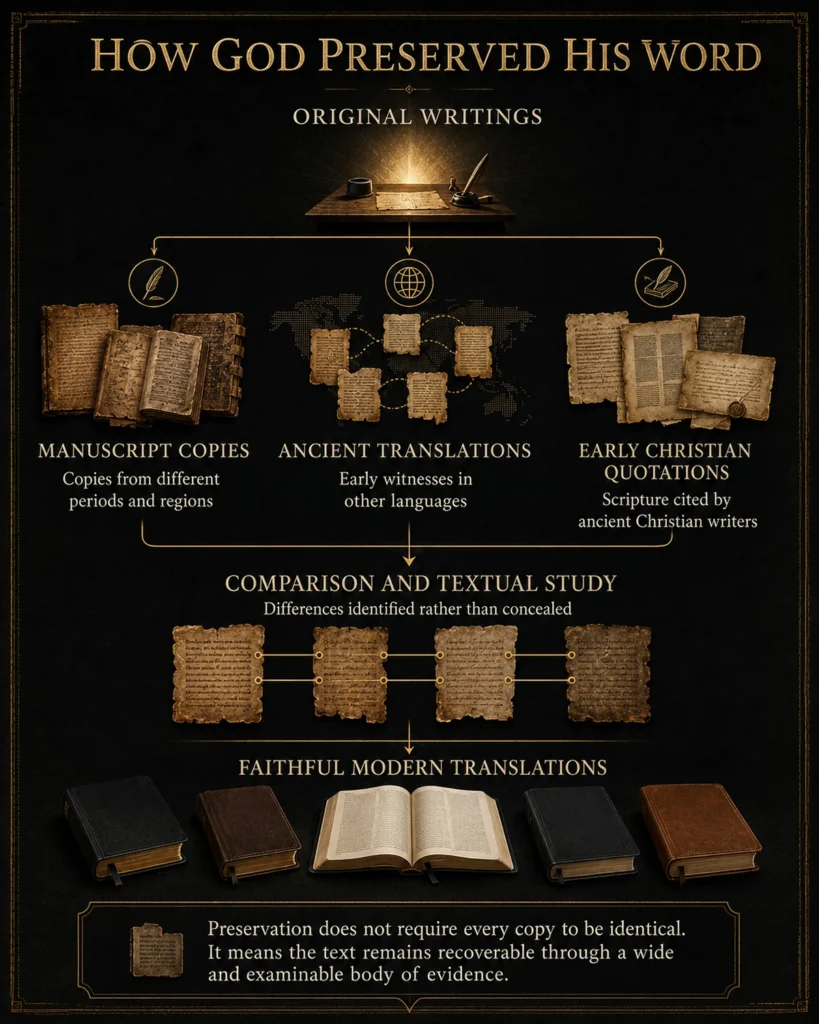
The original biblical documents were copied, circulated, collected, and translated across centuries. Copyists were human, and surviving manuscripts contain differences. We do not need to deny those differences or pretend that every ancient copy is identical.
Instead, we believe God faithfully preserved His Word through a wide and examinable body of evidence. Manuscripts from different places can be compared. Ancient translations and quotations provide additional witnesses. Difficult readings can be identified rather than concealed.
Textual questions matter because every word of Scripture deserves care. Yet manuscript differences have not erased the Bible’s central proclamation. Across the surviving evidence, Jesus remains the eternal Son, the Word made flesh, the crucified Savior, the bodily risen Lord, and the King who will return.
Our confidence does not depend on one manuscript being preserved without any variation. It rests on God’s providence working through a broad, public, and recoverable manuscript history. Responsible footnotes and brackets do not mean the Bible has failed. They show that places of uncertainty can be examined honestly.
Faithful Translations Communicate Holy Scripture
Paranoid Prophet normally quotes the New International Version because it communicates Scripture clearly and faithfully in contemporary English. The NIV is not the only legitimate Bible, and its translation committee was not infallible.
The King James Version, World English Bible, English Standard Version, New American Standard Bible, Christian Standard Bible, and other responsible translations can also faithfully communicate the Holy Scriptures. Christians may reasonably prefer different translations for reading, memorization, public worship, teaching, or detailed study.
A faithful translation can rightly be called Holy Scripture because it communicates the inspired biblical Word in another language. That does not mean every translation decision is equally precise or that translators receive a new act of inspiration. Individual renderings may still be examined against the Hebrew, Aramaic, and Greek texts.
We do not treat every translation, revision, or paraphrase as equally precise for every purpose. Some translations remain closer to the wording and sentence structure of the original languages. Others place greater emphasis on communicating the meaning in natural contemporary English.
Paraphrases such as The Message can help readers hear familiar passages in fresh language, but they make more interpretive decisions for the reader. They are best used alongside a standard translation rather than as the sole foundation for detailed doctrinal study.
A translation is not more faithful merely because its English is older or harder to understand. The goal is not to preserve one period of English. The goal is to communicate faithfully what God spoke through Hebrew, Aramaic, and Greek so that people can understand, believe, remember, and obey His Word.
We Are Nondenominational, but Not Without Convictions
Paranoid Prophet is not governed by loyalty to one denomination. We seek to test Christian claims by Scripture while learning from the history, scholarship, strengths, and failures of different Christian traditions.
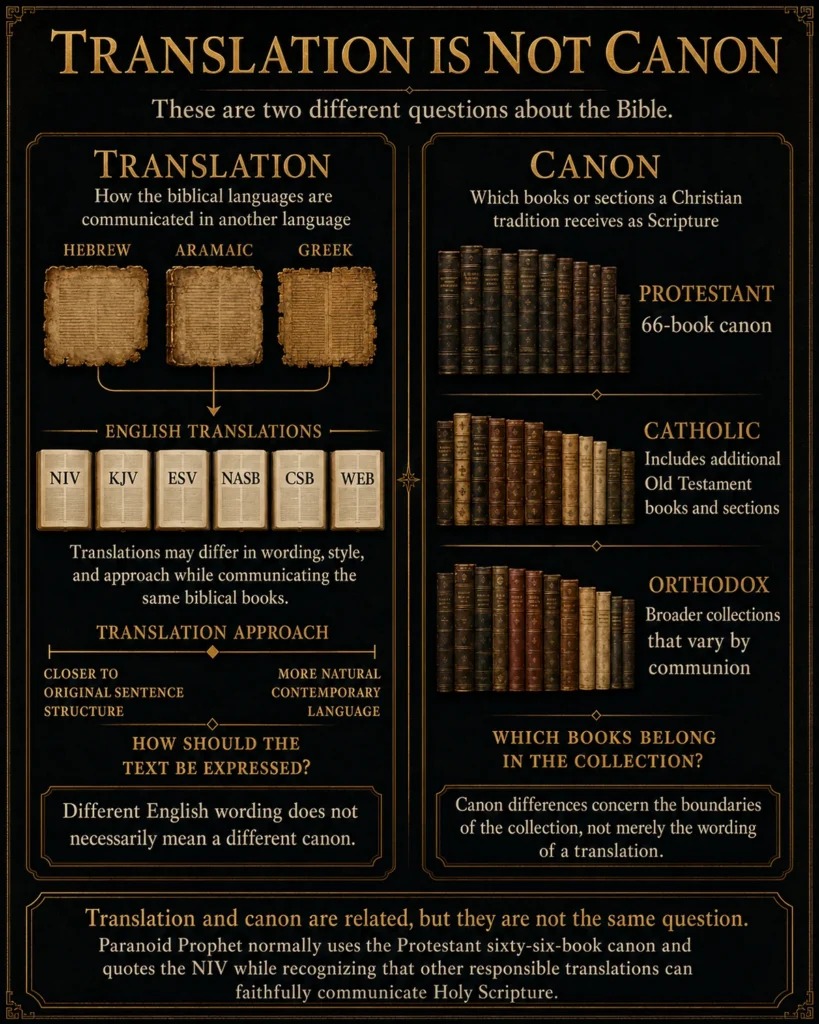
For ordinary reading, quotation, and site organization, Paranoid Prophet primarily follows the sixty-six-book Protestant Bible. Catholic and Orthodox Bibles contain additional Old Testament books or sections whose history and claims deserve careful examination. We do not dismiss those writings through slogans, nor do we assume that every traditional canon claim carries equal authority. Our aim is to examine the evidence openly while receiving the Holy Bible as God’s true Word.
Canon differences are not the same as translation differences. The NIV and King James Version normally contain the same sixty-six-book Protestant canon while using different English wording and, in some places, different textual evidence. Catholic and Orthodox Bibles share the central biblical testimony to Jesus Christ while receiving wider Old Testament collections.
These disagreements matter. They affect doctrine, worship, and how different traditions understand church authority. They should be investigated fairly rather than used to caricature sincere Christians who confess the same crucified and risen Lord.
Scripture Stands Above Commentary and Tradition
Study Bibles, commentaries, creeds, church traditions, sermons, and theological systems can help readers understand Scripture. They can also be mistaken.
Words printed beside or beneath the biblical text do not gain equal authority simply because they appear on the same page. This distinction matters when examining denominational study notes, prophecy systems, the Scofield Reference Bible, Christian Zionism, and every other interpretive tradition.
Scripture is the standard by which every commentary, tradition, doctrine, and political application must be tested.
We should listen to wise teachers without surrendering discernment. We should respect Christian history without confusing later tradition with divine inspiration. We should remain teachable without allowing any human authority to replace the Word of God.
This principle applies to Paranoid Prophet as well. Our conclusions, articles, and interpretations must remain accountable to Scripture. We do not claim authority simply because we speak confidently or provide historical sources. Every teaching must be tested.
Honest Questions Can Strengthen Faith
We do not believe Christians should fear questions about authorship, canon, manuscripts, translations, or church history. Faith built on exaggerated claims becomes vulnerable when a reader discovers that the real history is more complicated.
Complexity is not the enemy of confidence. Hidden complexity is. We would rather identify what the evidence establishes, acknowledge where serious debate remains, and explain why Christian faith is still reasonable than offer certainty built on claims that cannot survive examination.
History cannot place divine inspiration under a microscope. It can show that biblical writings circulated early, were read publicly, were preserved across regions, and remained available through a large manuscript tradition. Scripture itself explains the divine source of those writings, and the resurrection of Jesus stands as the public hinge of the Christian claim.
If God raised Jesus from the dead, then His identity, authority, teaching, and treatment of Scripture matter. Christian confidence in the Bible is therefore part of a larger cumulative case centered on the crucified and risen Christ.
Jesus Christ Is the Center
The Bible is not merely an ancient library, a source of moral quotations, or a collection of religious information. Its redemptive story leads to Jesus Christ.
The Law reveals God’s holiness, covenant, sacrifice, and humanity’s need. Israel’s history displays faithfulness, rebellion, judgment, mercy, and hope. The Psalms give language to worship, suffering, repentance, kingship, and trust. The prophets announce judgment, restoration, and the coming Messiah.
The Gospels reveal the Word made flesh. Acts records the gospel moving outward to the nations. The letters explain the work of Christ and the life of His people. Revelation announces His final victory, righteous judgment, and the renewal of creation.
We do not trust Scripture merely to win arguments about manuscripts, translations, canon lists, or church traditions. We trust Scripture because through it God makes known His Son.
Jesus Christ is the eternal Word made flesh, the promised Messiah, the sinless Lamb, the crucified Savior, the bodily risen Lord, and the King who will return. The written Word bears witness so that readers may know Him, trust Him, obey Him, and receive life in His name.