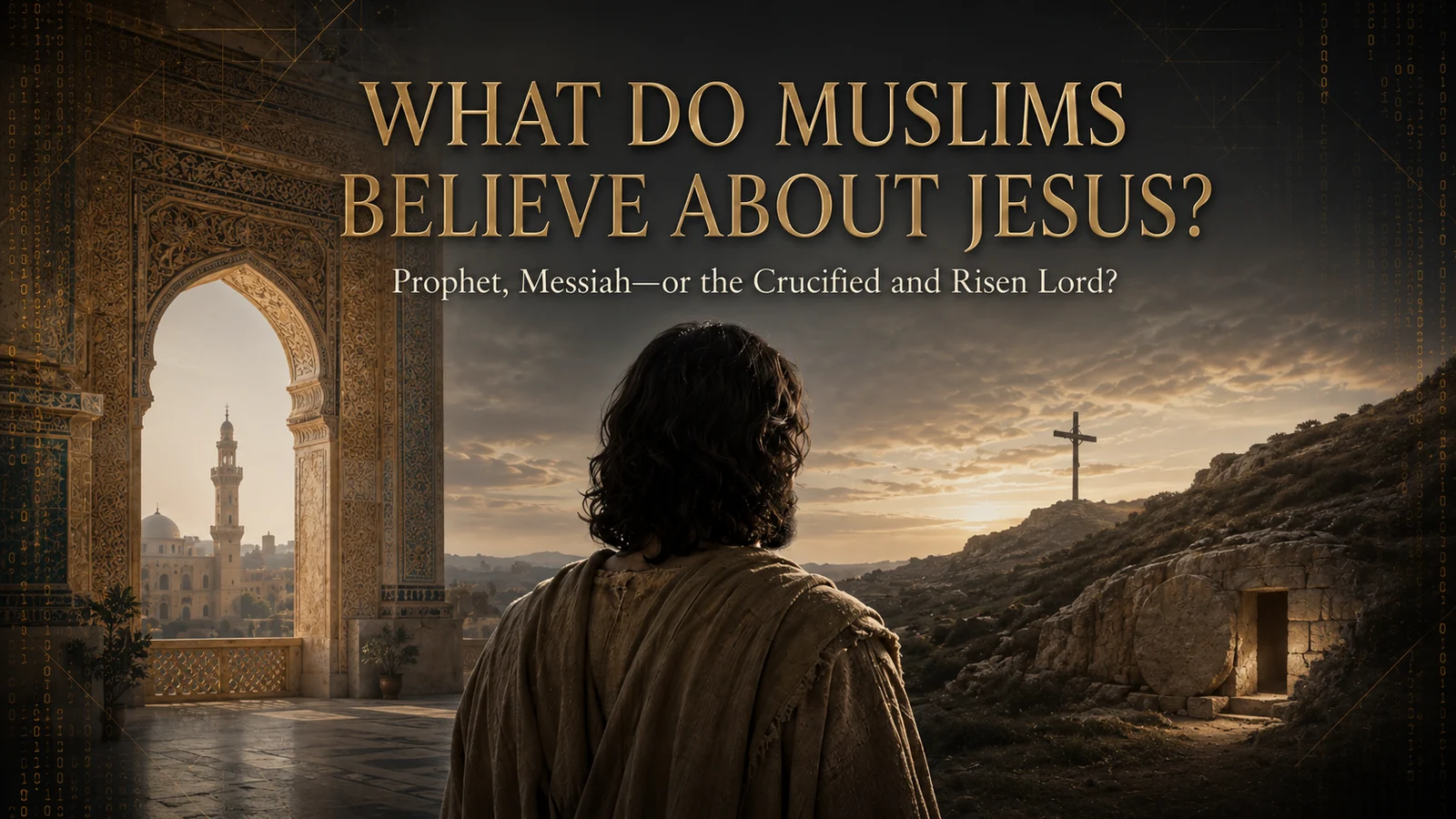

What do Muslims believe about Jesus? More than many Christians realize. Islam honors Jesus as the Messiah, affirms His miraculous conception, recounts astonishing miracles, calls Him a Word from God and a spirit from Him, and expects Him to have a role at the end of history. A Muslim can speak warmly and reverently about Jesus without being close to the Christian confession of who He is.
The disagreement is not over whether Jesus matters. It concerns His identity and saving work. The New Testament proclaims the eternal Son who became flesh, died for sinners, rose bodily, receives worship, and will judge the world. Islam places a theological boundary around each of those claims. This article will describe that boundary from Muslim sources, face the strongest Muslim objections, and then ask which portrait is supported by Scripture and the earlier historical evidence. Fair comparison requires understanding each faith in its own terms; it does not require pretending contradictory religions are all true.
Article Guide18 sections
Short Answer: What Do Muslims Believe About Jesus?
An extraordinary Messiah and prophet—but not God the Son
Muslims believe Jesus, called ʿĪsā in the Qur’an and Islamic usage, was a real messenger of God sent to the children of Israel. The Qur’an calls Him the Messiah, Jesus son of Mary, a messenger, a prophet, a servant, a Word conveyed to Mary, a spirit from God, and a sign for humanity. It presents His conception without a human father, gives Him miracles unavailable to ordinary people, and says God raised Him. Mainstream Sunni and Twelver Shia teaching also expects His future descent.
Those affirmations are substantial. They also operate inside Islam’s strict doctrine of divine unity, or tawhid. Jesus is not the eternal Son, is not God incarnate, and must not be worshiped. The Qur’an rejects saying that God is the Messiah, saying “Three,” or attributing a son to God (Qur’an 4:171-172; 5:72-75). In the dominant Muslim account, Jesus was neither killed nor crucified but was raised alive to God. He therefore was not raised bodily from death as Christianity claims.
Qur’an, hadith, tafsir, and Muslim diversity
Source labels matter. The Qur’an is Islam’s foundational scripture, believed by Muslims to be God’s revelation to Muhammad. Hadith are transmitted reports about Muhammad’s words and deeds; they supply many details about Jesus’ return that the Qur’an does not state. Tafsir is Qur’anic commentary, where interpreters explain ambiguous phrases and often preserve multiple narratives. A report in later commentary should not be called a Qur’anic statement.
Sunni and Twelver Shia Islam agree on the principal rejection of Christian Christology, although they differ over authority and end-times details. Ahmadiyya Muslims hold that Jesus survived crucifixion and later died in Kashmir. Some Quranist and modern interpreters accept Jesus’ death or decline the detailed hadith account of His return. These views deserve accurate mention, but they do not replace the mainstream position. For the larger authority structure and denominational landscape, see this overview of Islamic belief.
The decisive Christian disagreement
Christianity does not object because Islam says too little that is complimentary. It objects because Islam denies the apostolic gospel at its center. According to Scripture, the Word already was with God and was God before becoming flesh (John 1:1-18). The Son willingly laid down His life, was buried, rose on the third day, and appeared to witnesses. Calling Jesus a prophet while denying His Sonship, cross, and resurrection does not preserve a smaller version of the same faith. It gives those shared words a different governing meaning.
Why Jesus Is So Important in Islam
Mary, the miraculous conception, and Jesus as a sign
The Qur’an gives Mary an exceptional place. It says God chose and purified her, then announced “the Messiah, Jesus, son of Mary,” who would be honored in this world and the next (Qur’an 3:42-47). In Surah Maryam, a divinely sent spirit appears in human form and announces a pure son. Mary asks how she can have a child when no man has touched her, and the answer presents the birth as God’s creative decree and a sign of mercy (Qur’an 19:16-21).
This overlaps strikingly with Matthew and Luke, which also affirm conception by the Holy Spirit and no human father. Yet the explanations differ. The Qur’an compares Jesus’ creation to Adam’s: God says “Be,” and he is (Qur’an 3:59). Islamic theology therefore treats the virgin conception as a miracle of creation, not an incarnation. In the Gospels, the conception belongs to a larger identity: Mary’s child is conceived by the Spirit, called the Son of the Most High, inherits David’s throne, and saves His people from their sins (Luke 1:26-35; Matthew 1:18-23).
Miracles by God’s permission
The Qur’anic Jesus speaks in infancy, makes a bird-like figure from clay and gives it life, heals congenital blindness and leprosy, raises the dead, and discloses what people eat and store. The formula “by God’s permission” accompanies these wonders repeatedly (Qur’an 3:49; 5:110). That qualification is not incidental. It frames the miracles as signs granted to an authorized messenger, never as proof that Jesus independently possesses divine power.
Christians need not minimize the overlap or force it to carry more than it does. Both traditions portray Jesus as a worker of extraordinary signs. The dispute concerns what those signs reveal within each source’s full narrative. In the Gospels, Jesus’ works announce God’s kingdom and are joined to His authority to forgive sins, rule the Sabbath, give life, and receive the honor due to the Father. A miracle by itself does not settle His identity; the pattern of words, works, death, resurrection, and worship must be considered together.
Gospel, disciples, righteousness, and the sinlessness question
The Qur’an says God gave Jesus “the Gospel” as guidance and light, confirming the Torah before it (Qur’an 5:46). It portrays Jesus calling disciples to be God’s helpers, and it describes those disciples as believers and submitters (3:52; 5:111). It also places Jesus among the righteous and announces Him as a pure boy. Later Muslim theology commonly speaks of prophets as protected from serious sin.
It is still too strong to say that the Qur’an explicitly presents a developed doctrine of Jesus’ absolute sinlessness. The text gives Him unusual purity and records no confession of personal sin, but the full claim depends on theological inference. Christianity’s confession is more direct and serves a different purpose: Jesus “knew no sin,” offered Himself without blemish, and bore sins as the righteous representative of the guilty.
The “Gospel” also names different things in the two traditions. In Islam it is revelation given to Jesus, often understood as an original message later obscured or altered. In Christianity the gospel is the good news about Jesus’ reign, atoning death, and resurrection, preserved in apostolic proclamation and narrated in the four canonical Gospels. Whether a recoverable original Injil existed apart from that first-century witness will need historical evidence, not definition alone.
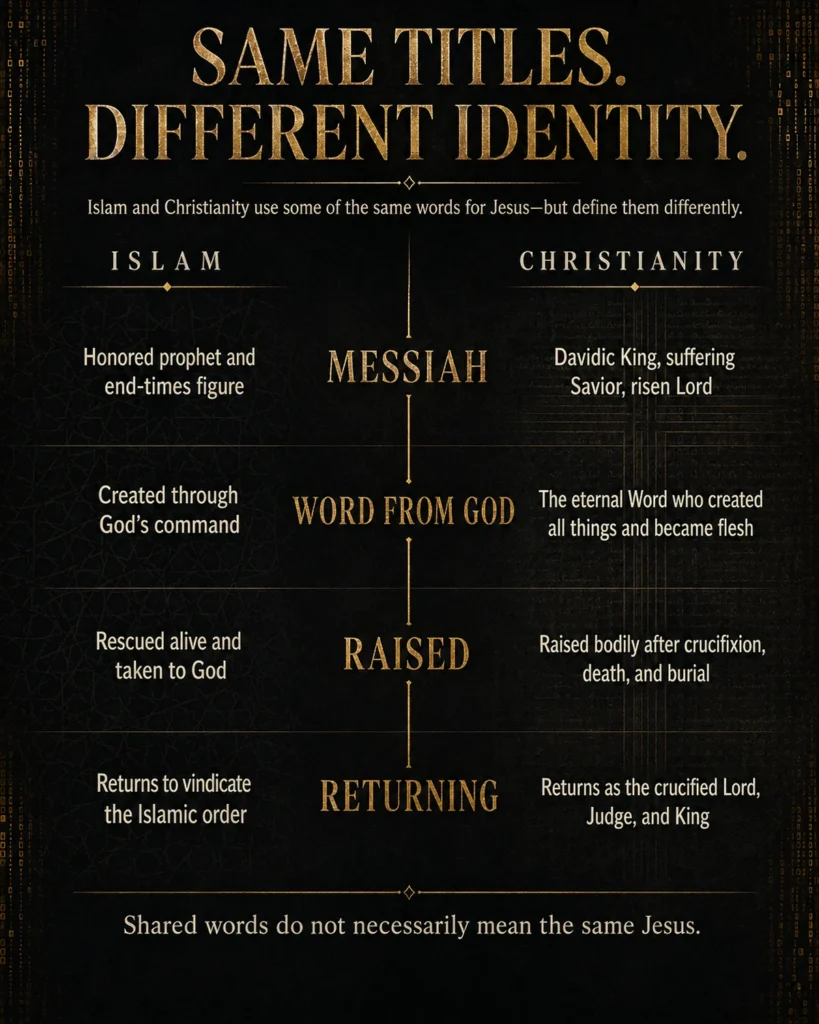
Same Titles, Different Identity
Messiah without the Christian messianic mission
The Qur’an calls Jesus al-Masih, “the Messiah,” but does not develop the title through Israel’s royal, priestly, and suffering-servant hopes. Classical commentators offered several explanations for the word, including blessing, travel, and Jesus’ healing touch. In the New Testament, the title belongs to a thicker story: Jesus is David’s promised King, Daniel’s Son of Man, Isaiah’s suffering Servant, the covenant-making Savior, and the Lord vindicated through resurrection.
Word from God without the eternal Logos
Qur’an 3:45 calls Jesus “a Word from Him,” while 4:171 says God conveyed His Word to Mary. Muslim interpretation normally connects this to God’s creative command: Jesus came into being by “Be” without a human father. John’s claim is categorically different. The Word exists before creation, is with God, is God, makes all things, and becomes flesh. Similar vocabulary identifies the dispute; it does not resolve it.
Spirit from God without incarnation
The Qur’an calls Jesus “a spirit from Him.” Muslim commentators may identify the Holy Spirit as Gabriel or read the phrase as a created spirit specially attributed to God. Christianity does not treat Jesus as a detachable portion of deity. It confesses that the eternal Son personally assumed a complete human nature through the Holy Spirit.
Servant, messenger, prophet, and son of Mary
These titles contain genuine overlap. Jesus is Mary’s human son, God’s servant, and the prophet sent by the Father. Christianity says they do not exhaust His identity: the servant shares glory with the Father before the world existed, and the prophet is also the Son through whom God finally speaks.
| Title or claim | Islamic meaning | Christian meaning |
|---|---|---|
| Messiah | Honored prophet and end-times figure | Davidic King, suffering Savior, risen Lord |
| Word from God | Created through God’s command | Eternal Creator who became flesh |
| Spirit from God | Created spirit or honorific origin | The Son incarnate by the Holy Spirit |
| Son of God | Rejected as incompatible with divine unity | Eternal personal relation, never biological procreation |
| Raised to God | Rescued and exalted alive | Raised bodily from death, then ascended |
| Return | Vindicates Islam in later tradition | The crucified Lord returns as Judge |
In Islam, every honor belongs to a created servant under God. Historic Christianity confesses that this servant is the eternal Son in human flesh. The next question is why Islamic theology rejects that confession so strongly.
Why Muslims Reject Jesus as God
Tawhid and the rejection of associating partners with God
Islam’s rejection of Jesus’ deity begins with a conviction Christians share in its basic form: God alone deserves worship. The Qur’an condemns shirk, the association of partners with God, and repeatedly denies that the Messiah is God (Qur’an 5:17; 5:72). If Jesus is a creature, then praying to Him is not an innocent excess. It is idolatry.
That is why the disagreement cannot be reduced to terminology. For a Muslim, guarding God’s uniqueness is an act of reverence, not a convenient way to diminish Jesus. Muslims hear Christian language about Father and Son as a violation of the Creator-creature distinction. They point to Jesus worshiping God, receiving a mission from God, and performing signs by God’s permission. They also see the incarnation as making the self-sufficient Creator dependent, changeable, and mortal. Serious Christian theology must answer those concerns without weakening the biblical confession that “the LORD is one” (Deuteronomy 6:4-5).
Divine Sonship is not biological procreation
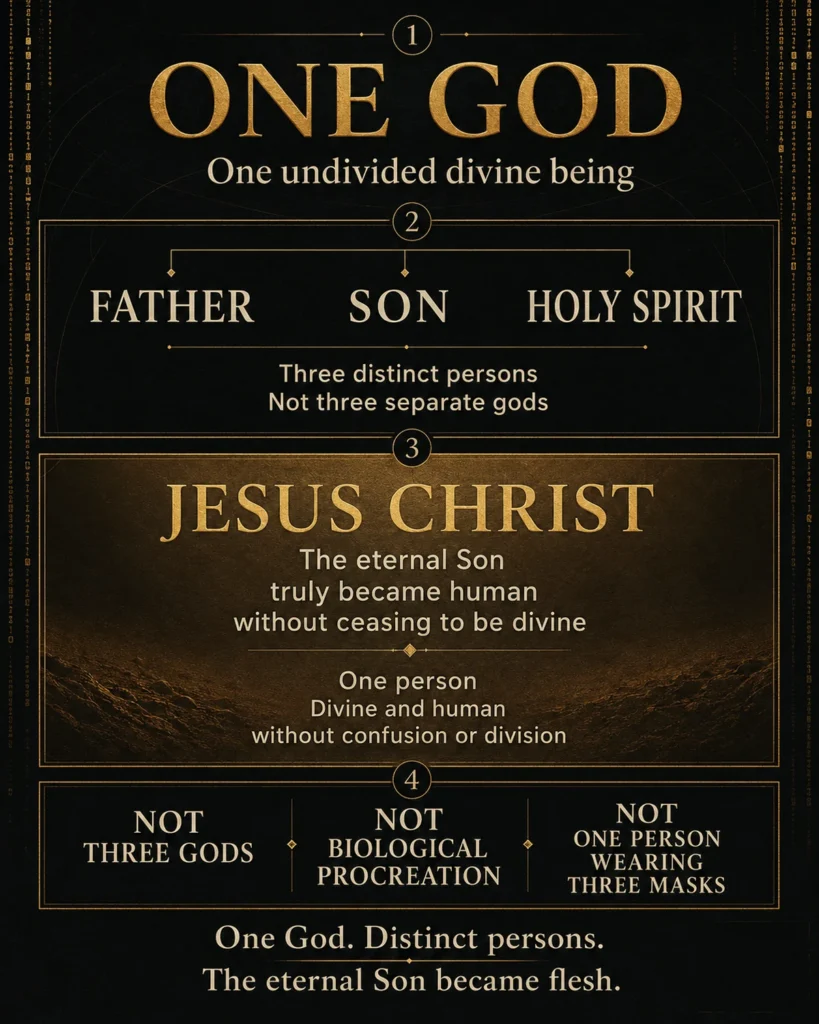
The Qur’an rejects the idea that God begets a son and connects sonship with a consort or offspring. Christianity rejects biological divine procreation too. The Father did not mate with Mary or produce another god in time. “Father” and “Son” describe an eternal personal relation within the one divine being; the miraculous conception describes how the Son assumed humanity, not how His divine person began.
Muslims correctly observe that “son of God” has several biblical uses. Israel, Davidic kings, heavenly beings, peacemakers, and adopted believers can receive sonship language. The title by itself is not a shortcut to deity. Jesus’ Sonship is unique because of the surrounding claims: He is the beloved heir after the servants, knows the Father with exclusive reciprocity, comes from the Father, shares the Father’s works and honor, possesses preexistent glory, and is the agent through whom God made all things. The full case is developed in this study of whether Jesus is the Son of God.
The Trinity is not three independent gods
Historic Christianity does not say that three divine beings form a committee or that one person is three persons. It says the one indivisible divine being exists eternally as Father, Son, and Holy Spirit. The persons are genuinely distinct; the divine essence is not divided into thirds. This doctrine uses later technical vocabulary, but it arose because Scripture compelled Christians to confess one God while identifying the Father, Son, and Spirit personally and divinely.
No created analogy solves that mystery. Water changing among liquid, ice, and vapor suggests one person wearing three modes. Three humans sharing humanity suggests three gods. Nor does the Hebrew word echad, “one,” grammatically prove a compound unity. The relevant question is exegetical: does Scripture place the Son and Spirit within God’s identity while distinguishing them from the Father? Christians believe it does, and Islam denies that reading.
What the Qur’an’s “Three” and Jesus-Mary polemics do and do not describe
Qur’an 4:171 commands Christians not to say “Three”; 5:73 condemns saying that God is “the third of three”; and 5:116 pictures God asking Jesus whether He told people to take Him and His mother as gods besides God. These texts clearly reject Christian divine claims. They do not state the Nicene doctrine in its own terms. The creed never named Mary as a person of the Trinity, and it never taught three independent gods of whom the Father is one-third.
Scholars debate the exact communities or devotional practices in view. Christians should not evade the Qur’an’s challenge by pretending it attacks nothing recognizable: people have offered worship and prayer to Jesus, and Marian devotion can become excessive. Still, a fair refutation must address the doctrine Christians actually confess. Once that doctrine is clear, the issue becomes evidential: do the earliest sources justify including Jesus in the worship owed to the one God?
Did Jesus Claim Divine Authority?
Evidence Check: Zakir Naik’s “unequivocal statement” challenge
Popular Muslim speaker Zakir Naik poses a memorable test in an official 2009 Mumbai lecture: “There is not a single unequivocal statement … where Jesus … says that ‘I am God’ or … ‘worship me’.” The observation is correct in a narrow sense. The Gospels do not contain that exact modern formula, Jesus distinguishes Himself from the Father, and isolated proof texts can be abused.
The test also controls the answer before the evidence is heard. A first-century Jewish claim could be expressed through actions, titles, scriptural allusions, prerogatives, and accepted devotion. Naik’s challenge leaves out Jesus personally forgiving sins, claiming Sabbath lordship, identifying Himself with Daniel’s cloud-coming ruler, placing Himself at the center of final judgment, claiming preexistence and shared glory, and requiring the Son to receive the Father’s honor.
The Christian answer is cumulative. Jesus’ identity is disclosed by what He says, does, receives, and fulfills, then vindicated in the resurrection proclamation. Readers can inspect Naik’s wording in his official lecture transcript. It represents his influential apologetic method, not every Muslim scholar.
Forgiveness, Sabbath, the Son of Man, and final judgment
The Synoptic Gospels do more than portray a miracle-working prophet. In Mark 2, Jesus does not merely announce that God has forgiven a paralytic; He declares forgiveness personally, then heals the man to validate “the Son of Man’s” authority on earth. A Muslim may answer that God delegates forgiveness. That is possible for this scene in isolation, but the authority joins a larger pattern.
Jesus calls Himself Lord of the Sabbath (Mark 2:27-28), speaks as the decisive interpreter of purity and Torah, commands creation, and sends angels to gather His elect. At His trial He combines Psalm 110’s enthroned Lord with Daniel 7’s Son of Man coming on the clouds (Mark 14:61-64). Daniel’s figure receives everlasting dominion and universal service. One can call this delegated authority, but an ordinary-prophet model is already under strain when Jesus also presides over the final judgment of nations.
Preexistence, shared honor, and “My Lord and my God”
John states the claims more explicitly. The Word exists before creation and makes all things. Jesus says that the Son gives life and executes judgment as the Father does, and that everyone must honor the Son just as they honor the Father (John 5:19-23). He claims existence before Abraham, speaks of glory shared with the Father before the world existed, and describes a mutual indwelling with the Father.
John’s Gospel is usually dated later than the Synoptics and has a distinctive theological voice. That historical observation should not be hidden. Neither should its climactic confession. Thomas addresses the risen Jesus, “My Lord and my God,” and Jesus responds by blessing those who believe without seeing (John 20:28-29). The narrator presents this as the destination of the Gospel, not as a correction of Thomas.
Paul, Maranatha, and early worship before Nicaea
High devotion to Jesus did not begin with John or a fourth-century council. Paul’s undisputed letters are the earliest surviving Christian writings. In 1 Corinthians 8:6, Paul confesses one God, the Father, “from whom” are all things, and one Lord, Jesus Christ, “through whom” are all things. He is not adding Jesus to the many pagan lords he has just rejected; he is including Jesus within the church’s monotheistic confession.
Paul applies Isaiah’s language of universal homage to Jesus in Philippians 2:5-11 and Joel’s call on the Lord to a Jesus-centered confession in Romans 10:9-13. He addresses believers as those who “call upon” Jesus’ name and preserves the Aramaic prayer Maranatha, “Our Lord, come” (1 Corinthians 16:22). The precise metaphysical language developed over time, but invocation, sacred meal, confession, and hope centered on Jesus while the movement remained fiercely opposed to idols. Nicaea did not create the evidence that later demanded doctrinal clarification.
Jesus Prayed, Obeyed, and Did Not Know the Hour
Prayer and mission distinguish the Son from the Father
Muslim objections return to facts Christians must affirm. Jesus prayed through the night, thanked the Father, submitted in Gethsemane, and called the Father “my God.” He was sent, received commandments, and did the Father’s will. These are not performances by a solitary divine person talking to Himself. The Father is not the Son, and the incarnate Son lived a genuinely dependent human life.
Prayer therefore counts against a modalistic caricature of Christianity, not against the Trinity as historically confessed. The Son’s mission also does not prove He began to exist when sent. In John, the One sent into the world speaks of the glory He possessed with the Father before the world. Philippians 2 presents the same downward movement: the One in God’s form takes the form of a servant and becomes obedient to death.
Mark 13:32 must not be explained away
Jesus says that no one knows the day or hour, “not even the angels in heaven, nor the Son, but only the Father” (Mark 13:32). The straightforward reading is that the Son did not know the time during His earthly ministry. Claims that He knew but merely refused to disclose it make the verse say less than it says.
This is a serious Christological difficulty. It is also evidence that the Gospels did not erase Jesus’ human limitation to make later theology easier. Luke says He grew in wisdom. Hebrews says He learned obedience through suffering. A complete human mind develops and knows finitely. Christian models differ over how divine and human cognition relate in the one person, but orthodoxy does not require a disguised omniscience in Jesus’ human consciousness.
Incarnation: complete humanity without surrendering deity
Incarnation does not mean the divine nature changed into human nature. The eternal Son assumed a complete human nature, body and rational soul, while remaining who He eternally is. The result is not a half-God, half-man hybrid or two persons cooperating. One person, the Son, lives and acts through divine and human natures.
That framework explains why Christians can confess real hunger, fatigue, learning, temptation, sorrow, prayer, and obedience without treating them as the whole truth about Jesus. It is mysterious, and Christians should say so. Yet it was not invented to hide inconvenient verses. The church needed such language because its sources held together Jesus’ full humanity, personal distinction from the Father, preexistence, divine works, and worship.
What Christians mean when they say God the Son died
God’s divine nature is immortal and cannot cease to exist. Christians do not believe deity was extinguished on Good Friday or that the Trinity temporarily became two persons. They mean that the person who truly underwent human death was the eternal Son incarnate. His embodied human life ended; His body was buried; His divine existence did not collapse.
Saying “God the Son died” identifies the person. Saying He died “according to His humanity” identifies how. This is not wordplay meant to evade mortality. If the Son assumed our nature, then suffering and death were real events in His human life. A deathless appearance could not ground resurrection from the grave. The confession of complete humanity therefore leads directly to the event Islam denies and Christianity places at the center: the crucifixion.
Was Jesus Crucified?
What Qur’an 4:157-158 actually says
The Qur’an reports a boast that “we killed the Messiah, Jesus son of Mary,” then denies it: “they did not kill him, nor did they crucify him,” followed by the difficult phrase shubbiha lahum, often translated “it was made to appear so to them.” It says the disputants lacked certain knowledge and that God raised Jesus to Himself (Qur’an 4:157-158).
The text does not name Judas, a volunteer disciple, or anyone else as a substitute. The passive Arabic phrase leaves the agent and the thing made similar or confused unstated. It can naturally support an appearance or substitution reading, but the narrative details familiar in popular retellings come from later commentary. Qur’an 3:55, which says God would “take” Jesus and raise Him, also generated disagreement because mutawaffika can be associated with death, sleep, completion, or taking, depending on context and interpreter.
Mainstream Sunni and Twelver Shia teaching resolves these passages by saying Jesus was rescued and raised alive. Christianity says He was publicly crucified, truly died, and was later raised from death. Those are rival sequences, not two ways of describing the same event.
Substitution, appearance, survival, and minority Muslim readings
Classical commentators commonly preserve substitution stories, but they disagree over the victim. A willing disciple, a betrayer, an arresting officer, and an unnamed person all appear in the tradition. The variety does not logically disprove substitution; it shows that no stable identification comes from the Qur’an itself.
Modern interpreters sometimes prefer an epistemic reading: witnesses sincerely perceived a crucifixion without knowing what God had done. Ahmadiyya Islam offers a different minority account in which Jesus was crucified but survived, recovered, traveled east, and died naturally. Other Muslim and academic readers think 4:157 denies the hostile claimants’ agency or triumph while allowing Roman crucifixion and even Jesus’ death.
These distinctions prevent a caricature. They also reveal the historical task. A rescue model must identify what happened in first-century Jerusalem, explain who was executed or how Jesus survived, and account for the death-burial-resurrection message among His earliest followers. An imaginable mechanism is not yet evidence that the mechanism occurred.
Evidence Check: Shabir Ally’s mistaken-inference model
Shabir Ally offers a more careful Muslim account than the familiar Judas story. In a separate reflection on Gospel development, he argues that the written portraits progressively elevated a human Jesus into a divine being. In a written 2011 response to William Lane Craig, Ally argues that “They crucified him not” means, “They did not kill him by means of impalement.” On his reading, Jesus could have been put on a cross without dying there. Ally further argues that followers can draw major conclusions from inadequate observations, so God need not have directly deceived the disciples.
This model gets several things right. The Qur’anic verse does not identify a substitute, sincere people can be mistaken, and the Gospel narratives must be historically assessed rather than treated as camera footage. The model can explain in principle why someone thought Jesus was dead and later thought He was alive.
What it lacks is positive evidence that this happened to Jesus. It must overcome Roman execution, the Gospel reports of official body release, early death and burial tradition, named appearance claims, and the absence of a first-century rescue or recovery stream. Ally’s original crucifixion response supplies a possible reconstruction; it does not supply an earlier witness who remembered Jesus surviving.
The earlier historical evidence for Roman crucifixion under Pilate
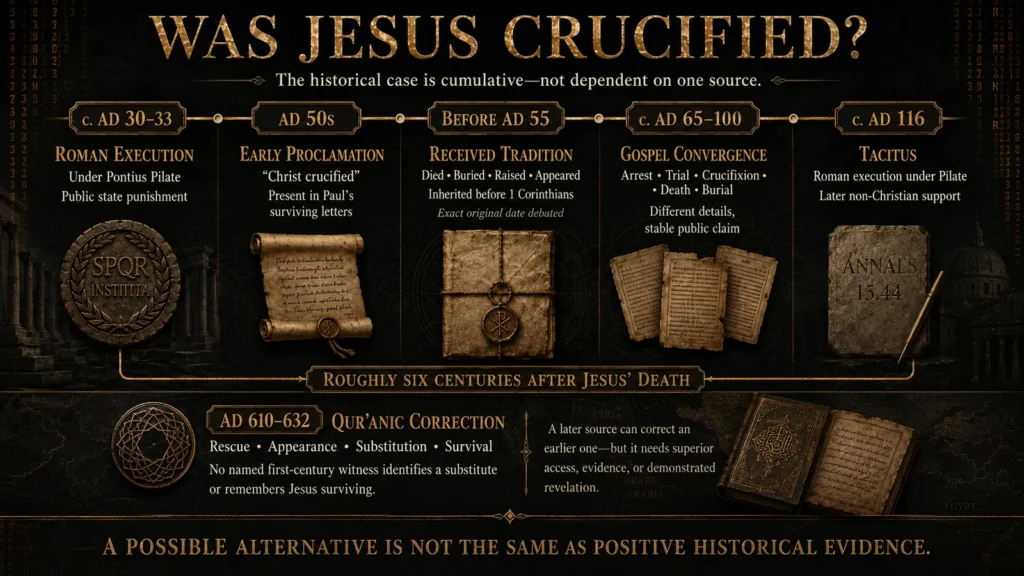
The historical conclusion is exceptionally firm: Jesus was executed by Roman crucifixion under Pontius Pilate. Paul’s undisputed letters from the 50s are the earliest surviving Christian writings. They repeatedly proclaim “Christ crucified,” and Paul says he received a tradition that Christ died, was buried, was raised, and appeared. This was not a respectable legend developed after the shame had faded. The movement placed an offensive, publicly executed Messiah at its center from its earliest recoverable stage.
All four canonical Gospels converge on arrest in Jerusalem, Roman adjudication under Pilate, crucifixion, death, and burial. They differ in chronology, speeches, and details, so they should not be treated as four identical transcripts. Their theological commitments do not erase their stable public claim. The fuller case is documented in the historical evidence that Jesus was crucified.
Non-Christian evidence is later but supportive. Josephus identifies James as the brother of Jesus called Christ; the longer passage about Jesus contains Christian-sounding material and should not carry the argument in its received form. Tacitus, writing with contempt for Christianity, reports that Christus suffered the death penalty under Pilate during Tiberius’ reign. He was not an eyewitness, and his information source is debated, but his report confirms the public Roman frame.
Crucifixion practices varied, and rare survival cases warn against saying every Roman crucifixion was mathematically fatal. Nor can modern medicine recover one certain physiological cause of death from ancient narratives. In Jesus’ case, however, prior abuse, execution, reported death, the Gospel reports of official body release, burial, and the absence of a wounded-survivor tradition make swoon theories historically very weak. The seventh-century denial must overturn this early convergence without offering a first-generation alternative source. Historical method cannot declare a later revelation impossible; it can require that the corrective account explain the earlier evidence it asks readers to abandon.
Why Would God Require the Cross?
Could God simply forgive?
Even if the crucifixion happened, Muslims can ask why a merciful God would make it necessary. A person can forgive an offender without demanding blood. If God is sovereign, why can He not simply pardon the repentant? A Christian answer that imagines God needing a quantity of pain before He can become loving deserves rejection.
God is not subject to a law above Himself, and the Bible portrays Him as freely merciful. Yet forgiveness is not pretending evil has no weight. A victim who forgives absorbs a real loss while still naming the wrong, protecting others, and seeking restoration. Divine forgiveness addresses rebellion against the Creator, personal and social ruin, covenant rupture, and death itself. The cross does not purchase compassion from a reluctant Father. It is the historical form taken by God’s own holy mercy.
Romans 3 holds mercy and righteousness together: God provides redemption in Christ while demonstrating His justice (Romans 3:21-26). Christians debate whether this plan was the only metaphysically possible one. The article need not settle that debate to make the biblical claim: God chose to confront evil without trivializing it and to bear reconciliation’s cost in the Son.
“No bearer bears another’s burden”
The Qur’an repeatedly says that no bearer will bear another’s burden (Qur’an 6:164). The Bible also teaches personal responsibility. Ezekiel 18 rejects the excuse that children are automatically punished as morally guilty for their parents’ sins. Paul says each person will give an account to God. Atonement cannot mean that Jesus became morally blameworthy for crimes He never committed or that the guilty need not repent.
Biblical representation is more than transferring a legal file between unrelated people. Humanity is corporate as well as individual: Adam’s rebellion brings corruption and death into the human family, and each accountable person confirms that rebellion through personal sin. Christ enters that family as the faithful new Adam. United to Him, His people share in His representative death and risen life (Romans 5-6). Responsibility remains; so do solidarity, consequence, covenant, and grace.
The innocent-substitute moral objection
Punishing an innocent third party against his will would be unjust. The Christian gospel does not place a random victim between an angry Father and sinners. The one who gives Himself is the eternal Son, sharing the Father’s saving purpose and assuming the humanity He represents. “God was in Christ reconciling the world to himself” (2 Corinthians 5:14-21).
Jesus describes Himself as the shepherd who lays down His life for the sheep. “No one takes it from me,” He says; He lays it down of His own accord (John 10:11-18). His submission to the Father is filial obedience, not divine abuse. The Father sends and gives; the Son loves and offers Himself through the eternal Spirit. Distinction of persons does not become opposition of wills.
This does not make crucifixion good. Rome’s violence, political calculation, betrayal, and human cruelty remain evil. God does not excuse them. He enters their worst result, bears sin’s judgment without becoming sinful, and overturns death through resurrection.
Voluntary self-offering, representation, sacrifice, victory, and reconciliation
No single image exhausts the cross. Jesus gives His life as a ransom, seals the new covenant in His blood, fulfills the suffering Servant’s sin-bearing mission, acts as priest and sacrifice, bears the curse, reconciles enemies, disarms hostile powers, and forms a new humanity. Penal and substitutionary dimensions belong in that account, but they are joined to sacrifice, covenant, victory, healing, union, and love.
These themes prevent opposite distortions. The cross is more than an inspiring example because it objectively deals with sin and judgment. It is more than a punishment transaction because the crucified One is priest, King, representative, victor, and self-giving God the Son. The Father is not made merciful by violence; the triune God initiates salvation. A fuller biblical synthesis appears in what the cross accomplished.
Islam protects its honored prophet from the shame of crucifixion. Christianity says the Son freely entered that shame and transformed it into the place where justice and mercy meet. If Jesus died, however, the cross alone would be defeat. The next question is whether He remained dead or whether God vindicated Him by bodily resurrection.
Resurrection—or Raising Jesus Alive to Heaven?
The Islamic sequence and the Christian sequence
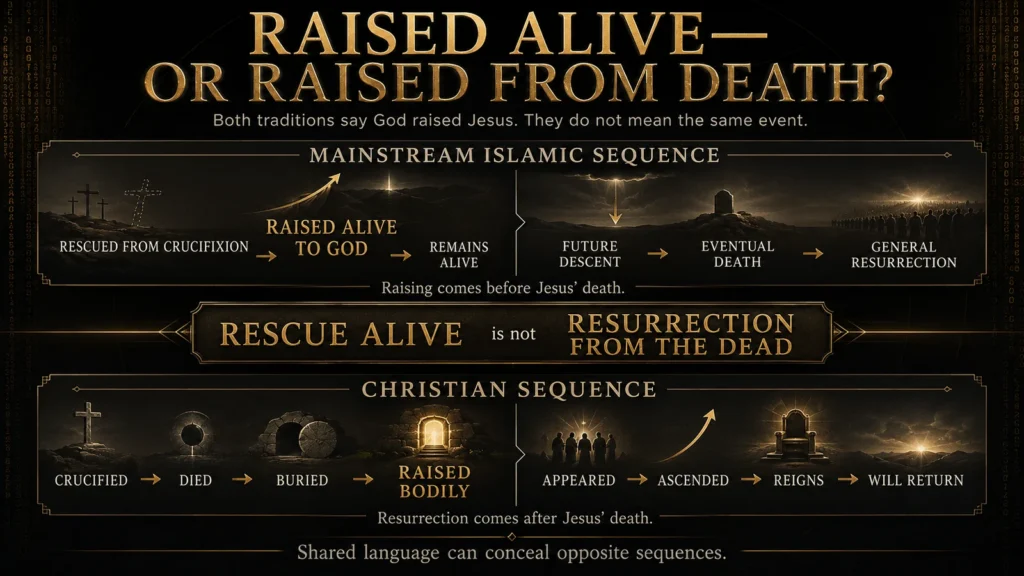
Mainstream Islam and Christianity both say God “raised” Jesus, but the shared verb can hide opposite sequences. In the dominant Islamic account, Jesus was rescued from crucifixion, taken bodily alive to God, remains alive, will descend, eventually die, and later participate in the general resurrection. Islam places Jesus’ raising before His death; Christianity proclaims His resurrection after death.
Christianity says Jesus was crucified, died, was buried, was raised bodily into transformed life, appeared, ascended, reigns, and will return. His resurrection is not a second chance at ordinary mortality like Lazarus received. It is victory through death and the beginning of the final resurrection promised to His people. The distinction is visible even before the evidence is weighed: rescue alive is not resurrection from the dead.
Qur’an 19:33 speaks of Jesus’ death and being raised alive, but Muslim interpreters commonly place the death after His future return. Some minority readers see an earlier death and exaltation. Qur’an 4:158 says God raised Jesus to Himself without narrating a tomb, Easter appearances, or transformed bodily life. Those details belong to the Christian claim the Qur’an corrects.
The received tradition in 1 Corinthians 15
Paul reminds the Corinthians of what he had “received” and “delivered”: Christ died for sins according to the Scriptures, was buried, was raised on the third day, and appeared to Cephas and the Twelve, followed by other appearances (1 Corinthians 15:1-8). At least verses 3b-5 are widely recognized as traditional material Paul inherited rather than composed from nothing.
The formula predates the letter, written in the 50s, and many scholars locate it within Christianity’s earliest years. Its exact wording, place of origin, and date remain debated. “Within months” is possible in some reconstructions, not an established timestamp. Its secure importance is simpler: death, burial, raising, and appearance were already central before Paul’s letter and long before John, Constantine, or Nicaea.
Paul’s “spiritual body” later in the chapter does not mean an immaterial ghost. He contrasts the present mortal body with a body transformed and empowered by God’s Spirit. Questions remain about ancient concepts of embodiment and precise continuity, but Paul proclaims resurrection of the dead, not the survival of Jesus’ influence.
Cephas, James, Paul, burial, and the empty-tomb question
The strongest historical network consists of named first-generation figures. Cephas, or Peter, stands first in the received appearance list and was personally known to Paul. James, the Lord’s brother, is named in the list, became a Jerusalem leader, and is independently anchored by Josephus. Paul writes firsthand that he had opposed the movement and then believed Jesus appeared to him. Galatians records his later meetings and conflicts with Peter and James.
Their convictions do not automatically prove a miracle. Peter’s own first-person account does not survive, Paul’s experience uses visionary and revelatory language, and the tradition provides no detailed narrative of James’s appearance. Yet “Paul invented the resurrection” cannot explain a proclamation he received or the Jerusalem leaders he knew. This first-witness network is more historically important than an anonymous crowd.
Burial is probable. Paul includes it in received tradition, and Mark’s early narrative of Joseph of Arimathea is retained across the Gospels. The empty tomb has a serious cumulative case, including the burial-discovery sequence and the consistent role of women. It is not universally accepted among scholars. Paul does not narrate the discovery, and the Gospels vary in their details. The earlier foundation is Jesus’ death, the received proclamation, and named followers convinced that He appeared.
Gospel differences and naturalistic alternatives
Christians should not describe the Easter narratives as four synchronized camera angles. Mark, Matthew, Luke, and John differ over which women arrive, how many angelic figures are present, the order of reports, the geographic emphasis, and the sequence of appearances. Most textual scholars regard Mark 16:9-20 as a later ending. These differences lower confidence in a minute-by-minute reconstruction.
They do not create the pre-Pauline proclamation. Later legendary growth can explain elaboration; it struggles to explain the early core. Grief visions can account for an individual’s experience; social reinforcement can spread conviction; cognitive dissonance can help a failed movement reinterpret defeat. Combined naturalistic models deserve serious consideration. They must still explain why Jewish followers proclaimed resurrection rather than mere heavenly survival, why Peter, James, and Paul became anchors, and how the burial evidence should be weighed. Historians who restrict explanation to ordinary causes will not infer resurrection; that methodological limit is distinct from what the sources report.
Survival and substitution models face the additional burden already discussed: they have no early positive witness. The Christian claim is that God raised Jesus bodily and that this divine act best explains the whole pattern.
What history supports and what resurrection faith concludes
Historical investigation can support several claims with high confidence: Jesus died by crucifixion; resurrection proclamation arose very early; Paul transmitted earlier tradition; Peter, James, and Paul were associated with appearance claims; and the movement’s worship and mission reorganized around the risen Jesus. Burial is probable; the empty tomb is meaningful but more debated.
History does not place God in a laboratory or compel every scholar to confess a miracle. The Christian inference is that bodily resurrection best explains the total pattern, while Scripture gives the event its authoritative meaning. The Father vindicated the Son, death was defeated, and Jesus was enthroned as Lord. For a deeper treatment of chronology, see how early the resurrection claim is.
Christian faith is not confidence that frightened disciples generated a useful symbol. It rests on the apostolic testimony that the crucified Jesus lives in transformed bodily glory. If Christ has not been raised, Paul says, Christian faith is futile. If He has, Islam’s rescue account does not protect Jesus; it denies God’s central vindication of Him.
What Do Muslims Believe About Jesus’ Return?
What the Qur’an suggests and what hadith adds
Many Muslims read Qur’an 4:159 and 43:61 as references to Jesus’ end-times role, although pronouns, readings, and referents are disputed. The Qur’an does not narrate a descent near Damascus, the Dajjal, cross-breaking, a Muslim imam, a forty-year life, or a burial in Medina. Those details come from hadith and later synthesis.
Within mainstream Sunni Islam, reports in Sahih al-Bukhari and Sahih Muslim carry the greatest traditional authority. They describe Jesus descending as a just ruler while a Muslim imam or commander is present. Sahih Muslim’s long account places His descent near the white minaret east of Damascus and says He kills the Dajjal, Islam’s false end-times messiah, at Ludd (Sahih Muslim 2937a). The Dajjal is not named in the Qur’an.
Dajjal, breaking the cross, killing swine, and abolishing jizya
An authoritative Sunni hadith says Jesus will “break the cross, kill the swine and abolish the Jizya” (Sahih al-Bukhari 2222). It is hadith, not Qur’anic wording. Traditional interpreters understand the cross-breaking literally, symbolically, or both: Jesus destroys Christianity’s central symbol and publicly refutes the beliefs attached to it. Killing swine reinforces Islamic law and the correction of Christian practice.
The jizya clause is more severe than a vague promise of harmony. Classical commentators commonly say the protected status under which Jews and Christians remain distinct communities ends and Islam alone is accepted. Some modern explanations say the tax disappears because everyone believes or no eligible community remains. This is an eschatological doctrine, not authorization for private violence, and ordinary Muslims do not all explain its legal mechanism identically. Its theological direction is clear: the returning Jesus vindicates Islam against Christianity.
The Muslim imam, the Mahdi, and Sunni-Shia differences
Bukhari says Jesus descends while “your imam is among you” (Sahih al-Bukhari 3449). Muslim 156 says a commander offers Jesus leadership in prayer and Jesus declines. Neither core report calls the leader the Mahdi. Later Sunni eschatology commonly combines these reports with separate Mahdi traditions and identifies the imam accordingly.
Twelver Shia teaching centers the hidden twelfth Imam, Muhammad al-Mahdi, more explicitly. Jesus commonly descends during the Mahdi’s rule, prays behind him, and assists the final triumph. Individual reports vary over whether Jesus or the Mahdi kills the Dajjal, and Shia collections themselves warn that not every preserved narration has equal authentication.
Sunni and Shia frameworks therefore differ, but both place Jesus’ return within Muhammad’s final religious dispensation. Quranist approaches may reject the detailed descent account because it depends on hadith. Ahmadiyya teaching interprets the return nonliterally after affirming Jesus’ natural death. There is no single minority replacement for the mainstream doctrine.
The returning Jesus of Islam and the returning Lord of Christianity
The resemblance between the two returns disappears when their purpose is defined. Islam expects a human prophet who destroys the cross’s meaning, defeats false claims, and confirms Muhammad’s order. Christianity expects the same Jesus who bears the marks of crucifixion, was raised in glory, receives heavenly worship, and completes His own kingdom (Revelation 5; 19:11-16).
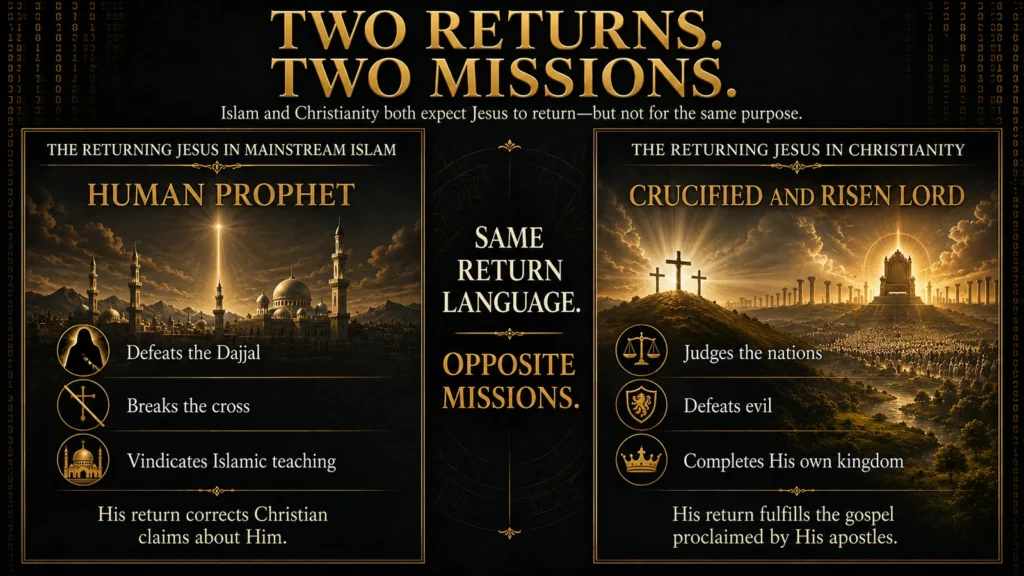
The Islamic future Jesus functions as a correction of the church’s confession. That creates the next historical problem. If the first Christians were wrong about His identity, cross, and resurrection, what happened to the Gospel and the texts that preserve their claims?
Was the Gospel Corrupted?
Distortion, concealment, textual change, and the range of tahrif theories
The Qur’an accuses some People of the Book of hearing God’s words and distorting them, writing material and attributing it to God, twisting recitation, concealing truth, and moving words from their places (Qur’an 2:75-79; 3:78; 5:13-15). Muslims use tahrif, distortion or alteration, for this problem. The term can refer to corruption of meaning through concealment or interpretation and to alteration of a written text.
Islam has not offered only one theory. Some interpreters emphasize communal misuse or concealed predictions of Muhammad. Others allege partial addition and loss. Medieval polemicists, especially Ibn Hazm, developed a broader textual case from discrepancies and version differences. Modern Muslims may regard the Bible as almost wholly unreliable, largely preserved but misread, or selectively trustworthy where the Qur’an confirms it.
The Qur’an also calls Torah and Gospel guidance, tells Christians to judge by what God revealed in the Gospel, claims to confirm earlier Scripture, and says Muhammad is written in Torah and Gospel (Qur’an 5:44-48; 7:157). Muslims may answer that genuine remnants remain under the Qur’an’s final authority. Historically, however, contradiction with the Qur’an cannot by itself identify when, where, or how a passage was altered.
What is the original Injil?
In mainstream Islamic thought, the Injil is one revelation God gave Jesus: pure guidance confirming the Torah, later lost, mixed, or changed. Christians do not claim that Jesus authored four books. In first-century Christian usage, “gospel” means the good news of God’s saving action in Jesus, preached before the four written Gospel narratives reached their final form.
No known first-century text matches the proposed Islamic book. The hypothetical sayings source Q, if it existed, is a scholarly reconstruction, not an intact Gospel denying crucifixion. The Gospel of Thomas, fragmentary Jewish-Christian Gospels, and the medieval Gospel of Barnabas do not supply a document in which Jesus teaches Qur’anic Christology or predicts Muhammad. History cannot prove that God gave no otherwise-lost revelation; it can say that the original Injil of Muslim theology has not been identified through manuscript, quotation, or first-century reception.
Manuscripts, real variants, and the pre-Muhammad textual record
Christians should not answer by claiming that the Bible “never changed.” No New Testament autograph survives. Copyists made accidental errors and intentional adjustments. Mark 16:9-20, John 7:53-8:11, and the explicit Trinitarian wording in the later form of 1 John 5:7-8 are serious secondary passages. John 1:18 and several Passion verses have meaningful variants. Textual criticism exists because the witnesses differ.
What survives is not one controlled medieval copy but an early, dispersed, openly variant record. P46, commonly dated around the late second or early third century, preserves Pauline letters with crucifixion, resurrection, lordship, and high Christology (CSNTM P46). P66 preserves much of John, including the Paraclete discourse, before Nicaea and centuries before Muhammad (CSNTM P66). P75 contains Luke and John; fourth-century Vaticanus and Sinaiticus provide broad pre-Islamic witnesses.
Latin, Syriac, Coptic, Armenian, Georgian, and other ancient versions spread the same central pattern across languages. Early Christian writers quoted and argued from these claims publicly. Any coordinated replacement theory must therefore explain manuscripts, translations, quotations, liturgy, and controversies across separated churches, not one editorial decision in one city. Variants make some individual readings uncertain. They do not reveal a manuscript family in which Jesus escaped the cross, was never proclaimed risen, or remained outside Christian worship. No central doctrine in this article depends solely on one seriously disputed passage.
Evidence Check: Mohammed Hijab’s selective-preservation argument
In a 2022 article listing evidence for Islam, Mohammed Hijab writes, “Despite being somewhat corrupted, the Bible remains an interesting historical document with possible remnants of the word of God.” He then appeals to Isaiah 42 as a possible prediction of Muhammad, connecting Kedar and Sela with Arabia and Medina.
The formulation is more nuanced than saying nothing biblical can be trusted. It also creates a methodological problem. If agreement with Islam identifies a preserved remnant while contradiction identifies corruption, the Qur’an becomes the rule for selecting evidence that is then presented as proof of the Qur’an. That reasoning can never discover that an Islamic interpretation is mistaken.
A historical method needs an independent test: an earlier reading, manuscript trail, dated alteration, identifiable community, or contextual argument not dependent on the desired conclusion. Isaiah 42 requires its own full study; geographic references alone do not identify Muhammad. Hijab’s wording and use of the passage can be read in his official article. It illustrates one contemporary method, not every Muslim position.
Did Paul or Nicaea Remake Jesus?
Paul persecuted a movement that already existed
Paul was not a disciple during Jesus’ ministry, and his surviving letters profoundly shaped Gentile Christianity. Those facts deserve weight. They do not make him the movement’s creator. Paul admits that he persecuted “the church of God” before becoming its missionary (Galatians 1:13-24). The movement, its leadership, and its dangerous claims already existed.
Paul’s conversion account can be interpreted as visionary revelation. Even then, he did not invent the people he had opposed. The Aramaic prayer Maranatha and inherited Lord’s Supper practice point to communal traditions not generated by a later Greek philosophical project. His letters are evidence of early development and interpretation inside an existing Jewish Jesus movement.
Paul received tradition and knew Cephas and James
Paul says he received and delivered traditions about the Lord’s Supper and about Jesus’ death, burial, resurrection, and appearances. He visited Cephas three years after his call and stayed with him for fifteen days; he also met James, the Lord’s brother. Later he recognized James, Cephas, and John as Jerusalem pillars (Galatians 2:1-10).
These meetings do not prove agreement on every matter. They do make a theory of isolated invention implausible. Paul located his gospel in continuity with a first-generation network and submitted his mission for recognition. The evidence places cross, resurrection, and Jesus’ lordship earlier than any council and connects their most influential interpreter with Jerusalem’s leaders.
Real conflict with Jerusalem did not create the crucifixion or resurrection
Galatians records sharp conflict over circumcision, Gentile inclusion, and table fellowship. Paul publicly opposed Peter at Antioch. Acts and Paul’s letters offer different emphases, and later Christian tradition sometimes softened the disputes. A credible history should not turn the apostles into an effortless committee.
Conflict also shows that the sources are not hiding every fracture. Paul argues fiercely inside a shared mission centered on Israel’s Messiah, His death, resurrection, and lordship. His theology develops implications for Torah and the nations; it does not supply the first occurrence of Jesus’ execution or the first resurrection proclamation. “Paul changed important things” is a historical thesis worth testing. “Paul created Christianity from nothing” does not fit his own hostile past, received material, or Jerusalem contacts.
Constantine, Nicaea, and what the council actually decided
Constantine convened the Council of Nicaea in 325, supported it financially, sought imperial unity, and enforced its result. Politics and coercion were real. The bishops adopted the technical term homoousios, “of one substance,” and confessed the Son as begotten, not made. That vocabulary sharpened a boundary not stated in precisely the same form in the New Testament.
The controversy was not a vote between “Jesus is an ordinary prophet” and “Jesus is God.” Arius regarded the Son as a preexistent, exalted heavenly being and agent of creation while denying that He was coeternal and of the same divine being as the Father. Nicaea judged between rival explanations of a Christ already worshiped. Its surviving creed and disciplinary canons do not show bishops inventing the crucifixion, resurrection, or divine status of Jesus.
Pre-Nicene worship and the myth that Nicaea chose the Bible
Decades before Nicaea, Ignatius called Jesus God and insisted on His real birth, suffering, and resurrection. Pliny reported Christians singing hymns to Christ “as to a god.” Justin described the Father, Son/Word, and prophetic Spirit; Irenaeus summarized a worldwide rule of faith centered on the incarnate, crucified, risen, and returning Son. Their formulations vary and sometimes sound subordinate by later standards. The worship and question are unmistakably earlier.
Nicaea also did not choose the New Testament. Its surviving business contains a creed, anathemas, disciplinary canons, and decisions related to Easter, not a vote on twenty-seven books. Four-Gospel and Pauline collections were already widespread, while Hebrews, James, 2 Peter, Revelation, and other edges remained disputed. Eusebius records accepted and disputed books near the period; later lists and regional decisions show that recognition continued.
The canon developed through use, apostolic association, liturgy, controversy, and institutional judgment. The records show that neither Paul nor Constantine can account for the prior cross, resurrection message, and Christ-directed devotion. The positive Islamic claim can now be tested: did Jesus Himself announce Muhammad?
Did Jesus Predict Muhammad?
Qur’an 61:6 and the name Ahmad
The Qur’an portrays Jesus saying that He confirms the Torah and brings good news of a messenger after Him “whose name is Ahmad” (Qur’an 61:6). Mainstream Islam identifies Ahmad, meaning praised or most praiseworthy, with Muhammad. This is a positive historical claim, not only a theological interpretation of Jesus.
Muslim explanations take several forms. The name may have stood in the original Injil and been removed. Jesus’ Aramaic words may have been translated into a Greek title instead of preserving the name. Most commonly, Muhammad is identified with the Paraclete promised in John 14-16. The coming figure testifies to Jesus, guides into truth, speaks what he hears, and follows Jesus’ departure, features Muslim apologists see fulfilled in Muhammad and the Qur’an.
The argument has real points of contact. Muhammad came later, affirmed Jesus as Messiah, claimed revelation rather than autonomous speech, and led a movement that presented itself as restoring truth. The historical question is whether those similarities arise from Jesus’ prediction or from a later rereading of the Christian text.
The Paraclete inside John 14-16
John uses parakletos for an advocate, helper, or one called alongside. The discourse does not leave the identity unstated. John 14:26 says, “the Helper, the Holy Spirit,” whom the Father sends in Jesus’ name. He is given to Jesus’ immediate disciples, remains with them, will be in them, reminds them of Jesus’ teaching, testifies to Jesus, convicts the world, guides them into truth, and glorifies Jesus (John 14-16).
That profile does not naturally describe a human prophet arriving six centuries later. Muhammad did not indwell the first disciples or personally remind them of Jesus’ words. The promised presence continues Jesus’ own ministry among them. “Another Paraclete” does not require another human, since 1 John 2:1 calls Jesus a parakletos with the Father.
Muslim interpreters may answer that “Holy Spirit” was inserted or that the title can designate a human recipient of revelation. That is a textual claim and needs textual evidence. The known Greek tradition contains the identification, and manuscripts of John long before Islam preserve the surrounding discourse.
Why the periklutos theory is not a manuscript reading
Some Muslim apologetics proposes that parakletos was originally periklutos, “renowned” or “praised,” corresponding to Ahmad. The words sound somewhat alike but are lexically distinct. No early Greek manuscript, ancient translation, patristic quotation, or textual-apparatus entry has been produced with periklutos in these passages.
P66 transmits the Johannine discourse in the late second or early third century, and fourth-century Codex Sinaiticus preserves John 14, all centuries before Muhammad. These witnesses contain real variants; their value is not perfect uniformity. They make the proposed replacement testable. The praised-one theory is a conjectural reconstruction, not a variant scholars found beneath a scribal correction.
Jesus likely spoke Aramaic in many settings, and an original saying can be translated. That general possibility does not establish this specific replacement. Evidence would need to show an early wording, quotation, or transmission trail. At present, the Qur’an states that Jesus named Ahmad, while the pre-Islamic Christian record does not independently confirm the name.
What evidence a lost prophecy would require
A missing prophecy could be established by an early manuscript, a quotation from a lost source, an ancient translation, an opponent discussing the wording, or a traceable alteration. No such trail has been identified. Nor does one emerge by removing Paul from Christianity: the Synoptic Gospels still contain crucifixion, resurrection, messianic authority, and no named Arabian successor.
This does not prove that God could never reveal a previously unknown saying of Jesus. It identifies the argument’s dependence. Accept the Qur’an as revelation, and Qur’an 61:6 guarantees the prophecy despite the manuscript record. Ask the verse to function as independent historical proof of Muhammad, and it circles back to the authority it is meant to establish.
Why Should Christians Accept Muhammad’s Correction of Jesus?
The strongest Muslim proofs of prophethood
Muslim apologetics offers more than “Muhammad said he was a prophet.” Its strongest case is cumulative. It appeals to the Qur’an’s Arabic rhetoric, literary structure, coherence, preservation, and challenge to produce something comparable. It points to Muhammad’s endurance, integrity, moral and social message, transformation of Arabia, fulfilled predictions, miracles reported in hadith, global impact, and claimed biblical prophecies. Institutions such as Yaqeen organize these into a multi-part proof-of-prophethood case.
Each category deserves its own test. Literary excellence involves judgments about Arabic form and criteria of imitation. Preservation concerns transmission, not divine origin by itself. Prophecies require secure wording and dating. Hadith miracles depend on the source history of the reports. Political and civilizational achievement establishes influence, not necessarily revelation. Moral teaching and personal transformation are genuine goods found in more than one religion.
The cumulative form is stronger than a single circular assertion, but its categories may still depend on the same Islamic tradition. Most importantly for this article, none automatically gives Muhammad superior historical access to Jesus’ final days or His earliest followers.
First-century witnesses versus a seventh-century correction
Chronological priority is not infallibility. A later source can correct an earlier one if it brings better access, newly discovered evidence, a demonstrably reliable revelation, or greater explanatory power. Islam therefore should not be rejected merely because the Qur’an is later.
Its burden is substantial because the correction is substantial. The Qur’an does not resolve an obscure biographical detail. It denies or redefines divine Sonship, crucifixion, resurrection, atonement, and worship, the same pattern already distributed across Paul’s letters, Gospel traditions, named Jerusalem leaders, early manuscripts, and pre-Nicene devotion. Muhammad did not know Jesus or the apostles, cite a first-century rescue archive, or preserve a named witness who corrected Peter, James, and Paul.
Islam answers that revelation gives the access history cannot. That answer returns the discussion to whether Muhammad’s revelation has been independently established. It cannot be assumed in the argument meant to prove that the earlier evidence is wrong.
The Christian test of a later contrary gospel
Christian Scripture supplies theological tests that are not religiously neutral. Deuteronomy 13 warns that signs cannot authorize departure from the God already revealed. Galatians 1 says even an angel must not overturn the apostolic gospel (Galatians 1:6-9). First John tests spirits by the apostolic confession of Christ and treats denial of Father and Son as decisive. Hebrews presents the Son, not another human prophet, as God’s climactic revelation (Hebrews 1:1-4).
These passages cannot prove themselves to a Muslim who rejects their authority. They explain why accepting Muhammad is not a small addition to Christian belief. His revelation contradicts the identity and saving work Christians confess God disclosed in the Son. Jesus is not one prophet competing with Muhammad for the highest rank. He is the Lord by whom every prophetic claimant is judged.
Muhammad’s moral example belongs to a separate full investigation
Islam also presents Muhammad’s character and conduct as evidence of prophethood. That claim matters because Christians are asked to trust his authority over the apostles. Difficult traditions concerning marriage, warfare, captives, opponents, and special permissions cannot be handled by a passing insult, nor settled by a defensive slogan. Source dates, hadith grading, historical context, Muslim defenses, modern critical scholarship, and the moral standard all require a dedicated investigation.
The present conclusion is narrower and prior. Before those contested biographical questions are settled, Muhammad’s message already contradicts the best-attested first-century claims about Jesus. Christians therefore cannot receive him as the prophet who restores Christ’s teaching. The accumulated evidence must now be compared directly: which portrait explains the cross, resurrection proclamation, divine authority, and worship closest to their historical source?
Which Portrait of Jesus Best Fits the Earliest Evidence?
The source chronology
The two accounts do not begin at the same distance from Jesus. The New Testament sources arise within the first-century movement: Paul’s letters in the 50s, traditions he says he received, Gospel narratives rooted in earlier material, and named leaders he knew. Manuscripts, translations, and pre-Nicene writers then make the movement’s core claims publicly traceable long before Islam.
The Qur’an appears in seventh-century Arabia and presents itself as revelation correcting the earlier communities. Its later date does not make it false by definition. It does mean that its correction needs superior access, identifiable evidence, demonstrated revelation, or explanatory power sufficient to overturn what came before. The Qur’an names no first-generation witness to Jesus’ rescue, no substitute, no lost Injil text, and no earlier community preserving its Christology.
Which account explains the cross, resurrection proclamation, and early worship?
The Christian portrait explains why the earliest movement preached a crucified Messiah, why a received death-burial-raising-appearance formula predates Paul’s letter, and why Cephas, James, and Paul anchor the proclamation. It also explains why Jewish monotheists called on Jesus’ name, prayed Maranatha, included Him in one-God discourse, and worshiped Him before Nicaea.
Naturalistic accounts can explain parts of this pattern through visions, social reinforcement, scriptural rereading, and legendary development. Islamic rescue can absorb sincere error as a theological possibility. Neither supplies positive early evidence for the Jesus Islam requires, while a merely created prophet does not adequately explain creation language, YHWH texts applied to Jesus, final judgment, equal honor, invocation, and the confession “My Lord and my God.”
The broader historical evidence for Jesus does not prove every Christian doctrine. It does locate the dispute in public history.
Similar language does not produce the same Jesus
Both religions can say Messiah, Word, servant, messenger, miracle worker, raised, and returning. Their narratives fill those words with incompatible content. Islam’s Messiah is rescued from the cross and returns to destroy its meaning. Christianity’s Messiah willingly dies, rises bodily, receives worship, and returns as Judge. Islam’s “Word” is created by God’s command; John’s Word creates all things and becomes flesh.
Muslims who revere Jesus are not pretending. They honor the prophet their sources describe. The disagreement concerns whether that honor responds truthfully to the historical Jesus. If the apostolic proclamation is substantially reliable, reducing Him to a messenger is not safer monotheism. It withholds the honor the Father gives the Son.
The Christian verdict
Historical reasoning and Scripture’s final authority have distinct roles. History strongly supports crucifixion, very early resurrection proclamation, named first-generation conviction, and devotion to Jesus before later councils. History alone does not force belief that God acted. Scripture identifies the meaning of the pattern: the eternal Son humbled Himself to death, God raised and exalted Him, and every knee will bow to Jesus as Lord (Philippians 2:5-11).
The Christian apologetic inference is explicit. Bodily resurrection best accounts for the whole evidential pattern, and the risen Christ’s identity makes sense of His authority and worship. Islam offers a later corrective portrait without an earlier witness stream capable of displacing that pattern. Its Jesus resembles the apostolic Jesus in titles and stories while denying the events and identity that make Him the center of the gospel.
The FAQ can now clarify common questions, but it does not suspend this judgment: Christians reject Islam’s portrait because the crucified and risen Lord is better grounded in the earlier record and authoritatively revealed in Scripture.
Frequently Asked Questions
Do Muslims believe in Jesus?
Yes. Muslims believe Jesus was a real and exceptionally honored messenger sent to Israel. The Qur’an calls Him Messiah, son of Mary, prophet, servant, Word from God, spirit from Him, and a sign. It affirms His miraculous conception, miracles, raising, and future return. Islam rejects the Christian confession that He is the eternal Son, God incarnate, crucified Savior, and bodily risen Lord.
Do Muslims believe Jesus is the Messiah?
Yes. The Qur’an repeatedly calls Jesus al-Masih. Islamic interpretation treats this as a unique title but does not give it the New Testament’s complete mission. Christianity identifies the Messiah as David’s promised King, Isaiah’s suffering Servant, covenant Savior, and risen Lord. The shared title therefore hides a decisive disagreement over what the Messiah came to accomplish.
Do Muslims believe Jesus is the Son of God?
No. Islam rejects divine Sonship as incompatible with God’s uniqueness. Christianity also rejects biological procreation. It uses Son to describe the eternal relation between Father and Son and confesses that the Son assumed humanity through Mary. Christians therefore argue from Jesus’ shared works, honor, glory, and worship—not from the title alone.
Do Muslims believe Jesus was sinless?
Muslims commonly describe Jesus as sinless or specially protected, although the Qur’an gives a less developed claim. It calls Him pure and righteous and records no confession of personal sin. Christianity explicitly presents Jesus as knowing no sin and offering Himself without blemish. His sinlessness is essential to His role as the willing representative of sinners.
Do Muslims believe Jesus was crucified?
Mainstream Sunni and Twelver Shia Islam say Jesus was not killed by crucifixion but was rescued and raised alive. Qur’an 4:157 does not name a substitute, and later substitution stories vary. Minority Muslims propose survival, mistaken perception, or readings that permit Roman crucifixion. Christianity and the broad historical evidence affirm that Jesus died by crucifixion under Pontius Pilate.
Do Muslims believe Jesus rose from the dead?
Not in the Christian sense. Mainstream Islam teaches that God raised Jesus alive without His first dying on the cross. Christianity proclaims that Jesus died, was buried, was bodily raised into transformed life, appeared, ascended, and now reigns. Easter is resurrection after death, not another name for Qur’anic rescue.
Do Muslims believe Jesus will return?
Most Sunni and Twelver Shia Muslims do. The detailed account comes mainly from hadith: Jesus descends, defeats the Dajjal, breaks the cross, kills swine, and abolishes jizya within a Muslim order. Christianity expects the crucified and risen Jesus to return as Lord and Judge, completing His own kingdom rather than correcting His apostles.
Why do Muslims believe the Bible was corrupted?
Muslims appeal to Qur’anic accusations of distortion, concealment, false writing, and misuse. Explanations range from corrupt interpretation to broad textual alteration. Christians acknowledge real manuscript variants but argue that early and geographically dispersed witnesses preserve the cross, resurrection, and high Christology centuries before Islam.
Do Muslims believe Jesus predicted Muhammad?
Yes. Qur’an 61:6 says Jesus announced a messenger named Ahmad, understood as Muhammad. Muslim apologists often connect Ahmad with John’s Paraclete. John 14:26 identifies the Paraclete as the Holy Spirit who will dwell with Jesus’ disciples and continue His ministry. No early Gospel manuscript containing Ahmad or the proposed alternate Greek reading has been produced.
Sources and Further Reading
- Primary scriptures: Qur’an.com and the New Testament.
- Jesus’ return in Sunni hadith: Sahih al-Bukhari 2222, Sahih al-Bukhari 3449, and Sahih Muslim 2937a.
- Classical Islamic interpretation: Ibn Kathir’s tafsir on Qur’an 4:171.
- Modern Muslim arguments examined: Shabir Ally’s crucifixion response, Zakir Naik’s official lecture transcript, and Mohammed Hijab’s evidence article.
- Qur’anic Jesus scholarship: Gabriel Said Reynolds, “The Muslim Jesus: Dead or Alive?”.
- Crucifixion and resurrection: Helen Bond on Jesus’ death under Pilate and James P. Ware on the pre-Pauline resurrection formula.
- Ancient non-Christian witnesses: Tacitus, Annals 15.44; Josephus, Antiquities 20.200, with the received wording of 18.63-64 treated cautiously.
- Early Jesus devotion: Larry W. Hurtado, Lord Jesus Christ: Devotion to Jesus in Earliest Christianity.
- Manuscripts: P46, P66, and Codex Sinaiticus.
- Nicaea and pre-Nicene Christianity: the Nicene creed and canons and Pliny’s report about Christian worship.
Islam Honors a Prophet—Christianity Worships the Risen Lord
Islam is not dismissive of Jesus. It preserves His title Messiah, honors Mary, affirms His miraculous conception, recounts His mighty works, gives Him unusual moral dignity, and expects His return. Christians should represent that reverence honestly.
Yet Islamic honor stops where the apostolic confession begins. The New Testament’s Jesus is the eternal Son who shared the Father’s glory, the Word who became flesh, the Lamb who willingly bore sin, and the Lord whom God raised bodily from death. Islam removes the cross to protect a prophet. Christianity sees at the cross the self-giving love of God the Son, followed by the Father’s public vindication in resurrection.
The contrast is not built on one disputed verse or a late church vote. Cross and resurrection stand in Christianity’s earliest recoverable proclamation. Peter, James, and Paul belong to its first-generation network. Invocation and worship of Jesus appear before Nicaea, and pre-Islamic manuscripts preserve the claims Muhammad’s revelation later denies. The Islamic portrait offers a correction centuries afterward without a first-century witness stream capable of overturning that testimony.
Jesus is not merely a teacher to admire at a safe distance. He is the Word made flesh, the Savior who laid down His life, the Lord who conquered death, the King who will return, and the Judge before whom every person will stand. Read the Gospels. Examine the evidence. Turn from sin and every lesser confidence. Trust the crucified and risen Christ, and confess with the earliest church that Jesus is Lord.