
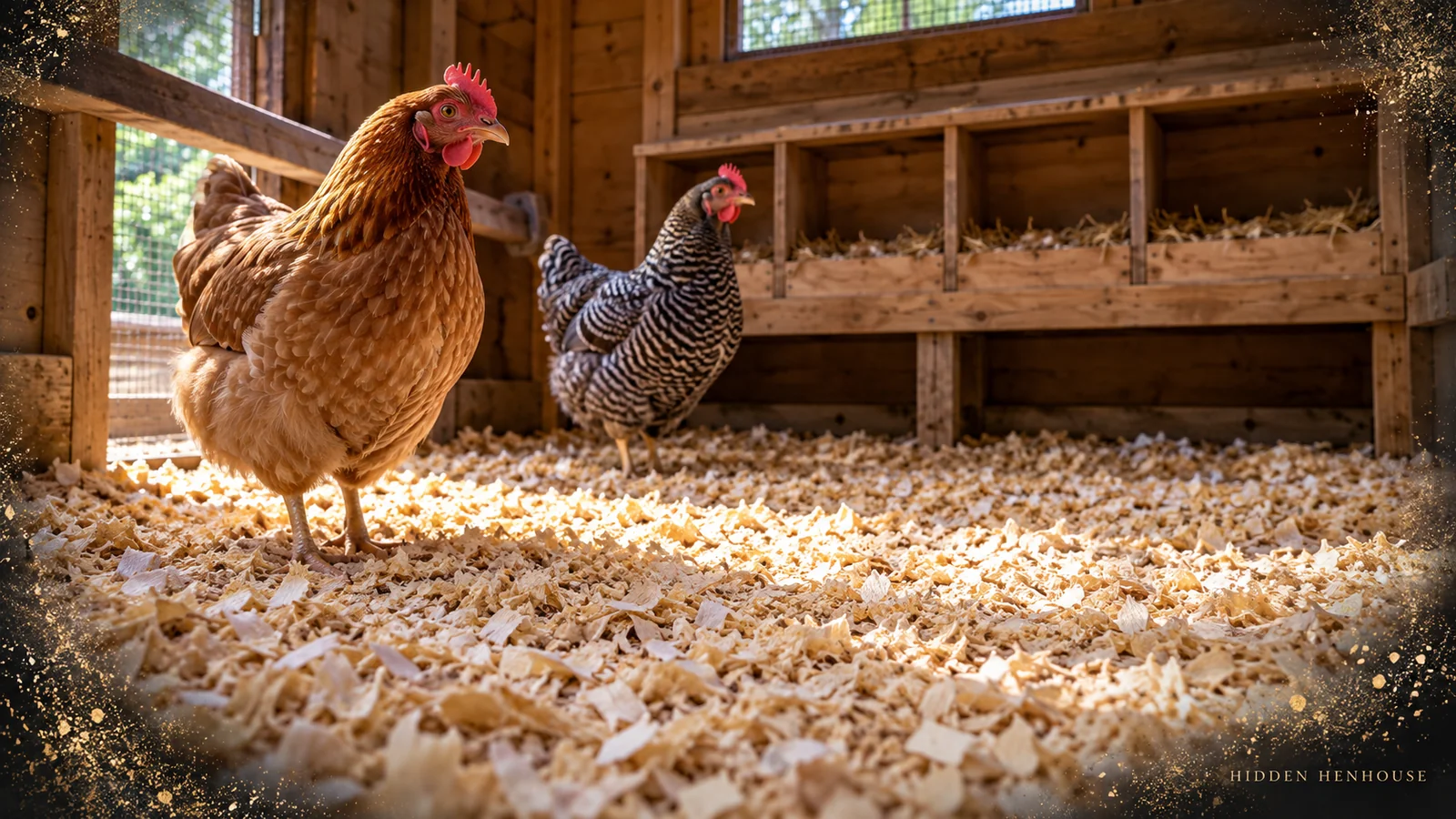

For a typical sheltered backyard coop, clean, dry, low-dust pine shavings are a sensible starting choice for chicken bedding. Hemp can be a worthwhile premium alternative if the particular product has little dust and its price works for you. Straw needs closer attention to caking and moisture. Sand suits a different routine built around frequent manure scooping and a well-designed floor. None is best for every coop.
With roughly a dozen hens, the useful question is what keeps their living space manageable. A bag labeled “premium” still needs checking, and a cheap material stops being cheap when it turns into a damp mat. This guide separates the coop floor, nest boxes, and run, then explains what the evidence can—and cannot—tell us about each material.
Updated October 5, 2026. Recommendations below distinguish backyard veterinary guidance, Extension advice, poultry research, and our editorial judgment.
GUIDED ARTICLE EXPERIENCE
Best Chicken Coop Bedding: Pine, Hemp, Sand, Straw & More Compared
Read along as the narration moves through the article.
Private device narration · No hosted audio or tracking
CONTINUE GUIDED TOUR
Continue where you left off.
GUIDED TOUR COMPLETE
You have reached the end of this study.
Study record saved on this device.
GUIDED TOUR
Best Chicken Coop Bedding: Pine, Hemp, Sand, Straw & More Compared
Narrator: Paranoid Prophet Recommended Voice Native device narration
Prepare to follow the article as it is narrated.
VOICE & TOUR OPTIONS
Voice & Listening
NARRATOR
Finding a narrator…
Checking the best narrator available on this device.
Restores the best curated narrator available on this device.
Narrator choices are curated for clear, long-form listening on this device.
Screen-awake support will be checked when narration starts.
CHOOSE A NARRATOR
Curated for this device
Choose a verified narrator for this browser, or use System Narrator. Automatic mode uses the best reliable route exposed by this device; your chosen narrator is preserved even if this device needs a temporary fallback.
Preparing the guided article experience…
RESUME GUIDED TOUR?
Continue where you left off.
GUIDED TOUR COMPLETE
You have reached the end of this study.
Article Guide8 sections
Choose bedding for the space it will occupy
Bedding usually means the fresh material you put down. Once it contains droppings, spilled feed, feathers, and moisture, poultry guidance generally calls it litter. You are managing that mixture, not just choosing a bag.
The best chicken coop bedding is a material you can keep in good condition in your particular setup. The Cooperative Extension litter-material guide emphasizes absorption, drying, availability, cost, and freedom from contaminants. Those criteria make a better starting point than a universal ranking.
- Coop floor: choose an absorbent, reasonably low-dust material you can inspect and maintain. Pine shavings are a common baseline; suitable hemp is an alternative. Check the material beneath roosts especially closely.
- Nest boxes: provide a clean, dry, comfortable place for eggs. Shavings or clean straw can serve this job; replace dirty or damp material rather than applying the floor’s deep-litter routine to the nests.
- Covered run: deal with drainage and rain entry first. Known-source, clean pine wood material can be an option in a sheltered run. “Wood chips” does not mean every load of landscaping mulch is suitable.
- Wet, uncovered run: fix runoff, roof discharge, and persistent pooling before buying another absorbent layer. Bedding cannot repair a drainage problem.
A poultry specialist’s Extension answer on run materials recommends kiln-dried pine material among the options and cautions about mold and other wood sources. Treat a covered run as a separate environment from a dry indoor coop floor. If your flock has worn away the yard, our guide to grass with backyard chickens addresses the ground-management problem beyond the coop.
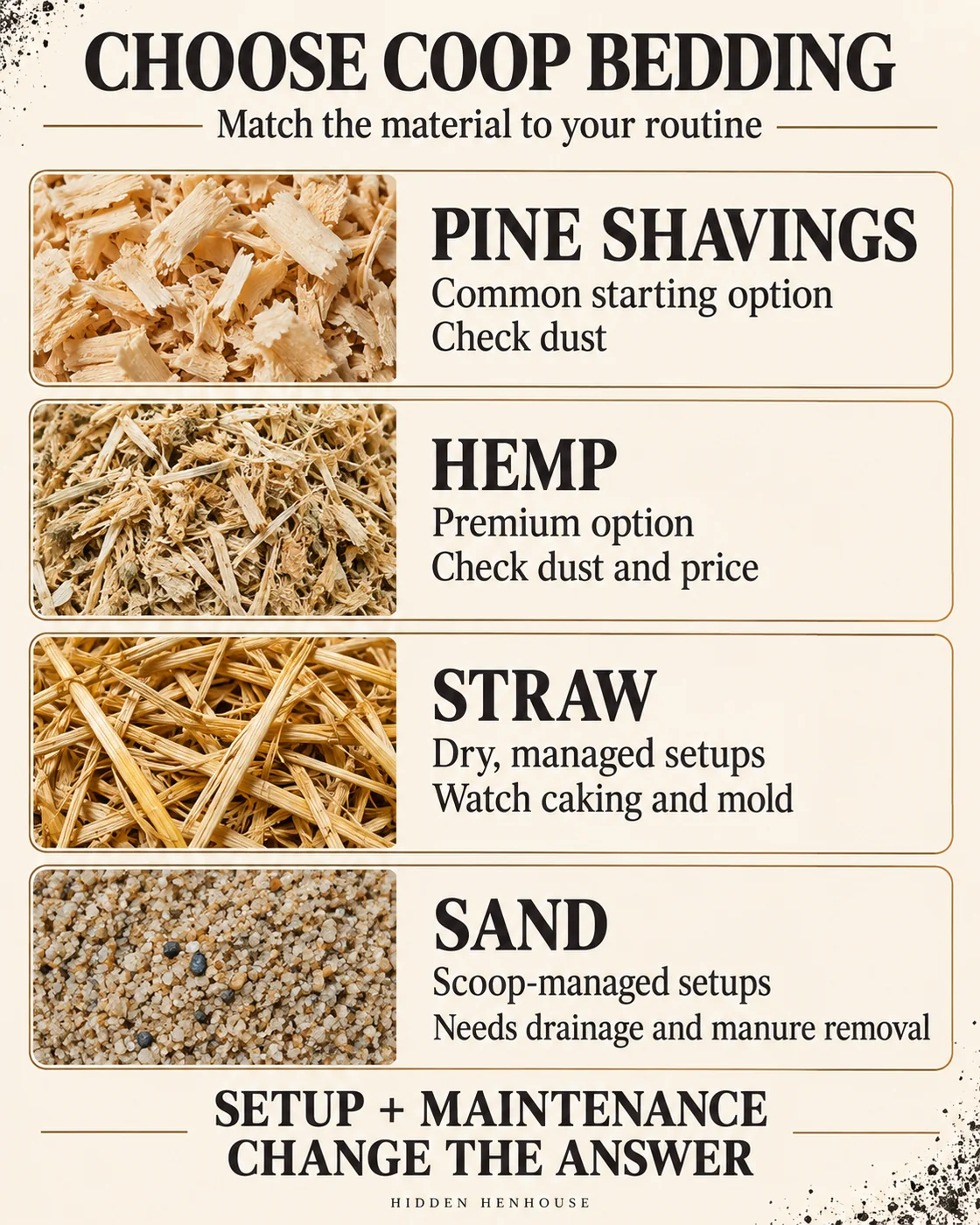
Pine, hemp, straw, and sand: the useful trade-offs
Pine shavings: a practical common starting option
Pine shavings are widely recommended in Extension guidance and included among beneficial litter materials in the Merck Veterinary Manual’s backyard poultry guidance, reviewed in November 2024. They are a reasonable reference point when comparing local alternatives.
Look for clean shavings with little loose dust, no musty odor, and no unknown chemical treatment. Fine powder and substantial sharp wood fragments are different problems. An unopened bag should be dry; a bargain bag stored in rain is already a poor candidate.
Our judgment: start here for an ordinary adult-hen coop unless your existing setup gives you a clear reason to use something else. Pine is familiar and manageable, but it still requires wet-patch removal and manure control. There is no promise that a particular brand lasts a particular number of weeks.
Hemp: a premium option, not a proven universal winner
Hemp bedding can be worth considering where a clean, well-processed product is available. Compare the delivered price, dust in the actual bag, particle texture, and how it behaves in your coop. “Hemp” identifies the plant material; it does not certify every product as dust-free.
A 2023 laboratory study of ten hemp varieties found useful bedding properties, with water absorption averaging about two and a half times dry weight under its test conditions. The authors called for further work, including farm trials. That is material testing, not proof that hemp improves backyard hens’ respiratory health or always lasts longer than pine.
The often-repeated “absorbs four times its weight” claim should not become a fixed expectation for every bag. Processing and testing methods matter. A 2025 bedding-characterization study likewise stresses variation among materials and properties that need to be assessed together. Neither study supplies a universal backyard product league table.
Best fit: a keeper willing to pay more for a particular product that proves easy to handle. Try a modest quantity before assuming the higher purchase price will pay for itself.
Straw: useful in some systems, with a real moisture caveat
Authoritative advice differs here. University of Minnesota winter guidance, reviewed in 2026, allows shavings or straw in a managed deep-litter system. University of New Hampshire winter guidance also lists straw or pine shavings. Merck’s veterinary guidance warns that straw absorbs poorly and can be moldy.
These sources address different practical contexts, and there is no single verdict that makes straw suitable everywhere. Dry storage, chopping, floor conditions, ventilation, and manure management influence the result. Straw that works in a dry, actively managed winter system may cake badly in a coop with a leaking drinker.
Our judgment: for a damp coop, choose a more readily managed absorbent material and correct the moisture source. If you use straw, start with clean, dry material, keep an eye on packed layers, and remove wet or moldy sections. Long stems are not automatically better bedding, and hay is not interchangeable with straw simply because both come in bales.
Sand: a different cleaning system, not an automatic upgrade
Sand appeals to keepers who prefer to scoop droppings rather than manage an organic litter bed. It is heavy, does not become ordinary compostable carbon material, and needs a floor arrangement that can carry it and stay dry. Check suitability for your particular coop before putting a heavy load on a raised floor.
The research is mixed. Cooperative Extension summarizes favorable Auburn broiler trials using sand. However, a 2017 hot, humid, naturally ventilated broiler trial reported lower survival with sand than with wood shavings, although several overall production measures were similar. These are commercial meat-bird studies with particular materials and management, not direct trials of every backyard laying-hen coop.
That disagreement rules out an automatic “sand is healthiest” conclusion. It also does not establish that all sand is unsafe. Avoid dusty, contaminated material; plan for manure removal and wet spots; and do not assume a sand floor disinfects itself.
Best fit: a dry, structurally suitable, scoop-managed setup whose owner wants that maintenance routine. “Hot climates only” and “never in winter” are too broad to substitute for checking the actual floor, shelter, moisture, and management.
In a damp coop, solve moisture before changing materials
Wet litter can damage feet and contribute to ammonia problems. Merck recommends removing wet, caked material and checking drinkers. At the other extreme, excessively dry, dusty material can irritate the respiratory tract. The aim is a clean, friable litter bed, not the driest imaginable powder.
Work through the cause while you remove the affected litter:
- Check water. Look for leaking drinkers, spilled water, roof leaks, and rain blowing through openings.
- Check the base. Lift the surface layer. A clean-looking top can hide a saturated floor or a compacted mat.
- Check ventilation. Moisture needs a route out of the coop. Our winter coop and run guide explains moisture control while protecting birds from direct drafts.
- Check concentrated mess. Material under roosts and around drinkers usually deserves attention before the whole floor looks dirty. A removable dropping board can make manure easier to collect.
- Check the routine. If the bed repeatedly becomes wet before you can maintain it, reconsider the setup, litter method, and flock pressure.
An ammonia smell is a warning, but the absence of a noticeable smell does not prove the air is safe. Mississippi State’s litter-management guidance notes that people can become less sensitive to ammonia with exposure. Its guidance is written for commercial poultry, but the limitation of using your nose as a measuring instrument is relevant here too.
Fix persistent wetness promptly. If birds have eye irritation, breathing difficulty, or foot lesions, seek poultry veterinary advice rather than treating a bedding change as a diagnosis.
Depth, cleaning, and deep litter depend on the system
How deep should chicken bedding be?
There is no single depth for every floor and method. Penn State’s laying-flock guidance, last updated in 2016, gives a general litter depth of three to four inches. UNH’s winter guidance describes four to six inches for floors open to the ground. Those recommendations address different conditions; averaging them into one supposedly exact rule would be misleading.
Use guidance matched to your floor and cleaning method, then inspect how the litter behaves. Enough material to cover the floor is not enough if the base stays wet. More depth also means more material to remove when the bed fails.
When should you change it?
Check litter during ordinary daily care. Remove wet, moldy, badly caked, or heavily contaminated patches when found. A complete change becomes necessary when localized removal no longer restores a clean, dry, manageable bed, or when a health problem requires a different cleaning plan.
A fixed “every one or two weeks” instruction ignores coop size, bird numbers, weather, drinking equipment, and whether you are spot-cleaning or using a managed litter system. Conversely, “deep litter” is not permission to leave a failing bed untouched. Thoughtful feeder placement can help you inspect and manage another common source of floor mess.
What makes deep litter different?
Deep litter keeps an organic litter bed in place while the keeper manages manure, aeration, dryness, and fresh additions. Minnesota’s winter guidance describes stirring and adding material as needed, followed by a spring cleanout. That is a management approach, not a guarantee that every coop can successfully keep the same bed all winter.
Shavings and straw appear in Extension deep-litter guidance; hemp is organic but does not automatically inherit a validated management recipe from those recommendations. Sand belongs to a different removal routine. A particular combination of materials should not be advertised as proven better without evidence for that combination.
Decomposition may produce some heat, but do not rely on it as a predictable heater or build a damp pile to encourage heating around the birds. Nor does ordinary coop decomposition establish that the litter has been sanitized for garden use.
Materials to avoid or approach cautiously
Low cost is useful only after cleanliness and suitability are established. Unknown-source workshop waste, chemically treated or painted wood, moldy bales, and material containing sharp debris should not become chicken bedding.
- Fine sawdust: advice differs. Older UNH egg-production guidance accepts shavings or sawdust. Merck’s more recently reviewed veterinary guidance warns about respiratory irritation from fine, dusty sawdust. For a backyard coop, favor low-dust shavings over a dusty product; do not treat all particle sizes as equivalent.
- Cedar: an older Extension response advises caution with finely chopped cedar around young chicks because of aromatic oils. This is precautionary guidance, not proof that every cedar product is universally poisonous to chickens. With familiar alternatives available, we would skip strongly aromatic cedar bedding, especially for chicks.
- Hay and long straw: inspect carefully for dampness, mold, and packing. Hay is a different material from straw, and an available bale is not necessarily a good floor-litter choice.
- Paper and cardboard: household scraps can compact or mat. Research on specially processed paper bedding does not make every shredded-paper or cardboard blend a tested equivalent. Slippery sheet newspaper is particularly unsuitable as a chick-brooding floor.
- Leaves, pine needles, coir, and assorted mulch: availability alone is not evidence of reliable absorption, drying, or safety. Avoid declaring these “low-dust,” “sustainable,” or ideal for a climate without support for the particular material. In a run, known source and drainage matter more than a generic mulch label.
This is an adult-hen bedding guide. Chick brooding brings additional concerns about footing and ingestion; use age-appropriate poultry guidance rather than copying an adult coop floor.
Composting used bedding: organic does not mean sanitized
Pine, hemp, and straw can contribute carbon to a compost system alongside manure. Sand will not break down into compost. But used organic litter is not automatically finished compost simply because it spent months in the coop.
University of Nevada Extension’s manure-composting guidance explains the pathogen concerns and the need for managed composting. Keep removed litter away from food-handling areas and runoff paths. Follow appropriate manure-composting and garden food-safety guidance before applying it near edible crops; a warm coop bed or an aged pile does not certify pathogen reduction.
Common bedding questions
What is the best bedding for chicken nest boxes?
Clean, dry shavings or straw can cushion eggs. The useful test is whether the nest stays clean and the eggs have a suitable resting surface. Replace damp or soiled material; nest boxes do not need to follow the floor’s litter method.
Is hemp better than pine shavings?
Not universally. A particular hemp product may suit your handling preferences, but the available material studies do not prove that every hemp bedding is healthier, longer-lasting, or cheaper over time. Compare actual dust, condition, availability, and cost.
Can I put fresh bedding over wet litter?
Remove the wet or caked section and correct the cause first. Fresh material on top can conceal the problem beneath it. Adding dry litter is part of maintenance when the underlying bed remains manageable; it is not a repair for saturation.
Should I mix sand and straw for winter?
There is no established universal advantage to that blend. Sand scooping and organic deep-litter management are different routines. Choose the method your floor and maintenance can support rather than stacking materials because a recipe sounds insulating.
Does a clean coop have to be dust-free?
A literal dust-free guarantee is unrealistic. Aim for a low-dust material and a well-maintained environment. Visible fine powder, heavy dust during handling, and respiratory or eye symptoms warrant attention; “natural” on the bag does not settle the question.
Sources and evidence notes
The linked veterinary and Extension guidance supports practical husbandry recommendations. The hemp studies characterize bedding materials; the sand trials concern commercial broilers. Their limits are stated alongside the relevant comparisons. Publication and review dates are distinguished: a recently accessible page is not necessarily recently reviewed evidence.
- Backyard care: Merck Veterinary Manual, Management of Backyard Poultry (reviewed November 2024); Cooperative Extension, Litter Material for Small and Backyard Poultry Flocks.
- Different setups: Minnesota, Caring for Chickens in Cold Weather (reviewed 2026); UNH winter guidance (2024), older egg-production guidance (2018), and Penn State laying-flock management.
- Material research: Arango and colleagues, Animals (2023), DOI 10.3390/ani13020284; Liegsalz and colleagues, Poultry Science and Management (2025), DOI 10.1186/s44364-025-00009-y; Garcês and colleagues, Tropical Animal Health and Production (2017), DOI 10.1007/s11250-016-1202-7.
- Management and disposal: Mississippi State litter guidance, specialist Extension run-material and cedar responses, and University of Nevada manure-composting guidance. The older cedar response is used as a precaution, not a toxicology verdict.
Good stewardship is steady work: notice the wet patch, fix the leak, and choose a routine you can keep doing. The hens do not need the most impressive bedding label. They need a clean, workable home and someone paying attention.