
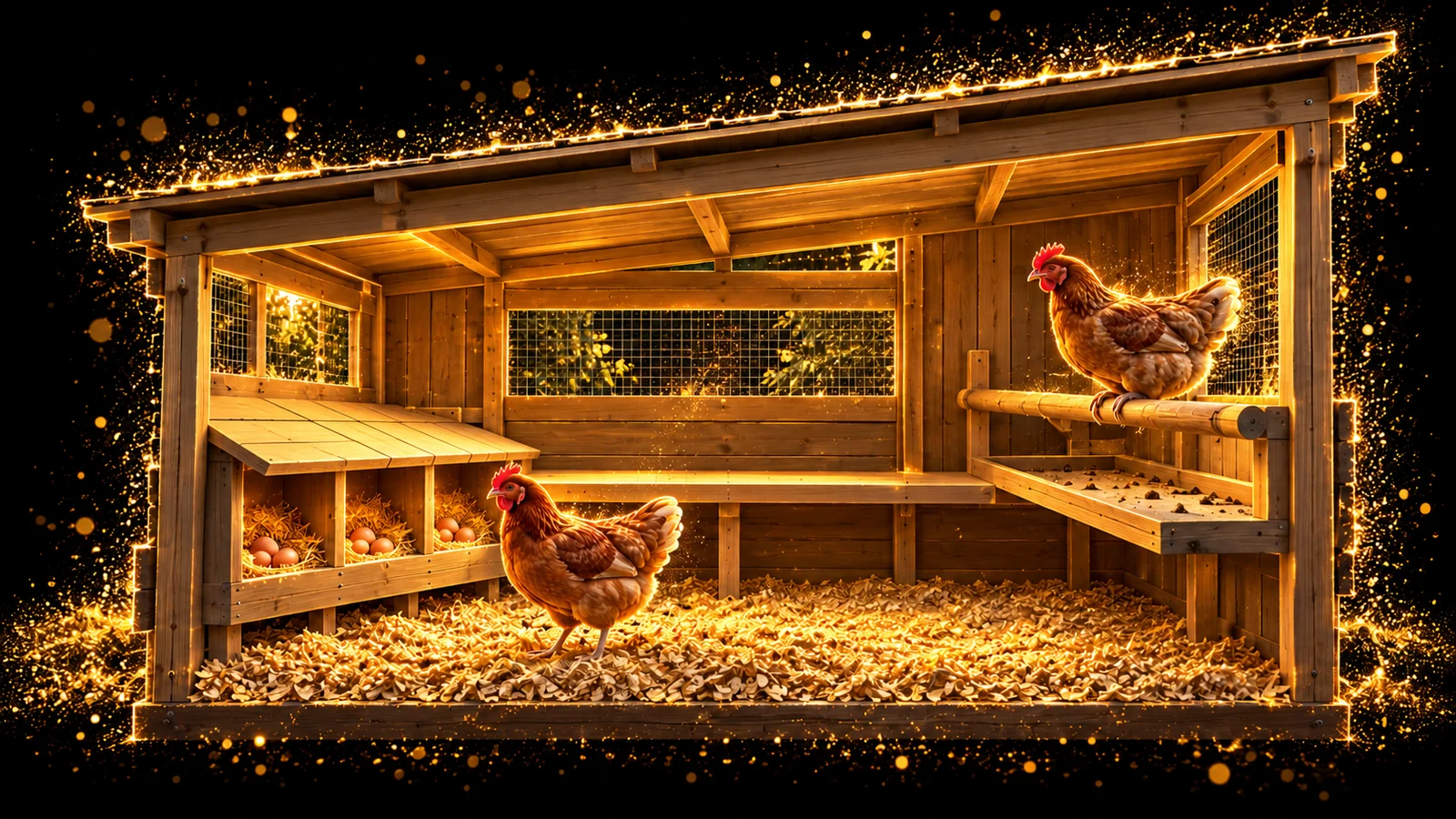

A coop can have enough floor area and still have an awkward interior. Eggs appear in the traffic lane, hens sleep in the nests, and the perch that looked spacious on paper becomes a nightly argument.
Chicken nesting boxes and roosting bars solve different problems. Plan them together, with access and cleaning in mind, before filling every spare corner with lumber.
GUIDED ARTICLE EXPERIENCE
Chicken Nesting Boxes & Roosting Bars: Sizes, Height & Placement
Read along as the narration moves through the article.
Private device narration · No hosted audio or tracking
CONTINUE GUIDED TOUR
Continue where you left off.
GUIDED TOUR COMPLETE
You have reached the end of this study.
Study record saved on this device.
GUIDED TOUR
Chicken Nesting Boxes & Roosting Bars: Sizes, Height & Placement
Narrator: Paranoid Prophet Recommended Voice Native device narration
Prepare to follow the article as it is narrated.
VOICE & TOUR OPTIONS
Voice & Listening
NARRATOR
Finding a narrator…
Checking the best narrator available on this device.
Restores the best curated narrator available on this device.
Narrator choices are curated for clear, long-form listening on this device.
Screen-awake support will be checked when narration starts.
CHOOSE A NARRATOR
Curated for this device
Choose a verified narrator for this browser, or use System Narrator. Automatic mode uses the best reliable route exposed by this device; your chosen narrator is preserved even if this device needs a temporary fallback.
Preparing the guided article experience…
RESUME GUIDED TOUR?
Continue where you left off.
GUIDED TOUR COMPLETE
You have reached the end of this study.
Article Guide13 sections
Quick Answer: Separate Laying and Sleeping
Give hens sheltered, clean nesting boxes and stable roosts that are generally higher than the nest floors. Start with roughly one nest for every four or five laying hens, then adjust to the flock’s size and use. Provide generous usable perch length, safe access and landing room. Keep droppings away from nests, feed and water.
Maryland Extension and Virginia Cooperative Extension support the nest-count starting point. Heavy, older or less mobile birds may need a lower perch or accessible platform. The older-hen care guide helps distinguish an accessibility adjustment from a change that needs veterinary assessment. Raising a roost higher is not always an improvement.
How Many Nesting Boxes Do You Need?
Nests serve hens laying eggs, not a requirement for every bird to occupy a separate box overnight. A six-hen flock can start with two usable boxes under the one-per-four-to-five guidance. Twelve layers can start with three. These are starting counts, not promises that all the hens will distribute themselves evenly.
Penn State’s small-flock guide is more generous for very small flocks: two nests for the first four hens, then an additional nest per four birds. That differs from simply rounding a one-per-five ratio. Extra choice can help, but adding boxes alone will not fix a favored dark corner, an inaccessible entrance or birds sleeping in the nests.
Watch for queues, broken eggs, dirty nests and floor laying. Ensure every box is actually usable rather than counting a compartment blocked by a feeder or difficult jump.
Nest Dimensions: Size the Box for the Bird
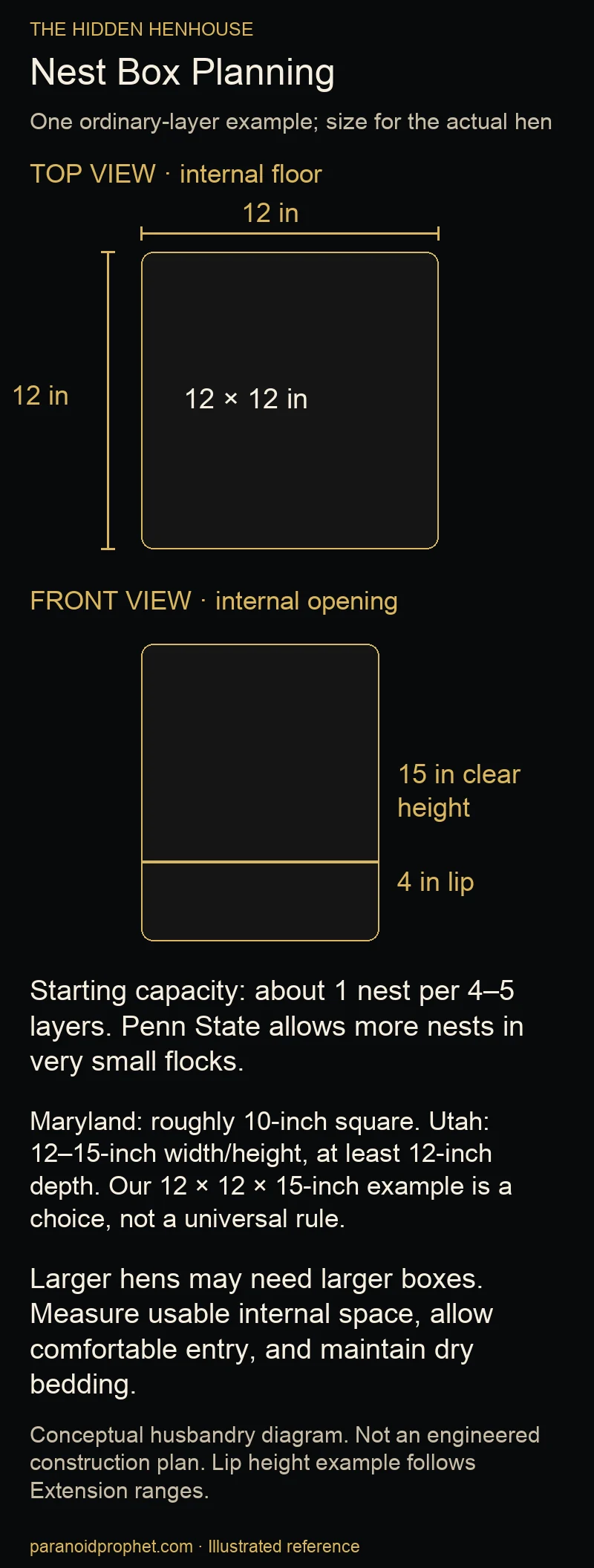
Maryland describes a roughly 10-inch-square nest for typical laying birds. Other Extension designs are larger: Utah State gives 12–15 inches in height and width, with at least 12 inches of depth. Penn State specifies at least a 12-by-12-inch nest floor.
Those figures are not one universal standard. Breed size and the actual box design matter. A large hen needs room to enter, turn and settle without becoming wedged. Our illustrated starting example uses a 12-by-12-inch internal floor and 15-inch clear height for an ordinary adult layer, with larger boxes where the birds require them. These are internal usable dimensions, not the outside measurement of thick boards.
A retaining lip keeps bedding and eggs from falling out. Utah shows a 4–6-inch front panel; Penn State uses 3–4 inches. Our example uses a four-inch lip, but the hen must still enter comfortably. Keep the entrance, bedding depth and access perch in the calculation.
Place Nests Where Hens Can Use Them
Choose a sheltered, relatively dim location away from the busiest walking route. Keep boxes dry and easy to inspect. Height guidance differs among designs: Maryland’s construction resource describes 18–20 inches, while other guidance uses different elevations. A height copied without considering the birds and access is not a complete plan.
Lower boxes can be appropriate when mobility requires them, provided they stay dry and clean. An accessible landing or intermediate step can help hens reach raised boxes. Avoid a narrow, steep ladder that requires a heavy bird to balance or jump blindly.
For an external nest bank, the lid, seams and latches are part of the predator barrier. Weather protection is also necessary. Use the predator-proofing guide for the full enclosure rather than assuming a heavy-looking nest lid is secure.
Roost Length, Shape and Surface
Published perch allowances vary. Maryland’s construction guidance gives about 6–10 inches per bird; Virginia’s 2023 guide recommends 8–10 inches. These starting allowances do not guarantee harmony between large birds or competing flockmates.
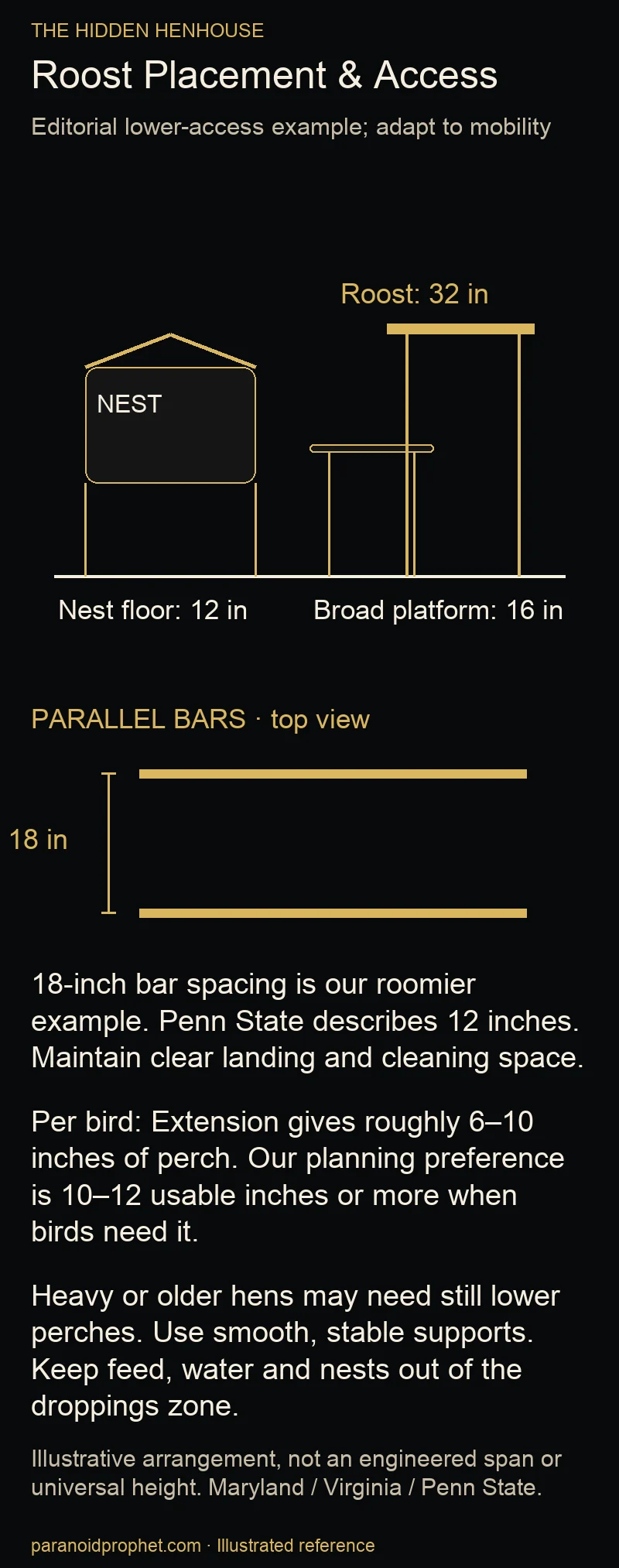
Our practical editorial preference is 10–12 inches of usable roost length per ordinary adult hen when space permits, with more for birds that require it. Count only the area a bird can comfortably occupy. A wall bracket, blocked end or awkward corner does not provide useful sleeping space.
Use stable, smooth material with enough grip and no sharp edges or protruding fasteners. Maryland describes natural branches at least two inches in diameter; Penn State illustrates wooden boards. Shape recommendations vary. Avoid thin wire, slippery surfaces and rough splinters. Check whether the actual hens can perch comfortably, rather than declaring one nominal lumber size universally best.
Fastening and maintenance matter
A perch should not rotate, sag or detach when the flock lands. Secure its supports, keep fasteners out of contact surfaces, and inspect regularly. Removable components can simplify cleaning only if they remain secure in use. Our drawings illustrate arrangement, not engineered spans, load ratings or building-code approval.
Roost Height and Safer Access
Hens seek elevated resting places, but their abilities differ. Virginia notes that heavier birds may benefit from elevated platforms, including very low ones. Older hens and birds with mobility limitations should not have to make an ambitious jump to reach a resting place.
The illustrated side view uses a nest floor 12 inches above the coop floor and a roost 32 inches high, with a broad 16-inch intermediate platform. These are an editorial lower-access example, not Maryland’s raised-nest specification or a requirement for all flocks. The route must still suit the birds. Lower the roost and adjust the nest relationship when necessary; do not force a painful bird to use the diagram.
Leave clear landing space. Put nests away from the flight or descent path, and prevent a bird from landing on sharp equipment or a waterer. For several parallel roosts, Penn State describes one-foot spacing. Our roomy example uses 18 inches between two bars, where the coop permits it. Large birds may need more.
Why the Roost Is Usually Higher Than the Nests
Alabama’s egg-quality guidance recommends attractive roosts above the nests to reduce sleeping and manure contamination in boxes. A sloping nest cover can discourage using the top as another perch.
Some older housing examples place nests and roosts at the same stated height. We prioritize the clear sleeping-versus-laying relationship while preserving safe access. If a hen keeps sleeping in a nest, investigate perch discomfort, bullying, illness and access before treating it as stubbornness. Never close occupied birds into a box to train them.
Collect eggs regularly, remove soiled nesting material and check under the sleeping area. Safe food handling begins here, but it continues after collection in the egg-storage guide.
Droppings, Bedding, Airflow and Cleaning
A removable droppings board beneath the roost can make concentrated manure easier to remove. Keep it away from nest openings and resource stations. It needs accessible edges, a cleanable surface and enough clearance that hens are not pressing against it while sleeping.
Retain ventilation without directing a cold draft across resting birds. Do not seal the coop to protect a perch from wind and create damp air instead. Wet bedding, persistent moisture or ammonia odor call for a management review. Bedding choice cannot compensate for a leak or inaccessible manure pocket.
Before fastening anything permanently, rehearse a clean-out. Can you reach underneath, remove a board, check the corners and safely catch a bird? Maryland’s construction guide emphasizes cleanable materials and removing sharp hazards. Use the cleaning guide for the full process.
A Roomy Six-Hen Layout Example
Our conceptual plan uses an eight-by-eight-foot interior, two nests along one wall, two four-foot roost bars on the opposite side, a cleaning zone below them, and a clear central route. Eight total feet of perch equals 16 inches per hen for six hens if both bars are usable; that extra choice is deliberate, not a revised minimum.
The 64-square-foot example is generous for six ordinary hens. It illustrates arrangement, not a stocking limit. Nest banks, platforms and equipment reduce usable floor area. Use Chicken Space Requirements for the separate footprint and run decision.
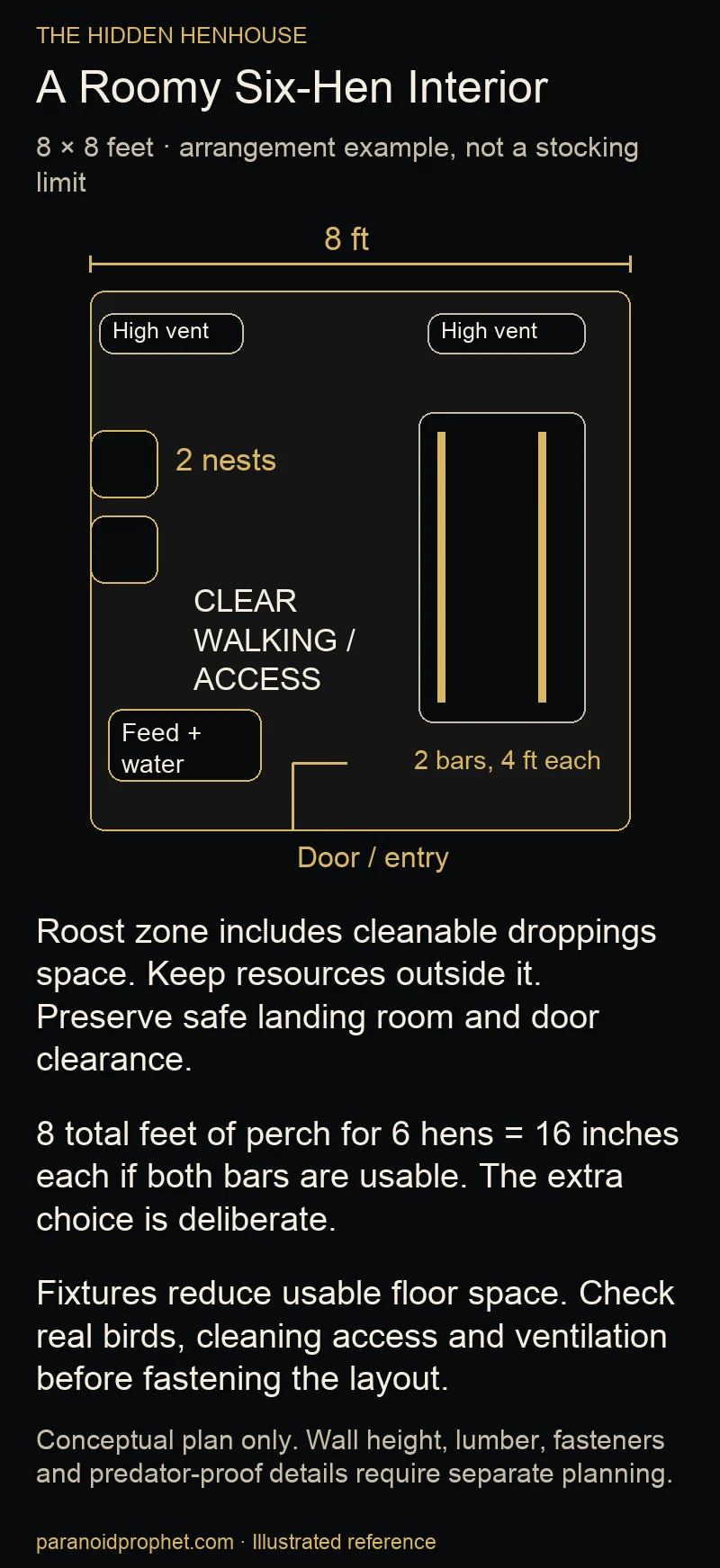
Water and feed belong outside the droppings zone, with reliable access when the birds need them. A sheltered run station may help reduce indoor moisture, but do not remove water access when birds are confined in the coop. Door swings, maintenance clearance and safe landing room take precedence over making the drawing look tidy.
Common Interior Mistakes
- Counting unusable perch ends or blocked nest compartments.
- Putting food, water or nests directly beneath roosting birds.
- Using a steep narrow ladder as the only route for heavy hens.
- Raising perches without leaving safe landing room.
- Making nest tops an attractive sleeping shelf.
- Adding fixtures until people can no longer clean or catch a bird safely.
Persistent crowding or one hen being excluded needs attention even when the arithmetic meets a published allowance. Observe the flock settling for the night, not just the empty coop at midday.
Frequently Asked Questions
Does every hen need her own nesting box?
No. One per four or five layers is common starting guidance. Watch actual use and provide more choice where necessary.
Should roosts always be as high as possible?
No. Accessibility and safe landing matter, especially for heavy or older hens. A lower usable perch is better than an impressive inaccessible one.
Can poor nest design explain fewer eggs?
It can affect where you collect them. Hidden eggs differ from reduced production; use the laying-loss guide to investigate both.
Are these diagrams construction plans?
No. They are arrangement examples with husbandry dimensions. Verify lumber, supports, fasteners, weatherproofing and applicable building requirements for the actual structure.
Build for the Birds You Have
A useful coop interior lets a hen settle, lay and move without daily obstacles. It also lets you notice trouble and keep the space clean. Stewardship is practical enough to include a lower step, a reachable corner and a perch that still works when a bird is older.
Sources and Design Scope
Sources checked October 8, 2026. Extension figures are qualified starting guidance. Larger allowances and illustrated layouts are editorial examples, not engineering certification.
- Maryland: Housing Requirements, updated May 2022.
- Maryland: Coop Construction, updated September 2021.
- Virginia: Small-Scale Poultry Housing, April 2023.
- National Cooperative Extension: Housing Overview; planning and access, not an independent engineered design.
- Utah State: Backyard Chicken Basics; alternative nest dimensions.
- Penn State: Small Laying Flock, updated 2016; comparative nest and roost guidance.
- Alabama: Egg Quality and Safety, reviewed 2022; separating roosts and nests.