
The best cheap chicken feed ideas usually start with the feed you already buy: keep it out of the rain, stop it landing on the ground, and compare the price per usable pound. Replacing a balanced ration with a pile of inexpensive ingredients can lower the receipt while creating a different, more expensive problem.
Keep an appropriate complete poultry feed as the foundation. Save money in this order: reduce waste, compare unit cost, improve storage, check feeder access, then consider modest supplements. Scraps, corn, sprouts and insects are not interchangeable with complete feed.
GUIDED ARTICLE EXPERIENCE
How to Save Money on Chicken Feed Without Hurting Nutrition
Read along as the narration moves through the article.
Private device narration · No hosted audio or tracking
CONTINUE GUIDED TOUR
Continue where you left off.
GUIDED TOUR COMPLETE
You have reached the end of this study.
Study record saved on this device.
GUIDED TOUR
How to Save Money on Chicken Feed Without Hurting Nutrition
Narrator: Paranoid Prophet Recommended Voice Native device narration
Prepare to follow the article as it is narrated.
VOICE & TOUR OPTIONS
Voice & Listening
NARRATOR
Finding a narrator…
Checking the best narrator available on this device.
Restores the best curated narrator available on this device.
Narrator choices are curated for clear, long-form listening on this device.
Screen-awake support will be checked when narration starts.
CHOOSE A NARRATOR
Curated for this device
Choose a verified narrator for this browser, or use System Narrator. Automatic mode uses the best reliable route exposed by this device; your chosen narrator is preserved even if this device needs a temporary fallback.
Preparing the guided article experience…
RESUME GUIDED TOUR?
Continue where you left off.
GUIDED TOUR COMPLETE
You have reached the end of this study.
Updated October 5, 2026. Source review separates poultry nutrition guidance, controlled research and our practical budgeting recommendations. Dollar figures below are invented calculation examples, not current retail prices.
Article Guide10 sections
Protect nutrition before cutting the feed bill
University of Georgia poultry guidance recommends formulated feed suited to the bird and treats scavenging as a supplement. Read the bag’s intended use: chicks, growing pullets, laying hens and meat birds do not have identical requirements. A layer feed is not the default for a mixed-age flock.
A bag of corn may cost less than a bag of layer feed because it is a different product. Matching the crude-protein percentage alone also does not establish a balanced ration. Amino acids, energy, minerals and vitamins matter together. If you want to formulate feed from ingredients, get qualified poultry-nutrition help rather than copying a kitchen recipe.
Maryland Extension puts scratch grain at about ten percent of daily consumption and warns that it dilutes a prepared diet. Our conservative household rule is to keep all optional extras together around ten percent or less, not ten percent for each treat. That is a practical ceiling, not a feeding target or a precise way to equate a wet cucumber with dry grain. Significant substitution needs proper diet formulation.
Do not restrict complete feed to force hens to forage. Keep suitable feed and clean water available. If consumption or laying changes unexpectedly, look beyond the receipt: age, season, access, waste and illness can all affect what you see. Saving money is not worth a hungry bird or a nutritionally diluted diet.
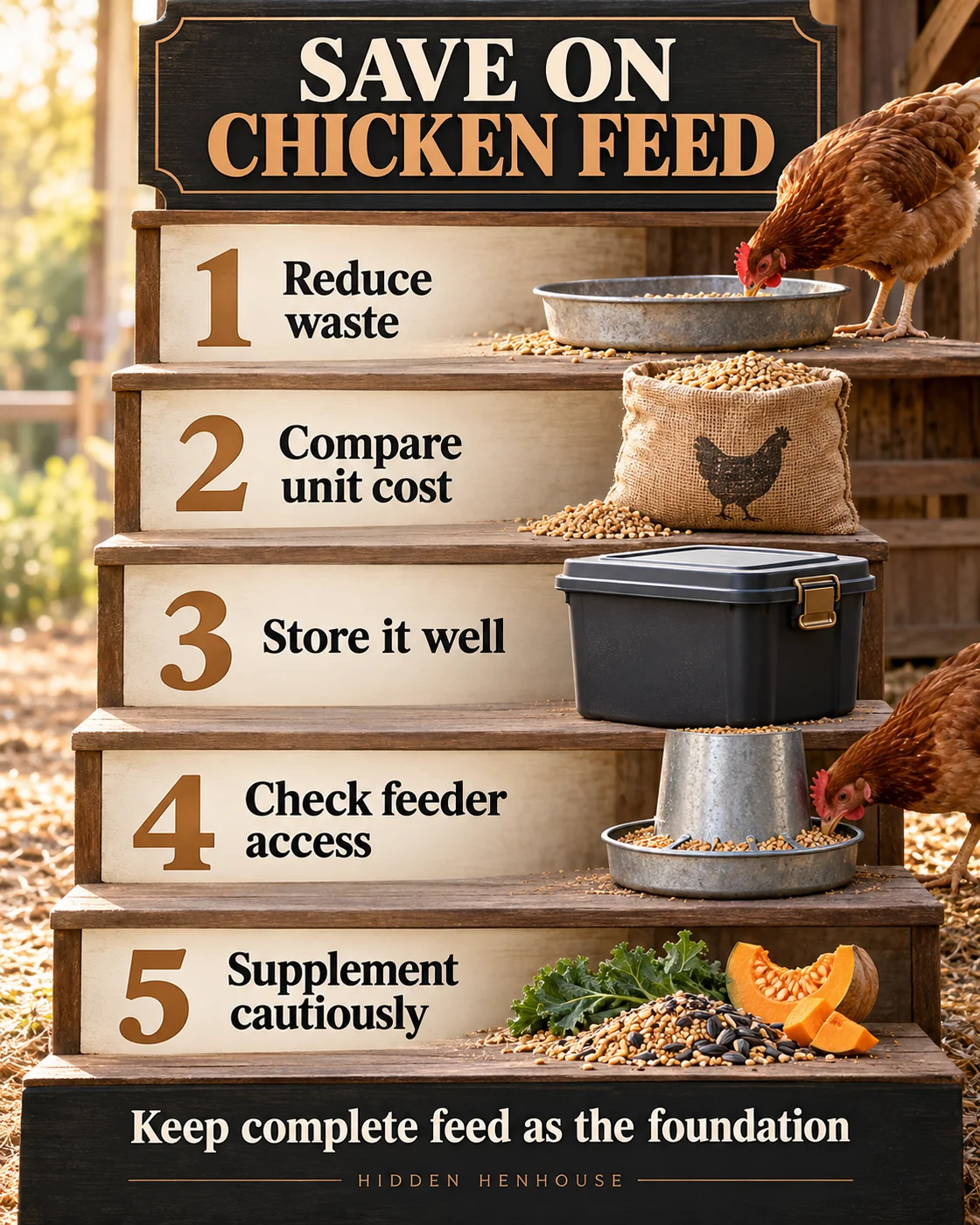
First, find the feed that never reaches a chicken
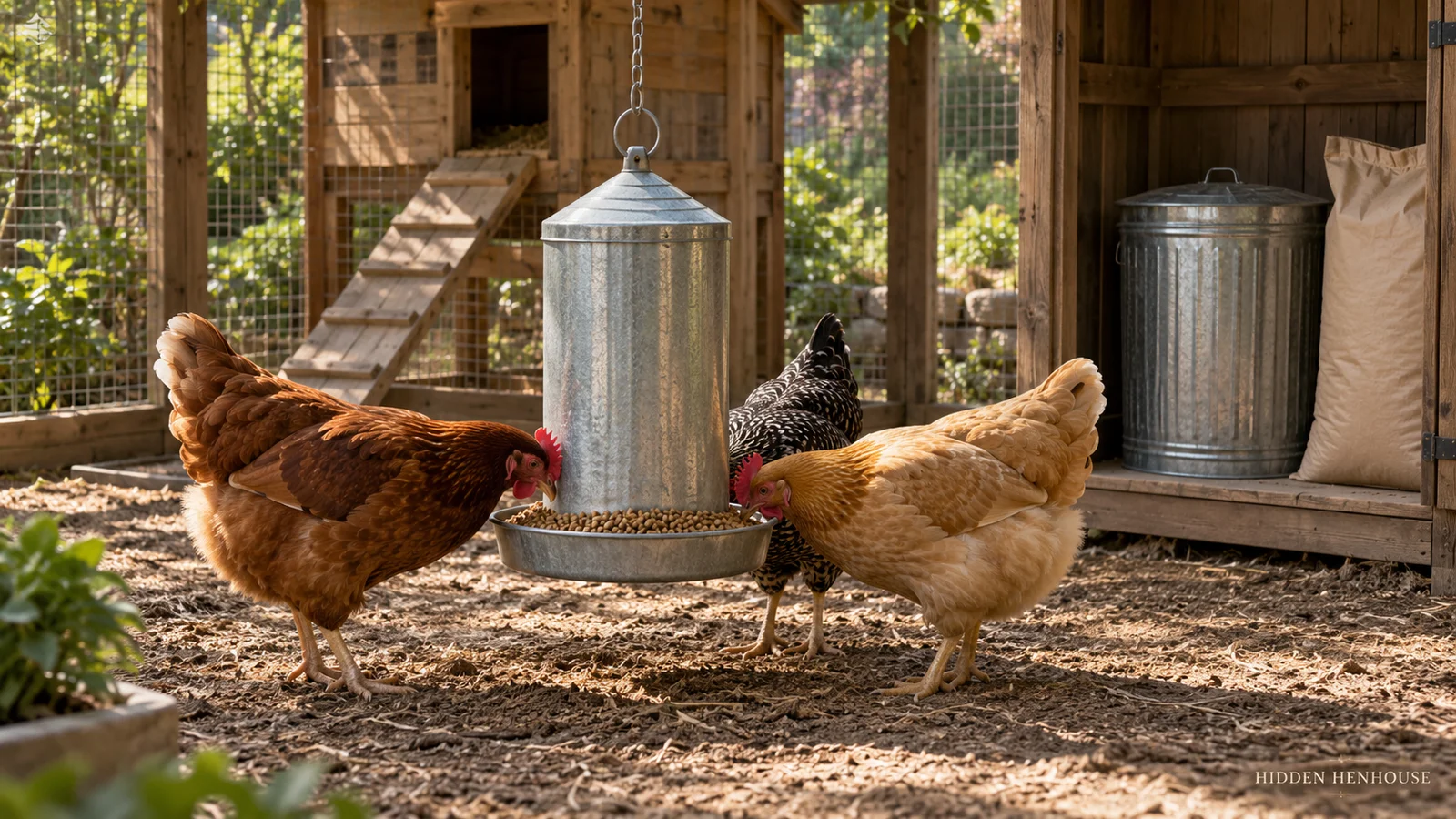
Spend a few mornings watching the feeder before buying another supplement. Is feed being billed out onto the floor? Does rain reach the tray? Can a timid hen eat, or does she wait while one bird guards the only access point? An empty feeder may reflect spillage or unwanted visitors rather than unusually hungry hens.
The USDA feed-and-litter biosecurity checklist calls for daily spill checks, prompt cleanup and protection from wildlife and rodents. That is both a health measure and a useful place to start a budget audit.
Our recommendation: weigh what you put out for a week and record obvious spill losses separately. Use a clean, appropriately sized feeder; avoid overfilling it. Inspect it after rain and at different times of day. Adjust one thing, then observe again. You do not need an elaborate experiment to notice a tray full of wet pellets.
Pellets sometimes reduce sorting and waste compared with mash, as Maryland Extension notes, but the more expensive bag is not automatically the cheaper feeding system. Compare what your birds can actually use. Buying a premium feeder also needs a payback calculation; a “no-waste” product name is not a measured result in your run.
Compare cost per usable pound
Use the receipt and the bag weight rather than the bag price alone. Compare feeds designed for the same birds and purpose before comparing their prices. A discount on a different ration is not a like-for-like saving.
- Price per pound: total purchase cost divided by pounds purchased.
- Usable-feed cost: total purchase cost divided by pounds remaining after known spoilage or waste.
- Days of supply: usable pounds divided by your flock’s measured daily use.
- Monthly feed spending: pounds used in the month multiplied by price per pound, plus relevant delivery costs.
Here is a fictional example. A 40-pound bag at $20 costs fifty cents per pound. A 50-pound bag at $23 costs forty-six cents per pound. But if ten pounds of the larger bag spoil, its usable-feed cost becomes $23 divided by 40, or about fifty-eight cents per pound. The apparent bargain now costs more.
The arithmetic measures cost, not nutrient equivalence. It also leaves out your time unless you choose to price it. Add extra driving, delivery, storage equipment and interest where they matter. The full chicken-cost guide owns the wider household budget; this page focuses on feeding choices.
Buy only what you can keep in good condition
Bulk buying makes sense when the ration is appropriate, the price advantage survives transport costs and the flock will use it within the manufacturer’s storage guidance. There is no universal number of months that makes every feed safe in every shed.
Keep feed dry and protected from pests, off damp floors and in clean closed storage. Retain the bag label, lot information and purchase date. Rotate older stock first, and avoid continually pouring fresh feed onto old residue. In a humid Southeast yard, inspect the actual storage conditions rather than trusting that a lid alone solves moisture.
Discard moldy or clearly spoiled feed; mixing it into fresh feed does not make it acceptable. A storage loss belongs in the budget even if the discount originally looked excellent. Splitting a purchase with another keeper may reduce inventory, but use separate clean containers and avoid sharing poultry equipment that could transfer contamination.
Improve access without making unsupported promises
A trough, hanging feeder and proprietary port feeder need different adjustments. Use the manufacturer’s instructions alongside poultry guidance, then watch the smallest and most hesitant birds. Height must let birds eat comfortably; it is not a universal measurement or a digestion treatment.
Our feeder-placement guide distinguishes linear feeding space from port counts and explains why raising a feeder does not make it rodent-proof. Keep feeding areas sheltered and clean, and protect feed from wild animals. Adding access may help when birds are being excluded, but a feeder cannot correct a poor ration.
Which low-cost extras are worth considering?
Kitchen, garden and shop scraps
Small amounts of suitable plain produce or other known-safe leftovers can be optional treats. Fresh does not automatically mean safe, and “past date” does not establish either safety or spoilage. Identify the ingredient and its condition. Reject mold, rot, unknown chemicals and mixed waste you cannot assess.
Restaurant and grocery collections add questions about ingredients, storage, contamination, packaging and applicable local feed rules. Our recommendation is to skip anonymous mixed bins and accept only identifiable items with a known handling history. Free food still needs collection, sorting and disposal. Remove uneaten perishable treats promptly; do not leave a rotting buffet in the run.
The existing what-not-to-feed guide provides the safety detail. This is not permission to make bread and leftovers the flock’s ration.
Pasture, weeds and mower clippings
Sources differ in emphasis. Maryland gives a context-dependent estimate of nutrients obtained from pasture, while Georgia stresses chickens’ limited use of fibrous plants and continued formulated-feed access. Pasture quality, season and the birds matter. Neither source establishes a fixed feed discount for every backyard.
Our yard supplied a clear limit: by the end of the first year, the grass was essentially stripped. That firsthand yard-pressure experience does not measure nutritional intake, but it explains why we would not budget on permanent free forage from a small neighborhood lawn.
Poultry Extension allows tender plant material conditionally, including attention to pesticide exposure. Maryland’s crop-health guidance also identifies poorly digestible grass among impaction hazards. These points describe different conditions, not a simple “all grass safe” or “all grass toxic” rule. Our conservative choice is to skip mower-clipping heaps and favor controlled access to suitable short vegetation. Unknown weeds and chemically treated material are not free feed.
Winter cover crops for chickens offers related planting context. Treat crops as managed supplemental forage and soil cover, not a replacement ration or guaranteed savings.
Sprouted grain and fodder trays
A tray that weighs several times more than its seed has absorbed water; fresh weight is not several times the original nutrition. A 2026 review of hydroponic fodder discusses potential benefits alongside dry-matter, inclusion and economic limits. Results from formulated livestock or poultry trials are not a ready-made home laying-hen recipe.
Count seed, trays, water, cleaning time and discarded batches. Use only suitable untreated seed, keep equipment clean and discard moldy material. A poultry-focused Extension response recommends modest supplemental use and acknowledges uncertainty. Our budgeting judgment is to try a small amount only if you enjoy the project; do not reduce complete feed on the strength of a lush-looking tray.
Mealworms, other insects and herbs
Extension’s mealworm advice makes the nutritional distinction clear: an insect treat can still displace a balanced diet. Home production has inputs and labor; purchased dried insects may be expensive per pound. No claim here makes a manure or rotting-food maggot bucket a safe feeding method.
Likewise, a garden handful of herbs is not equivalent to a tested feed additive. A recent scoping review of herbs in poultry research covers varied preparations and study outcomes. It does not justify calling homegrown oregano a guaranteed immune booster or pricing it as a substitute for complete feed.
Corn, sunflower seeds and pumpkin
Use these as optional extras within the same small allowance. Corn is an energy ingredient, not a balanced ration or a winter rescue plan. Seeds do not guarantee improved feather growth simply because they contain protein or fat. Do not add treats to solve a health concern without investigating the concern.
Pumpkin is not a dependable deworming plan. The research is mixed: a 2019 chicken trial reported moderate effects against some worms, while a 2022 laying-hen trial found no parasitological benefit from its pumpkin-seed treatment. Birds, parasite species, dosing and study designs differed. Neither gives a reliable household prescription for feeding pumpkin to clear an infestation. Suspected worms need appropriate diagnosis and veterinary guidance, including food-animal medication and withdrawal requirements.
A one-week feed-saving check
- Confirm the ration fits the birds and record its price and weight.
- Measure ordinary daily use; note spills, rain exposure and access problems.
- Correct one avoidable loss before adding another food source.
- Check storage and calculate how long the next purchase should last.
- Review bird condition and consumption, not just how slowly a bag empties.
Keep the change if it reduces genuine loss without restricting access or weakening the diet. Do not promise a saving percentage before you measure it. Sometimes the sensible result is buying the same feed in a better-sized quantity.
Common budget-feeding questions
Can chickens live on kitchen scraps and free range?
Do not plan a backyard laying flock that way. Those inputs vary and do not establish a balanced diet. Maintain suitable complete feed; an ingredient-formulated ration requires expert design.
Is bulk feed always cheaper?
No. Compare usable-feed cost after transport, storage and losses. Buy a quantity you can keep in good condition and use within the feed maker’s guidance.
Will sprouting grain multiply my feed savings?
Not automatically. Added fresh weight includes water, and the project has real inputs. Evaluate nutrition and costs rather than the appearance or weight of the tray.
Should I buy treats to improve laying?
First check complete-feed access, water and possible husbandry or health problems. More treats can dilute the ration. They are not a guaranteed production aid.
Sources and evidence notes
The linked sources above are the claim-specific reading: University of Georgia and Maryland poultry nutrition, USDA storage biosecurity, Poultry Extension and Maryland crop-health guidance, Extension supplement advice, the 2026 fodder review, recent herb review and the two contrasting pumpkin trials. Foundational Extension pages remain useful despite older dates; current research is preferred when it addresses the same question directly. Editorial savings priorities and hypothetical arithmetic are ours, not trial-proven savings promises.
Good savings leave the flock properly fed
A smaller feed bill is useful when it comes from fewer spills, sound storage and sensible purchases. It becomes a false economy when hens lose the nutrition they need. That is practical stewardship: save where you can without asking the animals to bear the cost. Start with the ordinary losses you can see, keep complete feed dependable, and let optional extras remain optional.