


A hen’s laying career and her life are different things. A quieter egg basket does not automatically mean an unhealthy flock, and a bird who no longer lays still needs food, shelter and attentive care.
If you are asking how long chickens live, the useful answer includes more than a number. It includes how to plan for older birds, recognize a change that needs help, and make responsible decisions when comfort becomes harder to maintain.
GUIDED ARTICLE EXPERIENCE
How Long Do Backyard Chickens Live? Aging Hens & Responsible Care
Read along as the narration moves through the article.
Private device narration · No hosted audio or tracking
CONTINUE GUIDED TOUR
Continue where you left off.
GUIDED TOUR COMPLETE
You have reached the end of this study.
Study record saved on this device.
GUIDED TOUR
How Long Do Backyard Chickens Live? Aging Hens & Responsible Care
Narrator: Paranoid Prophet Recommended Voice Native device narration
Prepare to follow the article as it is narrated.
VOICE & TOUR OPTIONS
Voice & Listening
NARRATOR
Finding a narrator…
Checking the best narrator available on this device.
Restores the best curated narrator available on this device.
Narrator choices are curated for clear, long-form listening on this device.
Screen-awake support will be checked when narration starts.
CHOOSE A NARRATOR
Curated for this device
Choose a verified narrator for this browser, or use System Narrator. Automatic mode uses the best reliable route exposed by this device; your chosen narrator is preserved even if this device needs a temporary fallback.
Preparing the guided article experience…
RESUME GUIDED TOUR?
Continue where you left off.
GUIDED TOUR COMPLETE
You have reached the end of this study.
Article Guide14 sections
Quick Answer: Many Hens Live Several Years Beyond Peak Laying
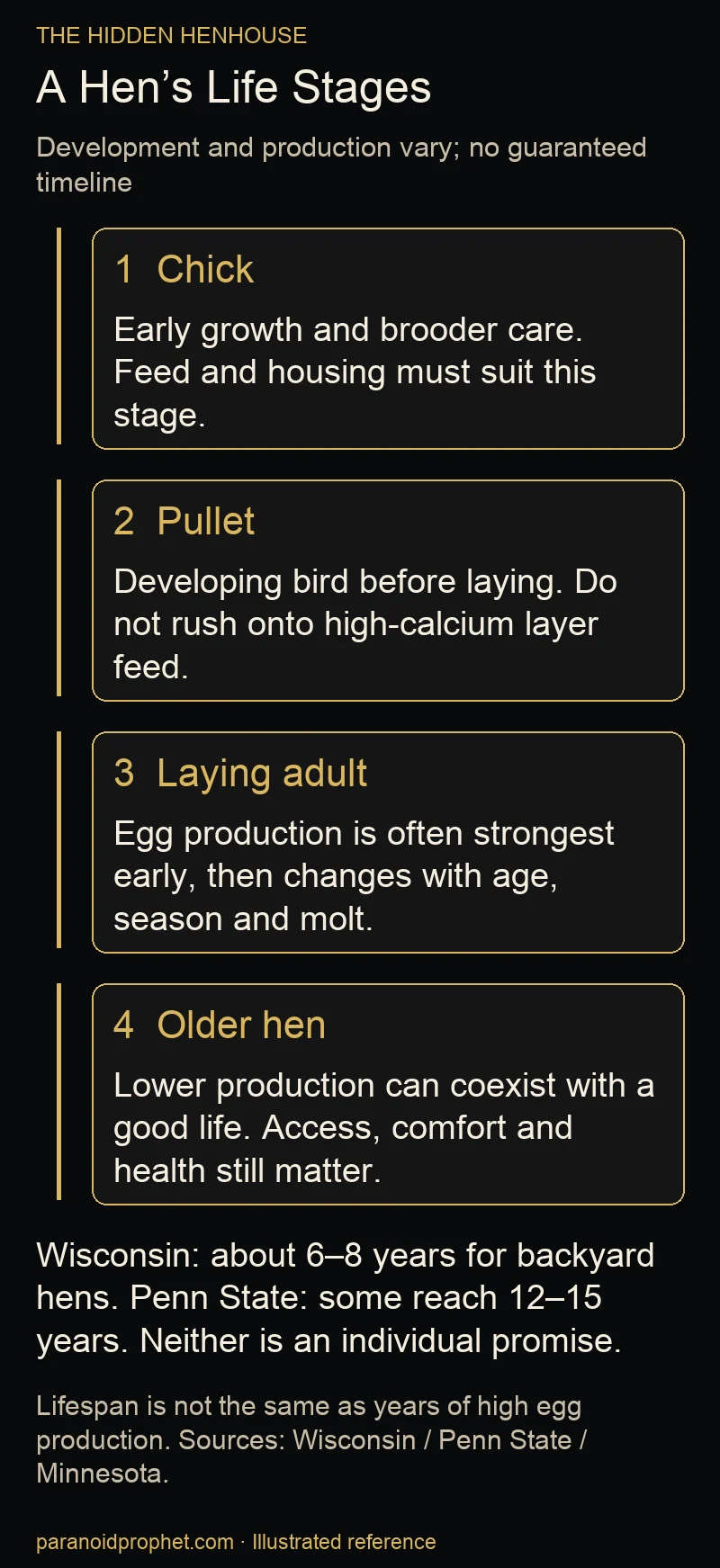
Wisconsin Extension describes backyard hens living around six to eight years. Penn State notes that some live considerably longer, including twelve to fifteen years. Those are population-level descriptions and possibilities, not a promise for an individual bird.
Plan for declining egg production without assuming poor health. At the same time, do not dismiss weight loss, breathing trouble, lameness or poor appetite as normal aging. Observe the bird’s comfort and abilities, and involve a poultry-capable veterinarian when they change.
Why Lifespan Estimates Differ
Sources describe different populations, purposes and management conditions. A commercial flock’s replacement age is an economic production decision, not the species’ maximum biological lifespan. A long-lived individual is not proof that every hen should reach the same age.
Genetics, nutrition, disease, predation and care all affect the outcome. Breed identity alone cannot predict an individual hen’s lifespan. There is no evidence-backed ranking here that declares every heritage hen long-lived or every commercial hybrid short-lived.
The six-to-eight-year range is useful planning context. Penn State’s longer possibilities explain why care and housing may be needed well beyond that interval. Neither number is a deadline, warranty or reason to stop investigating illness.
Years Alive and Years of High Egg Production
Minnesota Extension identifies the first two years as a productive period and explains that some hens continue laying for years afterward. Wisconsin describes most backyard flocks producing eggs for three or four years before production becomes very low. These accounts should not be flattened into one guaranteed laying schedule.
A hen may lay less frequently with age and still forage, move comfortably and participate in the flock. Season, molt, broody behavior, diet and hidden eggs can also change what reaches the kitchen. Use Why Chickens Stop Laying Eggs to separate those possibilities.
Compare a bird with her own recent pattern. A gradual production decline is different from suddenly becoming weak or refusing food. Egg numbers alone are a poor quality-of-life score.
What Can Change With Age?
Older birds may need easier access to the resources they previously reached without difficulty. The useful observation is specific: she no longer uses a high perch, takes longer to cross an uneven area, or is being displaced at a feeder. Those observations identify something to investigate or accommodate; they do not diagnose the cause.
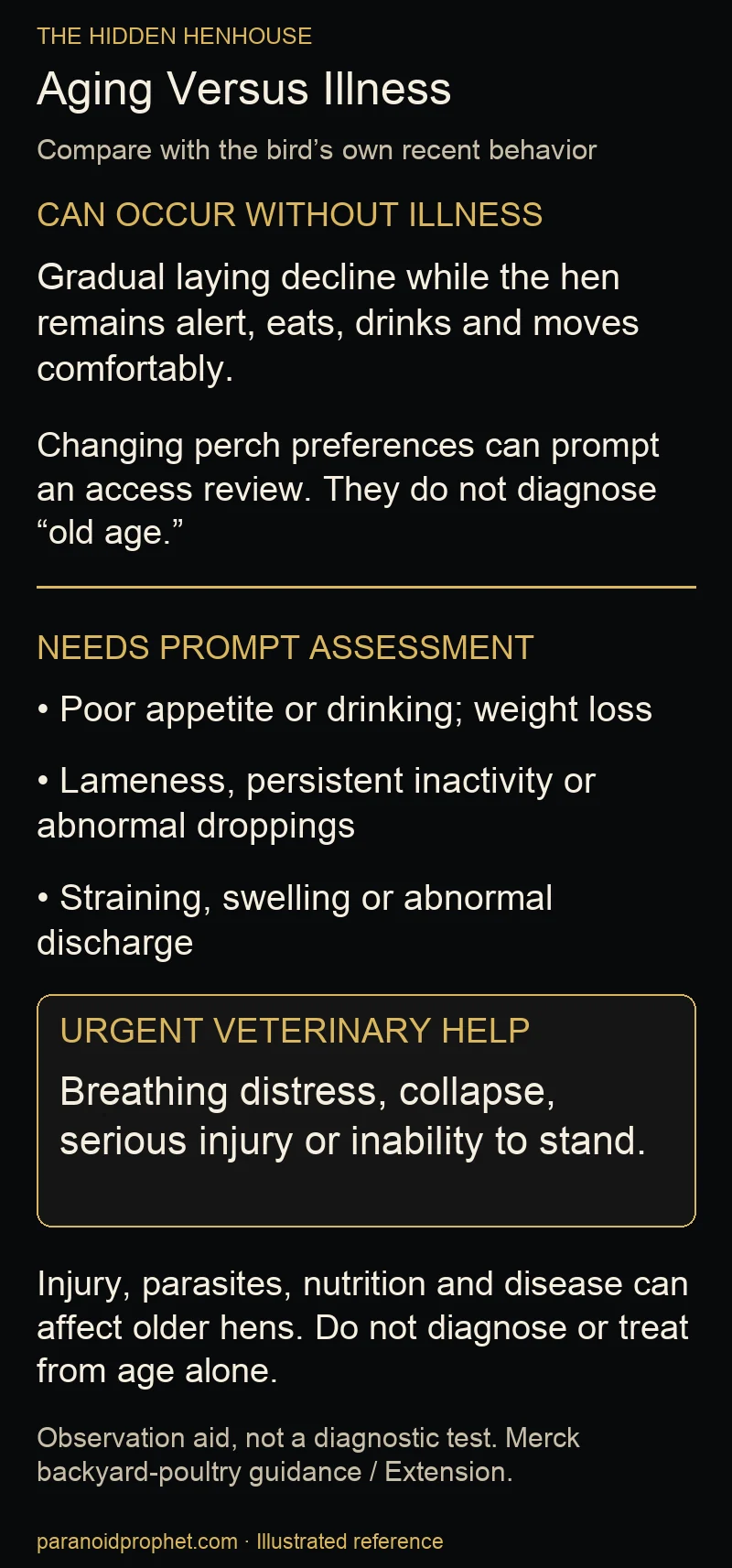
A hen who remains alert, eats and drinks, moves comfortably and engages in familiar activities may be doing well despite laying less. Feather appearance also changes during molt. Do not assume every rough-feathered bird is declining from age.
There is no cosmetic checklist that proves a hen is old. Do not expect gray feathers, a particular comb color or a fixed body shape to function as a birth certificate.
Aging Does Not Explain Away Illness
Merck’s backyard-poultry manual warns that birds can conceal early illness. Reduced appetite, weight loss, lameness, abnormal droppings and a change in activity deserve attention. Injury, parasites, nutritional problems and infectious disease can affect older birds as well as younger ones.
Breathing distress, collapse, serious injury or inability to stand require urgent veterinary help. Persistent straining, abdominal swelling, abnormal discharge or a bird who stops eating or drinking also need prompt assessment. Age is not a safe explanation for these signs.
The sick-chicken guide helps organize observations and escalation. Reproductive signs belong with the egg-binding guide and a veterinarian, not a home attempt to manipulate or drain the bird.
Monitor Weight and Body Condition Without Overhandling
Keep simple records: appetite, access to water, mobility, laying pattern and changes you can describe. When a bird can be handled calmly and safely, consistent weight measurements can reveal a trend that fluffy feathers hide. Ask the veterinarian to demonstrate safe handling and body-condition assessment.
Compare measurements taken under similar conditions and consider the trend rather than one reading. A crop full of feed can change the number. Do not chase an arbitrary target weight based on an internet breed chart or assume a heavier hen is healthier.
A bird in breathing distress should not be repeatedly caught or restrained for a household weighing project. Observe, contact the veterinarian and follow transport advice. Avoid compressing the chest, and do not force feed, water or medication into a struggling bird.
Make the Coop Easier to Use
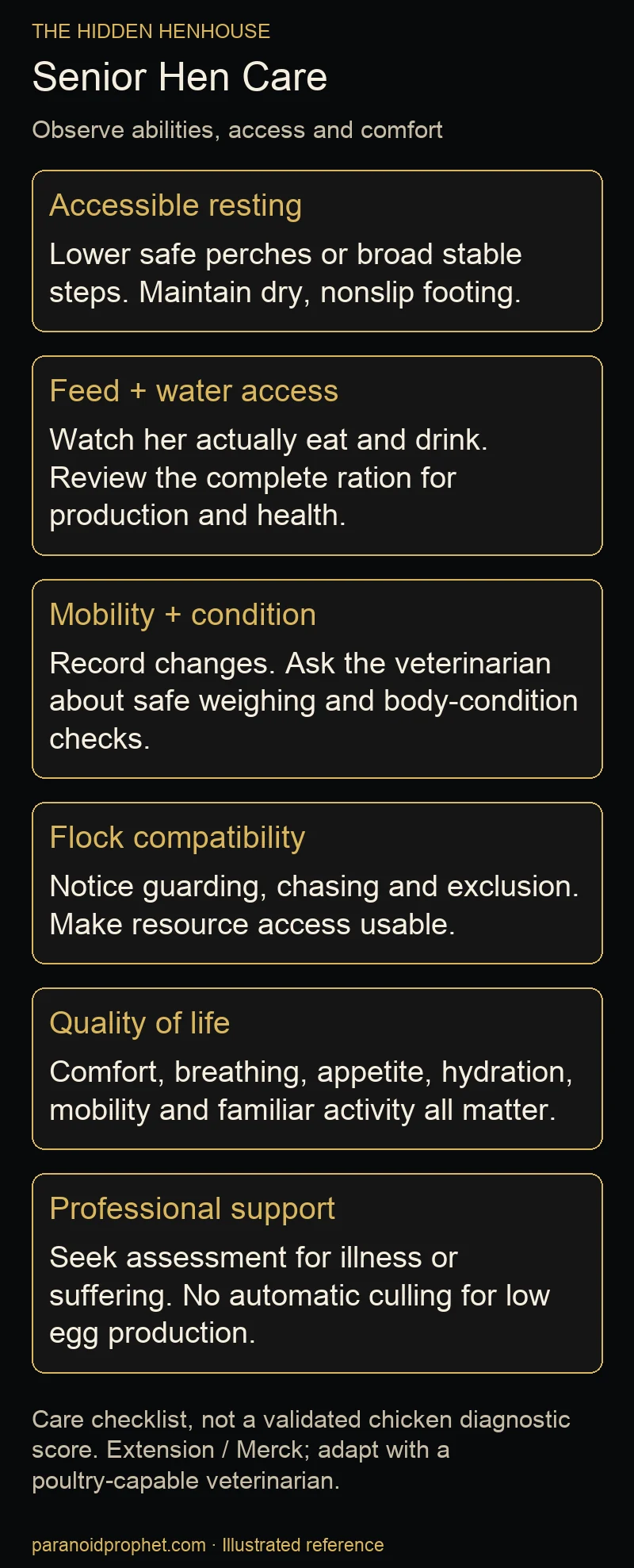
Use the nest-and-roost guide for practical interior planning. Lower a difficult perch or provide a broad stable intermediate platform when appropriate. Maintain dry, nonslip footing and a clear route to feed and water. A narrow steep ladder can create a new obstacle instead of solving the old one.
Observe the bird using the change. A platform that looks accessible to a person may still be painful or awkward for her. If mobility is worsening, an accommodation should accompany assessment rather than replace it.
Keep resting areas clean and inspect for foot injuries or lameness without attempting amateur surgery. Removing sharp hazards and wet bedding helps the environment; it does not diagnose or cure a foot problem. Leave enough room for the bird to avoid being crowded or chased.
Nutrition for an Older or Nonlaying Hen
Older does not mean that every bird needs the same special ration. Current laying activity, body condition, health and the other birds sharing the feeder matter. Review the complete feed label and the flock’s actual composition. The complete-feeding guide explains the distinction between production stage, calcium and grit.
Do not compensate for a quieter egg basket with unlimited treats, routine calcium additions or a promised rejuvenating tonic. A complete high-calcium layer ration is designed for laying birds; it is not automatically the lifelong answer for every nonlaying adult or growing bird sharing feed.
For a mixed flock, ask a poultry nutrition adviser or veterinarian about an appropriate complete ration and separate calcium access for layers. Do not make a clinical diet change from this article alone. Keep food and clean water within comfortable reach and watch the older bird actually use them.
Social Life and New Flock Members
An older hen may be excluded even when a feeder contains food. Add resource access where appropriate, monitor chasing and separate an injured or persistently harassed bird safely while seeking help. Isolation should have a care purpose rather than becoming permanent neglect in a spare crate.
New birds bring health and social decisions. Follow the introduction and quarantine guide, with enough room and observation for the existing flock. Do not release energetic new pullets and assume the oldest hen will sort it out.
Our household began with about sixteen chickens and later had about twelve. That scale makes the planning issue tangible: adding layers without accounting for birds already present changes space, feed and daily work. It does not create an obligation to remove nonlaying hens.
Use space requirements and flock-size planning before adding birds. Retired layers still occupy real space and still need care.
Keeping Hens After Peak Production
Keeping retired layers is a legitimate husbandry choice. Budget for feed, bedding, secure housing and veterinary care without relying on those hens to repay every expense in eggs. Separate the household’s egg goal from its commitment to birds already in its care.
A nonlaying hen is not automatically unhealthy or useless. She can still participate in normal flock behavior. Conversely, affection should not make us overlook suffering because she is familiar and cherished.
Quality of Life: A Conversation, Not an Egg Count
Ask whether the hen can breathe comfortably, eat and drink, move to resources, rest without distress and take part in familiar activities. Look for ongoing pain, repeated exclusion and a pattern of difficult days. Record specific observations for the veterinarian rather than assigning a homemade score that decides her fate.
Merck’s 2025 pet-owner guidance discusses comfort, hunger, hydration, mobility and the balance of good and bad days. These are useful discussion areas. Its general pet checklist is not a validated chicken-specific diagnostic instrument.
Treatable disease and environmental obstacles should be considered. When illness or injury prevents an acceptable level of comfort, a poultry-capable veterinarian can discuss treatment, supportive care and whether humane euthanasia is appropriate. Do not wait for collapse simply to avoid a difficult conversation.
This guide provides no euthanasia technique or amateur veterinary procedure. Ask the veterinarian what will happen, how distress will be minimized, and what lawful aftercare options apply. A decision about an individual bird needs professional assessment, not a universal age cutoff.
Frequently Asked Questions
How long do backyard chickens live?
Wisconsin describes around six to eight years, while Penn State notes some can live twelve to fifteen. Individual outcomes vary substantially, so plan for long-term care without treating either range as guaranteed.
Is a hen who stops laying sick?
Not necessarily. Aging, season and molt can reduce production. Illness is more concerning when appetite, activity, breathing, body condition or mobility also change.
Do old hens need to be culled?
No automatic age-based rule is recommended here. Consider the bird’s health and comfort, the household’s responsibilities and veterinary advice when suffering is present.
Can I assume a limp is arthritis?
No. Injury, foot problems and other disease can cause lameness. Provide safer access and seek assessment rather than diagnosing from age.
Should an older hen be kept alone?
Not routinely. Monitor flock compatibility and resource access. A sick or injured bird may need separation and a specific care plan; age alone is not a reason for solitary housing.
Care Beyond the Egg Basket
Christian stewardship does not expire when production falls. It asks us to notice what an animal needs and to act honestly when care becomes harder. An accessible perch, dependable water and a timely veterinary conversation are practical expressions of that responsibility.
The stewardship guide considers the larger obligation. Here the task is concrete: care for the hen in front of you, without promising endless life or dismissing a life that has become less productive.
Sources and Care Scope
Sources checked October 8, 2026. Lifespan estimates describe populations or possibilities. This is husbandry and observation guidance, not diagnosis, treatment or a euthanasia protocol.
- Wisconsin: Life Cycle of a Laying Hen; lifespan and laying decline.
- Penn State: Small Flock of Laying Chickens, updated 2016; longevity possibilities.
- Minnesota: Raising Chickens for Eggs; production changes with age.
- Merck: Backyard-Poultry Management Problems, updated April 2025; illness and management concerns.
- Merck: Euthanasia and Pet Loss, September 2025; general veterinary quality-of-life discussion, not a chicken-specific scoring system.