
A Christian asks whether getting a tattoo is a sin. Someone quotes Leviticus 19:28. Someone else asks whether that person eats shrimp. Before long, both sides are arguing about hypocrisy, and almost nobody is reading the chapter.
The question deserves better. Some people are deciding whether to get their first tattoo. Others already have one and wonder whether it puts them beyond God’s acceptance. Both need an answer that takes Scripture seriously without making claims the text cannot carry.
Our conclusion: a tattoo is not automatically sinful for a Christian simply because it is a tattoo. But its meaning, motive, circumstances, and effect on others matter. Christians disagree about how Leviticus 19:28 applies today, and that disagreement deserves a careful hearing.
GUIDED ARTICLE EXPERIENCE
Can Christians Get Tattoos? What the Bible Actually Says
Read along as the narration moves through the article.
Browser narration · No stored audio or site tracking
CONTINUE GUIDED TOUR
Continue where you left off.
GUIDED TOUR COMPLETE
You have reached the end of this study.
Study record saved on this device.
GUIDED TOUR
Can Christians Get Tattoos? What the Bible Actually Says
Narrator: Paranoid Prophet Recommended Voice Native device narration
Prepare to follow the article as it is narrated.
VOICE & TOUR OPTIONS
Voice & Listening
NARRATOR
Finding a narrator…
Checking the best narrator available on this device.
Restores the site recommendations available in this browser.
Our listening picks lead when available; other voices are ranked for narration. Known novelty voices are hidden. Browser-provided voices may use an online voice service.
Screen-awake support will be checked when narration starts.
Optional: improve your device voices
Listening works with the voices already available here. Your device may offer additional free voices through its own settings.
iPhone or iPad: Settings → Accessibility → Read & Speak (or Spoken Content) → Voices → English. Look for Premium or Enhanced choices, then return here.
If offered, preview Ava or Zoe for U.S. English, or Serena or Jamie for British English. An explicit Premium or Enhanced version can improve on its compact version.
Mac: System Settings → Accessibility → Read & Speak → System voice. Open the voice list to preview or download additional choices.
Windows: Settings → Accessibility → Narrator → Add natural voices. Browser availability varies; a Narrator voice may not appear on websites. Edge may also expose online Natural voices without a model download.
Android: Open Accessibility → Text-to-speech output (the location varies by device). In the preferred engine settings, look for voice data and English choices.
Download sizes vary; some enhanced voices exceed 100 MB. This website cannot install system voices, and an installed voice appears here only if your browser exposes it.
Apple voice guide · Windows voice guide · Android voice guide
CHOOSE A NARRATOR
Recommended on this device
Our listening picks: Aaron, Martha, then Daniel, when available here. Otherwise, automatic uses the highest-ranked suitable voice. Preview alternatives or save your own choice.
Preparing the guided article experience…
RESUME GUIDED TOUR?
Continue where you left off.
GUIDED TOUR COMPLETE
You have reached the end of this study.
Article Guide9 sections
What does Leviticus 19:28 actually say?
“Ye shall not make any cuttings in your flesh for the dead, nor print any marks upon you: I am the LORD.”
Leviticus 19:28, KJV
This is a real command. A faithful answer cannot make it disappear because tattoos are popular or because someone has a meaningful design in mind.
But a faithful answer also reads the command where God gave it. Leviticus 19 addresses Israel as a people called to be holy. The chapter includes instructions about worship, agriculture, justice, family life, bodily practices, and love of neighbor.
The surrounding verses forbid divination and consulting mediums. Verse 28 explicitly connects cutting the flesh with the dead. That setting gives good reason to consider mourning and religious practices when interpreting the passage.
We should still be precise: “for the dead” explicitly describes the cutting. Whether it also limits the prohibition on marks is an interpretive question. The verse does not say that ordinary decorative tattoos are allowed. Nor does it describe every modern kind of tattoo and its purpose.
The United Bible Societies translation handbook on Leviticus connects the cutting with mourning but notes disagreement over whether the marking clause has that same specific reference. Old Testament scholar Paul Williamson likewise treats the ancient religious setting as important without claiming that it resolves every uncertainty about the word or its scope in his discussion for Moore Theological College. Context helps us read the command; it does not give us permission to rewrite it.
Some Christians therefore read this as a continuing prohibition of tattooing. Others understand it within Israel’s covenant obligations and religious setting, and do not treat it as a universal ban on modern body art. The disagreement cannot be settled simply by quoting the verse or by declaring that ancient context makes it irrelevant.
A representative argument for abstaining comes from Ángel Manuel Rodríguez at the Seventh-day Adventist Biblical Research Institute. In “Marked,” he connects the command with holiness and care for a body that belongs to God, and recommends that Christians avoid tattoos. He also urges churches to welcome tattooed people without condemnation. His position is a recommendation grounded in those principles; it should not be overstated as an argument that every tattooed believer is disobeying God.
The strongest case for a continuing prohibition is more than a dislike of modern fashion. It argues that the marking clause is not expressly limited to mourning, that this chapter contains enduring moral commands, and that bodily holiness reflects God’s claim on His image-bearers. Gordon Wenham’s commentary grounds the bodily restrictions in divine likeness and Israel’s holy identity, as quoted in Wayne Grudem’s discussion of the passage. That provides a serious theological rationale for the objection, though it should not be presented as Wenham explicitly ruling on every modern tattoo. Grudem himself reaches a permissive conclusion.
On the continuing-prohibition reading, the absence of an explicit New Testament repeal also matters. The response cannot simply be “That is in the Old Testament.” We must explain why the command’s covenant form does not bind Christians unchanged while its call to holiness still does.
The larger question is how Christians receive the law of Moses through Jesus Christ.
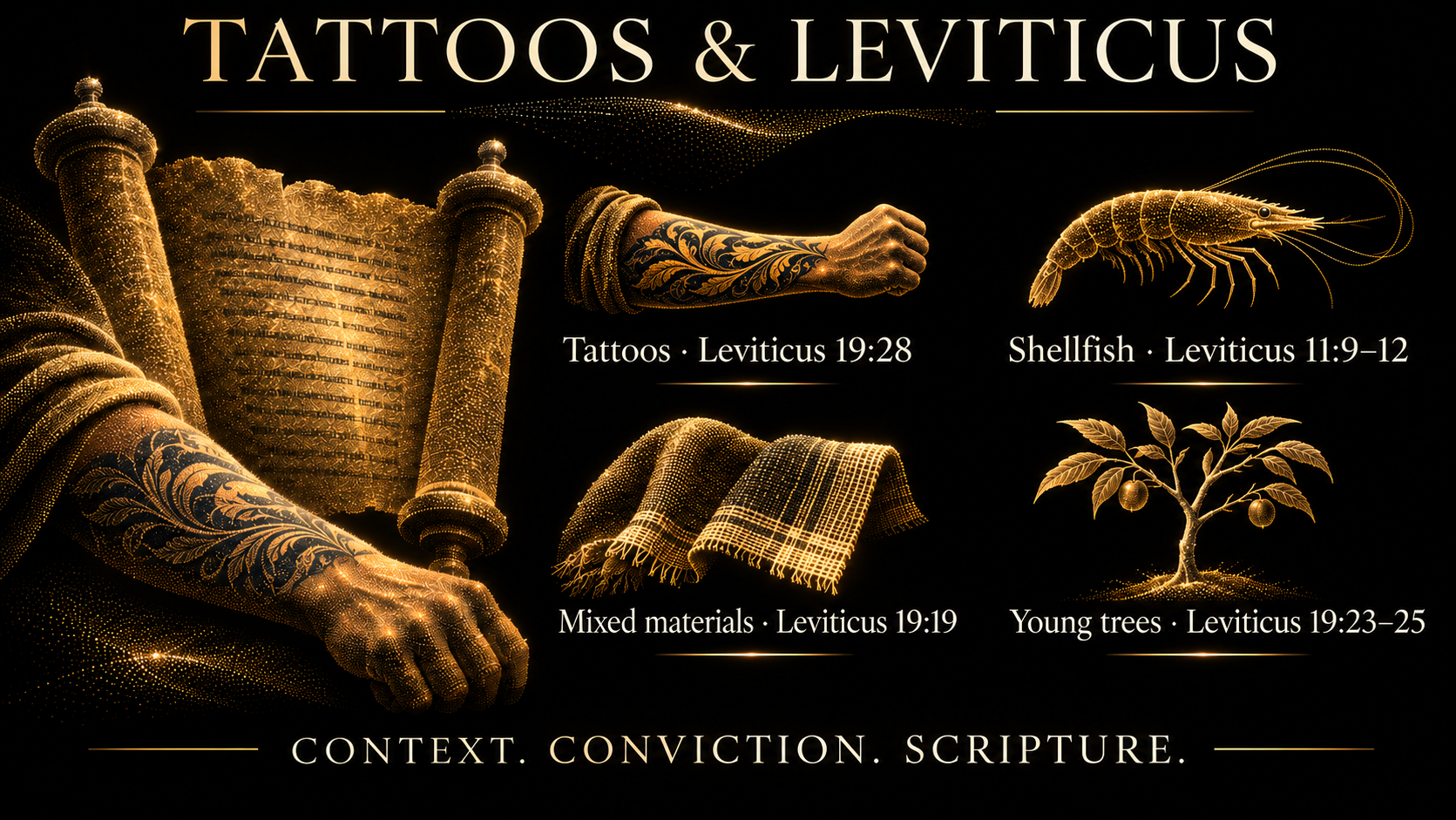
References shown in the illustration
- Tattoos and bodily marks: Leviticus 19:28. The relationship between the two prohibitions is disputed.
- Aquatic food restrictions: Leviticus 11:9–12. The food rule distinguishes creatures with fins and scales.
- Mixed kinds and materials: Leviticus 19:19. The verse addresses livestock, seed, and a mixed-material garment.
- Young fruit trees: Leviticus 19:23–25. The first three years’ fruit is not eaten; the fourth is holy to the Lord; the fifth may be eaten.
What about shrimp, mixed fabrics, and fruit trees?
The shrimp comeback points toward a legitimate question: why do Christians apply some Old Testament commands differently from others?
But it is often used as a shortcut instead of an answer.
The dietary rule relevant to shrimp is in Leviticus 11:9–12, which distinguishes aquatic creatures with fins and scales from those without them. It is not part of the tattoo verse.
Leviticus 19 does include rules about mixed seed and garments in verse 19. It also gives a specific instruction about fruit trees planted after entering the land: their fruit is not to be eaten for the first three years; the fourth year’s fruit is holy to the Lord; in the fifth year the people may eat it (verses 23–25). This is not a general command that every person must wait five years before eating any fruit.
These commands remind us that we are reading instructions given to a particular covenant people. Yet the same chapter also forbids theft, dishonesty, oppression, and hatred, and commands love of neighbor.
So neither shortcut works:
- “It appears in Leviticus, so every Christian must apply it in exactly the same way Israel did.”
- “It appears beside agricultural and dietary rules, so it has no moral significance.”
Christians need an account of fulfillment, covenant, and obedience, rather than a collection of convenient exceptions.
Does following Jesus mean ignoring the Old Testament?
Jesus said He came to fulfill the Law and the Prophets, not to destroy them (Matthew 5:17–20). Christians should never speak as though God’s earlier revelation was a mistake.
At the same time, the apostles did not require Gentile believers to become circumcised and take on the Mosaic law as the condition of belonging to God’s people. That dispute is central to Acts 15. The council affirmed salvation through the grace of Jesus and gave concrete instructions concerning idolatry, sexual immorality, blood, and strangled animals.
Acts 15 is not a tattoo ruling. Its relevance is that the church did not simply transfer every command given to Israel onto Gentile Christians unchanged. Its short list also is not an exhaustive catalog of everything Christians must obey.
Likewise, Galatians 5:1–14 defends freedom in Christ while commanding believers to serve one another in love. Freedom does not authorize whatever our desires demand.
The distinction is covenantal, not permission to ignore God’s moral will. Hebrews 8:6–13 presents Jesus as mediator of the new covenant and calls the first covenant obsolete, while promising God’s laws written on His people’s hearts. Romans 7:4–6 describes believers as having died to the law through Christ so that they belong to Him, bear fruit for God, and serve in the newness of the Spirit. This changes their covenant relationship; it does not make holiness optional.
Paul therefore says he is not without God’s law but is under the law of Christ (1 Corinthians 9:19–23). We read an Israelite command in its original setting, then ask how its purpose and obligation are carried forward through Christ and the apostles. This is not a mechanical rule that only commands repeated verbatim in the New Testament matter. The whole canon informs Christian obedience. In this case, bodily holiness continues, but neither permanent ink by itself nor the absence of an explicit repeal establishes that every tattoo violates it.
For the fuller framework, read How Should Christians Apply Old Testament Law? alongside What Are the Biblical Covenants?.
Christian traditions explain the continuity between the covenants differently. Some distinguish moral, ceremonial, and civil aspects of the law; others frame the relationship differently. Those categories can help explain an interpretation, but the headings are not printed above every command in Leviticus. Each passage still needs careful reading.
Our conclusion rests on this broader New Testament framework: Leviticus 19:28 should not, by itself, be treated as a universal tattoo ban for Christians under the new covenant. That conclusion does not excuse idolatry, contempt for God, or careless treatment of the body.
For more on the text Christians are interpreting, see How Did We Get the Bible?.
Isn’t your body a temple of the Holy Spirit?
Yes. First Corinthians 6:19–20 teaches that believers belong to God and should glorify Him with their bodies.
The immediate argument concerns sexual immorality and the believer’s union with Christ. Paul is not directly discussing tattoos. We should not present the passage as if it specifically says that every permanent mark defiles the body.
Its broader principle still matters. A Christian cannot dismiss every concern with “It’s my body, so nobody gets a say.” Our bodies belong to the Lord. Their care, use, and treatment should reflect that belonging.
The temple passage calls for stewardship. Deciding whether a particular tattoo violates that stewardship requires further judgment about the design, intention, risks, and circumstances.
Can a tattoo be sinful even if tattooing is not always sinful?
Yes. A practice does not have to be wrong in every possible situation to be wrong in a particular one.
A tattoo that celebrates hatred, sexual exploitation, or allegiance to a false god raises questions about what the person is affirming. A design chosen to humiliate someone or provoke a family member raises questions about motive. Spending money needed for basic responsibilities raises questions about stewardship.
Likewise, a cross or Bible verse does not automatically make every decision wise. Religious imagery cannot repair a reckless motive or settle a troubled conscience.
In 1 Corinthians 10:23–33, Paul moves beyond whether something is permitted to whether it builds others up and glorifies God. His immediate subject includes food associated with idolatry. Applying those principles to a tattoo is a moral application, not a claim that Paul was answering a tattoo question.
Six questions to ask before getting a tattoo

1. What does this design communicate?
Understand the words and symbols before making them permanent. Check a foreign-language phrase with a competent speaker. Consider both your intended meaning and meanings the design already carries in your community.
A symbol’s history and present use deserve examination. Avoid both careless adoption and exaggerated claims that an image automatically gives spiritual powers to its wearer.
2. Why do I want it?
Be honest about grief, beauty, memory, belonging, attention, anger, or pressure from others. A meaningful story can be part of the decision, but it does not make the decision exempt from examination.
Would you still want the tattoo if nobody praised it? Can you consider objections without becoming defensive?
3. Can I proceed with a clear conscience before God?
Romans 14 addresses disagreements about food and days. It warns against acting contrary to conscience and against despising or condemning fellow believers over disputable matters.
Applying it here assumes that tattooing itself is not universally forbidden, which is precisely where Christians disagree. It should not be used to wave away a biblical argument without answering it.
If you believe getting the tattoo would disobey God, do not rush ahead because someone online says it is fine. Study, pray, and speak with a mature pastor or trusted Christian. Conscience needs to be informed by Scripture, not bullied into silence.
4. Have I considered the permanence, expense, and health risks?
Tattoos involve more than an image on a screen. The FDA identifies risks including infection and allergic reactions. Contaminated ink can cause problems even when an artist follows hygienic procedures. Removal can be expensive and incomplete.
Check applicable local requirements, choose a reputable practitioner, and discuss personal medical concerns with a qualified clinician. If you are a minor, follow the law and involve your parent or guardian. A spiritual argument should never become an excuse to ignore practical safety.
5. How will this affect people I am responsible to love?
Consider your spouse, family, church, work, and the people you hope to serve. Loving them does not mean that every personal dislike becomes a divine command. It does mean their concerns deserve more than contempt.
Paul’s concern about causing another person to stumble involves their spiritual welfare, not merely someone finding your appearance unfashionable. Do not pressure someone else to imitate a choice they believe would be sinful.
6. Am I willing to wait?
A permanent decision rarely benefits from manufactured urgency. Live with the design on paper. Revisit the wording. Ask whether you would still want it after the emotion or trend has passed.
Choosing not to get a tattoo is a valid Christian decision. You do not need to exercise every possible freedom to prove that you understand grace.
What if you already have tattoos?
Having a tattoo does not put a person beyond Christ’s mercy. The gospel does not offer salvation only to people with unmarked skin.
Nor should someone assume that every tattooed Christian is rebellious, spiritually immature, or less fit to be welcomed in church. An outward mark tells us very little about a person’s present faithfulness.
If a tattoo expresses something you now reject, you can acknowledge that honestly. Depending on its content and your circumstances, covering, altering, or removing it may be worth considering. But the New Testament gives no command requiring tattoo removal as a condition of conversion or salvation. Do not make a painful, costly procedure a test of whether someone belongs to Jesus.
Seek wise counsel about the particular situation. Repentance concerns turning to Christ; physical changes may sometimes support that change, but they cannot purchase forgiveness.
Common questions about Christians and tattoos
Does the New Testament explicitly forbid tattoos?
It contains no explicit command naming tattooing. Christians draw conclusions from the Old Testament and from New Testament teaching about holiness, the body, conscience, and love. Silence alone does not prove that every tattoo is acceptable.
Can a Christian get a cross or Bible verse tattoo?
On the interpretation explained here, it can be permissible. The image still needs to be considered alongside motive, conscience, wisdom, safety, and responsibilities. A Christian design is not a substitute for Christian obedience.
Does Jesus have a tattoo in Revelation 19:16?
Revelation 19:16 describes a name written on Christ’s robe and thigh in John’s vision. It does not say that the name was tattooed into His skin. The passage proclaims His kingship; using it as a clear endorsement of modern tattooing goes beyond the text.
Must Christians agree about tattoos?
Christians should pursue truth together and take objections seriously. But they should not turn a disputed application into permission to despise one another. Someone who abstains need not be a legalist, and someone with a tattoo need not be rejecting biblical authority.
Follow Christ with the whole of your life
If you are deciding whether to get a tattoo, take time to examine the design, your reasons, and your conscience before God. If you already have one, do not mistake the presence of ink for the absence of grace.
A church can take holiness seriously while welcoming people whose skin tells a different story. Whatever decision you make, give it the seriousness appropriate to someone who belongs to Christ.
Continue studying
- How Did We Get the Bible? explores the Scriptures behind Christian belief.
- How Can We Evaluate a Religious Truth Claim? offers a framework for testing an argument rather than repeating it.
- Sources and Verification explains how Paranoid Prophet distinguishes Scripture, evidence, and disputed interpretation.
Scripture quotation: King James Version. Linked passages provide the primary texts for this study. The conclusion about modern tattooing is an interpretation argued from those texts, not a claim that all Christian traditions agree.