

Open a Bible study website and one verse can produce twenty translations, a column of cross-references, several commentaries, and a Greek word with a numbered entry. The abundance is useful until every link seems equally authoritative. A reader can spend an hour collecting explanations without becoming clearer about what the passage says.
Christians should use Bible study tools to answer specific questions, test interpretations, and return to Scripture with better understanding. Read the passage first, choose the aid that fits the question, inspect its evidence, and distinguish what the text says from what an interpreter proposes. Good tools support attentive reading and faithful obedience to Jesus Christ.
GUIDED ARTICLE EXPERIENCE
How Should Christians Use Bible Study Tools? Cross-References, Commentaries, and Word Studies
Read along as the narration moves through the article.
Browser narration · No stored audio or site tracking
CONTINUE GUIDED TOUR
Continue where you left off.
GUIDED TOUR COMPLETE
You have reached the end of this study.
Study record saved on this device.
GUIDED TOUR
How Should Christians Use Bible Study Tools? Cross-References, Commentaries, and Word Studies
Narrator: Paranoid Prophet Recommended Voice Native device narration
Prepare to follow the article as it is narrated.
VOICE & TOUR OPTIONS
Voice & Listening
NARRATOR
Finding a narrator…
Checking the best narrator available on this device.
Restores the site recommendations available in this browser.
Our listening picks lead when available; other voices are ranked for narration. Known novelty voices are hidden. Browser-provided voices may use an online voice service.
Screen-awake support will be checked when narration starts.
Optional: improve your device voices
Listening works with the voices already available here. Your device may offer additional free voices through its own settings.
iPhone or iPad: Settings → Accessibility → Read & Speak (or Spoken Content) → Voices → English. Look for Premium or Enhanced choices, then return here.
If offered, preview Ava or Zoe for U.S. English, or Serena or Jamie for British English. An explicit Premium or Enhanced version can improve on its compact version.
Mac: System Settings → Accessibility → Read & Speak → System voice. Open the voice list to preview or download additional choices.
Windows: Settings → Accessibility → Narrator → Add natural voices. Browser availability varies; a Narrator voice may not appear on websites. Edge may also expose online Natural voices without a model download.
Android: Open Accessibility → Text-to-speech output (the location varies by device). In the preferred engine settings, look for voice data and English choices.
Download sizes vary; some enhanced voices exceed 100 MB. This website cannot install system voices, and an installed voice appears here only if your browser exposes it.
Apple voice guide · Windows voice guide · Android voice guide
CHOOSE A NARRATOR
Recommended on this device
Our listening picks: Aaron, Martha, then Daniel, when available here. Otherwise, automatic uses the highest-ranked suitable voice. Preview alternatives or save your own choice.
Preparing the guided article experience…
RESUME GUIDED TOUR?
Continue where you left off.
GUIDED TOUR COMPLETE
You have reached the end of this study.
Article Guide10 sections
What authority should Bible study tools have?
Paranoid Prophet receives Scripture as God’s authoritative Word. A study note, dictionary entry, or commentary is a human aid to understanding it. That distinction remains important even when both appear on the same printed page or screen.
Receiving help can be an act of humility. Another reader may notice a grammatical relationship, historical detail, or objection that we missed. The danger comes when confidence in a teacher replaces the work of examining the teacher’s reasons.
Acts 17:10–12 describes the Bereans receiving the message readily and examining the Scriptures to test what they heard. The passage commends that receptive, examining posture. It does not prescribe modern dictionaries, software, or a particular study method.
Keep three things distinguishable: the biblical text, a tool’s explanation, and your conclusion. Agreement among interpreters can deserve consideration, but neither a famous name nor a long results page settles the meaning by itself.
Begin with a passage and one real question
Before opening another tab, read a complete paragraph or scene. Notice who speaks, what the writer emphasizes, and how the passage develops. Write a provisional summary in ordinary language. Our guide to reading the Bible in context explains that foundational work.
Then identify an actual difficulty. “What can I discover about this verse?” is almost unlimited. “Who does Paul mean by the assembly in this greeting?” gives the investigation a useful boundary.
Match the tool to the question. Cross-references help locate related passages. A commentary explains an interpreter’s reading of a passage. A Bible dictionary or atlas addresses people, places, customs, and geography. A lexicon describes how a Hebrew, Aramaic, or Greek word is used. A concordance locates occurrences of a word.
If English translations differ, compare the wording and footnotes before assuming that one has hidden something. Bible Translations Explained covers that larger subject. Here the task is narrower: use comparison to identify the question that needs investigation.
Follow cross-references without flattening the passages
A cross-reference proposes a connection. Ask what kind: an explicit quotation, a similar event, repeated wording, a shared subject, or a possible allusion. Those connections have different evidential weight.
For example, Bible Hub’s cross-references for 1 Corinthians 1:2 include 2 Corinthians 1:1 and Acts 18:1–11. The first repeats a greeting to God’s assembly at Corinth. The second narrates Paul’s ministry there. One offers closely related wording; the other supplies narrative background. They help for different reasons.
Read each destination rather than collecting its address. 2 Corinthians 1:1–2 names its recipients in its own greeting. Acts 18:1–11 describes preaching, believing, baptism, and teaching in Corinth. Neither becomes interchangeable with every sentence in 1 Corinthians simply because an editor linked them.
The discipline is simple: write one sentence explaining the connection and one explaining its limit. A shared word can establish a useful comparison without establishing the same audience, circumstances, or promise. If the relationship remains unclear, leave it as a question rather than forcing it into your conclusion.
Read commentaries as reasoned interpretations
A useful commentary helps you see how its conclusion follows from the passage. Look for attention to the paragraph, explanations of difficult wording, relevant evidence, and fair treatment of serious alternatives. An application may be moving while the interpretation supporting it remains weak.
Identify the writer, publication date, intended audience, and theological commitments. Protestant, Catholic, Orthodox, and other scholarly approaches can ask different questions or give different weight to tradition. Knowing that setting helps you understand an argument; it does not automatically establish or discredit it.
There is a small, instructive disagreement in the commentaries on 1 Corinthians 1:2. The note in Ellicott’s Commentary for English Readers understands the greeting as addressing the wider church. Alexander MacLaren prefers to see Paul reminding Corinth of its union with other believers, pointing to the letter’s local concerns.
Both recognize a connection beyond Corinth. They differ over how the greeting functions. Two explanations reveal an interpretive question, not a scholarly consensus. Compare their reasons with the letter and preserve uncertainty where warranted. For broader tests of a teacher’s reliability, see How Should Christians Evaluate Teachers and Teaching?.
Use word studies to investigate usage, not secret meanings
A lexicon gives possible senses and examples of usage. The immediate sentence and wider argument help determine which sense fits. Do not pour every listed meaning into one occurrence, or choose the most dramatic definition because it makes an impressive sermon.
An interlinear can help identify a source-language word. A Strong’s number helps locate an entry. Neither supplies the training needed to resolve every question of grammar or interpretation. Recognizing a label is a beginning, not a finished argument.
Distinguish a word’s history from its meaning in a particular passage. Explaining the parts from which a word developed does not, by itself, prove what a writer intended. Likewise, an English word may translate different Greek words, while one Greek word may require different English translations.
Prefer a modest question: “Which uses are plausible here, and what evidence favors one?” Read examples in their own contexts, especially relevant occurrences within the same book. If an important conclusion depends on grammar you cannot evaluate, consult a qualified teacher or detailed commentary and explain the limits of your confidence.

A worked example: what does “assembly” mean in 1 Corinthians 1:2?
Begin with 1 Corinthians 1:1–9. The World English Bible addresses “the assembly of God which is at Corinth” in verse 2. The surrounding words identify people sanctified in Christ Jesus, called saints, and connected with others who call on Jesus as Lord. Paul thanks God for grace given to them and speaks of their fellowship with his Son.
The question: Does the Greek word itself mean a specially holy group of “called-out ones,” or does the passage identify what kind of assembly Paul means?
Inspect an actual entry. Blue Letter Bible’s G1577 page identifies the word as ekklēsia. The page combines several resources, including an outline, Strong’s material, Thayer’s Greek Lexicon, and a concordance. In the Thayer section, civic assemblies and disorderly gatherings are distinguished from Christian assemblies. The entry places 1 Corinthians 1:2 among references to a local Christian community. Those are identifiable claims in a named resource, not a definition reconstructed from memory.
Check another resource and a contrasting occurrence. Bill Mounce’s Greek New Testament Dictionary gives church, congregation, and assembly as glosses and identifies Acts 19:32, 39, and 41 as examples of a popular assembly. In Acts 19, the context is a disturbance in Ephesus associated with opposition to Paul’s ministry. Verse 32 describes a confused gathering; verse 39 refers to a lawful assembly. These are not descriptions of the Corinthian church.
Return to the original sentence. The shared Greek word establishes a range of usage. It does not make the Ephesian crowd Christian or transfer its confusion into Paul’s greeting. In 1 Corinthians 1:2, the surrounding phrases identify the community as belonging to God and sanctified in Christ.
The claim that Christians are called by God can be examined directly in this passage, including verse 9. It does not need to be smuggled into the definition of ekklēsia through its roots. Our conclusion is stronger when its theological content comes from Paul’s actual statements.
Now carry that reading into verses 10–13, where Paul confronts division around human leaders. A fitting application is to examine our own factional loyalties in light of belonging to Christ. The lexical work has served the letter’s argument rather than becoming a detour around it.
Ask what background resources can actually establish
Maps, historical dictionaries, and archaeological discussions can clarify unfamiliar places and practices. Their usefulness depends on the question and evidence. A custom documented somewhere in the ancient world is not automatically the explanation for every passage that sounds similar.
When a note says that people “always” acted a certain way, ask where, when, and among whom. Does the author cite an ancient text, an inscription, a material discovery, or another modern writer? Is the evidence close to the setting of the biblical passage? Is the proposed connection explicit or inferred?
Check a resource’s original publication date and edition, not merely the date of the webpage hosting it. Older works can preserve valuable observations; newer works can still make weak arguments. Neither age nor novelty decides the issue.
Distinguish the evidence from the reconstruction. A documented practice may make an interpretation plausible without proving that the biblical writer had it in view. Use background to clarify what the text communicates, and be cautious when an explanation requires an elaborate story the passage never supplies.
Build a small study kit you can actually use
You do not need an expensive subscription to begin. The passage pages, cross-references, commentaries, and lexical entries used in this article are publicly readable. They are examples of accessible resources, not a blanket endorsement of everything their hosting sites publish.
Start with a readable Bible, access to a comparison translation, cross-references, a named commentary, and a notebook. Add a dictionary, map, or lexical resource when a question calls for one. A church or public library may also give you access to works you would not buy.
For each resource, record its author or editor and edition. A website’s name alone may conceal which writer supplied the explanation. Notice, too, when several sites reproduce the same older commentary. Repetition across websites does not turn one interpretation into several independent judgments.
Use search engines and AI answers to locate leads cautiously. Open the actual source, check the passage, and verify any quotation. An answer that supplies no traceable evidence should not become the foundation of a teaching claim.
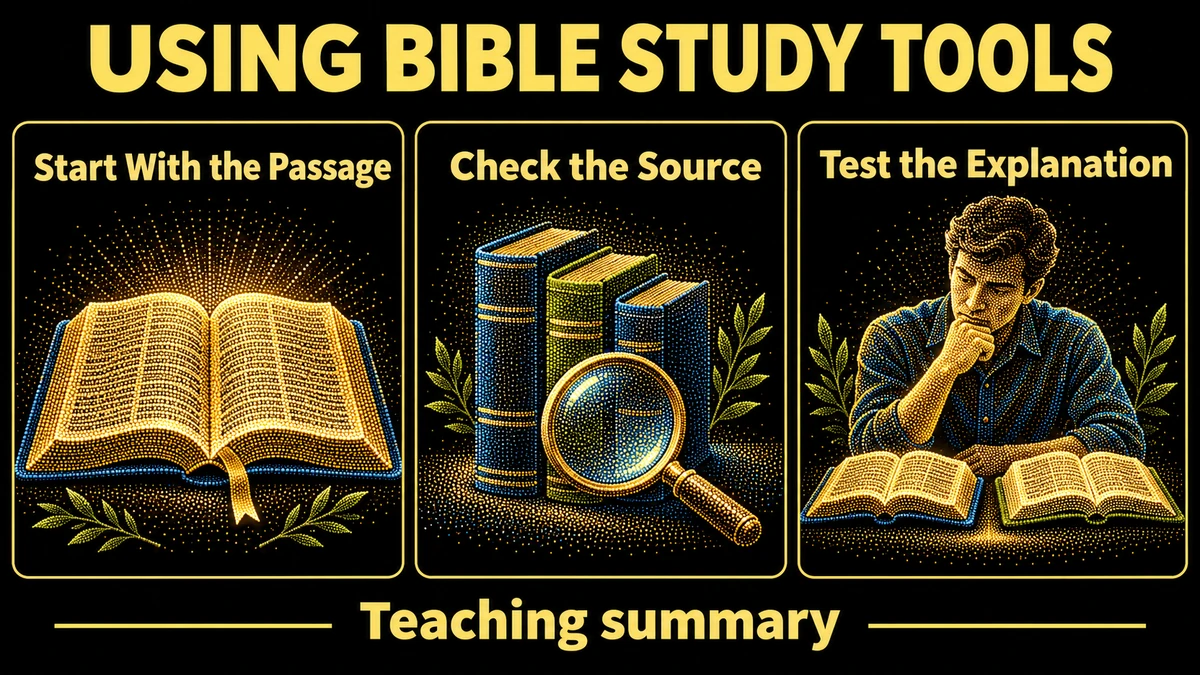
Using Bible Study Tools: start with the passage; check the source; test the explanation. Teaching summary, not a quotation of Scripture.
Finish with a conclusion, a limit, and a response
Keep a short record that someone else could follow. For the example above, it might read:
Question: What identifies the assembly in 1 Corinthians 1:2 as Christian?
Evidence: The sentence describes people sanctified in Christ Jesus. The consulted lexicons show that ekklēsia also has non-Christian uses.
Conclusion: Paul means the Christian community at Corinth. The surrounding language establishes its identity; the word’s roots alone do not.
Limit: This word study does not settle every doctrine of the church or every question about its organization.
Response: Read Paul’s appeal against division in verses 10–13 and consider whether loyalty to a favorite leader is damaging fellowship with other Christians.
Then stop collecting tabs long enough to pray and respond. James 1:22–25 calls hearers to act on the word. Careful study should make us more teachable, more truthful about our evidence, and more ready to obey Christ. A well-used tool leaves us better able to explain the passage and less eager to claim more than it supports.
Frequently asked questions
Do I need to know Greek or Hebrew to study the Bible well?
No. You can read responsibly in a reliable translation, follow the argument, compare passages, and learn from qualified teachers. Original-language study can deepen understanding, but a few lookup results do not equal language proficiency. Be especially cautious when a novel interpretation depends on a linguistic claim you cannot explain or verify.
Should I read a commentary before or after the passage?
Usually read the passage first and record your questions. Then consult a commentary to test and improve your understanding. A brief introduction may help orient you before starting an unfamiliar book. The point is to keep returning to the biblical writing rather than letting the commentary become the only text you actually read.
What if two trustworthy commentaries disagree?
Identify exactly where they differ and compare their reasons. They may agree about the main point while differing about a detail, or they may make substantially different claims. Consider context, language, and evidence rather than counting votes. If you cannot resolve the question, state the alternatives honestly and seek informed help without pretending uncertainty affects every part of the passage.
Are free Bible study tools reliable enough?
Some are very useful, including the resources demonstrated here. Evaluate the particular author, edition, evidence, and explanation rather than the price or website’s polish. Free access can include older works and differing theological traditions. Paid access can include weak material. Begin with a small set you understand and verify important claims against Scripture and identifiable sources.
Sources and translation: Scripture wording quoted here follows the World English Bible. The worked example uses the publicly accessible Blue Letter Bible G1577 entry, including its labeled Thayer section; Bill Mounce’s Greek New Testament Dictionary; Bible Hub’s cross-references; and the named commentary discussions linked above. Lexical observations, interpretive judgments, and Christian applications have been kept distinct.