


A command against theft makes immediate sense. A rule about an animal sacrifice belongs to a world most Christians have never entered. A law requiring a barrier around a roof seems strangely specific. Yet all three appear in Scripture. How do we read them faithfully without choosing whichever commands suit us?
Christians should apply Old Testament law by reading each command in its covenant setting, tracing its fulfillment in Jesus, and following the teaching of his apostles. The whole law remains Scripture that instructs us, but Christians do not stand in the same covenant position as Israel at Sinai. Learning the difference helps us receive God’s wisdom without rebuilding Israel’s institutions or treating grace as permission to ignore obedience.
GUIDED ARTICLE EXPERIENCE
How Should Christians Apply Old Testament Law?
Read along as the narration moves through the article.
Browser narration · No stored audio or site tracking
CONTINUE GUIDED TOUR
Continue where you left off.
GUIDED TOUR COMPLETE
You have reached the end of this study.
Study record saved on this device.
GUIDED TOUR
How Should Christians Apply Old Testament Law?
Narrator: Paranoid Prophet Recommended Voice Native device narration
Prepare to follow the article as it is narrated.
VOICE & TOUR OPTIONS
Voice & Listening
NARRATOR
Finding a narrator…
Checking the best narrator available on this device.
Restores the site recommendations available in this browser.
Our listening picks lead when available; other voices are ranked for narration. Known novelty voices are hidden. Browser-provided voices may use an online voice service.
Screen-awake support will be checked when narration starts.
Optional: improve your device voices
Listening works with the voices already available here. Your device may offer additional free voices through its own settings.
iPhone or iPad: Settings → Accessibility → Read & Speak (or Spoken Content) → Voices → English. Look for Premium or Enhanced choices, then return here.
If offered, preview Ava or Zoe for U.S. English, or Serena or Jamie for British English. An explicit Premium or Enhanced version can improve on its compact version.
Mac: System Settings → Accessibility → Read & Speak → System voice. Open the voice list to preview or download additional choices.
Windows: Settings → Accessibility → Narrator → Add natural voices. Browser availability varies; a Narrator voice may not appear on websites. Edge may also expose online Natural voices without a model download.
Android: Open Accessibility → Text-to-speech output (the location varies by device). In the preferred engine settings, look for voice data and English choices.
Download sizes vary; some enhanced voices exceed 100 MB. This website cannot install system voices, and an installed voice appears here only if your browser exposes it.
Apple voice guide · Windows voice guide · Android voice guide
CHOOSE A NARRATOR
Recommended on this device
Our listening picks: Aaron, Martha, then Daniel, when available here. Otherwise, automatic uses the highest-ranked suitable voice. Preview alternatives or save your own choice.
Preparing the guided article experience…
RESUME GUIDED TOUR?
Continue where you left off.
GUIDED TOUR COMPLETE
You have reached the end of this study.
Article Guide10 sections
Begin With the People God Was Addressing
The commandments arrive inside a story. Before God gives Israel the Ten Commandments, he identifies himself as the Lord who delivered them from slavery. Rescue precedes the instructions for life as his people (Exodus 20:1–2). Reading the laws without that setting can make them sound like a ladder Israel was supposed to climb to earn God’s attention.
The covenant at Sinai shaped a particular people, with a land, priesthood, sanctuary, courts, and shared public life. Commands concerning sacrifices or property boundaries belonged within those arrangements. Their original hearers were neither modern homeowners nor a congregation drawn from many nations.
Begin with ordinary interpretive questions: Who receives this command? What situation does it address? What comes before and after it? Does the passage explain its purpose? Our guide to reading the Bible in context develops these habits more fully.
Context also guards against caricature. The Old Testament itself celebrates God’s instruction and calls for heartfelt love, mercy, and trust. Jewish observance should not be dismissed as an attempt to purchase salvation. Christians can explain their convictions about Jesus without reducing Judaism to a negative example.
Make Jesus’ Fulfillment the Center
In Matthew 5:17–20, Jesus denies that he has come to abolish the Law and the Prophets. He comes to fulfill them. He then warns against dismissing God’s commands and calls his hearers to a righteousness deeper than outward appearances.
The rest of Matthew 5 shows what that involves. Jesus addresses anger alongside murder, desire alongside adultery, and love that extends even to enemies. His teaching reaches motives, relationships, and conduct. Fulfillment cannot mean that holiness has become optional.
Neither does fulfillment mean that every covenant practice continues unchanged. Jesus’ life, death, and resurrection bring God’s promises and purposes to their intended goal. Hebrews explains the significance for sacrifice: Christ’s offering accomplishes what repeated animal offerings could not (Hebrews 10:1–18). Christians receive that fulfillment by trusting him, rather than establishing another sacrificial altar.
These passages belong together. Matthew prevents us from treating the Old Testament as a mistake Jesus corrected. Hebrews prevents us from honoring a preparatory institution in a way that overlooks the fulfillment it anticipated. A faithful reading asks what the command reveals and how Christ changes our relationship to it.
Let Acts 15 Address the Gentile Question
The early church had to confront the issue directly. Some teachers insisted that Gentile believers needed circumcision to be saved. Others argued that they should be required to keep the law of Moses. The apostles and elders considered the dispute in Jerusalem (Acts 15).
Peter grounded salvation in the grace of the Lord Jesus. James appealed to Scripture’s promise concerning the nations. The council did not require Gentiles to become circumcised members of Israel’s covenant order as a condition of belonging to Christ.
Its letter nevertheless required abstention from idolatrous pollution, sexual immorality, blood, and meat from strangled animals. Christians differ over the precise relationship of these instructions to Leviticus, shared meals, and their continuing application. The decision itself gives us a firm starting point: Gentile inclusion does not require taking on the whole Mosaic covenant, and inclusion by grace still calls for a changed life.
Acts 15 is especially important when someone argues that every Christian must adopt Israel’s food laws, calendar, or circumcision. Such claims must reckon with the church’s recorded decision, rather than beginning with an isolated command and assuming its original covenant obligation transfers unchanged.
Read Paul’s Freedom Alongside His Call to Obedience
Paul’s language about the law can sound contradictory when individual sentences are separated from their arguments. In Romans, he teaches that the law exposes sin and cannot provide justification through our performance. God’s saving righteousness comes through Jesus Christ and is received by faith (Romans 3:19–31).
In Galatians, Paul describes the law’s temporary custodial role leading to Christ. Those who belong to Christ receive Abraham’s promised inheritance through him (Galatians 3:19–29). He therefore resists making circumcision and law observance the basis of Gentile believers’ standing before God.
Yet freedom from that obligation never becomes freedom to exploit people. When Paul says believers live under grace rather than law, he immediately rejects using grace as an excuse to sin (Romans 6:14–18). Galatians likewise moves from freedom to service, self-control, and life in the Spirit.
We should also notice how Paul continues to use Torah. In 1 Corinthians 9:8–14, a command concerning an unmuzzled working ox contributes to his argument that gospel workers may receive support. The ancient law still instructs the church, even though its application requires more than copying its original setting.

Use Moral, Civil, and Ceremonial Categories Carefully
Many Christians distinguish three kinds of Old Testament law:
- Moral laws concern duties toward God and neighbor.
- Civil or judicial laws order Israel’s public life and courts.
- Ceremonial laws concern worship, priesthood, sacrifices, and ritual practices.
This framework can clarify real differences. A prohibition of murder and an instruction for a priestly offering do not function identically. However, these are later theological categories, not three explicitly labeled sections supplied by the biblical authors. Commands can also overlap: worship, justice, holiness, and community life are closely connected.
The Reformed Westminster Confession, chapter 19, teaches an enduring moral law, the cessation of ceremonial requirements under the new covenant, and the expiration of Israel’s judicial order while retaining its underlying equity. Catholic teaching in the Catechism, paragraphs 1965–1972, emphasizes the law’s perfection in Christ and the Spirit’s work of forming love within believers. These accounts share convictions about fulfillment and obedience without being identical theological systems.
Other Christian interpreters put greater emphasis on reading the whole Mosaic covenant through Christ before identifying present obligations. BibleProject’s discussion of the categories cautions against using them to decide which texts deserve attention.
The practical lesson is modest: use the categories to ask better questions. Do not let a label replace reading the passage, or assume a ceremonial or civil command has nothing left to teach.
Follow the Law of Christ in Concrete Love
Paul describes bearing one another’s burdens as fulfilling the law of Christ (Galatians 6:1–2). He also says that his freedom in relation to the Mosaic law does not leave him outside God’s authority: he remains under Christ’s law (1 Corinthians 9:19–23).
That love has definite moral content. In Romans 13, Paul connects love of neighbor with prohibitions against adultery, murder, theft, and coveting. Love fulfills the law because it seeks the neighbor’s good rather than inflicting harm (Romans 13:8–10). Personal sincerity does not make a harmful action loving.
This keeps application accountable to Jesus’ teaching and the apostles’ instruction. We cannot announce a general principle of love and then disregard whatever challenges our desires. Nor can we use precise rule-keeping to excuse contempt, cruelty, or indifference. Our discussion of loving neighbors and enemies explores the costly reach of that obligation.
A Worked Example: The Roof That Needs a Barrier
Deuteronomy 22:8 requires a parapet, a protective barrier, when an Israelite builds a house. The verse gives its reason: someone could fall from the roof, bringing responsibility for bloodshed upon the household. This is a specific obligation concerning a foreseeable danger.
Consider an illustrative case. A Christian manages a community hall. A raised entrance has a loose handrail. Replacing it costs money, and no one has yet reported an injury. How could this ancient command shape the decision?
First, preserve the original meaning. Moses is addressing house construction in Israel. The verse is not directly prescribing the design of this hall. Its stated concern, however, includes responsibility for preventing a potentially fatal fall. We should not replace that concrete concern with a vague lesson about being spiritually careful.
Second, read it through Christ’s teaching. The requirement accords with the apostolic command to seek our neighbor’s good. A person responsible for premises should take foreseeable danger seriously before someone suffers. The absence of an accident is no proof that neglect is harmless.
Third, establish the facts. The manager needs a competent assessment of the handrail and should follow applicable safety requirements. Depending on the danger, restricting access or providing a safe alternative may be necessary while repairs are arranged. Scripture supplies moral direction here; it does not supply engineering measurements or settle every question of legal liability.
Fourth, make the application proportionate. Deuteronomy 22:8 does not demand the elimination of every imaginable risk. Nor does it identify a particular contractor or repair budget. The responsible decision depends on the actual hazard, who is exposed, what the manager controls, and suitable professional guidance.
The faithful application reaches further than admiring ancient wisdom. It asks whether concern for another person’s life will affect spending, scheduling, and responsibility. That conclusion follows the verse’s stated purpose without pretending that a modern hall is an Israelite house.
Do Not Turn Israel’s Courts Into a Modern Shortcut
Israel’s civil penalties require particular care. Their presence in Scripture does not, by itself, authorize a church, private individual, or modern state to impose the same punishments. The church’s multinational life under Christ cannot simply be equated with Israel’s national covenant institutions.
Christians can learn from laws addressing truthful testimony, impartial judgment, restitution, and protection of vulnerable people. Moving from those concerns to present public policy requires further reasoning about authority, justice, circumstances, and the full witness of Scripture. Quoting an ancient penalty does not complete that work.
Difficult laws also deserve honest attention. Historical context may explain features unfamiliar to us, but it should not become a quick claim that every difficulty has disappeared. Read carefully, consult responsible scholarship, and distinguish what the text says from what an interpreter infers.
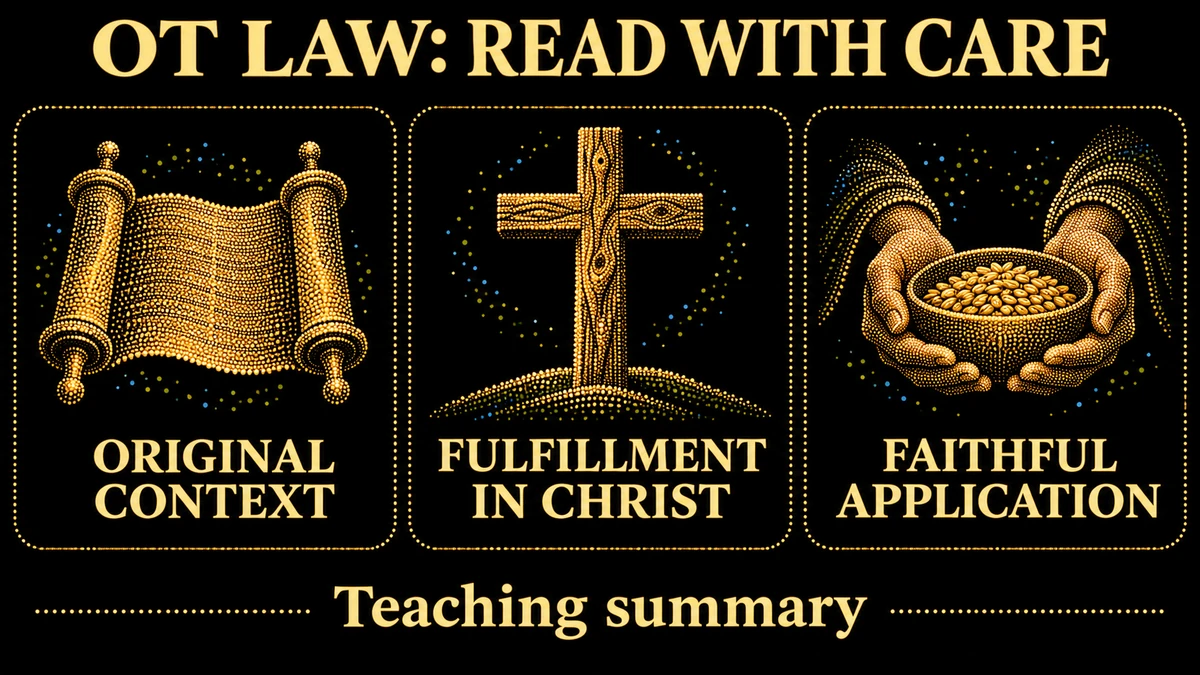
OT law: read with care. Original context; fulfillment in Christ; faithful application. Teaching summary, not a quotation of Scripture.
Five Questions to Carry Into Your Reading
When you encounter an Old Testament command, pause long enough to ask:
- What did it require of its original hearers? Read the surrounding passage and identify the situation.
- Where does it belong in Israel’s covenant life? Notice any connection to land, sanctuary, priesthood, or courts.
- How do Jesus and the apostles address this subject? Follow both continuity and fulfillment.
- What does it teach about God and faithful human life? Keep the answer anchored in the passage rather than a convenient slogan.
- What responsible action follows today? Distinguish a clear Christian obligation from a judgment requiring wisdom and further facts.
Some passages will take more study than others. Patience is preferable to confident misuse. The aim is to hear the whole of Scripture under Christ’s authority and let it form people who trust God, repent of sin, and take their neighbors’ good seriously.
Frequently Asked Questions
Do Christians have to keep the Ten Commandments?
Christian traditions broadly affirm their importance for moral instruction, while explaining their relationship to the new covenant differently. The New Testament repeatedly teaches duties they express, including worship of God, faithfulness, honesty, and care for others. Sabbath interpretation remains a significant point of disagreement. See should Christians keep the Sabbath? for that question specifically.
Why do most Christians not follow Israel’s food laws?
Most Christians understand the New Testament’s teaching on food and Gentile inclusion as removing the obligation to observe Israel’s dietary distinctions. Acts 15 is central, alongside Mark 7:18–23 and Romans 14. The council’s instructions about blood and strangled meat receive different interpretations across traditions. These questions should be approached with informed conviction and respect for conscience, rather than contempt for another person’s practice.
Does a law matter only if the New Testament repeats it?
No. Repetition can help establish continuity, but it is not the sole measure of a passage’s value. Paul’s use of the ox command in 1 Corinthians 9 demonstrates how Torah can instruct a new setting. Read each law within the biblical story and alongside apostolic teaching. An unrepeated command is not automatically irrelevant, and a repeated phrase still needs context.
Does being saved by grace make obedience unnecessary?
No. Grace brings believers into a life of faith working through love. In Galatians 5, Paul rejects reliance on circumcision for justification and also warns against destructive conduct. Christians obey in dependence on Christ and his Spirit. Treating obedience as a purchase price for salvation and treating salvation as permission to disregard God both distort his argument.