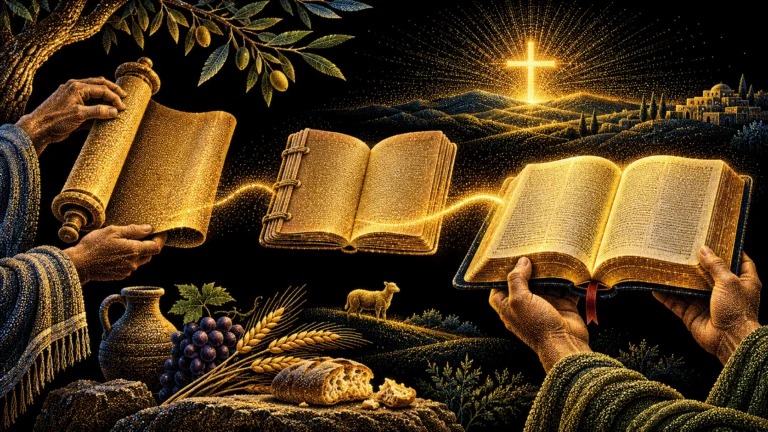


A rainbow appears after judgment. An elderly couple receives a promise of descendants. A rescued people gathers at a mountain. A king hears that his house will outlast him. At supper, Jesus speaks of a new covenant in His blood. These moments belong to one developing story, and understanding their connections changes how we read the Bible.
The biblical covenants are solemn commitments through which God establishes relationships, gives promises, and calls His people to faithfulness. Five major covenants help readers follow Scripture: those associated with Noah, Abraham, Israel at Sinai, David, and the new covenant fulfilled in Jesus Christ. They reveal God’s persistent purpose to bless, redeem, and dwell with His people. They also explain why grace and obedience appear together throughout the Bible.
GUIDED ARTICLE EXPERIENCE
What Are the Biblical Covenants?
Read along as the narration moves through the article.
Browser narration · No stored audio or site tracking
CONTINUE GUIDED TOUR
Continue where you left off.
GUIDED TOUR COMPLETE
You have reached the end of this study.
Study record saved on this device.
GUIDED TOUR
What Are the Biblical Covenants?
Narrator: Paranoid Prophet Recommended Voice Native device narration
Prepare to follow the article as it is narrated.
VOICE & TOUR OPTIONS
Voice & Listening
NARRATOR
Finding a narrator…
Checking the best narrator available on this device.
Restores the site recommendations available in this browser.
Our listening picks lead when available; other voices are ranked for narration. Known novelty voices are hidden. Browser-provided voices may use an online voice service.
Screen-awake support will be checked when narration starts.
Optional: improve your device voices
Listening works with the voices already available here. Your device may offer additional free voices through its own settings.
iPhone or iPad: Settings → Accessibility → Read & Speak (or Spoken Content) → Voices → English. Look for Premium or Enhanced choices, then return here.
If offered, preview Ava or Zoe for U.S. English, or Serena or Jamie for British English. An explicit Premium or Enhanced version can improve on its compact version.
Mac: System Settings → Accessibility → Read & Speak → System voice. Open the voice list to preview or download additional choices.
Windows: Settings → Accessibility → Narrator → Add natural voices. Browser availability varies; a Narrator voice may not appear on websites. Edge may also expose online Natural voices without a model download.
Android: Open Accessibility → Text-to-speech output (the location varies by device). In the preferred engine settings, look for voice data and English choices.
Download sizes vary; some enhanced voices exceed 100 MB. This website cannot install system voices, and an installed voice appears here only if your browser exposes it.
Apple voice guide · Windows voice guide · Android voice guide
CHOOSE A NARRATOR
Recommended on this device
Our listening picks: Aaron, Martha, then Daniel, when available here. Otherwise, automatic uses the highest-ranked suitable voice. Preview alternatives or save your own choice.
Preparing the guided article experience…
RESUME GUIDED TOUR?
Continue where you left off.
GUIDED TOUR COMPLETE
You have reached the end of this study.
Article Guide10 sections
What Does Covenant Mean in the Bible?
A covenant establishes a binding relationship through solemn commitments. The Hebrew word berit can describe treaties between peoples, loyalty between individuals, and relationships God establishes with His creatures. The parties, promises, obligations, and signs vary. God takes the initiative in the covenants considered here; people do not negotiate with Him as equals.
The Society for Old Testament Study’s overview explains this range and discusses comparisons with ancient Near Eastern treaties. Those comparisons illuminate the historical setting, though scholars disagree about their implications for dating biblical texts. A treaty resemblance cannot, by itself, prove when a passage was written or establish its theological truth.
Readers sometimes sort covenants into “conditional” and “unconditional” categories. Those labels can identify an emphasis, but they need explanation. A divine promise may rest on God’s faithfulness while particular people face real obligations and consequences. Abraham’s story contains both God’s pledged gift and commanded obedience.
The five-covenant outline is therefore a useful map rather than the Bible’s official numbered list. It helps us practice reading Scripture in context without forcing every passage into an identical arrangement.
Noah: God’s Commitment to Preserve Life
After the flood, God establishes His covenant with Noah, his descendants, and every living creature. Its scope reaches beyond one nation. God promises that a flood will never again destroy all flesh, and He gives the rainbow as its sign (Genesis 9:8–17).
The promise is specific. It does not guarantee freedom from local floods, disasters, suffering, or all future judgment. It assures creation of God’s restraint after the judgment narrated in Genesis.
The surrounding passage also gives responsibilities: humanity is to multiply, respect life, and answer for the shedding of human blood. Genesis grounds the seriousness of murder in human beings bearing God’s image. Yet the promise against another world-destroying flood is not presented as a reward earned by future human success.
This covenant supplies the setting in which the later promises unfold. The world continues under God’s preserving commitment even though human sin remains. Before the story narrows to Abraham’s family, its horizon includes humanity and the living world.

Abraham: A Family Through Whom Blessing Reaches the Nations
God calls Abram to leave his homeland and promises descendants, land, and blessing. The purpose extends outward: through him, all the families of the earth will be blessed (Genesis 12:1–3). God’s choice of this family serves a purpose larger than the family’s success.
Genesis 15 deepens the promise. Abram believes God, and his faith is counted as righteousness. In the covenant ceremony, a smoking fire pot and flaming torch pass between divided animals while Abram has been overtaken by deep sleep. The narrative places the decisive commitment with God. It also announces a difficult future involving oppression and deliverance, rather than immediate prosperity.
Genesis 17 adds further detail: Abraham will become the father of nations, Sarah will bear Isaac, and circumcision will mark the covenant. Abraham must walk faithfully before God, and the chapter warns against breaking the covenant by rejecting its sign.
Holding these chapters together prevents two mistakes. Abraham does not manufacture the promise through achievement. Neither does God’s generosity make covenant faithfulness irrelevant. The promise is given graciously, received in faith, and accompanied by a commanded way of life.
In Christian interpretation, this blessing reaches the nations through Christ. Paul connects belonging to Christ with sharing Abraham’s promised inheritance (Galatians 3:16–29).
Sinai: A Rescued People Called to Holiness
The covenant at Sinai, often called the Mosaic covenant, concerns Israel after the exodus. That sequence matters. God delivers the people from slavery before giving the covenant law. The Ten Commandments begin by identifying Him as the God who brought them out of Egypt.
Israel is called to be God’s treasured possession, a kingdom of priests, and a holy nation. The covenant gives communal shape to that calling through worship, justice, social responsibilities, and commands concerning life with God. The people pledge obedience, and Moses ratifies the covenant with sacrificial blood (Exodus 19–24).
The Sabbath is identified as a sign between God and Israel (Exodus 31:12–17). Sinai also includes explicit blessings and curses. Israel’s faithfulness or rebellion affects its life in the land; exile is among the threatened consequences of covenant breach (Deuteronomy 28). These are serious terms, not decorative language attached to a relationship without accountability.
Yet describing Sinai simply as “salvation by works” distorts its setting. Rescue, divine presence, sacrifice, forgiveness, and mercy belong within the Torah itself. Israel’s obedience is a response to God’s prior action, even as disobedience brings judgment.
The covenant also exposes a persistent problem: a people can receive God’s instruction and still resist Him. The prophets’ call for renewed hearts grows from this history. Understanding that movement comes before deciding how any particular Old Testament command applies to Christians today.
David: The Promise of an Enduring Kingdom
David wants to build God a house, meaning a temple. God announces that He will establish David’s house, meaning a royal dynasty. A descendant will build the temple, and God promises an enduring throne (2 Samuel 7:8–16).
The immediate horizon includes Solomon. The promise also reaches beyond a single reign. Although 2 Samuel 7 does not use the word “covenant,” Psalm 89 explicitly describes God’s commitment to David that way.
Once again, promise and accountability stand together. David’s descendants may be disciplined for wrongdoing. Psalm 89 itself wrestles with the apparent collapse of the royal promise, refusing to treat national disaster as an easy theological puzzle. The question becomes how God’s pledged faithfulness will survive the failure of kings.
The New Testament identifies Jesus as David’s promised royal heir. Gabriel announces that He will receive David’s throne and reign without end (Luke 1:32–33). This covenant helps explain why the Gospels’ announcement of the kingdom of God is central to Jesus’ identity and mission.
The New Covenant: Forgiveness and Hearts Made New
Jeremiah announces a new covenant explicitly with the house of Israel and the house of Judah. Its setting is the catastrophe of covenant-breaking and the promise of restoration. God will write His law within His people, establish their knowledge of Him, and forgive their sins (Jeremiah 31:31–34).
The promise concerns a healed relationship and inward transformation. Ezekiel similarly speaks of cleansing, a new heart, and God’s Spirit enabling His people to walk in His ways (Ezekiel 36:25–27). God addresses the rebellion that receiving commandments alone has not cured.
At the Last Supper, Jesus identifies the cup with the new covenant in His blood (Luke 22:20). Christians understand His sacrificial death as the act that inaugurates this promised relationship. Hebrews presents Him as its mediator and explains His offering as accomplishing what repeated animal sacrifices could not complete (Hebrews 8–10).
Hebrews therefore speaks of the first covenant becoming obsolete. This is a substantial claim about the covenant order and Christ’s priestly work. It does not mean the Old Testament becomes worthless, that God’s character changes, or that Jewish people become disposable.
New covenant grace also forms a faithful people. Forgiveness and inward renewal belong together. Believers still need repentance, endurance, and growth; the promised renewal is not permission to treat sin lightly or a claim that Christians already live without failure.
How Jesus Brings the Covenant Story Together
Matthew 1:1 introduces Jesus as the son of David and son of Abraham. Those names connect His mission to the royal promise and the blessing intended for the nations. His life, death, resurrection, and reign bring the earlier promises into focus.
Paul argues that the law given later does not cancel God’s prior promise to Abraham. In Christ, Gentiles receive the blessing of Abraham and the promised Spirit through faith (Galatians 3:8–18). The movement toward the nations was present within the promise from the beginning.
BibleProject’s covenant overview offers a Christian theological account of this storyline culminating in Jesus. It is a useful teaching resource, distinct from historical scholarship examining the texts’ ancient setting. The controlling evidence for Christian fulfillment remains the biblical passages themselves.
The story’s destination is God’s dwelling with His people in renewed creation (Revelation 21:1–4). Covenant provides a way to understand that hope as the fulfillment of God’s faithful purpose across Scripture.
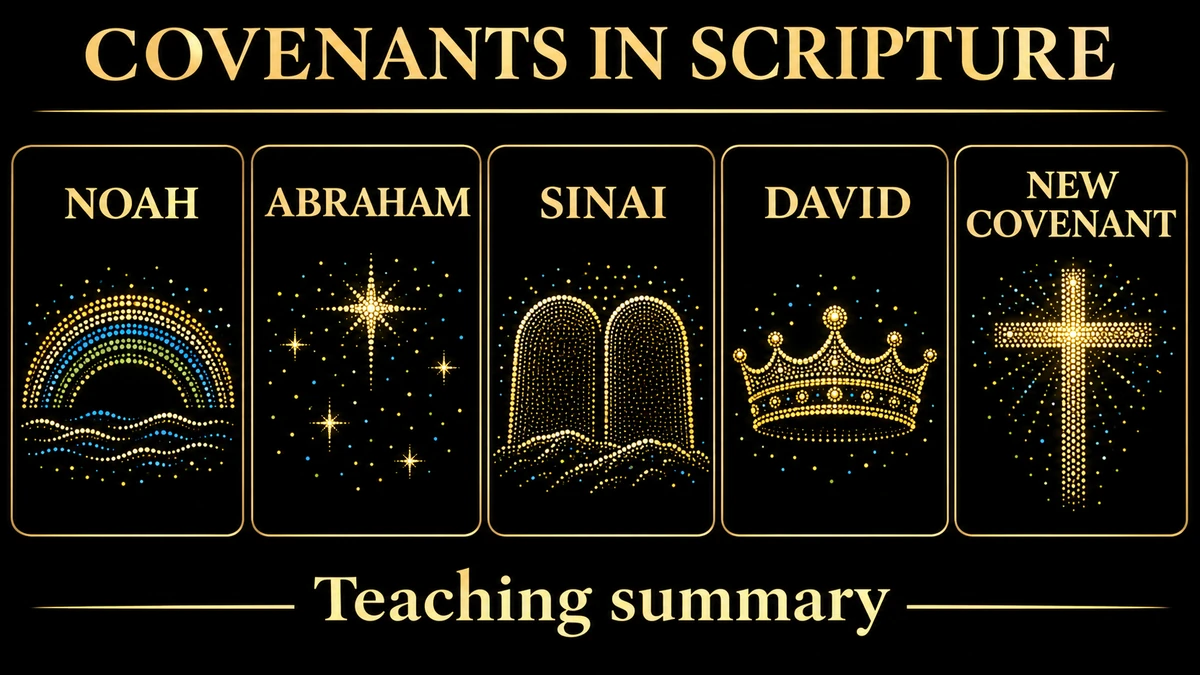
Covenants in Scripture: Noah; Abraham; Sinai; David; new covenant. Teaching summary, not a quotation of Scripture or an exhaustive list.
Where Christians Differ About the Covenants
Christians agree broadly that Jesus mediates the new covenant, but disagree about how the covenants relate to one another, the church, and Israel’s future.
Reformed covenant theology commonly understands the history of salvation through one covenant of grace administered differently before and after Christ. The Westminster Confession, chapter 7, is a classic expression. This approach stresses the continuity of God’s saving purpose and people.
Dispensational approaches distinguish Israel and the church more sharply and expect a future fulfillment of promises to Israel as Israel. The Dallas Theological Seminary doctrinal statement expresses one influential version. Dispensationalists themselves differ about how the church participates in new covenant blessings.
These two approaches do not exhaust Christian interpretation. Catholic, Orthodox, and other Protestant traditions also discuss continuity, fulfillment, and covenant membership in different ways. Labels should introduce a position, not replace careful reading of it.
Every Christian account must reckon with Paul’s warning against Gentile arrogance. In Romans 11, Gentile believers are grafted into an existing olive tree, told not to boast over its branches, and confronted with God’s continuing faithfulness. Christians disagree over the details of Israel’s future; contempt for Jewish people is incompatible with Paul’s warning. Judaism must also be understood on its own terms rather than reduced to a failed attempt to earn God’s love.
Why Covenants Matter for Ordinary Faith
Covenants teach us to locate our confidence in God’s character while taking our response seriously. They challenge both anxious bargaining with God and casual indifference to obedience. God’s faithfulness gives people reason to trust Him, confess sin, and keep walking when fulfillment seems slow.
Consider this illustrative everyday situation: a Christian promises to help a neighbor move, then cancels without explanation because a more enjoyable invitation arrives. Reading about God’s covenant faithfulness prompts an uncomfortable recognition. The believer should apologize, acknowledge the inconvenience, and offer realistic help rather than invent an excuse.
That apology does not buy salvation. Nor is an ordinary promise equivalent to God’s covenant. The example simply shows how receiving faithful love should shape a person’s own reliability. Grace gives room for honest repentance, while fidelity gives that repentance practical expression.
Covenant study ultimately directs attention toward Jesus. We approach God through the mediator He has provided, depend on forgiveness we could not earn, and learn to become people whose words and conduct can be trusted. Scripture’s long history of promise and fulfillment gives substance to that daily hope.
Frequently Asked Questions About Biblical Covenants
How Many Covenants Are in the Bible?
There is no universally agreed total. Noah, Abraham, Sinai, David, and the new covenant are five major landmarks. Scripture also describes other covenants, including God’s priestly covenant with Phinehas in Numbers 25:12–13. Counts differ depending on whether renewals, human agreements, and inferred theological covenants are included.
Did God Make a Covenant With Adam?
Many Christians understand God’s relationship with Adam covenantally, often using the name “covenant of works.” Genesis 1–3 does not explicitly call it a covenant. Hosea 6:7 is relevant, but its reference to Adam is disputed. The classification is a theological interpretation, not an uncontested label in Genesis.
Are the Old and New Testaments the Same as the Old and New Covenants?
The names are related, but the categories differ. The Testaments are collections of biblical books. The old covenant usually refers to the Mosaic arrangement when contrasted with the new covenant in Christ. The Old Testament contains several covenants and already announces the new one.
Does the New Covenant Mean Christians No Longer Need to Obey God?
No. Jeremiah’s promise includes God’s law written on the heart, and Ezekiel connects renewal with walking in God’s ways. Christians debate how particular Mosaic commands apply, but the new covenant joins forgiveness with transformed allegiance. Trust in Christ produces a life learning love, holiness, and faithfulness.