
GUIDED ARTICLE EXPERIENCE
Did the Apostles Die for the Resurrection? What We Can Honestly Say
A narrated path through Scripture, evidence, and the article’s central conclusion.
Narrated chapter by chapter · No hosted audio or tracking
CONTINUE GUIDED TOUR
Continue where you left off.
GUIDED TOUR COMPLETE
You have reached the end of this study.
Study record saved on this device.
NOW GUIDING YOU
Did the Apostles Die for the Resurrection? What We Can Honestly Say
Paranoid Prophet Recommended Voice Native device narration
Prepare to follow the article as it is narrated.
VOICE & TOUR OPTIONS
Voice & Listening
NARRATOR
Finding a narrator…
Checking the best narrator available on this device.
Restores the best curated narrator available on this device.
Narrator choices are curated for clear, long-form listening on this device.
CHOOSE A NARRATOR
Curated for this device
Choose a verified narrator for this browser, or use System Narrator. Automatic mode uses the best reliable route exposed by this device; your chosen narrator is preserved even if this device needs a temporary fallback.
Preparing the guided article experience…
RESUME GUIDED TOUR?
Continue where you left off.
GUIDED TOUR COMPLETE
You have reached the end of this study.
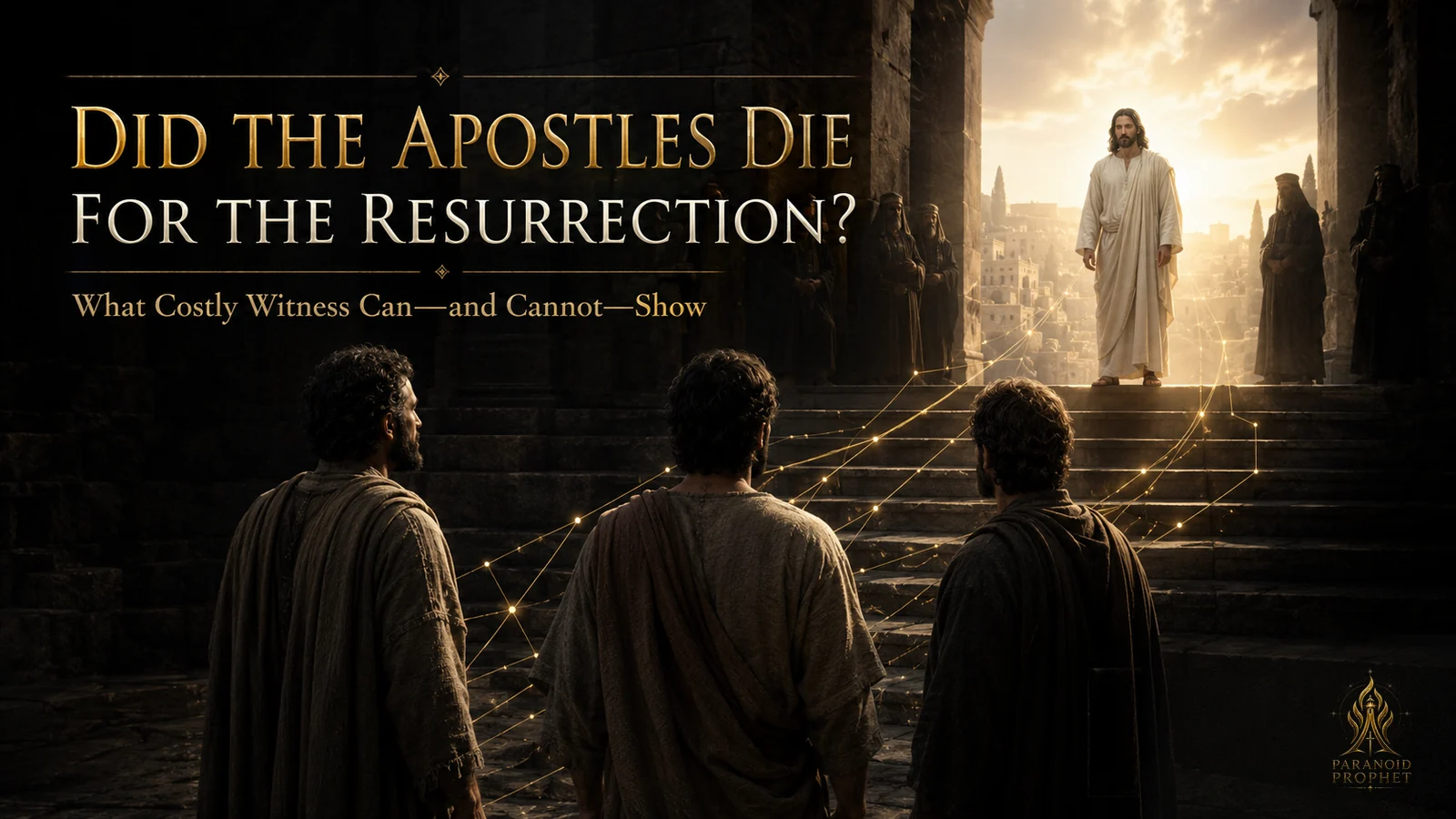
Did the apostles die for the resurrection? The honest answer is more careful than a slogan.
The evidence does not establish that every apostle died as a martyr under identical circumstances. It does not show that every witness faced the same formal choice to deny Jesus or die. And later traditions about individual deaths are not all equally early, independent, or historically secure.
Yet the earliest Christian sources do establish something important. The resurrection of Jesus was proclaimed publicly, tied to named witnesses, opposed from the beginning, and costly for many who carried it forward. Acts records arrest, threats, flogging, imprisonment, persecution, and the execution of James the son of Zebedee. Paul’s own letters describe repeated suffering connected to his ministry. Early Christian memory also preserves the costly endurance of Peter and Paul.
That pattern does not prove that Jesus rose from the dead by itself. People can suffer or die for beliefs that are false. But it does matter when evaluating whether the first witnesses were knowingly inventing the message they proclaimed. Costly witness can support sincerity and make deliberate fabrication harder to explain. It belongs within the larger case for the risen Christ.
For the wider survey of individual apostolic traditions, evidence tiers, and what can be said about specific disciples, see Martyrdom of Jesus’ Disciples.
Article Guide12 sections
Short Answer: Did the Apostles Die for the Resurrection?
Some early Christian witnesses plainly suffered, and some were executed. The New Testament directly records the execution of James, the brother of John, during early persecution against the church. Paul’s letters provide firsthand testimony to repeated danger, beatings, imprisonment, and hardship in Gospel ministry. Early Christian sources remember Peter and Paul as men who endured severe suffering and reached death as faithful witnesses.
But the evidence is not uniform for every apostle. The best sources do not give matching death accounts for all twelve, identical legal circumstances, or a universal recantation test. A responsible Christian argument should not pretend otherwise.
The stronger conclusion is narrower: the earliest movement was built around public testimony that God raised Jesus from the dead. That testimony was linked to identifiable people, continued under pressure, and proved costly for many of its central witnesses. This makes it difficult to explain the movement as a message its leading proclaimers knew to be false.
Before Counting Deaths: What Claim Are We Testing?
Questions about apostolic martyrdom often begin in the wrong place. Readers are handed a list of twelve names, a collection of dramatic death stories, and the conclusion that all the apostles chose death rather than deny the resurrection. But historical inquiry must begin before the final scene. What exactly do the sources record? Which witnesses are being discussed? What kind of cost did they face? And what conclusion can that evidence reasonably support?
The central issue is not whether Christians can assemble a memorable death story for every apostle. It is whether the earliest witnesses to the risen Jesus treated their public message as something they knew was invented, disposable, or false.
The New Testament presents the resurrection as a public claim. The apostles were not merely preserving a private spiritual impression. They proclaimed that God had raised Jesus, that they had been appointed as witnesses, and that His resurrection marked Him out as the promised Messiah and Lord.
“One of these men must become with us a witness to his resurrection.”
That apostolic role matters. The earliest Christian message was tied to named people who claimed continuity with Jesus’ ministry, death, and resurrection. Paul likewise preserves an early received proclamation that names Cephas, the Twelve, James, and others in connection with appearances of the risen Christ. 1 Corinthians 15:3–8
None of this means each named witness has an equally documented death account. It means the Christian proclamation was not presented as an anonymous legend with no identifiable witnesses attached to it. The question of suffering and death belongs within that first-generation network of public resurrection testimony.
Witness, Suffering, Execution, Martyrdom, and Personal Knowledge
These words should not be treated as interchangeable.
- Witness refers to a person who publicly testifies to what he or she claims to know about Jesus and the resurrection.
- Suffering includes opposition, threats, arrest, flogging, imprisonment, danger, exile, and social loss connected to Christian proclamation.
- Execution means that a person was put to death by an authority. It does not automatically tell us every detail of motive, trial, or final testimony.
- Martyrdom properly refers to death understood as faithful witness under hostility. The historical evidence for that conclusion varies from person to person.
- Personal knowledge concerns the particular relationship of a witness to the resurrection claim. A first-generation witness who publicly proclaims Jesus risen is not in the same position as a later convert who dies for a received belief.
These distinctions do not weaken the Christian case. They keep it from relying on inflated claims. A source may strongly support suffering without recording execution. It may establish execution without narrating a chance to recant. It may preserve later martyr memory without supplying an eyewitness account. Careful reasoning asks each source to bear only the weight it can carry.
Scripture First: What the Earliest Christian Texts Record
Acts gives Scripture’s direct canonical record of the first Christian witnesses proclaiming Jesus publicly amid resistance. It is not a modern court transcript, and Christians should not treat it as though it independently settles every later question about every apostle. But it directly presents the early movement as public, resurrection-centered, and opposed.
Acts 4 begins with Peter and John speaking to the people after the healing of a man at the temple. The priests, captain of the temple, and Sadducees are disturbed because the apostles are teaching the people and “proclaiming in Jesus the resurrection from the dead.” Peter and John are arrested, questioned, and ordered not to speak or teach at all in Jesus’ name. Their response is not silence but continued witness. Acts 4:1–22
Acts 5 intensifies the pattern. The apostles are arrested again, brought before the council, and charged with continuing to teach in Jesus’ name. Peter responds by proclaiming that God raised Jesus and exalted Him. The apostles are flogged and ordered not to speak in His name. Yet they leave “rejoicing that they were counted worthy to suffer dishonor for the name,” and they continue teaching and preaching that Jesus is the Christ. Acts 5:17–42
This evidence matters because the resurrection claim is not separated from the pressure that follows it. Acts does not portray the apostles as safely repeating a harmless religious idea. It portrays them as publicly proclaiming the risen Jesus under the threat of official opposition.
Paul’s own letters provide a second kind of evidence: firsthand testimony from a missionary who describes the cost of his ministry. He speaks of imprisonments, countless beatings, danger from authorities and opponents, stoning, shipwreck, hunger, sleeplessness, and the daily pressure of concern for the churches. 2 Corinthians 11:23–28
Paul does not write this list as an attempt to prove that every apostle suffered in precisely the same way. He writes as someone defending the character of his ministry. But the letter provides direct personal evidence that carrying the Gospel publicly was not a path to ease, status, or safety.
Paul also places himself in contact with the earliest witness network. After his conversion, he says that he visited Cephas and later saw James, the Lord’s brother. Galatians 1:18–20 That contact does not give readers the death history of every witness. It does show that the resurrection proclamation connected Paul to identifiable first-generation leaders rather than to an anonymous story detached from living memory.
Three Key Examples, Three Different Evidence Types
The evidence becomes clearer when cases are not forced into one category. James the son of Zebedee, James the brother of Jesus, and Peter and Paul each illustrate a different kind of historical support. Their stories should not be merged, but carefully distinguished.
James the Son of Zebedee: Direct Biblical Execution
Acts records that Herod Agrippa “killed James the brother of John with the sword.” Acts 12:1–2 James, the brother of John and son of Zebedee, was one of the Twelve. This is the clearest New Testament death account for a member of that group.
The text establishes an execution during early persecution against the church. It does not give James’s final words, describe his trial, state that he was offered a formal chance to deny the resurrection, or explain every dimension of Herod’s motive. Those missing details should remain missing in the article’s argument.
Still, Acts 12 belongs within the larger pattern already visible in Acts 4 and 5. The church’s public witness to Jesus had encountered arrest, threats, and flogging. James’s execution shows that the cost of that early movement could become lethal.
The next examples require a different evidentiary method. James the brother of Jesus is not one of the Twelve, but Paul and Josephus place him within the first-generation Christian movement. Peter and Paul are remembered in an early Christian source as men of costly endurance and death, while the most familiar details of their deaths appear later. Those distinctions are not problems to hide. They are precisely how responsible historical reasoning works.
James the Brother of Jesus: First-Generation Witness and External Execution Anchor
James the brother of Jesus must be kept distinct from James the son of Zebedee. He is not evidence about the death of a member of the Twelve. He belongs instead to the first-generation leadership and witness network surrounding the earliest Christian proclamation.
Paul includes James among those connected to the resurrection message. In the tradition Paul received and passed on, Christ “appeared to James,” then to all the apostles. 1 Corinthians 15:3–8 Later, Paul describes visiting Cephas and seeing James, the Lord’s brother, in Jerusalem. Galatians 1:18–20
Those passages do not tell the full story of James’s life or death. They do establish that James stands within the earliest network of people connected to the resurrection proclamation and the Jerusalem church. That matters because the Christian message was not carried forward only by distant converts. It was also carried by figures close to the earliest witness community.
Josephus provides an important external historical anchor for James’s execution. In Antiquities of the Jews, he identifies James as “the brother of Jesus who was called Christ” and reports that James and others were brought before the Sanhedrin and delivered to be stoned. Josephus, Antiquities 20.200” target=”_blank” rel=”noreferrer noopener”>Josephus, Antiquities 20.200
That source should be used with care. Josephus establishes James’s identity in relation to Jesus and gives an external report of his execution. It does not independently report a resurrection appearance to James. It does not say that James was killed because he repeated a particular resurrection formula. And it does not place James among the Twelve.
The significance is therefore cumulative rather than simplistic. Paul places James within the first-generation witness and leadership network. Josephus supplies an external execution anchor. Together, those sources make James an important case in the wider story of costly early Christian witness. They do not permit the article to claim more than they say.
Peter and Paul: Early Christian Memory of Costly Endurance
Peter and Paul occupy a different evidentiary category. The New Testament records Peter’s public witness, arrest, threats, and continued proclamation, while Paul’s own letters provide firsthand testimony to his suffering in ministry. But the most familiar details about the way Peter and Paul died come from later traditions, not from the New Testament itself.
An early Roman Christian letter known as 1 Clement remembers both men as examples of severe suffering and martyrdom. It portrays Peter as enduring many labors before reaching his appointed glory. It remembers Paul’s imprisonments, exile, stoning, broad proclamation, and final witness before rulers.
This matters because the letter preserves an early Christian memory that Peter and Paul were not remembered as comfortable religious teachers whose message cost them nothing. They were remembered as men who endured opposition and reached death as faithful witnesses.
But 1 Clement does not provide the details later generations often repeat. It does not say Peter was crucified upside down. It does not say Paul was beheaded. It does not identify the officials who condemned them, provide dates, preserve trial transcripts, or explain whether either man received a formal opportunity to renounce Christ.
That limitation is not a reason to discard the source. It is a reason to use it accurately. 1 Clement supports an early Christian memory of Peter and Paul’s costly endurance and death. It does not support every later detail attached to their deaths.
Paul’s own testimony remains especially important because it comes from Paul himself. He speaks of repeated imprisonments, beatings, danger, stoning, hardship, and concern for the churches. 2 Corinthians 11:23–28 That is direct evidence of costly ministry. The later question of Paul’s execution should be treated as a distinct historical question rather than folded into the firsthand record of his suffering.
How Later Tradition Should Be Weighed
Later tradition is neither useless nor self-authenticating. It can preserve genuine memory, especially when a community continues to remember a prominent witness over generations. But later traditions also stand at a greater distance from the events. They can absorb local devotion, literary expansion, name confusion, theological emphasis, and details that cannot be independently checked.
A responsible approach does not ask whether a story is moving, famous, or repeated in Christian art. It asks what the source actually says and how much historical weight it can bear.
Four questions help keep that process clear:
- How early is the source? Earlier testimony normally deserves greater weight than a much later narrative.
- How close is the source to the person and setting described? A source connected to the relevant region, community, or period may preserve more reliable memory than one written far away and centuries later.
- Is the tradition independent? Several late accounts may repeat one earlier story rather than provide several separate confirmations.
- Does the account identify the correct person and remain consistent with other evidence? Apostolic names recur, and some traditions conflict in place, manner, or sequence.
These questions do not create skepticism for its own sake. They protect the truth from being defended with claims that cannot be sustained. A detailed death story should not be treated as certain merely because it is memorable or ancient-sounding. At the same time, a later tradition should not be rejected automatically merely because it is later. Each claim should be weighed according to its date, source relationship, identity clarity, and agreement or conflict with other evidence.
This is why the article does not build its case on a tally of twelve matching martyrdom accounts. The strongest evidence comes first: named resurrection witness, public proclamation, direct records of pressure, direct records of some executions, Paul’s firsthand testimony of suffering, and carefully graded early Christian memory.
Names Matter: Do Not Borrow Evidence from Another Witness
One of the easiest ways to overstate apostolic martyrdom evidence is to merge people who share similar names. The New Testament itself contains several figures named James, Simon, Judas, and Philip. Later Christian traditions can add further naming variations, titles, and regional memories.
Historical care requires each witness to remain distinct.
- The three Jameses: James the son of Zebedee, James the son of Alphaeus, and James the brother of Jesus are not interchangeable. Acts 12 concerns James the son of Zebedee. Josephus concerns James the brother of Jesus.
- Philip: Philip the apostle should not be casually merged with Philip the evangelist in Acts.
- Jude, Judas, and Thaddaeus: Traditions using these names must be examined carefully and never confused with Judas Iscariot.
- The two Simons: Simon Peter and Simon the Zealot are distinct figures with different evidence trails.
These distinctions may seem technical, but they are essential. Evidence attached to one person cannot be transferred to another simply because names overlap or traditions become blended. A Christian case for the resurrection does not need borrowed evidence. It is stronger when each source is allowed to speak about the person it actually identifies.
For the broader survey of individual witnesses, their traditional death accounts, and the evidence level attached to each, see Martyrdom of Jesus’ Disciples.
Once the evidence is ranked this way, the next question can be asked honestly: what does costly witness contribute to the case for the resurrection, and what does it leave unproven?
What Costly Witness Can—and Cannot—Prove
People can suffer or die for beliefs that are false. History contains many examples of sincere people who were mistaken, deceived, or committed to ideas that did not correspond to reality. Death does not turn a belief into a fact, and Christian faith does not need that weak argument.
The narrower historical question is different. Were the earliest witnesses to Jesus’ resurrection knowingly inventing the message they proclaimed publicly? The evidence considered in this article cannot answer every question about every apostle’s death. It can, however, establish that the earliest resurrection proclamation was attached to named people, publicly declared under opposition, and costly for central witnesses.
That pattern supports sincerity. It makes a deliberate-fabrication explanation harder to sustain. Men and women may die for something false because they believe it is true. But the first witnesses stand in a distinct historical position if they were personally connected to the claim that Jesus had been raised and then continued proclaiming it amid pressure. Their costly witness does not prove the resurrection. It does challenge the idea that they knowingly manufactured the message.
This distinction matters. The resurrection must be considered through the larger biblical and historical case: Jesus’ death by crucifixion, the early proclamation that He was raised, the named witness tradition, Paul’s transformation, James’s place in the earliest movement, and the testimony preserved in the New Testament. Costly witness is one strand in that cumulative case. It is not the whole case.
Evidence Matrix: How to Weigh Apostolic-Death Claims
| Source | What it records | What it does not establish | Responsible conclusion |
|---|---|---|---|
| Acts 1:21–22; Acts 4–5 | Apostolic witness is tied to Jesus’ resurrection, and public proclamation brings arrest, threats, and flogging. | A full independent history of every apostle’s later death. | Resurrection proclamation was public and costly from the earliest Christian record. |
| Acts 12:1–2 | James son of Zebedee is executed with the sword during persecution. | Trial details, a recantation offer, final words, or a complete motive analysis. | One member of the Twelve was executed in the early period of church persecution. |
| 1 Corinthians 15:3–8; Galatians 1:18–20 | Early resurrection proclamation names witnesses, and Paul had first-generation contact with Cephas and James. | The death history of every named witness. | The resurrection message was attached to identifiable people, not an anonymous legend. |
| 2 Corinthians 11:23–28 | Paul reports imprisonments, beatings, stoning, danger, and hardship in ministry. | Paul’s death or a uniform experience for all early Christians. | Paul’s own letters provide firsthand evidence of costly ministry. |
| Josephus, Antiquities 20.200 | James, brother of Jesus called Christ, and others are delivered to be stoned. | That James was one of the Twelve, died for a stated resurrection claim, or faced a recantation test. | James’s execution has an important external historical anchor. |
| 1 Clement 5 | Peter and Paul are remembered as enduring suffering and reaching death as exemplary witnesses. | Exact execution methods, dates, officials, or detailed trial circumstances. | Early Christian memory supports the broad tradition of Peter and Paul’s costly endurance and death. |
| Later traditions | Some preserve regional memory about individual witnesses. | That every narrative detail is early, independent, or historically certain. | Each tradition must be assessed individually, never pooled into a universal claim. |
What Christians Can Say Confidently
- The earliest Christian proclamation centered on the claim that God raised Jesus from the dead.
- That proclamation was public, tied to identifiable witnesses, and met opposition early.
- Acts directly records arrest, threats, flogging, imprisonment, persecution, and the execution of James the son of Zebedee.
- Paul’s letters personally attest repeated suffering connected to his ministry.
- Josephus provides an external historical anchor for the execution of James, the brother of Jesus.
- 1 Clement preserves early Christian memory of Peter and Paul’s costly endurance and deaths.
- Costly witness supports the conclusion that early Christians did not treat the resurrection message as disposable.
- The fuller resurrection case rests on more than suffering: it includes Jesus’ death, early proclamation, named witnesses, and the biblical and historical evidence for the risen Christ.
What Christians Should Not Claim
- Every apostle died as a martyr.
- Every apostle had the same opportunity to deny Jesus and escape death.
- Every apostolic death tradition comes from an eyewitness source.
- James the brother of Jesus and James the son of Zebedee are interchangeable evidence.
- Josephus independently confirms a resurrection appearance to James.
- 1 Clement proves that Peter was crucified upside down or that Paul was beheaded.
- Martyrdom proves that the resurrection happened.
- A person’s willingness to die proves that every belief he or she holds is true.
These limits are not a retreat from the Christian case. They protect the argument from claims the evidence cannot bear. A strong case for Christ does not require every tradition to be equally secure. It requires that each source be used honestly, that strong evidence be allowed to remain strong, and that uncertain evidence be treated with humility.
Why This Matters for the Larger Resurrection Case
The witness evidence matters because the resurrection claim was not announced as a distant myth or private religious idea. It was proclaimed publicly by people whose names, relationships, and ministries appear within the earliest Christian sources. They testified that Jesus had been crucified, that God had raised Him, and that He was now the exalted Lord and Messiah.
Acts presents that proclamation as dangerous from the beginning. Paul’s own letters show that carrying the Gospel could involve real suffering. James the son of Zebedee was executed. James the brother of Jesus has an external execution anchor. Peter and Paul were remembered early as examples of costly endurance and death.
None of those facts, considered in isolation, forces a person to accept the resurrection. But together they help explain why the earliest Christian movement cannot be reduced to a cynical invention by leaders who knew they were deceiving others. The witnesses were not merely defending an abstract philosophy. They were publicly identifying themselves with the risen Jesus in circumstances that could bring real loss.
The final question is therefore larger than the fate of any one apostle. Why did the earliest movement proclaim a crucified Jesus as risen Lord? Why did that proclamation appear so early, attach itself to named witnesses, and continue despite opposition? The New Testament’s answer is not that the witnesses found a useful fiction. It is that God raised Jesus from the dead.
For the earliest evidence concerning the resurrection proclamation itself, see How Early Is the Resurrection Claim?. For the wider historical foundation concerning Jesus’ life and crucifixion, see Historical Evidence for Jesus. For the full Scriptural and historical case centered on His identity, see Is Jesus the Son of God?.
Frequently Asked Questions
Did every apostle die as a martyr?
No. The evidence is not equally strong for every apostle, and some later traditions are uncertain, late, dependent on earlier material, or in tension with other traditions. A responsible argument should not claim more than the sources establish.
Did the apostles all have a chance to recant?
We do not know that. The sources do not describe one universal legal procedure or the same choice for every witness. The evidence supports public pressure, costly witness, and some executions; it does not establish an identical recantation test for every apostle.
Does martyrdom prove the resurrection?
No. People can die for beliefs that are false. Costly witness can support sincerity and challenge a deliberate-fraud explanation, but it cannot establish the resurrection without the larger biblical and historical case.
Was James the brother of Jesus one of the Twelve?
No. James the brother of Jesus should be treated as a prominent first-generation leader and resurrection witness, not merged with James the son of Zebedee or James the son of Alphaeus.
Does 1 Clement tell us how Peter and Paul died?
No. It preserves early Christian memory of their suffering and deaths, but it does not provide execution mechanics, trial records, dates, named officials, or a formal recantation narrative.
Why use later traditions at all?
Later traditions may preserve genuine memory, especially when they are tied to an early Christian community or region. But they must be weighed individually for date, source proximity, identity accuracy, dependence on earlier sources, and conflict with other accounts. Later tradition is not worthless; it is simply not equal to direct Scripture, firsthand testimony, or an early independent historical source.
Continue the Evidence
- Read the Broader Survey: Martyrdom of Jesus’ Disciples
- Examine the Earliest Resurrection Proclamation
- Explore Prophecies of Jesus’ Resurrection Fulfilled
- Study Jesus’ Crucifixion Prophecies: Isaiah 53, Psalm 22, and the Cross
- See the Wider Case: Is Jesus the Son of God?
Sources and Further Reading
- Primary biblical texts: Acts 1:21–22; Acts 4–5; Acts 7; Acts 12:1–2; 1 Corinthians 15:3–8; Galatians 1:18–20; 2 Corinthians 11:23–28; Revelation 1:9.
- Primary ancient sources: Josephus, Antiquities of the Jews 20.200; 1 Clement 5.
- Sean McDowell, The Fate of the Apostles: Examining the Martyrdom Accounts of the Closest Followers of Jesus.
- Candida Moss, The Myth of Persecution: How Early Christians Invented a Story of Martyrdom.
- John Granger Cook, Roman Attitudes Toward the Christians: From Claudius to Hadrian.
- W. H. C. Frend, Martyrdom and Persecution in the Early Church.
- Paul Middleton, Radical Martyrdom and Cosmic Conflict in Early Christianity.
Ancient sources vary in purpose, date, and proximity to the events they describe. This article uses each source only for the claims it can reasonably support.
These works represent relevant scholarly resources for the texts discussed. Their inclusion does not imply agreement with every conclusion in this article.
Unless otherwise indicated, Scripture quotations are from the ESV® Bible.
The Witnesses Point Beyond Themselves to the Risen Christ
The apostles and early witnesses are not the center of the Christian message. Their courage does not save, and their suffering is not the foundation of the church. They matter because they point beyond themselves to Jesus Christ: the One they proclaimed as crucified, risen, exalted, and coming again.
The strongest Christian claim is not that every witness left behind a perfectly documented death story. It is that the earliest Christian movement was built around public testimony to the risen Jesus, carried by identifiable people who endured real pressure rather than treating their message as a convenient invention.
Jesus Christ is not sustained by the legends of His followers. He is the risen Lord whom His followers proclaimed. Their costly witness cannot replace the evidence for His resurrection, but it stands within that larger testimony and directs the reader back to Him: the crucified Savior, the risen Son of God, and the King who will make all things new.