
GUIDED ARTICLE EXPERIENCE
Did Mary Have Other Children?
Read along as the narration moves through the article.
Private device narration · No hosted audio or tracking
CONTINUE GUIDED TOUR
Continue where you left off.
GUIDED TOUR COMPLETE
You have reached the end of this study.
Study record saved on this device.
GUIDED TOUR
Did Mary Have Other Children?
Narrator: Paranoid Prophet Recommended Voice Native device narration
Prepare to follow the article as it is narrated.
VOICE & TOUR OPTIONS
Voice & Listening
NARRATOR
Finding a narrator…
Checking the best narrator available on this device.
Restores the best curated narrator available on this device.
Narrator choices are curated for clear, long-form listening on this device.
Screen-awake support will be checked when narration starts.
CHOOSE A NARRATOR
Curated for this device
Choose a verified narrator for this browser, or use System Narrator. Automatic mode uses the best reliable route exposed by this device; your chosen narrator is preserved even if this device needs a temporary fallback.
Preparing the guided article experience…
RESUME GUIDED TOUR?
Continue where you left off.
GUIDED TOUR COMPLETE
You have reached the end of this study.
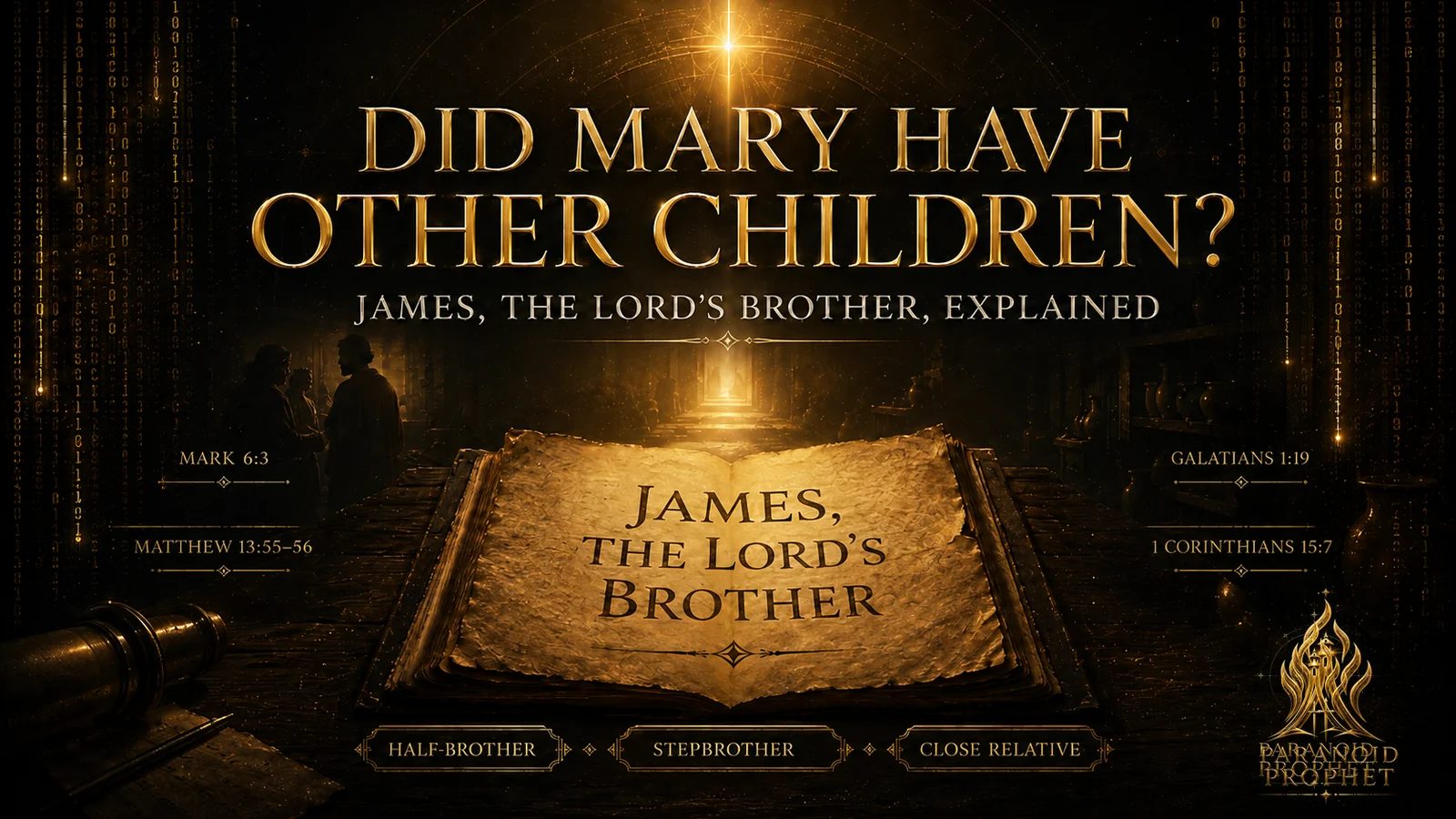
The New Testament calls James “the Lord’s brother.” That sounds simple until the next question appears: if James was Jesus’ brother, did Mary have other children?
For some Christians, the answer seems obvious. The Gospels mention Jesus’ brothers and sisters, and Paul specifically identifies James as “the Lord’s brother.” For others, the question touches one of the oldest Christian beliefs about Mary: that she remained a virgin before, during, and after the birth of Christ. Still others believe the best answer is that Joseph was older, previously widowed, and already had children before he was entrusted with Mary and the child conceived by the Holy Spirit.
So what was James? Was he Jesus’ half-brother, Mary’s later son with Joseph? Was he Jesus’ stepbrother, Joseph’s son from a previous marriage? Was he a cousin or close relative described with family language? And how should Christians handle this question when Scripture gives real evidence, but not every detail we might want?
This article begins with Scripture, then weighs the three major Christian views. We will not treat every theory as equally strong. We also will not pretend the Bible answers more than it actually answers. Scripture is final authority. Tradition can help us understand how Christians have wrestled with the question, but tradition cannot outrank the biblical text.
Article Guide12 sections
The Short Answer
The Bible clearly refers to Jesus’ brothers and sisters. In Mark 6:3, the people of Nazareth ask, “Is not this the carpenter, the son of Mary and brother of James and Joses and Judas and Simon? And are not his sisters here with us?” Matthew 13:55–56 gives a similar list.
Paul also refers to James in a striking way. In Galatians 1:19, he says he saw “James the Lord’s brother.” In 1 Corinthians 9:5, Paul speaks of “the brothers of the Lord” as a known group in the early Christian movement.
That means this is not a made-up question. The New Testament itself forces us to ask who these brothers were. At minimum, James belonged to Jesus’ family circle in a real and recognized way. He was not a random disciple given a symbolic nickname centuries later. He was known early as “the Lord’s brother.”
But here is where caution matters: the Bible does not explicitly tell us whether James was Mary’s later biological son, Joseph’s son from a prior marriage, or a close relative described with brother language. The brother language is clear. The exact family relationship is debated.
So the short answer is this: Scripture clearly teaches that Jesus had people known as His brothers and sisters, including James. The most direct reading is that they were family members in an ordinary household sense. The open question is whether that relationship came through Mary, through Joseph, or through wider kinship.
Christians have usually answered that open question in three main ways. The half-brother view says James and the others were later children of Mary and Joseph. The stepbrother view says they were Joseph’s children from a previous marriage. The cousin or close-relative view says they were not children of Mary or Joseph, but close kin described with family language.
This article will argue that the cousin view is possible, but least direct. The half-brother view has the strongest appeal if we limit ourselves to the biblical wording alone. The stepbrother view may offer the best historical-theological synthesis if Joseph was older, previously widowed, and had children before being entrusted with Mary and Jesus.
Source discipline: Scripture is the final authority. The New Testament clearly refers to Jesus’ brothers and sisters, including James. It does not explicitly define whether James was Mary’s later son, Joseph’s son from a prior marriage, or a close relative. For that reason, this article weighs the biblical text first, then explains the major Christian interpretations fairly.
Why This Question Matters
This question matters because James is not a minor footnote in the New Testament. He becomes a major leader in the Jerusalem church. Paul names him. Acts shows him involved in the life of the early church. Later Christian history remembers him as James the Just.
So before we talk about James’ leadership, resurrection witness, or martyrdom, we need to answer the family question honestly. When we call him “James the brother of Jesus,” what do we mean?
The question also matters because it touches how Christians understand Mary and Joseph. If James was Mary’s later son, then Mary and Joseph had a normal married life after Jesus’ birth. That is not sinful or dishonorable. Marriage is holy, and ordinary marital intimacy is not unclean.
On the other hand, many Christians have believed that Mary remained uniquely consecrated as the mother of the Messiah. The Catechism of the Catholic Church teaches Mary’s perpetual virginity and understands the “brothers and sisters” of Jesus as close relations rather than other children of Mary. Eastern Orthodox tradition often preserves Mary’s perpetual virginity differently, by understanding James and the others as Joseph’s children from an earlier marriage. The Orthodox Church in America identifies James as Joseph’s son from his first marriage.
That is why this article needs a careful tone. This should not become a cheap Catholic-versus-Protestant fight. It is a Bible question, a family question, and a historical-theological question. We should bring conviction, but also humility.
How This Article Will Handle the Question
The goal is not to win a denominational argument. The goal is to read Scripture honestly, weigh the major Christian explanations, and avoid pretending certainty where God has not given us that level of detail.
Where Scripture speaks clearly, we should stand firmly. Where Scripture gives clues but not every detail, we should practice holy curiosity under biblical authority.
That means we will not mock the Catholic cousin view, even if we find it less direct. We will not dismiss the Protestant half-brother view, because marriage is honorable and the straightforward reading has real force. We will not treat the Orthodox stepbrother view as a convenient escape hatch, because it has deep roots in Christian tradition and may explain why James could be truly known as the Lord’s brother without requiring Mary to have borne later children.
Most importantly, this article will not let the Mary question swallow the larger point. James matters because he was close to Jesus, known in the early church, later counted among the leaders in Jerusalem, and connected to the resurrection witness. However the family details are understood, James stands near the center of the earliest Christian story.
So we begin where every Christian article should begin: not with tradition, not with denominational instinct, and not with speculation, but with the words of Scripture.
What Does the Bible Say About Jesus’ Brothers?
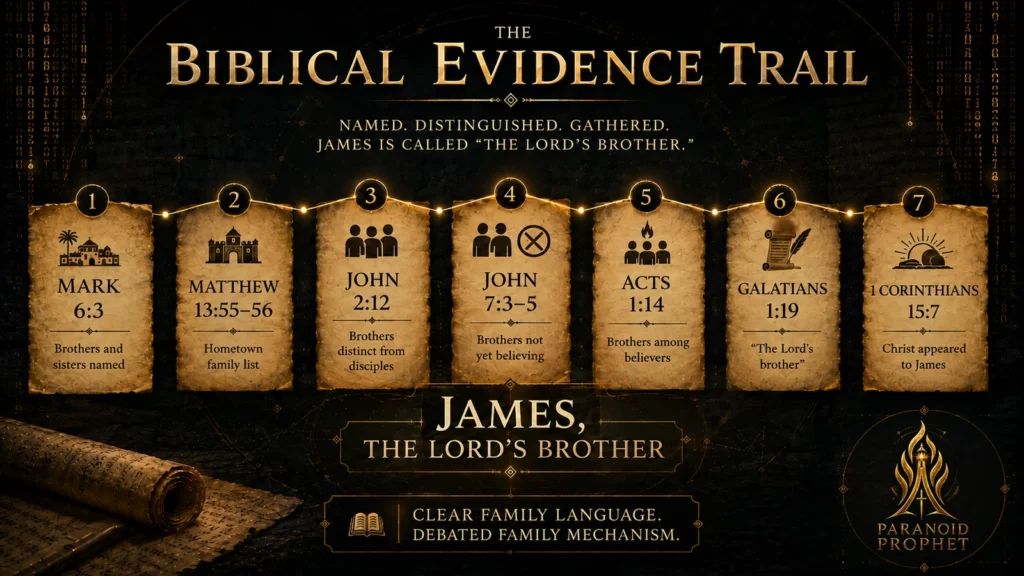
Before we decide whether James was Jesus’ half-brother, stepbrother, cousin, or close relative, we need to read the biblical pattern itself. The New Testament does not treat Jesus’ brothers as an imaginary category. They appear in the Gospel story. They are distinguished from Jesus’ disciples. They are named in His hometown setting. After the resurrection, they appear among the believers. Paul later refers to James as “the Lord’s brother.”
That does not settle every biological detail. The Bible does not pause to explain whether these brothers came through Mary, through Joseph, or through wider kinship. But the language is not weightless. Scripture gives us enough to say that James and the other brothers belonged to Jesus’ earthly family circle in a recognizable way.
James, Joses, Judas, Simon, and the Sisters
The clearest Gospel texts are Mark 6:3 and Matthew 13:55–56. In Mark, the people of Nazareth respond to Jesus by asking, “Is not this the carpenter, the son of Mary and brother of James and Joses and Judas and Simon? And are not his sisters here with us?” Matthew gives a parallel scene, calling Jesus “the carpenter’s son” and naming James, Joseph, Simon, Judas, and His sisters.
The setting matters. This is not a passage about abstract theology. It is a hometown recognition scene. The people are identifying Jesus by His local and family connections. They know His mother. They know His brothers. They know His sisters. Their response is not worshipful; it is dismissive. They think they already know where Jesus comes from.
That is why these verses have carried so much weight in the debate. On the surface, the language sounds like ordinary family language. Jesus is identified in relation to Mary, His brothers are named, and His sisters are mentioned as people known in the community.
Still, careful readers should not jump too quickly from “brothers and sisters are named” to “therefore Mary definitely had other children.” That may be the most direct reading, and many Christians have understood it that way. But the passage itself does not stop to define whether these brothers were later children of Mary, earlier children of Joseph, or close relatives described by family language.
What the text does establish is this: the brothers and sisters of Jesus were not invented by later speculation. The Gospel writers place them inside the public memory of Jesus’ earthly life.
Jesus’ Brothers in the Gospel Story
The brothers of Jesus appear elsewhere in the Gospels, not only in the hometown lists. In John 2:12, after the wedding at Cana, Jesus goes down to Capernaum with His mother, His brothers, and His disciples. That verse is easy to pass over, but it is important. John distinguishes Jesus’ mother, His brothers, and His disciples in one sentence.
That distinction matters because it shows that “brothers” does not simply mean “disciples.” John does not say Jesus went with His mother and His followers. He names His mother, His brothers, and His disciples as distinguishable groups around Him. Whatever else “brothers” means, it cannot be reduced to spiritual brotherhood or general discipleship.
John 7 gives an even sharper picture. Jesus’ brothers urge Him to go to Judea and make His works known publicly. Then John adds, “For not even his brothers believed in him” (John 7:3–5). That is a sobering line. Those closest to Jesus by family association did not automatically understand who He was.
We should be careful here. John does not name James in that specific scene, so we should not overbuild a detailed psychological portrait of James from one group reference. But John does show that Jesus’ brothers were a defined group in the Gospel narrative, and at that point they were not presented as believing disciples.
This also prepares us to understand why James becomes so important later. If Jesus’ brothers were once outside the circle of faith, then their later presence among the believers matters. The New Testament does not give every step in that journey, but it does show movement from family tension to post-resurrection faith.
James the Lord’s Brother in Paul
The strongest early reference to James comes from Paul. In Galatians 1:18–19, Paul says that after three years he went up to Jerusalem to visit Cephas and stayed with him fifteen days. Then he adds, “But I saw none of the other apostles except James the Lord’s brother.”
That phrase matters. Paul is not telling a childhood story about Jesus. He is describing contact with leaders in Jerusalem, and he identifies James by his relationship to the Lord. This makes James more than a background figure in the Gospel lists. He is known in the early Christian movement as “the Lord’s brother.”
Paul also refers to “the brothers of the Lord” in 1 Corinthians 9:5. In that passage, he speaks of the right to be accompanied by a believing wife “as do the other apostles and the brothers of the Lord and Cephas.” Again, the brothers of the Lord appear as a recognizable group.
This does not settle the half-brother, stepbrother, or cousin debate by itself. But it does make the brother language early and serious. James was not merely called “brother” in a later devotional sense. Paul, writing from inside the first-generation Christian movement, knew James by that identification.
For that reason, any explanation of Jesus’ brothers has to account for Paul. A theory may argue that James was a half-brother. It may argue that he was a stepbrother through Joseph. It may argue that he was a close relative. But it cannot honestly ignore that Paul calls him “the Lord’s brother.”
Jesus’ Brothers Before and After the Resurrection
One of the most interesting patterns in the New Testament is the change in how Jesus’ brothers appear before and after the resurrection. In John 7, His brothers are not yet believers. But in Acts 1:14, after Jesus’ resurrection and ascension, the believers are gathered in prayer with Mary the mother of Jesus “and his brothers.”
That is a quiet but powerful shift. The brothers who once stood in tension with Jesus’ mission are now found among the praying believers after the resurrection. Acts does not explain every detail of how that change happened. It simply places them there, inside the earliest Christian community.
This matters especially for James. Paul says the risen Christ appeared to James in 1 Corinthians 15:7. John shows Jesus’ brothers in tension before the cross. Acts places them among the praying believers after the resurrection. Paul then names an appearance to James. That does not fill in every personal detail, but it gives James a serious place in the resurrection-witness story.
That is why this article cannot treat the “brothers of Jesus” question as trivia. The family language points into something larger. James was connected to Jesus before the resurrection, named by Paul after the resurrection, and remembered in the early church as a major Jerusalem figure.
At this stage, we are not yet deciding between half-brother, stepbrother, and cousin. We are simply observing the biblical pattern: Jesus’ brothers and sisters are repeatedly mentioned, James is specifically called the Lord’s brother, and the brothers of Jesus appear in both the Gospel story and the early church.
The biblical evidence gives us genuine family language. Now we have to ask what kind of family relationship that language describes. That is where the three major Christian views begin.
Was James Jesus’ Half-Brother?
The first major view is the half-brother view. This is the explanation many Protestants find most straightforward: Jesus was conceived by the Holy Spirit, so Joseph was not His biological father. If Mary and Joseph later had ordinary children together, then James would be Jesus’ half-brother through Mary.
This view does not deny the virgin birth. It does not say Joseph fathered Jesus. It says Mary was a virgin when she conceived and bore Jesus, and that after Jesus’ birth, Mary and Joseph lived as a married couple and had other children. On that reading, James, Joses or Joseph, Judas, Simon, and the sisters mentioned in Mark 6:3 and Matthew 13:55–56 were later children of Mary and Joseph.
The Plain-Reading Protestant View
The strength of the half-brother view is obvious: it reads the family references in the most direct way. When the people of Nazareth name Jesus’ brothers and mention His sisters, the plain sense sounds like members of His household. When Paul calls James “the Lord’s brother” in Galatians 1:19, the phrase naturally sounds like a family identification.
That is why this view should not be dismissed lightly. It does not need a complicated reconstruction to explain the words “brother” and “sister.” It takes the New Testament wording at face value and says: Jesus had siblings in His earthly household, and James was one of them.
This view also treats Mary and Joseph’s marriage as a real marriage. That matters. A normal married life is not unholy. Ordinary marital intimacy is not unclean. Scripture honors marriage, and there is nothing sinful about a husband and wife living faithfully as husband and wife.
So if Mary and Joseph had children after Jesus’ birth, that would not diminish the holiness of Jesus, the reality of the virgin birth, or Mary’s obedience to God. The Son of God was conceived by the Holy Spirit and born of the virgin Mary. That doctrine stands whether James was Mary’s later son, Joseph’s earlier son, or a close relative.
What This View Explains Well
The half-brother view explains the Gospel hometown scenes with little strain. The people know Jesus’ mother. They name His brothers. They mention His sisters. The most natural reading is that they are identifying Him by His family.
It also explains why John can distinguish Jesus’ brothers from His disciples in John 2:12, and why Paul can speak of “the brothers of the Lord” in 1 Corinthians 9:5. They were not simply spiritual brothers, and they were not merely generic disciples. They were known as the Lord’s brothers in a recognizable family sense.
This view also fits easily with the movement from John 7 to Acts 1. In John 7, Jesus’ brothers are not yet believers. In Acts 1, His brothers are gathered with Mary and the disciples after the resurrection. If these were Jesus’ actual household siblings, that movement becomes powerful: those closest to Him by family did not automatically believe, but after the resurrection they appear among the praying believers.
What This View Must Still Answer
The half-brother view is the strongest if we are reading only the surface of the New Testament family references. But it still has questions to answer.
First, it must explain why so much ancient Christian tradition resisted the idea that Mary had later children. That does not mean the tradition is automatically correct. Scripture outranks tradition. But if many early Christians were careful to preserve Mary’s perpetual virginity, that instinct deserves to be represented fairly rather than mocked.
Second, it must consider Mary’s unique calling. Mary was not an ordinary mother in an ordinary situation. She bore the Son of God. Joseph was not merely a normal husband entering a normal marriage arrangement. He was the righteous man entrusted to protect Mary and legally father the child conceived by the Holy Spirit. That unique calling does not prove perpetual virginity, but it explains why many Christians have thought the household may have been unusual.
Third, some point to Matthew 1:25, where Joseph “knew her not until she had given birth to a son,” and argue that “until” implies normal marital relations afterward. That is a serious argument, but it should not be overplayed. The verse clearly protects the virgin birth. Whether it also proves what happened afterward is debated.
So the half-brother view has strong textual force. It may be the most direct reading of the biblical wording by itself. But it is not the only serious Christian explanation.
Was James Jesus’ Stepbrother?
The second view says James was Jesus’ stepbrother. In this view, Joseph was older, had been married before, was widowed, and already had children before he became Mary’s husband and the earthly father entrusted to protect Jesus. James and the other brothers would then be Joseph’s children from a previous marriage.
This view is especially important in Eastern Orthodox tradition. The Orthodox Church in America identifies James the Brother of the Lord as the eldest son of Joseph the Betrothed from his first marriage. In that framework, James is not reduced to a distant or undefined relative. He is a true member of Jesus’ household, but not a later child of Mary.
The Older Joseph View
The stepbrother view tries to hold together two concerns. First, it takes the New Testament’s brother language seriously. James and the others are not explained away as merely symbolic brothers or unrelated disciples. Second, it leaves room for the belief that Mary remained uniquely consecrated after bearing Christ.
This is why the view can feel like a strong synthesis. It explains how Jesus could have brothers and sisters known in His hometown while also explaining why many Christians believed Mary had no later children. If Joseph already had sons and daughters, then Jesus could grow up in a household with brothers and sisters without those children being born from Mary after Jesus.
The view also makes sense of Joseph’s quiet disappearance from the later Gospel narrative. Scripture does not tell us when Joseph died. But if Joseph was older, previously widowed, and entrusted with Mary in a protective role, his absence during Jesus’ public ministry becomes easier to understand. That does not prove the theory, but it gives it narrative plausibility.
Joseph’s Earlier Children and Ancient Tradition
The older-Joseph view appears in early Christian tradition. The Protoevangelium of James, an early non-canonical writing, depicts Joseph as an older man who already has children when he is chosen to take Mary into his keeping. In that account, Joseph objects by saying, “I have children, and I am an old man, and she is a young girl.”
This source must be handled carefully. The Protoevangelium of James is not Scripture. It should not govern the interpretation of Matthew, Mark, John, Paul, or Acts. It contains legendary material and should not be treated as equal to the New Testament.
But it still matters historically. It shows that the older-Joseph / prior-children explanation is not a modern invention. Early Christians were already trying to explain how Jesus could have brothers while Mary remained virgin. Whether every detail of that tradition is historically reliable is another question. The point is that the stepbrother view has deep roots in Christian memory.
That makes the stepbrother view different from a convenient escape hatch. It is not a random modern attempt to avoid the plain meaning of “brothers.” It is a historically important explanation that takes the household language seriously while preserving Mary’s unique role.
Why This View May Hold the Pieces Together
This is why we find the stepbrother view compelling as a synthesis, though not something Scripture requires us to hold as dogma. Scripture does not explicitly tell us Joseph’s full backstory. It does not say, “Joseph was a widower with children from a previous marriage.” Therefore, we should not speak as if the stepbrother view is proven beyond debate.
But if we are weighing Scripture first and tradition second, the stepbrother view has a serious claim. It treats James and the others as real household brothers of Jesus. It accounts for the repeated family references in the Gospels and Paul. It also explains why ancient Christian tradition so strongly remembered Mary as uniquely set apart.
It may also fit Joseph’s character. Joseph appears in Scripture as a righteous man, obedient, protective, and willing to bear public shame in order to shelter Mary and the child. It is not hard to imagine him serving as a husband, protector, and legal father in a uniquely consecrated household. That does not make the stepbrother view certain, but it does make it plausible.
The strength of this view is that it does not flatten the evidence. It does not ignore the brother language. It does not require Mary to have later children. It does not reduce James to a distant cousin. It allows James to be truly known as the Lord’s brother while leaving room for Mary’s unique calling as the mother of the Messiah.
Was James Jesus’ Cousin or Close Relative?
The third major view says James and the other “brothers” were not Mary’s later children or Joseph’s earlier children, but cousins or close relatives. This is the common Roman Catholic explanation, because Catholic doctrine confesses Mary’s perpetual virginity and therefore does not understand the brothers and sisters of Jesus as other children of Mary.
The Catechism of the Catholic Church says the Church has always understood the references to Jesus’ brothers and sisters as not referring to other children of the Virgin Mary. It identifies James and Joseph, called “brothers of Jesus,” as sons of another Mary and close relations of Jesus.
The Roman Catholic View
The Catholic view is trying to preserve something important in Catholic theology: Mary’s perpetual virginity. In that framework, Mary did not have later children, and Joseph did not have a normal marital relationship with her after Jesus’ birth. Therefore, the “brothers” must be understood as close kin, not biological sons of Mary.
This view usually argues that biblical family language can sometimes be broader than modern English usage. In Scripture, kinship terms may sometimes include relatives beyond strict biological siblings. So, in the Catholic reading, “brothers” can refer to close relatives within the larger family network.
Catholic interpreters also often compare the names in the brother lists with the women near the cross. Matthew mentions “Mary the mother of James and Joseph” (Matthew 27:56), while Mark mentions “Mary the mother of James the younger and of Joses” (Mark 15:40). John also names “Mary the wife of Clopas” near the cross (John 19:25). By comparing these passages, some argue that the James and Joseph/Joses called Jesus’ brothers were sons of another Mary and therefore close relatives, not Mary’s own later children.
That argument should be represented fairly. It is a serious attempt to harmonize the Gospel family references with the doctrine of Mary’s perpetual virginity. The question is whether that harmonization is more persuasive than the direct force of the hometown brother-and-sister language.
Jerome, Helvidius, and Mary’s Perpetual Virginity
The classic early debate over this issue is associated with Jerome and Helvidius. Helvidius argued that the Gospel references to Jesus’ brothers and sisters showed that Mary had later children. Jerome strongly opposed him and defended Mary’s perpetual virginity. His work, The Perpetual Virginity of Blessed Mary Against Helvidius, became an important source in the later Christian debate.
Jerome’s argument matters because it shows that this question is not new. Christians were already debating how to understand Jesus’ brothers in the early centuries of the church. The same basic questions remain: does “brother” mean later child of Mary, earlier child of Joseph, cousin, or close relative?
We should represent Jerome and the Catholic tradition fairly. They are not asking the question because they hate Scripture. They are trying to read Scripture in light of a theological conviction about Mary. Whether that conviction should control the interpretation is the point under debate.
Why This View Has the Most Explanatory Work to Do
The cousin view is possible, but it has the most explanatory work to do. Mark and Matthew place Jesus’ brothers and sisters in a hometown family setting. John distinguishes Jesus’ brothers from His disciples. Paul calls James “the Lord’s brother” and refers to “the brothers of the Lord” as a known group. The cousin view must explain why all of that language should be read less directly.
That does not make the cousin view impossible. It does mean the view depends more heavily on theological tradition, Gospel harmonization, and broader kinship-language arguments than on the most straightforward reading of the New Testament texts by themselves.
For that reason, we would rank the cousin or close-relative view as possible but least likely. It deserves respect because it is a major historic Christian interpretation. But Scripture-first readers should be honest: it does not feel like the most natural reading of the Gospel and Pauline language on its own.
Which View Is Strongest?
Now that the three major views are on the table, we can weigh them directly. The goal is not to declare a denominational victory. The goal is to ask which view best honors the biblical language, the history of Christian interpretation, and the limits of what Scripture actually reveals.
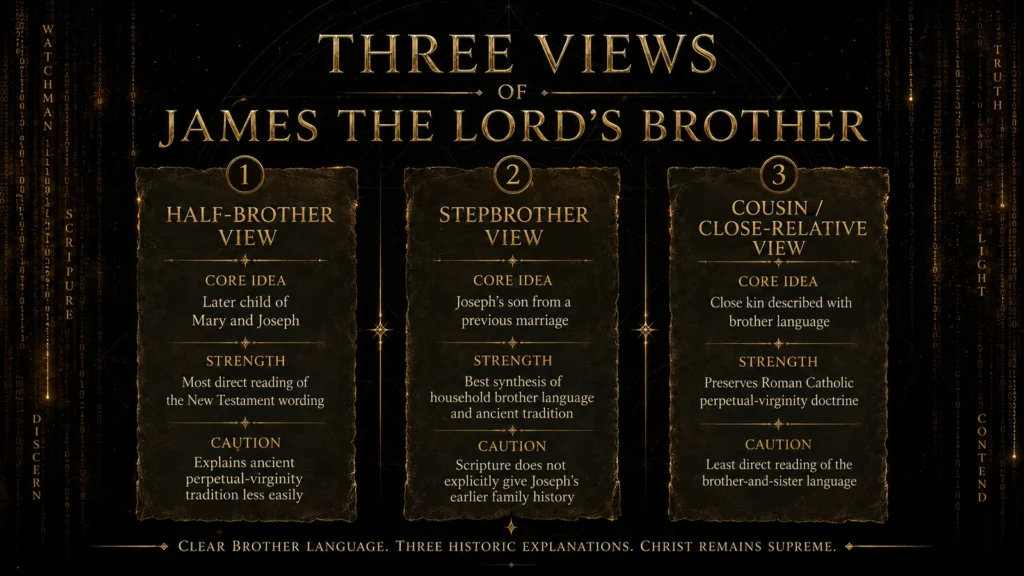
The answer should be measured. The cousin view is possible, but least direct. The half-brother view has the strongest plain-reading force from the New Testament text alone. The stepbrother view may be the most balanced synthesis, especially if Joseph was older, previously widowed, and had children before being entrusted with Mary and Jesus.
We are not ranking spiritual worth. We are ranking explanatory strength. Faithful Christians have held different views on this question, and the exact family mechanism is not the foundation of the gospel. But the views do not all explain the evidence with the same level of directness.
The half-brother view is the cleanest reading of the New Testament wording by itself. It takes the hometown family lists, John’s distinction between brothers and disciples, and Paul’s phrase “the Lord’s brother” in the most straightforward way. A direct reading is not always the same thing as a complete reading, but the direct force of the text still matters.
The cousin view is possible and historically important, especially in Roman Catholic interpretation. But it depends more heavily on theological tradition, Gospel harmonization, and broader kinship-language arguments. It has to explain why repeated brother-and-sister language in family settings should be read less directly.
The stepbrother view stands in the middle. It takes the brother language seriously. It does not reduce James to a distant relative. It allows the brothers and sisters to be real household members known in Jesus’ family setting. In that kind of household and village world, Joseph’s legal fatherhood would have mattered. If Joseph had earlier children, those children could truly belong to the family circle in which Jesus was raised, without requiring them to be later children of Mary.
That is why we lean toward the stepbrother view as a plausible synthesis. Not because Scripture demands it. Not because the Protoevangelium of James or later tradition can settle the question. But because it honors the real household language, takes early Christian memory seriously, and leaves room for Mary’s unique consecration.
Still, we should say it plainly: if someone holds the half-brother view because they are trying to follow the most direct reading of Scripture, that is not irreverent. If someone holds the cousin view because they are trying to honor Mary’s perpetual virginity in continuity with Roman Catholic tradition, that is not automatically dishonest. Our task is not to caricature. Our task is to test the views carefully and hold our conclusions with the right level of confidence.
What We Should Not Overclaim
A strong Christian answer does not need false certainty. Scripture never explicitly gives the full family mechanism. It gives us enough to know that James was called the Lord’s brother. It does not give us enough to treat one reconstruction of Mary and Joseph’s household as though every detail were beyond debate.
The subject calls for conviction, not arrogance. We can reject false certainty without becoming timid. We can respect Catholic, Orthodox, and Protestant readers without pretending all interpretations carry the same explanatory strength. We can value early tradition without treating non-canonical writings as Scripture.
We should also avoid making Mary and Joseph’s holiness depend on our preferred theory. If Mary and Joseph had a normal marriage after Jesus’ birth, that would not make them unholy. If Mary remained uniquely consecrated and Joseph served as her husband and protector in an unusual household, that would not make their marriage fake. The holiness of the household comes from obedience to God, not from our ability to reconstruct every family detail.
Most importantly, this question should never become larger than Christ Himself. The identity of Jesus does not rest on whether James was His half-brother, stepbrother, or cousin. Jesus is the eternal Son of God, conceived by the Holy Spirit, born of the virgin Mary, crucified under Pontius Pilate, raised from the dead, and exalted at the right hand of the Father.
So yes, this question matters. It matters for James, for Mary and Joseph, and for how Christians read Scripture and tradition together. But it does not change who Jesus is. He is not Lord because of James’ exact family category. He is Lord because He is the eternal Son, the Word made flesh, the crucified Savior, and the risen King.
Does This Change Who Jesus Is?
No. Whether James was Jesus’ half-brother, stepbrother, or close relative does not change who Jesus is.
The family question can clarify James. It cannot redefine Christ. Jesus is not Lord because of how we categorize James. He is Lord because He is the eternal Son of God, conceived by the Holy Spirit, born of the virgin Mary, crucified for sinners, raised from the dead, and exalted at the right hand of the Father.
The angel told Mary that the child to be born would be called holy, “the Son of God” (Luke 1:35). John says the Word became flesh and dwelt among us (John 1:14). Paul presents Christ as the One who humbled Himself to death on a cross and was highly exalted by God (Philippians 2:6–11). Colossians presents Him as supreme over creation and reconciliation (Colossians 1:15–20). Hebrews says God has spoken finally in His Son, who is “the radiance of the glory of God” (Hebrews 1:1–4).
That is the center. Mary matters because she bore the Messiah. Joseph matters because he obeyed God and protected the household into which Jesus came. James matters because he was known as the Lord’s brother and became part of the resurrection-witness story. But Jesus is not merely one family member among others. He is the Son of God, the Word made flesh, the crucified Savior, and the risen King.
Frequently Asked Questions About Mary and Jesus’ Brothers
Was James Jesus’ biological brother?
It depends on which view is correct and what someone means by “biological.” If the half-brother view is correct, James was Mary’s later son and biologically related to Jesus through Mary, though not through Joseph, because Jesus was conceived by the Holy Spirit. If the stepbrother view is correct, James was Joseph’s son from a previous marriage and Jesus’ true household brother, but not biologically related to Him. If the cousin view is correct, James was a close relative rather than a sibling. Scripture calls James “the Lord’s brother” in Galatians 1:19, but it does not define the exact family mechanism.
Did Mary and Joseph have children after Jesus?
Christians answer this differently. Many Protestants say yes, based on the direct reading of the Gospel references to Jesus’ brothers and sisters. Roman Catholic teaching says no, because it confesses Mary’s perpetual virginity and understands the “brothers and sisters” as close relations rather than other children of Mary. Eastern Orthodox tradition often also says no, but explains the brothers and sisters as Joseph’s children from a previous marriage. This article leans toward the stepbrother view as a balanced synthesis, while acknowledging that the half-brother view has the strongest direct appeal from the New Testament wording alone.
Why do Catholics say Jesus’ brothers were cousins?
Roman Catholics usually explain Jesus’ brothers as cousins or close relatives because Catholic doctrine teaches Mary’s perpetual virginity. The Catechism of the Catholic Church says the references to Jesus’ brothers and sisters do not mean other children of Mary. Catholic interpreters also compare the brother lists with passages about another Mary, including “Mary the mother of James and Joseph” in Matthew 27:56 and “Mary the mother of James the younger and of Joses” in Mark 15:40. That is a serious harmonizing argument, though this article finds it less direct than the ordinary family-language reading.
Why do Orthodox Christians say James was Joseph’s son?
Eastern Orthodox tradition often understands Joseph as older, previously widowed, and already a father before he became Mary’s husband and Jesus’ earthly legal father. In that view, James and the others were Joseph’s children from a prior marriage. The Orthodox Church in America identifies James the Brother of the Lord as Joseph’s eldest son from his first marriage. This lets James be a true household brother of Jesus without making him a later child of Mary. It is a tradition-supported explanation, not something the New Testament explicitly states in detail.
Is it wrong to believe Mary remained a virgin?
No, it is not wrong to believe Mary remained a virgin, as long as the belief is held under biblical authority and not used to dismiss Scripture carelessly. Many ancient Christians believed Mary remained uniquely consecrated after bearing Christ. Roman Catholics and Orthodox Christians still confess Mary’s perpetual virginity, though they often explain the brothers of Jesus differently. Scripture clearly teaches the virgin conception and birth of Christ. It does not give the same direct level of detail about every later aspect of Mary and Joseph’s household.
Is it wrong to believe Mary and Joseph had a normal marriage?
No. Believing that Mary and Joseph had a normal marriage after Jesus’ birth is not irreverent by itself. Marriage is honorable, and ordinary marital intimacy is not sinful or unclean. If Mary and Joseph had later children, that would not diminish the virgin birth, the holiness of Jesus, or Mary’s obedience to God. The virgin birth concerns the miraculous conception of Jesus by the Holy Spirit. It does not automatically settle every later question about Mary and Joseph’s married life.
That is why Christians should avoid two mistakes at once: making normal marriage sound dirty, or making perpetual virginity sound foolish. Scripture gives us enough to honor Mary, Joseph, and Christ without turning this question into a weapon.
Why does this matter for James the Just?
This matters because James was not just an abstract relative in a family debate. Paul calls him “the Lord’s brother” in Galatians 1:19. Paul also says the risen Christ appeared to James in 1 Corinthians 15:7. Acts places Jesus’ brothers among the believers after the resurrection (Acts 1:14), and James later appears as a leading voice in Jerusalem (Acts 15:13–21).
Understanding his family relationship helps us understand why his later faith and leadership mattered. The resurrection did not merely settle an argument for James; it reordered his allegiance. The next question is not only “Who was James?” but “What happened to James after he became a witness of the risen Christ?”
Conclusion: James Was Close to Jesus—and Became a Witness
The New Testament clearly calls James “the Lord’s brother” and places Jesus’ brothers and sisters inside His family setting. The exact mechanism is debated, and the answer should be held with humility: the half-brother view is the cleanest direct reading, the stepbrother view is the synthesis we find most compelling, and the cousin view is possible but less direct.
But the center is not Mary’s later household. The center is Christ. Jesus is not merely Mary’s child, Joseph’s legal son, or James’ brother in the family circle. He is the eternal Son of God who entered a real human household without ceasing to be Lord of all.
However James was related to Jesus in the household, he eventually had to bow before Him as Lord. That is where the story of James becomes powerful. The man known as the Lord’s brother became a leader and a witness. His later death belongs in the next part of the story.
The family question matters, but the greater wonder is this: the One James knew in the household was the same Jesus the church worshiped as risen Lord.
Read Next: Follow the James and Jesus’ Brothers Trail
If this article helped clarify the family question, the next step is to follow James from the household of Jesus into the resurrection witness and the early church.
- The Martyrdom of Jesus’ Disciples: What We Can and Cannot Prove
- James the Brother of Jesus: Witness, Leader, and Martyr (coming next)
Sources and Further Reading
This article treats Scripture as the final authority. The biblical passages below provide the foundation for the discussion. The Christian tradition sources are included to show how Catholic, Orthodox, and early Christian writers have understood the question of Jesus’ brothers. They are useful for historical and theological context, but they do not outrank the biblical text.
Biblical Passages
- Mark 6:3 — Jesus is identified in Nazareth as the son of Mary and brother of James, Joses, Judas, and Simon, with sisters also mentioned.
- Matthew 13:55–56 — Matthew’s parallel hometown passage names Jesus’ brothers and mentions His sisters.
- Matthew 1:18–25 — Joseph, Mary, and the virgin birth of Jesus.
- Luke 1:35 — Jesus’ conception by the Holy Spirit and His identity as the Son of God.
- John 2:12 — Jesus’ mother, brothers, and disciples are distinguished from one another.
- John 7:3–5 — Jesus’ brothers are shown in tension with His public ministry before the resurrection.
- Acts 1:14 — Mary and Jesus’ brothers are present among the praying believers after the resurrection and ascension.
- Acts 15:13–21 — James appears as a leading voice in the Jerusalem church.
- 1 Corinthians 9:5 — Paul refers to “the brothers of the Lord” as a known group.
- 1 Corinthians 15:7 — Paul says the risen Christ appeared to James.
- Galatians 1:18–19 — Paul identifies James as “the Lord’s brother.”
- Galatians 2:9 — James is recognized as a pillar in the early church.
Christian Tradition and Historical Context
- Catechism of the Catholic Church, 499–500 — Roman Catholic teaching on Mary as “Ever-virgin” and the Catholic explanation that the “brothers and sisters” of Jesus are close relations, not other children of Mary.
- Orthodox Church in America: Righteous James the Brother of the Lord — Represents the Orthodox tradition that James was Joseph’s son from a first marriage.
- Orthodox Church in America: Holy Righteous Joseph the Betrothed — Gives the Orthodox tradition that Joseph had children from a previous marriage before being entrusted with Mary.
- Protoevangelium of James — An early non-canonical text that presents Joseph as older and already having children. This source is useful for historical context, but it is not Scripture and should not govern the interpretation of the New Testament.
- Jerome, The Perpetual Virginity of Blessed Mary Against Helvidius — A classic early Christian defense of Mary’s perpetual virginity in response to arguments that Jesus’ brothers were later children of Mary.
CONTINUE THE INVESTIGATION
Recommended continuation
How Did James the Brother of Jesus Die? The Martyrdom of James the Just
Move from the Gospel references to Jesus’ brothers into the historically significant witness and death tradition surrounding James the Just.