
GUIDED ARTICLE EXPERIENCE
How Did James the Brother of Jesus Die? The Martyrdom of James the Just
Read along as the narration moves through the article.
Private device narration · No hosted audio or tracking
CONTINUE GUIDED TOUR
Continue where you left off.
GUIDED TOUR COMPLETE
You have reached the end of this study.
Study record saved on this device.
GUIDED TOUR
How Did James the Brother of Jesus Die? The Martyrdom of James the Just
Narrator: Paranoid Prophet Recommended Voice Native device narration
Prepare to follow the article as it is narrated.
VOICE & TOUR OPTIONS
Voice & Listening
NARRATOR
Finding a narrator…
Checking the best narrator available on this device.
Restores the best curated narrator available on this device.
Narrator choices are curated for clear, long-form listening on this device.
Screen-awake support will be checked when narration starts.
CHOOSE A NARRATOR
Curated for this device
Choose a verified narrator for this browser, or use System Narrator. Automatic mode uses the best reliable route exposed by this device; your chosen narrator is preserved even if this device needs a temporary fallback.
Preparing the guided article experience…
RESUME GUIDED TOUR?
Continue where you left off.
GUIDED TOUR COMPLETE
You have reached the end of this study.
James, the brother of Jesus, was killed in Jerusalem around A.D. 62 according to Josephus, our strongest external source for his death. Josephus says the high priest Ananus brought James before the Sanhedrin and had him stoned. Later Christian tradition gives a fuller martyrdom scene, remembering James as “the Just,” but those details should be weighed more carefully than Josephus’ shorter report.
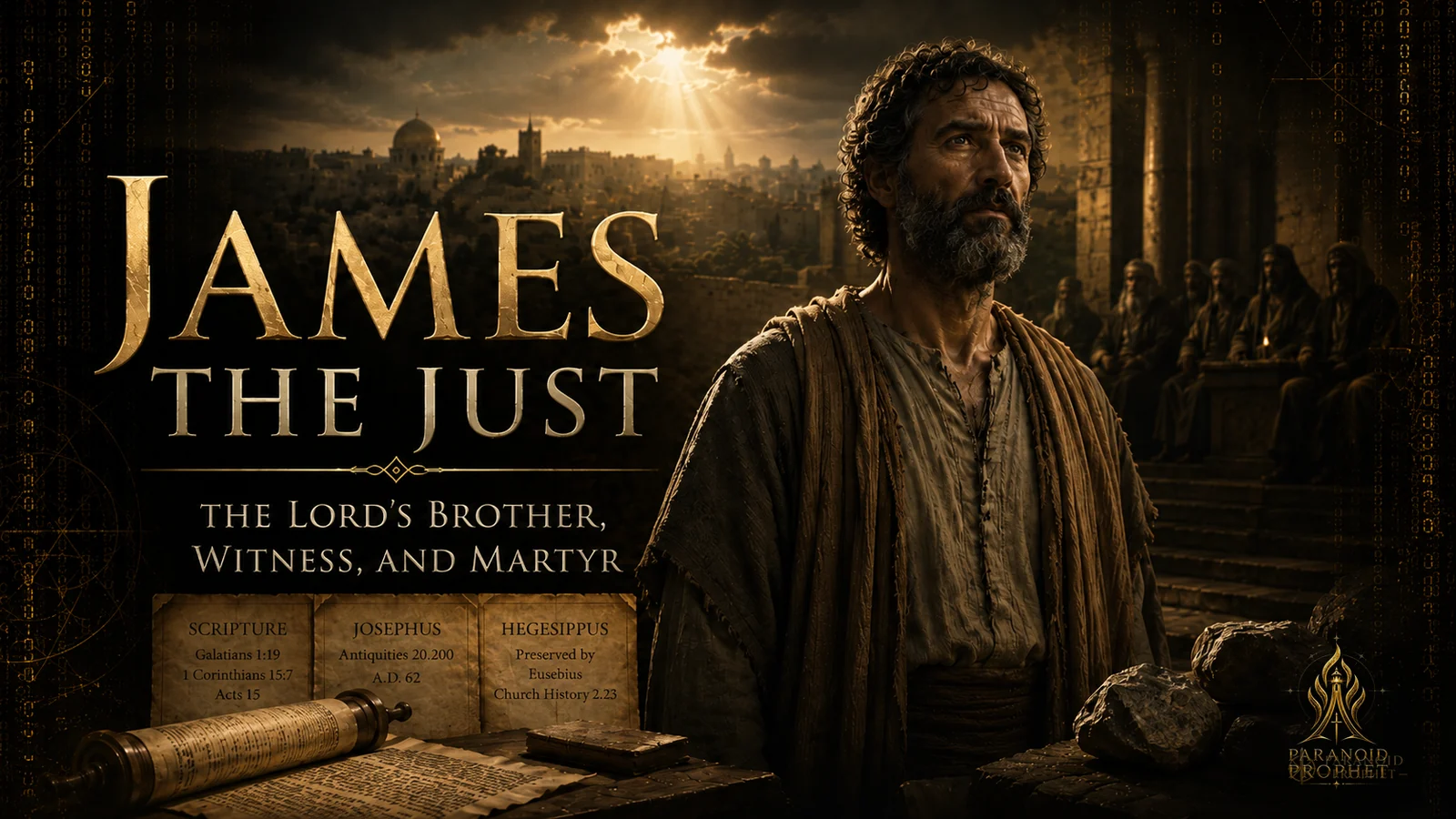
That distinction matters from the start. If we are building a serious case for Christ, we should not treat every source as equally strong. Scripture identifies James as “the Lord’s brother,” places him inside the resurrection-witness tradition, and shows him as a leading figure in Jerusalem. Josephus gives the strongest external report of his death. Hegesippus, preserved by Eusebius, gives the fuller Christian memory of his martyrdom.
This article will not make the weak argument that James’ death by itself proves the resurrection. Martyrdom can show sincerity, but sincerity alone does not prove truth. The stronger argument is cumulative: the man known as the Lord’s brother became a public leader of the Jesus movement after the resurrection proclamation, and his death is reported outside the New Testament.
James stands at the intersection of Jesus’ earthly family, the early resurrection testimony, the Jerusalem church, and first-century historical memory. He was not a vague legend drifting in from the edges of Christian tradition. He was known, named, and remembered.
The strongest historical source for James’ death is not a late medieval legend, but Josephus. In Antiquities 20.200, Josephus identifies James as “the brother of Jesus who was called Christ” and reports that Ananus delivered him and others to be stoned. Josephus does not preach a Christian sermon. He does not give a resurrection argument. He gives a brief historical report that places James’ death in a recognizable political and religious setting.
Later Christian tradition gives a more dramatic account. Eusebius, preserving Hegesippus, remembers James as “the Just,” a righteous man revered in Jerusalem, publicly questioned about Jesus, thrown down, stoned, and finally struck with a fuller’s club. That account matters. It may preserve older Christian memory. But it is fuller, later, and more developed than Josephus. It should be used carefully.
Source discipline: Scripture identifies James as the Lord’s brother, places him in the resurrection-witness tradition, and shows him as a leader in Jerusalem. Josephus gives the strongest external report of his death by stoning under Ananus. Hegesippus, preserved by Eusebius, gives a fuller Christian martyrdom tradition. This article will not treat every detail as equally certain. It will distinguish what Scripture teaches, what Josephus reports, what later Christian tradition remembers, and what can be responsibly inferred.
That is the path forward. First, we need to identify James. Then we need to trace how the Lord’s brother became the Lord’s witness. Only then can we weigh the evidence for his death with the right level of confidence.
Article Guide10 sections
Who Was James the Just?
James the Just was one of the most important figures in the earliest Christian movement. He is usually identified as James, the brother of the Lord, the Jerusalem leader known from Paul, Acts, Josephus, and later Christian tradition.
He should not be treated as a side character. James stands close to Jesus’ earthly family, appears in the early resurrection tradition, becomes a recognized leader in Jerusalem, and later enters historical memory as a righteous man whose public allegiance to Jesus carried real cost.
The title “James the Just” comes from later Christian memory of his righteousness. The New Testament itself does not usually call him by that title. Paul’s most important phrase is different: he calls him “the Lord’s brother.”
James Was Known as the Lord’s Brother
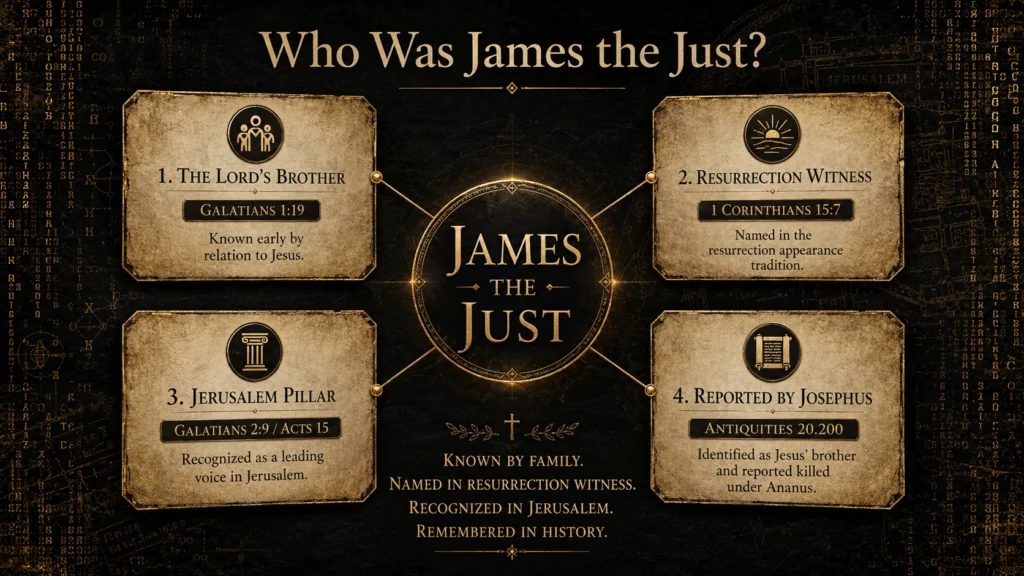
The strongest New Testament identification comes from Paul. In Galatians 1:18–19, Paul says that after three years he went up to Jerusalem to visit Cephas and stayed with him fifteen days. Then he adds, “But I saw none of the other apostles except James the Lord’s brother.”
That line is historically important. Paul is not writing centuries later. He is not inventing a devotional nickname. He is describing his contact with key figures in Jerusalem, and he identifies James by his relationship to the Lord.
The phrase does not answer every family question by itself. Christians have long debated whether James was Jesus’ half-brother through Mary, stepbrother through Joseph, or close relative described with brother language. For the full discussion, see Did Mary Have Other Children? James and the Brothers of Jesus Explained.
This article does not need to re-argue that entire family question. The key point here is simpler: James was known early in the Christian movement as “the Lord’s brother.” Whatever precise family category someone adopts, James was not a distant legendary figure invented long after the fact. He stands inside the earliest Christian memory as a man closely connected to Jesus.
Paul also preserves a resurrection tradition that names James. In 1 Corinthians 15:3–8, Paul says Christ died for our sins, was buried, was raised on the third day, and appeared to Cephas, the Twelve, more than five hundred brothers, James, all the apostles, and last of all to Paul himself. The appearance to James is not explained in detail, but it is listed inside one of the most important early resurrection summaries in the New Testament.
That gives James’ later life a resurrection context. He is not merely important because he died. He is important because the earliest Christian testimony places him in the orbit of the risen Jesus before later sources ever describe his death.
James Was Not James the Son of Zebedee
The New Testament has more than one important James, and confusing them blurs the evidence. This article is not about James the son of Zebedee, the brother of John, one of the Twelve apostles.
James the son of Zebedee was killed earlier by Herod. Acts 12:1–2 says Herod laid violent hands on some who belonged to the church and “killed James the brother of John with the sword.” That James was one of the sons of Zebedee. His death belongs to a different martyrdom article.
James the Just is different. He is the James Paul calls “the Lord’s brother.” He is the James who appears as a leading voice in Jerusalem. He is the James later connected by Josephus and Christian tradition with the events around A.D. 62.
This distinction matters because skeptics and casual readers sometimes collapse the James traditions together. The evidence is not served by confusion. The death of James son of Zebedee is reported in Acts 12. The death of James the Lord’s brother is reported by Josephus and expanded in later Christian tradition.
Why the Family Question Matters
The family question matters because James’ relationship to Jesus gives his later story unusual weight. If James was known as the Lord’s brother, then his leadership in the Jerusalem church is not an abstract biographical detail. It means someone from Jesus’ own family circle became publicly identified with the movement proclaiming Him as risen Lord.
We still need restraint. The New Testament does not give us a diary of James’ private thoughts before and after the resurrection. It does not tell us every step in his journey from family proximity to public leadership. A serious article should not pretend to know what Scripture does not say.
But Scripture does give us important pieces. The Gospels show Jesus’ brothers were not automatically aligned with His public ministry. Paul says the risen Christ appeared to James. Acts and Galatians show James as a recognized leader in Jerusalem. Josephus later reports his death. Together, those pieces create a serious historical arc.
That arc is what makes James compelling. His martyrdom does not stand alone as proof of Christ, but it becomes powerful inside the larger evidence chain: the Lord’s brother became the Lord’s witness, the Lord’s servant, and a public witness whose allegiance to the risen Jesus carried real cost.
Before we weigh Josephus and the later martyrdom tradition in detail, we need to ask how the Lord’s brother became the Lord’s witness. The story moves from family proximity, to resurrection proclamation, to public leadership in Jerusalem.
From Skepticism to Witness
James’ death cannot be understood apart from James’ change in position. Before Josephus reports his execution, Scripture shows James moving into the center of the early Christian witness.
The New Testament does not give us every private detail of James’ inner journey. It does not tell us exactly when he believed, what he felt, or what words passed between him and the risen Jesus. A faithful article should not invent what Scripture withholds. But the pieces Scripture does give are serious. They form a pattern that should not be ignored.
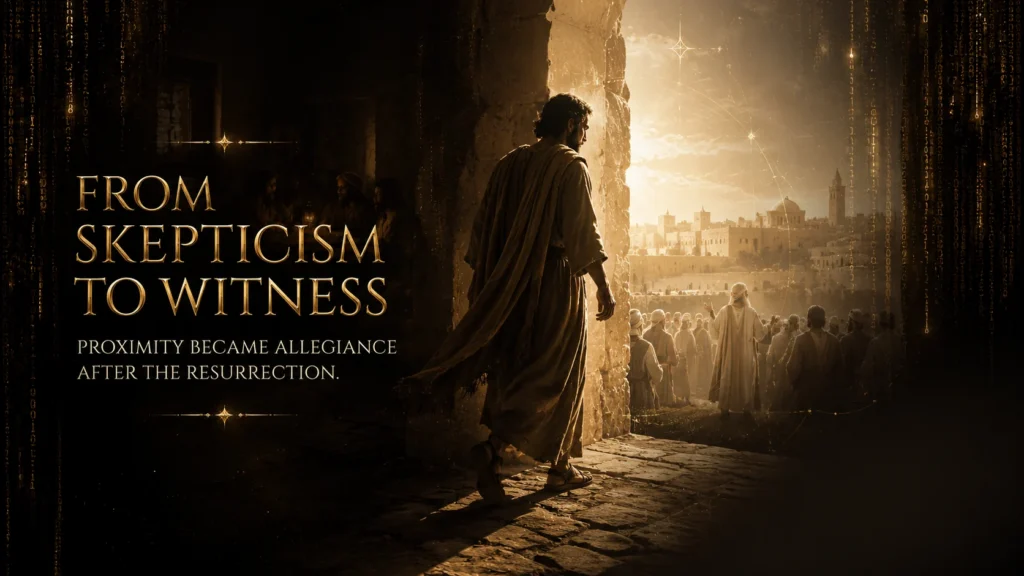
Family proximity did not produce automatic faith. Yet after the resurrection, the man known by relation to Jesus became known for allegiance to Jesus.
Jesus’ Brothers Did Not Always Believe
The Gospel of John gives one of the most sobering glimpses into Jesus’ family circle during His public ministry. In John 7:3–5, Jesus’ brothers urge Him to go to Judea so His works can be seen publicly. Then John adds, “For not even his brothers believed in him.”
That sentence should slow us down. The men close to Jesus by family association did not automatically understand Him. They had proximity to Him, but proximity is not the same as faith. They knew Him according to the household. They had not yet bowed before Him as Lord.
We should be careful here. John does not pause to name James in that scene, so we should not build a full psychological biography of James from one group reference. The verse does not tell us exactly what James personally thought that day. It does not say whether he was hostile, confused, embarrassed, skeptical, or simply not yet convinced.
But John does show that Jesus’ brothers as a group were not automatic believers during His ministry. That makes their later faith more striking. Something changed.
That change becomes visible after the resurrection. In Acts 1:14, after Jesus’ resurrection and ascension, the believers are gathered in prayer with “Mary the mother of Jesus, and his brothers.”
Acts does not tell us how each brother came to faith, but it does show where they stood after the resurrection: with the praying believers. The family circle had moved into the fellowship of faith.
This is one reason James matters. He was not merely someone who heard rumors from a distance. He belonged to the circle around Jesus’ earthly life, and later he appears among the leaders of the church that proclaimed Jesus risen from the dead.
The Risen Christ Appeared to James
The key text is 1 Corinthians 15:3–8. Paul says he delivered what he had received: that Christ died for our sins in accordance with the Scriptures, was buried, was raised on the third day in accordance with the Scriptures, and appeared to witnesses. Among those witnesses, Paul includes James.
Paul presents this as received tradition, not as a private idea he invented. The line about James is brief: “Then he appeared to James.” Paul does not elaborate. He does not tell us where it happened. He does not describe James’ face, his emotions, or the words Jesus spoke. He gives no dramatic scene and no sentimental reconstruction.
But the brevity should not make us miss the significance. Paul places James inside the resurrection appearance tradition. The Lord’s brother is not merely attached to the story by later imagination. He is named in one of the most important resurrection summaries in the New Testament.
For apologetics, this point must be handled carefully. We should not say, “James saw the risen Jesus, therefore the resurrection is automatically proven to every skeptic.” Scripture’s authority is final for Christians, but when we make a public historical argument, we should distinguish what the text claims from what history can independently verify.
What we can say is strong enough: the early Christian proclamation did not treat James as irrelevant. Paul’s received tradition includes him among those to whom the risen Christ appeared. The resurrection did not merely add James to a list; it reordered his allegiance. It gives his later leadership a resurrection context and his death a deeper significance.
James’ importance is not merely that he became religious. It is that he became identified with the message that Jesus had been crucified, buried, raised, and seen. The man known by relation to Jesus became a witness to Jesus.
The resurrection proclamation did not leave James on the edge of the story. It pulled him into the center.
James Became a Pillar in Jerusalem
James did not remain a private believer in the background. The New Testament presents him as a recognized leader in Jerusalem.
In Galatians 2:9, Paul refers to “James and Cephas and John” as those who “seemed to be pillars.” Paul is describing recognized leaders whose approval carried weight in the early church. James is named alongside Cephas and John, not as a footnote, but as one of the prominent figures in Jerusalem.
Acts shows the same kind of visible role. In Acts 15:13–21, after discussion over the Gentiles and the law, James speaks and gives a judgment rooted in Scripture. He is not presented as the only leader, and we should not overstate his role as though he alone ruled the church. But he is clearly a leading voice in Jerusalem at a decisive moment.
That role continues to appear later. In Acts 21:18, Paul goes in “to James,” and the elders are present. Once again, James stands near the center of Jerusalem church leadership.
This is why James’ death cannot be treated as a random tragedy detached from the Jesus movement. By the time Josephus reports his execution, James was not merely a private relative of Jesus. He was a visible leader connected to the church in Jerusalem.
For the case for Christ, this does not function as a shortcut. It means James belongs to a larger evidence chain. The Lord’s brother became the Lord’s witness. The witness became a pillar in Jerusalem. And the pillar would later be struck down in the city where the movement began.
Now the article moves from Scripture’s picture of James as witness and leader to the strongest external historical report of his death: Josephus.
Josephus: The Strongest Historical Source for James’ Death
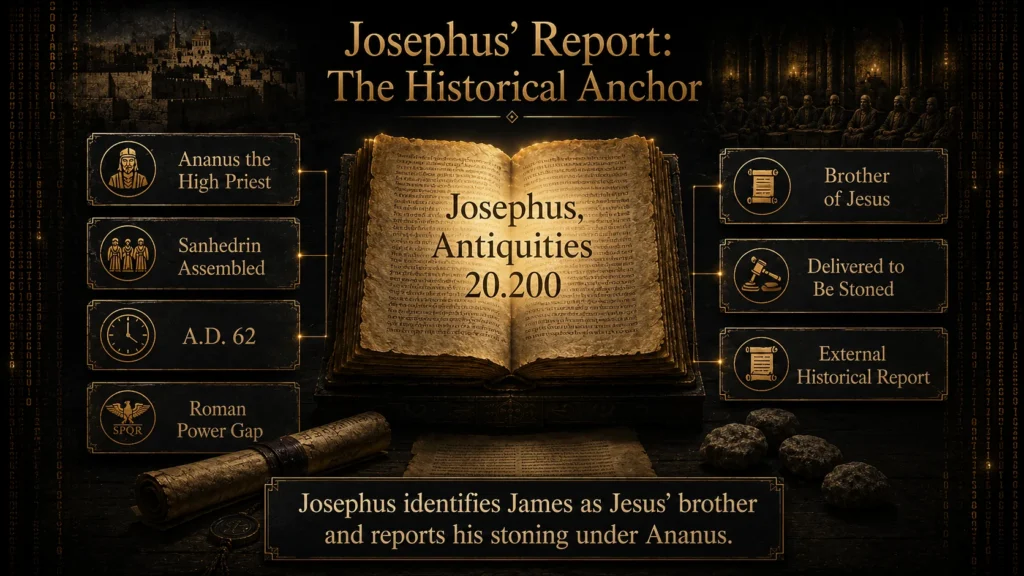
The strongest external source for the death of James is Josephus, the first-century Jewish historian who wrote Antiquities of the Jews near the end of the first century. His report is brief, but it carries real historical weight.
Josephus does not write like a Christian preacher. He does not pause to honor James as a saint. He does not give a sermon on the resurrection. He does not try to persuade the reader that Jesus is Lord. That restraint is part of what makes the passage useful for historical argument.
In Antiquities 20.200, Josephus describes the actions of Ananus son of Ananus, the high priest, during a brief gap in Roman administration. Festus, the Roman governor, had died. Albinus, his replacement, was still on the road. Ananus saw an opportunity to act before the new Roman authority arrived.
Into that political opening, Josephus places the death of James.
What Josephus Reports
Josephus says Ananus assembled the Sanhedrin of judges and brought before them “the brother of Jesus who was called Christ, whose name was James,” along with some others. He accused them as breakers of the law and delivered them to be stoned.
That is the central report. James was identified by his relationship to Jesus. The setting was Jerusalem. The authority involved was Ananus, the high priest. The charge was lawbreaking. The method of death was stoning. The timing is usually placed around A.D. 62, during the transition between Festus and Albinus.
Josephus then adds another important detail. Some of the more fair-minded citizens were disturbed by what Ananus had done. They objected that his action was not justified. Some appealed to King Agrippa. Others went to meet Albinus and argued that Ananus had no right to assemble the Sanhedrin without the governor’s consent.
In Josephus’ telling, James’ death is not presented as a quiet religious footnote. It causes controversy. Ananus’ action produces backlash, and Agrippa eventually removes him from the high priesthood after only a short time in office.
This gives the report a concrete historical shape. Josephus is not giving us a floating legend about an unnamed holy man. He gives names, offices, political timing, legal conflict, and consequences. James’ death is placed inside the tense world of first-century Jerusalem, where priestly power, Roman oversight, and Jewish legal authority overlapped uneasily.
Josephus is less interested in James’ theology than in Ananus’ misuse of opportunity. Yet in making that point, he gives us a valuable external witness to James’ death.
Why Josephus Matters
Josephus matters because he gives us an outside historical anchor. A reader does not have to accept every later Christian detail about James’ martyrdom to recognize the force of Josephus’ report. Josephus identifies James by reference to Jesus, places his death in Jerusalem, names the high priest involved, and reports that James was stoned.
This is why the passage is important for the case for Christ. It does not prove everything. It does not need to. Its value is narrower and stronger: it independently attests that James, known by his relationship to Jesus, appears in first-century historical writing as a real figure who died violently.
This also connects naturally with Paul. In Galatians 1:18–19, Paul calls James “the Lord’s brother.” Josephus, writing outside the New Testament, identifies James as “the brother of Jesus who was called Christ.” The wording is not identical, and the purposes are different, but the convergence is hard to ignore.
The passage is also generally treated as far less disputed than Josephus’ longer Jesus passage in Antiquities 18, often called the Testimonium Flavianum. That longer passage is heavily debated because parts of it sound unusually Christian. The James passage in Antiquities 20 is different. It is brief, restrained, and incidental to Josephus’ larger point about Ananus.
A recent Oxford Academic appendix on Antiquities 20.200 states that the vast majority of scholars regard the James passage as authentic. That does not mean every possible question disappears. But it does mean this is not a fringe text Christians have to smuggle into the conversation. It is one of the strongest external references connected to Jesus’ family and the early church.
Josephus is valuable precisely because he is restrained. He does not decorate the story. He does not call James “the Just.” He does not describe James praying for his enemies. He does not mention the temple pinnacle, a fall, or a fuller’s club. Those details belong to later Christian tradition. Josephus gives the spare report: James, the brother of Jesus who was called Christ, was condemned under Ananus and stoned.
What Josephus Does Not Prove
Josephus is important, but we should not make him say more than he says. A strong Christian case does not need inflated evidence.
Josephus does not prove the resurrection. He does not tell us that James saw the risen Christ. He does not say James died specifically for preaching 1 Corinthians 15. He does not record James’ final words. He does not confirm the full martyrdom scene later preserved by Hegesippus and Eusebius.
Josephus also does not write as a believer. When he refers to Jesus as the one “who was called Christ,” that phrase should not be treated as a Christian confession from Josephus. It functions as identification. Josephus is telling his readers which Jesus he means in order to identify James.
That is enough. We do not need Josephus to preach the gospel in order for his testimony to matter. His report helps establish the historical setting around James’ death. Scripture gives the theological meaning of James’ witness. Josephus gives an external anchor for the violent end of James’ visible life.
This distinction protects the argument. If we claim Josephus proves the resurrection, we overreach. If we say Josephus confirms every detail of later Christian tradition, we overreach again. But if we say Josephus independently reports that James, the brother of Jesus who was called Christ, was brought before the Sanhedrin under Ananus and stoned, we are standing on strong ground.
That strong ground gives us the central historical report. James, identified by Josephus as the brother of Jesus who was called Christ, was condemned under Ananus and stoned. To understand how the church remembered the meaning of that death, we now turn to Hegesippus as preserved by Eusebius.
Hegesippus and Eusebius: The Fuller Martyrdom Tradition
Josephus gives the central external report. Eusebius preserves the fuller Christian tradition.
That difference matters. Josephus gives names, political setting, legal conflict, and consequences. But he does not tell us how the early church understood James’ final witness. For that fuller tradition, we turn to Eusebius’ Church History, where Eusebius preserves material attributed to Hegesippus.
This is not the same kind of source as Josephus. Eusebius wrote in the early fourth century. Hegesippus was earlier, usually placed in the second century, but we know his account through later preservation. The tradition is openly Christian, more detailed, and more theological. That does not make it worthless. It does mean we should handle it differently.
Eusebius also mentions Clement’s shorter form of the tradition, in which James was thrown from the temple pinnacle and beaten with a club. Hegesippus gives the fuller account. That helps us see that the Christian memory of James’ death was not a single loose rumor floating by itself, but a tradition preserved in more than one stream, even if the details still need to be weighed carefully.
The wise approach is not to throw the tradition away, and not to make it carry more weight than it can bear. Josephus anchors the death historically. Hegesippus helps explain why the church remembered that death as martyrdom.
James the Just in Christian Memory
In Christian memory, James was not described only as the brother of the Lord. He was known as James the Just.
That title was not a throwaway compliment. It became the remembered name by which this James was distinguished from other men named James. Eusebius says James was called “the Just” because of the excellence of his virtue. He also identifies him as the brother of the Lord and connects him with leadership in the Jerusalem church.
This fits what we have already seen from the New Testament. James appears as a recognized figure in Jerusalem, not as a distant or marginal name. Josephus identifies James by relation to Jesus. Hegesippus preserves James by reputation: the Just.
We should still read the title carefully. Not every detail in the later description of James’ piety should be treated as equally certain historical data. Ancient Christian writers often portrayed holy figures in ways that emphasized virtue, devotion, and symbolic importance. But the title still tells us something significant: early Christian memory did not hand down James as a mere administrator. It portrayed him as a righteous witness.
This is one reason the James tradition carries apologetic weight. The brother of the Lord was not presented as someone who used family status for private advantage. He was held up as a man of prayer, righteousness, and costly allegiance to Jesus. His authority in Jerusalem was not only institutional. It was moral.
That does not make James the center of the story. He is not. The point of James’ righteousness is not James himself. The point is the One to whom he bore witness. The early tradition calls James “the Just” because his life was bound to his testimony that Jesus is the Christ.
The Temple Account
The most vivid Christian account of James’ death comes from Hegesippus as preserved by Eusebius. According to this account, James’ reputation among the people was so strong that certain leaders wanted him to address the crowd concerning Jesus. They expected him to restrain the people. Instead, the tradition presents James bearing witness to Christ.
The account says James was placed where the people could hear him and was asked about Jesus. Rather than deny Christ, James testified concerning Him. His opponents then threw him down. When the fall did not kill him, they began to stone him. The tradition says James prayed for their forgiveness before he was finally struck by a fuller with a club.
That is the fuller martyrdom scene. It is vivid, solemn, and deeply Christian. It presents James as a righteous witness whose final public act was not self-defense, but confession. In that memory, James dies not as a rebel chasing power, but as a servant whose allegiance to Jesus could not be broken.
We should notice what the account is doing. It is not merely interested in the mechanics of death. It is interested in witness. James is portrayed as one who would not deny Jesus when pressured to speak. His death is meaningful because his testimony is meaningful.
That makes the tradition powerful, but it also means we need to keep our categories clean. The temple account is not Josephus. Josephus gives a shorter legal and political report: James was brought before the Sanhedrin under Ananus and stoned. Hegesippus gives a fuller Christian account of public witness, violence, prayer, and final death. The overlap is significant, but the sources are not identical.
The tradition also connects James’ death with coming judgment on Jerusalem. That theological interpretation should be handled carefully. Christians may see deep moral meaning in the death of a righteous witness, especially in the shadow of Jerusalem’s destruction. But we should avoid claiming that surviving Josephus clearly says Jerusalem fell because of James’ death. That claim appears in later Christian discussion; it is not the point of Josephus’ leaner report about Ananus and the stoning.
Used properly, the temple account does not weaken the article. It enriches it. Josephus tells us that James was killed. Hegesippus shows how the church understood the meaning of that death: James the Just bore witness to Christ, and that witness cost him.
Why These Details Should Be Used Carefully
The fuller tradition should be used carefully because it is later, more detailed, and more openly shaped by Christian memory. That does not mean it should be dismissed. It means we should not pretend it has the same historical weight as Josephus.
Josephus was a first-century Jewish historian writing outside the church. Eusebius was a Christian historian writing much later. Hegesippus was earlier than Eusebius, but his account reaches us through Eusebius’ preservation. Those differences matter for historical method.
If we blur the sources, the argument becomes weaker. If we say Josephus reports the temple pinnacle, the prayer, and the fuller’s club, we would be wrong. Josephus does not say that. Those details belong to the Christian tradition preserved by Eusebius. Josephus gives the external report of condemnation and stoning. Hegesippus gives the fuller martyrdom memory.
A serious Christian argument should be willing to say that out loud. We do not need to inflate the evidence. We need to arrange it honestly.
From this tradition, we can say early Christians portrayed James as righteous, publicly connected him with Jesus, and understood his death as the death of a witness rather than merely the death of a political victim. The exact dramatic details should still be treated with more caution than Josephus’ shorter report.
That careful distinction strengthens the case. The early Christian memory of James does not float in empty space. It stands beside Josephus’ external report. Josephus gives us the historical anchor. Hegesippus gives us the church’s memory of James’ courage, righteousness, and confession.
The value of this tradition is not that every dramatic detail carries the same weight as Josephus. Its value is that early Christian memory preserved James as righteous, visible, and faithful to Jesus unto death. The brother of the Lord became the servant of the Lord. The servant became a witness. And the witness was handed down as James the Just.
So how should we finally classify James’ death? Was he truly a martyr, and what does his death actually prove for the case for Christ? To answer that, we need to separate confidence from caution.
Was James Really a Martyr?
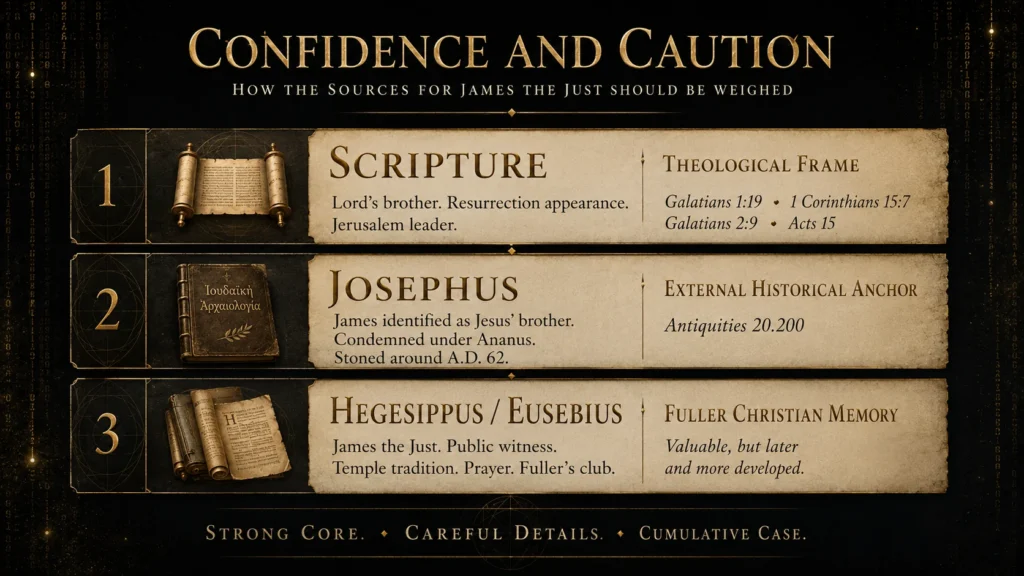
If martyr means a witness whose allegiance to Christ brought public cost and death, James belongs in that category. The exact details of his final moments are debated, but the basic picture is strong: James was known as the Lord’s brother, named in the resurrection appearance tradition, recognized as a leader in Jerusalem, reported by Josephus as stoned under Ananus, and handed down in early Christian memory as James the Just.
That does not mean every detail carries the same level of certainty. Scripture gives the theological frame. Josephus gives the strongest external report of James’ death. Hegesippus, preserved by Eusebius, gives the fuller Christian martyrdom tradition. A serious case should let each source do its own work.
What We Can Say with Confidence
First, James was known early as “the Lord’s brother.” Paul says this directly in Galatians 1:18–19.
Second, James was named in the resurrection appearance tradition. Paul says Christ appeared to James in 1 Corinthians 15:3–8, in the same summary where he declares that Christ died, was buried, was raised, and appeared to witnesses.
Third, James became a recognized leader in Jerusalem. In Galatians 2:9, Paul names James with Cephas and John as those who seemed to be pillars. In Acts 15:13–21, James speaks as a leading voice in Jerusalem. In Acts 21:18, Paul goes in to James, and the elders are present.
Fourth, Josephus reports James’ violent death. In Antiquities 20.200, Josephus identifies him as “the brother of Jesus who was called Christ,” says Ananus brought him and others before the Sanhedrin, accused them as lawbreakers, and delivered them to be stoned.
Finally, early Christian tradition preserved James as a righteous witness. Eusebius, preserving Hegesippus, gives the fuller account of James the Just, his public witness, his death, and the reverence with which the church held his memory.
Taken together, those points make James historically and apologetically important. He is not a vague symbol. He is not merely a name in a later legend. He stands inside the earliest Christian movement as the Lord’s brother, a resurrection-witness figure, a Jerusalem leader, and a man whose death has an external historical anchor.
What Remains Debated
Some questions should be held with caution. Josephus reports the charge against James and the others, but he does not give us the full case Ananus thought he had against them. He does not explain James’ theology. He does not say James was killed specifically because he preached the resurrection. He does not record final words.
The fuller Christian account also contains details that should be weighed carefully. Did the temple scene happen exactly as Hegesippus gives it? Can we recover James’ final prayer word for word? Did the fuller’s club detail preserve exact memory, or was it shaped in the telling of a martyrdom tradition? These are fair questions.
There is also a source-history caution involving Origen and Eusebius. Later Christian discussion says Josephus connected Jerusalem’s fall to the murder of James the Just. But our surviving text of Josephus does not clearly say that. This article should avoid claiming that Josephus himself plainly blamed Jerusalem’s destruction on James’ death. The stronger argument does not need that claim.
Confidence and caution belong together. The core is strong. The dramatic details are less certain. A responsible article should not pretend otherwise.
Why His Death Still Matters for the Case for Christ
James’ death matters because James’ life had already become a witness.
Martyrdom can prove sincerity. It cannot, by itself, prove truth. Many people have died for things that were false. So the argument should not be, “James died, therefore Christianity is proven.” That is too thin.
The better argument is cumulative. James was known in the earliest Christian movement as the Lord’s brother. Jesus’ brothers did not automatically believe during His public ministry. Paul says the risen Christ appeared to James. James then appears as a pillar in Jerusalem. Josephus reports his death by stoning. Christian tradition preserves him as James the Just, a righteous witness who would not deny Christ.
That chain is compelling. James is powerful evidence not because death magically proves doctrine, but because of the whole pattern: family proximity, resurrection proclamation, Jerusalem leadership, external death report, and early Christian martyrdom memory.
In other words, James does not carry the entire case for Christ by himself. He strengthens the case by fitting into it. His story stands beside the empty tomb proclamation, the early received resurrection tradition in 1 Corinthians 15, the appearances, the rise of worship around Jesus, the courage of the apostles, and the rapid spread of the church from Jerusalem outward.
Objections and Cautions
Does James’ Death Prove the Resurrection?
No. James’ death should not be used as a standalone proof of the resurrection. Martyrdom can show sincerity, conviction, and cost. It cannot automatically prove that the belief was true.
But James’ case belongs inside the wider resurrection argument. Paul places James in the resurrection appearance tradition. Acts and Galatians show James in leadership. Josephus reports his violent death. The early church understood him as a faithful witness.
That is a serious piece of cumulative evidence. It does not force belief by itself, but it helps answer a real historical question: why did the Jesus movement become so publicly centered on the risen Christ, even among those closest to Jesus’ earthly life?
Are the Later Martyrdom Details Legendary?
Some details may be developed in the tradition. That possibility should not scare us. Development in a tradition does not mean every part of the tradition is invented. It means we weigh the layers.
Josephus gives the shorter external report: James was condemned under Ananus and stoned. Hegesippus, preserved by Eusebius, gives the fuller Christian memory: James the Just, public witness, stoning, prayer, and final death. The sources overlap on a violent death, but they do not give the same kind of account.
The careful answer is this: the dramatic details should be used as early Christian tradition, not as the same level of evidence as Josephus. But the tradition remains valuable because it shows how the church understood James’ death—as the death of a righteous witness to Christ.
Did Josephus Really Mention Jesus?
Yes. In the James passage, Josephus identifies James by reference to “Jesus who was called Christ.” This should be distinguished from the more debated Josephus passage about Jesus in Antiquities 18, often called the Testimonium Flavianum.
The James passage in Antiquities 20 is generally treated as far less disputed. It is brief, restrained, and incidental to Josephus’ larger point about Ananus. A recent Oxford Academic appendix on Antiquities 20.200 states that the vast majority of scholars regard the James passage as authentic.
That does not mean Josephus was confessing Jesus as Messiah. He was identifying James. The phrase “who was called Christ” functions as a way of saying which Jesus he means. It is not a Christian creed from Josephus. It is still historically significant.
Was This the Same James?
No. This is not James the son of Zebedee. James the son of Zebedee, the brother of John, was killed earlier by Herod in Acts 12:1–2. That James was one of the Twelve.
This article is about James the Lord’s brother, also known in Christian tradition as James the Just. He is the James Paul identifies in Galatians 1:19, the James named in 1 Corinthians 15:7, the James associated with Jerusalem leadership in Acts and Galatians, and the James whose death Josephus reports in Antiquities 20.
Conclusion: The Lord’s Brother Became the Lord’s Witness
James does not matter because he is impressive in isolation. James matters because of Jesus.
The New Testament calls him the Lord’s brother. Paul places him in the resurrection appearance tradition. Acts and Galatians show him as a leader in Jerusalem. Josephus reports his death under Ananus. Hegesippus, preserved by Eusebius, shows how the church preserved his memory: James the Just, a righteous witness whose allegiance to Christ carried real cost.
That is a serious historical chain. It should not be inflated, and it should not be dismissed. James’ death does not prove the resurrection by itself. But his life and death strengthen the case for Christ because they fit the larger pattern of early Christian witness.
The Lord’s brother became the Lord’s servant because the crucified Jesus was not finished in the tomb. The risen Christ appeared, gathered witnesses, built His church, and turned even His own household into servants of His kingdom.
James the Just matters because Jesus is the Christ.
Frequently Asked Questions About James the Brother of Jesus
How did James the brother of Jesus die?
Josephus reports that James, the brother of Jesus who was called Christ, was brought before the Sanhedrin under the high priest Ananus and delivered to be stoned. This is usually dated around A.D. 62, during the transition between the Roman governors Festus and Albinus.
Who killed James the Just?
Josephus places responsibility on Ananus son of Ananus, the high priest, who assembled the Sanhedrin during a brief gap in Roman oversight. Later Christian tradition gives a fuller martyrdom account, but Josephus is the strongest external source for the basic death report.
Did Josephus mention James the brother of Jesus?
Yes. In Antiquities 20.200, Josephus identifies James as “the brother of Jesus who was called Christ.” This passage is generally treated as far less disputed than Josephus’ longer and more debated passage about Jesus in Antiquities 18.
Was James the brother of Jesus one of the Twelve apostles?
No. James the Lord’s brother should not be confused with James the son of Zebedee, the brother of John, who was killed by Herod in Acts 12. James the Just was a leading figure in the Jerusalem church, but he was not James the son of Zebedee.
Does James’ death prove the resurrection?
Not by itself. Martyrdom can show sincerity, conviction, and cost, but it does not automatically prove truth. James’ death matters because it fits a larger evidence chain: the Lord’s brother became a resurrection-witness figure, a Jerusalem leader, and a man whose violent death is reported outside the New Testament.
Why does James matter for the case for Christ?
James matters because he connects several important strands of evidence: Jesus’ earthly family, the early resurrection appearance tradition, Jerusalem church leadership, Josephus’ external report, and early Christian martyrdom memory. He does not prove the whole Christian case alone, but he strengthens the cumulative case for Christ.
Read Next
- Did Mary Have Other Children? James and the Brothers of Jesus Explained
- The Martyrdom of Jesus’ Disciples: What History Actually Says
- Peter’s Martyrdom: Evidence, Tradition, and the Cost of Witness
Sources and Further Reading
This article uses Scripture as the final authority, with ancient historical sources and scholarship used to clarify the historical context around James’ death.
Biblical Passages
- John 7:3–5 — Jesus’ brothers did not yet believe.
- Acts 1:14 — Mary and Jesus’ brothers among the praying believers.
- 1 Corinthians 15:3–8 — Resurrection summary; appearance to James.
- Galatians 1:18–19 — James as “the Lord’s brother.”
- Galatians 2:9 — James named among those who seemed to be pillars.
- Acts 15:13–21 — James speaks in Jerusalem.
- Acts 21:18 — Paul meets with James and the elders.
- Acts 12:1–2 — James son of Zebedee killed by Herod.
Ancient Historical Sources
- Josephus, Antiquities of the Jews, Book 20 — James, Ananus, Sanhedrin, stoning.
- Eusebius, Church History, Book II — James the Just and the fuller martyrdom tradition.
- Eusebius / Schaff edition at CCEL — Clement and Hegesippus traditions concerning James.
- Origen, Commentary on Matthew — source-history caution involving Josephus and James.
Scholarship and Context
- T. C. Schmidt, “James the Brother of Jesus: Antiquities 20.200,” Oxford Academic — discussion of Josephus’ James passage and authenticity.
- Sabrina Inowlocki, “Did Josephus Ascribe the Fall of Jerusalem to the Murder of James, Brother of Jesus?” — caution on later claims about James’ death and Jerusalem’s fall.
CONTINUE THE INVESTIGATION
Evidence standard continuation
Did the Apostles Die for the Resurrection? What We Can Honestly Say
Return from the focused James tradition to the source-disciplined overview that distinguishes stronger apostolic evidence from weaker reports.