
GUIDED ARTICLE EXPERIENCE
What Is the Trinity? One God, Father, Son, and Holy Spirit
Read along as the narration moves through the article.
Private device narration · No hosted audio or tracking
CONTINUE GUIDED TOUR
Continue where you left off.
GUIDED TOUR COMPLETE
You have reached the end of this study.
Study record saved on this device.
GUIDED TOUR
What Is the Trinity? One God, Father, Son, and Holy Spirit
Narrator: Paranoid Prophet Recommended Voice Native device narration
Prepare to follow the article as it is narrated.
VOICE & TOUR OPTIONS
Voice & Listening
NARRATOR
Finding a narrator…
Checking the best narrator available on this device.
Restores the best curated narrator available on this device.
Narrator choices are curated for clear, long-form listening on this device.
Screen-awake support will be checked when narration starts.
CHOOSE A NARRATOR
Curated for this device
Choose a verified narrator for this browser, or use System Narrator. Automatic mode uses the best reliable route exposed by this device; your chosen narrator is preserved even if this device needs a temporary fallback.
Preparing the guided article experience…
RESUME GUIDED TOUR?
Continue where you left off.
GUIDED TOUR COMPLETE
You have reached the end of this study.
Christians confess that there is one God. They also worship the Father, confess Jesus Christ as Lord, and speak of the Holy Spirit as God’s living and personal presence among His people.
That raises an understandable question: what is the Trinity? Does Christianity teach three gods? Does it teach one God who appears under three different names? Or did later church leaders create a formula that Scripture never actually teaches?
The doctrine of the Trinity exists because Christians believe the Bible will not permit any of those shortcuts. Scripture insists that God is one. Yet it also reveals the Father, the Son, and the Holy Spirit in ways that cannot be reduced to three rival gods, one divine person wearing three masks, or a created Son standing somewhere between God and the world.
The Trinity is not an attempt to make God sound mysterious for mystery’s sake. It is an attempt to speak truthfully about the God Scripture reveals: the Father who sends, the Son who comes in flesh to save, and the Holy Spirit who gives life and brings believers into communion with God.
This article focuses on that central Christian confession. For the wider biblical question of God’s identity, character, and self-revelation, see Who Is God? The Biblical Answer Revealed in Jesus Christ.
Article Guide8 sections
What Is the Trinity? The Short Answer
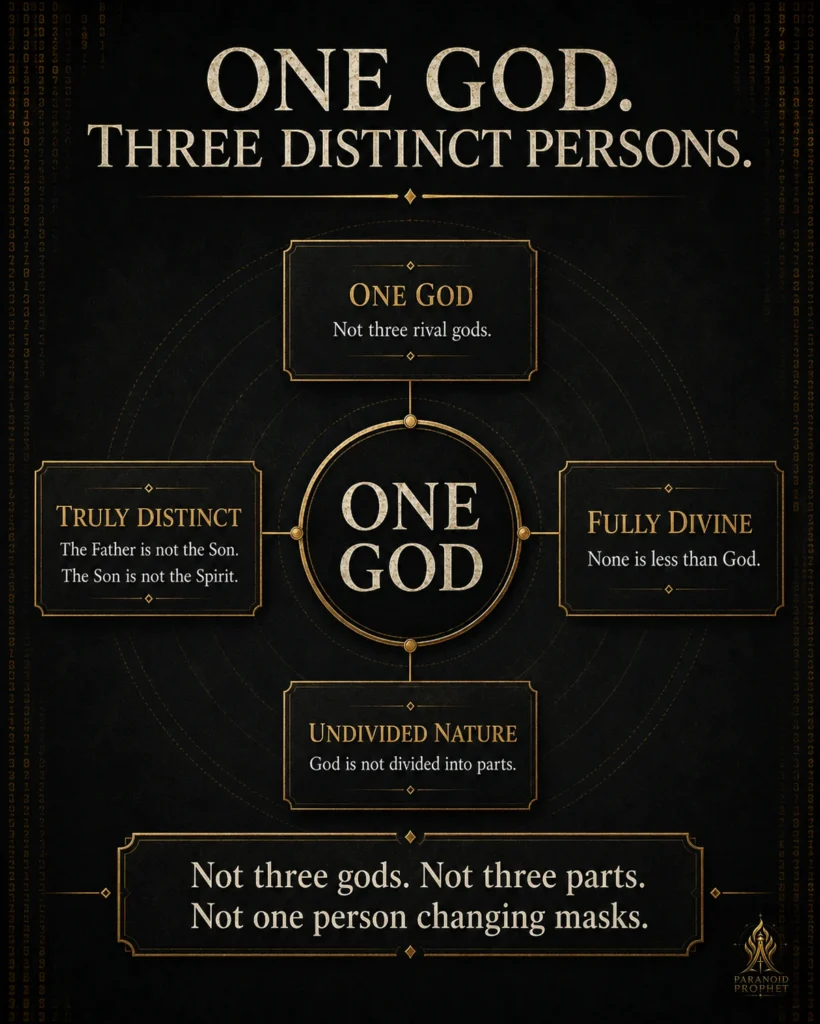
The Trinity is the Christian confession that there is one God who eternally exists as three distinct persons: the Father, the Son, and the Holy Spirit.
The Father is God. The Son is God. The Holy Spirit is God. Yet the Father is not the Son, the Son is not the Holy Spirit, and the Holy Spirit is not the Father.
There is one God: Father, Son, and Holy Spirit. The three are personally distinct, fully divine, and united in the one undivided divine nature.
This does not mean that Christians worship three gods. Nor does it mean that God is divided into three pieces, with each person being one-third of God. The Father is fully God. The Son is fully God. The Holy Spirit is fully God. God’s divine nature is not split, shared out, or diminished.
One God, Father, Son, and Holy Spirit
Christian faith begins with uncompromising monotheism. Israel was commanded to confess, “The LORD our God, the LORD is one.” Through Isaiah, God declares that there is no other God beside Him. He alone is God, Creator, Savior, and Judge.
The Trinity does not weaken that confession. It protects it while taking seriously everything Scripture says about the Father, the Son, and the Spirit.
When Christians say God is one, they are not describing Him as one spiritual being among many. God is not one god in a crowded universe, competing with lesser gods for authority or worship. He is the one eternal Creator on whom everything else depends.
When Christians say Father, Son, and Holy Spirit are distinct persons, they are not imagining three separate divine beings with separate bodies, separate limits, and separate divine lives. The word person is a careful way to preserve what Scripture makes impossible to deny: the Father is not the Son, the Son is not the Spirit, and the Spirit is not the Father.
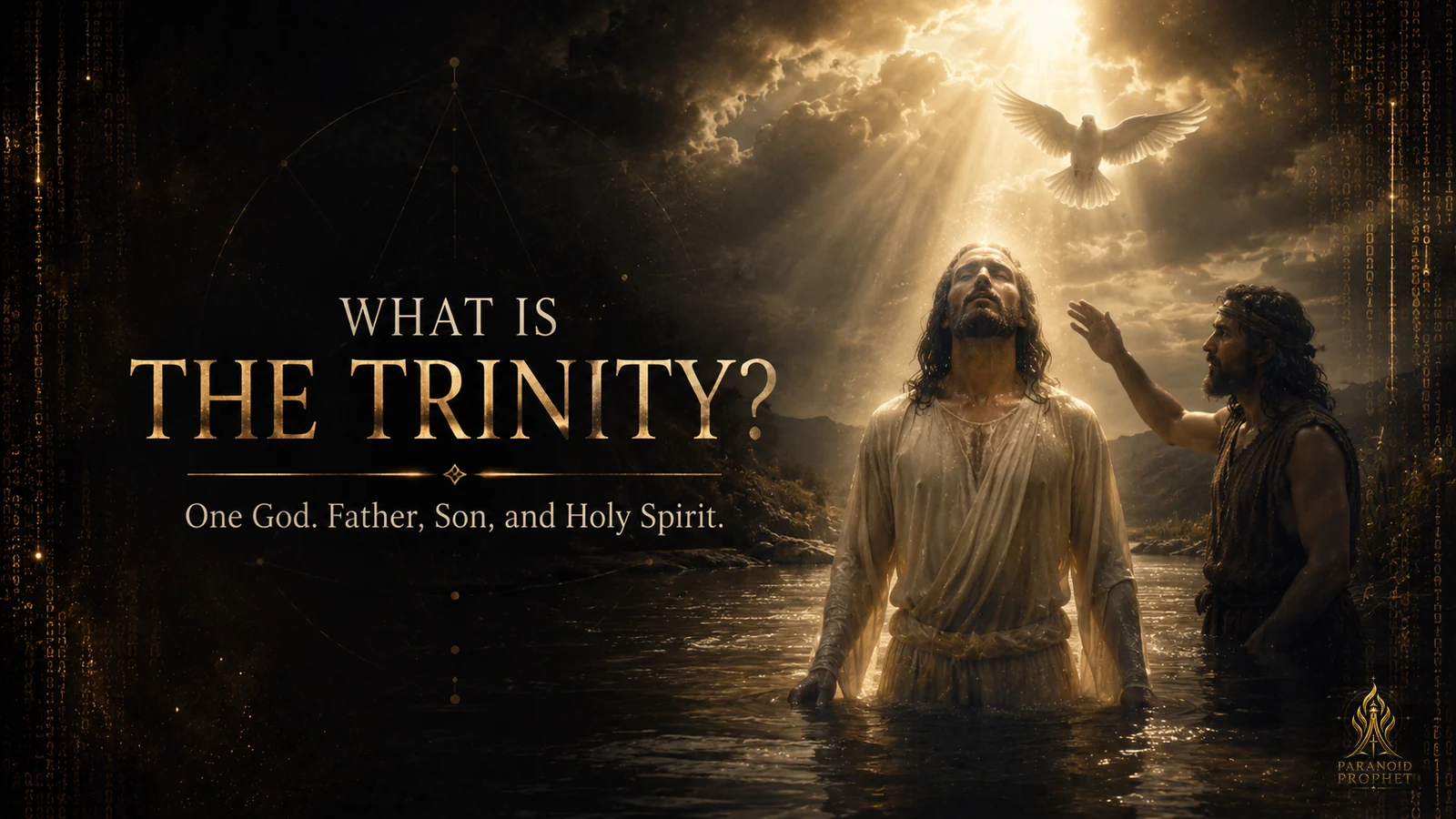
At Jesus’ baptism, the Son stands in the Jordan River, the Spirit descends like a dove, and the Father speaks from heaven. All three are present distinctly and simultaneously. Jesus later says that He will ask the Father, who will give His followers another Helper, the Holy Spirit. The Father sends, the Son asks, and the Spirit comes.
Those distinctions are not imaginary. They belong to the way Scripture tells the story of salvation. The Father truly sends the Son. The Son truly obeys the Father in His incarnate mission. The Spirit truly gives life, bears witness to Christ, and brings believers into the family of God.
What the Trinity Does Not Mean
- It does not mean three gods. Christianity confesses one God, not three independent divine beings working together like a committee.
- It does not mean three parts of God. Father, Son, and Spirit are not each one-third of God.
- It does not mean one person wearing three temporary masks. The Father does not become the Son, then become the Spirit.
- It does not mean the Son is a created intermediary. Scripture presents Jesus with divine identity, authority, glory, worship, and a role in creation itself.
- It does not mean the Holy Spirit is impersonal energy. The Spirit speaks, teaches, wills, intercedes, and can be grieved.
The Trinity is profound, but it is not a contradiction. Christianity does not say that God is one person and three persons, or one being and three separate beings. It says that God is one God, while the Father, Son, and Holy Spirit are distinct persons who fully share the one divine nature.
That is difficult to picture because God is not one more object inside creation. Yet difficulty is not the same as incoherence. The doctrine gives Christians clear boundaries: one God, real distinction, full deity, and no division within God.
This is also why common Trinity analogies eventually fail. Water, eggs, clovers, and human relationships may highlight one small feature, but each can distort the doctrine by making God sound like one person changing forms, three parts combined into one whole, or three separate gods. Scripture is safer than a clever illustration.
The rest of the article tests this confession against the Bible itself. Does Scripture truly present one God, the Father, the Son, and the Holy Spirit in this way? That is where the case must begin.
The Bible’s Pattern: One God, Father, Son, and Holy Spirit
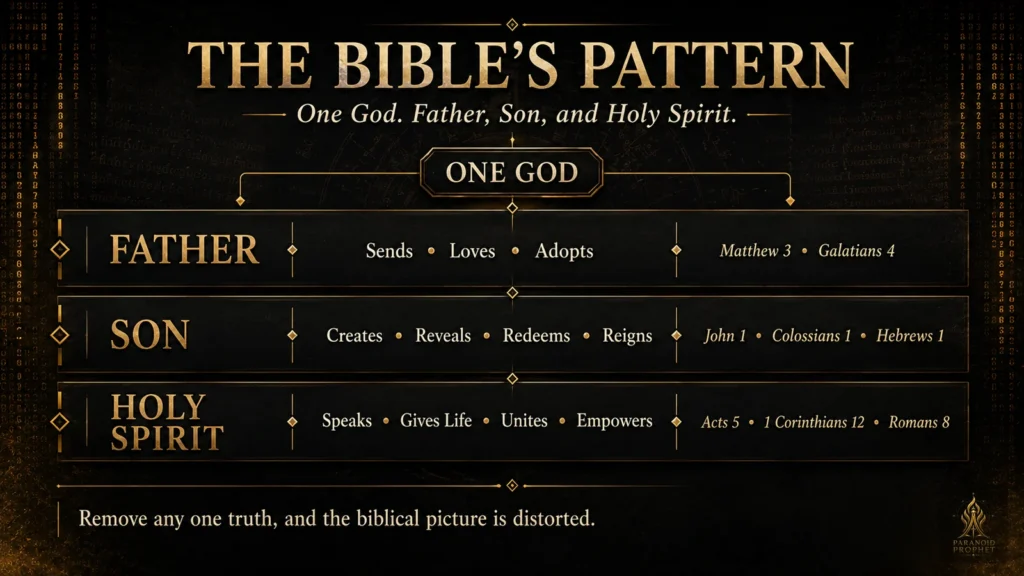
Scripture does not give Christians one sentence that reads, “God is one essence in three persons.” It gives something that must be taken just as seriously: a unified pattern that refuses to let any major truth disappear.
There is one God. The Father, Son, and Holy Spirit are each spoken of in divine ways. The Father, Son, and Spirit are genuinely distinct. And the gospel itself is told through their united saving work.
Remove any one of those truths, and the biblical picture is distorted. Deny that God is one, and Christianity becomes polytheistic. Deny the Son’s divine identity, and the New Testament’s testimony about Jesus is reduced. Deny the Spirit’s divine personhood, and the Spirit becomes an impersonal force. Deny the distinction between Father, Son, and Spirit, and Scripture’s account of salvation loses its shape.
One God Remains the Foundation
The New Testament does not revise Israel’s confession that there is one God. It carries that confession forward while speaking of Jesus and the Holy Spirit in ways that demand explanation.
Paul writes that “there is no God but one,” then says that for Christians there is “one God, the Father,” and “one Lord, Jesus Christ, through whom are all things and through whom we exist.” First Corinthians 8:4–6 does not present Jesus as a second god alongside the Father. Paul writes inside a passage that rejects rival gods, yet he speaks of Christ within the language of creation, existence, and Christian confession.
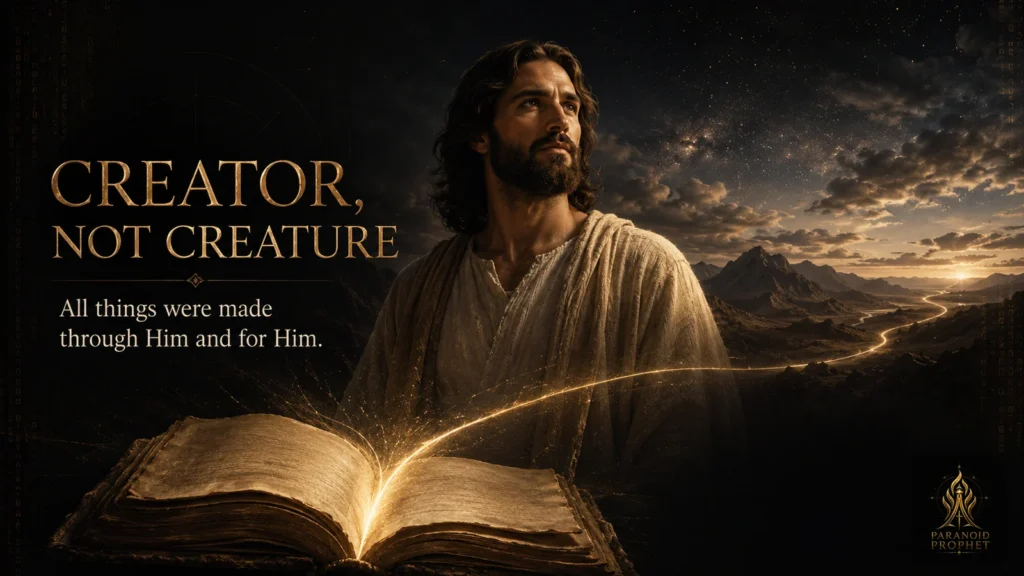
All things are from the Father, and all things are through the Son. The Father and Son are distinct, but the Son is not placed on the creaturely side of reality as though He were merely another being God made.
This passage does not give a full technical definition of the Trinity. It establishes the foundation beneath the doctrine: early Christian faith remains uncompromisingly monotheistic while including Jesus Christ within the identity and saving work of the one God.
The Son Is Not a Creature Alongside God
The New Testament does not present Jesus as merely a remarkable prophet, a morally perfect teacher, or an angelic messenger raised to special honor. It presents Him with divine identity, divine authority, divine glory, and a role in creation itself.
John opens his Gospel by taking readers back before Bethlehem, Nazareth, and the beginning of the created world. “In the beginning was the Word, and the Word was with God, and the Word was God.” John holds distinction and divine identity together. The Word is with God, so the Word is not the Father. Yet the Word is God, and all things came into being through Him.
Then John says that the Word became flesh and dwelt among us. Jesus did not begin to exist when Mary gave birth. The Son truly entered human history, but John presents Him as existing before creation and as the One through whom creation itself came to be.
After the resurrection, Thomas sees the crucified and risen Jesus and responds, “My Lord and my God!” The confession is personal, worshipful, and placed near the climax of John’s Gospel. It does not explain every dimension of the Father-Son relationship, but it prevents readers from reducing Jesus to a mere creature.
Paul adds another crucial layer in Philippians 2:5–11. He describes Christ’s humility, His taking the form of a servant, His obedience to death on a cross, and His exaltation. The passage ends with every knee bowing and every tongue confessing that Jesus Christ is Lord.
That language reaches back to Isaiah 45, where the Lord declares that every knee will bow to Him. Paul does not erase the Father-Son distinction. He says this universal confession of Jesus Christ as Lord is “to the glory of God the Father.” Yet he places the Son within the horizon of worship and honor Isaiah reserves for the one God.
Colossians 1:15–20 speaks with the same scope. All things were created through Christ and for Christ. He is before all things. All things hold together in Him.
The phrase “firstborn of all creation” requires careful treatment, and this article addresses that objection below. But Paul’s own context must govern the reading. Christ is not simply placed within creation as its earliest member. He is described as before all things, the One through whom all things exist, and the One for whom all things were made.
Hebrews 1 reinforces that witness. The Son is the radiance of God’s glory and the exact imprint of His nature. He sustains all things by His powerful word, receives honor angels do not receive, and is associated with God’s eternal throne and creative work.
No one verse offers a finished Trinity formula. Together, however, these passages establish a boundary Christian doctrine cannot cross: the Son is not a created assistant standing somewhere between God and the world. He belongs within the divine identity, glory, and creative work Scripture ascribes to God alone.
The Holy Spirit Is God and Not an Impersonal Force
The Holy Spirit is sometimes treated as God’s influence, spiritual energy, or impersonal power. Scripture does speak of people being filled with the Spirit, receiving the Spirit, and being strengthened by the Spirit. Those descriptions, however, do not make the Spirit less than personal.
The Spirit speaks, teaches, sends, guides, bears witness, gives gifts, intercedes, and can be grieved. These are not the actions of an impersonal force.
In Acts 5:1–4, Peter tells Ananias that he has lied to the Holy Spirit. He then says that Ananias has lied not merely to men but to God. The text does not pause to write a technical doctrine of the Spirit, but it identifies lying to the Spirit with lying to God.
Paul also says that the Spirit searches even the depths of God. First Corinthians 2:10–11 compares the Spirit’s knowledge of God to a person’s awareness of his own thoughts. The Spirit is not one more spiritual observer standing outside God. He knows the depths of God in a way that belongs within God’s own life.
In First Corinthians 12:4–11, the Spirit distributes gifts to believers “as he wills.” He is not mechanical power flowing automatically into the church. He acts with purpose and will.
Believers are also warned not to grieve the Holy Spirit. Ephesians 4:30 does not speak of grieving an atmosphere or an abstract religious feeling. It speaks of grieving the Holy Spirit of God.
The Spirit is therefore neither a lesser divine assistant nor vague spiritual energy. Scripture presents Him as God’s personal presence and action among His people: the One who gives life, bears witness to Christ, convicts, teaches, strengthens, and brings believers into the family of God.
The Gospel Has a Father-Son-Spirit Shape
The distinction between Father, Son, and Spirit is not hidden in a technical puzzle. It is woven into the way Scripture tells the story of salvation.
Jesus commands His disciples to baptize believers “in the name of the Father and of the Son and of the Holy Spirit.” Matthew 28:19 does not define every later theological term, and it should not be turned into a grammatical trick. Yet it clearly shows that Christian identity and worship are marked by this coordinated Father-Son-Spirit pattern.
Paul’s blessing to the Corinthian church reflects the same reality: “The grace of the Lord Jesus Christ and the love of God and the fellowship of the Holy Spirit be with you all.” Second Corinthians 13:14 places Father, Son, and Spirit together at the heart of Christian worship and blessing.
The gospel itself carries this shape. Galatians 4:4–6 says that God sent forth His Son, born of a woman, to redeem those under the law. Then God sent the Spirit of His Son into believers’ hearts, crying, “Abba! Father!”
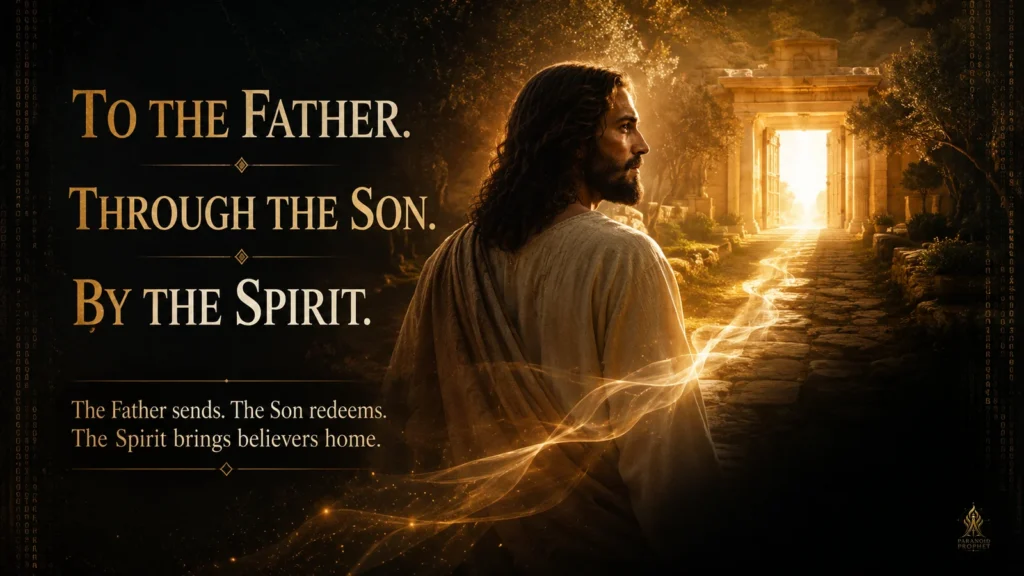
The Father sends. The Son redeems. The Spirit brings the redeemed into the Father’s family.
This is not three separate salvation projects. The one God saves His people. Yet Scripture reveals that salvation comes with a real Father-Son-Spirit shape. The Father is not absent from the cross. The Son is not a tool in the Father’s hand. The Spirit is not an impersonal after-effect of conversion.
The Father loves and sends the Son. The Son comes in flesh, obeys, dies, rises, and reigns. The Spirit gives life, joins believers to Christ, and brings them before God as adopted sons and daughters.
That is why the Trinity is not distant speculation. It is already present in the biblical story of creation, revelation, redemption, and new life.
How Can God Be One and Three?
By this point, the biblical pattern is clear enough to create a real question. If the Father is God, the Son is God, and the Holy Spirit is God, while the Father, Son, and Spirit are truly distinct, how can Christianity still confess one God?
The answer requires careful language. Christians are not saying that God is one person and three persons, or one being and three separate beings. That would be a contradiction.
They are saying that God is one in divine nature and three in persons.
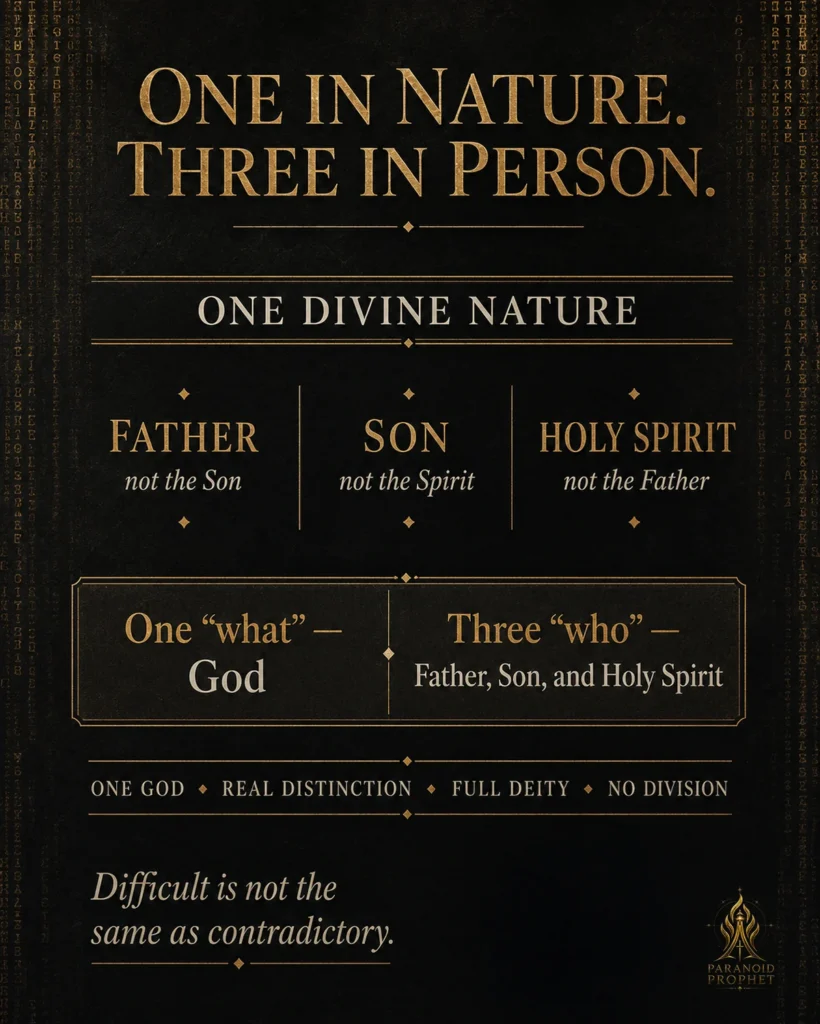
One Divine Nature, Three Distinct Persons
When Christians say God is one, they are speaking about what God is. There is one eternal, uncreated, holy, all-powerful God. He is not divided into parts. He does not share His divine nature with rival gods. He is not one spiritual being among many.
When Christians say Father, Son, and Holy Spirit are three persons, they are speaking about who God is. The Father is not the Son. The Son is not the Spirit. The Spirit is not the Father.
The word person is not perfect modern shorthand. In ordinary speech, a person is usually an individual human being with a separate body, separate limits, and an independent life. Christians are not imagining three enlarged human beings in heaven.
The word is used because Scripture gives real distinction that cannot be erased. The Father sends the Son. The Son prays to the Father. The Spirit bears witness to the Son. Jesus speaks of glory shared with the Father before the world existed. John 17:1–5 does not present the Father and Son as one person speaking to Himself under different titles.
At the same time, this real distinction does not split God into three separate divine beings. The Father is not one-third of God. The Son is not one-third of God. The Spirit is not one-third of God. Each is fully God, and God is one.
That is why the Trinity should not be reduced to a slogan such as “three gods in one group” or “one person in three forms.” Both explanations remove truths Scripture requires Christians to keep.
Why the Trinity Is Not a Contradiction
The Trinity is difficult, but difficulty is not the same as incoherence.
Christianity does not claim that God is one and three in the same respect. It does not say that God is one person and three persons. It does not say that God is one being and three beings.
It says that there is one God and that the Father, Son, and Holy Spirit are distinct persons who fully share the one divine nature.
That explanation does not give believers a complete mental picture of God’s eternal life. It does not pretend that the Creator can be reduced to a familiar creaturely category. It establishes the boundaries Scripture gives us:
- God is one.
- The Father, Son, and Holy Spirit are not interchangeable.
- The Son is not a creature.
- The Spirit is not an impersonal force.
- No person of the Trinity is less divine than another.
- God is not divided into competing divine parts.
Those boundaries matter because every false shortcut eventually damages the gospel. If the Son is a creature, He cannot be confessed with the full divine identity Scripture gives Him. If Father, Son, and Spirit are merely different roles, then the Father’s sending of the Son and the Son’s obedience to the Father lose their real meaning. If God is divided into three gods, Christian monotheism collapses.
Why Analogies Eventually Fail
Because the Trinity is difficult to explain, Christians often reach for illustrations. Water can become ice, liquid, or vapor. An egg has shell, white, and yolk. A clover has three leaves. A person can be a father, son, and husband.
Each picture may highlight one limited idea. None can explain the Trinity without eventually distorting it.
Water can suggest that God changes forms. An egg can suggest that God is composed of parts. A clover can suggest that each person is only one-third of God. Three human beings can suggest three separate gods who merely share a category called divinity.
The problem is not that every analogy is malicious. The problem is that no created object can carry the full weight of the doctrine. God is not one more item inside creation.
Scripture is safer than a clever illustration. It tells Christians what they must affirm without pretending that God can be reduced to a household object, a diagram, or a human relationship.
The Word “Trinity” Is Not in the Bible—So Does It Matter?
The word Trinity does not appear in Scripture. Christians should admit that plainly.
Scripture also does not provide a single verse that functions as a completed fourth-century creed. The word came later as Christians tried to summarize the biblical witness without surrendering any part of it.
That does not settle whether the doctrine is true.
The real question is whether the word faithfully describes what Scripture teaches. Christians use other theological terms in the same way. The word Bible does not appear as a title page inside Scripture. The word incarnation is not used as a formal doctrinal label in the New Testament. Yet both terms summarize real biblical teaching.
The word Trinity is meant to do the same thing. It is not a replacement for Scripture. It is shorthand for the pattern Scripture gives:
- There is one God.
- The Father is God.
- The Son is presented with divine identity, glory, authority, worship, and creative power.
- The Holy Spirit is presented as divine and personal.
- The Father, Son, and Spirit are truly distinct.
- The one God saves through the Father’s sending love, the Son’s redeeming work, and the Spirit’s life-giving presence.
A useful doctrinal term should make Christians more faithful readers of Scripture, not less. The word Trinity earns its place only if it protects the truths Scripture teaches without adding a different God behind the Bible’s words.
That raises the next historical question. If the word came later, did the doctrine come later too? Or did the early church develop more precise language because it was trying to defend the biblical pattern Christians were already confessing?
Did Nicaea Invent the Trinity?
No. The Council of Nicaea did not invent Christian belief in the Father, Son, and Holy Spirit. It did not create the worship of Jesus, write the New Testament, or introduce the claim that the Son belongs with the one God of Israel.
But a careful answer needs more than a slogan. Nicaea did matter. It gave the church sharper language during a fierce controversy over whether the Son was eternal and fully divine or whether He was a created being exalted above everything else.
The council did not create a new God. It clarified how Christians should speak faithfully about the God Scripture reveals.
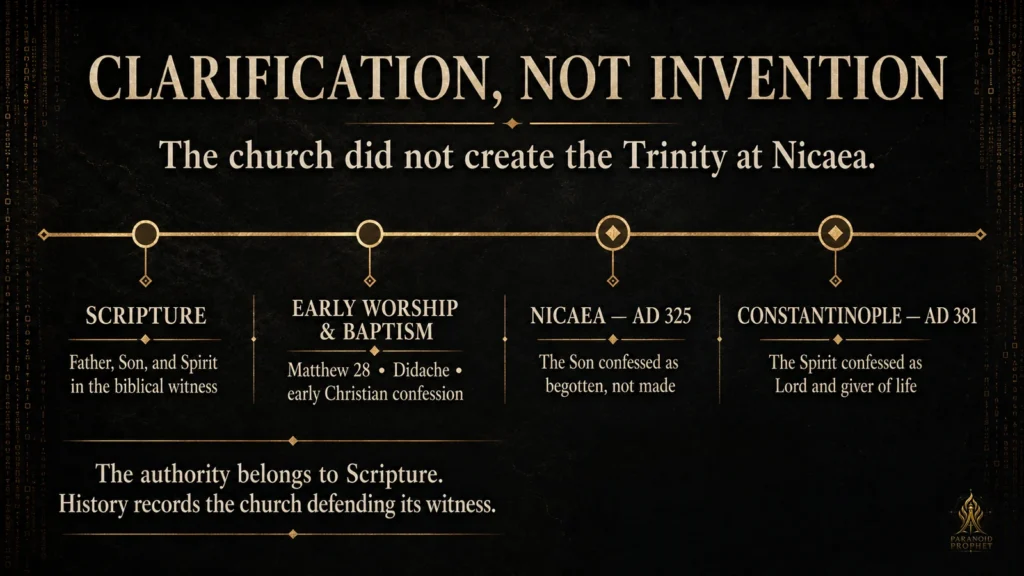
Christian Faith Did Not Begin at Nicaea
Long before 325, Christians were already baptizing in the name of the Father, Son, and Holy Spirit, confessing Jesus in divine terms, and wrestling with how the one God could be known through Father, Son, and Spirit.
The Didache, an early Christian teaching document, instructs believers to baptize in the name of the Father, Son, and Holy Spirit. It does not give readers a completed fourth-century explanation of divine essence and personhood. It does not use the word homoousios, and it is not a miniature Nicene Creed. Yet it shows that this triadic pattern already stood at the entrance into Christian life long before Nicaea.
That should not surprise readers of the New Testament. It echoes Jesus’ baptismal command in Matthew 28:19. Christians were not waiting for a Roman emperor or a fourth-century council to begin speaking of Father, Son, and Spirit. The pattern was already embedded in Scripture, worship, baptism, prayer, and the church’s understanding of salvation.
Pre-Nicene writers also debated how to preserve both God’s unity and the real distinction of Father, Son, and Spirit. Tertullian, writing more than a century before Nicaea, argued against the claim that Father, Son, and Spirit were merely one person under different names.
In Against Praxeas, Tertullian spoke of divine unity while also speaking of Father, Son, and Spirit in a threefold relation. His language was not identical to the mature fourth-century vocabulary. Christians should not pretend every later question had already been settled in his day. Still, his work shows that the central issue was alive before Nicaea: how to confess one God without erasing the Son or the Spirit.
What Nicaea Actually Addressed
The Council of Nicaea met in 325 because the church faced a serious dispute about the Son’s relation to the Father.
Arius and those who agreed with him taught that the Son did not share the Father’s eternal divine life in the fullest sense. On that account, the Son stood above the rest of creation but was still a being brought into existence by God.
The issue was not academic trivia. If the Son were a creature, then the New Testament’s claims about His role in creation, worship, salvation, and divine glory would need to be drastically reinterpreted. The question was whether Jesus Christ belongs on the Creator side of reality or the creature side.
Nicaea answered with language meant to close that door. The creed confessed Jesus Christ as “God of God,” “Light of Light,” and “very God of very God.” It declared that the Son is “begotten, not made” and “of one substance with the Father.”
The Greek word behind “of one substance” is homoousios. It is often translated as “of one essence” or “consubstantial.” The term is technical, but its purpose is clear: the Son is not a created intermediary between God and the world. He fully shares the divine nature of the Father.
The Creed of Nicaea from 325 did not replace Scripture with philosophy. It sought to protect the biblical witness against a reading that made Christ less than fully divine.
This is why the phrase “Nicaea made Jesus God” is historically misleading. The council did not invent John 1, Philippians 2, Colossians 1, Hebrews 1, or Revelation 5. It responded to a conflict about how those Scriptures should be read.
Emperor Constantine did convene the council, and his political authority shaped the setting in which bishops gathered. That should not be hidden or romanticized. But convening a council is not the same as creating its theology. By the time Nicaea met, Christians had already spent generations reading Scripture, worshiping Christ, baptizing in triadic language, and debating the Son’s identity.
Why Constantinople Matters for the Holy Spirit
Nicaea in 325 focused especially on the Son’s relation to the Father. Its creed ended with a brief confession of belief in the Holy Spirit, but it did not yet provide the fuller description of the Spirit many Christians recite today.
The creed traditionally associated with the Council of Constantinople in 381 gave more explicit expression to the Spirit’s identity. It confessed the Holy Spirit as “the Lord” and “the giver of life,” proceeding from the Father and worshiped and glorified together with the Father and the Son.
The creed traditionally associated with 381 matters because the Trinity is incomplete if the Holy Spirit is treated as an afterthought, an impersonal force, or a lesser spiritual assistant.
Scripture already presents the Spirit as divine and personal. He speaks, gives gifts according to His will, intercedes for believers, can be grieved, and is identified with God. The later creed did not create those biblical claims. It gave the church language that openly confessed their implications.
The statement commonly called the Nicene Creed is therefore more precisely called the Niceno-Constantinopolitan Creed in its widely recited form. It reflects both Nicaea’s confession in 325 and the fuller fourth-century expression traditionally associated with Constantinople in 381.
Development Is Not Invention
The word Trinity is later than the New Testament. The word homoousios is not a New Testament word. The formal creed associated with Constantinople came centuries after Pentecost.
None of those facts automatically proves that the doctrine is false.
Christians use later doctrinal language because Scripture gives them a pattern that must be guarded. The Father is God. The Son is presented with divine identity, glory, worship, authority, and creative power. The Holy Spirit is divine and personal. Father, Son, and Spirit are distinct. Yet there is one God.
A doctrinal summary is faithful when it keeps those truths together. It becomes unfaithful when it denies or replaces them.
The Trinity is not true because a council approved it. Councils can err, institutions can fail, and Christian leaders remain accountable to the Word of God. Nicaea and Constantinople matter because they represent the church’s effort to speak carefully when central biblical truths were being denied or distorted.
The authority belongs to Scripture. History helps readers see that Christians did not invent this question in the fourth century. They inherited it from the Bible itself.
Why the Trinity Matters for Jesus, Salvation, Prayer, and Worship
The Trinity is not a doctrinal puzzle kept on a shelf for theologians and church councils. It reaches into the heart of the gospel.
Christianity is not built on vague belief in a higher power. It is built on the God Scripture reveals: the Father who sends, the Son who saves, and the Holy Spirit who gives life.
Remove the Trinity, and the Christian story changes at every major point. Jesus becomes either a created intermediary, a merely human teacher, or the Father appearing under another title. The Spirit becomes a force instead of God’s personal presence. Salvation becomes less than the Father drawing sinners to Himself through the Son and by the Spirit.
The Trinity Protects the Identity of Jesus
The question of the Trinity is inseparable from the question of who Jesus is.
The New Testament does not present Jesus as a man who slowly became divine, a heavenly creature promoted into worship, or a prophet who merely represented God’s authority. It presents the eternal Word becoming flesh, the Son through whom all things were made, and the risen Christ receiving Thomas’s confession, “My Lord and my God.”
John 3:16–17 says that God loved the world and gave His only Son so that the world might be saved through Him. The Father did not send a spiritual assistant to stand at a distance between God and sinners. He sent His Son.
The Son truly took flesh. He prayed, obeyed, suffered, died, rose from the dead, and now reigns in glory. His humanity is not an embarrassment Christians need to hide. It shows that the incarnation is real.
Yet His true humanity does not erase the New Testament’s wider testimony to His divine identity. Jesus can pray to the Father because the Father is not the Son. He can obey the Father in His incarnate mission because the Son truly came as the willing servant and Savior. That obedience does not make Him a creature. It displays the depth of His saving love.
For the wider historical and biblical case for Christ’s identity, see Is Jesus the Son of God? Evidence from History, Prophecy, Resurrection, and Scripture.
The Trinity Gives the Gospel Its Shape
The one God saves His people. Yet Scripture reveals that salvation has a real Father-Son-Spirit shape.
Ephesians 1:3–14 begins with the Father’s eternal purpose, centers redemption in the Son’s blood, and speaks of believers being sealed with the promised Holy Spirit. Galatians 4:4–6 says that God sent forth His Son to redeem those under the law and then sent the Spirit of His Son into believers’ hearts, crying, “Abba! Father!”
The Father sends. The Son redeems. The Spirit brings the redeemed into the Father’s family.
That is not cold theology. It is adoption.
Christians do not climb toward God through moral effort or spiritual achievement. The Father acts in mercy. The Son bears sin and opens the way. The Spirit unites believers to Christ and assures them that they belong to God.
Romans 8:9–17 describes the Spirit as the Spirit of God and the Spirit of Christ, giving life to believers and bearing witness that they are children of God. Christian faith is therefore life in the Son, by the Spirit, before the Father.
The Father, Son, and Spirit are not divided against one another at the cross. The Father sends the Son in love. The Son willingly gives Himself in obedience and love. The Spirit applies the Son’s finished work to those who believe.
The Trinity Changes Prayer and Worship
Christian prayer is communion with the living God. Believers come to the Father through the Son by the Holy Spirit.
Jesus teaches His disciples to pray, “Our Father.” He also says that no one comes to the Father except through Him. The Spirit helps believers in weakness and intercedes according to the will of God. Christian prayer therefore has a Trinitarian shape even when the person praying does not use that word.
We come to the Father because the Son has opened the way. We come through the Son because He is the mediator who has reconciled us to God. We come by the Spirit because the Spirit gives life, helps in weakness, and teaches our hearts to cry, “Abba! Father.”
Worship has the same shape. Christians worship the Father without diminishing the Son. They honor the Son without creating a second god. They depend on the Spirit without treating Him as a mystical atmosphere.
In Revelation 5:8–14, the Lamb receives worship alongside the One seated on the throne. The scene does not divide heaven’s worship between rival gods. It reveals the glory of the Father and the Lamb in the worship of all creation. For a closer look at the exalted Christ in John’s apocalyptic vision, see Jesus in Revelation 1.
The goal is not to master God with vocabulary. It is to worship the Father, confess the Son, and walk by the Spirit.
The Trinity Reveals God’s Eternal Love
Jesus says that the Father loved Him before the foundation of the world. John 17:24 gives Christians a glimpse of eternal love within God’s own life.
Christians cannot map every detail of God’s eternal life. But Scripture does show that God did not create because He lacked love, joy, relationship, or glory. Before there was a universe, the Father loved the Son. The Son shared glory with the Father. The Holy Spirit was not absent from the life of God.
Creation is not God searching for someone to complete Him. Redemption is not God reluctantly tolerating sinners. The God revealed in Scripture creates freely, loves freely, and saves freely.
Frequently Asked Questions About the Trinity
Does the Trinity mean Christians worship three gods?
No. Christianity confesses one God. The Father, Son, and Holy Spirit are not three independent divine beings who cooperate like a committee. They are personally distinct, fully divine, and united in the one undivided divine nature.
Is the word Trinity in the Bible?
No. The word came later as a concise way to summarize the biblical pattern: one God; Father, Son, and Holy Spirit; real distinction between them; and full divine identity ascribed to the Son and Spirit. The word is not inspired Scripture. It is useful only when it faithfully protects what Scripture teaches.
Did the Council of Nicaea invent the Trinity?
No. Nicaea did not invent Christian worship of Jesus or triadic language about Father, Son, and Spirit. It responded to a fourth-century dispute by confessing that the Son is “begotten, not made” and of one essence with the Father. The council clarified doctrinal language; it did not create the biblical evidence it was trying to defend.
Why did Jesus pray to the Father, say the Father was greater, and not know the day or hour?
Those passages show that the Father and Son are not the same person and that the Son truly became man. Jesus genuinely prayed, obeyed, suffered, grew in wisdom, and lived within the limitations of His incarnate mission. Christians should not explain that away.
Yet those passages must also be read alongside the texts that present the Son as preexistent, Creator, recipient of worship, sharer of the Father’s glory, and confessed as God. His true humanity does not reduce Him to a creature. It shows that the eternal Son truly entered our condition to save us.
Does 1 Corinthians 15:24–28 prove that Jesus is less than the Father?
First Corinthians 15:24–28 describes the risen Son completing His messianic reign, defeating every enemy, and presenting the kingdom to the Father so that God may be all in all. It clearly shows the Son’s real submission within salvation history.
But the passage does not say that the Son becomes a creature, loses divine identity, or stops sharing the Father’s glory. It describes the completion of His saving reign, not the collapse of His divine nature.
Do “firstborn of all creation” and Revelation 3:14 prove that Jesus was created?
Not by themselves. In Colossians 1:15–20, Paul immediately says that all things were created through Christ and for Christ, that He is before all things, and that all things hold together in Him. The phrase must be read in that context.
Revelation 3:14 is debated because the word translated “beginning” can carry more than one sense, including origin or source. Christians should not build an entire doctrine on one disputed phrase while ignoring John 1:1–3, Colossians 1:16–17, and the wider New Testament witness to Christ’s role in creation.
Is the Holy Spirit a force or a person?
The Holy Spirit is not an impersonal force. Scripture says the Spirit speaks, teaches, wills, intercedes, gives gifts, can be grieved, and is identified with God. The Spirit is God’s personal presence and action among His people.
Are the Father, Son, and Holy Spirit simply different roles of one person?
No. Scripture presents real relationship between them. The Father sends the Son. The Son prays to the Father. The Father sends the Spirit in the Son’s name. The Spirit bears witness to the Son. At Jesus’ baptism, Father, Son, and Spirit are revealed distinctly and simultaneously.
Sources and Further Reading
Source discipline: Scripture is the authority for Christian doctrine. Early Christian writings and church councils help us trace how believers confessed, debated, and clarified that doctrine through history. They do not replace Scripture. This article distinguishes what the Bible teaches, what historical sources show, and what Christians infer by bringing the biblical pattern together. For the site’s wider research and verification standards, read Sources & Verification.
Primary Scripture
- Deuteronomy 6:4; Isaiah 45:5–6, 22–23; 1 Corinthians 8:4–6
- John 1:1–3, 14; John 20:28; Philippians 2:5–11; Colossians 1:15–20
- Acts 5:3–4; 1 Corinthians 12:4–11; Romans 8:9–17; Ephesians 4:30
- Matthew 3:16–17; Matthew 28:19; John 14:16–17, 26; John 15:26; John 17:1–5
- Ephesians 1:3–14; Galatians 4:4–6; Romans 8:9–17; 1 Peter 1:1–2
Early Christian and Creedal Sources
- The Didache, chapter 7
- Tertullian, Against Praxeas
- The Creed of Nicaea, 325
- The Niceno-Constantinopolitan Creed traditionally associated with 381
Further Reading
- Lewis Ayres, Nicaea and Its Legacy: An Approach to Fourth-Century Trinitarian Theology.
- Khaled Anatolios, Retrieving Nicaea: The Development and Meaning of Trinitarian Doctrine.
- Gilles Emery, The Trinity: An Introduction to Catholic Doctrine on the Triune God.
- Peter C. Phan, ed., The Cambridge Companion to the Trinity.
- Fred Sanders, The Triune God.
The One God Revealed in Jesus Christ
The Trinity does not ask Christians to worship an abstract formula. It calls them to know the God Scripture reveals.
The Father is not a distant force behind the universe. He is the holy God who sends His Son in love.
The Son is not merely a teacher who showed people how to reach God. He is the eternal Word made flesh, the crucified and risen Lord, and the One through whom sinners are reconciled to the Father.
The Holy Spirit is not a vague religious feeling. He gives life, convicts of sin, unites believers to Christ, teaches them to cry, “Abba! Father,” and forms them into the likeness of the Son.
So what is the Trinity? It is the Christian confession that the one God has made Himself known as Father, Son, and Holy Spirit—not as an abstract riddle, but in the saving work of Jesus Christ.
Jesus did not come merely to give better ideas about God. He came to reveal the Father, bear sin, defeat death, pour out the Spirit, and bring His people home. The Trinity matters because the gospel matters. And the gospel matters because the crucified and risen Son is not a distant religious symbol, but the Lord through whom we come to the Father and receive new life by the Holy Spirit.