
A verse can fit on a coffee mug and still take a whole paragraph to understand. You hear it in a sermon, save it from a post, or remember a few words when life gets difficult. Then someone uses the same verse to make a very different claim. How do you tell whether either reading is faithful?
Reading the Bible in context means understanding a passage within its surrounding sentences, its kind of writing, its original situation, and the wider witness of Scripture before applying it to life today. You can begin without knowing Hebrew or Greek. Start by reading more than the sentence that caught your attention, then let the passage correct your first impression.
GUIDED ARTICLE EXPERIENCE
How to Read the Bible in Context: A Practical Guide for Beginners
Read along as the narration moves through the article.
Browser narration · No stored audio or site tracking
CONTINUE GUIDED TOUR
Continue where you left off.
GUIDED TOUR COMPLETE
You have reached the end of this study.
Study record saved on this device.
GUIDED TOUR
How to Read the Bible in Context: A Practical Guide for Beginners
Narrator: Paranoid Prophet Recommended Voice Native device narration
Prepare to follow the article as it is narrated.
VOICE & TOUR OPTIONS
Voice & Listening
NARRATOR
Finding a narrator…
Checking the best narrator available on this device.
Restores the site recommendations available in this browser.
Our listening picks lead when available; other voices are ranked for narration. Known novelty voices are hidden. Browser-provided voices may use an online voice service.
Screen-awake support will be checked when narration starts.
Optional: improve your device voices
Listening works with the voices already available here. Your device may offer additional free voices through its own settings.
iPhone or iPad: Settings → Accessibility → Read & Speak (or Spoken Content) → Voices → English. Look for Premium or Enhanced choices, then return here.
If offered, preview Ava or Zoe for U.S. English, or Serena or Jamie for British English. An explicit Premium or Enhanced version can improve on its compact version.
Mac: System Settings → Accessibility → Read & Speak → System voice. Open the voice list to preview or download additional choices.
Windows: Settings → Accessibility → Narrator → Add natural voices. Browser availability varies; a Narrator voice may not appear on websites. Edge may also expose online Natural voices without a model download.
Android: Open Accessibility → Text-to-speech output (the location varies by device). In the preferred engine settings, look for voice data and English choices.
Download sizes vary; some enhanced voices exceed 100 MB. This website cannot install system voices, and an installed voice appears here only if your browser exposes it.
Apple voice guide · Windows voice guide · Android voice guide
CHOOSE A NARRATOR
Recommended on this device
Our listening picks: Aaron, Martha, then Daniel, when available here. Otherwise, automatic uses the highest-ranked suitable voice. Preview alternatives or save your own choice.
Preparing the guided article experience…
RESUME GUIDED TOUR?
Continue where you left off.
GUIDED TOUR COMPLETE
You have reached the end of this study.
For a concrete demonstration, jump to Philippians 4:13 in its paragraph. To begin today, use the short reading session. If a verse seems to clash with another, see how to handle difficult passages.
Article Guide11 sections
Start with Four Questions
These questions give you a repeatable way to slow down. They are a study aid, not a guarantee that you will immediately settle every disagreement.
- What does the passage actually say? Read a whole paragraph or scene. Notice the people, actions, repeated words, reasons, contrasts, and questions.
- Where does it belong? Identify the kind of writing, the speaker or author, the audience, and the situation. Read what comes before and after.
- What is its main point? Explain the passage in one or two sentences, using its own details rather than a topic you hoped to find.
- How should I respond? Consider what that meaning calls you to believe, trust, change, practice, or pray about in your situation.
You will sometimes go back and forth. An attempted application may reveal that you have not understood the argument. A question about the setting may send you back to the paragraph. That is part of attentive reading.
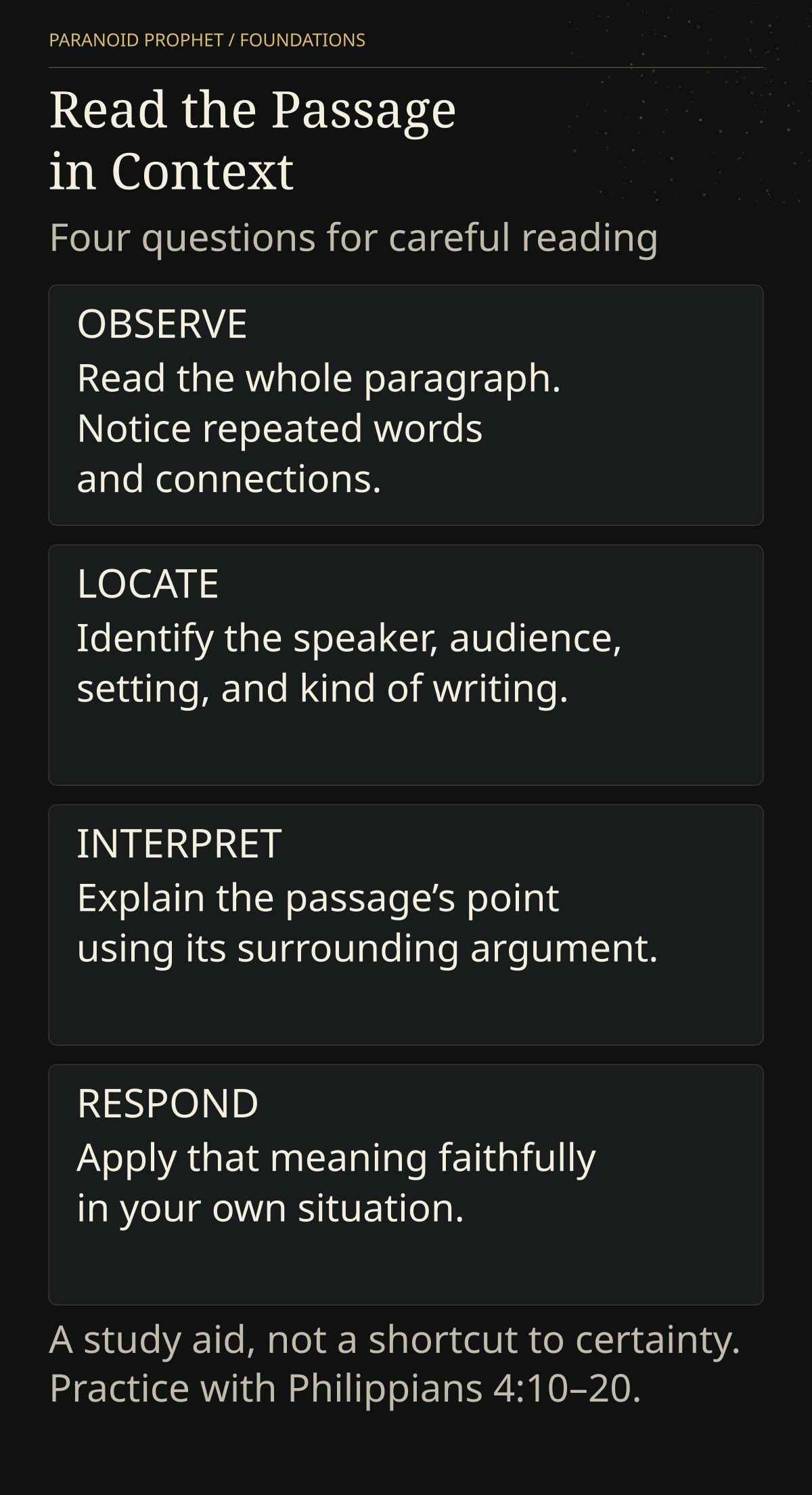
Read the Passage in Context (image text)
Four questions for careful reading
- OBSERVE
Read the whole paragraph.
Notice repeated words
and connections. - LOCATE
Identify the speaker, audience,
setting, and kind of writing. - INTERPRET
Explain the passage’s point
using its surrounding argument. - RESPOND
Apply that meaning faithfully
in your own situation.
A study aid, not a shortcut to certainty. Practice with Philippians 4:10–20.
PARANOID PROPHET / FOUNDATIONS
Read a Complete Thought Before Isolating a Verse
A verse number helps you find a sentence. It does not necessarily mark the beginning or end of an idea. Read the paragraph, the surrounding section, and, when possible, the whole book. Short letters are especially manageable in one sitting.
Pay attention to connecting words. A conclusion introduced by “therefore” depends on something already said. A contrast introduced by “but” may prevent you from turning one sentence into the opposite of the author’s point. Pronouns also matter: ask who “you,” “we,” or “they” refers to before assuming that every statement addresses you directly.
Headings and paragraph breaks in modern editions help readers, but editions sometimes divide a passage differently. If a heading makes the argument feel abrupt, read across it. Our guide to Bible chapters and verses explains the navigation system; the task here is to follow the thought beneath the numbering.
Write down observations before conclusions. “Paul mentions hunger and abundance” is an observation you can point to. “This guarantees my promotion” is an interpretation that must be tested against the passage. Keeping those separate makes correction easier.
Worked Example: What Does Philippians 4:13 Mean?

Open Philippians 4:10–20. Verse 13 is often used as encouragement before an exam, competition, or demanding project. Depending on the translation, it may sound like a promise of being able to accomplish absolutely anything. Let us read the surrounding paragraph before deciding how to use it.
Step 1: Observe the paragraph
Paul begins by expressing joy over the Philippians’ renewed opportunity to care for him. He says he has learned contentment in different circumstances. He names both having enough and going hungry, both abundance and need. His statement about strength comes inside that explanation.
The following verses thank the Philippians for sharing in his trouble. He remembers their financial help and acknowledges the gift brought by Epaphroditus. The paragraph closes with confidence in God’s provision and praise to God.
On a page of notes, you could write: care, contentment, changing circumstances, strength, shared trouble, generosity, provision. Those are the paragraph’s themes. Winning a contest is not among the situations it names.
Step 2: Locate the situation
Philippians is a letter addressed to believers at Philippi. Paul describes imprisonment earlier in the letter. We do not need to settle the debated location of that imprisonment to see that his words about difficulty are grounded in experience. See Philippians 1:1–14.
The gift in chapter 4 belongs to an existing relationship of gospel partnership. Paul is both expressing gratitude and explaining that his confidence does not depend entirely on how much he currently possesses. Reading the paragraph as a thank-you within that relationship gives its statements a concrete setting.
Step 3: Explain the main point
A responsible summary would be: Paul has learned contentment through Christ’s strengthening in both plenty and need, while gratefully receiving the Philippians’ generous support.
This reading takes verse 13 seriously. It also allows the surrounding verses to define the circumstances under discussion. The paragraph does not promise that Christians will achieve every chosen goal, avoid hunger, or escape adversity. Paul explicitly says he has experienced need.
Nor does contentment mean refusing help. Verse 14 praises people who share in his trouble. The same passage that teaches dependence on Christ honors practical support from other believers. Using it to tell a struggling person to stop asking for assistance would work against the paragraph’s movement.
Step 4: Apply the meaning faithfully
Imagine that you are worried about losing income. You could use this passage to pray for strength to remain faithful, resist making your worth depend on your circumstances, and receive help without shame. A friend reading alongside you might respond by offering practical support.
Before an exam or game, you may certainly ask God for help. But this paragraph does not guarantee a particular score. Its encouragement can sustain you when the result disappoints you, too. You do not need to claim an outcome the text never promises in order to receive the hope it actually offers.
The same care applies to verse 19. Read its assurance of provision alongside the hunger already mentioned and the generosity of the community. It gives no formula by which a donation purchases wealth or makes suffering impossible.
Now try the exercise yourself: write one sentence about the paragraph’s meaning and one concrete response. Then underline the details that support both. If your response cannot be connected to anything in the passage, revise it.
Let the Kind of Writing Shape How You Read
A song, a law, a historical account, and a personal letter do different things with language. Taking Scripture seriously includes recognizing those differences. The Books of the Bible guide provides the larger map; here are three examples of why genre changes the reading task.
Wisdom requires discernment
Proverbs 26:4–5 places two apparently opposite instructions together: one warns against answering a fool in a way that makes you resemble him; the other warns against leaving him confident in his own wisdom.
Notice that each instruction gives a reason. Together they train judgment about how to respond, rather than handing you a single rule for every argument. A faithful application asks whether your reply would imitate foolishness or expose it. Context sometimes lives in the reason attached to the command.
Poetry gives language to experience
Psalm 13 begins with a sufferer asking whether God has forgotten him. It moves through petition toward trust and praise. Read as a prayer, it gives believers words for distress. Treating its opening question as a detached theological assertion that God has literally forgotten His people would misunderstand the speech.
Follow the whole prayer without forcing your emotions to change on a schedule. The poem’s movement can guide prayer while leaving room for a person whose grief remains heavy.
Narrative requires attention to the narrator
A biblical account may report a person’s actions without endorsing them. Ask what the narrator emphasizes, what consequences follow, and how the passage relates to clearer teaching elsewhere. A memorable character is not automatically a model for imitation in every detail.
With parables, follow the question Jesus is addressing and the story’s main movement before assigning hidden meanings to every object. With visions and prophetic imagery, notice biblical echoes and the original audience before identifying contemporary events. Genre is a reason to read more carefully, not permission to make a text mean anything.
Use Historical Background Without Inventing It
Start with what the book tells you. A named audience, a controversy, a journey, or a remembered gift may supply enough background to illuminate the argument. Then consult a reliable introduction or commentary for what remains unclear.
Keep three categories separate: what the text states, what independent evidence supports, and what a scholar proposes. A plausible reconstruction can help explain a passage without becoming a fact the passage itself announces.
Be cautious with dramatic claims that begin, “In ancient times, everyone knew…” Ask for a source, a date, and a reason the information applies to this audience. An interesting custom from another century or region may have little bearing on the verse in front of you.
You do not have to master the entire ancient world before beginning. You do need the humility to say when a background claim is uncertain. Our Sources and Verification standard explains why we separate evidence from inference.
Read Each Passage within the Bible’s Larger Story
Christians read Scripture in light of Jesus. In Luke 24:25–27 and 44–49, the risen Jesus relates Israel’s Scriptures to His suffering, resurrection, and the proclamation of repentance and forgiveness.
That larger perspective should deepen attention to a passage, not erase its original setting. Ask how its covenant, promise, command, or pattern fits the unfolding biblical story. Avoid turning every incidental detail into a secret prediction when the text gives you no reason to do so.
Promises addressed to a particular person or nation also require care before being transferred directly to every modern reader. Ask who received the promise, whether conditions were attached, and how later Scripture develops it. Similarly, Christians disagree over how some Old Testament commands apply under the new covenant. A serious answer should explain that relationship rather than simply copying a command or dismissing it as ancient.
The saving work of Christ gives Christian reading its center. For that central announcement, see What Is the Gospel?.
Use Translations and Teachers as Helps
Choose a readable translation and stay with a passage long enough to follow its argument. If a phrase puzzles you, compare another established translation and read the footnotes. A difference may reflect wording choices, ambiguity, or a manuscript question. Our Bible translation guide explains those issues without requiring you to settle them before reading.
A concordance or word-study tool can show where a word occurs. It cannot justify importing every possible meaning into every occurrence. A word’s surrounding sentence still matters. Recognizing a Greek or Hebrew term does not by itself establish the correct interpretation.
Teachers, commentaries, and study Bibles can help you notice what you missed. Compare their explanations with the passage and ask which details support the conclusion. Acts 17:10–12 describes the Bereans receiving the message eagerly while examining the Scriptures. Openness and examination belong together.
Christians also differ about interpretive authority. The Reformed Westminster Confession, chapter 1, emphasizes Scripture interpreting Scripture and reading difficult passages alongside clearer ones. The Catholic Catechism, paragraphs 109–119, calls for attention to authorial intention, genre, and the unity of Scripture while also locating interpretation within the Church’s living Tradition and teaching authority. These are different frameworks, even where readers share useful habits.
This guide takes a Scripture-first Protestant approach while encouraging accountable learning in a healthy church community. Neither personal confidence nor a teacher’s status makes an interpretation immune to examination. AI summaries should be checked the same way: open the actual passage and source rather than trusting a fluent explanation.
When Passages or Interpretations Seem to Conflict
First, state each passage’s point in its own context. Do not resolve a difficulty by quietly removing the sentence that creates it. Check whether the texts address different questions, use a word differently, or speak to different circumstances.
Then distinguish what is clear from what remains disputed. Our study of grace, faith, Paul, and James models why the difficult language in both writers deserves a hearing. A longer explanation is sometimes more faithful than a quick slogan.
You can continue learning while holding a question open. Pray for understanding, discuss the passage with trustworthy readers, and compare explanations that engage the strongest evidence on each side. The Holy Spirit’s work does not give every private impression the authority of Scripture.
A Short Reading Session You Can Start Today
Set aside a manageable stretch of time. The aim is attention, not proving devotion through a timer. Try this with Philippians 4:10–20, then return to the whole letter over the following days.
- Prepare. Ask God for understanding and a willing response. Put distractions aside where possible.
- Read twice. Once for the flow, then again to mark repeated ideas, connections, and questions.
- Write three observations. Use details anyone could find in the passage. Leave uncertain background claims in a separate questions list.
- Summarize the point. Write a sentence about what the passage communicates to its audience. Check it against the beginning and ending of the section.
- Respond specifically. Name one fitting action, prayer, change of attitude, or truth to remember. Revisit it rather than rushing to collect another insight.
For a second exercise, read James 1:19–27. Trace how listening, anger, receiving the word, doing it, speech, and care for vulnerable people belong together. Write your own summary before consulting a study note.
Listening to an audio Bible or reading with another person also counts as serious engagement. If concentration or reading is difficult, use smaller passages and return to them. Understanding is allowed to grow gradually.
Keep Reading, and Let the Passage Speak
Careful reading can challenge an interpretation you have repeated for years. That is a reason to welcome correction. The goal is not to win every debate or collect unusual discoveries. It is to hear Scripture faithfully and respond with trust and obedience.
Read the paragraph. Follow the argument. Check the evidence. Bring your questions into prayer and responsible community. Then allow what you learn to shape ordinary life. Our guide to sanctification and Christian growth continues that connection between learning and living.
Sources and Translation Note
Scripture is paraphrased throughout this guide; linked passages open in the NIV for reading. The extended Philippians example was checked against the public-domain World English Bible as well. The method is a practical synthesis, not a biblical formula or a claim to settle every interpretive dispute. The two confessional sources above represent their own traditions, not every Christian position.