


A teacher can quote the Bible, speak with conviction, and offer genuinely useful counsel while still being wrong about something important. A critic can identify a real mistake and then exaggerate what it proves. Christians need a way to evaluate both without making confidence, popularity, or suspicion their guide.
Christians should evaluate teachers by examining their teaching in biblical context, their confession of Christ and the gospel, their character, and their accountability. The response should match the concern: a misunderstanding needs clarification, a serious doctrinal error needs correction, and abuse requires protection and appropriate reporting. Discernment becomes trustworthy when careful evidence and love for people govern it together.
GUIDED ARTICLE EXPERIENCE
How Should Christians Evaluate Teachers and Teaching?
Read along as the narration moves through the article.
Browser narration · No stored audio or site tracking
CONTINUE GUIDED TOUR
Continue where you left off.
GUIDED TOUR COMPLETE
You have reached the end of this study.
Study record saved on this device.
GUIDED TOUR
How Should Christians Evaluate Teachers and Teaching?
Narrator: Paranoid Prophet Recommended Voice Native device narration
Prepare to follow the article as it is narrated.
VOICE & TOUR OPTIONS
Voice & Listening
NARRATOR
Finding a narrator…
Checking the best narrator available on this device.
Restores the site recommendations available in this browser.
Our listening picks lead when available; other voices are ranked for narration. Known novelty voices are hidden. Browser-provided voices may use an online voice service.
Screen-awake support will be checked when narration starts.
Optional: improve your device voices
Listening works with the voices already available here. Your device may offer additional free voices through its own settings.
iPhone or iPad: Settings → Accessibility → Read & Speak (or Spoken Content) → Voices → English. Look for Premium or Enhanced choices, then return here.
If offered, preview Ava or Zoe for U.S. English, or Serena or Jamie for British English. An explicit Premium or Enhanced version can improve on its compact version.
Mac: System Settings → Accessibility → Read & Speak → System voice. Open the voice list to preview or download additional choices.
Windows: Settings → Accessibility → Narrator → Add natural voices. Browser availability varies; a Narrator voice may not appear on websites. Edge may also expose online Natural voices without a model download.
Android: Open Accessibility → Text-to-speech output (the location varies by device). In the preferred engine settings, look for voice data and English choices.
Download sizes vary; some enhanced voices exceed 100 MB. This website cannot install system voices, and an installed voice appears here only if your browser exposes it.
Apple voice guide · Windows voice guide · Android voice guide
CHOOSE A NARRATOR
Recommended on this device
Our listening picks: Aaron, Martha, then Daniel, when available here. Otherwise, automatic uses the highest-ranked suitable voice. Preview alternatives or save your own choice.
Preparing the guided article experience…
RESUME GUIDED TOUR?
Continue where you left off.
GUIDED TOUR COMPLETE
You have reached the end of this study.
Article Guide10 sections
Receive Teaching Eagerly and Examine It Carefully
In Acts 17:1–15, Paul explains from the Scriptures that the Messiah had to suffer and rise from the dead. When he reaches Berea, his hearers welcome the message while examining the Scriptures daily to assess what he says. Their eagerness and their examination belong together. Many come to believe.
The Bereans are considering Paul’s proclamation about Jesus against the Scriptures available to them, principally what Christians call the Old Testament. Acts 17:11 does not present detached suspicion as a spiritual gift or suggest that every individual interpretation is equally sound. It commends a receptive, searching response to the message.
We can practice that response by asking what a teacher actually claims, where the claim comes from, and whether the passage supports it. Pray for understanding and seek help from mature Christians. A good question opens a text for examination; it need not begin an accusation.
Teachers serve the church by helping people understand. Learning from them and testing their explanations are compatible responsibilities.
Ask What the Teacher Confesses About Christ
1 John 4:1–6 tells believers to test spiritual claims because false prophets are active. Its immediate concern includes confessing Jesus Christ come in the flesh and receiving the apostolic witness. The surrounding passage also insists on love. Christian vocabulary, spiritual excitement, and claims of inspiration cannot settle whether teaching is faithful.
Ask what the teacher means by familiar words. Is Jesus truly divine and truly human? Is His resurrection an event the teacher affirms, or merely a symbol? Does salvation center on God’s grace through Christ, or on access to a supposedly indispensable human leader? Our guide to Christian creeds explains how historic confessions help clarify such questions. Historic language is useful when we understand the claims it protects.
In 1 Corinthians 15:1–19, Paul connects the gospel with Christ’s death for sins and His resurrection, then explains why denying resurrection undermines Christian hope.
Galatians 1:6–10 likewise judges the messenger by the gospel already received, even if that messenger claims extraordinary authority. The letter’s dispute concerns a distortion of salvation, with Galatians 2:15–21 defending justification through faith in Christ rather than works of the law. This warning deserves seriousness without becoming a label for every disagreement.
Follow the Argument, Not Just the Quoted Verse
A biblical reference gives you somewhere to investigate. It does not establish that the explanation attached to it is correct. Read the paragraph, chapter, and relevant wider argument. Identify the original audience, the kind of writing, and the question being addressed.
Then distinguish what the passage says from what the teacher infers and how the teacher applies it. A sound principle can receive an unwise application. A helpful illustration can be mistaken for a promise God never made. Ask the teacher to explain the connection rather than assuming that a familiar verse supports every conclusion.
Responsible teachers acknowledge difficult passages, discuss plausible alternatives fairly, and distinguish certainty from inference. They can explain why they adopt a reading and what evidence might require reconsideration. Our guide to reading the Bible in context develops these habits.
Study aids matter here. Translations, commentaries, historical scholarship, and language expertise can expose assumptions we would otherwise miss. Neither a degree nor distrust of scholars guarantees sound interpretation. Consider the quality of the reasoning and evidence, and consult people equipped to explain questions beyond your present knowledge.

Distinguish Serious Error From Secondary Disagreement
Not every error has the same consequences. Denying Christ’s resurrection affects the gospel itself. Disagreements about baptism or church government can be significant enough to shape congregational membership without establishing that everyone on the other side has rejected Christ. Some questions permit a wider range of judgments within one congregation.
An evangelical framework often called theological triage distinguishes these levels. It is a useful aid rather than an inspired ranking chart. Christians differ over where particular doctrines belong, and traditions understand the authority of their confessions differently. Explain the substance of a disagreement before assigning it a category.
Romans 14:1–12 addresses disputes over food and the observance of days among people accountable to the Lord. Paul forbids contempt. The passage supports patient fellowship in those matters; it does not make every teaching or behavior morally indifferent. Our discussion of Christian conscience explores how conviction and concern for others belong together.
Keep other concerns distinct as well. Poor pastoral judgment may require correction even when the doctrine is accurate. Manipulation or dishonesty concerns conduct and safety. An unfamiliar accent, quiet temperament, academic vocabulary, or preaching style establishes neither heresy nor holiness.
Be specific: “This interpretation seems unsupported” says something different from “This person is unsafe.” Sometimes both concerns exist, but each requires its own evidence. Serious conduct concerns do not become secondary simply because the offender’s doctrinal statement is orthodox.
Examine Character and Meaningful Accountability
Near the end of the Sermon on the Mount, Matthew 7 warns about false prophets and directs attention to their fruit. The following verses challenge impressive religious claims made by people who practice evil. Read together, they prevent us from treating influence, apparent spiritual power, or verbal profession as sufficient evidence of faithfulness.
The leadership qualifications in 1 Timothy 3:1–13 and Titus 1:5–16 combine sound teaching with observable conduct: self-control, hospitality, gentleness, integrity, and freedom from greed. These passages directly concern church offices. They also explain why Christians should take a teacher’s conduct seriously rather than evaluating public performance alone.
Look for patterns and accountable responses to failure. Who can challenge the leader? Are concerns received without retaliation? Are finances subject to appropriate oversight? Can someone report harm outside the accused person’s immediate authority?
No leader is sinless, and an awkward moment is not a complete character assessment. Yet a promise to improve cannot erase harm or automatically restore fitness for office. Forgiveness, reconciliation, trust, and leadership eligibility involve related but distinct questions.
1 Peter 5:1–4 describes shepherding through willing service and example rather than domination. Accountability should make that kind of leadership possible in practice.
Establish the Evidence Before Sharing a Verdict
For a teaching dispute, begin with the original sermon, article, or statement rather than a reaction video or screenshot alone. Record the wording, date, and location. Check whether the speaker is explaining a rejected view, quoting someone else, speaking imprecisely, or offering a later correction.
State the concern in a sentence that represents the position fairly. Then identify the evidence for your conclusion and what remains unknown. A clipped sentence can reveal a problem, but its surrounding explanation may change what it means. Equally, a longer recording does not excuse an explicit harmful statement merely because other parts are helpful.
For reports of misconduct, take disclosures seriously and preserve relevant information safely. Distinguish a report, corroborating evidence, an investigation’s findings, and a public conclusion. Avoid distributing private details to people who have no role in protecting those affected.
1 Timothy 5:19–21 addresses accusations against elders alongside public correction and impartiality. It calls for a responsible process, not immunity for leaders. It must not be used to turn away an abuse disclosure because the person reporting has no second eyewitness.
You can seek protection and professional advice before every fact is established. Reporting a concern to an appropriate authority is different from announcing someone’s guilt online.
Respond Proportionately and Put Safety First
An ordinary doctrinal question may be resolved through a respectful conversation. Ask for clarification when it is safe and appropriate, involve trustworthy church leadership, and allow room for a genuine correction. 2 Timothy 2:22–26 places gentle correction within the pursuit of righteousness, faith, love, and peace. Its aim is repentance and understanding rather than winning a quarrel.
Where substantial error persists, stop recommending the teaching and seek reliable instruction. Where a leader’s conduct raises safety concerns, use safeguarding procedures and independent support. The response must address the actual problem.
Christian safeguarding charity Thirtyone:eight describes spiritual abuse in terms of coercion and control within a spiritual context. Warning signs include enforced secrecy, isolation, exploitation, and threats of divine consequences used to control people. A demanding teaching or uncomfortable disagreement is not, by itself, proof of abuse. The use of power and the harm involved require careful attention.
Nobody should be required to confront a suspected abuser privately before seeking help. The Church of England’s safeguarding guidance specifically warns against imposing that approach on abuse disclosures. If someone is in immediate danger, contact local emergency services. Report suspected crimes or child-protection concerns to the appropriate civil authorities, following local requirements. Church processes must not delay necessary protection. Thirtyone:eight’s reporting guidance provides UK-specific routes; readers elsewhere need their local equivalents.
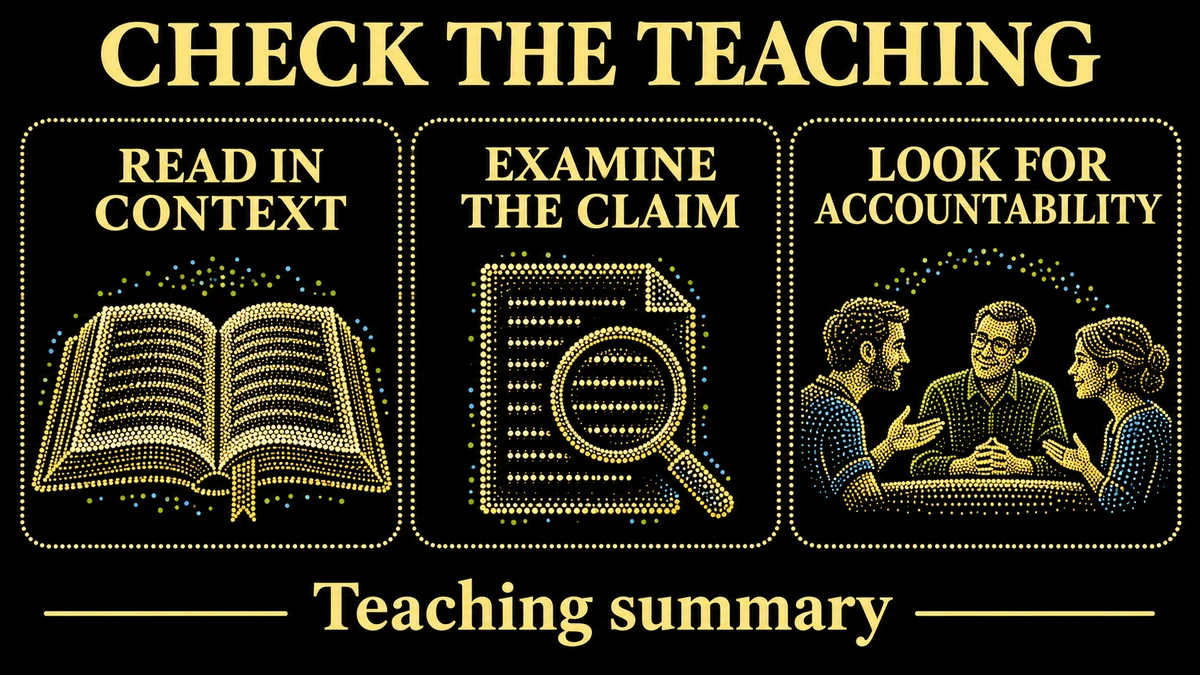
Check the teaching: read in context; examine the claim; look for accountability. Teaching summary, not a quotation of Scripture. Safety concerns may require immediate protective action.
A Worked Example: Testing a Promise of Success
Consider this illustrative scenario, not a reported event. Daniel hears a teacher use Philippians 4:13 to claim that Christians with enough faith will succeed in every career goal. Daniel admires the teacher and wants the promise to be true.
First, identify the claim. Daniel listens to the whole message. The speaker is making a universal promise about outcomes, rather than encouraging perseverance. Daniel records that distinction before criticizing it.
Second, read the passage. In Philippians 4:10–20, Paul thanks the church for its support and describes learning contentment in both abundance and need. The strength he receives enables faithfulness through changing circumstances. The passage does not promise that every ambition will succeed.
Third, assess the seriousness. This is a misleading use of Scripture that could burden disappointed people with misplaced guilt. It does not, on its own, establish that the teacher denies Christ’s divinity or deliberately intends harm.
Fourth, seek clarification and respond. Daniel asks a trusted pastor to review the passage with him. When appropriate, he asks the teacher how the promise accounts for Paul’s experience of need. A clear correction would matter. Repeatedly blaming suffering people or demanding payments to unlock success would raise further concerns requiring separate assessment.
Daniel rejects the unsupported promise without inventing motives. He also avoids dismissing its consequences as harmless enthusiasm. His conclusion stays specific enough to explain and revise if new evidence appears.
Common Questions About Evaluating Christian Teachers
Didn’t Jesus tell us not to judge?
Matthew 7 confronts hypocritical judgment and requires attention to our own sin before correcting others. The same chapter warns about false prophets. Christians must evaluate teaching and conduct with humility, while refusing contempt or claims to know another person’s heart completely.
Should I reject everything from a teacher I disagree with?
Consider the issue and its seriousness. You may learn from a Christian in another tradition while rejecting a particular interpretation. Persistent gospel distortion or serious misconduct gives stronger reasons to stop promoting a ministry. You have no obligation to keep listening simply because some material was helpful.
Can an online teacher replace a local church?
Online teaching can provide substantial learning, including for people whose circumstances limit attendance. It usually offers little reciprocal knowledge or personal accountability. As our guide to the church explains, Christian life involves a community. Seek trustworthy relationships and accessible pastoral care where possible. A public platform cannot demonstrate by itself how a teacher treats those under their care.
Must I stay until my concerns are proved?
You may step back while seeking advice, especially when you feel threatened or pressured. Immediate safety does not require a completed church investigation. For ordinary disagreements, patient discussion can be valuable when safe. Nobody should make your access to outside help depend on a leader’s permission.
Let Discernment Serve Faithfulness
Use a repeatable order: identify the claim, read the biblical context, assess its doctrinal importance, examine relevant conduct and accountability, establish what the evidence supports, and choose a proportionate response. Safety concerns may require immediate action before that whole sequence is complete.
Apply these standards to teachers you like, critics you trust, and your own conclusions. Correct misinformation you have repeated. Welcome evidence that changes your mind. Learn with people who can help you see what you missed.
The aim is a church better able to hear Christ, receive faithful instruction, protect vulnerable people, and practice truth in love. Careful discernment should make those goods more visible in our life together.