
GUIDED ARTICLE EXPERIENCE
Saint Andrew’s Martyrdom and the X-Shaped Cross
Read along as the narration moves through the article.
Private device narration · No hosted audio or tracking
CONTINUE GUIDED TOUR
Continue where you left off.
GUIDED TOUR COMPLETE
You have reached the end of this study.
Study record saved on this device.
GUIDED TOUR
Saint Andrew’s Martyrdom and the X-Shaped Cross
Narrator: Paranoid Prophet Recommended Voice Native device narration
Prepare to follow the article as it is narrated.
VOICE & TOUR OPTIONS
Voice & Listening
NARRATOR
Finding a narrator…
Checking the best narrator available on this device.
Restores the best curated narrator available on this device.
Narrator choices are curated for clear, long-form listening on this device.
Screen-awake support will be checked when narration starts.
CHOOSE A NARRATOR
Curated for this device
Choose a verified narrator for this browser, or use System Narrator. Automatic mode uses the best reliable route exposed by this device; your chosen narrator is preserved even if this device needs a temporary fallback.
Preparing the guided article experience…
RESUME GUIDED TOUR?
Continue where you left off.
GUIDED TOUR COMPLETE
You have reached the end of this study.
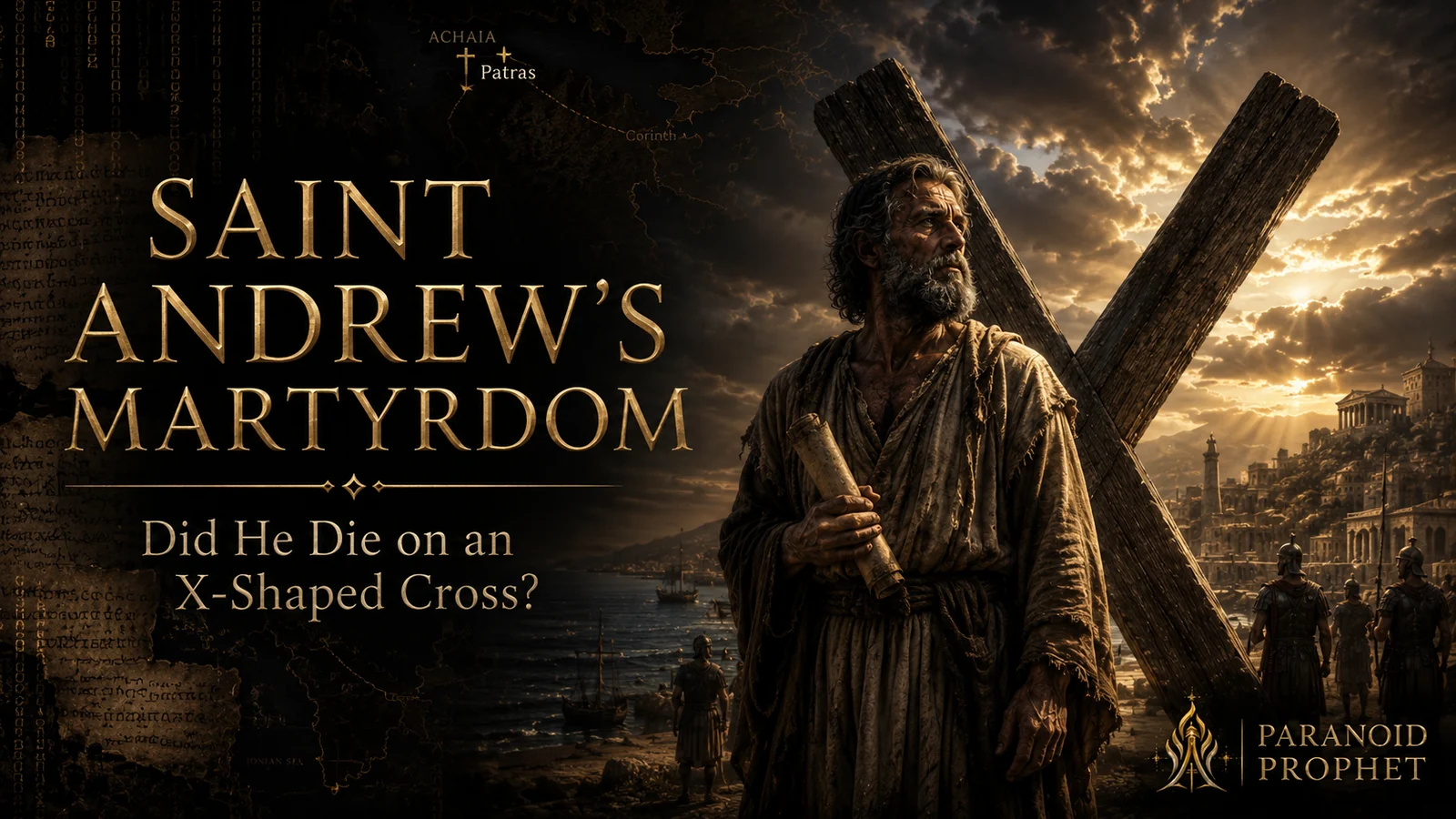
Saint Andrew’s Martyrdom: Did the Apostle Die on an X-Shaped Cross?
Andrew was not the loudest apostle. He was not the most famous. But Scripture repeatedly shows him doing one thing with quiet force: bringing people to Jesus.
He was among the first to follow Christ. He brought his brother Simon Peter to the Messiah. He noticed the boy with the loaves and fish. He helped bring Greek seekers who wanted to see Jesus. Andrew’s greatness is not that he pulled attention toward himself. It is that he kept pointing away from himself and toward Christ.
That makes his martyrdom tradition important, but it also means the evidence must be handled in the right order. James was killed by the sword in the book of Acts. Peter was remembered by early Christians as dying by crucifixion in Rome. John endured exile on Patmos because of the word of God and the testimony of Jesus. Andrew’s story moves in a quieter but powerful lane: Scripture gives us a first-generation disciple who brought others to Jesus, while later Christian memory remembers him as a missionary witness who suffered rather than abandon Christ.
This article belongs inside the larger disciple witness and martyrdom trail. It does not argue that Andrew’s death proves the resurrection by itself. It argues something more careful and more credible: Andrew’s remembered martyrdom supports the sincerity, cost, and continuity of apostolic witness to Jesus as the Messiah, the Lamb of God, and the risen Lord.
The center of Andrew’s story is not the shape of his cross. The center is the Christ he followed.
Article Guide11 sections
Saint Andrew’s Martyrdom: Evidence at a Glance
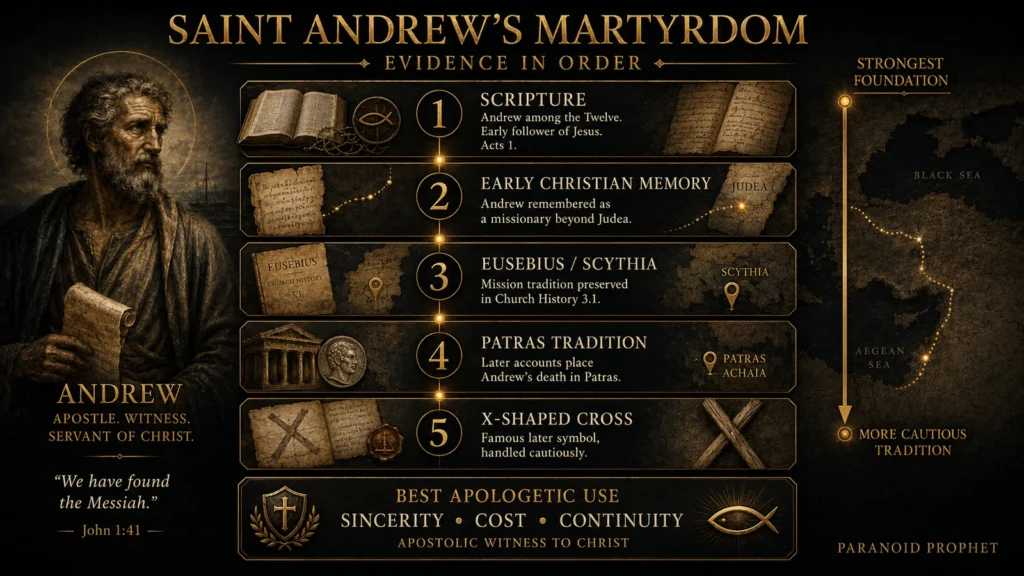
A serious article on Andrew should keep the evidence in order. Scripture gives us Andrew as one of Jesus’ earliest followers and a disciple who repeatedly brought others to Christ. Early Christian tradition remembers him as a missionary beyond Judea. Later martyrdom tradition connects him with Patras, Aegeates, and the cross that became known as Saint Andrew’s Cross.
| Person | Andrew the Apostle |
| Also Known As | Saint Andrew, Andrew the First-Called |
| Relationship to Jesus | One of the Twelve; brother of Simon Peter; one of Jesus’ earliest followers |
| Key Biblical Identity | Andrew follows Jesus after John the Baptist identifies Him as the Lamb of God, then brings Peter to Jesus and says, “We have found the Messiah” (John 1:35–42) |
| Key Witness Theme | Andrew brings people to Christ |
| Resurrection Connection | Andrew is listed among the apostles after the ascension in Acts 1:12–14, inside the first-generation apostolic community |
| Death in Scripture | The New Testament does not record Andrew’s death |
| Early Missionary Tradition | Early Christian tradition connects Andrew with missionary work beyond Judea, especially Scythia in the tradition preserved by Eusebius |
| Later Martyrdom Tradition | Later tradition places Andrew’s martyrdom in Patras under a ruler usually named Aegeates or Aegeas |
| X-Shaped Cross Tradition | The X-shaped cross is an important later tradition and symbol associated with Andrew, but it is not reported in the New Testament |
| Evidence Strength | Strong biblical evidence for Andrew as an apostle and early follower of Jesus; more cautious evidence for the exact details of his death |
| Best Apologetic Use | Andrew’s martyrdom tradition supports the sincerity, cost, and continuity of apostolic witness, not a standalone proof of the resurrection |
This evidence map keeps Andrew’s story in the right lane. Andrew should not be reduced to a symbol on a flag, a legend about an X-shaped cross, or a slogan about martyrdom. Scripture first presents him as a real disciple who followed Jesus early, confessed Him as Messiah, and brought others to Him.
What This Article Is Arguing
This article argues that Andrew’s witness matters because of who he followed, what he confessed, and how the church remembered his faithfulness.
Andrew was not a distant Christian defending a tradition centuries removed from Jesus. He belonged to the first generation of disciples. He heard John the Baptist identify Jesus as the Lamb of God. He followed Christ. He found his brother Simon and told him, “We have found the Messiah” (John 1:35–42).
That matters before we ever discuss Andrew’s death. Scripture does not present Andrew first as a martyr, a symbol, or a legend attached to an X-shaped cross. It presents him as a real disciple who followed Jesus early and pointed others toward Him.
Christian tradition later remembers Andrew as a missionary and martyr. Those traditions are worth studying, but they require careful handling. Scripture does not tell us how Andrew died. The specific claims about Patras, Aegeates, being bound to a cross, and the X-shaped form belong to later Christian memory rather than direct New Testament report.
Still, careful does not mean cynical. The church did not remember Andrew as a man who abandoned Christ when witness became costly. It remembered him as a servant of the risen Lord who carried the gospel outward and suffered for the name of Jesus.
That is why Andrew belongs inside the larger case for Christ. His martyrdom tradition does not replace the resurrection evidence, and it does not prove every later detail about his death. But it does support the wider pattern of apostolic sincerity, costly witness, and enduring confession.
Andrew’s story begins with a simple confession: “We have found the Messiah.” The question is what kind of man would carry that confession through life, mission, suffering, and death. The answer begins not with Andrew’s cross, but with Andrew’s Christ.
Who Was Andrew to Jesus?
Before Andrew is remembered as a martyr, he must first be seen as a disciple.
Scripture introduces Andrew through the direction of his witness. He hears Jesus identified, follows Him, leads his brother to Him, places a small offering before Him, and helps bring seekers who want to see Him.
Andrew’s story is not loud, but it is remarkably consistent. When Andrew appears in the Gospels, he is often moving someone or something toward Christ.
Andrew the First-Called
Andrew first appears in John’s Gospel as a disciple of John the Baptist. When John sees Jesus and says, “Behold, the Lamb of God,” two of his disciples hear him and follow Jesus. One of them is Andrew (John 1:35–42).
This is why Andrew is often called “the First-Called” in Christian tradition. The title is traditional language, not a separate New Testament office, but it rests on a real biblical memory: Andrew was among the first to follow Jesus after John the Baptist pointed to Him.
That beginning shapes the whole article. Andrew’s discipleship begins with Jesus identified as the Lamb of God. He does not begin with a political cause, a moral slogan, or a vague spiritual movement. He begins with Christ.
If later tradition remembers Andrew suffering for Christ, John’s Gospel first shows Andrew following the Lamb who would suffer for sinners. Andrew’s cross, if the tradition is true, was never the center. Christ’s cross was.
The Brother Who Brought Peter to Jesus
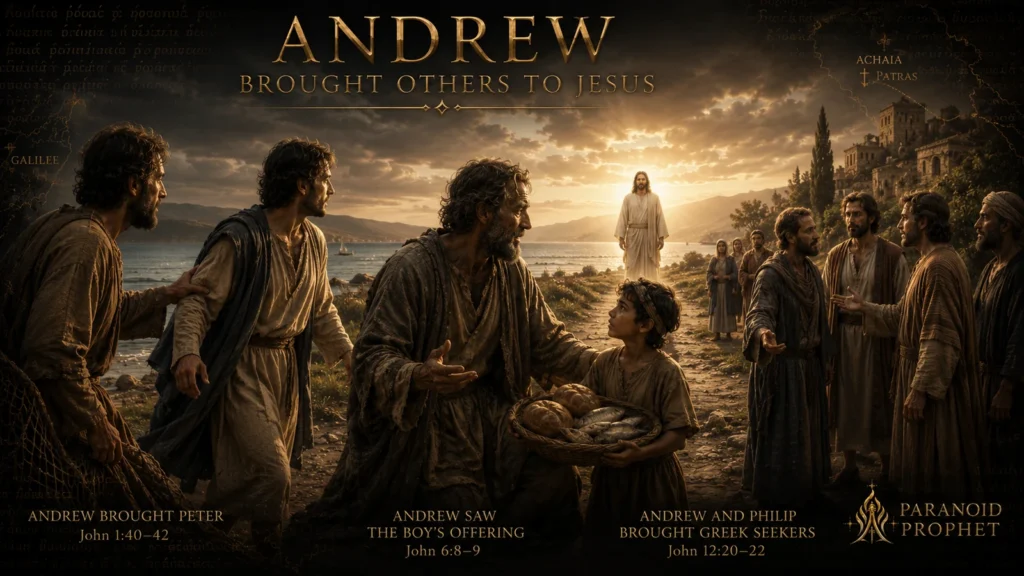
Andrew’s first recorded action after spending time with Jesus is simple and powerful: he finds his brother Simon.
John says, “He first found his own brother Simon and said to him, ‘We have found the Messiah’” (John 1:40–42). Then Andrew brings him to Jesus.
Peter would become the more famous brother. He would preach at Pentecost. He would lead, stumble, be restored, and later be remembered by early Christians as suffering for Christ in Rome. But before Peter’s long witness unfolded, Andrew brought him to Jesus.
That is Andrew’s quiet strength. He does not need the center of the stage. He finds the Messiah and points someone else to Him.
This makes Andrew’s witness deeply Christ-centered. He is not remembered in Scripture as a man building his own name. He is remembered as a man who directs his brother to the One whose name matters most.
Called from the Nets
The Synoptic Gospels also remember Andrew in the calling beside the sea. Matthew says Jesus saw two brothers, Simon Peter and Andrew, casting a net into the sea, for they were fishermen. Jesus said, “Follow me, and I will make you fishers of men.” Immediately they left their nets and followed Him (Matthew 4:18–22). Mark gives the same basic picture: Jesus calls Simon and Andrew from their nets, and they follow Him (Mark 1:16–18).
Andrew was not introduced as a polished religious scholar writing safely from a distance. He was a working man called by Jesus in the middle of ordinary life. Nets, boats, labor, family, and obedience all stand near the beginning of his story.
That makes his later witness more human. Andrew did not follow an idea floating above history. He followed a real Lord who stepped into ordinary places and summoned ordinary men to leave everything behind.
The Disciple Who Noticed the Loaves
Andrew appears again in John 6, when a great crowd follows Jesus and the question of food becomes impossible by human calculation. Philip sees the lack. Andrew notices a boy.
He says, “There is a boy here who has five barley loaves and two fish, but what are they for so many?” (John 6:8–9).
That sentence is honest. Andrew does not fully understand what Jesus is about to do. He sees the smallness of the offering and the greatness of the need. But he still places what he sees before Christ.
The miracle belongs to Christ, not Andrew. Jesus is the One who feeds the crowd. Jesus is the One whose power turns insufficiency into abundance. Andrew’s role is small, but it fits the pattern: he notices, he speaks, and he brings what is available to Jesus.
The Disciple Who Helped Bring Seekers to Jesus
One more scene sharpens the pattern. In John 12, some Greeks come to Philip and say, “Sir, we wish to see Jesus.” Philip tells Andrew. Then Andrew and Philip go and tell Jesus (John 12:20–22).
The scene is brief, but it is not accidental. Again, Andrew appears as a bridge. This time the movement is not only from one brother to Christ, or from a boy’s bread to Christ, but from Gentile seekers toward Christ.
That moment quietly prepares the reader for Andrew’s later missionary tradition. Scripture already shows him connected with people being brought toward Jesus. Later Christian memory will remember him carrying the name of Christ beyond familiar borders. The tradition must be weighed carefully, but the pattern is not strange to the biblical Andrew.
Andrew was not famous because he dominated the Gospel story. He mattered because he kept bringing people to the One who did.
By the time Christian memory remembers Andrew carrying the gospel beyond Judea, Scripture has already shown the shape of his witness. He is not an anonymous figure attached to a later legend. He is one of Jesus’ first followers: a disciple whose life pointed away from himself and toward Christ.
Andrew as a Witness to the Messiah, the Lamb, and the Risen Lord
Andrew’s witness matters because it was centered on Jesus’ identity.
The Gospel scenes that name Andrew do not present a man trying to make himself central. They show a disciple responding to Jesus, confessing Jesus, and directing others toward Jesus. Before later tradition speaks about Andrew’s death, Scripture shows us the One Andrew followed: the Lamb of God, the Messiah, and the risen Lord confessed by the apostolic church.
“Behold, the Lamb of God”
Andrew’s discipleship begins under the witness of John the Baptist. John sees Jesus and says, “Behold, the Lamb of God” (John 1:29–42). The next day, when John again identifies Jesus, Andrew follows Him.
That is not a small beginning. John’s Gospel frames Andrew’s first movement toward Jesus with Lamb language. Andrew may not have understood the full weight of the cross in that moment. The disciples often understood more slowly than they followed. But the Gospel does not let the reader miss the meaning: Andrew begins by following the One identified as the Lamb.
In Scripture, the Lamb is not a vague religious image. It points toward sacrifice, redemption, and the taking away of sin. John the Baptist says it plainly: “Behold, the Lamb of God, who takes away the sin of the world” (John 1:29).
That gives Andrew’s later martyrdom tradition its proper center. If Christian memory remembers Andrew suffering for Christ, John’s Gospel first shows Andrew following the Lamb who would suffer for sinners. Andrew’s cross, if the tradition is true, only matters because Christ’s cross came first.
“We Have Found the Messiah”
Andrew’s first recorded testimony is not vague admiration. It is confession.
After spending time with Jesus, Andrew finds Simon and says, “We have found the Messiah” (John 1:40–42). He does not merely say, “We found a wise teacher.” He does not say, “We found a new movement.” He says they have found the Messiah.
Andrew’s confession was not a generic religious compliment. It placed Jesus inside Israel’s long hope for God’s promised Anointed One. The Messiah was the King, deliverer, and covenant hope of God’s people. Andrew’s first witness to Peter was already centered on the identity of Jesus.
The wider question of Jesus’ identity belongs at the center of Christian faith. For a broader treatment of that question, see Who Was Jesus? Liar, Lunatic, or Lord?. Andrew’s own witness enters that larger argument at the level of Messiahship: he meets Jesus, recognizes Him as the Christ, and brings Peter to Him.
That is why Andrew’s story strengthens the disciple-witness trail. His death tradition is not attached to a man who followed generic religion. It is attached to a first-generation disciple whose first recorded words about Jesus confess Him as the Messiah.
Andrew Among the Apostles After the Ascension
Scripture does not give Andrew a private resurrection scene. It does not record Jesus appearing to Andrew by name after the crucifixion. A careful article should not pretend otherwise.
But Scripture does give us something more modest and still important. After the ascension, Acts lists Andrew among the apostles gathered in Jerusalem (Acts 1:12–14). He remains inside the apostolic company after the death, resurrection, and ascension of Jesus.
That matters for the larger witness of the church. Andrew is not presented as someone who followed Jesus for a season and then disappeared from the apostolic community. He is named among those who remained together after Christ’s ascension, before the public mission of Acts moves outward.
The resurrection case does not rest on Andrew alone. The strongest resurrection evidence belongs in its own lane: Jesus’ crucifixion, the early proclamation, Paul’s received tradition in 1 Corinthians 15:3–8, and the first-generation witness of Peter, James, and Paul. For the broader argument, see the full article on resurrection evidence for Jesus.
Andrew’s role is different. He belongs to the circle of first-generation disciples who followed Jesus before the cross and remained in the apostolic company after the resurrection. That does not prove every later story about his death. But it does mean the tradition about Andrew’s suffering is attached to a real apostolic witness, not an anonymous figure invented out of thin air.
Why Andrew’s Witness Matters
Andrew’s witness matters because it points beyond Andrew. His first confession was not about his own importance, but about Jesus as Messiah. His discipleship began not with a cause, but with the Lamb of God. His later place among the apostles after the ascension connects him to the first generation that bore witness to the risen Lord.
That is what makes Andrew useful for the larger case for Christ. Andrew is not the foundation of Christian faith. Christ is. Andrew’s testimony matters because it points away from Andrew and toward the crucified and risen Lord.
The martyrdom tradition should be judged carefully. It should not be used as if it proves the resurrection by itself. But neither should it be dismissed as irrelevant. If the church remembered Andrew as suffering for Christ, that memory belongs inside a broader pattern: the earliest followers of Jesus did not preserve Him as a harmless moral teacher. They confessed Him as Messiah, proclaimed Him as risen, and carried His name at cost.
Before we ask how Andrew died, we need to ask what he lived to confess. Scripture gives the answer before tradition ever speaks: Andrew followed the Lamb of God, confessed Jesus as Messiah, and remained among the apostles after the ascension. The later death tradition must be weighed carefully, but it is attached to a witness whose center was Jesus.
What Do We Actually Know About Andrew’s Death?
The first question is not whether Andrew’s martyrdom tradition is meaningful. It is. The first question is what kind of evidence we actually have.
Andrew’s death is not recorded in the New Testament. That does not erase his witness, but it does set the boundaries for a careful article. Scripture gives us Andrew as one of Jesus’ earliest followers, the brother of Peter, a disciple who brought others to Christ, and a member of the apostolic company after the ascension. The details of his death come from Christian tradition, not from the book of Acts.
That distinction matters. A serious Christian case does not need to pretend every claim is equally strong. Scripture gives us Andrew the apostle. Early Christian memory remembers Andrew the missionary. Later tradition gives us Andrew’s martyrdom in Patras and the cross associated with his name. Those categories are related, but they are not identical.
Scripture Does Not Record Andrew’s Death
The New Testament names Andrew among the apostles, but it never narrates his final days. Acts lists him with Peter, James, John, Philip, Thomas, Bartholomew, Matthew, James the son of Alphaeus, Simon the Zealot, and Judas the son of James after the ascension of Jesus (Acts 1:12–14).
That is the last clear biblical placement of Andrew. He remains within the apostolic company, but Scripture does not tell us where he later traveled, how long he preached, or how he died.
This makes Andrew different from James the son of Zebedee. James’ death is directly reported in Acts: Herod killed him with the sword (Acts 12:1–2). Andrew does not have that kind of biblical death report.
That should not be treated as an embarrassment. It simply means the article needs to keep the evidence in order. Scripture gives us Andrew as a real apostle and first-generation witness to Jesus. The later death tradition must be handled as tradition, not as direct biblical narration.
Eusebius and Andrew’s Missionary Tradition
One important early witness for Andrew’s later mission comes through Eusebius. In Church History 3.1, Eusebius preserves a tradition about the apostles being dispersed to different regions. In that tradition, Andrew is associated with Scythia.
This source belongs in the missionary-tradition lane. Eusebius helps us see that Andrew was remembered as a missionary apostle beyond the familiar Gospel setting. He does not give a detailed account of Andrew’s death. He does not describe Patras, the cross, or Andrew’s final words.
That still matters. The Andrew of Scripture already points people to Jesus. The Andrew of early church memory is remembered as carrying that witness beyond Judea. Eusebius does not verify every later martyrdom detail, but he does show that Andrew’s name was connected with the outward movement of apostolic mission.
The Acts of Andrew and the Patras Tradition
The fuller martyrdom account comes through the Acts of Andrew and related Andrew traditions. This is where the story becomes more detailed: Andrew in Achaia, conflict with a ruler usually called Aegeates or Aegeas, pressure against Christian faith, and a final witness connected with crucifixion.
But the Acts of Andrew must be named for what it is. It is not Scripture. It is not the New Testament book of Acts. It belongs to the world of Christian apocryphal literature. That does not make it worthless, but it does mean it must not be treated as equal to the Gospels or the apostolic writings.
Its value is not that it gives us apostolic-era certainty. Its value is that it shows how Andrew’s final witness was remembered, preached, and developed in Christian tradition. Modern source guides such as NASSCAL’s e-Clavis entry on the Acts of Andrew help place this material in the category of Christian apocrypha and provide scholarly bibliography for further study. Early Christian Writings also preserves helpful access to Andrew traditions and notes connected with their transmission.
The traditional account places Andrew’s final witness in Patras, in Achaia. It remembers him in conflict with pagan authority, refusing to abandon Christ, speaking against idolatry, and being condemned to die by crucifixion. Those are the broad contours of the story. They explain why Andrew became associated with Patras, martyrdom, and the cross.
Careful does not mean cynical. Christian tradition may preserve real memories, but those memories often come to us through devotional, theological, and expanded storytelling. A strong article should neither mock the tradition nor overstate it.
The safest conclusion is this: Scripture gives us Andrew as a real apostle and first-generation witness to Jesus. Early church memory remembers him as a missionary. Later tradition places his martyrdom in Patras and connects his final witness with crucifixion. The broad tradition is serious enough to examine, but the specific details should be weighed carefully.
The traditional account gives Andrew’s death a location, a conflict, and a martyrdom. But one detail has become more famous than all the rest: the claim that Andrew died on an X-shaped cross. That detail belongs in its own evidence category.
The X-Shaped Cross Tradition
The X-shaped cross is the most recognizable symbol connected with Andrew. It is also the detail most often repeated without explanation.
For many Christians, Saint Andrew is almost inseparable from the cross that bears his name. In art, iconography, flags, and devotional memory, Andrew is often shown with a diagonal cross. The image is powerful, but a careful article has to ask where the claim belongs in the evidence.
The answer is straightforward: the X-shaped cross is an important Christian tradition, but it is not reported in the New Testament. Scripture gives us Andrew the apostle. Later Christian memory gives us Andrew’s cross.
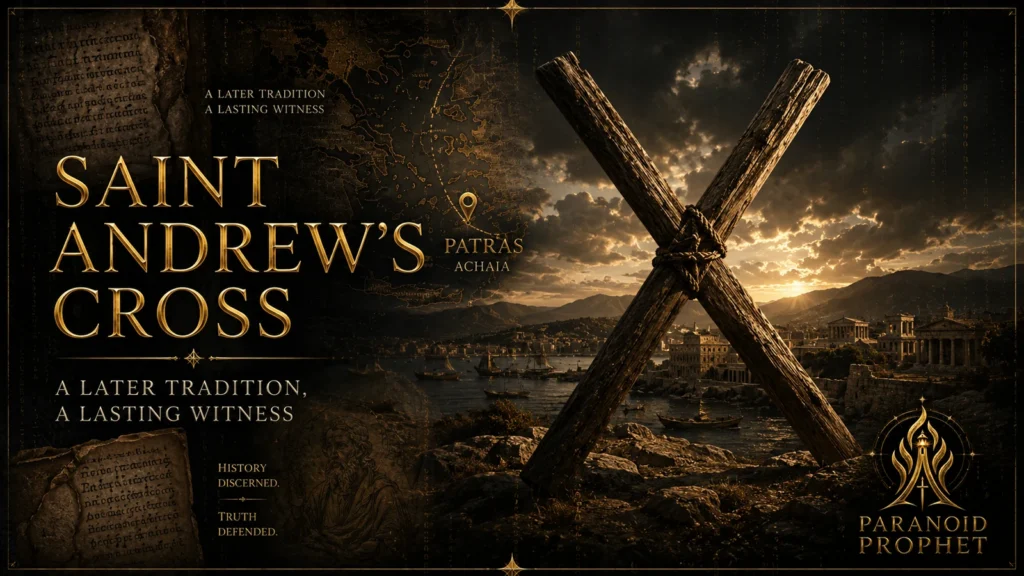
Did Andrew Die on an X-Shaped Cross?
Christian tradition widely associates Andrew with an X-shaped cross, often called Saint Andrew’s Cross. Over time, that cross became one of the most enduring symbols of his witness.
But the symbol should not be confused with the strongest evidence. The New Testament does not describe Andrew’s death, name Patras as the place of his martyrdom, identify Aegeates, or tell us the shape of his cross. Those details belong to the later martyrdom account, especially the stream of Andrew traditions connected with the Acts of Andrew and later Christian retellings.
That does not make the tradition meaningless. It means we should use careful language. It is better to say, “Christian tradition remembers Andrew as crucified on an X-shaped cross,” than to say, “history proves Andrew died this way.”
The X-shaped cross is visually powerful because it became a symbol of costly witness. But Andrew’s strongest value for this article is not the exact geometry of the cross. It is the biblical pattern of his life: he followed Jesus, confessed Him as Messiah, brought others to Him, and was remembered by the church as faithful to Christ unto death.
Was Andrew Tied or Nailed to the Cross?
Later tradition often remembers Andrew as being bound to the cross rather than nailed. The usual point of that detail is that his suffering was prolonged and that his final witness continued even as he died.
That is a moving part of the Andrew tradition, but Scripture does not tell us whether Andrew was tied or nailed. It does not give a procedural account of his execution. This detail belongs to later Christian memory, not to the biblical record.
The detail may preserve a memory of prolonged suffering, or it may reflect devotional storytelling that magnified Andrew’s endurance. Either way, it should not be treated with the same confidence as Andrew’s place among the Twelve.
The larger point is simpler: Andrew was not remembered as a man who escaped the cost of witness. He was remembered as one who endured suffering because of Christ.
Did Andrew Ask for a Different Cross Because He Felt Unworthy?
Many retellings say Andrew did not consider himself worthy to die in the same manner as Jesus. This is often used to explain why his cross was remembered as different from the traditional upright form associated with Christ’s crucifixion.
The theological instinct is reverent. Christ’s cross is unique. His death is not merely an example of courage. It is the saving death of the Lamb of God for sinners. No apostle, martyr, saint, or preacher stands equal to that sacrifice.
But the exact speech and motive belong to later tradition. A careful article can appreciate the devotional meaning without claiming certainty about every detail. If Andrew said such a thing, it would fit the humility of a disciple who knew the difference between the Savior and the servant. If the detail developed later, it still reflects a sound Christian instinct: the cross of Christ stands alone.
Why Saint Andrew’s Cross Matters
Saint Andrew’s Cross matters because symbols carry memory. The diagonal cross became a way of remembering Andrew’s witness, suffering, and devotion to Christ. It helped Christians tell the story of an apostle who was not as famous as Peter, not as directly recorded in death as James, and not preserved in Scripture through old age like John, but who was still remembered as faithful.
A symbol is only faithful when it points beyond itself.
In later history, the saltire became associated with Andrew in Christian art, devotion, and national symbols. That legacy is interesting, but it is not the main concern of this article. The point is not heraldry. The point is witness.
Andrew’s cross should never replace Andrew’s Christ. The symbol matters because of the Savior Andrew followed.
How Strong Is the Evidence?
The evidence for Andrew’s story is not all at the same level. A serious article should say that plainly.
| Strongest Biblical Evidence | Andrew was one of the Twelve, the brother of Peter, one of Jesus’ early followers, and a member of the apostolic company after the ascension. |
| Biblical Witness Pattern | Andrew repeatedly appears as a disciple who brings others or their needs toward Jesus. |
| Early Missionary Memory | Early Christian tradition remembers Andrew as a missionary beyond Judea, including the Scythia tradition preserved by Eusebius. |
| Secondary Martyrdom Tradition | The Patras martyrdom account and conflict with Aegeates or Aegeas belong to apocryphal and later Christian tradition. |
| Cautious Later Details | The X-shaped cross, being bound rather than nailed, and exact speeches from the cross should be treated as later tradition rather than Scripture-level evidence. |
| Best Apologetic Use | Andrew’s tradition supports the sincerity, cost, and continuity of apostolic witness to Christ, not a standalone proof of the resurrection. |
This evidence ranking does not weaken Andrew’s story. It strengthens the article’s credibility. A Christian case does not become stronger by pretending every detail is equally certain. It becomes stronger when the evidence is handled honestly.
The X-shaped cross may be the most famous image connected to Andrew, but it is not the deepest point. The deeper point is that Andrew’s biblical life and remembered martyrdom fit the wider pattern of apostolic witness: sincere, costly, Christ-centered, and difficult to dismiss as casual invention.
The next question is what Andrew’s witness contributes to the larger case for Christ. The answer is not that Andrew’s death proves everything by itself. It is that the man who brought others to Jesus was remembered as remaining faithful to Jesus when witness became costly.
What Andrew’s Witness Shows About the Case for Christ
Andrew’s martyrdom tradition matters most when it is placed in the right argument.
It is not the foundation of Christian faith. Christ is. But when Andrew’s story is kept in the right lane, it becomes one strand in a larger pattern of apostolic witness: men who knew Jesus, followed Him, confessed Him, proclaimed Him, and were remembered as carrying His name at cost.
Andrew does not carry the whole case for Christ by himself. But he belongs inside it.
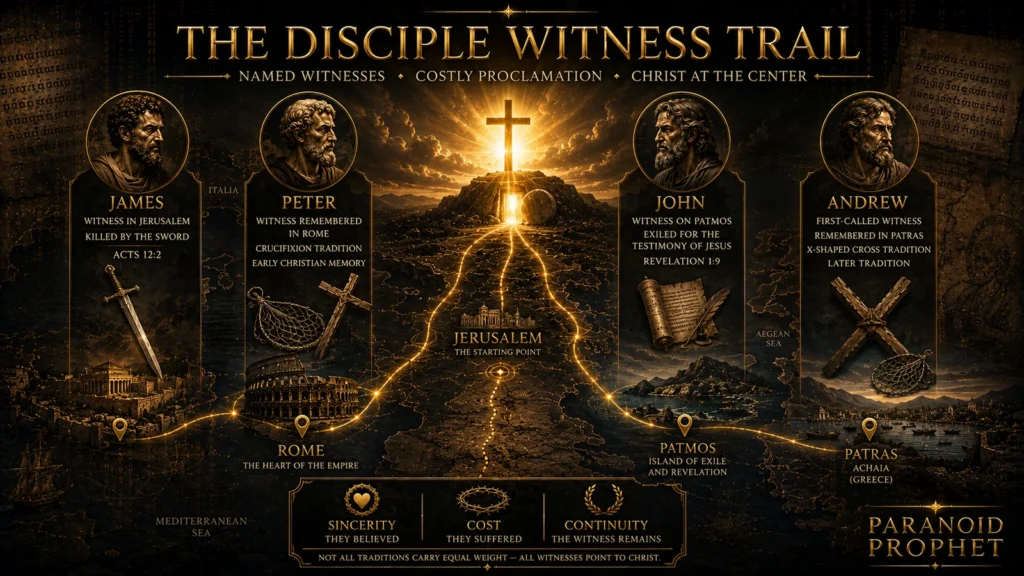
Andrew’s Witness Was Costly
Scripture presents Andrew as one of Jesus’ first followers. Christian tradition later remembers him as a missionary and martyr. Those two claims should not be collapsed into the same evidence category, but they do belong in the same story of witness.
The church did not remember Andrew as a comfortable admirer of Jesus who quietly outgrew his early devotion. It remembered him as a servant of Christ who carried the gospel outward and suffered rather than abandon the Lord he followed.
Costly witness does not prove every detail of the Patras tradition, the shape of Andrew’s cross, or the resurrection by itself. People can suffer for things they sincerely believe even when they are mistaken. Still, sincerity, cost, and continuity matter when weighing the character of apostolic witness.
Andrew’s tradition supports the picture of a first-generation disciple whose confession did not dissolve into convenience. The man Scripture shows bringing others to Jesus was remembered by the church as remaining loyal to Jesus when witness became costly.
Andrew Strengthens the Disciple Witness Trail
Andrew’s article belongs beside the other disciple-witness accounts, but his lane is distinct.
James gives the clearest apostolic death report in Scripture: he was killed by the sword. Peter shows the restored denier remembered by early Christians as suffering unto death in Rome. John shows the apostle who remained, endured exile, and bore witness to the glorified Christ.
Andrew shows something quieter: the first-called disciple, the brother who brought Peter to Jesus, the man who kept pointing others toward Christ, and the apostle later remembered as faithful unto death.
That strengthens the larger disciple witness and martyrdom trail. Not because every apostolic death tradition is equally strong. Not because martyrdom automatically proves every Christian claim. But because the overall pattern is difficult to dismiss cheaply. The earliest Christian witness was not built around a harmless memory of a dead teacher. It was built around the proclamation that Jesus is the crucified and risen Lord.
What Andrew’s Martyrdom Does and Does Not Prove
A strong Christian argument does not need to make Andrew’s martyrdom carry more than it can bear.
Andrew’s death tradition cannot prove the exact details of the Acts of Andrew, the shape of the cross, his final words, or the resurrection itself. Its best apologetic use is more careful and more credible: it supports the sincerity and cost of Andrew’s remembered witness, the continuity between the Andrew of Scripture and the Andrew of Christian memory, and the larger pattern of apostolic devotion to Christ under pressure.
That is the better argument. Not a slogan. Not “Andrew died, therefore everything is proven.” The argument is cumulative: Andrew’s story fits the wider witness trail of men whose lives were reshaped around Jesus, whose message centered on His identity, and whose memory in the church was marked by costly faithfulness.
Christianity did not begin as a private philosophy detached from public witness. It began with real disciples, named people, concrete claims, and costly proclamation. Andrew stands in that trail as the quiet witness who kept moving others toward Jesus.
Andrew Points Beyond Himself to Jesus
The center of Andrew’s story is not Andrew’s courage. It is the worthiness of Christ.
Andrew followed Jesus after hearing Him identified as the Lamb of God. He found Peter and said, “We have found the Messiah.” He brought need into the presence of Christ. He helped bring seekers who wanted to see Jesus. After the ascension, he remained among the apostles. Later Christian memory remembered him as a missionary and martyr.
In every layer of the story, Andrew points beyond himself.
That is why his witness matters for the larger question of Jesus’ identity. Andrew’s life makes little sense if Jesus was merely a passing teacher, a failed prophet, or a sentimental religious symbol. Andrew’s witness is tied to the Messiah, the Lamb of God, and the risen Lord proclaimed by the apostolic church.
For the wider identity argument, see Who Was Jesus? Liar, Lunatic, or Lord?. For the historical foundation, see The Historical Reality of Jesus. Andrew’s story does not replace those arguments. It strengthens the witness trail around them.
Andrew does not ask the reader to stop at Andrew. He presses the reader to look where he looked: to Jesus Christ, the Lamb of God, the Messiah, and the risen Lord.
If Andrew’s witness matters, it matters because Christ was worth following, confessing, proclaiming, and suffering for.
Frequently Asked Questions About Saint Andrew’s Martyrdom
Was Saint Andrew martyred?
Christian tradition commonly remembers Andrew as martyred, usually by crucifixion in Patras. The New Testament does not record his death, so Andrew’s martyrdom should be treated as serious Christian tradition rather than direct biblical report.
How did Saint Andrew die?
According to the traditional account, Saint Andrew died by crucifixion in Patras, in Achaia. The details come from later Christian memory, not from the New Testament itself.
Did Andrew die on an X-shaped cross?
Later Christian tradition says Andrew was crucified on an X-shaped cross, which became known as Saint Andrew’s Cross. That tradition is famous and meaningful, but Scripture does not describe the shape of Andrew’s cross.
Was Andrew tied or nailed to the cross?
Later tradition often remembers Andrew as being bound to the cross rather than nailed. This may reflect the church’s memory of prolonged suffering, but it is not reported in Scripture and should not be treated as certain.
Is Andrew’s martyrdom recorded in the Bible?
No. The Bible records Andrew as one of the Twelve and places him among the apostles after Jesus’ ascension (Acts 1:12–14), but it does not tell us how Andrew died.
What is the Acts of Andrew?
The Acts of Andrew is an apocryphal Christian text connected with traditions about Andrew’s mission, miracles, preaching, and martyrdom. It is useful for studying how Andrew was remembered in Christian tradition, but it is not part of the New Testament.
Is the Acts of Andrew Scripture?
No. The Acts of Andrew is not Scripture and should not be treated like the canonical Gospels or the New Testament book of Acts. It belongs to Christian apocryphal literature and is used here as historical and traditional context, not as final authority.
How strong is the evidence for Andrew’s martyrdom?
The evidence is strongest for Andrew’s biblical identity: he was one of the Twelve, the brother of Peter, an early follower of Jesus, and a member of the apostolic company after the ascension. The evidence for his exact death is less certain. Early Christian memory connects Andrew with missionary work, while the fuller Patras, Aegeates, bound-to-the-cross, and X-shaped-cross details come through later and apocryphal tradition.
Why is Andrew called the First-Called?
Andrew is often called “the First-Called” because he was among the first disciples to follow Jesus in John’s Gospel. After John the Baptist identified Jesus as the Lamb of God, Andrew followed Christ and then brought his brother Peter to Him (John 1:35–42).
What does Andrew’s martyrdom prove?
Andrew’s martyrdom tradition does not prove the resurrection by itself, and it should not be used that way. Its stronger use is cumulative: it supports the sincerity, cost, and continuity of apostolic witness to Jesus Christ.
Why does Andrew matter for the case for Christ?
Andrew matters because he was a first-generation disciple who followed Jesus, confessed Him as Messiah, brought others to Him, remained among the apostles after the ascension, and was later remembered by the church as faithful to Christ unto death. His story points beyond Andrew to Jesus Christ, the Lamb of God, the Messiah, and the risen Lord.
Why is Saint Andrew associated with Scotland?
Saint Andrew became associated with Scotland through later Christian and national tradition, especially through the saltire, or diagonal cross. That legacy is culturally important, but it is not the main evidence for Andrew’s apostolic witness or martyrdom.
Conclusion: Andrew Brought Others to the Living Christ
Andrew was not the most famous apostle. He was not the loudest voice in the Gospels. He was not the brother whose name became larger in the public memory of the church.
But Andrew kept bringing people to Jesus.
He followed Christ after hearing Him identified as the Lamb of God. He found Peter and said, “We have found the Messiah.” He noticed the boy with the loaves and fish. He helped bring seekers who wanted to see Jesus. After the ascension, he remained among the apostles.
Later Christian tradition remembers Andrew carrying that witness outward and suffering for Christ. The details require careful handling. Scripture does not record Andrew’s death, and the claims about Patras, Aegeates, being bound to the cross, and the X-shaped form belong to later Christian memory.
But that caution does not make the tradition meaningless. Andrew’s remembered martyrdom still belongs inside the larger witness trail. The man Scripture shows bringing others to Jesus was remembered by the church as remaining faithful when witness became costly.
That is not the foundation of Christian faith. Christ is. But Andrew’s story strengthens the cumulative picture of apostolic witness: real disciples, named people, concrete claims, costly proclamation, and enduring devotion to the crucified and risen Lord.
The center of the story is not Andrew’s cross. The center is Christ’s cross. The glory is not that Andrew was brave. The glory is that Jesus is worthy.
If the tradition preserves the heart of Andrew’s final witness, it was not that Andrew was great. It was that Christ was worth everything.
Sources and Further Reading
This article uses Scripture as the final authority, with early Christian sources used as historical context for Andrew’s later tradition.
Scripture
- John 1:29–42 — Jesus identified as the Lamb of God; Andrew follows Jesus and brings Peter to Him.
- Matthew 4:18–22 — Jesus calls Peter and Andrew from their nets.
- Mark 1:16–18 — Andrew and Peter follow Jesus.
- John 6:8–9 — Andrew notices the boy with five barley loaves and two fish.
- John 12:20–22 — Andrew and Philip bring Greek seekers toward Jesus.
- Acts 1:12–14 — Andrew listed among the apostles after the ascension.
- Acts 12:1–2 — James killed by the sword, providing a contrast with Andrew because James’ death is directly recorded in Scripture.
- 1 Corinthians 15:3–8 — the broader early resurrection proclamation lane.
Early Christian and Apocryphal Sources
- Eusebius, Church History 3.1 — preserves the tradition connecting Andrew with Scythia in apostolic missionary memory.
- Acts of Andrew / Acts and Martyrdom of Andrew — apocryphal Andrew tradition connected with his mission and martyrdom; used here as reception history and Christian tradition, not as Scripture or apostolic-level evidence.
- NASSCAL e-Clavis: Acts of Andrew — source classification and bibliography for the Andrew traditions.
- Early Christian Writings: Acts of Andrew — accessible text and transmission notes connected to Andrew tradition.
Source Discipline Note
Scripture gives us Andrew as one of Jesus’ earliest followers and a member of the apostolic company after the ascension. It does not record Andrew’s death. For that reason, this article treats claims about Patras, Aegeates, being bound to the cross, and the X-shaped cross as Christian tradition rather than Scripture-level evidence.
Those traditions are worth studying, but they should be handled in the right order: Scripture first, historical tradition second, apologetic synthesis last.
Continue the Disciple Witness Trail
Andrew’s martyrdom tradition belongs inside the larger witness of Jesus’ disciples. Continue with these related articles:
- Martyrdom of Jesus’ Disciples: What History Really Shows
- Saint James’ Martyrdom: The First Apostle Killed for Christ
- Peter’s Martyrdom: Was Peter Crucified Upside Down?
- Saint John’s Endurance: Was John the Apostle Martyred?
- The Historical Reality of Jesus
- Who Was Jesus? Liar, Lunatic, or Lord?
- Resurrection Evidence for Jesus
CONTINUE THE INVESTIGATION
Evidence standard continuation
Did the Apostles Die for the Resurrection? What We Can Honestly Say
Return from this individual witness tradition to the comparative source review that separates strong evidence, plausible tradition, and uncertainty.