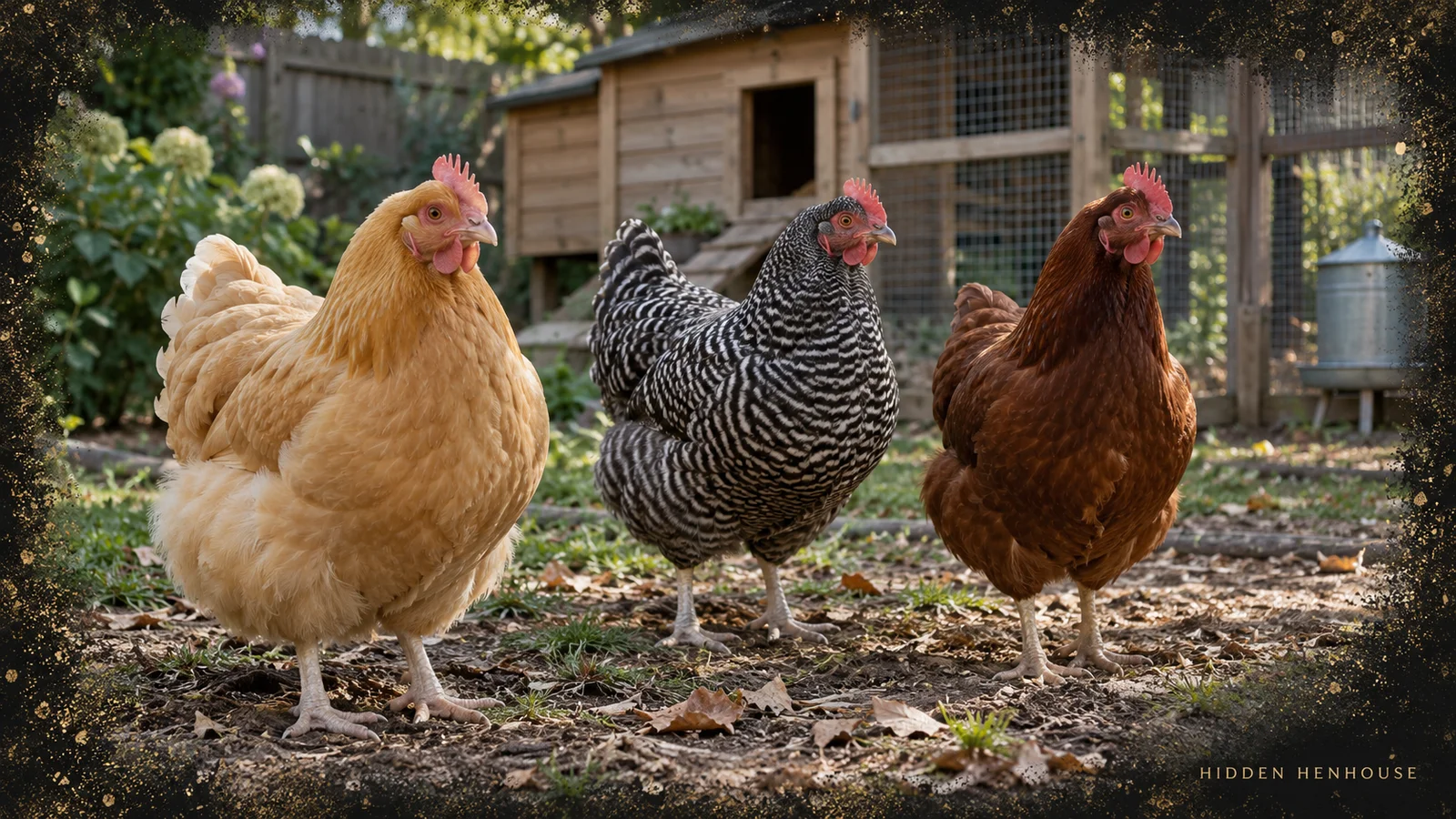

The best chicken breeds for beginners depend on what you want from the flock. Start with Buff Orpingtons or Plymouth Rocks if calm handling matters most; compare Rhode Island Reds and Golden Comet hybrids if brown eggs lead the decision. Consider Easter Eggers for varied egg colors, or Leghorns if white eggs matter more than a cuddly pet. Your climate, available space and the breeder’s particular line should narrow that shortlist.
Our household keeps roughly a dozen chickens and regularly gives away extra eggs. That experience makes us wary of choosing birds by the biggest number in a catalog. More eggs are useful only when the flock fits the yard and the people doing the daily care. This guide combines authoritative breed descriptions with our editorial judgment; it is not a claim that we have personally tested every breed below.
Updated October 5, 2026. Breed descriptions and source estimates are qualified below; individual birds and strains vary.
GUIDED ARTICLE EXPERIENCE
Best Chicken Breeds for Beginners: Choose by Your Priorities
Read along as the narration moves through the article.
Private device narration · No hosted audio or tracking
CONTINUE GUIDED TOUR
Continue where you left off.
GUIDED TOUR COMPLETE
You have reached the end of this study.
Study record saved on this device.
GUIDED TOUR
Best Chicken Breeds for Beginners: Choose by Your Priorities
Narrator: Paranoid Prophet Recommended Voice Native device narration
Prepare to follow the article as it is narrated.
VOICE & TOUR OPTIONS
Voice & Listening
NARRATOR
Finding a narrator…
Checking the best narrator available on this device.
Restores the best curated narrator available on this device.
Narrator choices are curated for clear, long-form listening on this device.
Screen-awake support will be checked when narration starts.
CHOOSE A NARRATOR
Curated for this device
Choose a verified narrator for this browser, or use System Narrator. Automatic mode uses the best reliable route exposed by this device; your chosen narrator is preserved even if this device needs a temporary fallback.
Preparing the guided article experience…
RESUME GUIDED TOUR?
Continue where you left off.
GUIDED TOUR COMPLETE
You have reached the end of this study.
Article Guide8 sections
Choose by priority before choosing by appearance
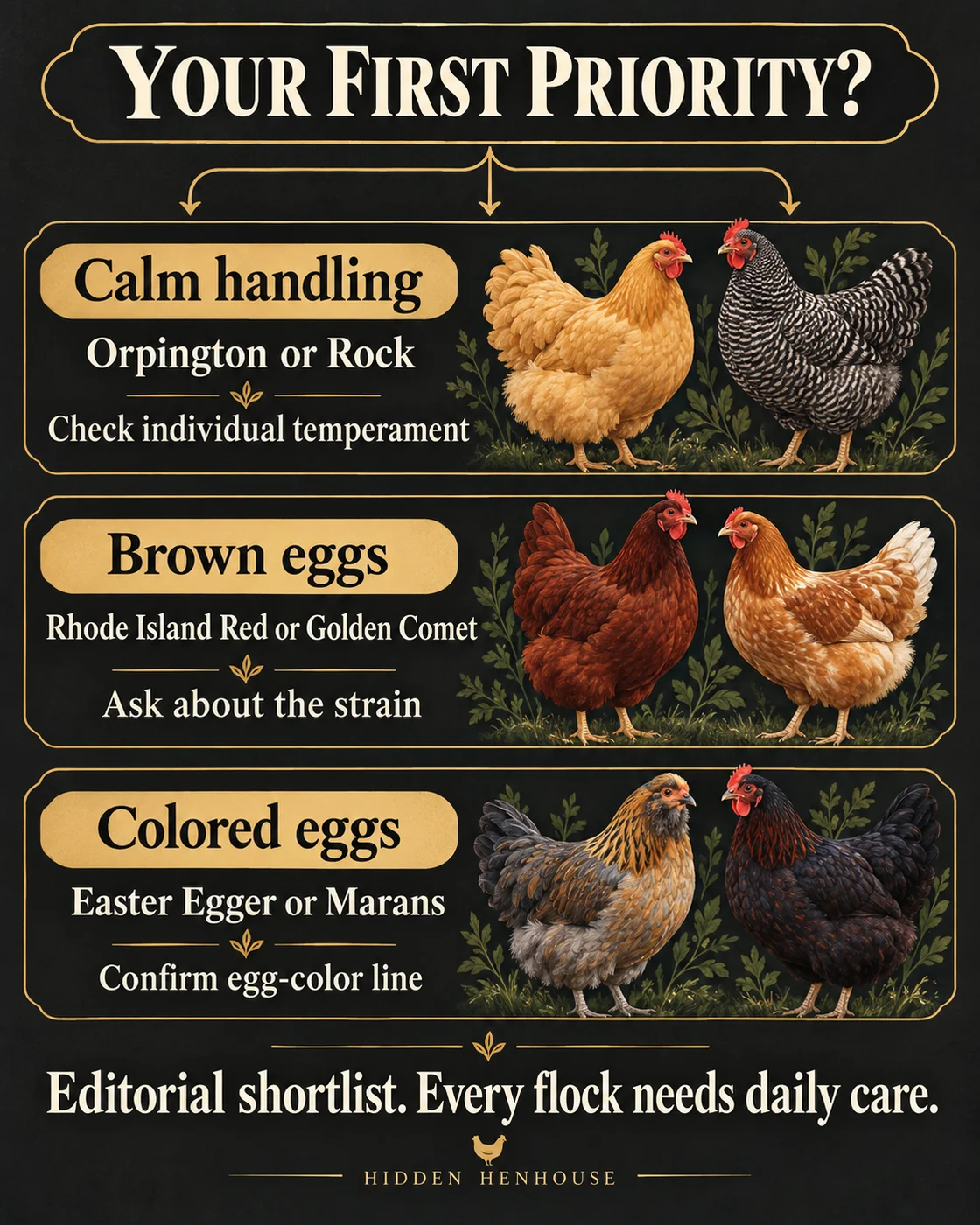
For a first flock, write down one main priority and one constraint. “Calm hens, hot summers” is a more useful brief than “the prettiest six chickens.” Our practical shortlist is:
- Calm interaction: Buff Orpington or Plymouth Rock. Meet the actual birds if possible; a breed reputation does not promise a hen will enjoy being held.
- Brown-egg production: Rhode Island Red, Australorp or a Golden Comet production hybrid. Ask which strain the seller carries and what its parent flock produces.
- A colorful egg basket: Easter Egger for blue/green possibilities, Marans for darker brown. Confirm the line’s egg colors rather than buying by a chick’s plumage.
- White eggs and an active flock: Leghorn, provided you can accommodate activity, containment and less predictable handling.
- Cold winters: compare heavier breeds and comb type, then check the housing. Plymouth Rocks and Orpingtons are reasonable candidates; Brahmas require room and dry footing.
- Close neighbors: choose hens with observed calm behavior, a manageable flock size and a legal setup. No breed gives you a silent flock.
These are editorial starting points, not an official ranking. Set your flock size with the beginner flock-size guide before ordering extras simply to sample more breeds.
How to read egg counts and breed descriptions
Annual production figures describe potential or typical performance under the source’s assumptions. They are not a promise for every age, year or backyard. Daylight, molt, broodiness, health, feed and strain affect laying; dividing an annual total by fifty-two does not create a dependable weekly schedule. Broodiness means a hen wants to sit on eggs, which can interrupt laying even when no rooster is present.
Mississippi State’s February 2026 breed-selection guide distinguishes egg-focused and dual-purpose birds and treats temperament as a selection factor. A production line and a show-focused line carrying the same breed name may differ substantially. Ask about the actual stock, not just the name.
Sources sometimes give different estimates. The Livestock Conservancy’s non-industrial Leghorn profile gives a broad annual range of 150 to 320 eggs, while its 2026 comparison chart lists roughly 250 to 300, with variation. Neither supplies a directly comparable backyard trial establishing one universal number. We show that difference instead of averaging it into a supposedly precise answer. Commercial Leghorn-derived layers also should not be treated as identical to every heritage line.
Ten beginner options and their tradeoffs
The following comparisons use mature standard-sized hens, not bantams. Where a strong source supplies an annual figure, it is attributed. Where it does not, a laying tendency is more honest than an invented range.
Plymouth Rock, including the Barred variety: a balanced starting point
The Livestock Conservancy describes Plymouth Rocks as calm, docile dual-purpose birds, with hens around seven and a half pounds and about 200 brown eggs annually. They can become broody. Barred refers to a color variety of Plymouth Rock, not a separate breed.
Our judgment: a useful first comparison for people who want ordinary brown eggs and less excitable handling. Their size still needs proper housing, and calm with people does not guarantee peace at the feeder. See the Plymouth Barred Rock profile.
Buff Orpington: calm handling with a larger body
The Conservancy’s Orpington profile emphasizes a calm, friendly disposition, brown eggs and hens around eight pounds. It describes strong laying ability without giving a single annual numerical range. Buff is one recognized color variety.
We would shortlist Orpingtons for a household that values steady interaction over maximum output. Budget space for a substantial bird. Mississippi State also notes their comparatively poor foraging ability; do not expect them to replace purchased feed by working the yard. A gentle reputation is no substitute for supervising children or respecting a hen that wants to be left alone. More in the Buff Orpington guide.
Rhode Island Red: brown eggs, with strain worth checking
The Conservancy’s Rhode Island Red profile reports about 200 to 300 brown eggs annually and distinguishes industrial selection from non-industrial stock. Hens are generally peaceful; that description is not a guarantee about every bird or rooster. Broodiness also varies with selection.
For an eggs-first beginner, ask whether the seller means heritage Rhode Island Reds, a production strain or a differently named production cross. Watch actual assertiveness in a mixed flock rather than assuming either a bully or a pet. Read the Rhode Island Red profile.
Australorp: productive, but not a heat-proof bird
The Conservancy describes Australorps as active yet gentle, with brown eggs, hens around six and a half pounds and roughly 250 or more eggs annually. That is a breed description, not an individual forecast. Some hens become broody.
Our recommendation: compare them when you want both approachable behavior and brown eggs. Their reputation for adaptability does not establish them as universally best for hot climates. Shade, water and ventilation remain essential. See the Australorp guide.
Speckled Sussex: curious hens, with a summer caution
The Conservancy’s Sussex description gives hens around seven pounds and approximately 200 to 250 tan/brown eggs annually. It describes calm curiosity, possible broodiness and good winter suitability, while explicitly cautioning that Sussex are not fond of heat.
That corrects the old article’s “all climates” promise. They may suit a beginner who enjoys an inquisitive dual-purpose bird, but a hot yard needs a serious cooling plan. Monitor gentler individuals around assertive flockmates. See the Speckled Sussex profile.
Easter Egger: colorful eggs, variable background
Easter Egger is a nonstandard category, often involving mixed ancestry, rather than one uniform standardized breed. The Ameraucana Breeders Club explains the distinction from standardbred Ameraucanas. Similar names on a hatchery order do not establish the same breed identity.
Cackle Hatchery estimates 200 to 280 eggs annually for its Easter Egger stock. That is a commercial, line-specific estimate. Color, body size, comb, temperament and broodiness vary. One hen generally lays one basic shell color; a rainbow basket comes from several hens, not one hen changing colors each day. Ask the supplier what colors its line actually produces. See the Easter Egger guide.
Leghorn: white eggs, activity and containment
Leghorns are comparatively light, active white-egg layers; the Conservancy puts non-industrial hens around four and a half pounds. Its profile cautions about flightiness, noise and pet-style handling. We retain the differing annual estimates discussed above instead of promising a near-daily egg.
Our judgment: a good candidate for an eggs-focused keeper comfortable with active birds, a weaker default for a close-neighbor yard or children hoping to cuddle hens. Check the actual comb variety; a large single comb deserves winter attention. See the Leghorn profile.
Brahma: large, calm and a different housing commitment
The Conservancy’s Brahma profile describes calm hens around ten pounds, brown eggs, possible broodiness and production up to about 200 annually. “Up to” is a ceiling in a general description, not a minimum. Feathered feet and a small pea comb help distinguish them.
They warrant particular care over body clearance, footing and heat. Mud can cling to foot feathers; the source cautions against hot southern conditions. A large calm hen can still intimidate a small child. Choose one because you can house that bird well, not because “gentle giant” sounds effortless. Read the Brahma guide.
Golden Comet: a production hybrid, not a standard breed
Cackle describes its Golden Comets as first-generation sex-link hybrids and estimates 250 to 320 brown eggs annually for its stock. Its current description calls them active. These are supplier claims about a selected commercial line, not independent guarantees for every bird sold under the name.
We would compare them for brown eggs rather than exhibition or predictable breeding. First-generation color sexing does not mean their offspring will reliably repeat the same traits. Productive hens still need daily husbandry and care as laying slows. See the Golden Comet guide.
Marans: choose the egg-color line deliberately
The Marans Club emphasizes variation in dark egg color with genetics, stress and the laying cycle, and the importance of selecting temperament. Its standard describes hens around six and a half pounds. It does not establish a universal annual production range.
For beginners, darker shells can be the priority without pretending Marans are the highest-output choice. Ask to see the breeder’s eggs and discuss handling and foot feathering. A breed name alone will not promise uniformly chocolate-dark eggs or quiet behavior. See the Marans profile.
Match climate to the actual bird and housing
Mississippi State describes larger combs as useful in warmer conditions and smaller combs as advantageous in cold. These are tendencies, not climate immunity. Minnesota’s cold-weather guidance, reviewed in 2025, also favors heavier birds for winter and highlights frostbite concerns for large combs and wattles.
For heat, compare body size, feathering and the actual line’s local performance. Do not rank a breed as “best for heat” from its name alone. Every yard needs shade and dependable water. For cold, prioritize dry, ventilated housing and inspect exposed combs and feet. A cold-hardy label does not justify a damp coop. Use the winter coop guide for the housing decision rather than treating breed choice as the whole solution.
Neighborhood fit and mixed-flock compatibility
All hens vocalize. We do not have comparable sound measurements that justify declaring one of these breeds universally quietest. The Conservancy’s Leghorn noise caution is useful, but it is not a decibel ranking of the other nine. Check local flock and rooster rules before buying. Hens do not require a rooster to lay eggs.
As an editorial precaution, start with birds of broadly compatible size and activity rather than combining extremes solely for appearance. Watch who reaches feed and water, who retreats and who gets repeatedly chased. Human friendliness and flock assertiveness are different traits. A docile bird can be pushed aside; an energetic bird is not automatically aggressive.
No breed is so low-maintenance that daily water, feed, observation and secure housing become optional. Free-ranging does not replace complete feed or predator protection. Size the enclosure using the chicken space guide, and price the commitment with the startup and monthly cost guide.
Five questions to ask before you buy
- What exactly is the stock? Breed, variety, heritage/show or production line, or named hybrid?
- What do the parent birds actually do? Ask about laying, broodiness, handling and local climate performance. Separate records from a sales estimate.
- Are these chicks or started pullets? Ask age, sexing method and the seller’s policy if a supposed pullet is male.
- What health information comes with them? Discuss vaccination history and follow local animal-health advice before mixing sources.
- Can this flock fit your household? Confirm legal numbers, housing, daily care and a plan for older hens before laying slows.
Choose the flock you can care for consistently. In a neighborhood backyard, responsible stewardship starts with that fit—not with collecting every attractive breed on the list.
Frequently asked questions
Which chicken breed should a beginner choose first?
For a balanced starting comparison, look at Plymouth Rock; for calm handling, compare Buff Orpington; for brown eggs, compare Rhode Island Red or a production hybrid. Narrow those options by climate, space and the actual seller’s line. There is no universal winner.
Which breed is best for children?
Calm Orpingtons and Rocks may be reasonable candidates, but no breed is child-safe by definition. Individual temperament, supervision and respectful handling matter. Do not assume a hen wants to be carried because a catalog calls her friendly.
How many eggs will three hens lay each week?
There is no dependable year-round number. Age, strain, daylight, molt and broodiness can change output substantially. Use annual figures only as qualified comparisons, and plan for periods with fewer eggs or none.
Can beginners keep several breeds together?
Yes, but choose compatible sizes and activity levels, provide enough resources and watch the actual social behavior. A mixed flock is an option, not a requirement for a colorful or successful backyard.
Sources and how we used them
Research checked October 5, 2026. Mississippi State’s 2026 publication and Minnesota’s 2025-reviewed winter guidance support selection and climate principles. The Livestock Conservancy profiles and 2026 chart support breed descriptions, with differing estimates retained openly. Breed clubs establish identity and standards. Cackle’s Easter Egger and Golden Comet descriptions are labeled commercial, strain-specific information. Undated profiles are not presented as newly reviewed scientific trials. Links beside the relevant claims lead to those sources.