


David refuses to kill the king hunting him. One chapter later, the same David prepares to slaughter the men of a household because its master insulted him. If our reading method is simply to imitate the hero, what should we do with that contrast?
Christians should read biblical stories by following the whole scene, distinguishing the narrator’s judgment from the characters’ claims, and asking how the passage reveals God’s purposes amid human faithfulness and failure. Scripture teaches through narrative, but a recorded deed does not automatically become an approved example. Learning to notice that difference helps us receive the story’s actual instruction.
GUIDED ARTICLE EXPERIENCE
How Should Christians Read Biblical Stories?
Read along as the narration moves through the article.
Browser narration · No stored audio or site tracking
CONTINUE GUIDED TOUR
Continue where you left off.
GUIDED TOUR COMPLETE
You have reached the end of this study.
Study record saved on this device.
GUIDED TOUR
How Should Christians Read Biblical Stories?
Narrator: Paranoid Prophet Recommended Voice Native device narration
Prepare to follow the article as it is narrated.
VOICE & TOUR OPTIONS
Voice & Listening
NARRATOR
Finding a narrator…
Checking the best narrator available on this device.
Restores the site recommendations available in this browser.
Our listening picks lead when available; other voices are ranked for narration. Known novelty voices are hidden. Browser-provided voices may use an online voice service.
Screen-awake support will be checked when narration starts.
Optional: improve your device voices
Listening works with the voices already available here. Your device may offer additional free voices through its own settings.
iPhone or iPad: Settings → Accessibility → Read & Speak (or Spoken Content) → Voices → English. Look for Premium or Enhanced choices, then return here.
If offered, preview Ava or Zoe for U.S. English, or Serena or Jamie for British English. An explicit Premium or Enhanced version can improve on its compact version.
Mac: System Settings → Accessibility → Read & Speak → System voice. Open the voice list to preview or download additional choices.
Windows: Settings → Accessibility → Narrator → Add natural voices. Browser availability varies; a Narrator voice may not appear on websites. Edge may also expose online Natural voices without a model download.
Android: Open Accessibility → Text-to-speech output (the location varies by device). In the preferred engine settings, look for voice data and English choices.
Download sizes vary; some enhanced voices exceed 100 MB. This website cannot install system voices, and an installed voice appears here only if your browser exposes it.
Apple voice guide · Windows voice guide · Android voice guide
CHOOSE A NARRATOR
Recommended on this device
Our listening picks: Aaron, Martha, then Daniel, when available here. Otherwise, automatic uses the highest-ranked suitable voice. Preview alternatives or save your own choice.
Preparing the guided article experience…
RESUME GUIDED TOUR?
Continue where you left off.
GUIDED TOUR COMPLETE
You have reached the end of this study.
Article Guide10 sections
Start with the kind of story you are reading
Biblical narrative communicates through events, settings, dialogue, conflict, and outcomes. It can describe something worth imitating, expose something wicked, explain how a promise advances, or leave us waiting for a resolution. Those purposes often appear together.
Begin with the book and the surrounding chapters. Where are we in Israel’s history or Jesus’ ministry? What problem has already developed? Has the author introduced a promise, warning, or conflict that this scene continues? Our guide to the books of the Bible supplies the larger map; reading the neighboring passages supplies the immediate one.
Also identify the form within the narrative. A parable Jesus tells has a different relationship to historical events from the Gospel’s report that Jesus told it. A character’s dream, a quoted song, and a battlefield account need not be interpreted identically because they appear in the same book.
Before asking what a scene means for you, summarize what happens in one ordinary sentence. Include the conflict and its outcome. That small discipline often reveals whether you have read the story or merely recognized a familiar name.
Separate what happened from what God approves
Description tells us what someone did. Approval requires a reason to regard that action as right. Sometimes the narrator supplies the judgment explicitly. After David takes Bathsheba and arranges Uriah’s death, 2 Samuel 11:27 says that David’s deed displeased the Lord. Royal status does not cancel that verdict.
Elsewhere judgment emerges through contrast, a prophetic rebuke, an established command, or the story’s development. Ask which evidence actually bears the weight. A tragic consequence may expose folly, but suffering alone cannot prove that the sufferer sinned. Likewise, immediate success cannot establish God’s approval.
Silence is especially easy to misuse. A narrator may report an act without pausing to repeat a command the audience already knows. The absence of a sentence condemning every lie or betrayal does not turn those actions into permissions.
Try a two-column note: what the passage records, and what grounds it gives for evaluating those actions. If the second column depends only on your admiration for the character, slow down. Scripture’s authority belongs to its truthful witness, including its exposure of human wrongdoing, rather than to every decision made by a person within it.
Listen for the difference between narrator and character
Characters speak from inside the action. They may be honest, mistaken, manipulative, frightened, or only partly informed. A sentence containing God’s name is not necessarily a statement from God.
In Judges 17, Micah concludes that the Lord will prosper him because he has hired a Levite as his priest. Read alone, his final speech might sound like confident faith. Read within the chapter, it belongs to a household shrine involving stolen silver, an idol, and self-appointed worship. The narrator’s observation in verse 6, that people did what was right in their own eyes, challenges Micah’s confidence.
This distinction does not require distrusting every character. It requires checking how the narrative presents the speaker. Does the narrator confirm the claim? Does subsequent action expose it? Is the speech consistent with the commands already given?
The same care matters when someone quotes a biblical character to settle a modern argument. Ask who originally said it, to whom, and whether the passage treats that statement as wisdom, accusation, temptation, or self-deception. Accurate quotation still needs accurate interpretation.

Follow David from restraint to threatened revenge
Read 1 Samuel 24 before reading chapter 25. Saul enters a cave where David and his men are hiding. David’s men interpret the opportunity as permission to deal with his enemy. David refuses to kill Saul, appeals to God’s judgment, and restrains his companions.
In 1 Samuel 25, Nabal insults David’s messengers after they request provisions. David arms his men and intends to kill the males of Nabal’s household. Abigail intervenes with food and an appeal against bloodshed. David accepts her correction and recognizes God’s restraint through her.
The contrast exposes how a person capable of remarkable restraint can become dangerous when offended. Chapter 25 does not celebrate David’s planned violence. Abigail’s warning and David’s response identify the bloodguilt he was approaching. God’s work includes interrupting the future king through someone he needs to hear.
Notice the reading sequence: identify the conflict, compare David’s responses, locate the corrective speech, and observe the changed action. Only then draw an application about receiving correction and refusing revenge. Abigail’s initiative deserves attention; the story does not make endangered people responsible for managing another person’s violence.
Nor does David’s refusal to kill Saul place abusive leaders beyond accountability. David names the wrong and remains apart from Saul at the chapter’s end. Refusing revenge is compatible with seeking safety, reporting wrongdoing, and pursuing justice.
Notice plot, repetition, and what the author leaves unsaid
A story’s arrangement helps communicate its meaning. BibleProject’s introduction to narrative plot offers an accessible explanation of why conflict and resolution matter. In David’s story, reading the chapters together reveals something a detached verse about courage or loyalty would miss.
Look for repeated words, parallel situations, reversed expectations, and changes in who speaks. Does someone who began confidently become silent? Does a supposedly minor character recognize what a leader misses? Does a promised outcome remain delayed? These observations are useful when they explain the passage rather than decorate it.
Resist filling every gap with invented psychology. A sermon may confidently announce what a character secretly feared or desired when the text never tells us. Distinguish an explicit statement, a reasonable inference, and an imaginative possibility. The last may help a dramatization, but it should not become the foundation of an interpretation.
You can also learn from unresolved endings. Scripture sometimes leaves readers feeling the weight of a failure rather than supplying an immediate motivational lesson. A faithful reading can acknowledge grief, moral horror, or unanswered questions without forcing the scene into a reassuring formula.
Read God’s purposes without excusing human evil
Biblical stories frequently hold divine faithfulness and human wrongdoing together. Joseph’s conclusion in Genesis 50:15–21 is a clear example. His brothers fear retaliation. Joseph identifies their intention as evil while recognizing God’s good purpose in preserving lives.
The distinction matters. God’s ability to bring good through wrongdoing does not make the wrongdoing good. Joseph does not rename betrayal as kindness or say his brothers were entitled to harm him. His response gives us grounds for hope in God’s purposes without providing an excuse for cruelty.
Genesis preserves a family history marked by rivalry, deception, and suffering alongside covenant promise. Judges increasingly confronts readers with religious confusion and social collapse. Neither book requires us to sanitize its characters to defend Scripture. Its honest portrayal of damaged people is part of its instruction.
When reading a hard episode, ask what the text attributes directly to God and what it attributes to human actors. Then keep those distinctions when applying it. We should not claim to know God’s specific purpose in another person’s suffering merely because a biblical narrator identifies His purpose in a particular event.
Take historical claims and ancient culture seriously
Literary craftsmanship and historical reference can coexist. An author can select events, arrange scenes, and emphasize a theme while intending to describe things that happened. Luke 1:1–4 explicitly connects an ordered account with transmitted testimony and careful investigation.
That does not mean literary analysis proves every historical claim. Neither does identifying a pattern prove an event was invented. Ask separate questions about the account’s form, its intended claim, and the evidence relevant to that claim. The guide to evaluating religious truth claims explains why different questions require different kinds of support.
Ancient social context can also clarify stakes that modern readers miss: household dependence, inheritance, royal authority, hospitality, or covenant obligations. Background knowledge should come from accountable sources rather than a preacher’s unsupported claim about what everyone supposedly did in ancient times.
Understanding a practice does not require approving it. Recognizing differences in power helps us avoid blaming vulnerable people or inventing consent where a passage does not describe it. Nor should cultural explanation erase the biblical author’s own criticism. Study context to hear the text more accurately, not to make its moral difficulties disappear.
Apply the story through Christ and the apostolic teaching
The New Testament expects Christians to learn from Israel’s Scriptures. In 1 Corinthians 10:1–14, Paul uses wilderness failures to warn against evil desire, idolatry, and presumption. His application follows identifiable connections between Israel’s conduct and the Corinthians’ dangers. He does not simply assign every reader a heroic role.
Romans 15:1–13 places Scripture’s instruction within a call to bear with others, follow Christ’s self-giving example, and welcome one another. Its promise of encouragement and hope serves a community learning to glorify God together. It is larger than private reassurance.
Move from observation to application in three steps. State the passage’s main claim in its original setting. Identify a moral or theological truth supported by the passage and the wider biblical witness. Then name a fitting response for your actual responsibilities.
For 1 Samuel 25, that might mean admitting that an insult has distorted your judgment and listening to someone challenging your retaliation. It does not mean identifying a coworker as Nabal and expecting God to kill him. Christian application remains accountable to Jesus, the apostolic teaching, and the distinction between Israel’s particular story and our place within God’s purposes. Our guide to the biblical covenants explains the covenant distinctions that help keep this transition faithful to the text.
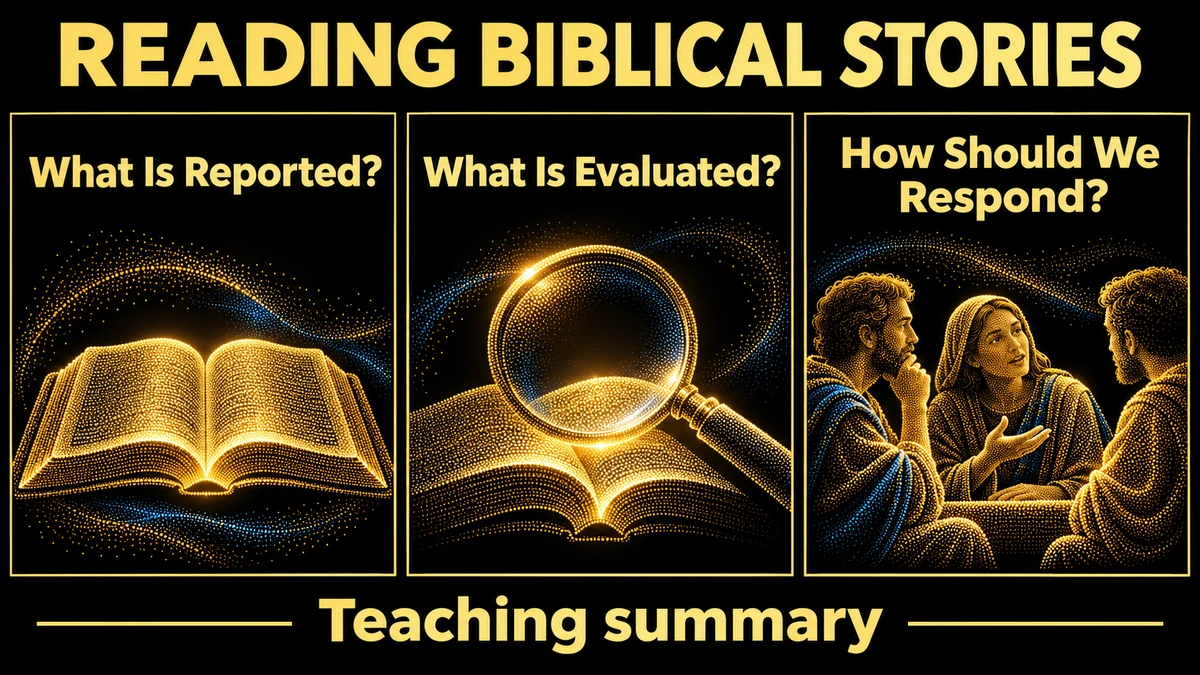
Reading Biblical Stories: what is reported? What is evaluated? How should we respond? Teaching summary, not a quotation of Scripture.
Practice with one complete scene
For your next study, read 1 Samuel 25 without stopping at the most memorable speech. Write down what Nabal does, what David plans, what Abigail says, and what David changes. Mark which judgments come from the narrator and which come from characters. Then reread chapter 24 and describe the contrast without defending everything David does.
Finish with two sentences: what this passage reveals about God and human beings, and how that truth calls for a faithful response today. Check that your application preserves the story’s moral distinctions and does not turn another person into a disposable villain.
Biblical stories form patient readers. They teach us to recognize faith, expose self-deception, grieve evil, receive correction, and trust God without pretending His people are flawless. We honor Scripture by letting its stories tell the truth about their characters before asking those stories to tell us what to do.
Frequently asked questions about biblical stories
Does Hebrews 11 endorse everything its heroes did?
No. Hebrews 11 commends faith and perseverance, including faith expressed by morally complicated people. Naming David or Jephthah does not approve every action recorded about them. Read the specific commendation alongside the original narrative. Notice also that the chapter includes both deliverance and suffering; faith does not guarantee escape from hardship.
Should Christians repeat a unique command given to someone in a story?
A command to a named person in a particular situation is not automatically a command to every reader. Genesis 22 concerns Abraham’s specific test, and God stops him from harming Isaac. It grants no permission to harm a child or coerce another person in God’s name. Determine the command’s recipient, covenant setting, and place in the wider biblical teaching before discussing application.
Can I identify with a biblical character?
Yes, as a way of noticing recognizable fear, pride, trust, or grief. Identification becomes misleading when you assume the character’s office, promises, enemies, or outcome belong to you. You can learn from David’s need for correction without treating yourself as Israel’s anointed king. Let the passage question your self-image rather than merely confirm it.
What if careful readers disagree about the story?
Name the precise disagreement and compare the textual reasons. One reader may notice a repeated word while another questions how much weight it carries. Consult a responsible commentary, compare translations, and distinguish a central claim from a tentative inference. Our sources and verification standard explains the difference between Scripture’s authority and the judgments of its interpreters.
Scripture references in this guide link to the World English Bible (WEB) and are paraphrased rather than quoted. Read the complete passages alongside the narrative-reading resource linked above.