


The Psalms can sound startlingly different from the prayers Christians think they are supposed to offer. One singer celebrates God’s goodness. Another asks why God seems absent. A third remembers enemies with words so fierce that a modern reader wants to close the book. Scripture preserves all of these voices, and reading them faithfully requires more than finding a comforting line.
Christians should read and pray the Psalms as Israel’s inspired poetry, attending to each poem’s speaker, images, movement, and place in the biblical story. Read the whole psalm before applying a verse. Then bring its praise, confession, grief, or longing for justice to God through Christ, allowing Scripture to shape your response without pretending every sentence is a personal prediction.
GUIDED ARTICLE EXPERIENCE
How Should Christians Read and Pray the Psalms?
Read along as the narration moves through the article.
Browser narration · No stored audio or site tracking
CONTINUE GUIDED TOUR
Continue where you left off.
GUIDED TOUR COMPLETE
You have reached the end of this study.
Study record saved on this device.
GUIDED TOUR
How Should Christians Read and Pray the Psalms?
Narrator: Paranoid Prophet Recommended Voice Native device narration
Prepare to follow the article as it is narrated.
VOICE & TOUR OPTIONS
Voice & Listening
NARRATOR
Finding a narrator…
Checking the best narrator available on this device.
Restores the site recommendations available in this browser.
Our listening picks lead when available; other voices are ranked for narration. Known novelty voices are hidden. Browser-provided voices may use an online voice service.
Screen-awake support will be checked when narration starts.
Optional: improve your device voices
Listening works with the voices already available here. Your device may offer additional free voices through its own settings.
iPhone or iPad: Settings → Accessibility → Read & Speak (or Spoken Content) → Voices → English. Look for Premium or Enhanced choices, then return here.
If offered, preview Ava or Zoe for U.S. English, or Serena or Jamie for British English. An explicit Premium or Enhanced version can improve on its compact version.
Mac: System Settings → Accessibility → Read & Speak → System voice. Open the voice list to preview or download additional choices.
Windows: Settings → Accessibility → Narrator → Add natural voices. Browser availability varies; a Narrator voice may not appear on websites. Edge may also expose online Natural voices without a model download.
Android: Open Accessibility → Text-to-speech output (the location varies by device). In the preferred engine settings, look for voice data and English choices.
Download sizes vary; some enhanced voices exceed 100 MB. This website cannot install system voices, and an installed voice appears here only if your browser exposes it.
Apple voice guide · Windows voice guide · Android voice guide
CHOOSE A NARRATOR
Recommended on this device
Our listening picks: Aaron, Martha, then Daniel, when available here. Otherwise, automatic uses the highest-ranked suitable voice. Preview alternatives or save your own choice.
Preparing the guided article experience…
RESUME GUIDED TOUR?
Continue where you left off.
GUIDED TOUR COMPLETE
You have reached the end of this study.
Article Guide10 sections
Begin With the Psalm’s Own Voice
Before asking what a psalm means for your day, ask who is speaking and what is happening within the poem. Is an individual addressing God, a congregation remembering deliverance, a teacher describing wisdom, or a royal voice speaking about the king? Sometimes God speaks within the psalm. Those changes matter.
Read the superscription, the heading attached to many psalms. It may identify David, Asaph, the sons of Korah, a musical direction, or a remembered occasion. Do not invent a precise historical crisis when the text supplies none. Also distinguish these ancient headings from section titles supplied by a modern translation.
Notice the addressee. A complaint spoken to God differs from a command spoken by God. A description of an enemy’s boast differs from the poet’s own confession. Inspiration calls us to receive the whole composition according to what it communicates, rather than treating every quoted voice as divine instruction.
For the larger literary setting, the guide to the books of the Bible places Psalms among Israel’s poetry and wisdom. That location helps explain why reading a psalm feels different from following an apostle’s argument or a Gospel narrative.
Read Poetry as Poetry, Not as a Hidden Code
Hebrew poetry often places lines beside one another so that they reinforce, develop, or contrast a thought. This is commonly called parallelism. The second line may sharpen the first rather than merely repeat it. In Psalm 13:1, the language of being forgotten and of God’s hidden face gives the same distress another angle.
Images likewise communicate through comparison. God as shepherd expresses care, guidance, and protection. Tears becoming food describe grief’s consuming presence. Neither image needs a secret numerical meaning. Counting letters or treating every object as a coded prediction can distract from what the poem plainly says.
Read slowly enough to hear repeated words, questions, contrasts, and changes of address. Ask what an image contributes before translating it into an abstract lesson. A valley creates a sense of exposure and danger that the word difficulty alone cannot carry.
Different English versions may preserve different features of the poetry. Comparing them can help, but unfamiliar wording is not evidence of concealment. The guide to reading the Bible in context explains the broader discipline. Read the actual passage before building an interpretation around one English phrase.
Recognize Lament, Praise, Wisdom, and Royal Hope
Psalms contain overlapping kinds of speech. A lament brings distress before God and asks for help. Praise celebrates who God is and what He has done. Thanksgiving recounts deliverance. Wisdom poetry teaches a way of life. Royal psalms concern Israel’s king and the hopes bound to God’s reign.
These categories guide expectations. Psalm 1 contrasts the righteous and wicked; it invites sustained obedience rather than promising an easy week. Psalm 2 concerns God’s anointed king; readers cannot simply place themselves on his throne. Psalm 100 summons worship, while Psalm 51 voices repentance. A confession of sin and a protest against unjust accusation should not be forced into the same mold.
The collection also has a shape beyond individual poems. Psalms 1 and 2 introduce instruction and kingship; the final psalms ring with praise. BibleProject’s overview usefully traces these themes across the book. Its literary synthesis is a reading aid, while Scripture remains the authority.
Reading broadly keeps a favorite psalm from carrying the entire weight of biblical teaching. The worshiper who learns praise also needs lament, and the person pleading innocence in one situation still needs confession in another.
Let Lament Remain Honest
Psalm 13 moves through repeated questions, a plea for God to answer, and an expression of trust. Its opening does not disqualify its ending. The singer brings the experience of abandonment into relationship with the God whose kindness he remembers.
Do not turn that movement into a timetable. Six verses cannot tell us how quickly a sufferer must move from sorrow to singing. Nor does the poem say that circumstances visibly changed between its opening and conclusion. Faith can speak trust while still waiting.
Psalm 88 refuses the neat resolution readers may expect. Its opening addresses the God of salvation, but its closing remains in isolation and darkness. The repeated act of addressing God matters even when relief never arrives within the poem. Scripture makes room for prayer that finishes without emotional brightness. For the larger pastoral question, see suffering and Christian hope.
Lament is therefore not automatically a failure of faith. It can be faith refusing to stop speaking to God. That does not make every conclusion drawn in distress a complete theological account. The Psalms give suffering a truthful hearing within worship; they do not authorize another person to diagnose someone’s spiritual condition from the intensity of their tears.
Follow the Refrain in Psalms 42 and 43
Read Psalm 42 alongside Psalm 43. Their repeated refrain about a downcast soul and hope in God creates a strong literary connection. They are commonly read together, though that connection need not be turned into certainty about their original composition.
Psalm 42 begins with thirst for God, moves through tears and memories of public worship, and describes overwhelming waters. The speaker addresses both God and his own soul. The call to hope occurs before the distress has disappeared; indeed, anguish returns after the first refrain.
Psalm 43 asks for vindication and for God’s light and truth to lead the worshiper back to the altar. The refrain returns again. The movement is more complex than sadness followed by a permanent breakthrough. Remembering, questioning, asking, and hoping coexist.
Try reading both psalms aloud and pausing at each refrain. Ask what has changed since its previous appearance. You may pray for restored fellowship without claiming that your circumstances duplicate the ancient singer’s. And if hope must be spoken repeatedly, the repetition itself is no proof that your earlier prayer was insincere.

This illustration expresses the poem’s imagery, not a promise that suffering will end on a particular timetable.
Pray Psalm 23 Without Erasing the Valley
Psalm 23 offers a practical worked example. Read all six verses first. The superscription connects the poem with David, and its central images present the Lord as shepherd and generous host. The speaker’s confidence concerns God’s faithful care amid danger.
In verses 1–3, observe provision, rest, restoration, and guidance. The paths are righteous paths, not simply the route to whatever the worshiper wants. Turn that observation into a request: Lord, provide what I need and lead me in what is right, especially where my desires resist Your direction. This is a sample prayer, not a quotation from Scripture.
In verse 4, notice the change from speaking about God to addressing Him directly. The valley remains real. The World English Bible gives the short confession, “for you are with me.” Pray concretely: I am afraid of this diagnosis, this loss, or this uncertain responsibility. Help me trust Your presence and take the next faithful step. The words do not guarantee a particular medical outcome.
In verses 5–6, the table stands in the presence of enemies. Hospitality and threat occupy the same scene. The ending expresses confidence in God’s goodness and belonging in His house. Ask for enduring fellowship with God rather than assuming He has promised to remove every hostile person immediately.
Finally, choose one response consistent with the reading: seek wise counsel about a decision, receive needed care, or offer practical help to someone facing a frightening week. Such actions do not purchase God’s protection. They are ways of living under the Shepherd’s guidance after the prayer ends.
Face Imprecations Without Turning Them Into Permission
Some psalms call for judgment against enemies. These appeals are often called imprecations. Psalm 137 begins among the rivers of Babylon, with displaced people weeping for Zion while captors demand songs. Its ending imagines terrible retaliation against Babylon’s children. Read that ending with the captivity, humiliation, and destruction already in view.
Historical trauma explains the setting of the cry; it does not make violence against children morally available to Christian readers. Nor should the passage become a personalized curse against a coworker, neighbor, or political opponent. The biblical preservation of this anguished appeal is not an instruction to carry out its violent wish.
Christians differ over precisely how these passages should be voiced in worship. Some emphasize appeals for God’s righteous judgment; others stress bringing vengeful desires before God for correction. Both must reckon with Jesus’ command to love enemies and pray for persecutors, and Paul’s instruction to refuse personal revenge.
A responsible prayer can ask God to stop oppression, protect victims, expose wrongdoing, bring perpetrators to repentance, and judge justly. Leave vengeance with Him. Seeking safety, reporting abuse, and pursuing lawful accountability remain compatible with refusing retaliation. Never use these psalms to make a harmed person choose between Christian faithfulness and protection from further harm.
Read the Psalms Through Christ Without Silencing Israel
In Luke 24:44–47, the risen Jesus identifies the Law, Prophets, and Psalms as bearing witness to what must be fulfilled concerning Him. Christians therefore read the Psalms within the scriptural story that culminates in His suffering, resurrection, and the proclamation of forgiveness.
That conviction requires careful connections. Begin with the original poem’s voice and concerns, then ask how the New Testament uses it. Jesus takes Psalm 22’s opening onto His lips in Matthew 27:46. Acts 2:25–32 reads Psalm 16 in relation to His resurrection. These are stronger guides than inventing a separate symbolic meaning for every detail.
A royal psalm may carry hopes fulfilled in the Messiah; a lament may illuminate the suffering He enters and bears. That does not mean every first-person confession of sin is directly spoken by the sinless Jesus. Christian interpretation should preserve meaningful distinctions between the king, the worshiper, Israel, Christ, and His people.
The same care governs promises. A testimony of past rescue is not automatically a guarantee of identical rescue now. Wisdom about flourishing does not promise wealth to every faithful reader. Poetic confidence in God’s protection must be read alongside the righteous sufferer and the crucified Messiah, not used to guarantee healing, prosperity, or immunity from danger.
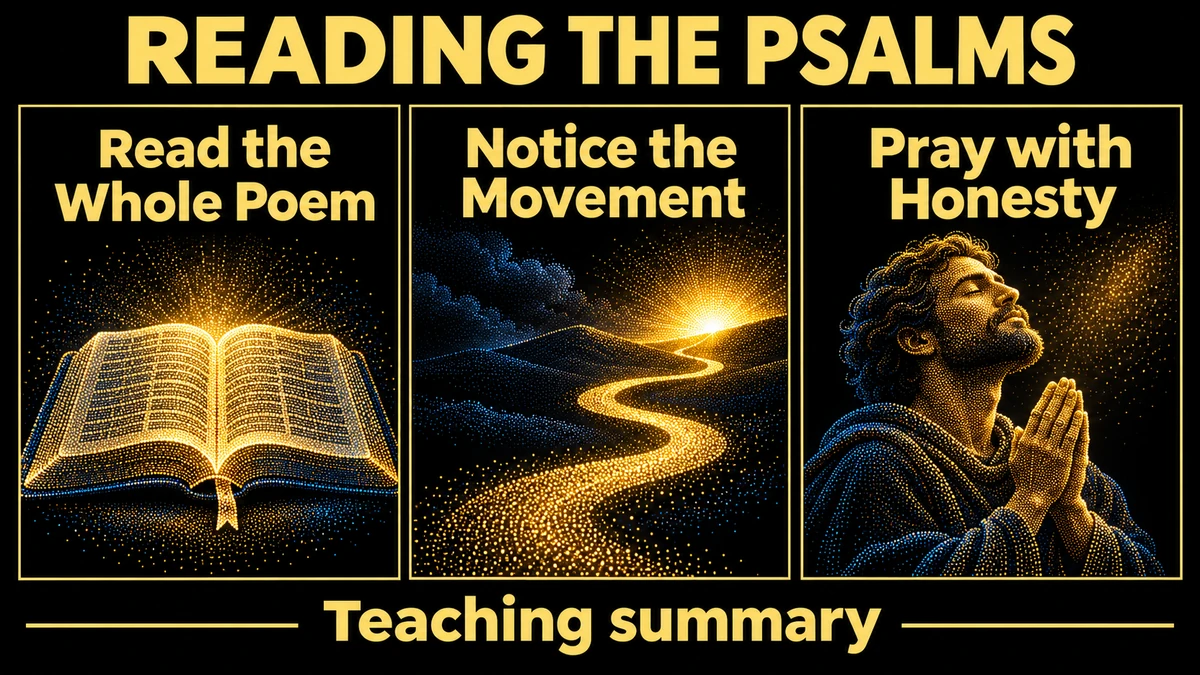
Reading the Psalms: read the whole poem; notice the movement; pray with honesty. Teaching summary, not a quotation of Scripture.
Build a Practice That Makes Room for Your Limits
Start with one whole psalm rather than a demanding quota. Read it, identify its speaker and main movement, and choose one or two lines to answer in your own words. Keep interpretation and personal association distinct: a verse may remind you of a relationship without originally referring to that relationship.
Pray beyond your immediate mood. A joyful psalm can teach thanksgiving; a lament can help you intercede for someone whose suffering you have overlooked. Reading with a church or trusted Christian friend also prevents prayer from shrinking into a private echo of your assumptions.
Some days concentration will be limited. Reading a short passage aloud, listening, or allowing someone else to pray beside you can be enough for that sitting. Repeating words is not a technique that obligates God to produce a feeling. Prayer also does not replace pastoral support, medical care, or other appropriate help.
For the broader foundations of Christian prayer, see how Christians should pray. Here, keep returning to the particular psalm: distinguish its words from your interpretation and speculation. A faithful reading can end with a question still open. You can continue praying without pretending to know why a particular sorrow has been permitted.
Frequently Asked Questions About Praying the Psalms
Can I pray a psalm when I do not feel its emotions?
Yes. You can receive its words as instruction, pray them for someone else, or ask God to grow what you cannot presently express. Avoid pretending. A praise psalm can become an honest request to recognize God’s goodness while grief remains.
Should I replace every mention of an enemy with a person’s name?
No. First understand who the enemies are within the poem and what the passage asks. Personalizing hostile language can feed resentment. Pray for protection and justice while submitting your anger to Christ’s commands concerning love and nonretaliation.
Does praying Psalm 23 guarantee that nothing bad will happen?
No. Its valley and enemies are part of the poem itself. The psalm teaches confidence in the Lord’s presence and care. Turning that confidence into guaranteed safety or prosperity promises more than the text gives.
Must every time of prayer end with feeling better?
No. Psalm 88 provides a biblical answer to that pressure. Continue seeking God and appropriate human support even when your feelings do not improve. The value of prayer cannot be measured only by whether distress has lifted before you close the Bible.
Scripture note: The brief quotation is from the World English Bible (WEB). Biblical summaries are paraphrases; sample prayers are original examples, not Scripture quotations.