

Revelation can leave readers staring at beasts, numbers, and disasters while losing sight of the book’s message. Others avoid it altogether, assuming its meaning belongs to specialists with elaborate charts. A better beginning is to listen to the churches who first received it and follow the visions toward their promised conclusion.
Christians should read Revelation as an apocalyptic prophecy addressed to real churches, interpreting its symbols through Scripture and its own explanations, following its literary structure, and responding with worship, endurance, and hope in Jesus Christ. Its difficult details deserve careful study. Its central summons to faithfulness need not wait until every disagreement is settled.
GUIDED ARTICLE EXPERIENCE
How Should Christians Read Revelation? Symbols, Context, and Hope
Read along as the narration moves through the article.
Browser narration · No stored audio or site tracking
CONTINUE GUIDED TOUR
Continue where you left off.
GUIDED TOUR COMPLETE
You have reached the end of this study.
Study record saved on this device.
GUIDED TOUR
How Should Christians Read Revelation? Symbols, Context, and Hope
Narrator: Paranoid Prophet Recommended Voice Native device narration
Prepare to follow the article as it is narrated.
VOICE & TOUR OPTIONS
Voice & Listening
NARRATOR
Finding a narrator…
Checking the best narrator available on this device.
Restores the site recommendations available in this browser.
Our listening picks lead when available; other voices are ranked for narration. Known novelty voices are hidden. Browser-provided voices may use an online voice service.
Screen-awake support will be checked when narration starts.
Optional: improve your device voices
Listening works with the voices already available here. Your device may offer additional free voices through its own settings.
iPhone or iPad: Settings → Accessibility → Read & Speak (or Spoken Content) → Voices → English. Look for Premium or Enhanced choices, then return here.
If offered, preview Ava or Zoe for U.S. English, or Serena or Jamie for British English. An explicit Premium or Enhanced version can improve on its compact version.
Mac: System Settings → Accessibility → Read & Speak → System voice. Open the voice list to preview or download additional choices.
Windows: Settings → Accessibility → Narrator → Add natural voices. Browser availability varies; a Narrator voice may not appear on websites. Edge may also expose online Natural voices without a model download.
Android: Open Accessibility → Text-to-speech output (the location varies by device). In the preferred engine settings, look for voice data and English choices.
Download sizes vary; some enhanced voices exceed 100 MB. This website cannot install system voices, and an installed voice appears here only if your browser exposes it.
Apple voice guide · Windows voice guide · Android voice guide
CHOOSE A NARRATOR
Recommended on this device
Our listening picks: Aaron, Martha, then Daniel, when available here. Otherwise, automatic uses the highest-ranked suitable voice. Preview alternatives or save your own choice.
Preparing the guided article experience…
RESUME GUIDED TOUR?
Continue where you left off.
GUIDED TOUR COMPLETE
You have reached the end of this study.
Article Guide10 sections
Begin With the Seven Churches
Revelation 1:1–11 introduces a revelation from Jesus Christ, identifies its human witness as John, and names seven congregations: Ephesus, Smyrna, Pergamum, Thyatira, Sardis, Philadelphia, and Laodicea. These churches were in the Roman province of Asia, in what is now western Turkey. The entire book is sent to them.
Read chapters 2–3 before trying to organize later visions. Smyrna faces poverty and coming imprisonment. Pergamum remembers Antipas, a witness who was killed. Ephesus needs to recover its first love. Laodicea mistakes material prosperity for spiritual sufficiency. The churches do not share one identical experience, and several need correction as urgently as comfort.
Historical background can help, but avoid making a vivid reconstruction do the work of evidence. Scholars debate the book’s date and the precise identity of John. Claims that every church faced a uniform, empire-wide persecution under Domitian go beyond what can securely be established. Francis J. Moloney’s historical discussion explains why that familiar picture needs qualification.
Begin with what the text actually names: suffering, compromised worship, perseverance, repentance, and promises. Later Christians hear Revelation faithfully by attending to those first hearers rather than treating them as an irrelevant preface to our own century.
Hold Apocalypse, Prophecy, and Letter Together
An apocalypse unveils realities that ordinary observation cannot fully disclose. Revelation brings readers into heavenly scenes and depicts spiritual conflict through striking visions. This literary form makes visible the deeper significance of worship, power, suffering, and God’s rule.
The book also calls itself prophecy. Revelation 1:3 blesses the person who reads aloud and those who hear and keep its words. Prophecy includes announcement of what God will do, but the command to keep these words makes present obedience essential to their purpose.
Finally, Revelation is a letter. Its opening names sender and recipients, and its closing offers grace. The visions belong to a communication meant to be heard by communities, including people who needed encouragement and people who needed to repent.
These forms work together. Read the images with attention to their symbolic force, hear the prophetic demand, and ask how the message addresses the churches. Reading only for a schedule can miss all three. For the wider prophetic background, see how to read Old Testament prophecy, while remembering that Revelation has its own distinctive arrangement and audience.
Let the Text and Scripture Guide the Symbols
Start with explanations Revelation supplies. In 1:20, the lampstands represent the churches. In 5:8, bowls of incense are identified with the prayers of the saints. In 12:9, the dragon is identified as the devil and Satan. These explanations give readers firmer ground than resemblance to a current headline.
Next, follow scriptural echoes. Read the earlier passage in context, then compare the wording, scene, and function. Daniel’s visions provide a particularly useful background. A throne, heavenly attendants, and a figure receiving dominion belong to Daniel 7:9–14. Revelation draws on that scriptural world while giving its own account of the Lamb’s authority.
An echo can illuminate a passage without proving that every detail has an exact one-to-one equivalent. Similar language deserves investigation; a superficial similarity does not establish a connection. Keep a distinction between an explanation stated in the text and an interpretation you infer.
Symbols can refer to real people, powers, and events. Calling an image symbolic does not make its message imaginary. It means that the image communicates through comparison, association, and narrative. The separate guide to Jesus in Revelation 1 explores that opening vision in detail; here the concern is how to read such imagery across the book.
Follow the Scenes Without Assuming One Timeline
Make a simple outline before making a detailed chronology. Notice the messages to the churches, heavenly worship, sequences of judgments, conflict, the fall of hostile powers, and the new creation. Also mark interruptions, songs, explanations, and shifts between earthly and heavenly viewpoints.
Repeated imagery deserves attention. Compare Revelation 6:12–17, 11:15–19, and 16:17–21. Each contains dramatic judgment language, although the scenes differ. Ask whether a later vision advances the action, revisits an earlier conflict, or expands a theme from another perspective.
Some interpreters read major judgment sequences as successive events. Others understand them as overlapping portrayals, often called recapitulation. Still others combine sequence and repetition. Brian J. Tabb’s commentary on Revelation discusses this structural disagreement and favors recapitulation. That preference is an interpretation to assess, not an undisputed feature of the text.
The order in which John reports seeing visions does not automatically settle the chronological relationship of everything depicted. Conversely, repetition does not prove that all sequences are identical. Record the textual evidence before choosing a model. A useful outline makes the book easier to follow while leaving genuinely disputed connections open.
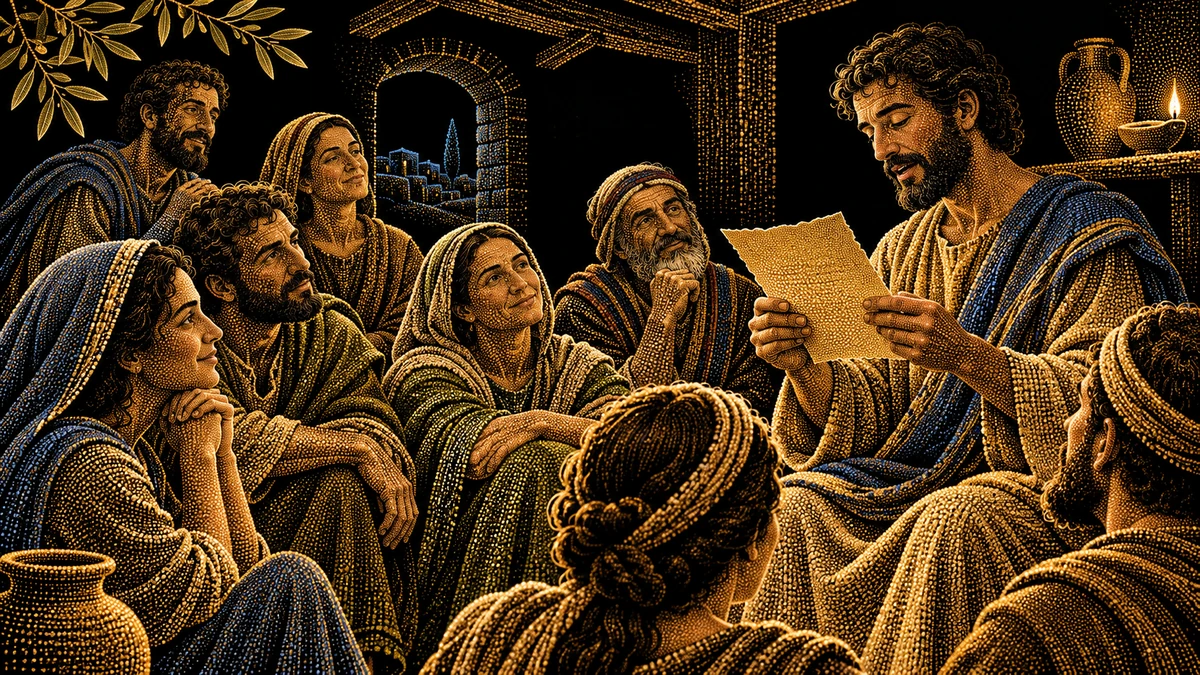
Work Through Revelation 5: The Lion and the Lamb
Read Revelation 5:1–14 as a complete scene. A sealed book is held by the one seated on the throne. An angel asks who is worthy to open it, and John weeps because no one is found. The problem concerns authority and worthiness before it concerns the contents of the seals.
Then an elder announces the victorious Lion from Judah, the Root of David. John looks and sees a Lamb standing as though slain. Notice the movement from what John hears to what he sees. The scene presents the Messiah’s victory through the image of a sacrificed yet living Lamb.
The worship that follows explains why the Lamb is worthy: his death has purchased people for God from every tribe, language, people, and nation. The vision’s meaning emerges from its accompanying song. It teaches readers to understand conquest through Christ’s saving death rather than imagine a zoological puzzle involving two competing animals.
Now compare Daniel 7:9–14. Both passages present a heavenly court, vast numbers of attendants, and an approach to the enthroned figure associated with authority. The comparison clarifies the setting without making Daniel’s scene and John’s scene interchangeable. Revelation gives particular emphasis to the Lamb’s death and the redeemed community.
Finally, observe the response. The scene expands into worship offered to the enthroned God and the Lamb. Ask what this does for a church threatened by violence or tempted by impressive earthly power. It teaches the congregation where worthiness and ultimate authority belong, and whose victory should shape its understanding of faithful witness.
Compare Interpretive Approaches Fairly
Christians use several broad approaches to Revelation, with considerable variation inside each. These labels describe tendencies; they do not replace close reading.
Preterist readings emphasize fulfillment within the world of the earliest hearers, especially ancient conflicts. Partial preterism also affirms a future return of Christ and final consummation. Ask how a particular reading accounts for both the first audience and the book’s final promises.
Historicist readings understand the visions as tracing developments across church history. Their proposed identifications vary. Ask what textual evidence supports the chosen historical sequence and whether the explanation depends too heavily on one region’s experience.
Futurist readings place much of the visionary material in events leading to Christ’s future return. Their timelines differ. Ask how the proposed future reference also addresses the seven churches who first heard the book.
Idealist readings emphasize recurring patterns of conflict, worship, judgment, and faithfulness. Many retain a final historical consummation. Ask whether a reading gives sufficient weight to particular historical references and promised events.
Mixed approaches combine insights from several models. Evaluate the actual argument rather than assuming a label guarantees either faithfulness or error. No approach grants permission to announce dates, identify today’s enemies by resemblance alone, or treat uncertain interpretations as tests of another Christian’s sincerity.
Read Judgment Alongside the Call to Endure
Revelation’s judgment scenes are morally serious. They confront wrongdoing and refuse to treat the suffering of faithful witnesses as invisible. In 6:9–11, the slain witnesses cry out for justice and are told to wait. The passage recognizes both their complaint and the painful reality of delay.
In Revelation 12:10–12, victory is connected to the Lamb’s blood and the witnesses’ testimony, even at the cost of their lives. The passage does not measure faithfulness by worldly success or promise that obedient Christians will avoid suffering.
As you read, identify who acts, who suffers, and what believers are commanded to do. God’s judgment must not become a permission slip for readers to threaten neighbors or imagine themselves authorized to carry out divine punishment. Nor should ancient polemical language become a label for contemporary ethnic or religious communities.
For a fuller doctrinal discussion, see what the Bible teaches about final judgment. The reading task here is narrower: preserve the connection between justice, worship, and faithful endurance instead of turning judgment scenes into detached spectacles.
Let the Ending Shape Your Reading
Revelation 21:1–5 brings the reader to a new heaven and earth, the holy city, and God’s dwelling with his people. Death, mourning, crying, and pain pass away. The one on the throne declares, “Behold, I am making all things new.” The ending gives the book’s hope a definite content.
Read backward from that destination without flattening the difficult scenes along the way. Ask how a passage exposes what destroys life, reveals God’s faithfulness, or prepares readers to hope for his presence. The city imagery deserves close attention to what the text says about dwelling, holiness, and communion with God.
Then read Revelation 22:6–21. The closing summons readers to keep the prophecy, worship God, and receive the offered water of life. Its repeated announcement of Christ’s coming creates urgency. It supplies no calendar date for readers to calculate.
This guide concentrates on reading the book’s conclusion within its argument. The broader study of Jesus’ return, reign, and new creation develops those promises further. Hope should make the reader more faithful in the present, not less attentive to the people and responsibilities nearby.
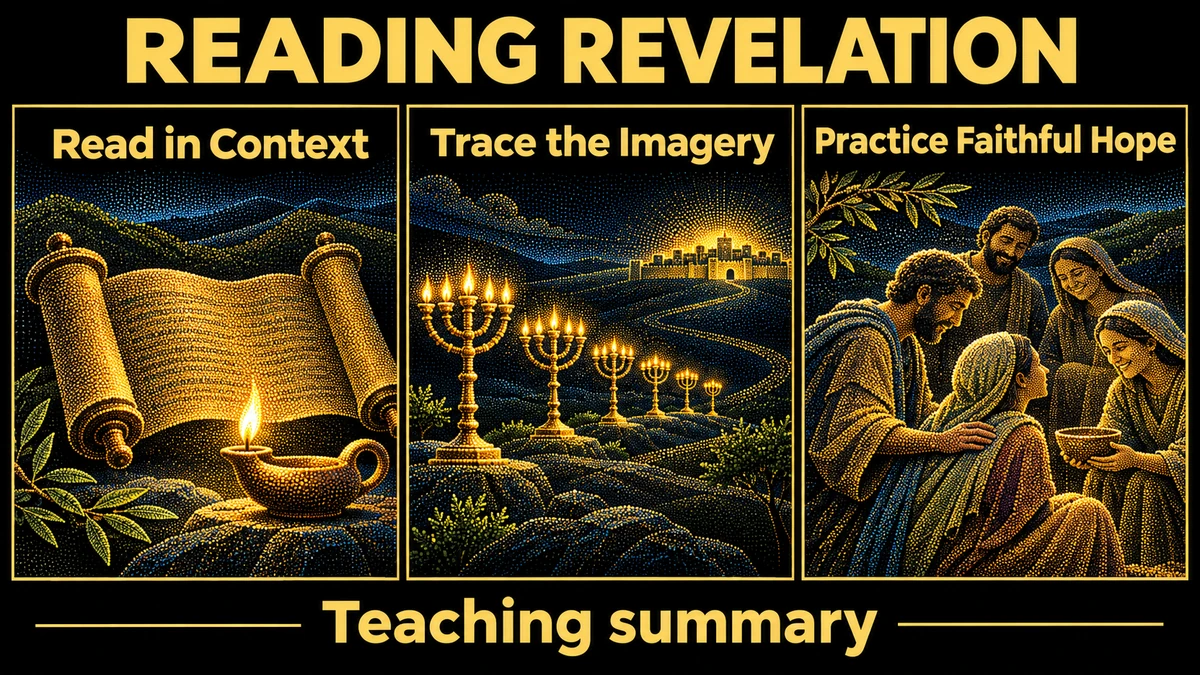
Reading Revelation: read in context; trace the imagery; practice faithful hope. Teaching summary, not a quotation of Scripture.
Use a Repeatable Reading Worksheet
Choose one complete scene rather than a startling sentence. Read it aloud if possible, then reread the paragraphs before and after it. Write a short answer to each of these prompts.
Scene and audience: Who speaks, who sees, and who is addressed? What changes during the scene? How might its warning or comfort matter to the seven churches?
Images and explanations: Which symbols does the passage explain? Which earlier Scriptures help illuminate them? Keep explicit explanations separate from proposed connections.
Place in the book: What has already happened in the narrative? Does this scene repeat language, answer a question, interrupt a sequence, or point toward the ending?
Meaning and response: What does the passage reveal about God, Christ, evil, or faithful witness? What response does it actually call for? Note unresolved questions without making them the center of the study.
For Revelation 5, the resulting summary might be: the slain and living Lamb is worthy to open the sealed book, and heaven responds in worship. That sentence can guide prayer and obedience while further questions remain under study. Return to a reliable commentary after making your observations, so you can evaluate its claims against the passage.
Frequently Asked Questions
Should Christians read Revelation literally or symbolically?
Read each passage according to its form. Revelation explicitly identifies some images as symbols, while addressing real churches and announcing real divine action. Respecting figurative language is part of reading accurately. The question is how a particular image communicates, not whether the entire book belongs in one of two rigid categories.
Is Revelation only about the future?
It addresses first-century congregations and their present faithfulness while announcing God’s judgment and promised consummation. Christians disagree about when many visions find fulfillment. A responsible interpretation must explain why the book mattered to its original hearers as well as how its promises orient Christian hope.
Do I need to choose an interpretive school before reading?
No. Begin with the audience, complete scenes, explicit explanations, and scriptural connections. Knowing the major approaches helps you recognize assumptions in commentaries and sermons. You can compare their arguments without forcing every observation into a system before you have followed the book itself.
What should I do when Revelation makes me anxious?
Read a complete passage rather than a stream of alarming predictions. Return to the Lamb’s worthiness, the calls to faithful endurance, and God’s promised presence. Discuss difficult passages with a trusted pastor or study group. You do not need to solve every symbol to hear the book’s invitation to worship and hope.
Translation and source note: Scripture quotations use the updated World English Bible, a public-domain translation; other biblical explanations are paraphrases. Primary passages are linked throughout. Historical cautions draw on Francis J. Moloney’s study, and structural discussion was checked against Brian J. Tabb’s commentary. Interpretive categories were compared with the Encyclopedia of the Bible and Tabb’s account of variations and mixed approaches. These scholars differ in perspective; their proposals are distinguished from the biblical text.