


Old Testament prophecy can feel like a locked room full of symbols, warnings, and promises. Readers may rush to connect its language with today’s headlines or lift a reassuring sentence out of a difficult chapter. Both habits can make the prophet’s actual message harder to hear.
Christians should read Old Testament prophecy by identifying its first audience, following the passage’s argument and literary form, and then considering its place in the biblical story fulfilled in Christ. Begin with what God was saying to those people. Distinguish that meaning from an explicit New Testament connection, a biblical pattern, or a proposed application today. Context makes judgment more searching and hope more substantial.
GUIDED ARTICLE EXPERIENCE
How Should Christians Read Old Testament Prophecy? Context, Judgment, and Hope
Read along as the narration moves through the article.
Browser narration · No stored audio or site tracking
CONTINUE GUIDED TOUR
Continue where you left off.
GUIDED TOUR COMPLETE
You have reached the end of this study.
Study record saved on this device.
GUIDED TOUR
How Should Christians Read Old Testament Prophecy? Context, Judgment, and Hope
Narrator: Paranoid Prophet Recommended Voice Native device narration
Prepare to follow the article as it is narrated.
VOICE & TOUR OPTIONS
Voice & Listening
NARRATOR
Finding a narrator…
Checking the best narrator available on this device.
Restores the site recommendations available in this browser.
Our listening picks lead when available; other voices are ranked for narration. Known novelty voices are hidden. Browser-provided voices may use an online voice service.
Screen-awake support will be checked when narration starts.
Optional: improve your device voices
Listening works with the voices already available here. Your device may offer additional free voices through its own settings.
iPhone or iPad: Settings → Accessibility → Read & Speak (or Spoken Content) → Voices → English. Look for Premium or Enhanced choices, then return here.
If offered, preview Ava or Zoe for U.S. English, or Serena or Jamie for British English. An explicit Premium or Enhanced version can improve on its compact version.
Mac: System Settings → Accessibility → Read & Speak → System voice. Open the voice list to preview or download additional choices.
Windows: Settings → Accessibility → Narrator → Add natural voices. Browser availability varies; a Narrator voice may not appear on websites. Edge may also expose online Natural voices without a model download.
Android: Open Accessibility → Text-to-speech output (the location varies by device). In the preferred engine settings, look for voice data and English choices.
Download sizes vary; some enhanced voices exceed 100 MB. This website cannot install system voices, and an installed voice appears here only if your browser exposes it.
Apple voice guide · Windows voice guide · Android voice guide
CHOOSE A NARRATOR
Recommended on this device
Our listening picks: Aaron, Martha, then Daniel, when available here. Otherwise, automatic uses the highest-ranked suitable voice. Preview alternatives or save your own choice.
Preparing the guided article experience…
RESUME GUIDED TOUR?
Continue where you left off.
GUIDED TOUR COMPLETE
You have reached the end of this study.
Article Guide10 sections
Start With the People the Prophet Addresses
A prophetic book speaks into real relationships and crises. Before asking which later event a sentence predicts, ask who receives it. Israel, Judah, Jerusalem, a particular ruler, and a foreign nation are not interchangeable audiences. Neither are people facing invasion and people already living in exile.
Look for evidence rather than supplying a dramatic background from imagination. A book’s opening may name kings or places. The passage may identify a messenger, a city, an accusation, or a letter’s recipients. Amos 1:1, for example, locates Amos’s message concerning Israel during the reigns of Uzziah of Judah and Jeroboam of Israel. Jeremiah 29 names displaced people in Babylon.
Record what the text establishes and what remains uncertain. A reliable commentary can explain historical setting, but a plausible reconstruction should not become an asserted fact. Sometimes we know the broad crisis without knowing the exact occasion of every speech.
Read the surrounding chapters as well. Prophetic books gather speeches, narratives, visions, and other material; adjacent passages do not always describe consecutive events. The guide to the books of the Bible helps locate each book before you narrow your attention to one oracle, or prophetic message.
Hear Covenant Faithfulness Behind the Warning
Prophets address worship, loyalty, and public conduct together. Their accusations expose abandoned faithfulness: idolatry, dishonest leadership, violence, and the exploitation of vulnerable people. Judgment concerns how a community actually lives before God, including what happens beyond its religious gatherings.
That setting explains why covenant language matters. A covenant establishes a relationship with promises and obligations. The prophets often confront God’s people with the contradiction between claiming that relationship and refusing its demands. The overview of biblical covenants supplies background for these appeals without making every covenant identical.
Ask three questions of an accusation: What wrongdoing is named? Who suffers because of it? What response does God require? Those questions keep prophecy from becoming an exercise in identifying someone else’s punishment. They also prevent reducing injustice to a vague feeling of social unease when the passage names bribery or oppression.
Hope belongs here too. Promises of restoration display God’s faithfulness amid human failure. Yet restoration need not erase consequences or arrive on the hearers’ preferred timetable. Let warnings remain serious and promises retain the shape the passage gives them.
Notice Poetry, Symbolic Action, and Prose
Prophecy uses more than one literary form. A poem may intensify an accusation through parallel lines, startling comparisons, and repeated words. Prose may report a confrontation or preserve a letter. A symbolic action makes a message visible, with accompanying words explaining what the action signifies.
In Amos 5, darkness and encounters with dangerous animals overturn confident expectations about God’s coming judgment. Read those images for their role in the argument before assigning each animal to a modern country. The imagery communicates danger that cannot be escaped by moving to an apparently safer place.
Jeremiah 19 provides a symbolic action: a pottery vessel is broken before witnesses, and the prophet explains its connection to judgment. The text’s explanation governs the symbol. Readers do not need a private dictionary in which every pot, color, or number conceals a different future event.
Jeremiah 29, by contrast, is introduced as a letter. Its commands belong to a communication sent to named recipients in a particular predicament. Reading according to form is part of taking Scripture seriously. Figurative language can announce real judgment, while a historical letter can teach later believers without being addressed directly to them.
Read Conditional Warnings Without Making Every Promise Conditional
In Jeremiah 18:1–12, Jeremiah observes a potter reshaping spoiled clay. God then speaks about nations and kingdoms: threatened destruction may be withdrawn when a nation turns from evil, and announced good may be withheld when it turns to disobedience. Verse 11 directs the appeal to Judah and Jerusalem; verse 12 records stubborn resistance.
This passage helps readers recognize the purpose of a warning. God may announce judgment to call people to repentance. An averted disaster can therefore reflect the warning’s intended effect rather than prove that it was empty speech. The moral response belongs inside the interpretation.
Read the conditions actually given, including calls to turn, seek, or obey. Also distinguish a warning inviting repentance from a passage announcing that judgment has become settled. The surrounding argument matters more than a formula applied indiscriminately.
Jeremiah 18 does not justify making every promise elsewhere contingent on conditions the reader invents. Different passages may emphasize human response, God’s pledged faithfulness, or both. Interpret each in its covenant and literary setting. Above all, do not turn this principle into permission to tell a suffering person that their illness or loss proves they failed to repent.
Work Through Jeremiah 29 as a Letter to Exiles
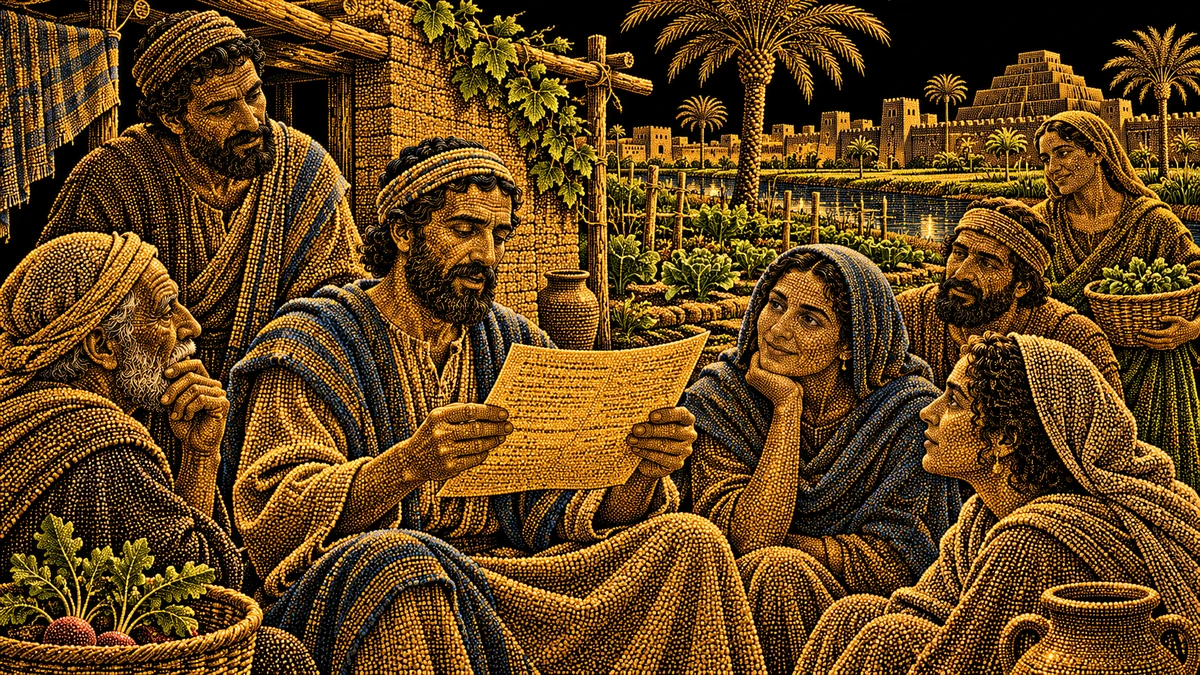
Read Jeremiah 29:1–14 before isolating verse 11. The opening identifies a letter sent from Jerusalem to elders, priests, prophets, and people whom Nebuchadnezzar had carried to Babylon. It also identifies the departure of King Jeconiah and other members of the community. These details establish the audience without requiring an elaborate reconstructed scene.
Verses 4–7 direct the exiles to build homes, plant gardens, form families, and seek their city’s peace. They are to pray for the place where they live. Faithfulness includes sustained communal life in an unwanted location, not merely waiting for permission to resume life elsewhere.
Verses 8–9 warn against deceptive prophetic voices. Verse 10 places the promised return after seventy years for Babylon. The promise therefore resists an expectation of immediate escape. Steed Davidson’s commentary likewise emphasizes Jeremiah’s instruction to establish a life in exile rather than expect its quick end.
Only then read the promise of hope in verse 11 and the prayer, seeking, and restoration of verses 12–14. The address is communal, and the horizon extends beyond an individual’s immediate circumstances. A promise given to an exiled people cannot simply become a guarantee that every Christian will receive a desired job, marriage, or financial outcome.
A responsible application follows the passage’s direction: resist comforting falsehood, pray, practice patient faithfulness, and pursue neighbors’ good while trusting God. You may learn these things without claiming that your difficult workplace is literally Babylon or that its difficulties will end on a schedule calculated from this letter. The historical setting strengthens the comfort by showing that hope can survive a long, costly wait.
Work Through Amos 5 Before Quoting Its Call for Justice
Read all of Amos 5, then concentrate on verses 18–24. The chapter begins with lament over Israel and calls to seek the Lord. Verses 10–12 identify hostility toward truthful correction, trampling the poor, bribery, and denying the needy justice. Verses 14–15 urge seeking good and establishing justice in the courts.
Against that background, verse 18 confronts people who desire the day of the Lord. They apparently expect God’s intervention to favor them. Amos announces darkness. The lion, bear, and snake in verse 19 make the reversal vivid: escaping one threat does not produce safety.
Verses 21–23 reject the community’s feasts, offerings, and music. Religious observance offers no shelter for a people persisting in the evils already named. Then verse 24 calls for justice and righteousness. The World English Bible reads, “But let justice roll on like rivers, and righteousness like a mighty stream.”
The water imagery belongs to a devastating warning about worship and communal life. Carolyn J. Sharp’s commentary highlights how Amos overturns his hearers’ expectations and makes their traditions measures of accountability. Verse 27’s announcement of captivity reinforces the chapter’s gravity.
For Christians, the passage calls for examination of the relationship between worship and conduct. Do our institutions protect truth-telling? Do our practices exploit people with little power? The text does not authorize discarding worship, assigning its judgment to a convenient enemy, or presenting a modern political platform as the complete meaning of biblical justice.
Read Through Christ Without Erasing the First Audience
Christians read the prophets within the whole biblical witness to Jesus. In Luke 24:25–27, 44–49, the risen Jesus explains the Scriptures concerning Himself. His suffering, resurrection, and the proclamation of repentance and forgiveness to the nations shape the disciples’ understanding and mission.
That Christian framework calls for careful connections. Original meaning asks what the passage communicated in its first setting. Explicit New Testament reuse identifies where a New Testament writer quotes or applies it. Typology recognizes a scriptural person, event, or institution as a pattern brought to fuller expression in Christ. Later application draws instruction for another situation. These categories can overlap, but they should not be confused.
For example, Hosea 11:1 looks back to God’s love for Israel and the exodus. Matthew 2:15 explicitly applies its language to Jesus. Christians commonly understand this as typological fulfillment: Jesus embodies Israel’s story. Matthew’s reuse is textual evidence; a reader’s proposed parallel with a current event does not carry the same authority.
For particular passages, see prophecies concerning Jesus’ ministry and the guide to prophecies fulfilled in Jesus. Study each connection rather than assuming that every entry in a collection works in exactly the same way. Reading toward Christ should deepen attention to the text.
Resist Headline Codes and Overconfident Fulfillment Claims
A similarity between an ancient description and a current event does not establish fulfillment. Nations, disasters, and conflicts recur throughout history. Before making a claim, ask whether the proposed connection follows the passage’s audience, geography, sequence, and theological purpose, rather than a handful of striking words.
Distinguish Israel, Judah, the church, and the nations named in each passage. Christian traditions disagree about how some promises relate to Israel and the church and about the timing or manner of future fulfillment. State the interpretation and its reasons; acknowledge serious alternatives when they affect the claim. Do not quietly substitute today’s country or organization for an ancient addressee.
Uncertainty does not make prophecy useless. Its witness to God’s holiness, judgment, mercy, and faithfulness can be clear even when some questions about fulfillment remain disputed. Begin with what the passage demands of its hearers before turning it into a verdict on everyone else.
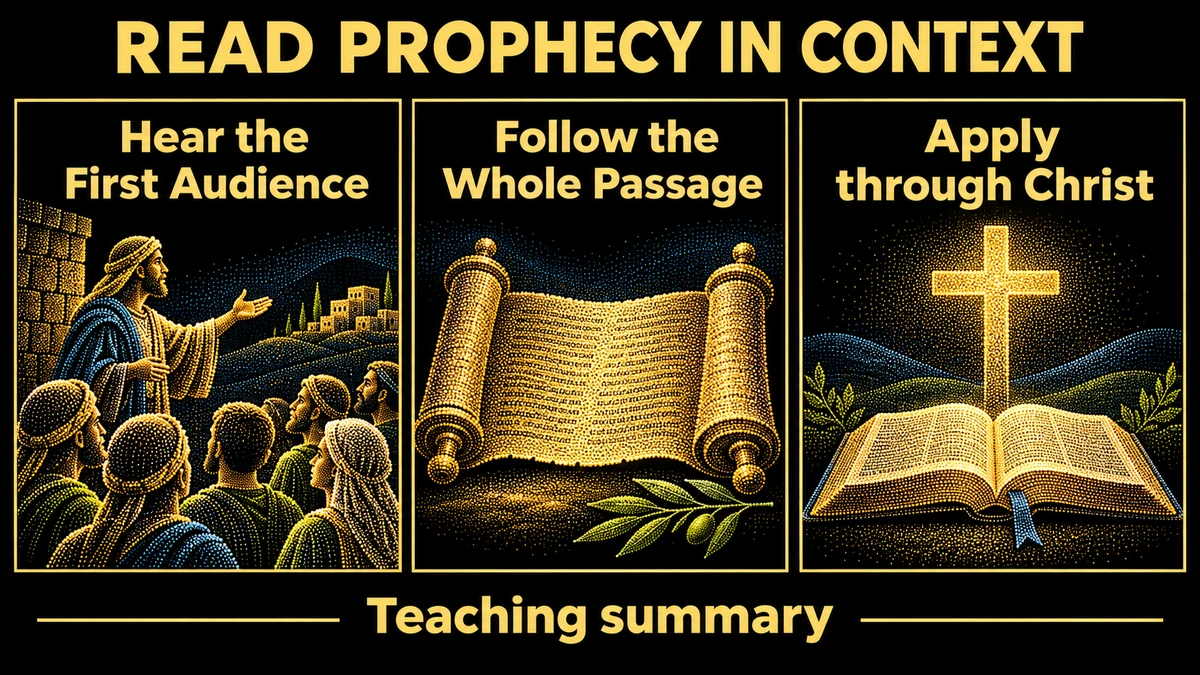
Read Prophecy in Context: hear the first audience; follow the whole passage; apply through Christ. Teaching summary, not a quotation of Scripture.
Use a Simple Prophecy Reading Worksheet
Choose a complete passage and write a short response to each prompt. The broader guide to reading the Bible in context develops this habit across other biblical genres.
Audience and occasion: Who speaks, to whom, and where? List the verses that establish those facts. Put uncertain historical details in a separate sentence.
Message and form: Is this poetry, narrative, a letter, or symbolic action? Summarize the accusation, warning, invitation, or promise. Identify any conditions and the surrounding passage’s movement.
Biblical connection: Does the New Testament explicitly use this text? If so, read that passage too. If you propose a typological connection, explain the evidence rather than relying on resemblance alone.
Faithful response: Write one action or prayer supported by the passage. Then name one conclusion it does not warrant. For Jeremiah 29, you might pray for your community and commit to patient service while rejecting a guarantee of immediate personal success.
Keep observation and application visibly separate. You should be able to show someone how you moved from the ancient passage to your proposed response. That discipline leaves room for both confidence and correction.
Frequently Asked Questions
Is Old Testament prophecy only about predicting the future?
No. Prophets also expose wrongdoing, summon repentance, interpret crises, and announce hope. Predictions belong within those purposes. Reading only for future events can miss the covenant faithfulness and concrete obedience a passage requires.
Can Christians take comfort from Jeremiah 29:11?
Yes, when they receive it within the letter to the exiles. It witnesses to God’s faithfulness through prolonged displacement and His purpose of restoration. It does not promise every reader immediate prosperity or the particular future they want.
Does reading prophecy in context exclude Jesus?
No. Luke 24 gives Christians a framework centered on Christ’s suffering, resurrection, and mission. Respecting an Old Testament passage’s first audience helps readers explain how the New Testament uses it instead of inventing connections without evidence.
What if Christians disagree about a prophecy’s fulfillment?
Identify what the passage clearly says, distinguish explicit biblical connections from interpretive proposals, and explain where disagreement remains. You can obey a clear call to repentance, justice, or hope without pretending that every question about fulfillment has been settled.
Scripture wording was checked against the updated World English Bible (WEB). The quotation from Amos 5:24 uses that translation; other passage explanations are paraphrases.