


The thought of final judgment can raise two very different concerns: whether our own failures can be forgiven, and whether the wrongs that wounded us will ever be addressed. The Bible takes both seriously. It presents a God whose mercy reaches guilty people and whose justice cannot be bought, distracted, or deceived.
The Bible teaches that God will judge humanity through Jesus Christ, bringing human life into the light and dealing justly with evil. Salvation rests on God’s grace through Christ, while our conduct remains consequential. Understanding final judgment therefore requires holding accountability, mercy, and Christian hope together.
GUIDED ARTICLE EXPERIENCE
What Does the Bible Teach About Final Judgment?
Read along as the narration moves through the article.
Browser narration · No stored audio or site tracking
CONTINUE GUIDED TOUR
Continue where you left off.
GUIDED TOUR COMPLETE
You have reached the end of this study.
Study record saved on this device.
GUIDED TOUR
What Does the Bible Teach About Final Judgment?
Narrator: Paranoid Prophet Recommended Voice Native device narration
Prepare to follow the article as it is narrated.
VOICE & TOUR OPTIONS
Voice & Listening
NARRATOR
Finding a narrator…
Checking the best narrator available on this device.
Restores the site recommendations available in this browser.
Our listening picks lead when available; other voices are ranked for narration. Known novelty voices are hidden. Browser-provided voices may use an online voice service.
Screen-awake support will be checked when narration starts.
Optional: improve your device voices
Listening works with the voices already available here. Your device may offer additional free voices through its own settings.
iPhone or iPad: Settings → Accessibility → Read & Speak (or Spoken Content) → Voices → English. Look for Premium or Enhanced choices, then return here.
If offered, preview Ava or Zoe for U.S. English, or Serena or Jamie for British English. An explicit Premium or Enhanced version can improve on its compact version.
Mac: System Settings → Accessibility → Read & Speak → System voice. Open the voice list to preview or download additional choices.
Windows: Settings → Accessibility → Narrator → Add natural voices. Browser availability varies; a Narrator voice may not appear on websites. Edge may also expose online Natural voices without a model download.
Android: Open Accessibility → Text-to-speech output (the location varies by device). In the preferred engine settings, look for voice data and English choices.
Download sizes vary; some enhanced voices exceed 100 MB. This website cannot install system voices, and an installed voice appears here only if your browser exposes it.
Apple voice guide · Windows voice guide · Android voice guide
CHOOSE A NARRATOR
Recommended on this device
Our listening picks: Aaron, Martha, then Daniel, when available here. Otherwise, automatic uses the highest-ranked suitable voice. Preview alternatives or save your own choice.
Preparing the guided article experience…
RESUME GUIDED TOUR?
Continue where you left off.
GUIDED TOUR COMPLETE
You have reached the end of this study.
Article Guide10 sections
Who Will Judge the World?
In John 5:16–30, Jesus explains His authority after conflict over a Sabbath healing. He describes the Father’s work and the Son’s inseparable participation in it. The Father has entrusted judgment to the Son, who gives life and judges in accordance with the Father’s will.
Jesus is therefore central to both salvation and judgment. Christians cannot set a compassionate Jesus against a supposedly less merciful Father. The passage presents their unity, including the honor due to the Son.
John 5 also places assurance beside accountability. Verse 24 promises life to those who hear Jesus and believe the Father who sent Him. Verses 28–29 describe the dead answering His voice and distinguish life from condemnation. These belong to one discourse. We should neither erase its warning nor make its promise unreliable.
The Judge is the Christ who gives life. His knowledge and righteousness are reasons to trust Him rather than to imagine Him as an unpredictable ruler. Our wider study of Jesus’ return and reign explains the larger future hope; here the concern is what His judgment means for human responsibility.
God Judges Impartially and Knows the Whole Truth
Romans 2 begins by confronting people who condemn others while practicing the same wrongs. Paul removes the imagined safety of standing among the morally informed. Knowing how to identify evil does not exempt us from answering for our own conduct.
He describes judgment according to deeds, without favoritism toward Jew or Gentile. Possessing the law is no substitute for obedience. God’s kindness calls people to repentance, and His patience must not be confused with approval.
Paul also speaks of conscience and the judgment of secrets through Jesus Christ. Human evaluation can be distorted by appearances, incomplete evidence, influence, and prejudice. God’s judgment has none of those limitations. Public reputation cannot conceal what someone has done, and obscurity cannot make a person’s suffering unimportant.
This impartiality does not imply that everyone has received identical opportunities. In Luke 12:35–48, Jesus’ teaching about responsible servants distinguishes knowledge and responsibility. Greater trust brings greater accountability. These texts give grounds for confidence in God’s fairness, without giving us a formula for calculating another person’s final verdict.
How Can Judgment According to Works Fit Salvation by Grace?
Romans 2 must be read within Paul’s developing argument. Romans 3:9–31 places Jews and Gentiles alike under sin and announces justification freely through the redemption accomplished by Christ. Paul does not solve human guilt by advising readers to accumulate enough good deeds to outweigh it.
Ephesians 2:1–10 makes the relationship particularly clear. God makes sinners alive with Christ because of His mercy. Salvation is His gift, received through faith, excluding boasting. Those made alive are then described as created in Christ for good works.
Conduct matters within a life that depends upon grace. Acts of generosity cannot purchase forgiveness, but neither can religious language make cruelty irrelevant. Repentance includes turning toward God in ways that become visible in how we live.
Christians explain the relationship among justification, transformation, perseverance, and final judgment differently. Protestant accounts commonly describe works as the fruit and evidence of living faith. Catholic and Orthodox accounts place different emphases on grace-enabled participation and transformation. These differences deserve explanation rather than the accusation that every other tradition teaches self-salvation.
The central safeguard is that Christ’s saving work is indispensable. Judgment according to deeds should produce honest self-examination, not an attempt to establish independence from mercy. Our guide to salvation by grace develops that foundation.
Believers Remain Accountable to Christ
In 2 Corinthians 5, Paul describes confidence in God’s promised future and the desire to please the Lord. He then includes himself when saying that all must appear before Christ’s judgment seat and answer for what was done in embodied life.
The surrounding argument matters. Paul goes on to speak of Christ’s love, His death for others, new creation, and God’s work of reconciliation. Accountability sits within this gospel-shaped life. The passage cannot responsibly become either permission for careless living or a denial that reconciliation is God’s gift.
Romans 8:1–17 likewise joins freedom from condemnation in Christ with life directed by the Spirit. Assurance and holiness belong together.
Paul’s picture of tested work in 1 Corinthians 3:5–17 distinguishes a builder’s loss from the builder’s salvation. Its immediate subject is ministry in God’s church, built on Christ. It teaches the seriousness of that work without supplying a complete reward system for every human action. We should resist turning these passages into a heavenly points chart.
Matthew 25 Makes Mercy Impossible to Ignore
Matthew 25:31–46 closes Jesus’ extended teaching about watchfulness and faithful readiness. The Son of Man gathers the nations and separates people as a shepherd separates sheep and goats. His verdict names concrete responses to hunger, thirst, vulnerability, sickness, and imprisonment.
The identity of His vulnerable brothers and sisters is debated. One interpretation understands them as Jesus’ disciples, especially His needy messengers. Matthew 10:40–42, where receiving His disciples means receiving Him, supports that reading. Another understands the reference more broadly as people in need. New Testament scholar Jeannine Brown explains both readings while stressing that neither should erase the actual destitution Jesus describes.
On either reading, response to Christ cannot be severed from treatment of those with whom He identifies. The passage exposes neglect as well as overt wrongdoing. Its people are answerable for help they withheld.
The kingdom is described as an inheritance prepared by the Father, not a wage negotiated through charitable purchases. Yet that language of gift does not cancel the King’s evaluation of conduct. Read alongside the teaching on grace, Matthew 25 calls for active mercy without presenting kindness as a technique for buying salvation. The appropriate response is to notice and serve people whose needs we have learned to overlook.

Revelation 20 Opens the Books
Revelation 20:11–15 portrays the dead before a great white throne. Books are opened, together with the book of life. People are judged according to their deeds, and neither social rank nor the place of their death puts them beyond God’s reach.
The books communicate complete accountability. The book of life makes belonging to God’s redeemed people central. The passage does not depict a competition in which the most impressive biographies win admission. Nor does it permit us to ignore the repeated emphasis on deeds.
John then sees death and Hades thrown into the lake of fire, which is called the second death. This is apocalyptic vision: even death appears as something subjected to judgment. Its imagery conveys a decisive divine reckoning, but interpreting that imagery requires care.
We do not need to settle the millennium or arrange every biblical judgment passage into separate events to hear this warning. Nothing is hidden from God, and evil will not enjoy permanent immunity. Equally, the vision offers no warrant for pretending that we possess God’s books or can issue His verdicts about particular people.
Shared Convictions and Disputed Understandings of Final Punishment
Historic Christian confession places final judgment under Christ’s authority. Human life matters, evil requires judgment, and salvation depends upon God’s action. Enduring conscious punishment has predominated in historic mainstream confessions, including Catholic teaching and major Protestant standards. Conditional immortality and ultimate restoration are minority interpretations with differing levels of acceptance. The nature and duration of final punishment remain points of serious disagreement, and these three readings should be described accurately.
Eternal conscious punishment understands the final exclusion and punishment of the unrepentant as enduring conscious realities. Advocates emphasize Matthew 25:46 and Revelation 14:9–12, alongside other texts. The Catholic Catechism’s teaching on hell is one authoritative example of enduring punishment and separation from God, though Protestant accounts differ in other respects. This view need not treat every image of fire as a literal physical description.
Conditional immortality, often associated with annihilationism, holds that everlasting life is God’s gift to the redeemed. The finally unrepentant face judgment culminating in irreversible destruction, rather than being sustained endlessly in conscious suffering. Advocates emphasize Matthew 10:28 and the second death. The Statement on Evangelical Conditionalism affirms resurrection and real punishment; it does not teach that death simply lets everyone evade judgment.
Ultimate restoration, or Christian universal reconciliation, holds that God will eventually reconcile all people through Christ, with judgment understood as serving that eventual restoration. Advocates appeal to passages such as Romans 5:18–21. The Christian Universalist Association’s beliefs illustrate this position. Believing universal restoration will occur is distinct from hoping that all may finally be saved while declining to claim certainty.
These interpretations cannot simply be combined. They disagree about whether final exclusion is everlasting, destructive, or ultimately overcome. Major churches also differ in which views their confessions permit. Describing a position does not establish it as equally accepted or settle its biblical adequacy.
Careful study must address the strongest passages raised by other readings, including the parallel of punishment and life in Matthew 25 and Revelation’s judgment imagery. We should avoid building an entire conclusion on a single English word, or declaring opponents either heartless or indifferent to Scripture without examining their arguments.
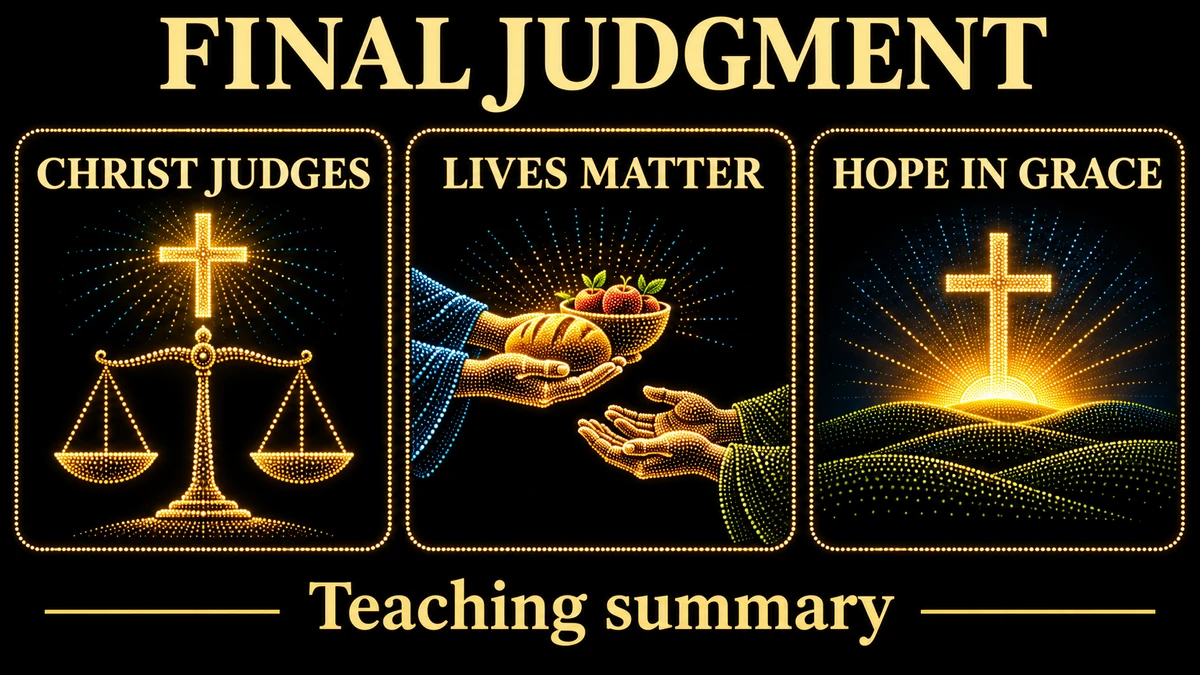
Final Judgment: Christ judges; lives matter; hope in grace. Teaching summary, not a quotation of Scripture or a literal heavenly scene.
Practice Justice Without Taking God’s Place
Belief in final judgment should make Christians more truthful about harm and less eager for personal revenge. Romans 12:17–21 tells believers to leave vengeance to God while doing good even to enemies. Trusting God’s justice releases us from the claim that we must personally inflict the final punishment.
That instruction must never become a demand that injured people remain in danger. Seeking safety, preserving evidence, reporting crimes, and pursuing appropriate accountability are compatible with refusing vengeance. Forgiveness does not require concealing abuse, restoring access, or treating an apology as proof of changed character.
Consider an illustrative case: a church officer discovers that a respected leader has diverted money entrusted to the congregation. “God will judge” is no reason to hide the records. Faithful action includes protecting those affected, securing independent scrutiny, and cooperating with appropriate authorities. The leader’s profession of faith does not remove responsibility.
The same doctrine also confronts the person who caused harm. A useful response is to tell the truth, stop the wrongdoing, seek forgiveness, and make appropriate restitution without demanding that injured people immediately trust again. Our study of repentance and faith explains why turning to God involves more than managing a reputation.
Common Questions About Final Judgment
Will Christians be judged if their sins are forgiven?
Christians remain accountable to Christ, as 2 Corinthians 5:10 teaches. Forgiveness does not make their lives meaningless. At the same time, Romans 8 grounds freedom from condemnation in Christ. Traditions explain the details differently, but assurance should rest in God’s saving grace rather than the belief that He no longer cares how believers live.
Does suffering now prove that God is punishing someone?
No. John 9:1–3 rejects the disciples’ proposed explanation for a man’s blindness. A doctrine of final judgment gives us no authority to diagnose someone’s illness, poverty, or loss as evidence of particular guilt. Respond to suffering with care rather than an invented account of its cause.
Can we know the final destiny of a particular person?
We can proclaim Scripture’s promises and warnings without claiming knowledge of every person’s heart, circumstances, or final response to God. The doctrine does not authorize confident verdicts based on a person’s reputation or our grief. Entrusting someone to God’s justice and mercy is different from announcing an outcome Scripture has not disclosed.
What if thinking about judgment leaves me afraid?
Read the promises alongside the warnings, especially John 5:24 and Romans 8. Bring specific wrongdoing into honest repentance, and seek support from a trustworthy pastor or mature Christian. Persistent, overwhelming fear deserves compassionate help. Our guide to assurance of salvation explores confidence grounded in Christ rather than repeated attempts to prove yourself worthy.
Let Final Judgment Lead to Accountable Hope
Revelation 21–22 carries the vision beyond judgment to God dwelling with His people, the removal of death and grief, and the healing of the nations. Warnings remain, alongside the invitation to receive life’s water freely. Mercy and holiness belong within the same promised future.
Final judgment means that our actions matter to God and that the world’s wounds will not simply be forgotten. It also directs guilty people toward the Savior who reconciles them to God. The response is practical: receive mercy, confess what needs to change, protect those at risk, and do the good presently within reach.
Christian hope rests in the righteousness of the Judge and the grace of the Savior. Scripture presents both in Jesus Christ.
Source and translation note: Linked biblical passages use the NIV for comparison; explanations are paraphrases. Denominational sources document particular interpretations rather than establish a position for this article.