


You sit down to pray, and the words do not come. Or they come all at once: a sick relative, a bill, something you regret saying, the fear you have carried through another day. Then you remember how confidently someone prayed at church and wonder whether you are doing this properly.
Jesus’ disciples needed to learn too. In Luke 11:1, one of them asks Him to teach them. Christian prayer begins with that willingness: coming to God honestly, trusting Christ, and allowing His teaching to shape what we ask. You can start before you feel confident.
GUIDED ARTICLE EXPERIENCE
How Should Christians Pray? Learning from Jesus
Read along as the narration moves through the article.
Browser narration · No stored audio or site tracking
CONTINUE GUIDED TOUR
Continue where you left off.
GUIDED TOUR COMPLETE
You have reached the end of this study.
Study record saved on this device.
GUIDED TOUR
How Should Christians Pray? Learning from Jesus
Narrator: Paranoid Prophet Recommended Voice Native device narration
Prepare to follow the article as it is narrated.
VOICE & TOUR OPTIONS
Voice & Listening
NARRATOR
Finding a narrator…
Checking the best narrator available on this device.
Restores the site recommendations available in this browser.
Our listening picks lead when available; other voices are ranked for narration. Known novelty voices are hidden. Browser-provided voices may use an online voice service.
Screen-awake support will be checked when narration starts.
Optional: improve your device voices
Listening works with the voices already available here. Your device may offer additional free voices through its own settings.
iPhone or iPad: Settings → Accessibility → Read & Speak (or Spoken Content) → Voices → English. Look for Premium or Enhanced choices, then return here.
If offered, preview Ava or Zoe for U.S. English, or Serena or Jamie for British English. An explicit Premium or Enhanced version can improve on its compact version.
Mac: System Settings → Accessibility → Read & Speak → System voice. Open the voice list to preview or download additional choices.
Windows: Settings → Accessibility → Narrator → Add natural voices. Browser availability varies; a Narrator voice may not appear on websites. Edge may also expose online Natural voices without a model download.
Android: Open Accessibility → Text-to-speech output (the location varies by device). In the preferred engine settings, look for voice data and English choices.
Download sizes vary; some enhanced voices exceed 100 MB. This website cannot install system voices, and an installed voice appears here only if your browser exposes it.
Apple voice guide · Windows voice guide · Android voice guide
CHOOSE A NARRATOR
Recommended on this device
Our listening picks: Aaron, Martha, then Daniel, when available here. Otherwise, automatic uses the highest-ranked suitable voice. Preview alternatives or save your own choice.
Preparing the guided article experience…
RESUME GUIDED TOUR?
Continue where you left off.
GUIDED TOUR COMPLETE
You have reached the end of this study.
Article Guide11 sections
How Should Christians Pray?
Christians pray to God with trust, honesty, gratitude, repentance, and concern for others. Jesus teaches us to seek the Father’s honor and will, bring daily needs, ask forgiveness, and seek protection from temptation and evil. We come through Christ and depend on the Holy Spirit’s help. Read Matthew 6:5–15, Ephesians 2:18, and Romans 8:26–27.
You do not need to speak beautifully. You do need to address God rather than use prayer to impress people, excuse wrongdoing, or demand control over another person.
If you want help beginning today, start with a simple way to pray. If the hard question is why God has not answered, go to unanswered prayer. For the central biblical pattern, read the Lord’s Prayer guide.
A Simple Way to Begin Today
Choose a few minutes when you can give your attention to God. A quiet room may help, but an exhausted parent, a hospital patient, or someone living in a crowded home does not need an ideal setting to pray.
Read Matthew 6:9–13 slowly. Then bring your actual life before God:
- Recognize who God is. Name something true about His character, such as His holiness, mercy, or faithfulness.
- Give thanks for something specific. A meal, an act of kindness, a person who stayed, or strength to do the next task.
- Confess honestly. Name a wrong without defending it. Ask for mercy and help to change.
- Bring a real need. Ask plainly for help, provision, wisdom, healing, or courage.
- Pray for someone else. Bring their needs before God without pretending you know everything about their situation.
- Entrust the outcome to Him. Ask for help to obey what is already clear while waiting for what remains uncertain.
This is an aid, not a required order or a test of whether God will listen. Sometimes a short cry for help is all you can manage.
Here is an original example you can adapt. It is not a Bible quotation or a formula that guarantees an answer:
Father, thank you for receiving me through Jesus. Help me honor you in what I do today. Forgive the anger I have excused, and help me repair the harm I caused. Please provide what my family needs and strengthen the person I am worried about. Give me wisdom for the next decision. Help me trust you with what I cannot control. Amen.
You can also pray the Lord’s Prayer itself. Familiar words can help when your own words are scattered.
What Did Jesus Correct About Prayer?
In the Sermon on the Mount, Jesus addresses the desire to perform religious acts for an audience. His warning about visible prayer concerns the motive of being admired. The same section warns against treating a large quantity of words as the reason God will hear. The Father already knows our needs. Matthew 6:1–8
That should relieve some pressure. You do not have to supply God with a convincing speech. You can tell the truth without dressing it up.
Jesus’ teaching does not prohibit praying with others. The believers pray together in Acts 4:23–31. Nor does it condemn every repeated request: Jesus returns to the same prayer in Gethsemane in Matthew 26:36–44. Repetition can express persistence, attention, and need. It can also become empty performance. The heart and purpose matter.
A written prayer and a spontaneous prayer can both be sincere. Either can become a way to sound spiritual without listening to what we are saying.
What Does the Lord’s Prayer Teach Us to Ask?
Read the prayer as a whole in Matthew 6:9–13. The following four themes summarize its petitions; they are not a replacement translation.
Begin with God’s Name, Kingdom, and Will
Jesus directs attention toward the Father before turning to daily needs. His prayer teaches reverence and a desire for God’s purposes to be fulfilled.
A practical application might be asking for integrity in a conversation where lying would benefit you. Seeking God’s will includes a willingness to have your own plans corrected. It also reaches beyond your private concerns to the spread of the gospel and the good of other people.
Bring Daily Needs
The request for daily bread gives ordinary dependence a place in prayer. You may bring rent, work, food, fatigue, and the responsibilities you cannot simply ignore.
The prayer speaks in the plural. Other people’s hunger belongs in our concern too. Praying for provision can accompany sharing a meal, applying for help, looking for work, or offering practical support. Receiving help is not evidence that your prayer failed.
Seek and Extend Mercy
The request for forgiveness connects our need for mercy with our treatment of others. Jesus reinforces this connection immediately after the prayer in Matthew 6:14–15. We cannot honestly celebrate mercy while making settled revenge the principle of our own lives.
Forgiveness does not require pretending harm was harmless, withdrawing a truthful report, or giving an unsafe person access to you. Reconciliation and restored trust involve further questions, including repentance and safety. The Repentance and Faith guide explains these responsibilities more fully.
Ask for Protection
The final petition asks for help in the face of temptation and evil. James 1:13–15 distinguishes temptation from any claim that God entices people to sin. The prayer expresses dependence on His protection, not suspicion that He wants us to fall.
A concrete application is asking for strength to refuse a familiar temptation, then taking a sensible step away from it. Prayer and responsible action belong together.
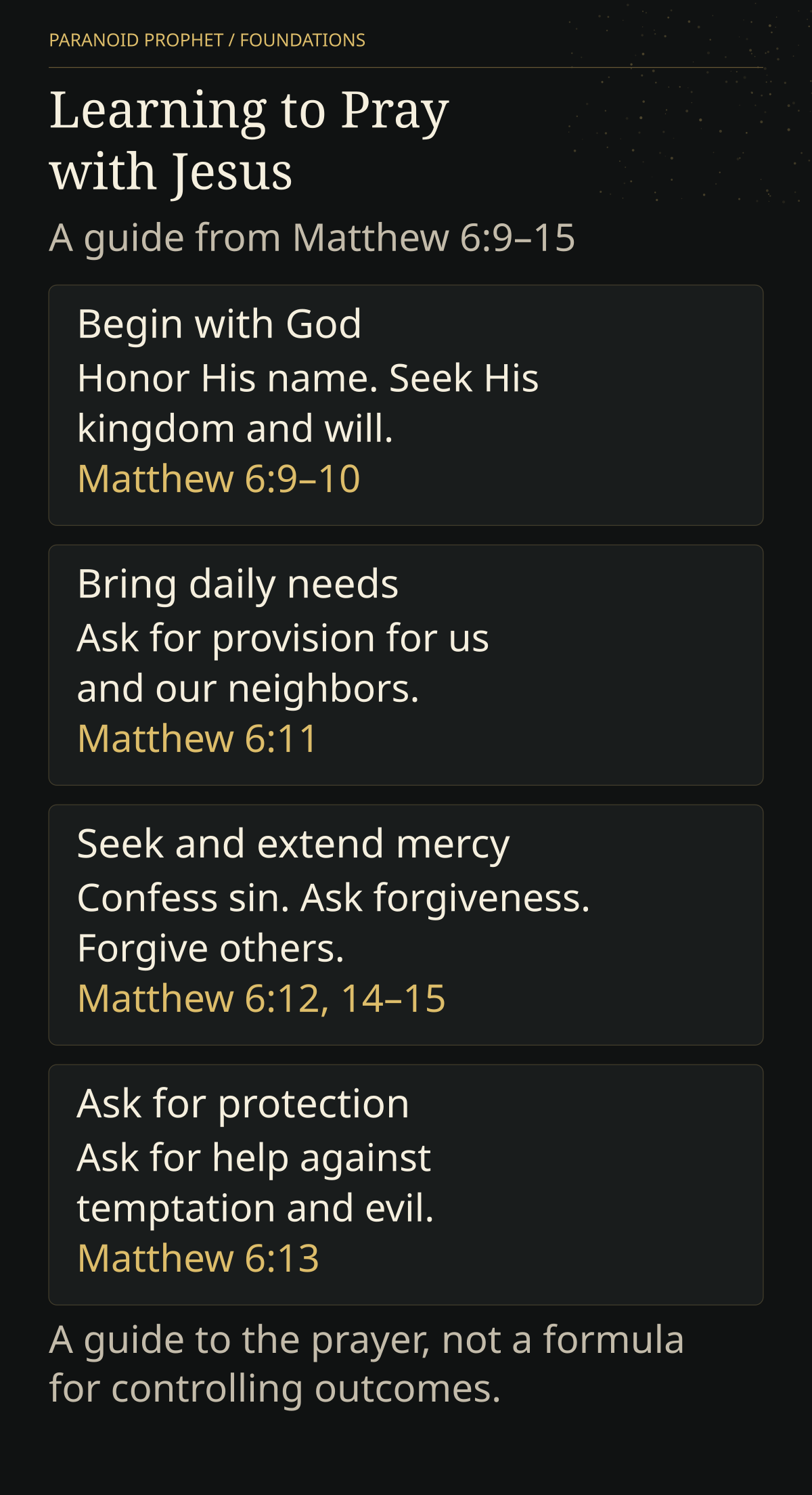
Learning to Pray with Jesus (image text)
A guide from Matthew 6:9–15
- Begin with God
Honor His name. Seek His
kingdom and will.
Matthew 6:9–10 - Bring daily needs
Ask for provision for us
and our neighbors.
Matthew 6:11 - Seek and extend mercy
Confess sin. Ask forgiveness.
Forgive others.
Matthew 6:12, 14–15 - Ask for protection
Ask for help against
temptation and evil.
Matthew 6:13
A guide to the prayer, not a formula for controlling outcomes.
PARANOID PROPHET / FOUNDATIONS
What Can You Bring to God?
The Bible gives us a wider vocabulary of prayer than cheerful requests followed by cheerful answers. It includes praise, grief, confession, protest, gratitude, and concern for others.
Gratitude Without Denying Pain
Philippians 4:4–7 brings prayer, requests, and thanksgiving together. You can recognize a real gift without calling everything that happened good.
Thanking God for a friend’s support does not require being thankful for the cruelty that made support necessary. If joy feels distant, begin with something small and true rather than forcing a feeling you do not have.
Confession Without Excuses
Psalm 51 gives language for acknowledging sin and asking for renewal. Confession names what is wrong instead of hiding it beneath explanations about everyone else’s behavior.
If you lied, harmed someone, or withheld what you owed, prayer should accompany the appropriate work of truthfulness, restitution, and change. You cannot use private confession to God as permission to keep harming another person. Our guide to sin also distinguishes genuine guilt from shame that has been wrongly imposed on you.
Lament When Life Hurts
In Psalm 13, the psalmist brings distress and a sense of abandonment before God. The prayer moves toward trust, but it does not begin by concealing grief.
You can say that you are frightened, exhausted, angry, or confused. Honest lament still addresses God, even when the speaker cannot see what He is doing. A difficult emotion is not, by itself, proof of unbelief.
Do not require yourself or another grieving person to reach a cheerful conclusion on demand. Some suffering lasts far longer than a conversation or a prayer meeting.
Intercession for Other People
1 Timothy 2:1–4 calls Christians to pray for others, including rulers. Intercession makes room for people whose needs, opinions, and circumstances differ from ours.
Pray concretely for protection, justice, wisdom, healing, repentance, and the knowledge of Christ. Where you can responsibly help, offer help as well. Respect confidentiality when sharing requests in a group. Someone’s private suffering is not yours to circulate simply because you attach a prayer request to it.
What About Unanswered Prayer?
This question deserves more than a slogan. People pray for healing, reconciliation, work, and the safety of someone they love. Sometimes the hoped-for outcome does not come. Sometimes it becomes impossible.
Jesus teaches confident asking in Luke 11:5–13. The passage points to the Father’s generosity and culminates in the gift of the Holy Spirit. 1 John 5:14–15 also places prayer within God’s will. Neither passage gives us permission to treat every preference as a promise God must fulfill on our timetable.
In Gethsemane, Jesus honestly asks about the suffering before Him and submits to the Father’s will. Paul describes repeatedly asking for the removal of his affliction and receiving an answer about grace and strength in weakness in 2 Corinthians 12:7–10. The passage does not precisely identify that affliction, so we should be cautious about confidently diagnosing it.
Scripture also addresses sinful motives. James 4:1–3 challenges requests driven by destructive desires. That warning invites honest examination. It does not justify telling every sick, grieving, or disappointed person that the outcome proves defective faith.
Christians should pray for healing. James 5:13–16 instructs sick believers to seek prayer from the church’s elders. Christians differ about how its promise of healing relates to particular circumstances, sacramental anointing, and the wider New Testament’s accounts of suffering. The passage should not be turned into a commercial guarantee, a reason to blame a patient, or an instruction to abandon medical care.
What can you do while waiting?
- Continue asking honestly, without pretending certainty about the outcome.
- Let trustworthy people pray with you and provide practical help.
- Attend to the responsibilities and opportunities already in front of you.
- Allow grief when something is lost. Prayer does not require denying reality.
- Resist anyone who claims that a payment, a special phrase, or allegiance to their ministry will secure God’s answer.
We are not always told why a particular request is not granted. A responsible Christian answer can admit that limit. Our confidence rests in God’s character and Christ’s work, not in our ability to explain every event. For questions about trusting Christ through doubt, see Can a Christian Be Sure of Salvation?
How Does the Holy Spirit Help Us Pray?
Romans 8:26–27 places prayer within human weakness. Paul says the Spirit helps and intercedes when we do not know what to pray as we ought. The surrounding chapter includes suffering, hope, and patient waiting.
This offers reassurance to someone who cannot assemble a polished prayer. The Spirit’s help is not restricted to people who can describe a dramatic spiritual experience. You can come to God with an unfinished sentence.
Prayer also needs discernment. A strong feeling during prayer does not automatically make an idea God’s command. Read Scripture in context, examine motives, seek wise counsel, and consider ordinary evidence. Never use a claim that God spoke to you to pressure someone else into an unsafe or coercive situation.
For the wider biblical account of His presence, work, and guidance, read Who Is the Holy Spirit?
How Can You Build a Regular Habit of Prayer?
Choose a practice small enough to repeat on an ordinary day. You might begin with a short Gospel passage in the morning, pray through one concern at lunch, and give thanks before bed. These times are practical suggestions, not rules binding every Christian.
Keep a short list if it helps you remember people and needs. A written record can remind you to give thanks and follow up with someone, but it should not become a scoreboard used to measure God’s faithfulness or your spiritual rank.
When your attention wanders, return gently to the next sentence or name. You do not need to restart the whole prayer until it feels perfect. Persistent, distressing fear about praying correctly can be worth discussing with a trusted pastor and a qualified mental-health professional rather than feeding it with endless repetition.
The call to ongoing prayer in 1 Thessalonians 5:16–18 belongs within an active community life. A reasonable application is a continuing posture of dependence expressed through regular prayer, rather than uninterrupted speech that prevents sleep, work, or care for other people.
Pray with a trustworthy church community as well as alone. Other believers can give you words when yours are few and help carry needs that have become too heavy to hold privately. The Church guide describes that shared life. The Sanctification guide places prayer among the ordinary practices through which Christians grow.

A Few Common Questions About Prayer
If God Already Knows, Why Ask?
Jesus acknowledges the Father’s knowledge and still teaches His disciples to pray. Prayer expresses dependence, love, and trust, and Scripture presents it as a real means through which God works. We are invited to ask rather than supply information He lacks. You do not need to solve every question about providence before bringing a need to Him.
Must Prayer Be Spoken Aloud or Use a Certain Posture?
1 Samuel 1:9–18 describes Hannah praying in her heart while her voice is not heard. Her story is not a guarantee that every request for a child will receive the same answer. It does show that audible words are not the only biblical expression of prayer.
Kneeling, standing, sitting, or raising hands can express reverence and attention. Physical ability and circumstances differ. Do not make a particular bodily position a condition God requires before listening.
What Does Praying in Jesus’ Name Mean?
In John 14:12–14, Jesus connects prayer in His name with the Father’s glory in the Son. Praying in His name involves dependence on Him and alignment with His purposes. Adding His name to the end of a request does not authorize cruelty, dishonesty, or demands contrary to His teaching.
For the saving work that grounds Christian access to God, begin with What Is the Gospel?. If you are comparing this approach with claims about attracting desired outcomes, see Manifestation and Christian Prayer.
Begin Where You Are
You can learn to pray while still learning what to say. Read the prayer Jesus taught. Bring one honest need, one confession, and one person before God. Ask for help to do the next faithful thing.
Tomorrow, return. A life of prayer grows through ordinary dependence on the Father, through Christ, with the Spirit’s help.
Scripture and Translation Note
This guide chiefly paraphrases and explains biblical passages. Its Scripture links open the NIV for reading in context; the original sample prayer is not Scripture. Practical suggestions about time, setting, and journaling are applications, not biblical requirements. The infographic summarizes the Lord’s Prayer rather than reproducing its exact wording. Read the linked passages alongside the explanations and compare them with the site’s source and verification standard.