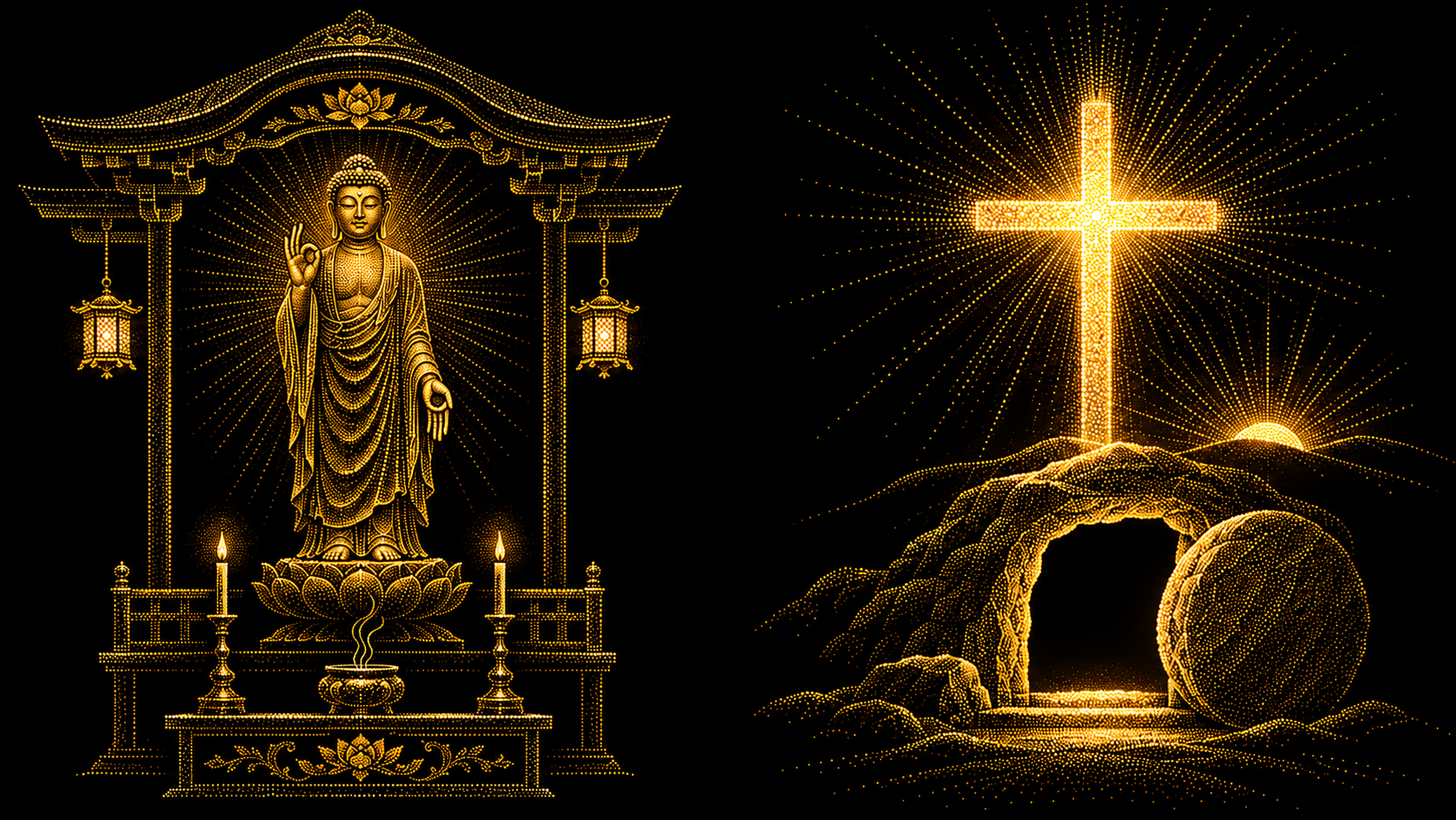

A Christian says that salvation cannot be earned. A Shin Buddhist says that liberation, release from the cycle of birth and rebirth, does not rest on the spiritual achievements of the calculating self. The resemblance deserves more than a quick dismissal.
It also deserves more than the conclusion that these are the same religion with different names.
Pure Land Buddhism challenges a familiar shortcut: “Every other religion teaches you to save yourself; Christianity alone offers help you cannot earn.” That claim does not adequately describe the tradition examined here. A stronger Christian comparison asks who saves, what the human problem is, and what salvation actually means.
The short answer: Jōdo Shinshū teaches entrusting to Amida Buddha’s compassionate vow rather than relying on one’s own spiritual accomplishment. Christianity locates saving grace in the God revealed through Jesus Christ, particularly His death and resurrection. Similarities in dependence and gratitude are real; the underlying claims remain substantially different.
GUIDED ARTICLE EXPERIENCE
Pure Land Buddhism and Christian Grace: Similar Words, Different Claims
Read along as the narration moves through the article.
Browser narration · No stored audio or site tracking
CONTINUE GUIDED TOUR
Continue where you left off.
GUIDED TOUR COMPLETE
You have reached the end of this study.
Study record saved on this device.
GUIDED TOUR
Pure Land Buddhism and Christian Grace: Similar Words, Different Claims
Narrator: Paranoid Prophet Recommended Voice Native device narration
Prepare to follow the article as it is narrated.
VOICE & TOUR OPTIONS
Voice & Listening
NARRATOR
Finding a narrator…
Checking the best narrator available on this device.
Restores the site recommendations available in this browser.
Our listening picks lead when available; other voices are ranked for narration. Known novelty voices are hidden. Browser-provided voices may use an online voice service.
Screen-awake support will be checked when narration starts.
Optional: improve your device voices
Listening works with the voices already available here. Your device may offer additional free voices through its own settings.
iPhone or iPad: Settings → Accessibility → Read & Speak (or Spoken Content) → Voices → English. Look for Premium or Enhanced choices, then return here.
If offered, preview Ava or Zoe for U.S. English, or Serena or Jamie for British English. An explicit Premium or Enhanced version can improve on its compact version.
Mac: System Settings → Accessibility → Read & Speak → System voice. Open the voice list to preview or download additional choices.
Windows: Settings → Accessibility → Narrator → Add natural voices. Browser availability varies; a Narrator voice may not appear on websites. Edge may also expose online Natural voices without a model download.
Android: Open Accessibility → Text-to-speech output (the location varies by device). In the preferred engine settings, look for voice data and English choices.
Download sizes vary; some enhanced voices exceed 100 MB. This website cannot install system voices, and an installed voice appears here only if your browser exposes it.
Apple voice guide · Windows voice guide · Android voice guide
CHOOSE A NARRATOR
Recommended on this device
Our listening picks: Aaron, Martha, then Daniel, when available here. Otherwise, automatic uses the highest-ranked suitable voice. Preview alternatives or save your own choice.
Preparing the guided article experience…
RESUME GUIDED TOUR?
Continue where you left off.
GUIDED TOUR COMPLETE
You have reached the end of this study.
Article Guide10 sections
Which Pure Land tradition are we comparing?
This article concentrates on Jōdo Shinshū Hongwanji-ha, a Japanese Pure Land school associated with Shinran, rather than speaking for every Buddhist who reveres Amitābha. Amida is the Japanese name used here. The school’s official account identifies Shinran, the Three Pure Land Sutras, and Amida as central to its teaching. Hongwanji’s teaching summary
Pure Land thought belongs within Mahāyāna Buddhism. It has a long history of scriptures, interpretation, and practice across Asia. Dennis Hirota’s scholarly account emphasizes that Japanese Pure Land developed from this substantial Buddhist inheritance; reading it as a disguised version of Protestant Christianity misses that background. The resemblance can illuminate a comparison, but it cannot supply the interpretation in advance. Stanford Encyclopedia of Philosophy
Jōdo Shū and Jōdo Shinshū are not interchangeable names. Jōdo Shū follows Hōnen, Shinran’s teacher, and places the recitation of Amida’s name at the center of practice. Its own explanation combines recitation with trust in Amida. We should not describe Hōnen’s school as a simplistic system of earning salvation merely to make Shinran look more gracious. Jōdo Shū’s own introduction
Keeping those names straight prevents a common mistake: borrowing one school’s most striking sentence and treating it as the teaching of all Buddhism. For the larger context, begin with our Buddhism and Christianity overview.
What problem does Shin Buddhism address?
In the Hongwanji account, ignorance and the passions of greed, anger, and foolishness keep people trapped in self-centered ways of seeing. We cling to a fixed self and judge the world by what benefits us. Religious striving itself can remain entangled with that same self-concern. Hongwanji: A Way of Living as a Nembutsu Follower
That last point gives this comparison its force. Imagine someone who becomes proud of being humble, competitive about spiritual discipline, or anxious to accumulate enough virtue. The attempt to overcome self-centeredness can become another project of self-centeredness. That is a recognizable human predicament, even for readers who do not accept the Buddhist account of existence.
Shin Buddhism should consequently be heard as more than an easy alternative for people unwilling to meditate. The Buddhist Churches of America describes a path of listening to the teaching within ordinary responsibilities: family life, work, relationships, and care for others. Everyday experience becomes an occasion for reflection rather than something outside religious life. BCA’s introduction to Shin Buddhism
A Christian can recognize pride and self-deception in this description. Recognition does not establish that Christian sin and Buddhist ignorance mean precisely the same thing. We will return to that difference.
Other-power and shinjin, in plain language
Other-power, or tariki, points here to the working of Amida’s vow rather than the practitioner’s calculation of spiritual qualifications. In a letter responding to Senshin, Shinran connects true entrusting with being firmly established in the vow and denies that the practitioner’s calculation supplies the decisive basis. Shinran’s reply to Senshin
The term shinjin is often rendered as faith, entrusting, or an entrusting heart. Translation matters. Hearing “faith” can make a Christian import an entire Christian account of belief, justification, and conversion before the Buddhist teacher has explained anything.
A contemporary Mountain View Buddhist Temple explanation describes shinjin as reliance on Amida’s Primal Vow rather than calculation about the rewards of one’s good and bad deeds. It also explains shinjin as arising through Amida’s working, not as an achievement that a practitioner manufactures. Receive Shinjin: True Entrusting
The useful parallel is therefore limited but important: spiritual security is not grounded in self-congratulation. The question still remains whether the source, meaning, and destination of that security are the same. They are not settled by translating two different terms with one English word.
Nor should “other-power” be reduced to passivity. An explanation of how liberation is received does not, by itself, tell us that everyday responsibilities disappear.
Is saying the nembutsu a way of earning salvation?
The nembutsu is the saying of Amida’s name, commonly expressed as Namo Amida Butsu. Its meaning must be understood within the tradition explaining it.
In a letter to Shōshin-bō, Shinran connects saying the nembutsu with gratitude for the Buddha’s benevolence. The letter also turns outward toward peace and the spread of the teaching. That is a very different picture from treating each recitation as another coin deposited toward admission to the Pure Land. Shinran’s letter to Shōshin-bō
The Tannishō, a record of remembered teachings rather than a text authored directly by Shinran, likewise emphasizes reliance on the vow for people burdened by karmic evil and blind passions. Its teaching cannot fairly be summarized as “become sufficiently impressive, then Amida will accept you.” A Record in Lament of Divergences
For comparison, a Christian hymn of thanksgiving is not automatically a claim that singing purchases forgiveness. We should give Buddhist recitation the same interpretive care. Ask what the practice means to its practitioners before assigning it a theological function.
Is Amida another name for God?
Not in the Christian sense of the personal Creator revealed as Father, Son, and Holy Spirit.
A BCA explanation by the Reverend Todd Tsuchiya describes Amida as a cosmic Buddha, not a historical figure, and presents the image of Amida as an embodiment of boundless wisdom and compassion. This is a contemporary Shin explanation, not permission to impose one uniform interpretation on every Pure Land community. The Cosmic Buddha That Embodies Infinite Light, Life
The scholarly background is also important: Pure Land accounts work within Mahāyāna understandings of awakening, Buddha-fields, and ultimate reality. The Larger Sutra tells of Dharmākara’s vows and attainment as Amida. This belongs to a Buddhist scriptural account, not to the New Testament’s account of the incarnation. Hirota’s historical and philosophical overview
Calling Amida “the Buddhist Jesus” may sound accessible, but it produces confusion precisely where clarity matters. It encourages readers to exchange names while leaving their previous assumptions untouched.
A better question is: What does this tradition claim about the one to whom a person entrusts themselves? The answer must come before the analogy.
Is the Pure Land the same as Christian heaven?
Hongwanji-ha describes the entrusting person as born in the Pure Land at the end of life, attaining Buddhahood, or full awakening, and returning to guide others to awakening. That goal should not be reduced to an endless comfortable afterlife. The Essentials of Jōdo Shinshū
The Christian comparison is not simply between two attractive destinations. Christianity’s resurrection hope concerns God’s redemption of His creatures, not their attainment of Buddhahood. Paul treats Christ’s resurrection as decisive for the future resurrection of those who belong to Him. Readers can examine that claim through our discussion of what the first resurrection witnesses claimed.
This distinction helps explain why the same words can mislead. “Saved,” “faith,” and “eternal life” may appear in English discussions, yet readers still need to identify the actual claim being made.
Christian grace: where the comparison reaches its limit
From this site’s Christian perspective, grace is inseparable from Jesus Christ. Ephesians 2:8–10 connects salvation with God’s gift, excludes boasting, and then describes a life of good works. Romans 3:21–26 places justification within the problem of human sin and the redemption accomplished through Christ. Read the biblical passages together
Christians differ over important questions concerning justification, sacraments, and how grace and human response relate. This article does not pretend to settle those disputes. It focuses on the central Christian claim that rescue comes through Christ, rather than treating one modern slogan as the exhaustive teaching of every church.
Three contrasts keep the discussion honest:
- The human problem: Shin teaching examines ignorance, blind passions, and bondage within the Buddhist account of existence. Christianity also speaks of deception and disordered desire, but explicitly addresses sin against God and the need for reconciliation.
- The source of rescue: Shin entrusting concerns Amida’s vow. Christian faith concerns the God made known in Jesus, whose death and resurrection are central to the gospel.
- The promised outcome: Buddhahood and compassionate activity within the Shin account are not interchangeable with forgiveness, reconciliation to God, and resurrection within Christianity.
These are differences in the content of the promise, not merely preferences about religious vocabulary. A comparison that erases them stops explaining either religion.
Human problem
- Jōdo Shinshū Hongwanji-ha
- Ignorance and blind passions
- Christianity
- Sin and estrangement from God
Entrusting
- Jōdo Shinshū Hongwanji-ha
- Amida’s compassionate vow
- Christianity
- God’s saving work in Jesus Christ
Ultimate hope
- Jōdo Shinshū Hongwanji-ha
- Buddhahood and guiding others to awakening
- Christianity
- Reconciliation to God and resurrection life
A concise comparison, not a claim that all Buddhist schools or Christian denominations explain every detail identically. Read with the sources and qualifications in the accompanying article.
Does receiving help make ethical conduct irrelevant?
No responsible comparison should jump from “not earned” to “nothing matters.”
Hongwanji’s account urges gentleness, awareness of selfishness, and concern for others’ suffering. It treats moral reflection as part of living in response to the teaching. A Way of Living as a Nembutsu Follower
On the Christian side, Ephesians places good works after its rejection of boasting about salvation. The sequence matters: the passage does not present kindness as pointless simply because rescue is a gift.
That creates a fruitful discussion. Both participants can ask how gratitude becomes visible when a person is impatient, unjust, or unwilling to apologize. Neither needs to pretend that their traditions have identical foundations in order to examine those failures honestly.
The question is not whether religious people always live up to their teaching. They do not. The useful question is what their teaching calls them to do when they fail, and why.
Human problem
What is the human problem?
Entrusting
To whom does a person entrust themselves?
Outcome
What outcome is promised?
Conduct
How does everyday conduct follow?
A shared English word is a starting point, not a completed comparison. This is an editorial analytical guide, not a historical religious diagram.
How should a Christian discuss this with a Shin Buddhist?
Begin with questions that allow the other person to speak accurately:
- Which Pure Land community or teacher shapes your understanding? Do not assume that a Japanese, Chinese, or American setting tells you everything.
- What does entrusting mean in your practice? Let the explanation arrive before substituting “Christian faith.”
- How do you understand Amida and the Pure Land? Ask rather than choosing between “literal” and “merely symbolic” on someone else’s behalf.
- How does gratitude affect your responsibilities? This brings the discussion into ordinary life without reducing truth to good behavior.
- What would count as a reason to accept or question these claims? Then be willing to answer the same question about Christianity.
Our guide to comparing religions fairly explains the method behind that approach. Fairness is not indecision. It is the discipline of evaluating the actual claim instead of an easier substitute.
Why Christ remains the decisive question
The Christian case should not depend on pretending that nobody outside Christianity has thought seriously about unearned help, humility, or gratitude. Pure Land Buddhism makes that shortcut particularly difficult to defend.
The stronger case concerns Jesus Himself. Is the Christian account of His identity true? Did His death and resurrection accomplish what the gospel claims? If those claims are true, their significance does not disappear because another tradition also criticizes spiritual pride. If they are false, similarity or dissimilarity to another religion cannot make them true.
That is why this site directs the reader from comparison toward the evidence concerning Jesus, rather than declaring victory through a definition of “grace.”
My conclusion is Christian: the answer to sin and death is found in Christ. The argument for that conviction should engage His identity and work, not deny the depth of the neighbor’s tradition. We can acknowledge a meaningful resemblance, state a serious disagreement, and still speak with respect.
Continue exploring in the World Religions hub.