
GUIDED ARTICLE EXPERIENCE
The Living Christ: Incarnate, Crucified, Risen, and Revealed
Read along as the narration moves through the article.
Private device narration · No hosted audio or tracking
CONTINUE GUIDED TOUR
Continue where you left off.
GUIDED TOUR COMPLETE
You have reached the end of this study.
Study record saved on this device.
GUIDED TOUR
The Living Christ: Incarnate, Crucified, Risen, and Revealed
Narrator: Paranoid Prophet Recommended Voice Native device narration
Prepare to follow the article as it is narrated.
VOICE & TOUR OPTIONS
Voice & Listening
NARRATOR
Finding a narrator…
Checking the best narrator available on this device.
Restores the best curated narrator available on this device.
Narrator choices are curated for clear, long-form listening on this device.
Screen-awake support will be checked when narration starts.
CHOOSE A NARRATOR
Curated for this device
Choose a verified narrator for this browser, or use System Narrator. Automatic mode uses the best reliable route exposed by this device; your chosen narrator is preserved even if this device needs a temporary fallback.
Preparing the guided article experience…
RESUME GUIDED TOUR?
Continue where you left off.
GUIDED TOUR COMPLETE
You have reached the end of this study.
Jesus Christ is not merely a figure preserved in ancient history. This generative Jesus Christ animation presents Him as Scripture does: the eternal Word who became flesh, gave Himself on the cross, rose from the dead, and reigns as the living Lord.
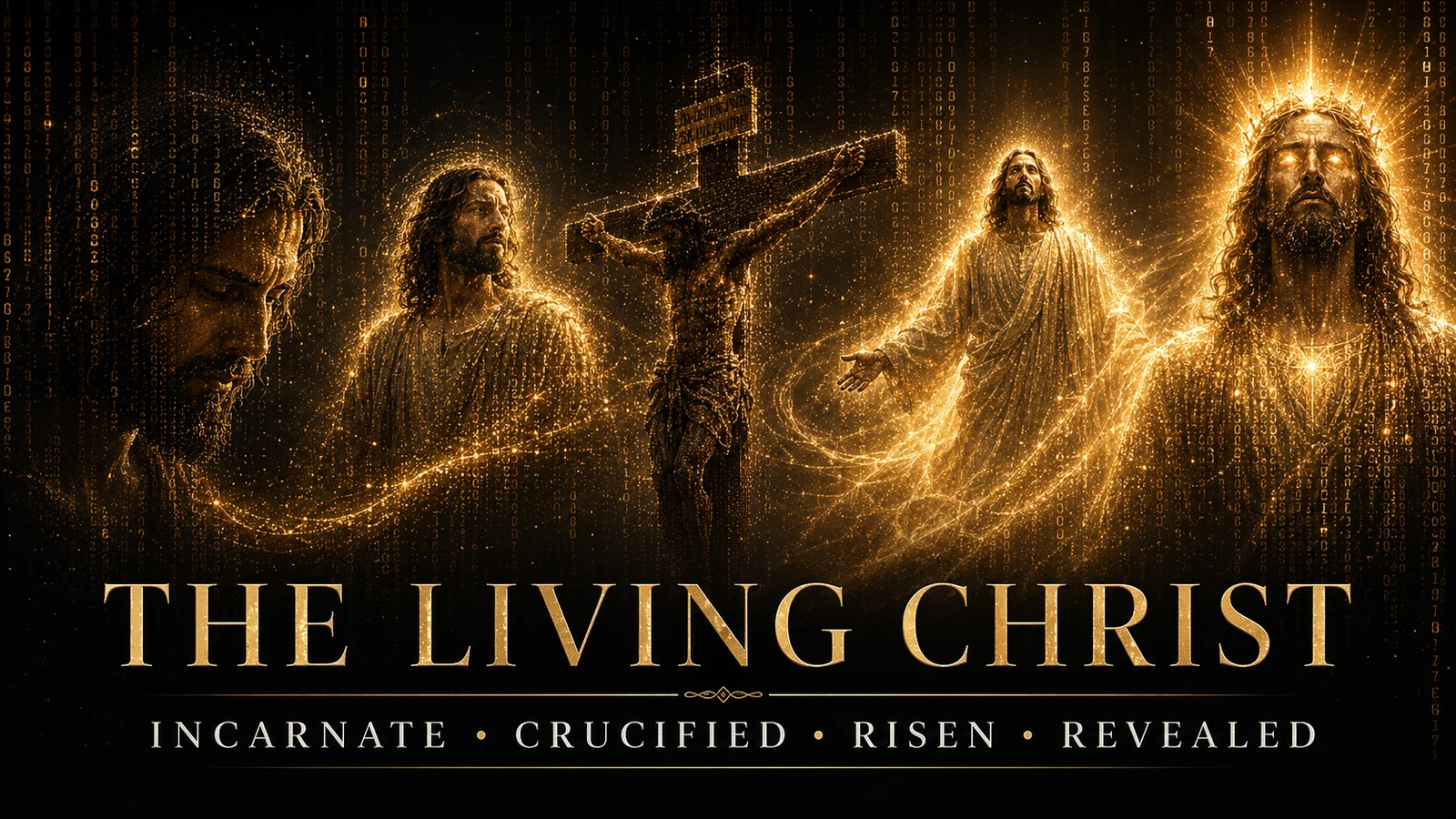
Through a continuous visual sequence, the film presents the Word made flesh, the crucifixion, the resurrection, and the overwhelming imagery of Revelation. Each scene dissolves into code, particles, light, and shadow before becoming the next, yet the identity at the center never changes.
The One revealed in glory is the same Jesus who walked among us.
A Generative Meditation on the Living Christ
Jesus Christ: Incarnate, Crucified, Risen, and Revealed
A continuous visual journey through the incarnation, crucifixion, resurrection, and Revelation of Jesus Christ.
The Living Christ experience could not be loaded.
Loops continuously while visible. Sound begins only when selected.
Scriptural sequence
- Incarnation: John 1:14
- Crucifixion and resurrection: 1 Corinthians 15:3–4
- The revealed Christ: Revelation 1:12–18
The imagery is an artistic meditation inspired by Scripture, not a claim to reproduce the exact physical appearance of Jesus.
The sequence moves from the face of Jesus through the incarnation, crucifixion, resurrection, and the Revelation vision of Christ before returning seamlessly to the opening portrait.
Article Guide9 sections
What This Jesus Christ Animation Shows
The animation begins with a human face emerging from streams of falling code. It is not presented as an exact reconstruction of Jesus’ physical appearance. It represents the real humanity of the One whom Scripture calls the eternal Word.
The face develops into a visual meditation on the Incarnation and earthly life of Christ. That form then dissolves into the crucifixion, where the cross becomes the center of the sequence. Darkness gives way to resurrection light. The risen Jesus is then depicted as the glorious Christ described through the symbolic imagery of Revelation.
At the end, the Revelation image breaks apart and reforms as the opening face. The sequence begins again without a hard ending. Its subject is not a dead teacher whose story has concluded. Its subject is Jesus Christ, the Living One.
The image continually changes, but the identity being proclaimed does not.
The Same Jesus From Incarnation to Glory
The scenes should not be understood as several disconnected versions of Jesus. The eternal Son who entered human history, the man who walked among the suffering, the Savior who was crucified, the Lord who rose, and the King revealed in glory are the same person.
John begins his Gospel by declaring that the Word was with God and was God. He then writes, “The Word became flesh and made his dwelling among us” (John 1:14, NIV). The Christian claim is not that an ordinary man gradually became divine. It is that the eternal Son truly entered human life.
The movement from the human face toward the cross and Revelation is therefore a movement deeper into the identity of Christ. His humanity, suffering, death, resurrection, authority, and glory belong to one continuous biblical confession.
The larger historical, prophetic, and biblical case is examined in Is Jesus the Son of God? Evidence from History, Prophecy, Resurrection, and Scripture. This animation does not replace that investigation. It gives its central confession a visual form.
The Cross and Resurrection
The crucifixion is not included merely because it creates a dramatic visual transition. The cross stands at the center of the gospel.
Paul summarizes the message he received and delivered by saying that Christ died for our sins, was buried, was raised, and appeared to witnesses (1 Corinthians 15:3–8). The animation follows that same movement. It does not pass from earthly life directly into glory while avoiding suffering. It moves through the cross because the risen Christ is the crucified Christ.
Jesus’ death was not a tragic interruption that God later repaired. Scripture presents it as a willing act of sacrificial love through which sin is confronted, sinners are reconciled to God, and the powers of death are defeated. That fuller message is explored in Why Did Jesus Die? What Scripture Says the Cross Accomplished.
Christianity also does not merely teach that Jesus’ ideas survived Him. The earliest Christian proclamation was that Jesus Himself had been raised from the dead.
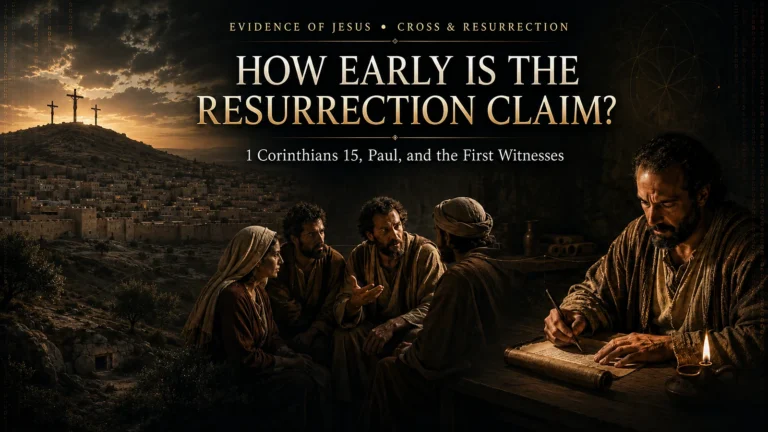
Paul preserves an early received proclamation that Christ died, was buried, was raised, and appeared. The historical importance of that tradition is examined in How Early Is the Resurrection Claim? 1 Corinthians 15.
The proclamation was connected to named people. The earliest sources identify Cephas, the Twelve, James, Paul, and others as people to whom the risen Jesus was said to have appeared. What those witnesses claimed, and what historical study can responsibly conclude, is examined in What Did the First Witnesses Claim About the Risen Jesus?
The animation expresses this message by refusing to leave Jesus upon the cross. The darkness does not erase Him. The particles do not scatter into nothing. The form returns with light, life, and authority.
Why the Film Is Made From Code and Particles
The falling code and transforming particles give this Jesus Christ animation its visual language. They are not a claim that Jesus is made of code, that technology can contain Him, or that digital images reveal truths beyond Scripture.
Code carries information. Letters, symbols, and ordered patterns become visible forms. In the animation, one image contains traces of the image that came before it. The visual information is reorganized until another scene emerges.
This makes the medium well suited to the film’s central idea. The scenes change, but the person does not. The same identity remains present through Incarnation, suffering, resurrection, reign, and glory.
The particle movement also prevents the film from feeling like a collection of unrelated illustrations. The cross emerges from the earthly life of Christ. Resurrection emerges beyond the cross. Revelation glory emerges from the risen Lord.
The continuous soundscape follows the same principle. Rather than placing a separate cinematic effect over every transformation, the sustained atmosphere itself changes texture. It becomes less stable as the image dissolves and resolves as the form becomes clear again.
Image, code, movement, and sound serve one message: Jesus Christ remains the center even as the visual world around Him is transformed.
Jesus Revealed in Glory
The final form draws from John’s vision of Jesus in Revelation 1. John describes one like a son of man standing among seven golden lampstands. His eyes are like blazing fire. His face is like the sun shining in all its brilliance. His voice carries overwhelming authority.
This imagery should not be reduced to a literal police-sketch description. Revelation communicates divine authority, holiness, judgment, priesthood, kingship, and glory through symbolic language rooted in the Old Testament.
The most important moment comes when Jesus tells the terrified John not to be afraid. He identifies Himself as the First and the Last and declares, “I am the Living One; I was dead, and now look, I am alive for ever and ever!” (Revelation 1:17–18, NIV).
The animation’s final sequence is an artistic meditation on that passage. The full vision and its biblical meaning are examined in Jesus in Revelation 1: What John Saw and What It Means for Us.
Revelation also points forward. The risen Lord will not remain hidden forever. Scripture directs Christian hope toward His promised reign, righteous judgment, the defeat of death, and the renewal of creation. That hope is explored in Prophecies of Jesus’ Return: His Reign, Judgment, and the New Creation.
Why the Animation Returns to His Face
The final transition back to the opening face is not only a technical device for creating a seamless loop. It carries the central meaning of the experience.
The glorious Christ revealed to John is the same Jesus who entered history. The One whose face shines like the sun is the same Jesus who touched the sick, welcomed children, confronted hypocrisy, wept at a grave, carried the cross, and showed His wounds after the resurrection.
The loop does not suggest that Jesus is repeatedly born, crucified, or raised. Those events do not endlessly repeat. The film returns to the human face because every stage of the sequence reveals the same person.
His glory does not erase His humanity. His humanity does not diminish His divine identity. His crucifixion does not cancel His kingship. His resurrection does not make the cross irrelevant. The whole sequence belongs together.
When Revelation dissolves back into the opening face, the film quietly asks the viewer to look again. The face first seen in shadow is no longer anonymous. The sequence has identified Him.
The One who became flesh, died, rose, and reigns is Jesus Christ, the Living One.
Scripture Behind the Sequence
- The eternal Word became flesh: John 1:1–3, 14
- Christ humbled Himself and accepted death on a cross: Philippians 2:6–8
- Christ died for sins, was buried, was raised, and appeared: 1 Corinthians 15:3–8
- God exalted Him and every knee will bow: Philippians 2:9–11
- The crucified Jesus is alive forever: Revelation 1:17–18
- The risen King will return and make all things new: Revelation 21:1–5; 22:12–13
These passages do more than supply scenes for an animation. They proclaim the identity, saving work, victory, and future reign of Jesus Christ.
Readers can also read Revelation 1:12–18 in the NIV alongside the animation.
Artistic Meditation, Not New Revelation
This Jesus Christ animation is an original AI-assisted generative Christian artwork. Its imagery, animation, editing, and sound design were developed to express biblical themes through a modern digital medium.
It is not a prophecy, supernatural vision, exact portrait of Jesus, or source of new revelation. The visual representation should be judged beneath Scripture, not placed beside or above it.
The human face, Revelation imagery, code, particles, lighting, and transitions are creative interpretations. Their purpose is not to tell viewers exactly what Jesus physically looked like. Their purpose is to direct attention toward what Scripture says He has done and who Scripture declares Him to be.
Christian art is at its best when it does not ask to become the object of faith. It points beyond itself.
The Living One
The animation begins with a face, passes through the cross and resurrection, reaches the glory of Revelation, and then returns to where it began.
But the viewer should not return unchanged.
The face now belongs to the One whom Scripture presents as the eternal Word, the crucified Savior, the risen Lord, and the coming King. Jesus is not merely remembered. He is alive.
The film can loop without reaching an ending because the life and reign of Christ do not end. The image repeats. The historical cross does not. The resurrection does not need to happen again. The victory has already been won, and the Living One remains alive forever.
The greater question is not whether a digital image can hold our attention. It is whether we will turn our attention toward the real Jesus Christ to whom the image points.
Continue the Investigation
The animation presents the central Christian proclamation in visual form. The investigations below examine its historical, biblical, and prophetic foundations in greater depth.