
GUIDED ARTICLE EXPERIENCE
What Does It Mean to Be Jewish? Religion, Ethnicity, Culture, and Peoplehood
Read along as the narration moves through the article.
Private device narration · No hosted audio or tracking
CONTINUE GUIDED TOUR
Continue where you left off.
GUIDED TOUR COMPLETE
You have reached the end of this study.
Study record saved on this device.
GUIDED TOUR
What Does It Mean to Be Jewish? Religion, Ethnicity, Culture, and Peoplehood
Narrator: Paranoid Prophet Recommended Voice Native device narration
Prepare to follow the article as it is narrated.
VOICE & TOUR OPTIONS
Voice & Listening
NARRATOR
Finding a narrator…
Checking the best narrator available on this device.
Restores the best curated narrator available on this device.
Narrator choices are curated for clear, long-form listening on this device.
Screen-awake support will be checked when narration starts.
CHOOSE A NARRATOR
Curated for this device
Choose a verified narrator for this browser, or use System Narrator. Automatic mode uses the best reliable route exposed by this device; your chosen narrator is preserved even if this device needs a temporary fallback.
Preparing the guided article experience…
RESUME GUIDED TOUR?
Continue where you left off.
GUIDED TOUR COMPLETE
You have reached the end of this study.
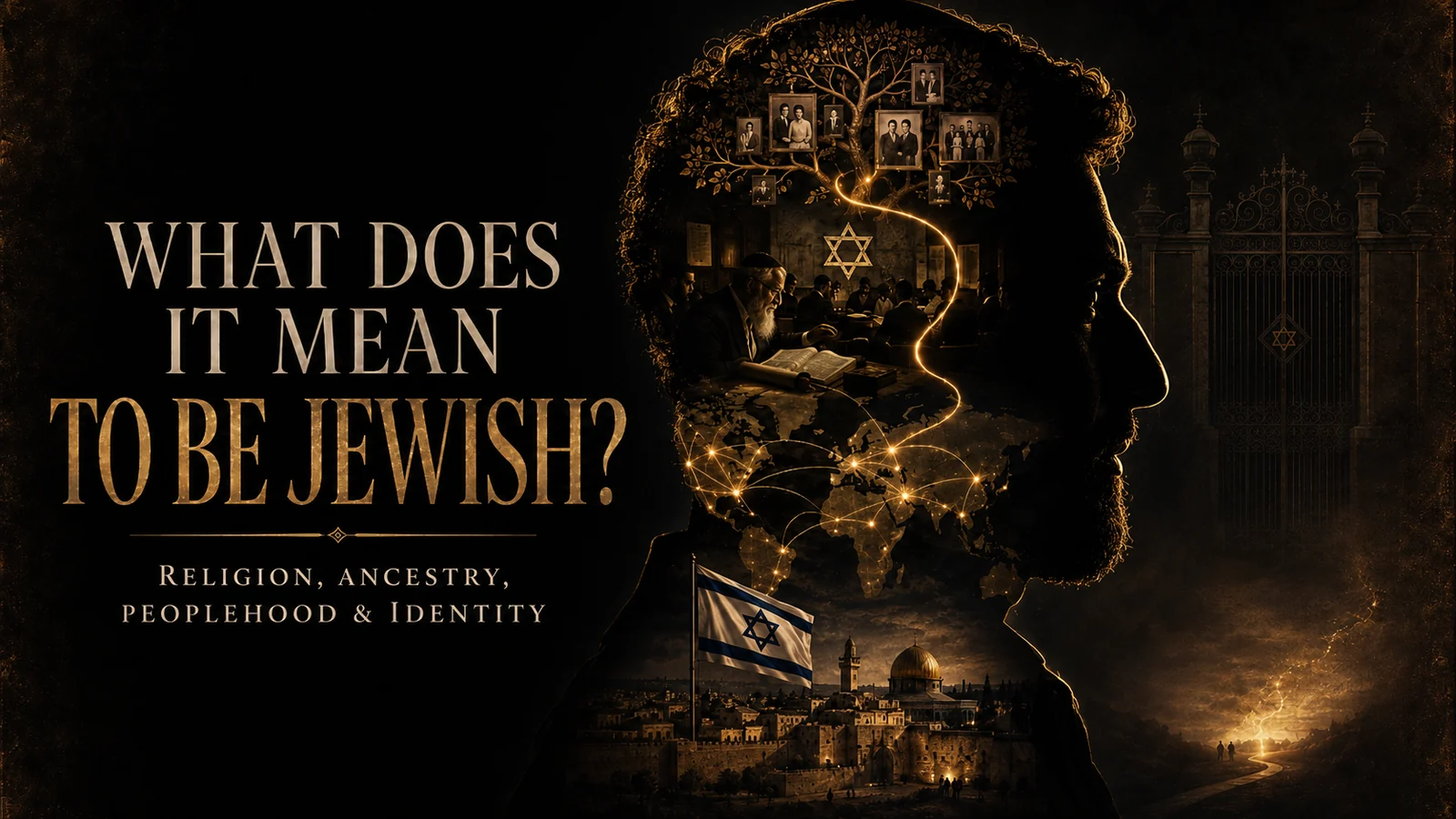
What does it mean to be Jewish? The simplest honest answer is that Jewishness is a form of historically continuous peoplehood with religious, ancestral, ethnic, cultural, familial, legal, and communal dimensions. A Jewish person may be devoutly observant, culturally connected, secular, atheist, descended from Jewish parents, or recognized as Jewish through conversion by a particular community. Because conversion is not universally portable, another movement or authority may reach a different status judgment. No single modern category captures every case.
That complexity is not a defect in Judaism. It reflects a people whose story crosses ancient Israel, exile, diaspora, rabbinic law, family life, persecution, conversion, emancipation, the Holocaust, modern Israel, and communities spread across the world. The boundaries are real, but different Jewish movements do not draw every boundary in the same place.
Christians need special care here. The Bible’s language of Israel, Judah, covenant, ancestry, remnant, and Messiah cannot be reduced to modern race or citizenship. Jewish identity deserves accurate description on its own terms. It also must not be confused with salvation. No ancestry, cultural memory, communal status, or passport reconciles a sinner to God. The gospel calls Jews and Gentiles alike to Jesus Christ.
Article Guide22 sections
Short Answer: What Does It Mean to Be Jewish?
To be Jewish is to belong, in one or more recognized ways, to the Jewish people. Jewish belonging may be expressed through descent, conversion, religious status, upbringing, culture, family, personal identity, and acceptance by a Jewish community. These layers overlap, but they do not confer the same kind of recognition.
Traditional Jewish law gives a technical answer to the question of status: a person is Jewish by birth from a Jewish mother or through a recognized conversion. Reform and Reconstructionist Judaism recognize some children of Jewish fathers as Jewish under defined conditions. Conservative Judaism retains the maternal or conversion standard while developing pastoral ways to affirm people raised with Jewish identity. Orthodox Judaism also retains the traditional standard and applies its own requirements to conversion. A person recognized in one community may therefore need conversion or formal confirmation to be recognized in another.
Jewishness can also persist without religious practice. The Pew Research Center’s 2020 study of American Jews found that only a minority described being Jewish as solely a matter of religion; respondents also spoke of ancestry, culture, memory, ethics, and family. That is U.S. evidence, not a definition imposed on every Jew worldwide. It nevertheless shows why “Jewish atheist” is not necessarily a contradiction. A person can reject belief in God while retaining ancestry, history, kinship, and communal identity.
Peoplehood is therefore the most useful controlling category: Jewish peoplehood with religious, ancestral, ethnic, cultural, and communal dimensions. It explains how converts can become fully Jewish within recognizing communities, secular Jews can remain Jewish, diverse communities can preserve distinct histories, and religious authorities can maintain real rules of recognition. It also keeps Jewish identity distinct from Israeli citizenship.
Why Jewish Identity Is Difficult to Define
Most familiar labels answer one question at a time. Religion normally concerns belief, worship, practice, and institutions. Ethnicity concerns shared ancestry, history, memory, and culture. Nationality concerns political membership. Race is a shifting social classification often treated as biological. Jewish identity reaches into all four conversations without fitting neatly inside any one of them.
The difficulty becomes clear through ordinary cases. A convert may have no Jewish ancestors and still become a Jew. An atheist born to a Jewish mother may reject Judaism’s theology while remaining Jewish under traditional law. A child raised as Jewish by a Jewish father may be fully Jewish in a Reform synagogue yet lack halakhic status in an Orthodox or Conservative setting. A grandchild of a Jew may qualify for immigration under Israel’s Law of Return without being recognized as Jewish by the Chief Rabbinate. An Arab, Christian, Muslim, or Druze citizen of Israel is Israeli without being Jewish.
These are not verbal tricks. Each answer comes from a different authority asking a different question. A rabbinic court asks about religious status. A synagogue asks about membership and ritual participation. A family tells a story of descent and belonging. A state applies civil law. An individual names a lived identity. Trouble begins when one answer is forced to settle all the others.
Jewish communities also disagree internally. There is no single pope, council, legislature, or demographic survey that speaks for every Jew. Orthodox, Conservative, Reform, and Reconstructionist institutions can state their own standards; none can erase the existence of the others. The task is to describe each standard precisely and then identify where recognition travels across communal lines and where it does not.
Hebrew, Israelite, Judean, Jew, and Israeli Compared
The vocabulary developed over centuries. Its terms overlap historically, yet they should not be treated as synonyms.
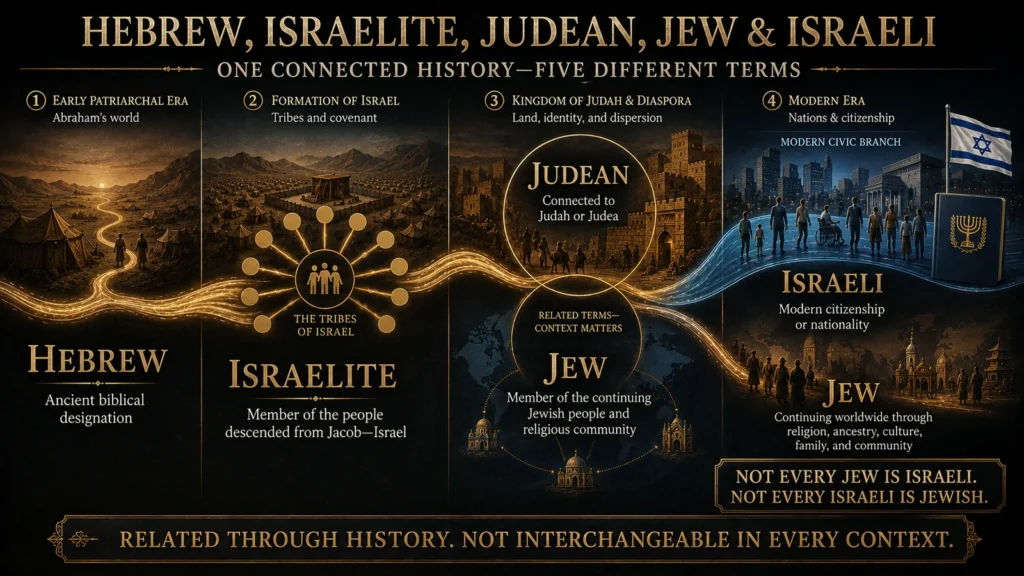
Hebrew
Hebrew is an ancient biblical designation associated with Abraham and, later, Israelites in particular settings. The word’s origins and range remain debated. In modern usage it most commonly names the Hebrew language, although older English sometimes used Hebrew as a label for a Jewish person. Calling every modern Jew a Hebrew can therefore sound archaic or imprecise.
Israelite
Israel first names Jacob after his encounter at Peniel (Genesis 32:22-32). Israelites are Jacob’s descendants and the ancient covenant people associated with the twelve tribes. After the kingdom divided, Israel could also refer more narrowly to the northern kingdom in contrast with Judah. Context controls the meaning.
Judean and Jew
Judean connects a person with Judah or Judea and can carry geographic, political, ancestral, and religious senses in ancient texts. Jew developed from the same linguistic family but came to name the continuing people and religious community in a broader way. Scholars still debate when ancient terms should be translated “Judean” rather than “Jew.” Jason Staples’s scholarly survey of Israelite and Jewish terminology shows why a single neat timeline oversimplifies the evidence.
Israeli
Israeli is a modern civic or national category: a citizen or national of the State of Israel. It does not identify one religion or ancestry. Not every Jew is Israeli, and not every Israeli is Jewish. A diaspora Jew may never have visited Israel; a non-Jewish Israeli may have deep family roots in the land and full citizenship.
The sequence is therefore historical, not a chain of perfect substitutions. Abraham can be called a Hebrew. Jacob becomes Israel. His descendants are Israelites. Judah and Judea give rise to Judean and Jewish language. The modern state adopts the name Israel. Each term carries part of the story, and none makes the others unnecessary.
Is Jewishness a Religion, Ethnicity, Race, or Peoplehood?
Judaism is unquestionably a religion. It has Scripture, worship, commandments, festivals, prayers, moral teaching, legal traditions, institutions, and competing theological schools. Yet a creed-only definition fails because Jews who cease practicing can remain Jewish, while a Gentile who agrees with several Jewish beliefs does not become Jewish merely by private assent.
Jewishness also has ethnic and ancestral features. Families transmit memories, customs, names, languages, foodways, experiences of exile, and bonds to earlier generations. Some Jewish populations share measurable ancestry because communities practiced endogamy for long periods. Still, Jews are not one uniform biological race. Jewish communities include European, Middle Eastern, North African, Ethiopian, Asian, Black, Latino, mixed-race, and convert members. A convert joins the people without acquiring a new genetic past.
The label ethnoreligious group can be useful because it joins ancestry and religion. It remains incomplete when it suggests one ethnicity or treats culture, law, conversion, and transnational belonging as minor details. Peoplehood does more work. It describes a historical community that can include ancestral descendants and adopted members, observant and secular people, common memories and internal disagreements.
Reconstructionist Judaism makes this self-understanding especially explicit. Its explanation of Judaism as an evolving civilization and transnational family places peoplehood at the center, though Orthodox, Conservative, and Reform Jews need not accept Reconstructionist theology to recognize that Jews are more than voluntary subscribers to a creed.
Race requires the greatest caution. Antisemites have repeatedly racialized Jews, assigning imagined biological traits and collective guilt. Modern genetic science can study population history, but it cannot identify a pure Jewish essence. Jewish identity contains ethnic and ancestral dimensions without constituting one uniform biological race.
The Seven Layers of Jewish Identity
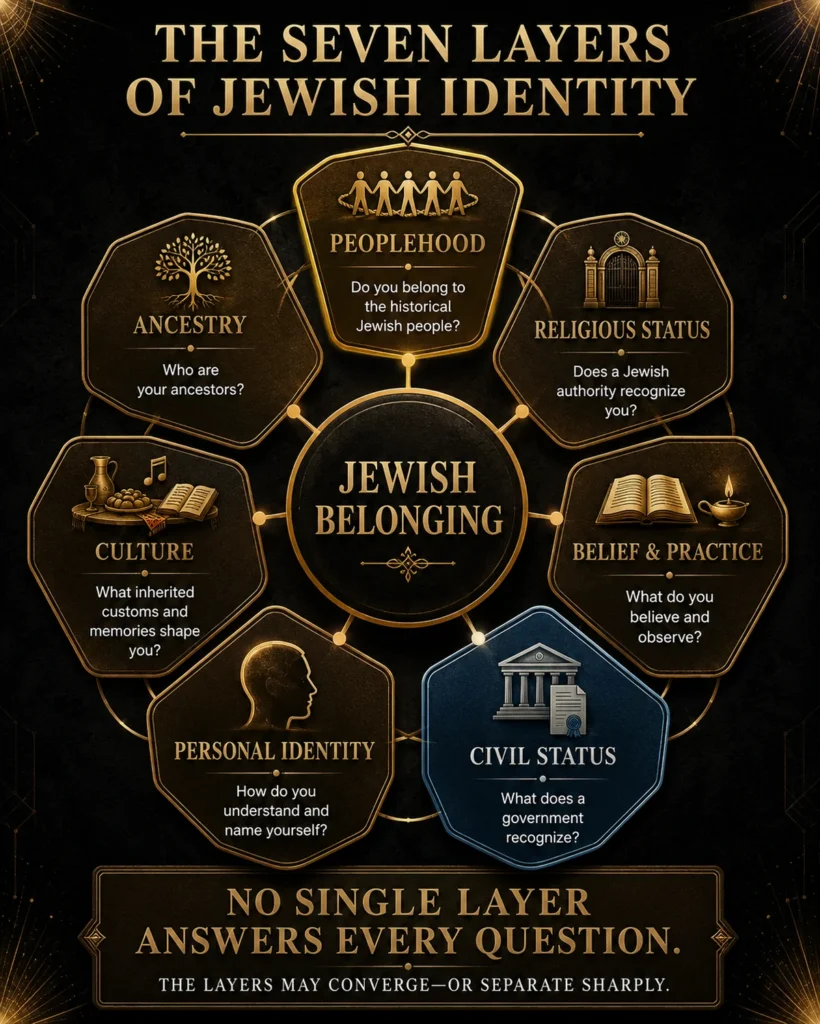
Seven overlapping layers make the complexity manageable. They are an explanatory model, not a new religious law. Different people and communities give the layers different weight.
| Layer | Central question | What it can establish |
|---|---|---|
| Ancestry | From whom is a person descended? | Family history, inherited memory, and links to Jewish populations |
| Religious status | Does a Jewish authority recognize the person as Jewish? | Eligibility for defined religious and communal purposes |
| Belief and practice | What does the person believe and observe? | Religious commitment, affiliation, and way of life |
| Peoplehood | Does the person belong to the historical Jewish people? | Corporate memory, kinship, responsibility, and continuity |
| Culture | What Jewish languages, customs, arts, foods, and memories shape life? | Lived connection that may cross levels of observance |
| Civil status | What does a government recognize? | Citizenship, immigration eligibility, and legal classification |
| Personal identity | How does the person understand and name the self? | Lived belonging, biography, and chosen identification |
Ancestry and religious status
Ancestry describes descent; status describes a community’s legal judgment. They often coincide, but not always. Traditional law treats maternal descent as determinative for Jewish status, while a person may have substantial Jewish ancestry through a father or grandparent without meeting that rule. Conversion produces the reverse case: full Jewish status without Jewish ancestry.
Belief, practice, and peoplehood
Belief and practice can deepen Jewish life without creating birth status by themselves. Peoplehood explains why the category can survive unbelief and why conversion is entry into a community, not only agreement with doctrines. It also explains why Jewish arguments about boundaries can be intense: the question concerns family, worship, marriage, children, and continuity at once.
Culture, civil status, and personal identity
Culture gives peoplehood texture through Hebrew, Yiddish, Ladino, Judeo-Arabic, Amharic traditions, music, literature, food, humor, mourning, celebration, and memory. Civil status belongs to governments and can be broader or narrower than a synagogue’s rule. Personal identity records the person’s own experience, but self-identification alone does not compel every religious body to grant status.
The seven layers may converge in one observant Jewish citizen of Israel whose parents and community all recognize the same status. In another person they may separate sharply. The purpose of the model is not to rank people. It is to keep one kind of evidence from doing a job it cannot do.
Who Is Jewish Under Traditional Jewish Law?
Traditional rabbinic law, or halakhah, recognizes Jewish status through birth to a Jewish mother or through a valid conversion. The rule concerns status within the Jewish people. It is not a scientific theory about which parent contributes more to a child’s identity, and it is not a claim that fathers are culturally or spiritually unimportant.
An Orthodox explanation such as Chabad’s account of who is recognized as Jewish states the standard directly: maternal birth or conversion under a recognized rabbinic court. Conservative Judaism retains the same baseline, although its pastoral treatment of people from blended backgrounds has developed in important ways. Reform and Reconstructionist standards differ, as the next section will show.
Jewish status and inherited lineage answer different questions
The maternal rule for Jewish status should not be confused with priestly or tribal lineage. In biblical genealogies, households and tribal affiliation usually follow fathers. Numbers describes Israel registering “by their fathers’ houses” (Numbers 1:18). Rabbinic law likewise treats a qualified father’s family as determinative in many lineage cases.
The Mishnah’s lineage rule in Kiddushin 3:12 distinguishes several kinds of unions. Where recognized betrothal applies and the union carries no prohibited status, the child’s lineage follows the father. In mixed Jewish and non-Jewish parentage, however, rabbinic law treats the child’s Jewish status according to the mother. This produces a two-part formulation that often surprises readers: traditional Jewish status follows maternal descent or recognized conversion, while priestly and tribal lineage traditionally follows the father.
For example, a Jewish mother and a non-Jewish father have a child who is Jewish under traditional law, but the non-Jewish father cannot transmit the status of Kohen or Levite. A Jewish father who is a Kohen and a non-Jewish mother have a child who is not Jewish under that same law; the father’s priestly ancestry does not override the child’s status. If the child later converts, detailed lineage questions remain separate from the fact that the convert is fully Jewish.
Status is communal and practical
Religious status affects concrete questions: Who may be counted in a minyan where one is required? Who may receive particular ritual honors? Whom may a rabbi marry under that movement’s law? Does a child require conversion? Can Jewish status be transmitted to the next generation? These are communal judgments rather than measurements of a person’s sincerity or cultural knowledge.
A person can therefore know more Hebrew, observe more festivals, and feel more attached to Jewish life than someone whose maternal status is undisputed, yet still need a formal process in a traditional community. Conversely, a person with traditional birth status may practice no Judaism at all. Halakhic status does not measure devotion, virtue, or salvation.
Why Is Jewish Status Traditionally Matrilineal?
The secure historical claim is narrower than many popular explanations. Biblical genealogy, inheritance, and tribal identity are commonly paternal. The maternal rule for Jewish status is plainly established in early rabbinic law, including the Mishnah, compiled around the early third century. Historians debate precisely when the rule emerged and why.
Traditional Jewish interpreters often argue that the principle is rooted in Torah and transmitted through the Oral Law. Historical scholars examine the surviving texts as evidence of development. These approaches ask related but different questions. The first asks why the rule has authority within the covenantal legal tradition. The second asks when a clearly formulated rule can be documented and what social or legal circumstances may have shaped it.
Shaye J. D. Cohen’s peer-reviewed study, “The Origins of the Matrilineal Principle in Rabbinic Law”, surveys biblical, Second Temple, and rabbinic evidence while testing several proposed explanations. His work helped frame the modern scholarly debate, but no single theory has closed it. Claims that the rule arose simply because maternity was certain, because Jewish women were assaulted, or because rabbis copied Roman law all outrun what the evidence can securely prove.
Christians do not need to mock the rule or pretend the historical question is settled. A fair account can say three things at once. Biblical tribal genealogy is usually paternal. Early rabbinic law clearly applies a maternal rule to Jewish status in mixed unions. Traditional communities receive that rule as authoritative halakhah even while historians debate its earlier development.
The distinction also prevents a common mistake in reading the Bible. Davidic, priestly, or tribal descent through a father does not by itself answer the later rabbinic status question. The systems classify different features of identity. Treating “matrilineal” as though it meant every aspect of Jewish ancestry passes through women is inaccurate.
How Orthodox, Conservative, Reform, and Reconstructionist Standards Differ
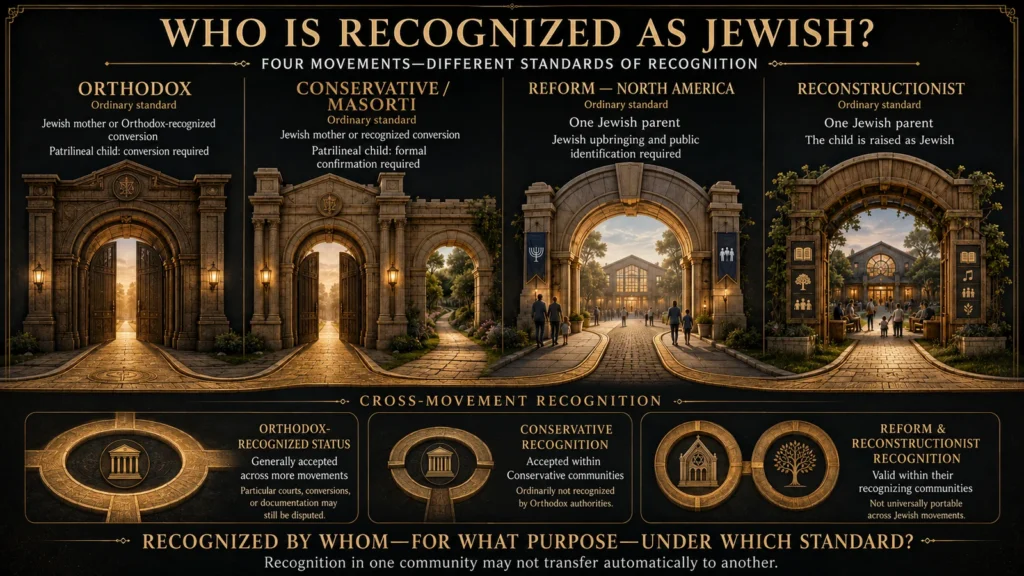
The four movements do not offer four opinions about one abstract label. They operate communities, train clergy, conduct conversions, solemnize marriages, educate children, and make judgments about participation. Their policies therefore shape real lives.
| Movement | Birth standard in ordinary cases | Response to a child of a Jewish father and non-Jewish mother |
|---|---|---|
| Orthodox | Jewish mother or Orthodox-recognized conversion | Conversion is required for Jewish status |
| Conservative/Masorti | Jewish mother or conversion recognized under Conservative halakhah | Jewish ancestry and upbringing may be affirmed; formal ritual confirmation is required for halakhic status |
| Reform in North America | One Jewish parent, with Jewish upbringing and timely public identification | May be recognized as Jewish when the stated conditions are met |
| Reconstructionist | One Jewish parent when the child is raised as a Jew | Recognized as Jewish within the movement under its standard |
Orthodox Judaism
Orthodox Judaism recognizes a person born to a Jewish mother or converted through a process it accepts as halakhically valid. Orthodox conversion ordinarily includes substantial study, commitment to the commandments, examination by a beit din, immersion in a mikveh, and circumcision or the appropriate ritual for a male convert. Chabad’s guide to the Orthodox conversion process presents these requirements from within Orthodox belief.
Orthodox authorities do not automatically recognize conversions performed under non-Orthodox auspices. Recognition can also vary among Orthodox courts, especially when later marriage or immigration questions require documentation. Saying “Orthodox recognizes conversion” is therefore true but incomplete; the recognizing authority matters.
Conservative or Masorti Judaism
Conservative Judaism retains maternal descent or conversion as its religious-status standard. It does not simply accept patrilineal descent. At the same time, contemporary Conservative guidance tries to distinguish technical status from the reality of a person who has been loved, educated, and formed as a Jew.
The Rabbinical Assembly’s 2024 Halakhic Guidance for Jews of Blended Backgrounds keeps maternal birth or conversion normative for ritual, marriage, and transmission of status. It also urges kindness and recommends an expedited process of ritual affirmation for some people raised exclusively as Jewish through a father, adoption, or other blended background. Conservative Judaism may therefore affirm Jewish ancestry, upbringing, and communal identity while still requiring formal confirmation of halakhic status.
That distinction is pastorally important. Telling a person that a formal step is needed does not require denying the Jewish family, education, memories, or community that shaped the person’s life. The Conservative approach attempts to preserve both halakhic continuity and human dignity.
Reform Judaism
North American Reform Judaism changed its policy through the Central Conference of American Rabbis’ 1983 resolution on the status of children of mixed marriages. The resolution applies the same presumption of Jewish descent to a child with either one Jewish mother or one Jewish father, but it does not make one Jewish parent sufficient regardless of upbringing.
The presumption is established through timely and public acts that express a positive and exclusive Jewish identity. The resolution lists examples such as entering the covenant, receiving a Hebrew name, Torah study, bar or bat mitzvah, and confirmation, with particulars determined in consultation with a rabbi. Reform Judaism thus recognizes descent through either parent when Jewish identity is established through upbringing and public identification.
The policy was written for the Reform community of North America. Reform and Progressive communities outside North America have not always used identical rules. A responsible explanation should therefore avoid turning a North American resolution into a worldwide law for everyone called Reform.
Reconstructionist Judaism
Reconstructionist Judaism was an early modern movement to grant equal recognition to maternal and paternal descent under an upbringing condition. Its official account states that a child is fully Jewish if either parent is Jewish and the child is raised as a Jew. This fits its larger understanding of Judaism as an evolving religious civilization and the Jewish people as a transnational family.
Reconstructionist recognition is real within Reconstructionist communities; it is not universally portable. Orthodox and Conservative authorities generally require maternal descent or a conversion or confirmation process. Reform recognition depends on Reform’s own conditions. The fact that standards differ does not make every standard meaningless. It means a person’s status may change when the recognizing community changes.
Cross-movement recognition
A status recognized by an Orthodox authority will generally be accepted across more Jewish movements, although Orthodox courts themselves may disagree over particular conversions, courts, or documentation. Conservative conversions are accepted within Conservative communities and may be accepted elsewhere, yet they are not normally accepted by Orthodox courts. Reform and Reconstructionist communities may recognize conversions and statuses that traditional authorities do not.
These differences affect marriage, synagogue participation, children’s status, and Israeli personal-status questions. They should not be used as weapons to humiliate people. The accurate question is: recognized by whom, for what purpose, under which standard?
How Conversion Makes Someone Jewish
Conversion proves that Jewishness is not a closed biological caste. A convert does not merely become a friendly Gentile who practices Jewish customs. Within the recognizing community, conversion joins the Jewish religion, the Jewish people, a covenantal way of life, and a chain of communal responsibility.
The book of Ruth supplies enduring language for that union: “Your people shall be my people, and your God my God” (Ruth 1:16-17). The order is revealing. Ruth’s pledge joins people and God, family loyalty and worship, future and burial. Later conversion procedures are more formally developed, but the twofold movement remains.
Across Jewish movements, conversion normally involves sustained learning, relationship with a rabbi or community, and a public commitment to Jewish life. Traditional and Conservative processes ordinarily include a beit din, ritual immersion, and circumcision or symbolic drawing of blood when applicable. Reform practice varies by rabbi and community, though contemporary Reform guidance often encourages a beit din, mikveh, and traditional rituals. Reconstructionist conversion likewise joins individual commitment to communal belonging.
Recognition remains the difficult part. A conversion accepted by one movement may not be accepted by another. The disagreement may concern the authority of the court, commitment expected, witnesses, immersion, circumcision, documentation, or the movement’s understanding of halakhah. Prospective converts are often advised to consider where they hope to worship, marry, raise children, or live.
Once a community accepts a conversion as valid, Jewish teaching within that framework strongly rejects treating the convert as a lesser Jew. The convert’s ancestry does not change, and no scientific test could make it change. Religious status and communal belonging change through a recognized religious act, even when that judgment does not transfer to another institution. That fact alone defeats any definition of Jewishness based on a supposedly pure bloodline.
Jewish Identity Versus Jewish Religious Status
Identity asks, “Who am I, and to what people do I belong?” Status asks, “How does this community classify me for worship, marriage, conversion, and the transmission of Jewish standing?” The questions influence each other, but they are not identical.
Consider a person whose Jewish father and non-Jewish mother raised her in a synagogue, sent her to Jewish school, celebrated every festival with her, and gave her a public Jewish life. She may have an unambiguous Jewish identity and full status in Reform or Reconstructionist Judaism. An Orthodox court would still require conversion. A Conservative rabbi may affirm the same upbringing and ancestry while recommending an expedited ritual confirmation before granting full halakhic status.
Now reverse the pattern. A person born to a Jewish mother may know little about Judaism, practice another religion, or identify only weakly with Jewish life. Traditional law can still regard that person as Jewish by birth. The status does not prove belief, practice, moral character, or active belonging.
Personal identity matters because human beings are more than entries in a registry. Communal recognition matters because communities require boundaries if membership is to mean anything. Wisdom refuses both extremes. Self-identification alone cannot force universal recognition, but a technical status ruling should not be used to erase a person’s family history or treat a life of Jewish formation as fiction.
This distinction also explains why requests for proof can be painful. Documents concerning mothers, grandparents, conversions, marriages, burials, and synagogue membership may be required when a person enters a new community or seeks marriage in Israel. The institution may understand the process as due diligence; the person may experience it as a trial of an identity never previously questioned. Accuracy and compassion are both necessary.
Can Someone Be Jewish Without Practicing Judaism?
Yes. Jewish identity can persist among secular, agnostic, and atheist Jews because Jewishness may describe peoplehood and status as well as religious conviction. This is one of the clearest reasons that “Judaism is only a religion” fails.
A secular Jew may remain connected through family, historical memory, language, food, music, literature, festivals, mourning practices, Holocaust memory, opposition to antisemitism, or solidarity with other Jews. Some observe Passover or Yom Kippur as family and cultural events without affirming traditional theology. Others participate in Jewish institutions while describing themselves as humanist, atheist, or religiously unaffiliated.
Pew’s U.S. survey distinguishes “Jews by religion” from “Jews of no religion” for demographic analysis. It also reports strong differences among Orthodox, Conservative, Reform, and unaffiliated respondents. The categories should not be exported as a global map, but they show that unbelief does not necessarily dissolve American Jewish identity.
Traditional law reaches the same practical result by another route. Birth status ordinarily remains even when a Jew sins, becomes nonobservant, or professes another faith, although apostasy can remove communal privileges and place the person religiously outside Judaism. The status may persist while religious affiliation changes. That is why Jewish arguments about a believer in Jesus require more precision than “still Jewish” or “no longer Jewish” by itself.
Christianity should neither deny secular Jewish identity nor mistake it for reconciliation with God. Christians also have cultural, familial, and institutional identities that do not save. The New Testament’s judgment is universal: all have sinned, and justification is God’s gift through faith in Jesus Christ (Romans 3:21-30).
Ashkenazi, Sephardi, Mizrahi, Ethiopian, and Other Jewish Communities
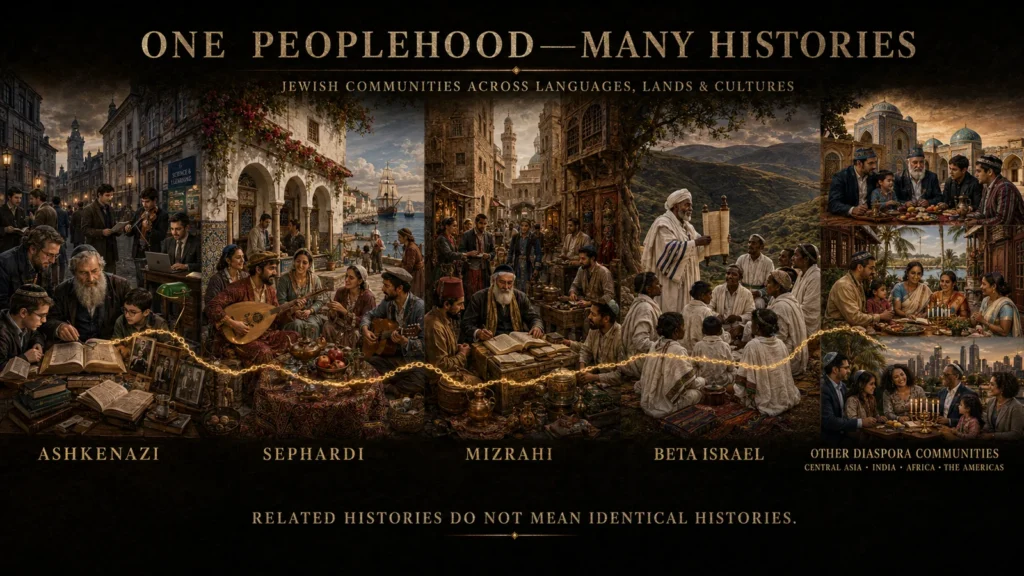
Jewish peoplehood has never meant cultural sameness. Diaspora communities developed across languages, empires, legal systems, climates, and neighboring cultures. Their histories overlap through Scripture, liturgy, law, trade, migration, marriage, persecution, and pilgrimage, yet each community carries its own inheritance.
Ashkenazi Jews
Ashkenazi usually refers to Jewish communities whose formative medieval and early modern history lay in Central and Eastern Europe. Ashkenazi life includes major differences among German, Polish, Lithuanian, Russian, Ukrainian, Hungarian, Romanian, Hasidic, non-Hasidic, religious, secular, and later American or Israeli communities. Yiddish became a major language, but neither Yiddish nor one European appearance defines every Ashkenazi Jew.
Sephardi Jews
Sephardi narrowly names descendants of Jews from the Iberian Peninsula, many of whom dispersed after expulsions from Spain and Portugal. It also names liturgical and legal traditions adopted by communities with different genealogies. Ladino, or Judeo-Spanish, became important in many Sephardi settings. A Jew may therefore be Sephardi by ancestry, rite, community, or a combination of these.
Mizrahi Jews
Mizrahi, meaning eastern, is a modern umbrella term for many Jews with roots in the Middle East, North Africa, Central Asia, and nearby regions. Iraqi, Iranian, Kurdish, Yemenite, Moroccan, Egyptian, Syrian, Bukharan, and other histories should not be flattened into one culture. Mizrahi and Sephardi identities often overlap because many Mizrahi communities follow Sephardi religious customs, but the words are not synonyms. My Jewish Learning’s overview of Mizrahi identity in Israel explains both the overlap and the modern social history of the label.
Beta Israel and Ethiopian Jewish identity
Beta Israel preserves a distinctive Ethiopian Jewish history with its own clergy, texts, festivals, purity traditions, and debates about origin. Its history did not develop through the same rabbinic institutions that shaped European and Middle Eastern communities. The ANU Museum of the Jewish People’s account of Ethiopian Jewry records the community’s distinctive development and twentieth-century migration to Israel.
The older label Falasha was imposed from outside and is often experienced as derogatory; Beta Israel is preferred. The community’s struggles for recognition also expose a weakness in any simple three-part map of Ashkenazi, Sephardi, and Mizrahi Jews. Ethiopian Jewish history is not an appendix to those categories.
Communities beyond the familiar map
Jewish communities also developed in India, the Caucasus, Central Asia, China, sub-Saharan Africa, the Americas, and elsewhere. Bene Israel, Cochin Jews, Georgian Jews, Mountain Jews, Bukharan Jews, and Kaifeng Jewish descendants have different histories of migration, conversion, local integration, and recognition. Modern Jewish communities also include people of many racial backgrounds and multiracial families.
These labels describe histories; they do not assign spiritual rank. No category is more genetically Jewish, morally representative, politically unified, or religiously authentic merely because it is more familiar to Western readers.
Does DNA Determine Whether Someone Is Jewish?
No. Genetics can illuminate population history. It cannot function as a religious court, a covenant test, or a measure of spiritual standing.
Population geneticists study patterns across groups, not a sacramental marker inside one person. Research can identify shared ancestry among some Jewish populations, connections with Middle Eastern populations, local admixture, founder effects, endogamy, and bottlenecks. Harry Ostrer and Karl Skorecki’s review of the population genetics of Jewish communities describes a variable shared Near Eastern component alongside different degrees of mixture with diaspora neighbors.
More recent high-resolution work continues to find both relatedness and diversity. A 2020 study of genetic relationships among Jewish populations distinguishes Ashkenazi, Sephardi, Mizrahi, and North African population structures while also identifying relationships within and among groups. That is a history of populations, not a definition of every Jew.
There is no single “Jewish gene.” No test can prove membership in every Jewish community, identify a valid conversion, establish maternal status with the documentation a court requires, or measure covenant faithfulness. Consumer ancestry estimates also depend on proprietary reference groups and can change when a company updates its database.
Conversion makes the limit decisive. A convert can be fully Jewish while carrying no ancestry associated with a historical Jewish population. Conversely, a person may have a Jewish genetic ancestor without being Jewish under any movement’s current standard. DNA can support a family-history investigation; it cannot confer religious status.
The moral safeguard is equally important. Population patterns imply no purity, superiority, or inferiority. Jews share ancestry with non-Jewish neighboring populations, and every population reflects migration and mixture. Genetic essentialism turns a limited historical tool into a false doctrine of human worth.
Jewish Identity in the Diaspora
Diaspora names Jewish life outside the land of Israel, but it should not be heard as a synonym for defective or temporary identity. Jewish communities existed beyond the land long before the modern State of Israel, and diaspora institutions preserved and developed major forms of Jewish learning, worship, law, philosophy, poetry, commerce, family life, and culture.
Babylonia became a great center of rabbinic learning. Jewish life in North Africa, Iberia, the Ottoman world, Europe, Ethiopia, India, and the Americas produced distinct traditions. Hebrew remained a sacred and learned language while Aramaic, Greek, Arabic, Ladino, Yiddish, Persian, Amharic, English, and many other languages carried Jewish life.
Modern diaspora identity may include a bond with Israel, indifference, criticism, Zionism, non-Zionism, or anti-Zionism. Even strong attachment does not equal endorsement of every Israeli government, party, war, border policy, or settlement. Pew found that large majorities of U.S. Jews regarded caring about Israel as important to their identity, but the strength and political meaning of that care varied substantially. Again, a U.S. survey cannot speak for every diaspora community.
Israel is central to many Jewish institutions and many Jewish identities, but attachment to Israel does not equal uniform support for every government or policy. Diaspora Jews are also citizens and participants in their own countries. Their loyalties cannot fairly be presumed divided, and they should never be held collectively responsible for the acts of a foreign state.
Jewish peoplehood is transnational. That can create solidarity across borders without creating one political mind. The diaspora is one of the places Jewish history happened and continues to happen, not a waiting room outside authentic Jewish existence.
What Does Israeli Law Mean by “Jew”?
Israeli immigration eligibility, Israeli citizenship, and religious Jewish status are related but distinct. They are sometimes administered by different authorities under different rules, so the same person can receive different answers.
The Law of Return and its family provisions
Israel’s Law of Return gives Jews a privileged path to immigration. The amended statute defines a Jew for its purposes as a person born to a Jewish mother or converted to Judaism who is not a member of another religion. It also extends rights to a child and grandchild of a Jew and to specified spouses. The translated text of the Law of Return places the narrower definition and broader family eligibility beside each other.
That structure creates two different routes inside one statute. A grandchild of a Jew may be eligible through the family provision without being classified as a Jew under the statute’s definition. A person may therefore immigrate, obtain oleh status, and acquire Israeli citizenship while remaining non-Jewish under Orthodox halakhah.
The law’s purpose is civil immigration and national refuge, not a final religious judgment. It was shaped by Jewish history, state policy, family unity, and the danger that persecutors often targeted people with Jewish ancestry beyond traditional status rules. Those considerations do not turn a grandparent threshold into a synagogue standard.
Citizenship is not Jewish status
Israel is home to Jewish and non-Jewish citizens. Israel’s Nationality Law provides routes through return, residence, birth, birth and residence, adoption, naturalization, and grant. An Israeli may be Jewish, Muslim, Christian, Druze, religiously unaffiliated, or otherwise identified. Likewise, most Jews worldwide are not Israeli citizens.
The rule bears repeating because political language often collapses the categories: not every Jew is Israeli, and not every Israeli is Jewish. Calling an Israeli policy “Jewish” can falsely assign the act of a government to an entire people and religion. Calling every Jew an Israeli can erase diaspora citizenship and life.
Immigration recognition and personal status can diverge
Civil recognition and religious recognition can diverge. In 2021, Israel’s Supreme Court held that Reform and Conservative conversions performed in Israel can qualify under the Law of Return; that civil ruling did not require the Orthodox Chief Rabbinate to accept those conversions for marriage. Under Israel’s Rabbinical Courts Jurisdiction Law, Jewish marriage and divorce within Israel are governed by Jewish religious law through rabbinical courts. A person eligible for citizenship under the Law of Return may therefore still face a demand to prove Jewish status to marry through the rabbinate.
Five questions must therefore remain separate:
- Is the person Jewish under Orthodox halakhah?
- Is the person recognized by a Conservative, Reform, or Reconstructionist community?
- Is the person eligible to immigrate under the Law of Return?
- Is the person recognized as Jewish for Israeli religious marriage and related personal-status purposes?
- Is the person an Israeli citizen?
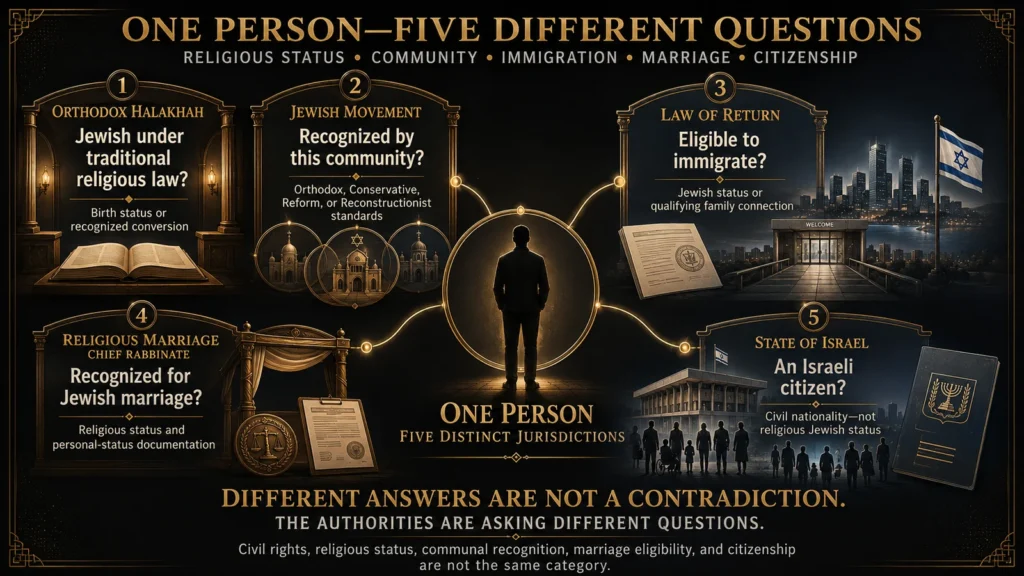
The answers can differ without contradiction because the questions come from distinct jurisdictions. Israeli law can grant a civil right; it cannot settle theology for every Jewish movement.
Why Judaism Does Not Seek to Make Everyone Jewish
Judaism accepts converts, and Jewish communities often welcome sincere seekers. Yet Judaism has usually not organized itself around a command to turn every nation into Jews. Its mission has more often focused on preserving, teaching, and renewing the Jewish people while bearing witness to God through covenantal life.
This inward emphasis can be seen in education, family continuity, synagogue life, Torah study, observance, care for Jews in danger, resistance to antisemitism, and efforts to reconnect unaffiliated Jews. The Orthodox term kiruv, meaning drawing near, commonly describes outreach to Jews who are less observant. Judaism often seeks the religious renewal of Jews rather than the conversion of the nations.
History also matters. Christian and Muslim rulers frequently restricted Jewish efforts to receive converts, while Jewish minorities faced coercion and missionizing directed at them. Reform Judaism’s answer to why Jews generally do not proselytize notes those historical pressures while acknowledging modern Jewish outreach and conversion.
Righteous Gentiles and the Noahide framework
A major traditional explanation is that Gentiles do not need to become Jews in order to stand rightly before God. Rabbinic tradition identifies commandments associated with Noah as universal moral obligations. In his Mishneh Torah, Maimonides teaches that a Gentile who carefully receives the seven commandments on their divine basis belongs among the righteous of the nations and has a share in the world to come. The text of Kings and Wars 8:11 provides a primary statement of this influential view.
Maimonides is a major authority, not a poll of every Jewish thinker. Jewish accounts of the afterlife, Noahide obedience, revelation, and righteousness vary. The point needed here is modest: Judaism generally does not summon all humanity into Jewish identity because righteous Gentiles may be accepted without conversion under major traditional accounts. It is false to say Judaism simply keeps salvation for Jews.
Conversion remains possible precisely because particular people may seek to join Israel’s covenantal life. The community may test sincerity and require lengthy preparation, but the door is not biologically sealed. Non-proselytism and conversion can coexist because Judaism does not regard becoming Jewish as the universal duty of every human being.
Christianity’s different missionary claim
Christianity begins from Israel’s Scriptures and Israel’s Messiah, but Jesus gives His disciples a universal commission: make disciples of all nations (Matthew 28:18-20). The apostles do not require Gentiles to become ethnic Jews. They preach repentance and forgiveness in Jesus’ name to every people.
The invitation is universal because the human problem is universal. The Savior is exclusive because reconciliation is found in Jesus Christ, not in several parallel covenants or equally saving beliefs. Christianity offers universal invitation through one exclusive Savior.
Where Jewish Identity Boundaries Reveal Deeper Theology
Judaism’s particularism extends beyond whether Gentiles must convert. Its internal boundaries reveal which forms of belonging survive and which beliefs place a person outside Judaism religiously.
Conversion Is Real, but Recognition Is Fragmented
Conversion genuinely joins a person to a Jewish community and peoplehood. The fracture appears when recognition must travel. Orthodox, Conservative, Reform, and Reconstructionist authorities do not accept every conversion equally, and Israeli civil recognition may diverge from recognition by the Chief Rabbinate.
No single Jewish authority can make a conversion universally portable. Admission is open in principle but institutionally mediated: later acceptance may depend on which rabbis supervised the process and which authority is asked. Fragmented authority is not unique to Judaism, and communities have legitimate reasons to guard membership. The tension remains because Judaism speaks of one people under covenant while operating through competing standards of entry.
Jewish Atheism May Remain Inside—Jesus Often Does Not
A Jewish atheist may retain birth status, ancestry, culture, peoplehood, and communal identity despite rejecting God’s existence. Confession of Jesus as Messiah and divine Lord, by contrast, ordinarily places a person outside recognized Judaism religiously even when ancestry and some inherited-status consequences remain.
Mainstream Jewish authorities give a coherent rationale: atheism is unbelief within the people, while Christianity is affiliation with a rival religion whose claims about incarnation, Trinity, Messiah, and resurrection Judaism rejects. That explanation distinguishes inherited belonging from religious allegiance. The Christian critique is that it also exposes an asymmetry. Mainstream Judaism may accommodate radical unbelief within Jewish peoplehood more readily than faith in the One Christians confess as Israel’s Messiah. Jesus becomes the decisive theological boundary.
National Inclusion Can Be Broader Than Religious Inclusion
The Law of Return extends family eligibility beyond people recognized as Jewish by Orthodox halakhah, while rabbinical marriage authorities apply narrower religious rules. The state may regard someone as sufficiently connected to Jewish peoplehood for national inclusion while the religious establishment regards the same person as insufficiently Jewish for Jewish marriage.
Civil and religious bodies ask different questions, so differing answers are not a logical contradiction. The practical asymmetry is still real: the same person may be welcomed for immigration and citizenship yet required to convert or prove additional status before marrying through the rabbinate.
The Deepest Boundary Is Jesus Christ
Mainstream Jewish institutions reject Jesus as Messiah and divine Lord. Some modern statements express that boundary in restrained institutional language. The historical record is not uniformly restrained. Babylonian Sanhedrin 43a portrays Jesus the Nazarene as practicing sorcery, inciting idolatry, and leading Israel astray. Manuscript traditions associated with Babylonian Gittin 57a have been read as placing Yeshu in an afterlife scene involving degrading punishment. Later Jewish polemical narratives also reject His messianic and divine claims through charges of deception or false claim-making.
Those claims require discipline. Not every passage using Yeshu is certainly about Jesus of Nazareth; surviving manuscripts and printed editions reflect variation and censorship; narrative polemic is not the same genre as a binding legal ruling. Peter Schafer’s scholarly study, Jesus in the Talmud, argues that several passages form deliberate anti-Christian polemic, while other scholars identify fewer references. None of this establishes what every modern Jew or rabbi teaches. It does establish that some Jewish opposition to Jesus has exceeded respectful disagreement. The complete textual and manuscript case belongs in a specialist article, not here.
Christianity makes a different judgment. Rabbinic Judaism is a historical tradition that developed after biblical Israel; Christianity claims that covenant, Temple, priesthood, sacrifice, Messiah, and promise reach their fulfillment in Jesus Christ. By the New Testament’s standard, teaching that denies Jesus as the Christ and Son is anti-Christ in content (1 John 2:18-23; 4:1-3). That judgment addresses doctrine, texts, and institutions. It must never become an ethnic label for Jewish ancestry, peoplehood, or every Jewish community.
These tensions converge in the Jewish believer in Jesus, whose ancestry and peoplehood may remain visible even while mainstream Judaism classifies the person’s confession as outside Judaism.
What About Jewish People Who Believe in Jesus?
This question exposes the difference between ancestry, status, belief, and communal affiliation more clearly than almost any other case.
A Jewish believer in Jesus does not lose Jewish ancestors, family history, memories, culture, or the historical experiences that shaped the family. Christianity does not turn a Jew into a Gentile. The first disciples of Jesus were Jews, and the New Testament continues to identify Paul as an Israelite and a descendant of Abraham after his confession of Christ (Romans 11:1).
Traditional Jewish law may also preserve birth status in limited personal-status matters even after a Jew adopts another religion. That does not mean the person remains religiously inside Judaism. Status can persist while affiliation and communal privileges change.
Mainstream Jewish institutions classify Christian confession outside Judaism. The Rabbinical Assembly’s detailed responsum on the status of Messianic Jews treats belief in Jesus as Messiah and God as Christian belief, while acknowledging that technical Jewish status can remain in some matters. The Reform rabbinate’s 1985 resolution on Messianic Jewish proselytization likewise rejects the claim that Messianic Judaism is another recognized branch alongside Orthodox, Conservative, Reform, and Reconstructionist Judaism.
Those rulings should be represented plainly, not caricatured. Mainstream Judaism does not accept the Christian confession of Jesus and sees Messianic Jewish theology as Christianity presented with Jewish forms. The classification can change religious affiliation and communal privileges without erasing ancestry, family history, culture, or every inherited-status distinction.
The Christian conclusion is equally precise. Jesus is Israel’s Messiah, not a foreign deity imposed from outside Israel’s story. Jewish believers in Him do not become Gentiles, and Gentile believers do not become ethnic Jews. Both are reconciled to God through the same crucified and risen Messiah and brought into one new-covenant people. Ethnic and cultural distinctions remain real; hostility and saving separation do not.
Jewish and Christian Covenant Membership Compared
Judaism preserves a particular people. Christianity calls every people into one redeemed family through Jesus Christ. The comparison is not “exclusive Judaism” versus “inclusive Christianity” if inclusive means every belief is equally true. The two traditions make different claims about covenant membership, mission, Messiah, and salvation.
The gospel does not ask the nations to enter a Jewish ethnicity. At the Jerusalem council, the apostles refuse to make circumcision and full Torah conversion conditions for Gentile disciples (Acts 15:1-21). Paul teaches that those once far off are brought near by Christ’s blood and that believing Jews and Gentiles are reconciled in one body (Ephesians 2:11-22).
This unity neither erases Jewish history nor establishes Gentile superiority. Gentile Christians are warned against boasting over Jewish branches. Jewish believers do not need to renounce ancestry to receive Jesus. The one family is created by grace, not by making everyone culturally identical.
The decisive boundary is Christ. No inherited identity, ancestry, culture, circumcision, synagogue standing, church membership, legal recognition, or national citizenship can justify a sinner. The apostles proclaim one Lord and one saving name (Acts 4:10-12). Christianity’s invitation reaches every nation, and its exclusivity rests in the unique person and work of Jesus.
Frequently Asked Questions
Is Judaism a religion or an ethnicity?
Judaism is a religion, while Jewishness also includes ancestry, peoplehood, culture, family, law, and communal belonging. Ethnoreligious people is useful, but no one label explains converts, secular Jews, diverse Jewish populations, movement disagreements, and Israeli civil law as well as a layered model does.
Can someone be Jewish and atheist?
Yes. A person may remain Jewish by birth status, ancestry, peoplehood, culture, and community while denying God’s existence. That position conflicts with religious Judaism’s belief in God, but it does not automatically erase Jewish identity or traditional birth status.
Is Jewishness determined by the mother?
Traditional rabbinic law recognizes a person as Jewish through a Jewish mother or valid conversion. Orthodox and Conservative Judaism retain that rule. North American Reform Judaism and Reconstructionist Judaism recognize descent through either parent under defined upbringing and identification conditions. Priestly and tribal lineage traditionally follows the father, so not every kind of lineage is maternal.
Can someone become Jewish through conversion?
Yes. Conversion joins the person to Judaism and the Jewish people. Requirements differ by movement and usually involve study, commitment, community, and formal ritual. Because movements do not recognize every conversion equally, the authority supervising the process matters.
Does having one Jewish grandparent make someone Jewish?
Not automatically under the major religious standards discussed here. A Jewish grandparent establishes ancestry and may create eligibility under Israel’s Law of Return. Traditional law looks to the mother or conversion; Reform and Reconstructionist rules concern a Jewish parent and defined Jewish upbringing, not any single ancestor at any distance.
Does DNA prove someone is Jewish?
No. DNA can suggest ancestry connected with populations included in a company’s reference data or illuminate broad population history. It cannot prove religious status, validate a conversion, establish covenant membership, or identify a single Jewish gene.
Are all Israelis Jewish?
No. Israeli is a civic or national identity. Israel has Jewish, Muslim, Christian, Druze, and other citizens. Most Jews worldwide are not Israeli citizens. Jewish and Israeli should never be used as automatic synonyms.
Can someone stop being Jewish?
Religious affiliation and communal participation can change, but traditional law ordinarily treats valid Jewish birth or conversion as enduring status. A person who adopts another religion may be classified as an apostate and lose religious privileges while remaining Jewish in limited personal-status senses. Other layers, such as ancestry and family history, plainly do not disappear.
Are Jewish believers in Jesus still Jewish?
They remain Jewish by ancestry, family history, and culture when those layers apply, and traditional law may preserve birth status in limited matters. Mainstream Jewish institutions classify belief in Jesus as Messiah and God as Christianity, not a branch of Judaism. Christianity teaches that a Jewish believer does not become a Gentile but joins believing Gentiles in one redeemed people through Israel’s Messiah.
Is a child adopted by Jewish parents automatically Jewish?
Adoption creates a real family bond but does not automatically establish Jewish religious status when the child does not already qualify by descent. Jewish communities ordinarily use conversion or a formal status process, with requirements differing among movements. Parents should consult the rabbi or authority whose future recognition matters to the family.
Why does Judaism not try to convert everyone?
Judaism generally focuses on sustaining Jewish covenantal life and renewing Jews rather than making all nations Jewish. Major traditional accounts hold that righteous Gentiles may stand rightly before God without conversion. Judaism accepts converts, but Jewish identity is not presented as every person’s universal obligation.
Sources and Further Reading
The article’s major boundary claims rest on primary movement policies, rabbinic texts, civil law, demographic research, and peer-reviewed scholarship. Each source has a limited job; no movement document speaks for all Judaism, and no demographic or genetic study can establish religious status.
Primary Jewish and civil sources
- Mishnah Kiddushin 3:12 states the rabbinic lineage categories behind the maternal-status and paternal-lineage distinction.
- The CCAR’s 1983 mixed-marriage resolution gives the North American Reform standard and its public-identification conditions.
- The Rabbinical Assembly’s guidance for Jews of blended backgrounds states the Conservative/Masorti baseline and pastoral confirmation process.
- Reconstructionism Explained gives the movement’s either-parent rule and peoplehood framework.
- The Law of Return provides the civil definition of Jew and the broader family-eligibility provisions.
- Maimonides on righteous Gentiles is a major primary source for the Noahide framework.
- Babylonian Sanhedrin 43a and Gittin 57a are primary references; the latter requires manuscript and identification cautions.
Demographic and scientific research
- Pew Research Center’s Jewish Americans in 2020 documents religious, ancestral, and cultural self-understanding in the United States.
- Ostrer and Skorecki’s review of Jewish population genetics summarizes shared ancestry, admixture, founder effects, and diversity.
- Waldman and colleagues’ high-resolution population study refines relationships among historically distinct Jewish populations.
History and identity scholarship
- Cohen’s study of the matrilineal principle establishes the early rabbinic rule while examining debates over its development.
- Staples’s study of Israelites and Jews traces the relationship between those ancient terms without pretending they were always interchangeable.
- ANU Museum’s history of Ethiopian Jewry introduces the distinctive Beta Israel story and its recognition struggles.
- Schafer’s Jesus in the Talmud analyzes Talmudic polemic; a JTS source collection samples later narratives.
Jesus Christ and the Family of Promise
Jewish peoplehood is historically real. Its extraordinary continuity cannot be reduced to a private creed, a genetic result, or a modern passport. Jewish communities have carried Scripture, memory, worship, family, argument, suffering, and hope across empires and continents. Christians should describe that inheritance truthfully, reject antisemitic racial myths, and refuse to treat Jews as one political or religious bloc.
The same honesty requires a Christian distinction. Birth into the Jewish people is not the new birth. Conversion to Judaism is not reconciliation through Christ. Eligibility under a state’s immigration law is not citizenship in heaven. A DNA estimate cannot diagnose sin or confer righteousness. Gentile ancestry has no saving advantage either.
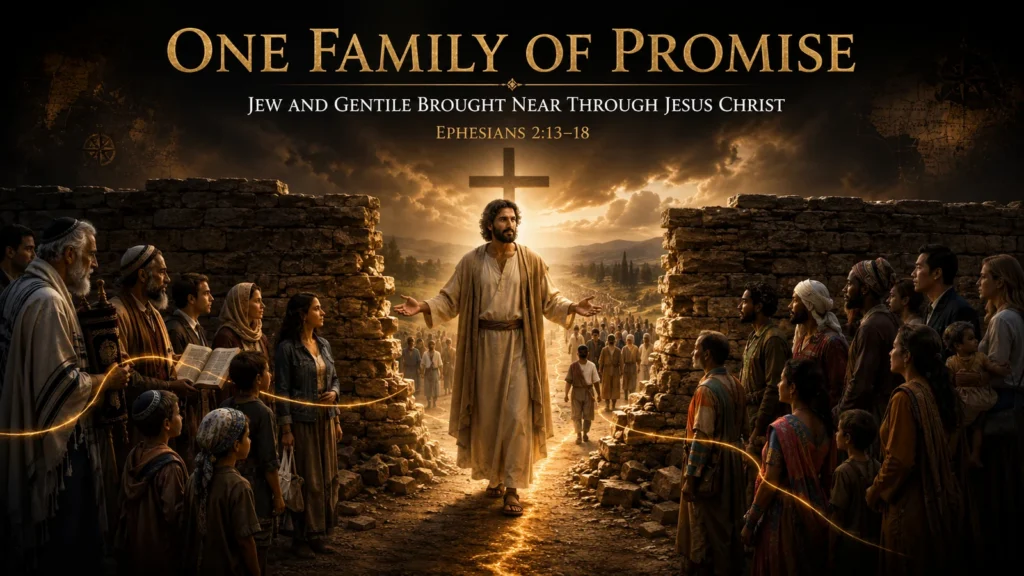
God’s promise to Abraham always moved toward blessing for the nations, and the New Testament identifies Jesus as the promised Seed in whom that blessing comes. The wider case appears in the site’s study of prophecies fulfilled in Jesus and its focused account of Jesus as covenant Redeemer. In Christ, Gentiles are brought near without pretending to become ethnic Jews, and Jewish believers receive their Messiah without becoming Gentiles.
This family is neither a coalition of equally saving religions nor a Gentile replacement for Israel. It is the people created by the crucified and risen Lord. Jesus breaks the hostility between Jew and Gentile, grants the same Spirit, and makes both one through His blood. The invitation therefore reaches every nation, while the ground of peace remains one Savior.
What does it mean to be Jewish? It means belonging to a historically continuous people through layers of descent, conversion, law, culture, family, community, and identity that no single label can contain. What reconciles a Jewish or Gentile sinner to God? Only repentance and faith in Jesus Christ. He is Israel’s Messiah, the Savior of the nations, and the one in whom the family of promise receives its life.