
GUIDED ARTICLE EXPERIENCE
What Do Jews Believe About Jesus? Rabbinic Views, Jewish Objections, and the Christian Answer
Read along as the narration moves through the article.
Private device narration · No hosted audio or tracking
CONTINUE GUIDED TOUR
Continue where you left off.
GUIDED TOUR COMPLETE
You have reached the end of this study.
Study record saved on this device.
GUIDED TOUR
What Do Jews Believe About Jesus? Rabbinic Views, Jewish Objections, and the Christian Answer
Narrator: Paranoid Prophet Recommended Voice Native device narration
Prepare to follow the article as it is narrated.
VOICE & TOUR OPTIONS
Voice & Listening
NARRATOR
Finding a narrator…
Checking the best narrator available on this device.
Restores the best curated narrator available on this device.
Narrator choices are curated for clear, long-form listening on this device.
Screen-awake support will be checked when narration starts.
CHOOSE A NARRATOR
Curated for this device
Choose a verified narrator for this browser, or use System Narrator. Automatic mode uses the best reliable route exposed by this device; your chosen narrator is preserved even if this device needs a temporary fallback.
Preparing the guided article experience…
RESUME GUIDED TOUR?
Continue where you left off.
GUIDED TOUR COMPLETE
You have reached the end of this study.
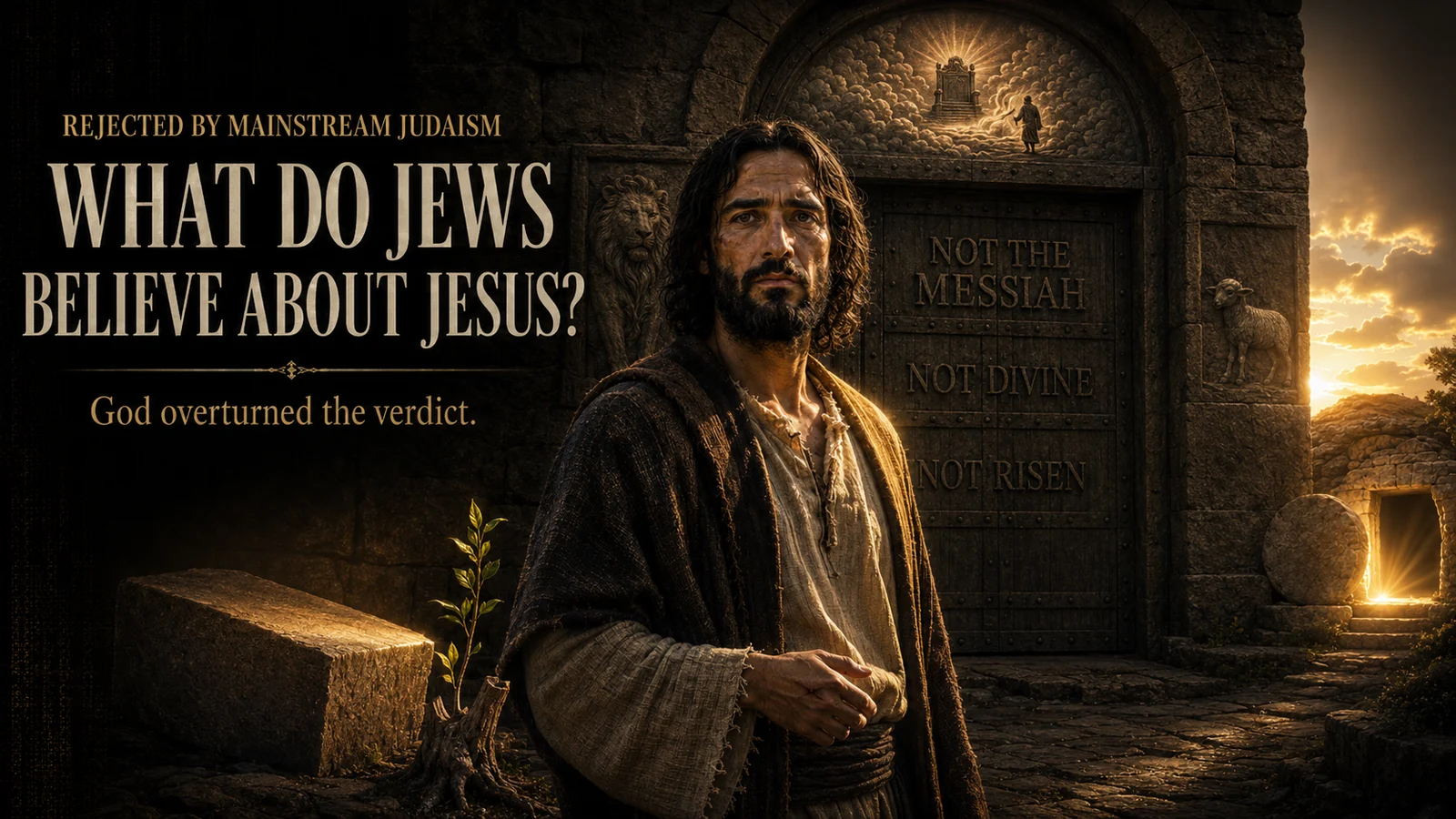
Christianity makes an arresting claim about Jewish history: the Messiah of Israel has come, and mainstream Judaism has rejected Him. Christians confess Jesus as the eternal Son, crucified Savior, risen Lord, final priestly atonement, and coming King. Mainstream Jewish theology denies every decisive part of that confession.
The disagreement should neither be blurred nor weaponized. Jewish people are not a theological monolith; movements, ancestry, practice, and personal judgment differ. Many rarely think about Jesus, while others admire Him or associate His name with Christian persecution. None of that permits collective guilt, ancestry-as-creed, or concealment of difficult sources.
This article will give the strongest Jewish objections their proper force before answering them. It will not begin with insults from late polemic when the central objection is far more serious: Jesus did not visibly complete every promised work of messianic restoration before He was killed. It will distinguish first-century evidence from late tradition, identify the leaders, crowd, governor, and soldiers involved in the crucifixion, and return to the claim on which Christianity stands or falls: God raised Jesus from the dead. Fairness requires accurate description. Truth requires a verdict.
Article Guide16 sections
Short Answer: What Do Jews Believe About Jesus?
No single Jewish opinion, but a clear mainstream theological boundary
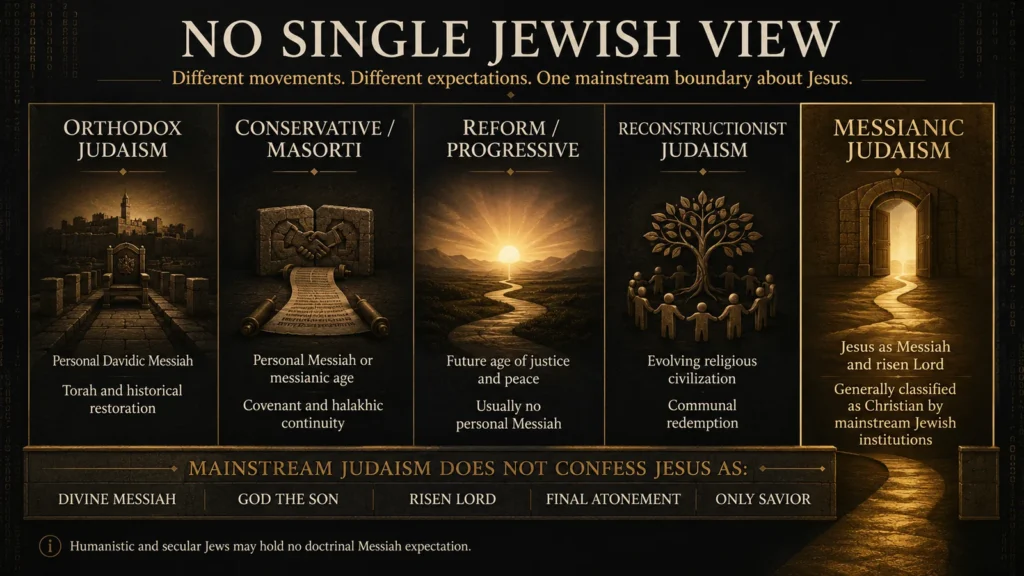
So, what do Jews believe about Jesus? There is no universal Jewish social opinion, yet there is a recognizable theological boundary. Orthodox, Conservative/Masorti, Reform/Progressive, and Reconstructionist Judaism do not confess Jesus as Israel’s Messiah, God the Son, the risen Lord, the once-for-all atonement for sin, or the only Savior. The official Reform explanation of Judaism’s difference from Christianity, for example, identifies Christian acceptance of Jesus as Messiah and personal Savior as the essential divide and says Jesus is not a divine being in Jewish theology.
The movements do not reject Jesus from identical theological systems. Orthodox Judaism generally expects a personal Davidic Messiah who restores Israel in history and upholds Torah. Conservative Judaism accommodates a range from a personal Messiah to a messianic age while retaining covenantal and halakhic commitments. Reform Judaism generally emphasizes a future age of justice rather than expectation of a personal Messiah. Reconstructionist Judaism understands Judaism as an evolving religious civilization and usually frames redemption communally rather than around a supernatural redeemer. Humanistic and secular Jews may not affirm a doctrinal Messiah at all. Their routes differ; none reaches the Christian confession.
Jewish people, Jewish movements, rabbis, and secular Jews are not interchangeable
The word Jewish can name ancestry, peoplehood, legal status within a Jewish community, religious affiliation, culture, or some combination. Those layers must remain distinct. A secular Jew does not become a spokesman for the Talmud. An Orthodox ruling does not describe every Reform Jew. One rabbinic passage is not a poll of living Jewish people. The fuller identity framework is examined in What Does It Mean to Be Jewish?.
History also requires distinctions. Biblical Israel, the varied Judaism of the Second Temple period, later rabbinic Judaism, modern Zionism, and the State of Israel are related but not interchangeable. Rabbinic Judaism developed through the Temple’s destruction, legal interpretation, liturgy, communal survival, and centuries of debate. It is not simply the Old Testament carried forward unchanged, and Christianity is not a Gentile idea dropped into a religion-free world. Both arose from disputes within Israel’s first-century setting. For that development, see Biblical Israel, Second Temple Judaism, and Rabbinic Judaism. The modern political state likewise must not be made identical to every biblical use of Israel, as Modern Israel vs. Biblical Israel explains.
Respectful description does not erase incompatible truth claims
Respect is not the claim that Judaism and Christianity are equally true paths describing the same spiritual destination. They make incompatible statements about a public figure. Either Jesus was raised or He remained dead. Either He is the Messiah or He is not. Either worship directed to Him belongs within fidelity to Israel’s God or it is idolatry. Either His death and living priesthood fulfill Israel’s sacrificial grammar or the Christian account is false.
Christians should state that collision without contempt. Jewish preservation of Scripture, moral seriousness, communal endurance, and resistance to coercion deserve honest recognition. Christian persecution committed under the sign of the cross was evil; it cannot be excused as zeal for Christ. Yet suffering inflicted by Christians cannot decide whether Christianity’s central claim is true. The question remains who Jesus is and what God did after His crucifixion.
Jesus Was Jewish—But Mainstream Judaism Rejects the Christian Verdict
Jesus inside Second Temple Judaism
Jesus was born, circumcised, raised, taught, worshiped, disputed, and died as a Jew under Roman rule. He cited Israel’s Scriptures, attended synagogue, went to Jerusalem for festivals, debated Sabbath and purity, affirmed the Shema, spoke of Abraham and Moses, and announced Israel’s God as King. His controversies make sense inside Second Temple Judaism, where Pharisees, Sadducees, priestly authorities, apocalyptic groups, teachers, and ordinary Jews disagreed about Torah, Temple, resurrection, purity, Rome, and the coming kingdom.
Calling Jesus Jewish is therefore historically necessary. It is not, however, a complete verdict on Him. A teacher can belong within Israel’s world while making claims that other Jewish teachers judge false. The Gospels present Jesus not merely as another participant in debate but as one who acts with messianic authority, forgives sins, claims lordship over Sabbath, announces judgment on the Temple establishment, and identifies Himself with the enthroned Son of Man.
Jewish New Testament scholar Amy-Jill Levine supplies a needed historical check. In PBS’s Jewish Jesus profile and Vanderbilt’s account of The Misunderstood Jew, she warns against making Jesus the lone compassionate, peaceful, woman-honoring teacher against a legalistic, violent, or misogynistic Judaism. Recovering His Jewish setting corrects Christian caricature and makes His disputes intelligible as Jewish disputes. It does not prove the Christian verdict. It sharpens the real question: why did this Jewish teacher place such extraordinary authority around Himself, and did Israel’s God vindicate Him by resurrection?
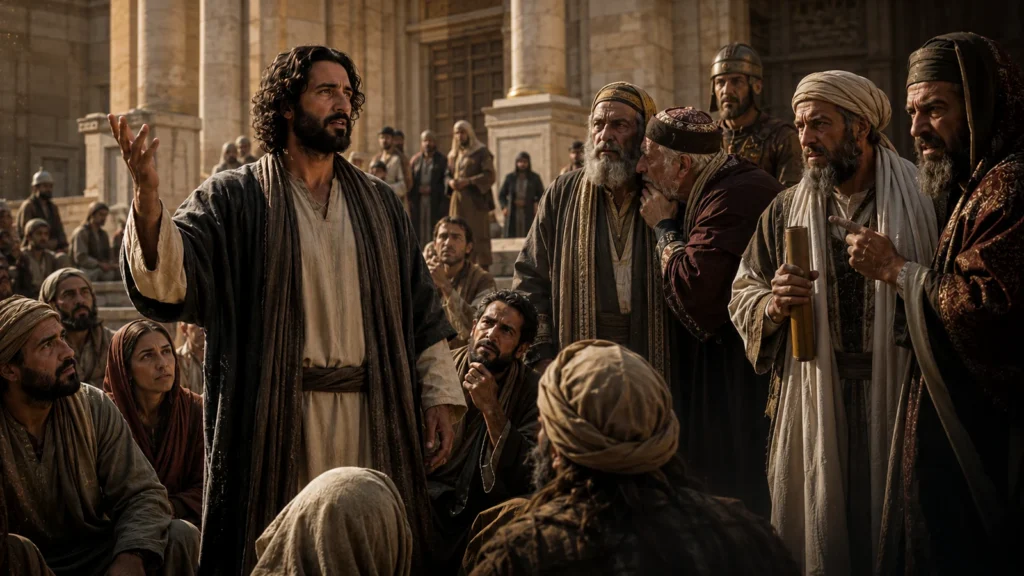
The earliest Jesus movement was Jewish
Jesus’ first disciples were Jews. The earliest proclamation arose in Jerusalem, used Israel’s Scriptures, and announced that the crucified Jesus had been raised by Israel’s God. Paul did not enter an empty field and invent a Gentile savior. Before his letters, there were assemblies, traditions, leaders, a sacred meal, baptism, Scripture arguments, and resurrection proclamation. Paul later met Cephas and James, Jesus’ brother, and said he transmitted what he had received.
The eventual Jewish-Gentile separation was real and painful, but it must not be projected backward as though Jesus, Peter, James, and Paul began outside Israel’s story. Christianity’s claim is not that God abandoned His earlier revelation and found a foreign replacement. It is that Israel’s Messiah came to Israel, was rejected by many of its leaders, was vindicated by God, and opened Abraham’s blessing to the nations without requiring Gentiles to become ethnic Jews.
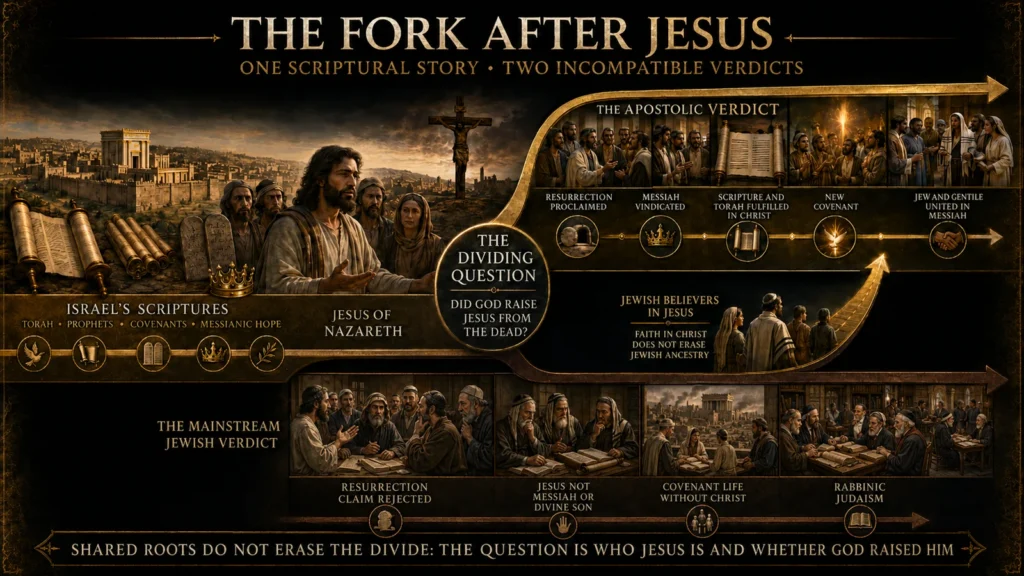
What mainstream Jewish movements reject about Jesus
Mainstream Jewish theology rejects more than the later label Christian. It rejects the apostolic verdict about Jesus’ identity and work. Jesus is not accepted as the promised Davidic Messiah because the visible messianic age is incomplete. He is not confessed as sharing the divine identity because Jewish monotheism regards incarnation and worship of Jesus as incompatible with God’s unity. His death is not received as the final atonement because repentance, prayer, restitution, divine mercy, Yom Kippur, and covenantal life are understood without a necessary crucified mediator. His resurrection is not accepted as God’s historical vindication.
Those denials fit together. If Jesus was not raised, the Christian structure collapses. A dead claimant who failed to restore Israel would not be rescued by later worship or theological ingenuity. If He was raised, however, every later judgment must be reconsidered: death becomes the scene of divine reversal, not final disqualification.
Messianic Judaism, ancestry, theology, and communal recognition
Messianic Jewish congregations affirm recognizably Christian claims while retaining Jewish forms, communal identity, and often Jewish ancestry. The Union of Messianic Jewish Congregations’ statement of faith confesses one God revealed as Father, Son, and Spirit, Jesus as risen Lord, forgiveness through Him, and the authority of both Tanakh and New Testament. Mainstream Jewish institutions generally classify that theology as Christianity rather than a movement within Judaism.
The resulting identity question cannot be solved with a slogan. A Jewish person who believes in Jesus does not lose ancestry. Halakhic status may persist under some definitions even when communal affiliation changes. A Messianic Jew may sincerely understand faith in Jesus as the fulfillment of Jewish hope, while a synagogue body may reject that religious claim as outside Judaism. Ancestry, halakhic status, self-understanding, and institutional recognition answer different questions.
The theological boundary is nevertheless clear. Mainstream Judaism refuses the Christian verdict; Messianic Judaism confesses it. That rejection is not arbitrary. It begins with what Judaism expects the Messiah to accomplish—and with the undeniable fact that the world Jesus left behind did not yet look redeemed.
Why Judaism Says Jesus Is Not the Messiah
The world is not yet at peace
The strongest Jewish objection begins outside the church and outside a book: look at the world. Israel’s prophets describe nations beating swords into tools of cultivation, universal knowledge of God, justice for the poor, creation healed from violence, and death finally defeated. War continues. Idolatry and cruelty continue. Graves continue to fill. If the Messiah’s arrival means visible restoration, a first-century execution followed by two thousand troubled years appears to disprove the claim.
This objection is stronger than saying Jewish people simply missed a few predictions. It asks whether Christianity changed the expected outcome after Jesus failed to produce it. The Christian answer must first admit the obvious: Jesus did not visibly complete every final restoration promise during His earthly ministry. Isaiah’s peace among the nations is not yet universal. The last enemy has not yet been removed. Calling an unfinished world finished would contradict both observation and the New Testament.
The exiles are not fully gathered and the Temple is not rebuilt
Traditional Jewish expectation also joins Messiah to Israel’s concrete restoration. Chabad’s current presentation of Moshiach offers an especially clear traditional Orthodox formulation: a human descendant of David and Solomon, devoted to Torah, who influences Israel toward the commandments, wages the battles of God, rebuilds the Temple, gathers the exiles, and then rules and teaches with justice. Miracles are not the identifying test; completed public works are. Chabad does not speak for every Jewish movement, but its criteria state the objection with useful precision. On those terms, Jesus’ first-century ministry did not complete the expected program.
Jesus did not rebuild the Jerusalem Temple. Rome destroyed it around four decades after His death. Nor did Jesus gather every Jewish exile to the land or establish an ordinary Davidic government. Christianity answers that Jesus Himself fulfills the Temple’s presence and sacrifice and that the ingathering has begun through a renewed people from Israel and the nations. Judaism replies that such spiritualization changes public promises into invisible claims. Christians therefore must show from Scripture, not convenience, why Messiah’s work may unfold through suffering, resurrection, present reign, and future return.
Messiah is expected as a human Davidic ruler
Jewish insistence that Messiah is human has real biblical grounding. Messiah means anointed one; Israel’s kings and priests were anointed, and the promised ruler arises from David’s line. The prophets can portray him judging, shepherding, defeating enemies, and ruling under God. They do not give a later Nicene creed.
Yet Second Temple hopes were not one uniform checklist. Jewish texts could expect royal, priestly, prophetic, or heavenly agents; some anticipated more than one anointed figure. Daniel 7 places a humanlike figure before the Ancient of Days to receive everlasting dominion shared with the saints. That variety does not prove incarnation, but it prevents a medieval synthesis from being treated as the sole possible expectation every first-century Jew was required to hold.
Maimonides and the disqualification of a killed claimant
The most influential systematic case appears in the twelfth-century legal code of Moses Maimonides. In Mishneh Torah, Kings and Wars 11, he describes a Davidic ruler devoted to Torah who compels Israel’s faithfulness, fights God’s battles, rebuilds the sanctuary, and gathers Israel’s dispersed. If the candidate does not succeed or is killed, Maimonides concludes that he is not the promised one. He explicitly places Jesus in that failed category.
That verdict has formidable internal logic. A killed king who leaves the promised restoration incomplete looks disqualified, not enthroned. Maimonides, however, wrote more than a millennium after Jesus and after centuries of Jewish-Christian conflict. His formulation is a major statement of rabbinic Judaism, not a transcript of one exhaustive first-century messianic creed. It tells us accurately how an influential Jewish authority assessed Jesus. It cannot by itself decide whether God raised Him.
Is the Second Coming a biblical explanation or an excuse after failure?
Counter-missionary writers press the sharpest form of the objection: once Jesus died without completing the promises, His followers deferred the missing work to a return. Any failed claimant could be protected by saying he will finish later. Where, they ask, does the Hebrew Bible announce two arrivals separated by millennia? Why should an uncompleted mission count as success?
Christians should not answer with a vague assurance that Jesus will come back someday. A promised return, standing alone, would be indistinguishable from an excuse. Nor should every prophetic text be divided mechanically into “first coming” and “second coming” predictions. The biblical case is cumulative: the Messiah suffers and is vindicated; David’s Lord reigns while enemies remain; Daniel’s humanlike ruler receives heaven’s kingdom; the servant dies, is assigned a grave, and yet afterward is vindicated; the enthroned king awaits the subjection of enemies.
The New Testament’s sequence is also present before later doctrinal systems. Paul’s early letters distinguish Christ’s resurrection as the firstfruits, His present reign, and the future defeat of death. They expect the risen Jesus from heaven and do so within the first Christian generation. That does not prove the sequence true, but it shows that the two-stage hope was not a medieval repair invented after centuries of disappointment.
If Jesus remained dead, the failed-Messiah verdict would stand. Christianity’s answer begins not with a future promise but with the claim that God raised Him.
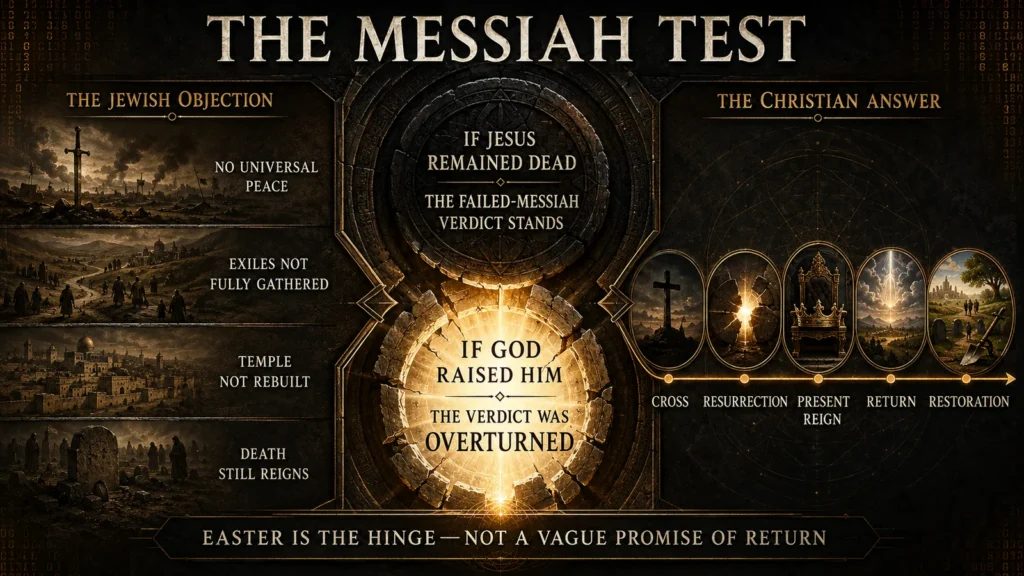
The Christian Answer: Cross, Resurrection, Present Reign, and Future Return
Suffering and glory within Israel’s Scriptures
Israel’s Scriptures do not present suffering and royal glory as mutually exclusive. Joseph descends before he rules and preserves life. David is anointed long before his enemies are subdued. The righteous sufferer is mocked before God vindicates him. Zechariah’s king arrives humble, while later scenes portray God’s decisive reign. Isaiah’s servant is rejected, bears wrongdoing, dies, and is afterward exalted.
These patterns do not allow Christians to label every sorrow a prediction of Jesus. They establish something more modest: humiliation before vindication is native to Israel’s story. Jesus’ claim cannot be dismissed merely because His path to kingship passed through suffering. The decisive issue is whether God vindicated this sufferer.
Why resurrection changes the failed-Messiah verdict
The Christian answer rises or falls at that point. Paul says plainly that faith is futile if Christ was not raised. The historical case begins with Jesus’ well-attested crucifixion and the very early proclamation summarized in 1 Corinthians 15:3-8: Jesus died, was buried, was raised, and appeared to named people and groups. Paul says he received this tradition; in Galatians he reports personal contact with Cephas and James.
History can establish the earliness of the claim, its ties to first-generation leaders, Paul’s transformation, and the movement built around it. Historical method cannot place divine action in a laboratory or force a reader to permit miracles. Yet the Christian inference is clear. If God raised Jesus, death did not expose a false Messiah. God overturned the rulers’ sentence and identified the crucified one as His chosen King.
This is why the early resurrection proclamation matters more than a generic prediction of return. Christianity does not ask readers first to trust an absent claimant’s unfinished plan. It asks what best explains why resurrection belief arose so early around named Jerusalem figures and a former persecutor.
The Messiah reigns before every enemy is visibly subdued
Psalm 110 portrays David’s Lord seated at God’s right hand while enemies still await defeat. Paul follows that shape in 1 Corinthians 15:20-28: the risen Christ is firstfruits and presently reigns until every enemy, finally death, is destroyed. Present reign and incomplete visible restoration are therefore not an embarrassed contradiction inside Christianity. They are part of its earliest announced sequence.
That reign is not merely private comfort. The gospel gathers Jews and Gentiles under one Lord, creates communities ordered toward holiness and reconciliation, and announces Christ’s authority over every power. Still, churches remain sinful and nations remain violent. Christians must not confuse partial signs of the kingdom with its consummation.
What remains future at Christ’s return
Christianity expects what Judaism rightly notices is absent: resurrection of the dead, final judgment, the removal of evil, peace under God’s King, and creation’s renewal. It also insists that these promises belong to the same Jesus who suffered. His return does not replace His cross; it reveals the full public result of the victory God began by raising Him.
The dispute therefore narrows. Judaism says an unfinished and killed claimant is disqualified. Christianity says a merely dead claimant would be disqualified, but a resurrected Messiah is enthroned and will complete His work. The second coming is empty as a rescue theory without Easter. With Easter, it is the completion of a sequence already embedded in the earliest Christian witness.
The resurrection may overturn the verdict of failure, but it raises an even sharper Jewish question: can a man receive divine honor without violating the one God of Israel?
Does Worshiping Jesus Violate the Shema?
The strongest Jewish monotheistic objection
The Shema commands Israel to hear that the Lord is one and to love Him with undivided allegiance. Jesus Himself names it the foremost command in Mark 12:28-34. Mainstream Judaism therefore hears Christian prayer to Jesus, baptism in His name, and worship of Father, Son, and Spirit as a breach of Israel’s defining confession. God is not a man, has no body, and does not share His glory with another. Calling Jesus divine can sound like adding a second deity and then protecting the addition with philosophical language.
Christians should not answer that the Hebrew word echad, “one,” secretly proves a compound unity. The word alone does no such work. Nor did ancient Judaism already possess the Nicene doctrine of one divine essence and three persons. That doctrine was articulated later as Christians tried to speak consistently about biblical texts and established worship. The real question is whether the earliest evidence includes Jesus within the unique identity, works, honor, and name of Israel’s God while distinguishing Him from the Father.
Word, Wisdom, Name, Glory, agency, and Daniel’s Son of Man as context—not a shortcut to the Trinity
Jewish Scripture and interpretation provided categories more complex than a solitary divine individual with no agents. God’s Word creates and accomplishes His purpose. Wisdom is poetically present with God and active in creation. God’s Name and Glory make His presence known. Angels and commissioned representatives may speak with delegated authority. Daniel’s humanlike Son of Man receives everlasting dominion before the Ancient of Days.
These categories help explain the Jewish grammar in which early Christians spoke. They do not prove that a Galilean teacher is God. An agent can represent God without sharing God’s identity; personified Wisdom can remain a literary figure; interpretations of Daniel 7 differ. The Christian case cannot leap from “Judaism had intermediaries” to “therefore the Trinity.” It must account for the specific convergence around Jesus.
Jesus within divine works, honor, Scripture, invocation, and worship
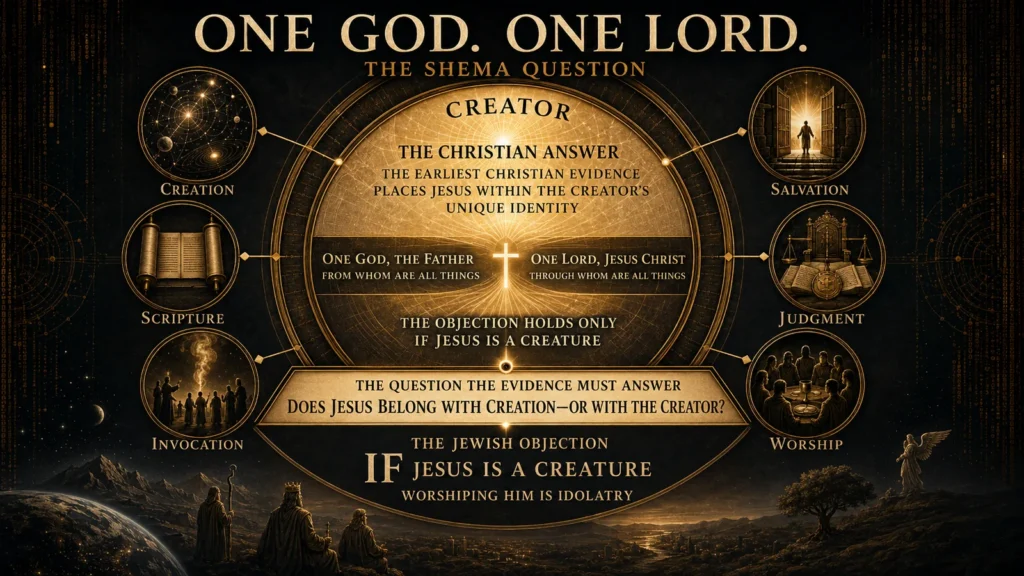
The strongest historical evidence comes from Paul’s undisputed letters, written before the Gospels. In 1 Corinthians 8:4-6, Paul rejects idols and speaks of one God, the Father, from whom are all things, and one Lord, Jesus Christ, through whom are all things. The wording does not collapse Father and Son into one person. It places Jesus inside a Shema-shaped confession and associates Him with creation and the believers’ existence.
Paul also describes Christians as those who call on Jesus’ name, preserves the Aramaic appeal Maranatha, directs communal life around the Lord’s meal, and invokes Jesus in blessing and prayer. In Romans 10:9-13, he connects confession of Jesus as Lord with Joel’s promise that those calling on the Lord’s name will be saved. Philippians 2:5-11 applies Isaiah 45’s universal homage to Jesus. Whether that passage is a formally pre-Pauline hymn is debated; its high Christology and early date are not.
The pattern widens beyond titles. Jesus is linked to creation, salvation, final judgment, forgiveness, invocation, prayer, sacred meal, and corporate worship. Believers do not honor Him as one useful spirit among many while continuing ordinary pagan worship. Their devotion occurs inside a fiercely scriptural movement that rejects idols. That extraordinarily early pattern is difficult to explain as a slow Gentile deification centuries after Jesus.
Later New Testament writings make the confession more explicit. John identifies the Word as divine and records Thomas addressing the risen Jesus as Lord and God. Hebrews places the Son above angels. Revelation directs heavenly praise to the One on the throne and to the Lamb. Those texts cannot prove every phrase goes back verbatim to the historical Jesus, but they show that Nicaea did not invent worship of Christ.
Father and Son distinguished without dividing the one God
Christian monotheism does not teach that Jesus is the Father or that two gods cooperate. The Father sends the Son; the Son obeys, prays, gives Himself, and is raised and exalted. Personal distinction is real. The same sources also place Jesus on the divine side of the Creator-creature divide. Later creedal language sought to guard both truths: distinction without separation, unity without confusion.
The Jewish objection exposes the unavoidable either/or. If Jesus is a creature, worshiping Him is idolatry, and Christianity has violated the Shema. If the Son shares the divine identity and the God of Israel raised Him, then refusing Him is not fidelity to monotheism. Confessing Jesus as Lord becomes obedience to Israel’s God, who has made Himself known through His Son.
That conclusion belongs within the wider evidence that Jesus is the Son of God, where history, resurrection, prophecy, and Scripture converge.
The resurrection does not by itself explain every metaphysical question. It identifies whose claims demand judgment. The earliest disciples did not first construct an abstract Trinity and then assign Jesus a place within it. Convinced that God raised and enthroned Him, they reread Israel’s Scriptures and worshiped accordingly. The scandal is not that Christians forgot the Shema. It is that Jewish monotheists came to include the crucified Jesus within their worship of the one God.
The dispute over identity becomes a dispute over authority. Did Jesus fulfill Israel’s Torah, or did Christianity use Him to abandon it?
Did Jesus or Paul Reject the Torah?
Jesus’ Jewish obedience and messianic authority
Jesus lived within Jewish covenant life. He was circumcised, observed festivals, taught from Torah, affirmed the Shema, and sent a healed man to make the offering Moses commanded. In Matthew 5:17-48, He denies coming to abolish Torah and speaks of fulfillment. Yet the same sermon places His own repeated declaration, “I say to you,” at the center of interpretation. Continuity is real; so is extraordinary personal authority.
Calling every controversy a rejection of Judaism mistakes intra-Jewish dispute for apostasy. Calling every ruling mere agreement with existing teachers misses the Gospel claim. Jesus does not treat Torah as evil. He interprets it around God’s intention and His own messianic authority, moves from external compliance to the heart, and presents Himself as the one in whom Scripture reaches its goal.
Sabbath, purity, food, and Temple disputes
Sabbath arguments concern mercy, necessity, and the authority of the Son of Man; they occur within a Jewish world that already debated permitted action. Jesus’ purity teaching targets the moral corruption proceeding from the heart. Mark’s comment in Mark 7:14-23 is often read as declaring all foods clean, but its grammar, scope, and relation to Jewish food law remain debated. It should not be advertised as an uncontested moment when Jesus canceled kosher practice.
The Temple evidence is similarly two-sided. Jesus worships there, teaches there, and treats it as His Father’s house. He also disrupts its commerce, denounces corrupt leadership, predicts judgment, and identifies His body with a destroyed and raised sanctuary. Christianity’s conclusion is not that the Temple was always fraudulent. It is that its God-given functions reach fulfillment in the Messiah.
Jeremiah’s new covenant: fulfillment, transformation, and Torah written on the heart
Jeremiah 31:31-34 promises a new covenant with the houses of Israel and Judah after the prior covenant was broken. God writes His Torah within, forgives iniquity, and establishes intimate knowledge of Himself. The passage neither calls God’s earlier revelation false nor describes a Gentile religion detached from Israel. It promises covenantal renewal through internalization and mercy.
Jesus applies new-covenant language to His death at the Last Supper. The New Testament then speaks of the Spirit, a renewed people, and access to God through Christ. Real change follows: priesthood, sacrifice, covenant membership, and purity are interpreted through the crucified and risen Messiah. “Fulfillment” cannot mean that nothing changed. It means the change claims continuity with God’s purpose rather than repudiation of it.
Why Gentiles were not required to become Jews
Paul’s fiercest words about law and circumcision address a specific crisis: must Gentiles become Jews to belong to Abraham’s family? In Galatians 2-5, Paul says no. He can oppose compelled Gentile circumcision while calling the law holy and retaining Jewish identity. That setting must not be stretched into two saving covenants, one through Christ and another apart from Him.
Acts 15 presents the Jerusalem assembly rejecting circumcision as a requirement for Gentiles while assigning a short list of practices important for holiness and shared fellowship. That account helps show an early communal settlement, but it should not be used to erase Paul’s sharper memory of conflict at Antioch. Galatians reports that fear, table separation, and public confrontation continued even among leading apostles. Gentile inclusion was not a frictionless administrative change. It forced the movement to decide whether Messiah’s table could unite people whose covenantal histories remained distinct.
Paul did not invent Christ, but his Gentile mission produced real covenantal change
Paul was enormously influential. His mission accelerated a multiethnic church, generated conflicts over table fellowship and circumcision, and supplied theological arguments that later Christians could misuse against Jews. Acts offers a wider narrative of Gentile inclusion, but Paul is the primary witness to his own disputes; the tension visible in Galatians must not be airbrushed away.
Influence is not invention. Paul says the gospel existed before he joined it. He received the death, burial, resurrection, and appearance tradition; knew Cephas and James; inherited the Lord’s meal; and persecuted assemblies already confessing Jesus. His letters preserve an early high view of Christ rather than creating Jesus’ significance from nothing.
The Christian verdict holds continuity and discontinuity together. Jesus fulfills rather than vilifies Torah. The new covenant changes how God’s people are constituted around Messiah and Spirit. Gentiles enter without ethnic conversion, yet they are called away from idolatry and into concrete obedience. Jewish believers do not need to despise their ancestry, while neither Jew nor Gentile can make Torah observance an alternative to Christ.
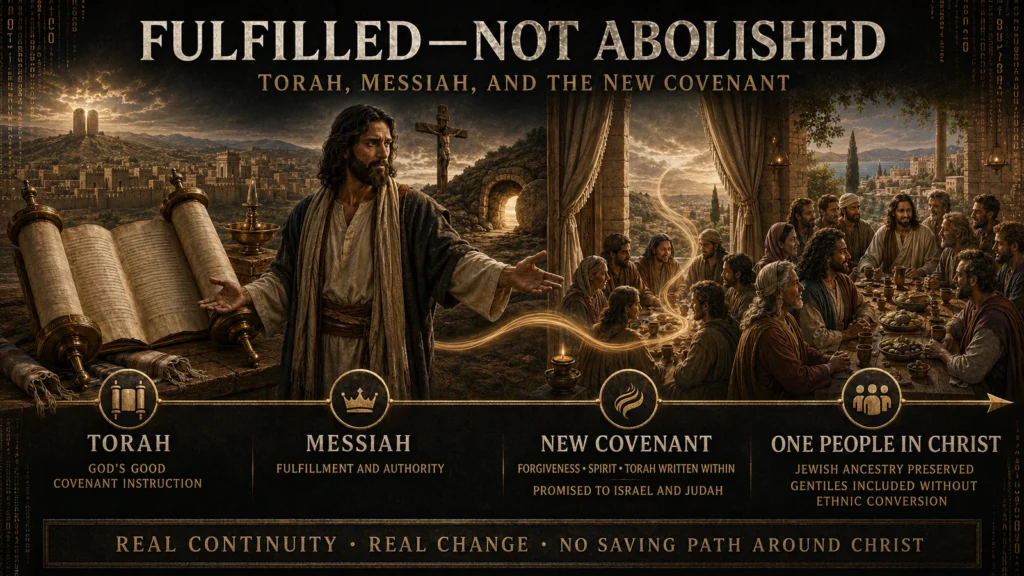
Torah leads to priesthood, sanctuary, sacrifice, and forgiveness. If God forgives the repentant, why should a final atonement through Christ be necessary?
Can God Forgive Without Jesus?
Repentance, prayer, restitution, mercy, and forgiveness in the Hebrew Bible
Judaism’s strongest answer begins in Scripture, not in a modern desire to avoid the cross. When Solomon dedicates the Temple, he anticipates exile far from the altar and asks God to hear repentant Israel from heaven. David’s penitential psalms appeal to mercy and a broken heart. Isaiah calls corrupt worshipers to wash, cease evil, seek justice, and reason with God. Ezekiel summons the wicked to turn and live. Hosea tells Israel to return with words. Nineveh repents in Jonah and receives mercy without entering Israel’s sacrificial system.
These passages establish truths Christians must affirm. God is not trapped by ritual. Repentance, confession, restitution, prayer, justice, and mercy are not evasions from real forgiveness. Sacrifice without obedience is offensive. The popular slogan “no blood, no forgiveness” is therefore too broad. Leviticus itself includes differentiated offerings, and not every purification or atonement rite requires an animal’s death in the same way.
Jews for Judaism asks whether the Torah is genuinely possible to keep and argues that Torah’s viability invalidates the claimed need for Jesus to die for sins. That challenge correctly rejects the caricature that every command was designed to be impossible and every Israelite lived under uninterrupted divine condemnation. Christianity need not defend that caricature. Its claim is not that no covenant member ever obeyed faithfully or received mercy. It is that even faithful Torah observance never abolished universal sin, death, priestly mediation, or the need for God’s final act of cleansing and reconciliation.
The Christian claim is narrower and deeper. The God who forgives freely also gave Israel a priesthood, sanctuary, Day of Atonement, and sacrificial order. Mercy and sacrifice were not competing religions. Repentance was never optional, and the altar was never meaningless.
Sacrifice was never mechanical—and was never meaningless
Leviticus joins sacrifice to confession, priestly mediation, purification, restitution, and restored communion. Different offerings address different conditions; the English word atonement can compress several functions. The blood of Leviticus 17 signifies life given by God for the altar. On Yom Kippur in Leviticus 16, blood rites cleanse the sanctuary while the live goat bears confessed wrongs away. Reducing this rich system to a payment mechanism distorts it.
Prophetic criticism does not repeal sacrifice. Isaiah and Amos condemn worship used to shelter oppression. Psalm 51’s preference for a contrite heart is followed by hope for righteous offerings. The proper conclusion is that God never accepts ritualized impenitence. It is not that He accidentally burdened Israel with empty ceremonies that later insight could discard.
This balance strengthens the Christian argument. If sacrifice were pagan nonsense, Christ’s death could not fulfill it. If repentance automatically made priesthood and altar unnecessary, much of Torah would become inexplicable. Israel’s system taught that sin corrupts worship and community, forgiveness is God’s gift, life belongs to God, mediation is graciously provided, and reconciliation costs more than verbal regret.
Yom Kippur, rabbinic teshuvah, and adaptation after the Temple
After Rome destroyed the Temple in 70, Jewish life adapted without pretending the loss was trivial. Prayer, fasting, confession, restitution, charity, study, and communal liturgy assumed greater practical weight. Rabbinic teaching developed teshuvah, the return to God expressed in remorse, abandonment of sin, confession, repair, and changed conduct. Yoma 85b-86b treats repentance and Yom Kippur seriously and distinguishes wrongs against God from wrongs against another person, which require reconciliation with the injured party.
This is not evidence that Jews had never valued sacrifice, nor did prayer begin only after 70. The daily prayers retained Temple-shaped memory, and traditional liturgy continued to mourn the sanctuary. Rabbinic Judaism constructed a viable covenantal life under conditions in which sacrifice was impossible. Christians should describe that achievement accurately rather than caricature Judaism as a religion with no answer to guilt.
The dispute is theological: does post-Temple adaptation provide the final form of atonement, or did God fulfill the priestly pattern in Messiah before the sanctuary fell? Christianity answers that the altar did not simply vanish into ethics. Its meaning converged on a person.
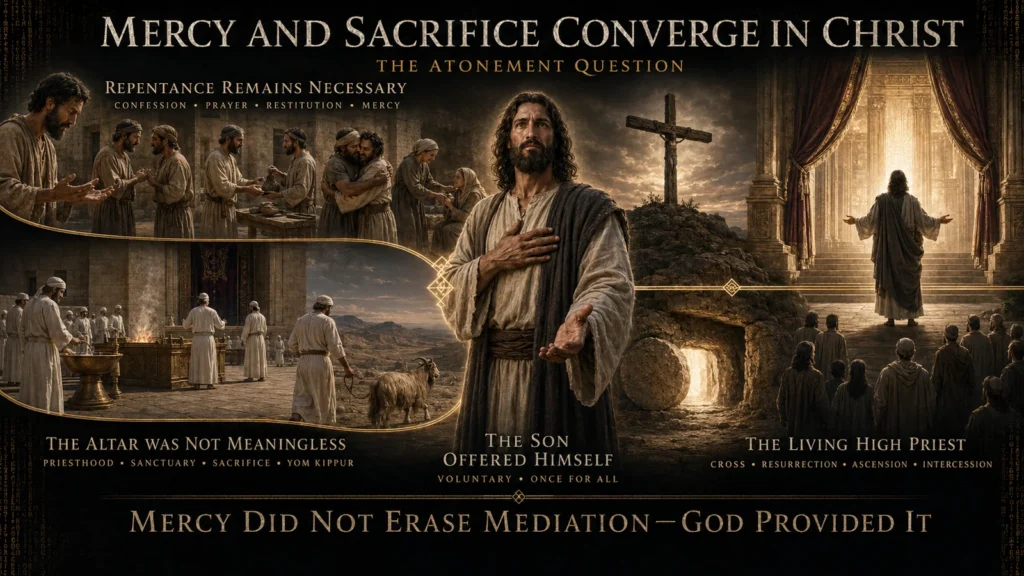
Why Christianity insists on Christ’s final offering and living priesthood
Jesus interprets His approaching death as service and ransom, gives the cup of the Last Supper new-covenant meaning, and willingly lays down His life. Paul places Christ’s death for sins inside the tradition he received. Hebrews then develops the fullest synthesis: Jesus is both holy offering and living High Priest, entering God’s presence through His own self-giving and continuing to intercede.
Jews for Judaism’s sacrificial-category objection is concrete: Jesus was a human being, not a permitted clean animal; His injured body was not an unblemished victim; He died outside the Temple, without an Aaronic priest, and without blood placed on the altar. A related article argues that blood loss was not the cause of His death. Those objections would defeat the claim that Jesus was one more Levitical animal offering performed according to sanctuary procedure. Hebrews makes a different category claim. Earthly priests, animals, altar, and sanctuary are God-given patterns, not a checklist for reenacting an animal rite with a man. The Son voluntarily offers Himself; His priesthood is associated with Melchizedek rather than Aaron; He enters the heavenly sanctuary; and the new covenant reaches the conscience rather than merely repeating earthly purification.
The resurrection is therefore essential, not an appendix to bloodshed. A dead victim alone cannot be an eternal priest. Hebrews 7:23-28 grounds Jesus’ enduring priesthood in an indestructible life, while Hebrews 9-10 joins His decisive self-offering to heavenly ministry. Christianity’s claim is the integrated work of cross, resurrection, ascension, priesthood, and intercession. Treating it as a defective livestock sacrifice misses the argument Hebrews actually makes; rejecting Hebrews’ typology is possible, but answering another category is not a refutation of it.
Repentance remains necessary. Christians confess sin, turn from evil, repair wrongs where possible, and depend on mercy. They do not purchase pardon by feeling sufficiently ashamed. Christ is necessary because the New Testament identifies Him as God’s appointed mediator who deals with guilt, cleanses conscience, defeats death, and restores communion. The fuller account of what Jesus’ death accomplished belongs to that entire death-resurrection-priesthood pattern.
The cross is divine self-giving, not pagan manipulation of God
A sharp Jewish objection compares substitutionary atonement with pagan sacrifice: an angry deity is appeased by killing an innocent third party. That picture would be morally grotesque. It is also not the Christian confession at its best. The Father does not seize an unrelated victim. God acts in the Son; Christ freely gives Himself; Father and Son are united in the mission to reconcile enemies. Human authorities commit injustice, while God transforms their evil act into voluntary saving self-giving.
The cross does not make God merciful. God’s mercy sends the Son. Nor does it make cruelty good. The leaders’ plot, Pilate’s sentence, and Roman torture remain sinful. Divine providence and human guilt operate at different levels. Christians see the holy Lamb bearing sin because the incarnate Son chooses obedience and love, not because suffering has magical value.
That account must still be tested. Its scriptural center appears in the strange servant whose suffering becomes redemptive.
The disagreement sharpens around the servant who suffers, bears sin, dies, and is vindicated.
Does Isaiah 53 Speak About Israel, the Messiah, or Both?
Israel as God’s servant
Isaiah repeatedly calls Israel or Jacob God’s servant. A collective reading of Isaiah 52:13-53:12 therefore has genuine textual grounding. It did not begin with the medieval commentator Rashi, and Christians should stop claiming that rabbis invented it simply to avoid Jesus. Jewish interpreters can read the servant as Israel suffering among the nations and eventually vindicated.
That context matters, but the label servant does not settle every referent. Isaiah can portray a servant who embodies Israel’s calling while also addressing Israel, restoring Jacob, and bringing light to the nations. Corporate identity and individual representation can overlap, as kings, prophets, priests, and faithful remnants embody a people.
The servant who restores Israel and suffers despite innocence
The servant songs create a difficult profile. The servant is chosen, Spirit-endowed, gentle, and commissioned to establish justice. In Isaiah 49 he is associated with Israel yet tasked with bringing Jacob back. In Isaiah 53, speakers confess that they misjudged him. He suffers despite innocence, bears others’ wrongdoing, is cut off from the land of the living, receives a grave, and is afterward vindicated and allotted triumph.
Israel’s historical suffering can illuminate the passage, especially its humiliation before nations. Yet the servant’s innocence and representative action create pressure on a flat equation with the whole nation. The figure is Israel-shaped and more concentrated than undifferentiated Israel. The text invites a representative who fulfills the vocation the people were called to carry.
Corporate, representative, individual, and messianic readings
The named counter-missionary case deserves more than the myth that Rashi invented an Israel reading. Tovia Singer’s rabbinic interpretation of Isaiah 53 and Jews for Judaism’s Jewish perspective identify the servant with Israel, read the astonished nations as speakers, and place the song between Israel’s humiliation and restoration. That corporate reading existed before Rashi and has serious contextual force. Nor does Targum Jonathan amount to a concealed Christian confession: it names Messiah but redistributes much of the suffering. No text was “forbidden” because it obviously proves Jesus.
Yet corporate and representative meanings need not exclude one another. Isaiah’s servant is called Israel and also restores Israel; he is presented as innocent, bears others’ wrongdoing, is cut off, receives a grave, and is afterward vindicated. The Christian reading is strongest when it does not erase Israel: Jesus is Israel’s faithful representative who gathers the servant vocation into Himself. Context supplies the corporate identity; the servant’s concentrated profile and Jesus’ resurrection supply the messianic identification.
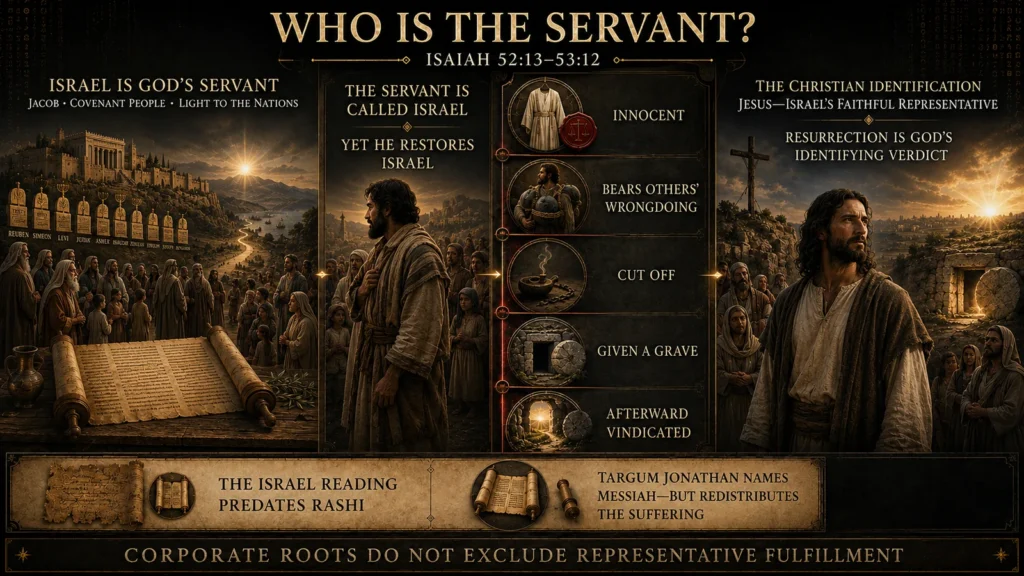
Targum Jonathan and the limits of popular apologetic claims
The later Aramaic Targum Jonathan on Isaiah 52-53 explicitly introduces the servant as the Messiah. That fact shows a messianic interpretation was available within Jewish reception. It does not show the Targum teaches the Christian doctrine of substitution. Its paraphrase redistributes suffering and judgment, often shifting affliction away from the Messiah toward peoples or enemies.
Two internet myths should therefore be rejected. The Targum is not a rabbinic confession of the complete Christian reading, and Isaiah 53 was not removed from synagogue readings because it obviously proves Jesus. Honest apologetics gains nothing by repeating claims its own sources cannot sustain.
Why the resurrection identifies Jesus as the vindicated servant
The Gospel accounts present Jesus’ passion in the servant’s pattern, and early Christian tradition says He died for sins, was buried, was raised, and then appeared. Correspondence alone could be dismissed as literary rereading. Resurrection makes the Christian claim concrete: God vindicated the innocent sufferer after death.
Resurrection is what turns the Christian reading from correspondence into identification. The servant’s movement from humiliation and grave to vindication finds a historical candidate of extraordinary fit: Jesus embodies Israel, restores Israel’s vocation, bears sin voluntarily, passes through death, and is identified by resurrection as the servant whom God exalted.
Readers who reject the Christian interpretation often attempt to preserve Jesus by reducing Him to a more familiar role: teacher, prophet, revolutionary, or victim of Paul’s theology.
Modern Jewish Portraits of Jesus—and What They Fail to Explain
Jesus as Jewish ethical teacher or reformer
A common modern portrait retrieves Jesus from centuries of Christian anti-Judaism and places Him back among Jewish teachers. He announces God’s kingdom, cites Torah, disputes interpretation, blesses peacemakers, commands love of neighbor, welcomes outcasts, criticizes hypocrisy, and demands mercy. This approach corrects the old caricature in which Judaism was legalistic darkness and Jesus imported love into it. His ethical world is Jewish; love of God and neighbor, care for the poor, repentance, justice, and mercy all have deep roots in Israel’s Scriptures.
The reformer portrait also explains why Jewish readers may admire Jesus without worshiping Him. A courageous teacher can expose corrupt leadership and renew moral seriousness while remaining human. Some Gospel sayings fit comfortably within Jewish wisdom and debate. Christians should welcome the historical correction wherever it removes contempt for Judaism.
What the model leaves unexplained is the scale of Jesus’ authority and the movement that followed. He does not only repeat sound ethics. He announces the kingdom as arriving through His ministry, forgives sins, claims authority over Sabbath, speaks as judge of human destiny, enacts judgment at the Temple, interprets Israel’s hope around Himself, and demands allegiance that can divide families. His death and the earliest resurrection proclamation become the center, not a tragic footnote to a moral program. “Jewish teacher” is true, but too small.
It also leaves Jesus’ reported mighty works in an awkward position. A historian may dispute a miracle’s cause, but healings and exorcisms belong to the earliest ministry traditions and are interpreted as signs of God’s invading reign. Reducing them to later decoration removes part of the data instead of explaining why Jesus was remembered as an agent of unusual power.
Jesus as failed political revolutionary
Featured public-claim evidence check: Ben Shapiro on a revolutionary Jesus. In The Joe Rogan Experience #1276 at approximately 1:33:11, Ben Shapiro says he thinks Jesus was “a Jew who tried to lead a revolt against the Romans.” Rogan then suggests that Jesus’ story grew into legend, and Shapiro agrees. Shapiro also rejects Jesus’ resurrection. When he calls that “not a Jewish belief,” the wording should be read in context: he likely means that Judaism does not accept the resurrection of Jesus, not that Jewish tradition contains no doctrine of resurrection at all. Traditional Judaism does affirm a future resurrection of the dead. The actual dispute is whether Israel’s God raised Jesus bodily ahead of the general resurrection as Messiah and firstfruits. This is Shapiro’s own reconstruction, not a statement on behalf of every Jewish person or every Orthodox Jew.
The reconstruction gets important context right. Judea was occupied, Passover was volatile, Jesus announced God’s kingdom, entered Jerusalem in royal symbolism, disrupted Temple activity, and died by Roman crucifixion under the charge “King of the Jews.” His kingdom claim had public and political implications, and both priestly authorities and Rome could regard Him as dangerous. Yet those facts do not establish an army, a campaign, or an attempt to seize Jerusalem by force. Jesus teaches enemy-love and servant leadership, rejects domination, stops arrest-scene violence, and submits to death. Rome could execute a disruptive messianic claimant without that claimant being an ordinary insurgent.
The resurrection wording also needs correction. Traditional Judaism does affirm a future resurrection of the dead; Maimonides includes it among Judaism’s principles, and Jewish liturgy preserves it. The dispute is not whether resurrection can be Jewish belief. It is whether Israel’s God raised Jesus bodily ahead of the general resurrection as Messiah and firstfruits. Shapiro’s legend explanation is possible only if it can account for how early that specific claim appears and why it became the center of a movement rooted in Jerusalem.
Shmuley Boteach offers a fuller revolutionary version in his 2005 Jerusalem Post essay “Discovering the Jewish Jesus”. He portrays Jesus as a Torah-observant Jewish patriot whose revolt against Rome was obscured by Pauline and Lukan editors after the war of 66-70. The recovery of Roman occupation and Jesus’ Jewish identity is welcome. The editorial chronology is not: Paul’s undisputed letters come from the 50s, before the revolt, and already proclaim crucifixion, resurrection, sacred meal, lordship, and received tradition. Greek scriptural use does not prove Hebrew illiteracy, and Roman guilt does not erase conflicts with local leaders preserved across the sources.
Jesus as failed apocalyptic prophet
The apocalyptic portrait deserves more than a dismissive answer. Jesus proclaims that God’s kingdom has drawn near. He speaks of the Son of Man, judgment, resurrection, cosmic signs, the Temple’s fall, and an urgent need to watch. Difficult sayings include some standing there not tasting death before seeing the kingdom come, the mission not being completed before the Son of Man comes, and “this generation” not passing before the predicted events. Paul likewise expects Christ’s return and writes as someone who could include himself among those alive at it.
Critical scholars argue that Jesus expected a dramatic intervention within His generation and was wrong. This explains the urgency of His proclamation, the apocalyptic imagery, and later Christian efforts to order delay. A responsible Christian answer cannot make every time statement mean “eventually.”
The texts also resist a one-event reading. In Mark 13, Jesus begins with a question about the Temple He has just condemned. Prophetic cosmic language can describe historical judgment, while the discourse also opens toward final gathering and a day whose timing no one knows. The Transfiguration immediately follows the saying about some seeing the kingdom come in power. At His trial, Jesus combines Psalm 110 enthronement and Daniel 7’s coming Son of Man, language that can announce vindication and judgment on His judges rather than only visible descent to earth.
Christian interpretation therefore distinguishes related horizons: Jesus’ resurrection and enthronement, the kingdom’s powerful advance, Jerusalem’s judgment in 70, and final consummation. That framework can be abused to dissolve hard sayings, and no single reconstruction commands universal agreement. Still, the evidence does not force the conclusion that Jesus set and missed one simple date. Most importantly, the failed-prophet verdict again depends on what happened after His death. Resurrection would vindicate the apocalyptic claimant even while the final horizon remains future.
The delay remains pastorally and intellectually difficult; the New Testament itself recognizes scoffing and weariness. A credible defense admits the tension while observing that watchfulness, not date-setting, is the repeated command.
Paul as inventor or corrupter of Christianity
Boteach’s essay makes the accusation concrete: post-revolt Pauline and Lukan editing allegedly converted a Jewish anti-Roman revolutionary into a less Jewish figure and redirected blame. Jews for Judaism also hosts a video framed by the title “Did Paul Invent Christianity?”. The page verifies that question and its presenters, not a transcript, so no further video claims should be attributed to it. The broader theory has force where it notices Paul’s enormous influence, his Gentile mission, and real conflict with Jerusalem.
It fails as a chronology of invention. Paul’s undisputed letters were written in the 50s, before the revolt of 66-70. He says he received the death, burial, resurrection, and appearance tradition; transmits the Lord’s meal; knows Cephas and James; and admits that he persecuted assemblies already organized around Jesus. His communities already call on Jesus, confess Him as Lord, and preserve the Aramaic prayer Maranatha. Paul changed the movement’s scale, membership, disputes, and vocabulary. He did not manufacture its crucified and risen Messiah from nothing.
Why each reconstruction explains part of the evidence but not the whole pattern
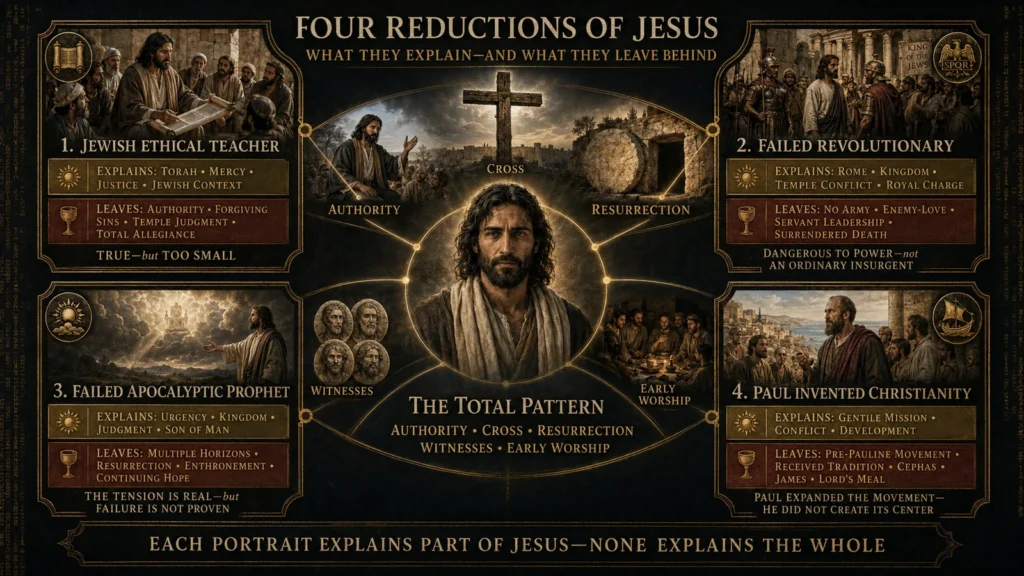
These portraits are strongest when treated as lenses rather than total explanations. The ethical-teacher model recovers Jesus’ Jewish moral world. The revolutionary model recovers occupation, Temple conflict, royal danger, and Roman power. The apocalyptic model recovers urgency, judgment, and eschatological hope. The Pauline-invention model recovers genuine development, controversy, and mission-driven change.
Each leaves residue. A teacher alone does not explain Jesus’ personal authority, execution, or post-Easter worship. An armed revolutionary does not fit the absence of a military program and the presence of enemy-love, servant leadership, and surrendered death. A simply failed prophet does not settle the multiple horizons of the sayings or explain why resurrection proclamation arose so early. An inventive Paul cannot precede the traditions and Jerusalem leaders he says he received and met.
The cumulative pattern is harder to reduce. A real first-century Jewish Jesus acts with messianic authority and is crucified under a royal charge. Very early believers proclaim that God raised Him. Paul receives that proclamation, knows Cephas and James, and changes from persecutor to apostle. Devotion to Jesus appears inside a Jewish monotheistic movement before slow Gentile legend could plausibly account for it. None of these points alone proves Christianity. Together they demand a theory with greater reach than the four reductions.
Modern reconstructions soften Jesus. Later polemics often do the opposite, attacking His birth, miracles, authority, and fate.
What Do the Talmud and Later Jewish Texts Say About Jesus?
A source is not a creed
The Babylonian Talmud is a vast record of legal argument, story, interpretation, and editorial layering, reaching its compiled form centuries after Jesus. A statement attributed to a rabbi is not automatically a ruling; an anecdote is not every Jew’s belief; a late hostile memory is not an eyewitness deposition. Jesus passages also have censorship, manuscript, identity, and chronology problems. They should be shown, not hidden, then weighed by the same historical standards applied to Christian sources.
Sanhedrin 43a: sorcery, deception, and execution near Passover
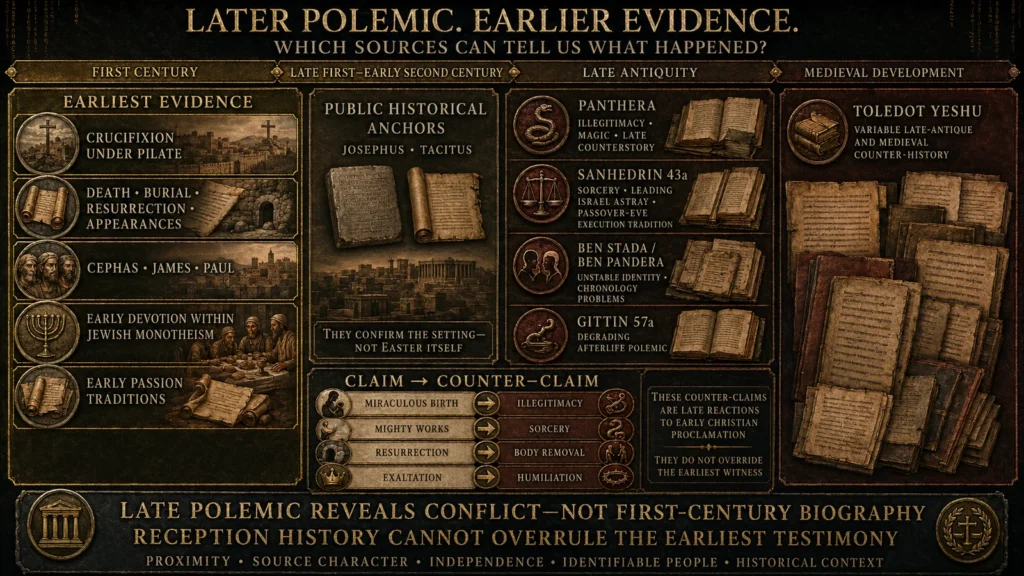
The uncensored tradition in Sanhedrin 43a is the clearest likely Talmudic reference to Jesus of Nazareth. It says Yeshu was hanged on Passover’s eve for sorcery and leading Israel astray and surrounds the execution with a herald seeking a defense. Hanged can refer to execution or postmortem exposure in Jewish legal language.
The Bavli’s final literary setting is late antique, several centuries after the crucifixion, even if some material is earlier. Its Passover, execution, sorcery, and deceiver themes reveal a Jewish counter-memory responding to Christian claims about miracles and death. Its procedural scene conflicts with the stronger first-century evidence that Roman authority crucified Jesus. It cannot establish an actual forty-day legal process or overturn the Passion sources.
Ben Stada and Ben Pandera: identity and chronology problems
Shabbat 104b, paralleled in Sanhedrin 67a, discusses Ben Stada and Ben Pandera in a tangle of parentage names, an unfaithful mother, magic brought from Egypt, and execution at Lydda. Readers often merge this figure directly with Jesus. The passage itself displays unstable identification and chronology; names may be wordplay, conflated traditions, or references to another person.
Sanhedrin 107b places a Yeshu as a rejected disciple of Joshua ben Perahiah in the era of Alexander Jannaeus, roughly a century before Jesus of Nazareth. Whatever polemical motifs later attached to the name, this chronology cannot provide a straightforward biography of the Gospel Jesus. It is evidence of displaced legend or a different figure, not first-century history.
Gittin 57a and degrading afterlife polemic
Gittin 57a presents a necromantic narrative in which Onkelos consults dead enemies of Israel. A figure commonly identified as Jesus receives degrading punishment in the afterlife for mocking the words of the sages. The material is ugly and should not be sanitized.
It is also a late polemical story, not a universal Jewish creed about Jesus’ present condition and not evidence for anything that happened in the first century. Its value is historical in a different sense: it shows the intensity of Jewish-Christian conflict and the symbolic reversal of Christian claims about Jesus’ exaltation.
Celsus, Panthera, and the attack on Jesus’ birth
Around the late second century, the pagan critic Celsus attacked Christianity through a literary Jewish speaker. His work survives mainly in Origen’s reply, composed around 248. In Against Celsus 1.32, Origen preserves the accusation that Jesus’ mother committed adultery with a soldier named Panthera and that Jesus used magic learned in Egypt.
This is not a Talmudic text, and the accusation reaches us through an opponent answering Celsus. It shows that an illegitimacy-and-magic counterstory circulated by the late second century. It supplies no independent evidence about Jesus’ paternity. Its form is well suited to rebut Christian claims of virginal conception and divine power.
Toledot Yeshu as later anti-Christian counter-history
Toledot Yeshu is not one stable ancient book. It is a family of manuscripts and recensions that developed through late antiquity and the Middle Ages. The Princeton Toledot Yeshu Project tracks this textual plurality. Versions retell Gospel themes as anti-Christian counter-history: illegitimate birth, stolen divine power or sorcery, deception, execution, body-removal, and humiliation.
Because date, wording, and plot vary by recension, quoting “the Jewish life of Jesus” as one original text is misleading. These narratives illuminate medieval and late-antique polemic, popular resistance, and communities living under Christian pressure. They cannot authenticate their own counter-biography.
What these texts reveal—and what they cannot prove
The late texts reveal memory under conflict. Christian proclamation about miraculous birth, mighty works, crucifixion, resurrection, and heavenly glory receives point-for-point inversion: illegitimacy, magic, deserved execution, body theft, and shame. That relationship makes the material important for reception history.
It makes the material weak as evidence for Jesus’ life. Paul and the early Passion traditions are closer to the events; Josephus and Tacitus provide external anchors; later polemic depends on a dispute already underway. A fair Christian article does not suppress the hostility. A disciplined one refuses to let the latest and most rhetorically useful insult outrank the earliest testimony.
Hostile memory is not the same question as who historically drove, authorized, and carried out the execution.
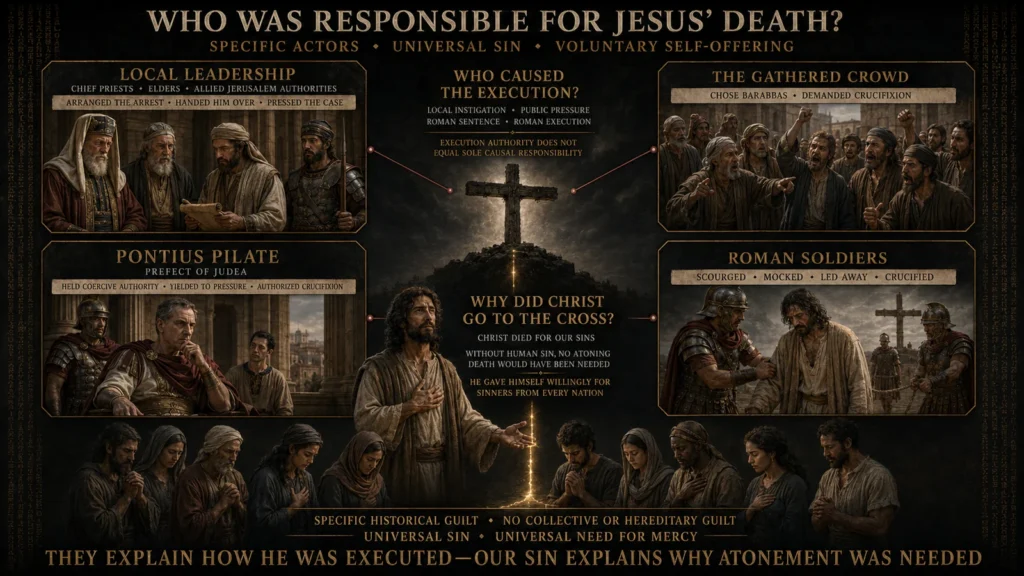
Who Was Responsible for Jesus’ Death?
Jerusalem leaders drove the case and stirred the crowd
The Gospel narratives identify specific chief priests, elders, and allied Jerusalem authorities as the human drivers of the case. They plot, arrange the arrest, bring accusations, hand Jesus to Pilate, and press for death. Mark 15:1–15 says the chief priests accuse Jesus and stir the crowd. Matthew 27:20–26 says the chief priests and elders persuade the crowd to choose Barabbas and demand Jesus’ death. Luke 23:13–25 portrays Pilate repeatedly seeking release before granting their demand. John 19:12–16 records political pressure framed around loyalty to Caesar. Peter later confronts Jerusalem hearers for handing Jesus over and rejecting Him before Pilate in Acts 3:13–15, while Acts 4:27–28 names Herod, Pontius Pilate, the Gentiles, and the peoples of Israel within the coalition gathered against Him.
Those actors must not disappear behind the slogan “Rome killed Jesus.” The Gospels assign them initiative and grave guilt. They are not, however, “the Jews” as an ethnic whole. Jesus, His disciples, the women at the cross, and the movement that proclaimed Him were Jewish. Many pilgrims in Jerusalem never stood before Pilate.
The crowd before Pilate demanded Barabbas and crucifixion
The crowd in the hearing chooses Barabbas and repeatedly demands Jesus’ crucifixion. It is a particular crowd gathered and influenced in a charged Passover setting, not a referendum of worldwide or future Jewry. The narratives do not permit its role to be muted; neither do they authorize hereditary guilt.
The Gospels do not provide a census of that gathering or license confident claims about every participant’s motive. Some may have arrived with the leadership; others may have been swept into a volatile scene. What the narratives do specify is action: this crowd is persuaded, chooses Barabbas, and presses Pilate for death. Precision means saying exactly that, no less and no more.
Pilate yielded to pressure and remains guilty for authorizing the sentence
The Gospels portray Pilate recognizing envy, declaring insufficient grounds for death, seeking or desiring release, and capitulating amid public and political pressure. That reluctance does not make him innocent. Pilate holds the coercive authority. He chooses expediency, orders scourging, and authorizes crucifixion. Ancient sources—especially Josephus and Philo—portray Pilate as provocative, inflexible, and capable of brutality. The Gospel pressure narrative should not be turned into a sentimental rehabilitation of the governor.
Roman soldiers carried out crucifixion
Roman soldiers mock, beat, robe, crown, lead away, and physically crucify Jesus. Crucifixion is a Roman sentence performed by Roman force. A complete causal account therefore includes the local leadership that drove the prosecution, the crowd that demanded death, the governor who yielded and sentenced, and the soldiers who executed.
Featured public-claim evidence check: Shmuley Boteach and “Rome alone.” On April 9, 2026, Rabbi Shmuley Boteach published “Case closed: The Romans, not the Jews, killed Jesus”. He is right to reject the lethal fiction of hereditary Jewish guilt. He is not right to make Roman execution authority erase every other causal actor named in the Gospel accounts. Boteach speaks for his own argument, not for all Jews.
Rome supplied the governor, legal coercion, sentence, soldiers, torture, and cross. But sole authority to execute is not sole causal responsibility. The sources identify chief priests, elders, and allied Jerusalem authorities as arranging the arrest, handing Jesus over, pressing accusations, influencing the gathered crowd, and demanding crucifixion. The crowd chose Barabbas; John records Caesar-based political pressure. Pilate’s brutality does not make him innocent, and it does not prove that a Roman prefect could never yield to threatened disorder or political exposure. The full account is local instigation and pressure, a guilty governor’s capitulation, and Roman execution.
Several historical details in the article also fail inspection. Pilate’s contemporary inscription calls him prefect of Judea, not proconsul. Tacitus anchors Jesus’ execution under Pilate but does not provide a portrait of Pilate’s brutality; Philo and Josephus especially do. The claim that Pilate killed about 250,000 Jews is unsupported. Josephus says that, after Samaritan accusations, Vitellius ordered Pilate to Rome to answer before the emperor; Pilate arrived after Tiberius had died. That is not a personal recall by Tiberius for cruelty. Nor does Paul’s frequent use of the Greek Septuagint establish that he could not read Hebrew or that his reported Pharisaic training was fabricated. Greek Scripture was widely used in the Jewish diaspora, and Paul’s scriptural practice cannot bear that conclusion. Rejecting collective blame requires exact history, not a rival slogan.
Specific historical guilt is not collective or hereditary guilt
Acts 4 names Herod, Pontius Pilate, Gentiles, and peoples of Israel in the coalition against Jesus. Other speeches confront Jerusalem audiences directly. Those accusations are audience-specific; they do not transform descendants into participants. The long Christian history of deicide charges makes precision morally urgent, and the identities named in the sources require it.
The deeper reason: Christ died for our sins
The leaders, crowd, governor, and soldiers explain how Jesus was executed. They do not by themselves explain why Christianity says His death saves. Those are related questions, but they are not the same question. The deeper Christian claim is that Christ went to the cross because humanity needed reconciliation with God.
Scripture describes that need without assigning one ethnicity a uniquely corrupt nature. “All have sinned and fall short of the glory of God,” Paul writes in Romans 3:9–26. Sin is more than a collection of isolated mistakes. It bends worship toward created things, corrupts love of neighbor, produces guilt, and ends in death. Had humanity never rebelled against God, no atoning death would have been necessary. Christ died for our sins because we had broken fellowship with God and could not make ourselves innocent again.
That universal need must not be confused with universal historical guilt. Modern Jewish people did not arrange Jesus’ arrest, stand in the tribunal crowd, authorize a Roman sentence, or drive the nails. No people living today inherit the personal guilt of Pilate or the soldiers. Christians living centuries later were not present either. The slogan “we all killed Jesus” can therefore mislead if it collapses two different truths. We did not all participate in the first-century proceedings. We do all belong to the sinful humanity for whom atonement was necessary.
The cross also cannot be reduced to a tragic political accident. Jesus speaks of giving His life as a ransom in Mark 10:45, and in John 10:17–18 He insists that no one simply takes His life from Him: He lays it down willingly. Paul summarizes the received apostolic proclamation by saying that Christ “died for our sins” in 1 Corinthians 15:1–8. Human beings acted wickedly, political power chose expediency, and Roman force carried out the execution. Yet the Son was not an unrelated third party swept helplessly into someone else’s punishment. He knowingly gave Himself in love and obedience.
This is why naming the historical actors does not authorize Christian boasting. Specific Jerusalem leaders, a particular gathered crowd, a Roman governor, and Roman soldiers form a dark coalition of human rebellion, but Christians do not stand outside that judgment as morally superior spectators. The cross exposes the sin of Jew and Gentile alike and offers mercy to both. Christ gave Himself for sinners from every nation—including those who rejected Him, the rulers who condemned Him, the soldiers who crucified Him, and those who later misuse His death to condemn the people from whom Messiah came.
The complete Christian answer is therefore precise: specific actors explain how Jesus was executed; our sin explains why atonement was needed; Christ’s love explains why He willingly gave Himself. Historical guilt remains specific. The need for mercy is universal.
Once the leaders, crowd, governor, and executioners are named honestly—and the deeper purpose of Christ’s self-offering is understood—the latest polemics must give way to the earliest testimony about what happened next.
Why the Earliest Evidence Matters More Than Later Polemic
Jesus’ crucifixion under Pilate as a public historical anchor
The case returns to the first century. Paul’s undisputed letters already speak of a recent Jewish man who was crucified. The Passion traditions converge on execution under Pontius Pilate; Josephus identifies James as the brother of Jesus called Christ, and Tacitus later corroborates execution under Pilate. The historical evidence for Jesus and focused crucifixion evidence make late myth or survival theories poor starting points.
Paul received rather than invented the central resurrection proclamation
In 1 Corinthians 15, Paul introduces Jesus’ death, burial, raising, and appearances with the language of receiving and delivering tradition. Its precise wording and origin are debated, but the summary predates the letter and reaches behind Paul’s own authorship. His prior persecution matters: he was attacking a movement before he joined it, so its central proclamation cannot be the product of his later need to defend a failed mission. The Gospels add narrative detail; they do not create Easter after centuries of silence.
Cephas, James, Paul, and the Jerusalem connection
Paul reports meeting Cephas and James in Jerusalem within the period covered by his own letters. James is especially resistant to a simple anonymous-legend model: he is Jesus’ brother, later leads the Jerusalem assembly, and appears in the received list. Paul writes as a former persecutor transformed by what he understood as an appearance. These claims remain interested testimony, not neutral laboratory records, but they are identifiable first-generation lives rather than names invented after the movement’s origins. The first resurrection witnesses study weighs the limits.
Early devotion to Jesus within Jewish monotheism
The same early letters show communities calling on Jesus, celebrating His meal, confessing Him as Lord, and applying Israel’s Scriptures to Him. Such devotion arose within a Jewish monotheistic matrix and is already assumed when Paul writes. It does not prove that every later doctrinal formula was complete at the start. It does require an explanation stronger than a slow fourth-century invention.
Why resurrection best explains the total pattern
Featured public-claim evidence check: Tovia Singer’s resurrection challenge. In “Did Jesus Rise from the Dead? What Is the Evidence for the Resurrection?”, Rabbi Tovia Singer argues that pagan religions supplied resurrection analogies, Christian witnesses were interested rather than neutral, no contemporary outside historian confirms Easter, and the Gospel accounts contain destructive tensions. His accompanying crucifixion and resurrection chart presses the narrative differences. He treats resurrection belief as failed-Messiah rationalization and biological impossibility. That is a serious cumulative objection, not a question to dismiss with “the Bible says so.”
Analogy, however, is not genealogy. Broad stories about gods, heroes, exaltation, or return do not by themselves prove that a Jewish proclamation of one man’s bodily, eschatological resurrection was copied from a specific pagan source. First Corinthians 15 is earlier than the written Gospels and transmits material Paul says he received. Galatians places him in personal contact with Cephas and James. Resurrection was already a Jewish hope; the unexpected claim was that the crucified Messiah had been raised in advance as firstfruits. Paul had persecuted that movement, James was both family and a Jerusalem leader, and devotion to Jesus appears extraordinarily early.
Singer is right that the Gospel narratives vary and sometimes stand in genuine tension over chronology, messengers, movements, and appearances. A bloated harmonization that invents unseen episodes proves little. Yet variation does not erase their shared core: Jesus was crucified and died, was buried, women found the burial place empty, and followers claimed appearances. The empty tomb is more disputed than crucifixion or Paul’s transformation, and the five hundred lack independent detail; neither should carry the case alone. Nor would silence from uninvolved Roman writers be surprising: they were not positioned to certify a divine act in a small Jewish movement at its birth.
Singer’s strongest examples deserve to be named. John’s Passover chronology and the Synoptic chronology remain genuinely debated, as does the relationship between Matthew’s compressed account of the women and John’s focus on Mary Magdalene. Proposed harmonizations vary in plausibility, and Christians should not invent unseen episodes merely to remove every tension. Yet those literary questions concern the later narrative presentation of Easter; they do not erase Paul’s earlier received proclamation, his personal contact with Cephas and James, or the fact that resurrection belief was already central before the written Gospels reached their final forms.
Grief experiences, dissonance, scriptural rereading, and legend may explain portions of the record. They do not as neatly explain the received proclamation’s early date, its Jerusalem connections, Paul the persecutor, James the brother, bodily and eschatological meaning, and worship of Jesus within Jewish monotheism. Nor do they explain why the proclamation was resurrection, not survival or private consolation. History cannot place God in a laboratory, and biological regularity is precisely what the miracle claim says God overcame. The Christian inference is cumulative: resurrection explains more of the total pattern with one cause than the alternatives explain separately.
The historical question cannot compel worship, but it can reveal whether Judaism’s rejection rests on a verdict God Himself overturned.
The Christian Verdict on Judaism’s Rejection of Jesus
Real preservation and moral seriousness do not make the rejection correct
Jewish communities preserved Scripture, sustained worship through exile, pursued repentance, and resisted coercive conversion. Those realities deserve gratitude and honesty. They do not make contrary claims about Jesus compatible. Mainstream Judaism rejects the identity and work Scripture assigns to Him. Christianity says that rejection is wrong.
Rabbinic authority cannot overrule the risen Son
Maimonides, Talmudic argument, and later polemic tell us how Jewish tradition judged Jesus. None can decide the resurrection by authority. If God raised the Son, His verdict outranks every later court.
There is no salvation covenant apart from Christ
The gospel offers no dual arrangement in which Gentiles need Jesus while Jews may knowingly reject Him and be saved by another covenant. Jesus is Israel’s Messiah and the world’s Lord. Jew and Gentile alike are reconciled through His self-offering, living priesthood, and mercy, and both are summoned to repent and believe.
Gentile Christians have no ground for boasting
Paul warns Gentile believers against arrogance toward Israel. They did not generate the patriarchs, covenants, Scriptures, Messiah, or apostles. Grace excludes superiority. Christians may disagree decisively with Judaism while repudiating contempt, coercion, ethnic blame, and every use of the cross to persecute the people from whom Christ came.
Several practical questions remain, but none changes the central issue.
Frequently Asked Questions
Do all Jews believe the same thing about Jesus?
No. Jewish ancestry, halakhic status, movement affiliation, culture, and personal belief are different categories. Orthodox, Conservative, Reform, Reconstructionist, Humanistic, secular, and Messianic Jews do not speak with one voice. Mainstream Jewish movements nevertheless share a theological boundary: they do not confess Jesus as divine Messiah, risen Lord, final atonement, and exclusive Savior. Some individuals admire Him as a teacher; others rarely consider Him. Movement theology cannot erase variation or ancestry.
Why does Judaism reject Jesus as the Messiah?
Mainstream Judaism sees the promised restoration as visibly incomplete: universal peace has not arrived, evil and death remain, all exiles are not gathered, and the Temple is not rebuilt. Traditional expectation emphasizes a human Davidic ruler, while Maimonides says a killed candidate who fails to complete the work is not Messiah. Christianity agrees that a merely dead claimant failed, but says resurrection vindicated Jesus and His return will complete the restoration. Those promises remain measurable realities. The dispute turns on whether Easter happened, not on denying the world’s unfinished condition.
Does the Talmud really mention Jesus?
Some passages probably or clearly refer to Jesus; others involve unstable names or impossible chronology. Sanhedrin 43a likely preserves a hostile execution tradition. Shabbat 104b and Sanhedrin 107b contain identity and dating problems. These materials appear in a late-antique compilation, centuries after Jesus, and reveal later Jewish-Christian polemic more reliably than first-century biography. No single passage is a creed for every Jewish person. Their value lies mainly in reception history; they cannot outrank Paul’s earlier testimony and the Passion traditions or historically settle who Jesus actually was.
Does Judaism teach that Jesus is being punished in the afterlife?
Gittin 57a contains a degrading afterlife story about a figure commonly identified as Jesus. It belongs to late polemical narrative, not to first-century evidence and not to a universal Jewish creed. The passage should neither be hidden nor inflated. It shows how some later storytellers reversed Christian claims about Jesus’ exaltation; it cannot establish His actual fate before God or justify saying that all Jewish people affirm the tale.
Does worshiping Jesus violate belief in one God?
If Jesus is a creature, worshiping Him violates the Shema and is idolatry. Christianity instead argues that the earliest evidence includes Jesus within God’s unique works, saving name, Scripture, judgment, invocation, and worship while distinguishing Him from the Father. If Israel’s God raised Jesus and the Son shares the divine identity, confessing Him as Lord is fidelity to the one God, not worship of a second deity. Both sides should state that collision. The dispute concerns Jesus’ identity and resurrection, not a word trick involving the Hebrew term for “one.”
Did Jesus or Paul abolish the Torah?
Jesus lived as a Jew, affirmed Torah, and claimed authority to fulfill and interpret it. His Sabbath, purity, food, and Temple disputes belong inside Jewish debate while carrying messianic implications. Paul opposed requiring Gentiles to become Jews through circumcision. Real covenantal change followed through Messiah and Spirit, but neither Jesus nor Paul called Torah evil. Jeremiah’s new covenant promises internalization, forgiveness, and transformation. Acts and Galatians show that this transition generated communal conflict. Torah is fulfilled, not offered as a separate saving path around Christ for either Jew or Gentile.
Did Paul invent Christianity?
Paul profoundly shaped Gentile Christianity, but he joined a movement he had persecuted. He says he received the death-resurrection tradition and the Lord’s meal, and he personally knew Cephas and James. Communities were already calling on Jesus before his letters. His own testimony includes real conflict with Jerusalem, so influence in the churches should not be minimized. Paul expanded the mission and argued through its consequences; he did not invent Jesus’ crucifixion, resurrection proclamation, or earliest worship from nothing.
Who was responsible for Jesus’ crucifixion?
Specific chief priests, elders, and allied Jerusalem authorities drove the case, handed Jesus over, accused Him, stirred the crowd, and demanded death. The crowd before Pilate chose Barabbas and called for crucifixion. Pilate yielded but remained guilty because he held authority and authorized the sentence. Roman soldiers tortured and crucified Jesus. Acts also names Herod, Pilate, Gentiles, and peoples of Israel. Responsibility belongs to those actors, not to Jewish people collectively or their descendants. No group inherits blame from those events. Theologically, Christ gave Himself for sinners from every nation.
Can someone be Jewish and believe in Jesus?
Yes in the senses of ancestry and, under some definitions, continuing halakhic status. Messianic Jews also understand faith in Jesus as fulfillment of Jewish hope and may retain Jewish practice. Mainstream Jewish institutions generally classify belief in Jesus’ divinity, resurrection, and saving lordship as Christian theology rather than Judaism. Institutional nonrecognition describes a religious boundary; it does not erase family history or cultural belonging. Ancestry, religious affiliation, communal recognition, self-description, and theology must not be collapsed into one answer.
Sources and Further Reading
- Biblical texts: Isaiah 52:13-53:12, Mark 15, 1 Corinthians 15, and Galatians 1-2.
- Jewish primary and institutional sources: Maimonides, Kings and Wars 11, Yoma 85b-86b, Chabad on Moshiach, Reform Judaism on Jesus, and My Jewish Learning’s overview.
- Inspectable public claims: Ben Shapiro on JRE #1276 at 1:33:11; Shmuley Boteach on a revolutionary Jesus and “Rome alone”; and Tovia Singer’s resurrection challenge with its comparison chart. Each primary receipt is linked at first citation above.
- Counter-missionary arguments: Jews for Judaism on Paul, Torah’s viability, sacrificial requirements, blood loss, and Isaiah 53, alongside Singer’s servant reading. Each organization is named narrowly, and each argument is linked where it is evaluated.
- Jewish scholarly context: Amy-Jill Levine in PBS’s Jewish Jesus and Vanderbilt’s overview of The Misunderstood Jew, both linked in the Second Temple context section.
- Ancient and academic sources: Josephus, Antiquities 20.200; Tacitus, Annals 15.44; N. T. Wright, The Resurrection of the Son of God; Dale C. Allison Jr., The Resurrection of Jesus; Larry W. Hurtado, Lord Jesus Christ; Peter Schäfer, Jesus in the Talmud.
Jesus Is Not Outside Israel’s Story—He Is Its Fulfillment
Jesus belongs inside the story of Abraham’s promise, Israel’s exodus, David’s throne, the prophets’ hope, the servant’s suffering, and the new covenant. He is not a Gentile correction to Israel. He is the eternal Son and Word made flesh, Israel’s promised Messiah, the holy Lamb, the crucified Savior, and the eternal High Priest.
Chief priests, elders, and allied Jerusalem authorities drove the case against Him and stirred the crowd. The crowd demanded crucifixion. Pilate capitulated, ordered punishment, and authorized Rome’s sentence. Roman soldiers carried it out. That is specific guilt, not hereditary Jewish guilt. Beneath the cross, Jew and Gentile alike are exposed as sinners, and Gentile Christians are forbidden to boast.
Human rejection was not God’s verdict. God raised Jesus from the dead. If He remained dead, Christianity is false and Judaism’s failed-Messiah judgment stands. If He rose, His cross is saving self-giving, His throne is present, His priesthood is living, and His return will complete the peace, resurrection, justice, and restoration still awaited.
No ancestry grants immunity from His call, and no Gentile stands above the people who gave the world the Scriptures and the Messiah. The same mercy addresses all: repent, believe, and receive the risen Lord. Jesus Christ is Israel’s faithful Messiah and the nations’ only Savior, the coming King and Judge before whom every ruler, tradition, people, and person must answer. The final word belongs neither to polemic nor to empire, but to the living Christ.