
GUIDED ARTICLE EXPERIENCE
Biblical Israel, Second Temple Judaism, and Rabbinic Judaism Explained
Read along as the narration moves through the article.
Private device narration · No hosted audio or tracking
CONTINUE GUIDED TOUR
Continue where you left off.
GUIDED TOUR COMPLETE
You have reached the end of this study.
Study record saved on this device.
GUIDED TOUR
Biblical Israel, Second Temple Judaism, and Rabbinic Judaism Explained
Narrator: Paranoid Prophet Recommended Voice Native device narration
Prepare to follow the article as it is narrated.
VOICE & TOUR OPTIONS
Voice & Listening
NARRATOR
Finding a narrator…
Checking the best narrator available on this device.
Restores the best curated narrator available on this device.
Narrator choices are curated for clear, long-form listening on this device.
Screen-awake support will be checked when narration starts.
CHOOSE A NARRATOR
Curated for this device
Choose a verified narrator for this browser, or use System Narrator. Automatic mode uses the best reliable route exposed by this device; your chosen narrator is preserved even if this device needs a temporary fallback.
Preparing the guided article experience…
RESUME GUIDED TOUR?
Continue where you left off.
GUIDED TOUR COMPLETE
You have reached the end of this study.
Article Guide21 sections
Short Answer: Is Rabbinic Judaism the Same as Biblical Israel?
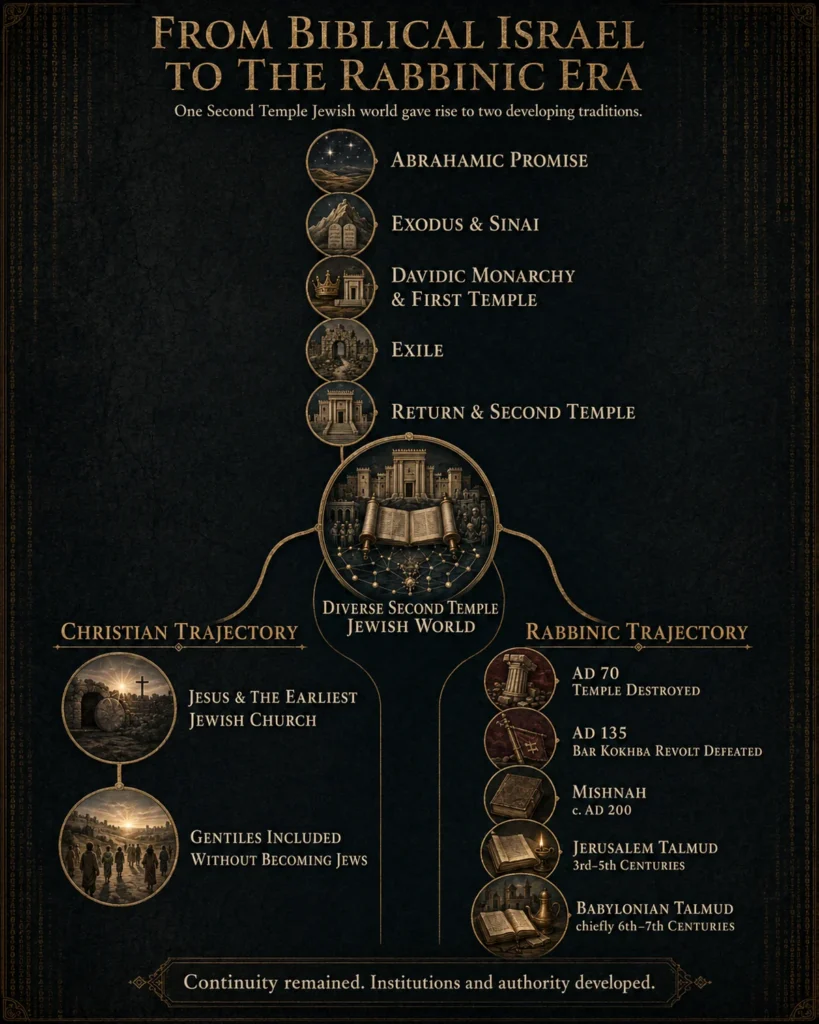
The relationship between biblical Israel and rabbinic Judaism is one of real continuity and substantial development. Rabbinic Judaism preserves Israel’s Scriptures, confession of one God, covenant memory, festivals, moral commandments, Jewish peoplehood, and hope for redemption. Yet it is not the full national, priestly, sacrificial order described in the Torah simply carried forward without interruption. Biblical Israel had a functioning sanctuary, Aaronic priests, animal sacrifices, tribal land allotments, covenant courts, and, for part of its history, a Davidic king. Rabbinic Judaism developed durable Jewish life without most of those institutions, centering communal practice on Written and Oral Torah; halakhah, the Jewish path of law and practice; prayer; study; synagogue; household; and the authority of sages.
That development did not begin from nothing in AD 70. Interpretation, synagogue life, prayer, legal debate, and traditions outside the written text existed before the Temple fell, yet no finished rabbinic system appeared overnight. The transition unfolded across generations, especially after the Roman destruction of the Second Temple in AD 70 and the crushing of the Bar Kokhba revolt in AD 135. The Mishnah, an early rabbinic collection of legal traditions, reached written form around AD 200; the two Talmuds came later still.
Christianity also arose from the varied Jewish world of the Second Temple period. Jesus, His earliest disciples, and the first resurrection witnesses were Jews. The Christian claim is therefore not that a foreign Gentile religion later replaced God’s dealings with Israel. It is that Israel’s God fulfilled His promises in Israel’s Messiah: Jesus inaugurated the new covenant, offered the final sacrifice for sin, rose from the dead, and opened Abraham’s blessing to the nations without erasing the Jewish people.
Why This Matters for Christians
Understanding biblical Israel and rabbinic Judaism corrects a common timeline in which Old Testament Judaism continued unchanged until Jesus and modern Judaism is simply the same religion minus belief in Him. The world Jesus encountered had already been shaped by exile, empire, a rebuilt Temple, diaspora communities, competing legal interpretations, and hopes of restoration. Rabbinic Judaism and Christianity both emerged from that world but made incompatible claims about Jesus and covenant authority.
Getting the history right prevents opposite errors: treating rabbinic Judaism as a fabrication despite its preservation of Scripture, worship, identity, and memory, or treating every later ruling as though Moses plainly taught it in the Pentateuch. It also guards against treating modern Israel as identical to biblical Israel merely because they share a name.
The distinction also clarifies the Christian gospel. Christians do not merely prefer one later interpretive school to another. They confess that Jesus possesses divine authority over Sabbath, purity, forgiveness, Temple, sacrifice, resurrection, and judgment. If that confession is true, the decisive question is not which community looks most ancient. It is whether God has acted finally in the crucified and risen Messiah.
What Was Biblical Israel?
Biblical Israel can refer to Jacob, his tribes, the covenant nation, the northern kingdom, or the restored people after exile. Here it means the people and institutions presented in the Hebrew Scriptures, especially the Torah, historical books, and prophets. Four features establish the basic frame.
Family, Tribes, and Covenant
Israel’s story begins with God’s promises to Abraham: descendants, land, blessing, and a worldwide purpose. The covenant sign of circumcision marked Abraham’s household, while God’s promise moved through Isaac and Jacob. Jacob received the name Israel, and his sons became the ancestors of the tribes. Israel was thus a people formed by divine promise and family descent before it was a state.
The exodus deepened that identity. God redeemed Israel from slavery and called the nation His treasured possession and a kingdom of priests. Israel had households, tribes, elders, assemblies, inheritance, and public covenant obligations. Foreigners could live among Israel and, under defined conditions, join its worship, but the covenant people remained a concrete historical community.
Sinai and Torah
At Sinai, God bound the redeemed people to Himself through covenant. Torah means instruction, not merely penalties. It embraced worship, holiness, work, sexuality, property, justice, festivals, care for the vulnerable, and love for God and neighbor. The commandments formed Israel’s public life before a holy God.
Application always required judgment. A command written for a covenant people still had to be taught, interpreted, and applied to actual disputes. Deuteronomy 17 directs difficult cases to Levitical priests and the judge in office. That text supports real interpretive authority within Israel. It does not by itself settle every later rabbinic claim about the content, transmission, or perpetual jurisdiction of Oral Torah; that larger claim must be considered on its own evidence.
Priesthood, Sacrifice, and Temple
The Torah assigned sacrificial service to Aaron’s line and broader sanctuary duties to the Levites. Offerings included burnt, grain, peace, purification, and reparation offerings. The Day of Atonement gave the high priest a unique annual ministry. Leviticus 17 connects sacrificial blood with atonement because life belongs to God.
Israel first worshiped at the tabernacle. Later, Solomon’s Temple in Jerusalem became the central sanctuary. Prayer, repentance, mercy, and obedience were always essential; the prophets condemned sacrifices offered by unjust and unrepentant worshipers. But those truths did not make the sacrificial system optional. In the biblical order, priesthood, altar, sacrifice, purity, pilgrimage, and sanctuary belonged together under God’s command.
Land, Monarchy, and Prophets
The land was covenant gift and responsibility. Tribal allotments, sabbatical patterns, cities of refuge, harvest laws, and festivals tied obedience to place. Israel’s monarchy arrived later than Sinai, but God’s promise of an enduring house and throne for David fed messianic hope.
The prophets did not offer a religion against Torah. They confronted covenant unfaithfulness, defended the poor, called Israel to repentance, and announced judgment and restoration. They looked beyond Israel’s failures toward cleansing, a righteous Davidic ruler, resurrection, the Spirit, and a new covenant written on the heart. Biblical Israel’s story therefore expected God to act more deeply against sin.
Exile, Return, and the Second Temple
The exile and Second Temple centuries altered Jewish life long before the rabbis produced the Mishnah and Talmuds.
The Babylonian Catastrophe
Assyria destroyed the northern kingdom in the eighth century BC. In the early sixth century BC, Babylon conquered Judah, destroyed Solomon’s Temple, ended the reigning Davidic monarchy, and deported part of the population. Could Israel remain God’s people away from the land and Temple? Had God’s promises failed?
Biblical writers answered with judgment and hope. Exile was covenant discipline, not God’s defeat. Daniel prayed toward Jerusalem; Ezekiel envisioned cleansing, renewed hearts, restoration, and resurrection-like life. Exiles preserved identity through family, Scripture, prayer, circumcision, and Sabbath.
Return Under Persia
After Persia conquered Babylon, the biblical account says Cyrus authorized Judeans to return and rebuild the Jerusalem Temple. Some Judeans returned; many remained throughout the diaspora. Ezra and Nehemiah describe a restored community ordered around Torah, priesthood, public reading, covenant renewal, and separation from practices judged unfaithful. The returned people were connected to pre-exilic Israel, yet their political circumstances were different: they lived under imperial rule, not an independent Davidic kingdom.
The term Jew developed from Judean and acquired ethnic, geographic, and religious meanings, while Israel remained a covenant name. The terms continued to overlap.
The Rebuilt Temple
The Second Temple was completed in the late sixth century BC and later expanded by Herod. It centered Jewish sacrifice, pilgrimage, priestly service, and national symbolism until AD 70. The Temple Jesus visited was neither Solomon’s building nor a rabbinic synagogue but the sanctuary of Second Temple Jewish life.
Priests and sacrifices remained active, even while many Jews criticized corrupt leadership or disputed the Temple’s calendar and purity. The Qumran community appears to have rejected the Jerusalem establishment while still thinking in intensely priestly and Temple-centered categories. Opposition to a particular priesthood was not indifference to the sanctuary.
A Growing Diaspora
By the time of Jesus, large Jewish populations lived outside Judea, and many historians believe diaspora Jews may already have formed the majority of the Jewish population. John M. G. Barclay’s Cambridge chapter, “The Jews of the Diaspora”, documents communities across Egypt, Syria, Asia Minor, Mesopotamia, Rome, and elsewhere. Diaspora Jews prayed toward Jerusalem, sent support, made pilgrimage, read Scripture in Greek, gathered in synagogues, and maintained Jewish identity under local conditions.
Synagogues and Scripture reading did not simply begin after AD 70. They already served communal, educational, judicial, and devotional functions. Yet their presence did not mean the Temple had become irrelevant. Second Temple Judaism was capable of local assembly and a sacred center at the same time.
What Jews Shared in the Second Temple Period
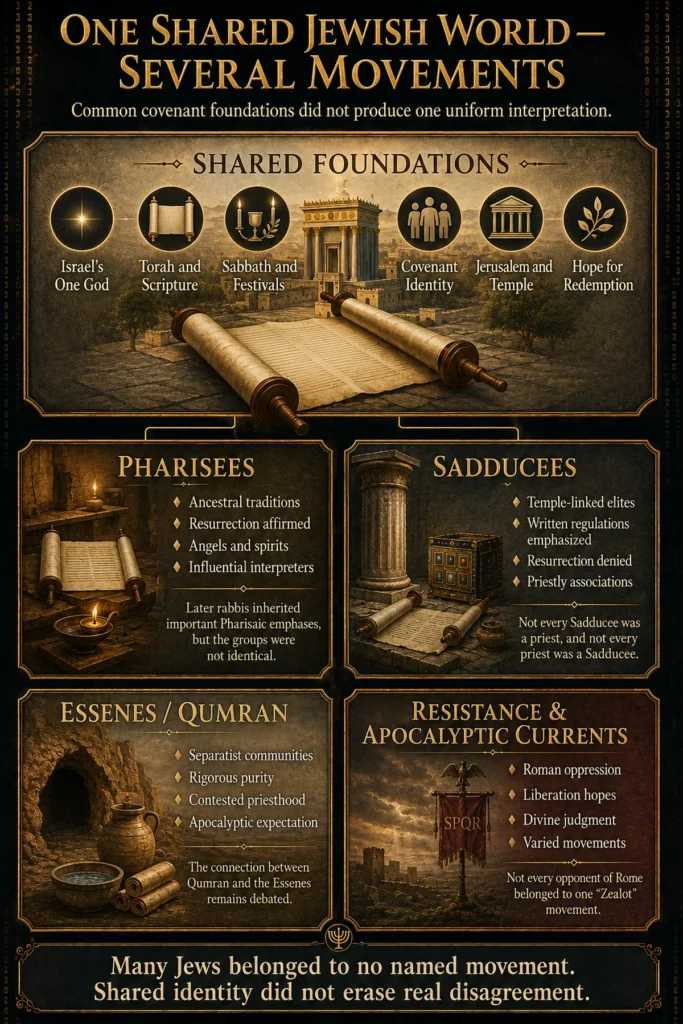
Scholars use Second Temple Judaism for the Jewish traditions that flourished between the return from Babylon and Rome’s destruction of the Temple. The singular word Judaism should not hide the era’s diversity. Still, diversity did not mean there was no shared world.
Jews commonly confessed Israel’s one God, revered Torah and Scripture, practiced circumcision, honored Sabbath and festivals, remembered exodus and covenant, and understood themselves as Israel’s people. Jerusalem and its Temple held unique significance even far away. Purity, marriage, almsgiving, prayer, and communal care mattered, though interpretations differed.
Hope also took multiple forms. Some expected a Davidic ruler; some anticipated priestly leadership; some imagined more than one anointed figure; some emphasized national liberation, final judgment, resurrection, or the age to come. No single checklist described every Jew. Annette Yoshiko Reed’s Oxford Bibliographies entry, “Second Temple Judaism”, therefore speaks of Jewish traditions and treats the period as the world from which both Christianity and classical rabbinic Judaism emerged.
Pharisees, Sadducees, Essenes, and Other Movements
Josephus, the New Testament, the Dead Sea Scrolls, and rabbinic texts provide uneven, overlapping evidence rather than a neutral census. Josephus describes three schools; the New Testament focuses on groups relevant to Jesus and the church. Many Jews probably belonged to no named movement.
Pharisees
The Pharisees were influential interpreters. Josephus reports that they transmitted inherited observances not written in Moses’ law. The New Testament depicts them as believing in resurrection and angels or spirits, unlike the Sadducees, and records disputes between Jesus and particular Pharisees over Sabbath, purity, vows, meals, status, and tradition.
Pharisees should not be reduced to hypocrites. Some challenged Jesus, while others warned or hosted Him, and Acts presents Pharisees in the Jesus movement. Jesus rebuked hypocrisy and misuse of authority, not ethnicity or careful obedience. Later rabbis inherited Pharisaic emphases such as resurrection and interpretive tradition, but the labels are not interchangeable; rabbinic institutions, texts, and authority structures developed after the pre-70 movement.
Sadducees
The Sadducees were associated in surviving sources with elite and priestly circles, though the evidence is too limited to make every Sadducee a priest or every priest a Sadducee. Josephus says they rejected the Pharisaic body of ancestral observances and held only written regulations as binding in that dispute. The New Testament says they denied resurrection, angels, and spirits.
Their influence depended heavily on the Temple order, so AD 70 was especially consequential. Because surviving accounts come largely from rivals or outsiders, however, historians should avoid claiming that the movement vanished simply because its theology could not survive catastrophe.
Essenes and Qumran
Josephus describes Essenes as disciplined communities with shared goods, rigorous admission, purity practices, common meals, and distinctive beliefs. The Dead Sea Scrolls reveal a separatist movement that considered Jerusalem’s establishment corrupt, interpreted prophecy around its own time, and followed exacting covenant rules.
The Qumran settlement and scrolls have often been connected with the Essenes, but the identification remains disputed. The scrolls nevertheless open a window onto a Jewish sectarian world with meaningful parallels to Josephus’s Essenes. They also show that strict interpretation, communal discipline, expectations of divine intervention, and conflict over priesthood and calendar preceded later Christianity and rabbinic Judaism.
Resistance and Apocalyptic Currents
Not every resistance group shared one ideology, and the label Zealot should not be stretched over every Jewish opponent of Rome. Some movements sought armed liberation; others awaited divine intervention; some combined political hopes with expectations of divine judgment. Roman occupation, taxation, elite collaboration, memories of the Maccabees, and biblical promises all contributed to a volatile setting.
Apocalyptic texts—writings that reveal earthly events from a heavenly perspective—portrayed empires under judgment and anticipated God’s kingdom. That language helps explain the urgency of John the Baptist, Jesus’ proclamation of God’s reign, and early Christian resurrection hope. It does not mean Jesus copied one sectarian program; His announcement centered on His own authority and mission.
What Jews Believed About Resurrection, Messiah, Purity, and Torah
Second Temple Jews did not speak with one voice on the issues that later separated rabbinic Judaism and Christianity. Resurrection is the clearest example. Daniel 12 anticipates the awakening of the dead, the Pharisees affirmed resurrection, and the Sadducees denied it. The debate was already Jewish before Christians proclaimed that God had raised Jesus bodily as the firstfruits of the coming resurrection.
Messianic expectation was equally varied. Messiah means anointed one, and Israel’s Scriptures could generate royal, priestly, prophetic, and heavenly patterns. Some Jews expected a Davidic deliverer; others focused on God’s direct reign, the purification of the Temple, or the defeat of wicked powers. A Christian should not say that every first-century Jew expected precisely the same Messiah and then inexplicably rejected Him. The New Testament claims something more specific: Jesus fulfills Israel’s patterns in surprising unity through suffering, resurrection, heavenly enthronement, and future return.
Purity concerned access to holy space, food, bodily conditions, and community boundaries. It was not merely a synonym for moral superiority. Different groups debated how priestly holiness related to ordinary life and how biblical rules should be extended. Jesus did not dismiss holiness. He challenged interpretations that obscured God’s purpose, located defilement in the evil flowing from the heart, and claimed authority to cleanse those considered unclean.
Torah stood at the center of all these arguments. Disagreement usually concerned faithful interpretation, not whether Israel’s God had spoken. Pharisaic ancestral tradition, Sadducean resistance to it, Qumran’s sectarian rulings, and Jesus’ own teaching all show an interpretive contest. The crucial Christian claim is that Jesus was not merely one more scribe proposing a better set of deductions. He taught with the authority of the Son and declared that Israel’s Scriptures reached their goal in Him.
Jesus Within—and Above—the Jewish Debates
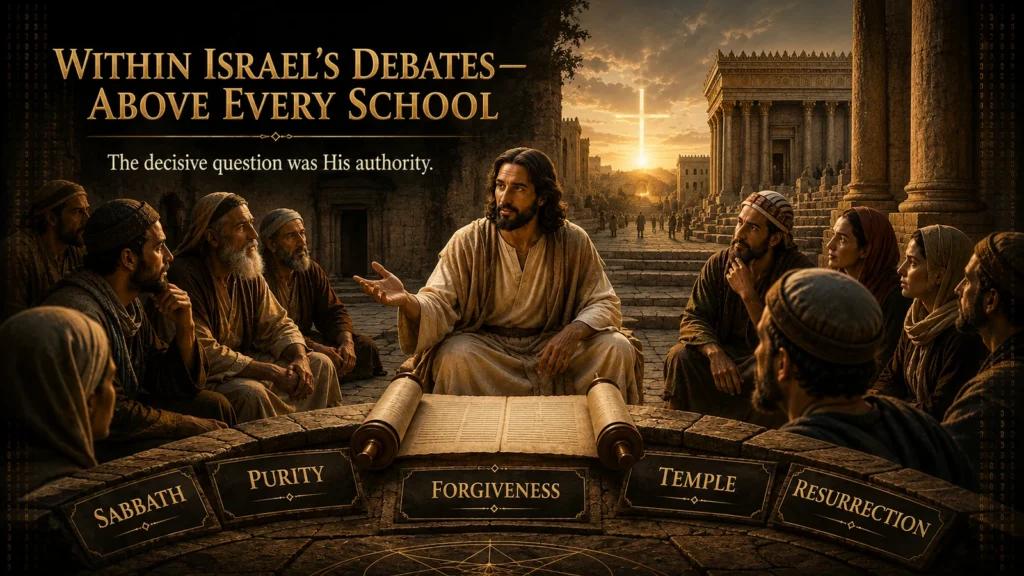
Jesus belongs inside first-century Jewish history, but the New Testament does not permit Him to be contained within it. He participated in Israel’s worship and arguments while making claims that placed Him above every school.
Fully Jewish
Jesus was born to a Jewish mother, circumcised, presented at the Temple, raised in Galilee, and recognized as David’s descendant. He attended synagogues, traveled to Jerusalem for festivals, quoted Scripture, debated Torah, wore tassels, and addressed Israel’s God as His Father. His disciples called Him Rabbi, Messiah, Son of David, and King of Israel.
These facts are not decoration: the incarnation took place in Israel’s covenant story. Jesus was no generic teacher detached from Abraham, Moses, David, and the prophets. Salvation is from the Jews, He said, even as He announced worship beyond Jerusalem.
Shared Convictions
Jesus affirmed the Shema: the Lord is one, and His people must love Him wholly. He upheld Scripture, resurrection, final judgment, angels, the seriousness of sin, and love for God and neighbor. Those convictions placed Him within Jewish debates and, on some points, nearer the Pharisees than the Sadducees.
Yet shared vocabulary did not eliminate conflict. Jesus’ proclamation of the kingdom demanded repentance in response to His own arrival. He forgave sins, called disciples to Himself, and made allegiance to Him decisive for life. Agreement that resurrection would happen someday was not enough when He claimed to be the resurrection and the life.
Challenge to Tradition
Jesus did not condemn every transmitted tradition. He practiced customs and respected legitimate teaching, but warned that tradition could evade God’s command. In Mark 7, He exposed a vow practice that could release someone from caring for parents and declared that moral defilement proceeds from the heart.
That criticism matters in the later discussion of Oral Torah. The need for interpretation is real, but interpreters remain accountable to God’s word. Longevity, communal acceptance, and learned argument do not make a ruling infallible. Jesus placed inherited interpretation under His judgment rather than placing Himself under its final authority.
Authority Greater Than Existing Schools
Jesus pronounced forgiveness without first sending the paralytic to the Temple and called Himself Lord of the Sabbath. He said something greater than the Temple was present, identified His body as the true Temple, and judged the sanctuary’s leadership. He received divine honor, claimed authority to raise the dead and judge, and declared that the Son of Man would sit at God’s right hand and come with heaven’s clouds.
His crucifixion appeared to refute those claims. His resurrection, the apostles testified, vindicated them. Christianity therefore stands or falls on a historical and theological announcement, not on the idea that Gentile customs improved Judaism. God raised Israel’s Messiah, and His authority now determines how Torah, Temple, sacrifice, and covenant reach their intended goal.
The Earliest Church Was Jewish
The New Testament’s word ekklesia means assembly or congregation. The first church was a Jewish messianic community in Jerusalem before it became a multinational body across the Roman world.
Jewish Witnesses
Mary, the Twelve, the women at the tomb, Jesus’ brothers, and the earliest public witnesses were Jews. They interpreted Jesus through Israel’s Scriptures and worshiped Israel’s God. Peter preached at the Temple; Paul remained an Israelite while insisting that righteousness comes through Christ.
This origin does not prove every Christian claim, but it rules out the caricature that anonymous Gentiles invented Jesus’ messiahship centuries later. The historical evidence for Jesus begins within Jewish life: some Jews confessed Him, others rejected Him, and still others opposed the movement as dangerous or blasphemous.
Resurrection Proclamation
The earliest resurrection proclamation did not merely preserve Jesus’ ethical insights. It announced that God had raised the crucified Jesus and made Him both Lord and Messiah. The apostles claimed that the empty tomb and appearances fulfilled Scripture, inaugurated the last days, and guaranteed the future resurrection.
That message sharpened Jewish disagreement about resurrection and transformed messianic expectation: the Messiah had suffered, risen, ascended, and would return. The interval before final restoration made worldwide mission possible without reducing redemption to inward spirituality.
Pentecost
Acts 2 places the Spirit’s outpouring at the Jewish festival of Pentecost, with pilgrims from the diaspora hearing God’s works in their own languages. Peter explains the event through Joel, Psalms, David, and the resurrection of Jesus. Three thousand respond, joining a community devoted to apostolic teaching, fellowship, breaking bread, and prayers.
Pentecost is therefore both Israel-centered and outward-facing. The Spirit promised by the prophets forms a restored people around the risen Messiah, then sends witnesses toward the nations.
Gentile Inclusion
The inclusion of Gentiles created a major covenant question. Must non-Jews be circumcised and take on the full Jewish way of life to receive Israel’s Messiah? Acts portrays God answering through the Spirit’s gift to Cornelius’s uncircumcised household. Paul argues that Abraham was counted righteous before circumcision and that the promised blessing reaches the nations through Christ.
Gentile inclusion did not mean God had rejected Jews or declared Jewish ancestry unreal. It meant that belonging to the Messiah’s redeemed people was not restricted by ethnic conversion. Jewish and Gentile believers retained real histories while receiving the same Spirit and the same justification.
Acts 15
The Jerusalem meeting in Acts 15 is crucial. Jewish apostles and elders rejected the demand that Gentile converts be circumcised and keep the law of Moses as a condition of salvation. Peter emphasized cleansing by faith and salvation through the grace of the Lord Jesus. James grounded the Gentile mission in the prophets and proposed requirements that enabled holy fellowship.
The decision did not announce contempt for Moses. It announced that Gentiles enter God’s people as Gentiles through the Messiah. That conclusion preceded the Mishnah and both Talmuds by generations. Christianity’s basic covenant claim cannot historically be explained as a late Gentile reaction to a finished rabbinic system.
What Changed in AD 70?
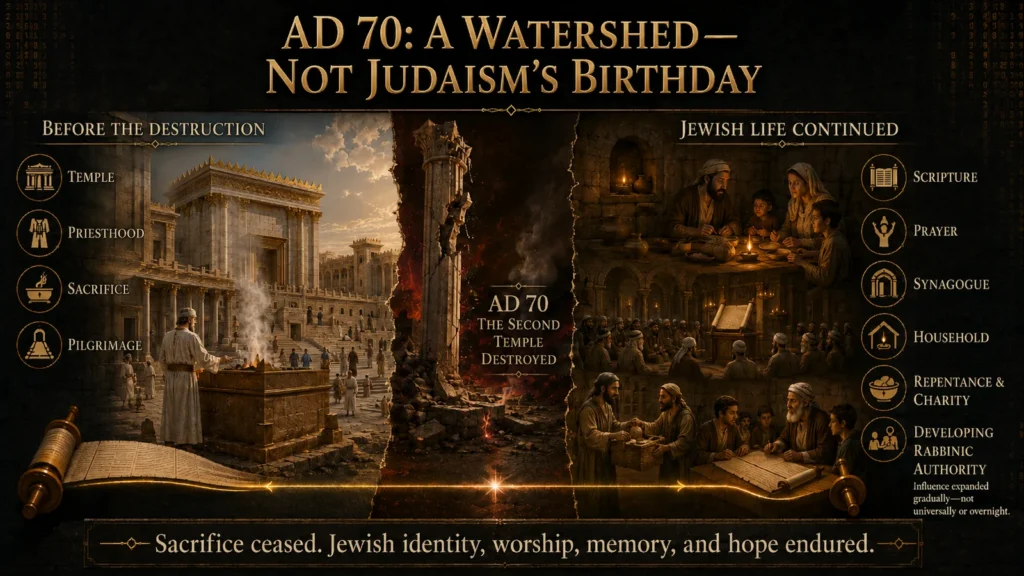
In AD 66, revolt against Rome became open war. Roman forces eventually captured Jerusalem and destroyed the Second Temple in AD 70. The event devastated Jewish political, social, and religious life, but its consequences must be described with precision.
Sacrifice Ceased
Without the Jerusalem sanctuary and altar, the commanded sacrificial service could not continue. Pilgrimage offerings, daily offerings, festival sacrifices, and the high priest’s Day of Atonement ministry stopped. This was not the first time Jews had lived without a Temple, but the Second Temple was never rebuilt.
Prayer, repentance, mercy, and obedience were biblical before AD 70, but the Torah also commanded actual sacrifices at the chosen sanctuary. Rabbinic preservation of sacrificial law and hope for restoration confirms that the absent institution still mattered.
Priestly Power Declined
Priests did not cease to be Jews, and priestly lineage retained ritual significance. But the public system that gave the high priest and Temple aristocracy unusual authority was gone. Groups closely tied to that order, especially Sadducean elites as known from earlier sources, no longer occupied the same institutional position.
Authority increasingly operated through local communities, households, teachers, judges, and networks of sages. Rabbis did not instantly gain universal control; their uneven influence expanded over time.
Judaism Continued
The destruction did not erase the Jewish people or make covenant faith impossible. Scripture, Sabbath, circumcision, festivals, food practices, prayer, charity, purity concerns, family life, synagogue, and hope continued. Jews interpreted the disaster through biblical patterns of sin, judgment, repentance, and future restoration.
Josephus and apocalyptic works show that this resilience was not initially unique to rabbis. In “Josephus and Judaism after 70 CE”, Jonathan Klawans warns against assuming that only rabbis possessed theological resources for explaining the Temple’s fall.
A Watershed, Not Instant Reinvention
AD 70 changed what Jewish communities could do. A religion ordered around one central sanctuary had to live indefinitely without it. Robert Kirschner’s “Apocalyptic and Rabbinic Responses to the Destruction of 70” describes the Temple as the center of priesthood, pilgrimage, sacrifice, and ritual atonement while also noting other forms of worship.
AD 70 was a watershed, not Judaism’s birthday. Earlier practices supported survival, and rabbis reshaped them through generations of interpretation. The result was neither unchanged Mosaic Israel nor a religion invented at once.
Yavneh, Bar Kokhba, and the Rise of the Rabbis
Later rabbinic stories associate Rabbi Yohanan ben Zakkai and other sages with Yavneh after Jerusalem’s fall. They show how rabbis understood their foundations: as a place where legal questions were decided, practices adjusted, and learning preserved. The literary construction of Yavneh in later narratives cautions against reading them as minutes from one constitutional convention.
Older accounts described a formal “Council of Jamnia” that replaced the Temple, fixed the Jewish canon, expelled all Christians, and established universal rabbinic authority. Source-based reviews of the Jamnia myth have dismantled that tidy scenario. Yavneh may have hosted an important circle of sages, but no reliable evidence shows one council accomplishing all those acts.
The political setting also remained unstable. The Bar Kokhba revolt against Rome in AD 132–135 ended in another catastrophe. Roman suppression damaged Jewish settlement in Judea and extinguished immediate hopes of restoring Jerusalem and the Temple. The revolt also matters for Jewish-Christian relations: Christians could not confess another claimant as Messiah, while Bar Kokhba’s supporters viewed his campaign through restoration hopes.
Rabbinic influence became more durable after these revolts, but it still grew through networks rather than an empire-wide bureaucracy. In “The Rabbinic Movement”, Hayim Lapin describes circles of learned and pious men in Palestine and Mesopotamia from the second through seventh centuries. Their teaching, academies, disciples, writings, courts, and communal relationships eventually gave Jewish life a shared framework.
That gradual account avoids two distortions. Rabbis were not simply Pharisees with a new name, because post-70 social structures and texts changed. Nor were they disconnected innovators, because they inherited Scripture, ancestral interpretation, practices, and questions already visible among Pharisees and other Jews. Rabbinic Judaism is best described as a historically developing claimant to Israel’s inheritance.
What Is the Oral Torah?
The Oral Torah is not one secret book. In classical rabbinic thought it encompasses explanations, applications, methods of interpretation, remembered rulings, and enacted safeguards associated with the written Torah. Some teachings are claimed to go back to Sinai; others are openly attributed to later sages and courts.
The Traditional Claim
Pirkei Avot 1 begins with a chain: Moses received Torah at Sinai and transmitted it to Joshua, the elders, the prophets, and the men of the Great Assembly. Chabad’s representative Orthodox article, “What Is the Oral Torah?”, explains that Moses received the Written Torah with oral instruction needed to understand and practice it while distinguishing Sinaitic laws from deductions and later enactments.
This distinction matters. A fair Christian account should not say rabbinic Jews believe every Talmudic sentence was dictated verbatim to Moses. The broader claim is that an authorized oral interpretive tradition accompanies the written revelation and that legitimate sages can apply it across changing circumstances.
Why Interpretation Is Necessary
Written law cannot apply itself. Commands concerning Sabbath work, binding signs on the hand, slaughter, damages, courts, and festivals require definitions and procedures. Even people who reject rabbinic conclusions interpret language, compare passages, weigh precedent, and decide what counts as obedience.
The Jewish continuity argument is therefore strong at this point: Israel always needed teachers and judges. A “Bible only” slogan does not eliminate interpretation; it can merely hide the interpreter. Rabbinic literature also preserves disagreements rather than pretending every case was obvious, and that argumentative form can express reverence for Torah rather than contempt for it.
Deuteronomy 17
Rabbinic defenders appeal to Deuteronomy 17:8–13, where difficult cases go to the priests and judge at the place God chooses, and Israel must follow their decision. The passage establishes a divinely ordered process for resolving difficult cases and warns against arrogant refusal of lawful judgment.
Yet the text locates that court within Israel’s land-and-sanctuary order. It does not name the Mishnah, identify every later rabbinic institution, or state that all later majority rulings were secretly delivered at Sinai. It supports the necessity of authorized judgment more directly than it proves an unbroken, fully specified rabbinic chain.
What History Can and Cannot Prove
History can show that transmitted interpretation existed before AD 70. Josephus says Pharisees maintained ancestral observances not written in Moses’ law, while the New Testament depicts traditions of elders applied to washing, vows, Sabbath, and purity. The Dead Sea Scrolls reveal other groups interpreting and extending Torah in detail. At minimum, Jews practiced legal reasoning beyond a bare recitation of written commandments; this does not prove that they already shared the later technical category of Oral Torah.
History can also trace development. Specific rulings are attributed to named sages; schools disagree; compilations arrange earlier and later material; anonymous editorial voices shape arguments. In “The Origins of Oral Torah: A New Pauline Perspective”, Yael Fisch cautions against projecting the later rabbinic Written Torah/Oral Torah distinction directly onto earlier Second Temple evidence.
What history cannot independently verify is the complete theological claim that the authoritative content later collected and developed under rabbinic auspices passed in an unbroken divine chain from Moses. That claim may be accepted by faith within rabbinic Judaism, but its scope exceeds what surviving historical evidence can establish. Christianity answers the authority question through Jesus and His commissioned apostles, not through denial that interpretation is necessary.
What Are the Mishnah and Talmuds?
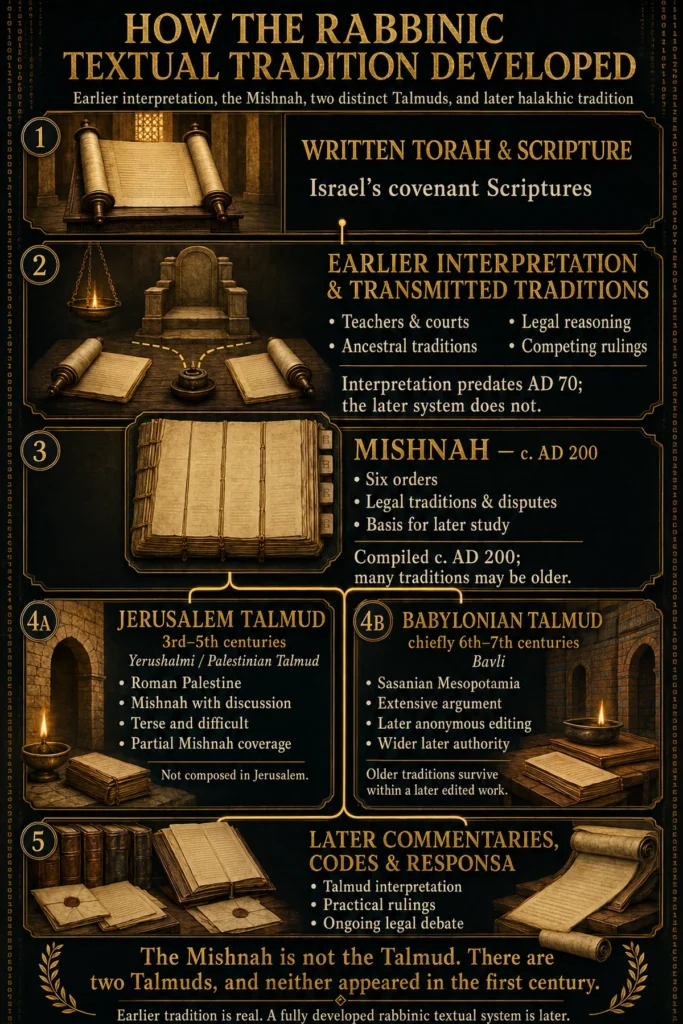
People often use Talmud for all rabbinic tradition, but the sources have distinct dates and functions. The basic sequence is Scripture, earlier traditions, the Mishnah, and two later bodies of discussion called Talmuds. Scholars call the era through the Mishnah tannaitic, after its early teachers, the tannaim; the later sages behind the Gemara—discussion and analysis of the Mishnah—belong to the amoraic era.
The Mishnah
The Mishnah is a compact Hebrew collection of legal traditions arranged in six orders: agriculture, festivals, women and family law, civil and criminal matters, holy things, and purity. Tradition associates its compilation with Rabbi Judah the Patriarch around AD 200. It records named disagreements, anonymous rulings, remembered Temple practices, and extensive laws that could not be fully practiced without the sanctuary.
Calling it a “law code” is useful but incomplete because it does not consistently issue one final rule. Its debates became the foundation for later study. Compilation around AD 200 does not mean every tradition originated then, nor does ancient attribution automatically prove pre-70 origin.
The Jerusalem Talmud
The Jerusalem Talmud, also called the Palestinian Talmud or Yerushalmi, combines Mishnah with layers of discussion produced in Roman Palestine. Despite its name, it was not composed in Jerusalem. Its formation is generally placed across the third through fifth centuries, and it covers much but not all of the Mishnah.
The Yerushalmi is terse and textually difficult. It preserves Palestinian rabbinic interpretation and social context, but readers should not treat every reported conversation as a verbatim transcript. Like other ancient compilations, it carries traditions through literary shaping.
The Babylonian Talmud
The Babylonian Talmud, or Bavli, joins Mishnah with extensive Aramaic and Hebrew analysis from Jewish scholarly circles in Sasanian Mesopotamia. It probes definitions, resolves contradictions, constructs hypothetical cases, preserves stories, and links legal questions across texts. Its identifiable traditions span centuries, while later anonymous layers of argument and editing shape the finished work.
Joshua Ezra Burns’s Oxford Bibliographies entry, “Talmud”, places the Bavli’s compilation chiefly in the sixth and seventh centuries, with subsequent revision—many centuries after Jesus and the first apostles.
The Later Authority of the Bavli
Both Talmuds matter, but the Bavli eventually gained greater authority across much of diaspora Jewish life. Medieval commentators and legal authorities interpreted it, resolved its tensions, and translated its discussions into practical halakhah. Later codes did not make the Talmud unnecessary; they entered an ongoing conversation with it.
The Bavli’s later date does not make it worthless; it can preserve older material and remains indispensable for understanding rabbinic Judaism. But sixth-century edited arguments cannot be projected uncritically into the first century. Each claim must be assigned to its layer and weighed by its evidence.
What Does Rabbinic Judaism Believe Today?
Modern Judaism is internally diverse. Orthodox, Conservative or Masorti, Reform or Progressive, Reconstructionist, and other Jewish communities do not assign the same authority to halakhah or define revelation in the same way. Secular and cultural Jews may identify deeply with the Jewish people while rejecting religious belief. The following description concerns the classical rabbinic inheritance and notes where modern commitments vary.
Torah and Halakhah
Classical rabbinic Judaism confesses the Torah as God’s gift to Israel and reads the Written Torah with the Oral Torah. Halakhah means the path or way of Jewish law and practice. It addresses worship, Sabbath, food, family, business, prayer, festivals, mourning, ethics, and communal life. Its reasoning draws on Scripture, Mishnah, Talmuds, later commentaries, responsa, customs, and legal codes.
Orthodox Judaism generally regards this halakhic system as binding, though Orthodox authorities can disagree about application. Conservative/Masorti Judaism claims fidelity to halakhah while giving historical development and institutional decision-making a larger formal role. Reform Judaism and Reconstructionist Judaism treat inherited practice more selectively and frame authority differently. Therefore, “Judaism teaches” must never be used to hide substantial modern disagreements.
Prayer and Repentance
Prayer, repentance, charity, and deeds of mercy are central to Jewish life. They did not originate after the Temple’s destruction: the Hebrew Scriptures already join prayer and repentance to forgiveness, and diaspora Jews prayed before AD 70. Rabbinic liturgy regularized daily, Sabbath, festival, and repentance-focused worship for life without an operating sanctuary.
Chabad’s representative Orthodox article, “Atonement in the Absence of Sacrifices”, appeals to Solomon’s prayer in 1 Kings 8, the prophets’ calls to return, fasting, charity, and Hosea’s language about the offering of lips. Mishnah Yoma 8:9 stresses repentance and requires reconciliation for offenses against another person. This is a morally serious theology, not a scheme for earning forgiveness through empty ritual.
Temple and Sacrifice
Rabbinic Judaism did not delete the Temple. The Mishnah devotes major attention to sacrifices and purity; traditional prayers remember the service; mourning customs mark the destruction; and traditional Jewish hope includes restoration. Priestly identity and certain related practices also continue.
At the same time, no Aaronic priesthood currently performs Torah-commanded offerings at a Jerusalem altar. Jewish communities have learned to worship through prayer, study, repentance, charity, table fellowship, synagogue, and festival observance. A fair description holds both facts together: post-70 Judaism developed functional religious life without sacrifice, while sacrifice remained in text, memory, law, and hope.
Messiah and Restoration
Classical Jewish hope expects God’s future redemption, but details vary. Maimonides describes a human Davidic king who restores Torah observance, gathers Israel, rebuilds the Temple, and leads an era of peace and knowledge of God. Chabad’s representative Orthodox overview, “Who Is Moshiach?”, follows that pattern.
Many Reform Jews speak more readily of a messianic age than a personal Messiah, and Jewish opinions differ concerning resurrection, the afterlife, the modern State of Israel, and the sequence of future events. What unites these hopes is not a universally detailed timetable but confidence that injustice and exile do not receive the final word.
Jewish Peoplehood
Rabbinic Judaism is not only a set of beliefs an individual chooses. It carries the identity of a historical people bound by ancestry, conversion, memory, covenant, calendar, and communal responsibility. Jewish law has standards for Jewish status, while modern movements disagree about descent and conversion in some cases.
This peoplehood helps explain what it means to be Jewish: a Jew may remain Jewish by family and communal status even while personally nonobservant or unbelieving. Christianity should neither reduce Jewishness to a club membership nor turn ancestry into a separate way of salvation. The New Testament can recognize enduring Jewish identity while insisting that Jews and Gentiles alike are justified through faith in Jesus Christ.
Righteous Gentiles
Rabbinic tradition does not generally teach that every Gentile must convert to Judaism. The Noahide framework identifies universal moral obligations, and influential authorities speak of righteous people among the nations who have a share in the world to come. Maimonides’ formulation is important but also debated in wording and interpretation.
This teaching corrects the claim that Judaism is simply an ethnic salvation monopoly. It also reveals a real Christian disagreement. The apostles did not call Gentiles to become Jews, but they did call every nation to repent and confess Jesus as Lord. The Christian gospel offers one crucified and risen Savior to Jew and Gentile, not parallel covenant paths with different saving centers.
Biblical Israel and Rabbinic Judaism Compared
The comparison of biblical Israel and rabbinic Judaism below describes dominant institutional patterns. Biblical Israel itself changed across centuries, and rabbinic Judaism contains multiple periods and modern movements. The table is a map, not a claim that either side was perfectly uniform.
| Dimension | Biblical Israel | Rabbinic Judaism |
|---|---|---|
| Public center | Tabernacle, then Jerusalem Temple | Torah-centered community, synagogue, home, school, and court |
| Governing authority | Elders, judges, priests, prophets, and at times kings | Rabbis, legal scholars, communal institutions, and diverse modern movements |
| Torah | Written covenant instruction taught and applied by judges | Written Torah interpreted through Oral Torah and accumulated halakhah |
| Priesthood | Aaronic priests conduct sanctuary service | Priestly lineage remembered; no operating sacrificial service |
| Sacrifice | Commanded offerings at the chosen sanctuary | Preserved in study, liturgy, memory, and hope; not currently performed |
| Land and tribes | Tribal allotments and national law tied to the land | Global peoplehood; tribal administration largely inoperative |
| King | Davidic monarchy for part of Israel’s history | No reigning Davidic king; traditional hope awaits Messiah |
| Atonement | Sacrifice, priesthood, repentance, prayer, mercy, and covenant faithfulness | Repentance, prayer, charity, Yom Kippur, restitution, and divine mercy |
| Core literature | Torah, Prophets, and Writings in developing collection | Tanakh plus Mishnah, Talmuds, midrash, codes, commentaries, and responsa |
| Historical form | Covenant nation under changing judges, kings, empires, exile, and return | Religious and legal tradition practiced across many communities, formed especially after AD 70 |
| Christian assessment | Divinely given covenant history pointing forward | Real continuity with Israel, but later authority claims disputed in light of Christ |
The contrast is not “grace versus works” or “Bible versus invented religion.” Biblical Israel needed interpretation, and rabbinic Judaism preserves biblical truth. The dividing issue is where God placed final covenant authority and how He provides definitive atonement.
Where Rabbinic Judaism and Christianity Conflict
The history of biblical Israel and rabbinic Judaism supplies much of the vocabulary Judaism and Christianity share, which can make their disagreement look smaller than it is. The conflict is not solved by saying both traditions value Scripture and ethics. They identify different final authorities and give incompatible answers about Jesus.
Authority
Rabbinic Judaism reads Written Torah through a developing tradition of sages, Talmudic reasoning, and halakhic precedent. Christianity receives Israel’s Scriptures and the apostolic writings as one canon whose center and fulfillment is Jesus Christ. Church tradition has ministerial value, but it remains subject to God’s written word.
The Christian objection is not that all tradition is evil. Paul himself speaks of apostolic traditions. The issue is authorization: the apostles claimed commission from the risen Messiah and delivered public testimony about Him. A later rabbinic majority cannot overrule the Son whom Christians confess as Lord.
Temple
Rabbinic Judaism sustains holy life without a functioning Temple while remembering and, in traditional forms, hoping for it. Christianity claims that Jesus is the true meeting place between God and humanity. He identified His body with the Temple, and His people become God’s dwelling through the Spirit.
This does not mean the Jerusalem Temple was wicked or meaningless. God instituted it. Its holiness makes Jesus’ claim more, not less, astonishing. The copy gives way because the reality to which it pointed has come.
Sacrifice and Atonement
Rabbinic Jewish sources emphasize repentance, prayer, restitution, charity, Yom Kippur, and God’s mercy in the absence of sacrifice. Christianity affirms repentance and mercy but insists that forgiveness rests finally on God’s provision of atoning blood. Hebrews 7–10 presents Jesus as the eternal High Priest who offered Himself once for all and entered the heavenly sanctuary.
The cross is not a Gentile rejection of biblical sacrifice. It is the Christian claim that God completed the pattern through a willing, sinless Messiah. Good works are the fruit of reconciliation, not a substitute for Christ’s offering.
Torah and Covenant
Rabbinic Judaism understands the Sinai covenant and its commandments as the enduring constitution of Jewish life. Christianity teaches that Torah is holy and revelatory while claiming that Jesus inaugurates the promised new covenant. Circumcision, food laws, calendar, and sanctuary regulations no longer mark the multinational people of God in the same way.
Christians disagree among themselves about the law’s continuing categories, but apostolic teaching is clear that Gentiles are not justified or admitted by taking on Mosaic identity. The law bears witness to Christ, exposes sin, and instructs God’s people when read through its fulfillment in Him.
Messiah
Traditional rabbinic Judaism awaits a future Davidic Messiah and rejects Jesus because the expected restoration, peace, Temple, and worldwide knowledge of God are not visibly complete. This is the strongest Jewish objection, not a trivial refusal to read proof texts.
Christianity answers with two-stage fulfillment rooted in Jesus’ death and resurrection. The Messiah first suffers for sin, rises, pours out the Spirit, gathers the nations, and then returns to judge and restore. The question becomes whether Israel’s Scriptures permit that pattern and whether the resurrection testimony is true. Readers can examine the broader case in fulfilled prophecies of Jesus.
New Covenant
Jeremiah promised a new covenant with the house of Israel and the house of Judah, involving internalized law, knowledge of God, and forgiven sin. Rabbinic Judaism may interpret the passage as Israel’s covenant renewed rather than a new religion. Christianity agrees that the promise is made within Israel’s story but says Jesus explicitly enacted it through His blood.
The new covenant does not portray Israel’s God as changing His character. It accomplishes what human rebellion prevented: cleansed hearts, the Spirit, decisive forgiveness, and a people gathered around the Messiah.
God’s People
Rabbinic Judaism locates Israel’s covenant identity in the Jewish people, Torah, and communal continuity. Christianity teaches that Jews do not cease to be Jews and that God has not made ethnic contempt holy. It also teaches that saving membership in the new-covenant people comes only through union with Christ.
Gentile believers are not a superior ethnicity that replaced an inferior one. They are wild branches grafted by grace and warned against boasting. Jewish and Gentile believers are reconciled in one body, while unbelief remains unbelief for either. There is one gospel because there is one Lord.
The Strongest Case for Rabbinic Continuity
The best rabbinic case begins with a practical truth: the written Torah presupposes interpretation. Israel had priests, judges, elders, teachers, customary practice, and remembered judgments. Deuteronomy commands obedience in difficult cases. Ezra publicly read and explained Torah. Pharisees demonstrably transmitted ancestral traditions before AD 70. Synagogues, prayer, almsgiving, fasting, and Scripture study were already part of Jewish life.
From this perspective, the rabbis did not casually replace God’s religion after Rome destroyed it. They preserved covenant obedience under catastrophic conditions. They organized prayer, guarded Sabbath and festivals, carried Hebrew and Scripture across continents, debated how commandments should govern new cases, sustained families and communities, remembered the Temple, and refused to let imperial violence erase Israel’s identity. Recording the Mishnah safeguarded accumulated teaching; the Talmuds made disagreements available for disciplined study rather than concealing them.
Rabbinic debate can itself be understood as fidelity. If Torah is God’s instruction for life, faithful people must reason about ovens, contracts, marriage, damages, food, purity, prayer, and countless new circumstances. Minority opinions preserve intellectual humility and possible resources for later judgment. Community acceptance and generations of holy practice give the tradition a cumulative weight greater than private interpretation.
The case also appeals to providence. Rabbinic forms enabled Jewish survival through dispersion, persecution, forced conversion, and social exclusion. A tradition that preserved Scripture, peoplehood, ethical seriousness, repentance, generosity, and hope for nearly two millennia cannot be dismissed as empty legalism. Christians should be able to state that case so a knowledgeable Jewish reader recognizes it, even while disagreeing with its final authority claim.
The Christian Response
Christianity can affirm nearly all the historical observations in that case without granting its theological conclusion. Interpretation is necessary; pre-70 oral traditions existed; post-70 sages achieved remarkable preservation; later date alone does not make a teaching false. But none of those facts proves that the completed rabbinic system, or every authoritative ruling within it, was delivered to Moses at Sinai.
The historical evidence displays continuity and development. Priesthood, sacrifice, national courts, tribal administration, and Davidic monarchy are not currently operating as Torah describes. Rabbinic texts emerged in layers, preserve disputes, and sometimes give later literary form to earlier memories. Providence in survival does not by itself identify the bearer of final covenant authority, because Christians also confess providential preservation while remaining accountable to Scripture.
Jesus brings the authority issue to its center. He did not reject interpretation; He judged interpreters. He warned that tradition could nullify command, claimed lordship over Sabbath, pronounced forgiveness, identified Himself as greater than the Temple, and announced judgment over its leadership. Hebrews presents the Son as greater than Moses, as the builder deserves more honor than the house. Those claims would be arrogant if made by an ordinary teacher. The resurrection is God’s vindication that He is not ordinary.
The apostles did not solve Israel’s sin by constructing another fence of rulings. They proclaimed that the Messiah bore the curse, rose bodily, and gives the Spirit. The new covenant places God’s instruction within transformed hearts while forming a holy community under apostolic teaching. That community still interprets and can still err, but its foundation is the once-for-all revelation of Jesus rather than a continuing chain of rabbinic legal rulings.
The cross also answers the absence of sacrifice. Christians do not say blood no longer matters; they say Christ’s blood matters finally. They do not say priesthood was pointless; they say Jesus is the eternal High Priest. They do not say the Temple was a mistake; they say the incarnate Son is its reality. The promised Redeemer fulfills Israel’s hope rather than borrowing its vocabulary for an unrelated religion.
This response leaves no room for dual-covenant salvation. Jewish ancestry is a gift and Jewish preservation deserves gratitude, but no one is reconciled to God apart from the Son. Nor does it leave room for ethnic replacement. Gentile Christians stand only by grace, owe a spiritual debt to Israel, and must never turn the gospel into contempt for the people through whom the Messiah came.
Frequently Asked Questions
Is Modern Judaism the Religion Moses Practiced?
Not in an unchanged institutional sense. Comparing biblical Israel and rabbinic Judaism shows why: Moses’ Torah ordered Israel around a sanctuary, Aaronic priesthood, sacrifices, tribal structures, covenant courts, and life in the land. Modern rabbinic Judaism preserves Moses’ Torah and Jewish covenant identity but practices them through a later halakhic tradition without an operating Temple system. It is historically continuous with Israel and also historically developed.
Did Judaism Begin After AD 70?
No. Jewish identity, Scripture, worship, Torah interpretation, prayer, synagogue life, festivals, and multiple Jewish movements all existed before AD 70. The Temple’s destruction was a watershed that accelerated new forms of authority and adaptation. Classical rabbinic Judaism emerged gradually after the destruction, especially through the second-century sages, the Mishnah around AD 200, and the later Talmuds.
Did Pharisees Become Rabbis?
The Pharisees are the most important pre-70 movement behind later rabbinic Judaism, and there are clear continuities in resurrection belief, ancestral tradition, and interpretive practice. But the groups are not identical. The title, social networks, institutions, political setting, and literary culture of the rabbis took shape after the Temple’s fall. It is more accurate to say the rabbinic movement inherited and transformed important Pharisaic traditions.
What Is Oral Torah?
Oral Torah is the rabbinic category for the authoritative interpretation and application accompanying Written Torah. It includes traditions claimed from Sinai, principles of interpretation, remembered rulings, debates, and later rabbinic enactments. Jewish movements differ over its divine status and binding force. Christians can acknowledge that written law requires interpretation without accepting that the later rabbinic corpus carries a complete, unbroken Sinaitic authority.
Is the Mishnah the Talmud?
No. The Mishnah is an early rabbinic compilation organized around legal topics, traditionally associated with Rabbi Judah the Patriarch around AD 200. The Talmuds include the Mishnah together with generations of later rabbinic discussion. Someone reading the Talmud therefore encounters Mishnah as a base text and Gemara, the later analysis, debate, narrative, and application around it.
Are There Two Talmuds?
Yes. The Jerusalem or Palestinian Talmud developed in Roman Palestine, mainly from the third through fifth centuries. The Babylonian Talmud developed in Mesopotamia and reached its compiled form later, chiefly in the sixth and seventh centuries with further revision. They overlap but are not identical, and the Babylonian Talmud eventually became more authoritative across much of Jewish legal tradition.
Did Jamnia Create the Jewish Bible?
No evidence supports a single Council of Jamnia that closed the Jewish canon in one formal decision around AD 90. Discussions about particular books and sacred writings occurred over time, and later rabbinic texts remember debates. Yavneh was important in early rabbinic memory and development, but the familiar one-council canon story is an outdated historical simplification.
Why Do Jews Not Sacrifice?
The Torah restricts sacrificial worship to the sanctuary God chooses, and no authorized Jewish Temple and altar currently operate in Jerusalem. Jewish communities therefore do not perform the sacrificial system. Traditional Judaism continues to study its laws, remember the Temple in prayer and mourning, and often hope for restoration. Lack of sacrifice is a consequence of the Temple’s absence, not proof that the Torah never valued sacrifice.
Did Prayer Replace Sacrifice?
That sentence is too simple. Prayer, repentance, charity, and mercy were vital before AD 70 and became still more central after the Temple’s destruction. Rabbinic texts also align set prayers with the former daily offerings. Yet traditional Judaism retains sacrificial texts, laws, memories, and hopes. It is better to say Jewish worship adapted to life without sacrifice than that prayer made sacrifice meaningless.
Was Jesus Opposed to Judaism?
Jesus opposed sin, hypocrisy, unbelief, corrupted leadership, and traditions that nullified God’s command. He did so as Israel’s Messiah within Jewish covenant history. He affirmed Israel’s God and Scriptures, worshiped at the Temple, observed festivals, and taught Jewish hearers. His conflicts with Jewish leaders were serious, but they do not justify contempt for Jews or the claim that everything Jewish was legalistic.
Is Christianity a Later Gentile Religion?
Christianity became majority Gentile, but its origins are Jewish. Jesus, the apostles, and the first resurrection witnesses were Jews; the earliest church began in Jerusalem; and its preaching interpreted Jesus through Israel’s Scriptures. Gentiles were included without first becoming Jews. Later Gentile failures and anti-Jewish sins are real, but they do not change the movement’s first-century Jewish foundation.
Do Christians Believe the Old Testament Is Obsolete?
No. Christians receive the Old Testament as God’s word and the indispensable story, promise, and theological grammar of the gospel. Old covenant does not mean worthless Scripture. Christians believe Jesus fulfills the Torah, Prophets, priesthood, sacrifice, kingship, and covenant hopes. The Old Testament continues to reveal God’s character and instruct His people when read in light of Christ.
Sources and Further Reading
This article distinguishes ancient sources, modern scholarship, Jewish self-description, and Christian theological interpretation. The following sources are especially useful for readers who want to test the chronology and claims:
Ancient Jewish and Christian Sources
- Genesis through Deuteronomy, selected covenant and sanctuary texts
- Jeremiah 31 and the promise of a new covenant
- Josephus, Antiquities 13, on Pharisaic and Sadducean tradition
- Pirkei Avot 1:1–2 on transmission and the pillars of the world
- Mishnah Yoma 8:9 on repentance and reconciliation
Historical and Rabbinic Scholarship
- Annette Yoshiko Reed, “Second Temple Judaism”
- Rivka Ulmer, “Rabbinic Judaism”
- Joshua Ezra Burns, “Talmud”
- John M. G. Barclay, “The Jews of the Diaspora”
- Hayim Lapin, “The Rabbinic Movement”
- Jonathan Klawans, “Josephus and Judaism after 70 CE”
- Robert Kirschner, “Apocalyptic and Rabbinic Responses to the Destruction of 70”
- Yael Fisch, “The Origins of Oral Torah: A New Pauline Perspective”
- Cambridge Mishnah manuscript overview
Representative Jewish Explanations
- Chabad, “What Is the Oral Torah?”
- Chabad, “Atonement in the Absence of Sacrifices”
- Chabad, “Who Is Moshiach?”
- Rabbinical Assembly, Conservative/Masorti movement
- Reform Judaism, “What Is Reform Judaism?”
- Reconstructing Judaism, “Evolving Religious Civilization”
Christian Theological Sources
Primary texts must be read by genre and date. Josephus writes with defensive and political aims; rabbinic compilations preserve traditions through later editing; modern Jewish organizations describe particular communities; and Christian Scripture supplies the article’s theological judgment rather than pretending to be a neutral Jewish account.
Jesus Christ Is the Fulfillment, Not a Later Substitute
The journey connecting biblical Israel and rabbinic Judaism through the Second Temple period is not a story of simple sameness or simple betrayal. Israel endured exodus and kingdom, division and exile, return and empire, Temple destruction and dispersion. Jewish communities preserved Scripture, confession, memory, and hope through extraordinary pressure. Christians should approach that history with truth, gratitude, and humility.
But respect cannot erase the question Jesus placed before Israel and the nations. Who has authority to forgive sins? Who is Lord of the Sabbath? Who can claim to be greater than the Temple, the resurrection and the life, and the heavenly Son of Man? Rabbinic Judaism answers by continuing Israel’s covenant life through Torah and the sages while awaiting redemption. Christianity answers that redemption has entered history in Jesus and awaits completion at His return.
Jesus is not a patch for a religion that failed. He is the Son promised within Israel’s own story. He recapitulates Israel’s calling, obeys where humanity rebelled, bears covenant judgment, and rises as the beginning of new creation. In Him, the Temple theme becomes personal: God’s glory dwells among us in the incarnate Word. In Him, priesthood reaches permanence: death cannot end His ministry. In Him, sacrifice reaches completion: He offers Himself willingly and once for all.
The new covenant therefore is not God’s abandonment of His earlier word. It is God’s faithfulness to Jeremiah’s promise of forgiveness and transformed hearts. The Spirit writes God’s instruction within a people drawn from Israel and the nations. Gentiles do not become the new ethnic Israel, and Jews are not saved by ancestry. Both come to the Father through the same Messiah, become one body, and retain no ground for boasting.
That claim deserves historical examination. The messianic prophecies concerning Jesus’ divine identity and the apostolic resurrection testimony must be weighed, because Christianity is false if Jesus remained dead. If He rose, no later human authority can stand above Him, and no act of repentance or religious preservation can replace His atoning work.
The final contrast is therefore not old religion against new religion, Jews against Christians, or tradition against thought. It is the difference between waiting for redemption and confessing that the Redeemer has come. Jesus Christ is not a later substitute for Israel’s story; He is its promised Messiah, final sacrifice, eternal High Priest, new-covenant Mediator, risen Lord, and only Savior.