
GUIDED ARTICLE EXPERIENCE
Is Modern Israel the Same as Biblical Israel?
Read along as the narration moves through the article.
Private device narration · No hosted audio or tracking
CONTINUE GUIDED TOUR
Continue where you left off.
GUIDED TOUR COMPLETE
You have reached the end of this study.
Study record saved on this device.
GUIDED TOUR
Is Modern Israel the Same as Biblical Israel?
Narrator: Paranoid Prophet Recommended Voice Native device narration
Prepare to follow the article as it is narrated.
VOICE & TOUR OPTIONS
Voice & Listening
NARRATOR
Finding a narrator…
Checking the best narrator available on this device.
Restores the best curated narrator available on this device.
Narrator choices are curated for clear, long-form listening on this device.
Screen-awake support will be checked when narration starts.
CHOOSE A NARRATOR
Curated for this device
Choose a verified narrator for this browser, or use System Narrator. Automatic mode uses the best reliable route exposed by this device; your chosen narrator is preserved even if this device needs a temporary fallback.
Preparing the guided article experience…
RESUME GUIDED TOUR?
Continue where you left off.
GUIDED TOUR COMPLETE
You have reached the end of this study.
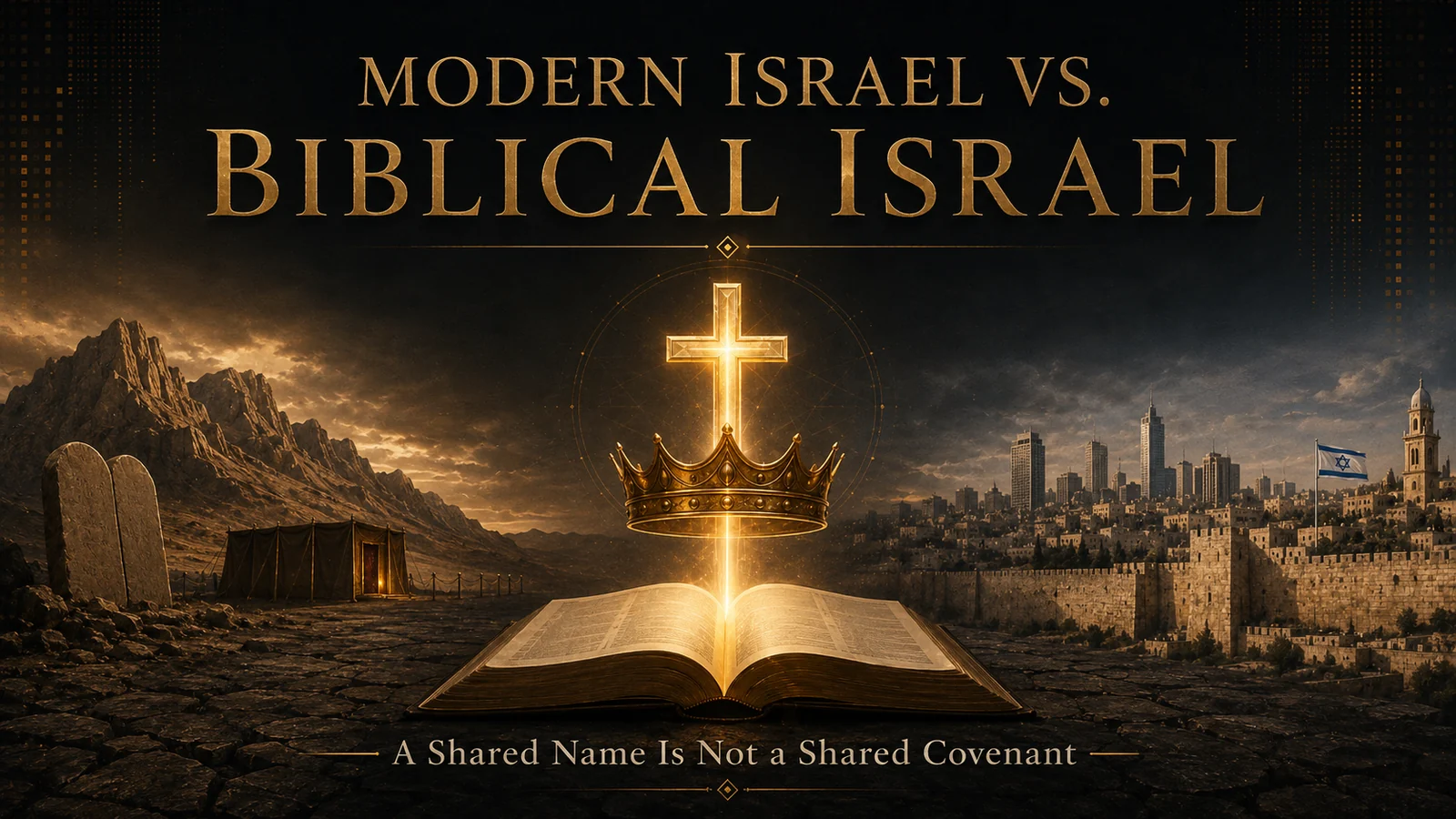
The debate over modern Israel vs biblical Israel often begins with a shared name and ends with conclusions that the name cannot carry. The State of Israel stands in the land where Abraham sojourned, Jacob’s descendants became a people, David ruled, the prophets spoke, and Jesus lived, died, and rose. Jewish attachment to that land is ancient and real. Yet the Bible uses Israel for several related subjects, each defined by a particular place in God’s covenant story. A contemporary state does not become all of them simply by bearing their name.
This distinction is theological, not a license for contempt. Jewish people are not collectively responsible for an Israeli government’s decisions, and Palestinian lives are not obstacles to prophecy. The Christian task is to tell the truth about Scripture without turning people into symbols.
Article Guide19 sections
Short Answer: Is Modern Israel Biblical Israel?
No. The State of Israel established in 1948 is a modern nation-state with a genuine historical relationship to Jewish peoplehood and the ancient land, but it is not the Israel of the Bible in the covenantal sense. It is not Jacob, the twelve tribes, the exodus assembly, the nation constituted at Sinai, the Davidic kingdom, the faithful remnant, or the new-covenant people gathered around the Messiah.
That answer does not deny Jewish history, sever Jews from their ancestral homeland, or settle the political question of how states should be recognized and secured. Political legitimacy can be argued from history, law, self-determination, security, diplomacy, and justice. Covenant identity asks another question: Who belongs to the saving order God brought to fulfillment through Jesus Christ?
The New Testament answers through union with Christ. Jesus is Abraham’s promised Seed, David’s Son, Israel’s faithful Messiah, and mediator of the new covenant. Believing Jews and Gentiles become one reconciled people without erasing ethnicity. Romans 9-11 gives Christians strong reason to hope for a future large-scale turning of Jewish people to Jesus, but neither ethnicity nor statehood supplies saving covenant membership apart from Him.
Why the Name “Israel” Creates Confusion
One word, several biblical referents
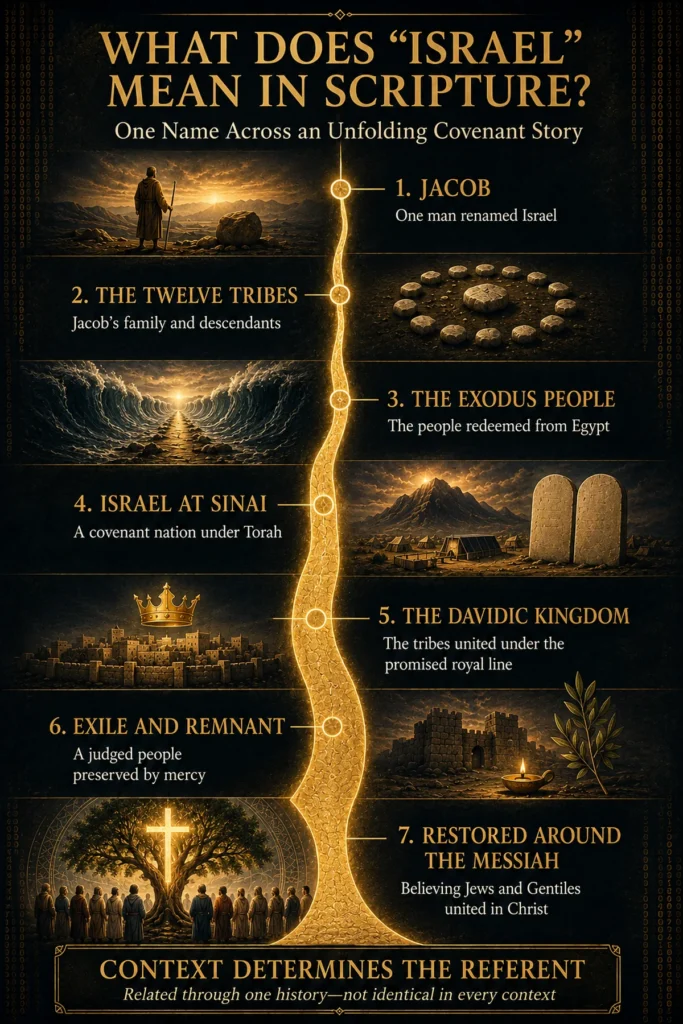
In Scripture, Israel first becomes the new name of one man. It then names his family, the people delivered from Egypt, the twelve tribes bound to God at Sinai, the united monarchy, the northern kingdom after civil division, the exiled and restored people, and the faithful remnant within the larger nation. The prophets can address “Israel” while simultaneously distinguishing rebels from servants who trust the Lord.
These referents overlap within one unfolding history, but they are not interchangeable. Hosea’s northern kingdom, Jacob at Peniel, and Paul’s kinsmen according to the flesh are related subjects, not identical ones. Context determines the referent.
A modern state bearing an ancient covenant name
The founders of the state deliberately chose an ancient national name. Israel’s Declaration of Independence appealed to Jewish historical connection with the land, modern Zionist organization, the catastrophe of the Holocaust, the United Nations partition resolution, and a claimed natural right to sovereign self-determination. It declared a state called Israel on May 14, 1948. Those are modern historical and political claims, even when they invoke biblical memory.
Jewish communities preserved language, prayer, festivals, texts, memory of Jerusalem, and attachment to the land across centuries of dispersion and persecution. The state did not invent that connection, and the Holocaust did not create it, though genocide gave terrible urgency to refuge and security.
Why shared terminology does not prove shared identity
Shared terminology can express genuine historical continuity without reproducing an earlier covenant order. Geography and nomenclature alone cannot supply that identity; the constituting features must also be present.
Biblical Israel was constituted by divine acts and covenants: God’s call of the patriarchs, redemption from Egypt, Sinai, Torah, priesthood, sacrifice, tribal inheritance, Davidic kingship, prophetic judgment, and promised restoration. The state founded in 1948 has citizens, borders, courts, elections, ministries, military institutions, and civil law. Its religious character is debated within Israel itself. Shared peoplehood and place establish historical continuity; they do not establish identity with every stage of the biblical covenant order.
What Does “Israel” Mean in the Bible?
Jacob renamed Israel
The first bearer of the name is Jacob. After wrestling through the night, he is told that his name will be Israel because he has striven with God and with men and prevailed (Genesis 32:22-32). Genesis repeats the naming and joins it to promises of fruitfulness, nations, kings, and land. Israel is therefore personal before it is national: the patriarch whose twelve sons stand at the head of the tribes.
Jacob’s descendants and the twelve tribes
The name broadens from the father to his household. “The sons of Israel” are first Jacob’s sons, then their descendants. Genesis 49 blesses the tribal ancestors; Exodus opens by recalling the family that entered Egypt. This genealogy gives biblical Israel an ethnic and historical dimension that Christian theology must not erase.
Descent never guaranteed faithfulness. Genesis exposes sin within the family while God’s mercy preserves a people; later Scripture likewise separates covenant privilege from covenant obedience.
Israel delivered from Egypt
God calls the enslaved people His “firstborn son” and rescues them through Passover and the sea. Israel is now the redeemed exodus people, defined by ancestry and God’s saving action. The exodus becomes the historical grammar by which prophets and apostles describe judgment, rescue, worship, and belonging.
Israel at Sinai
At Sinai, the delivered people enter a national covenant order. God calls them His treasured possession, a kingdom of priests, and a holy nation (Exodus 19:3-6). Torah governs worship and social life through priesthood, sacrifice, holiness, and blessings and curses in the land.
This is a decisive difference from modern citizenship. Biblical Israel at Sinai was not merely an ethnic population possessing territory. It was a covenant nation under a revealed law, with a divinely appointed priesthood, sanctuary, sacrifices, and a corporate vocation before the nations.
The united kingdom
Israel later names the tribes united under Saul, David, and Solomon. The Davidic covenant focuses hope on a righteous royal heir. Jerusalem and Zion become royal and sanctuary language as well as geography, and restoration after judgment remains inseparable from the promised King.
Israel and Judah after division
After Solomon, the kingdom fractures. “Israel” often names the northern tribes, while “Judah” names the southern kingdom centered on Jerusalem (1 Kings 12). The northern kingdom falls to Assyria; Judah later falls to Babylon. Prophets may use Israel narrowly for the north, broadly for Jacob’s people, or hopefully for a reunited future. Readers who flatten these uses can make a modern headline appear in a text whose historical subject is something else.
Exile, remnant, and restoration
The exile did not end Israel’s story. Prophets answered covenant rebellion with judgment, then promised return, cleansing, a faithful remnant, a Davidic ruler, the Spirit, and renewed dwelling with God. Post-exilic Judeans could again be called Israel; restoration already involved continuity through transformation.
The remnant theme is especially important. Isaiah distinguishes a surviving remnant that truly relies on the Lord from the larger people under judgment (Isaiah 10:20-11:10). Paul later uses that pattern in Romans. Scripture can affirm Israel’s historical privileges while denying that ancestry automatically equals saving faith.
What Is the Modern State of Israel?
The state established in 1948
The state emerged through decades of migration, institution-building, diplomacy, conflict, and Zionist work. Its May 1948 declaration established provisional institutions and promised liberty, justice, religious freedom, and equal civic rights.
The state’s self-description remains explicitly Jewish. The 2018 Basic Law: Israel – The Nation State of the Jewish People defines it as the Jewish people’s nation-state, names Hebrew as the state language, supports Jewish immigration and diaspora connection, and gives Arabic special status. These are current national categories.
A modern government rather than a Mosaic covenant order
Israel is governed through the Knesset, cabinet, judiciary, civil service, military, municipal institutions, and a body of Basic Laws. This national order has neither a reigning Davidic king nor an Aaronic sacrificial system. Its constitution is modern civil law rather than the Mosaic covenant’s civil, ceremonial, tribal, and priestly structure.
Religious law influences parts of public and personal life, and Jewish symbols and calendars shape the state. That does not make the Knesset the assembly at Sinai. Secular and religious Israelis dispute the state’s proper Jewish character precisely because modern sovereignty has not restored one uncontested biblical order.
Jewish and non-Jewish citizens
Israel’s population is not religiously or ethnically uniform. The Israel Central Bureau of Statistics’ 2026 release groups residents as “Jews and Others,” Arabs – including Muslims, Arab Christians, and Druze – and foreigners. Citizenship and residency involve further legal distinctions, but the basic fact is enough here: not every Israeli is Jewish, and not every Jewish person is Israeli.
Non-Jewish citizens and residents are neighbors made in God’s image, not covenant scenery. Their dignity cannot be subordinated to a prophetic timeline. Jewish citizens likewise are people, not proof objects for an end-times chart.
Israeli, Jewish, and practicing Judaism are different categories
Israeli is a civic or national category. Jewish can involve ancestry, peoplehood, culture, religious law, communal belonging, or combinations of these. Judaism names a diverse religious tradition with its own movements, practices, authorities, and debates. A Jewish person may be Orthodox, Conservative, Reform, secular, atheist, Zionist, non-Zionist, or anti-Zionist. An Israeli citizen may be Jewish, Muslim, Christian, Druze, or otherwise identified.
These distinctions prevent two errors. Christians should not assign every Israeli policy to “the Jews.” Nor should they treat every Jewish neighbor as a representative of Israel. Collective blame is false, and the old habit of turning Jews into a theological abstraction has caused catastrophic harm.
Jewish Peoplehood Is Not the Same as Covenant Israel
Ancestry, culture, religion, and peoplehood
Jewish identity survived without modern sovereignty because it was never reducible to citizenship. Family, communal law, liturgy, language, memory, worship, and endurance formed diverse communities. Jesus, His apostles, Israel’s Scriptures, and the earliest church were Jewish.
That continuity explains why Christians must reject any theology that speaks as if Jews vanished from history. It also explains why the modern return carries profound human meaning for many Jews even when a Christian does not regard the state as covenant fulfillment.
A Jewish person may be religious or secular
Jewish peoplehood is broader than observance. A secular Jew retains family and communal identity; a religious Jew need not endorse a party or Zionist theology. Some Zionists view statehood as liberation and protection. Some Jewish anti-Zionists challenge Zionism on ethical or political grounds, while some Haredi communities reject redemptive meaning for secular sovereignty. None speaks for all Jews.
Historical connection does not establish new-covenant standing
The Christian claim does not deny Jewish continuity. Jewish people retain real descent, history, and a unique place in the gospel’s story. Paul names their adoption, covenants, law, worship, promises, patriarchs, and the Messiah’s ancestry. He also prays for their salvation. Both statements belong together.
The new-covenant mediator defines new-covenant standing. Ancestry, statehood, and possession of Jerusalem concern historical and political identity; saving participation comes through faith, the Spirit, and union with the Messiah. This same rule humbles Gentile Christians, who possess no natural superiority and stand only by faith. With the identities defined, the next step is to ask what Zion, Zionism, land, and Abrahamic inheritance mean within the whole biblical story.
Biblical Zion and Modern Zionism Are Not the Same
Zion in Scripture
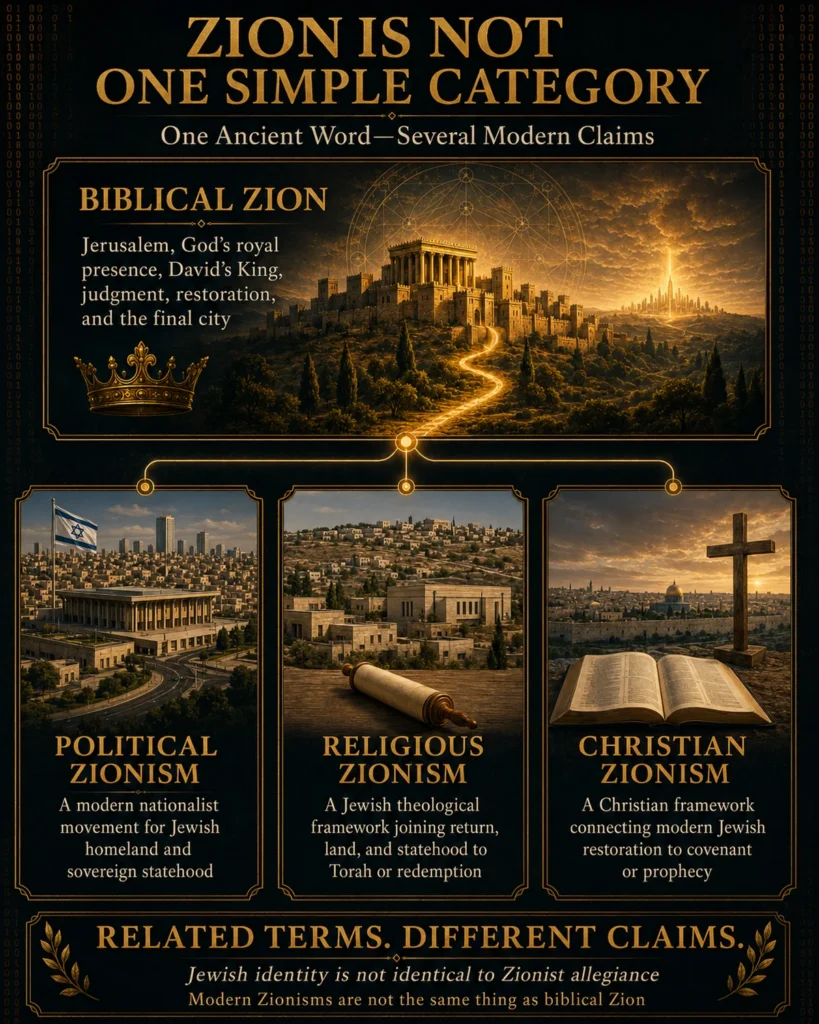
Zion begins as a place. David captures the stronghold of Zion, identified with the City of David. The name expands to include the temple mount, Jerusalem, and finally the city as the center of God’s royal presence and saving reign. The prophets can address Zion as a woman, grieve her judgment, and promise her restoration. The Psalms announce God’s King on Zion and envision the nations coming under His rule (Psalm 2).
Biblical Zion is therefore more than a poetic synonym for a modern capital. It belongs to a theological world of temple, Davidic kingship, holiness, judgment, pilgrimage, and the Lord dwelling with His people. The New Testament does not discard that hope. It brings believers to “Mount Zion” and the heavenly Jerusalem through Jesus, mediator of the new covenant, and ends in the New Jerusalem where God dwells with redeemed humanity.
Political Zionism
Modern political Zionism arose within the world of nineteenth-century nationalism, European antisemitism, Jewish emancipation, and arguments about the future of diaspora life. It sought Jewish national self-determination and a secure homeland, eventually focused on sovereign statehood in the ancestral land. The movement was never ideologically uniform. Liberal, socialist, revisionist, cultural, practical, and religious currents argued over means and ends.
The current World Zionist Organization’s Jerusalem Program calls Zionism the Jewish people’s national liberation movement. It affirms the centrality of Israel and Jerusalem, immigration, Jewish and Hebrew education, resistance to antisemitism, democratic statehood, peace, and settlement. That is an organization’s official platform, not a creed confessed by every Jew. Michael Stanislawski’s Oxford history, Zionism: A Very Short Introduction, likewise traces modern Jewish nationalism while emphasizing its internal developments and divides.
Jewish opposition also accompanied Zionism. Some Orthodox Jews believed political restoration should await divine redemption; some diaspora thinkers defended Jewish flourishing outside a territorial nation-state; some socialists pursued other forms of autonomy; contemporary anti-Zionist Jews offer ethical and political critiques. Jewish Voice for Peace’s approach to Zionism is one current advocacy position, not a referendum on Jewish opinion. Its existence is enough to disprove the claim that Jewish identity and Zionist allegiance are identical.
Religious Zionism
Religious Zionism joins Jewish national return and statehood to Torah, land, divine promise, or redemption in varying ways. Some regard the state as religiously significant without treating each government decision as holy. Some have assigned messianic meaning to sovereignty or settlement. Others seek a Jewish democracy shaped by religious tradition while rejecting theocracy or automatic sanctification of the state.
The diversity is documented in serious scholarship. Oxford’s study The Invention of Jewish Theocracy examines religious-Zionist efforts to make halakha state law and the conflict with advocates of a secular democracy. David Novak’s Zionism and Judaism: A New Theory defends a religiously grounded Zionism while contrasting it with versions that ascribe messianic significance to the State of Israel. Neither book permits “religious Zionists believe” to function as a universal sentence.
Christian Zionism
Christian Zionism is a Christian theological and often political commitment to Jewish return, national restoration, and the land. Its adherents vary. Some begin with dispensational distinctions between Israel and the Church. Others emphasize the Abrahamic covenant more than end-times charts. Some offer strong political support while criticizing particular Israeli policies. A fair account should not accuse every Christian Zionist of wanting catastrophe or denying salvation through Christ.
The International Christian Embassy Jerusalem gives a strong contemporary self-description. Its theological account of Israel says modern restoration demonstrates God’s faithfulness to the Abrahamic covenant, rejects replacement theology, anticipates national spiritual restoration, and explicitly affirms that salvation comes only through Jesus and the new covenant. The disagreement in this article is therefore not with a caricatured dual gospel. It is whether the New Testament allows territorial-national fulfillment to be assigned to a state that, as a state, exists apart from faith in the Messiah.
Did God Permanently Give Abraham’s Descendants the Land?
The Abrahamic land promise was real
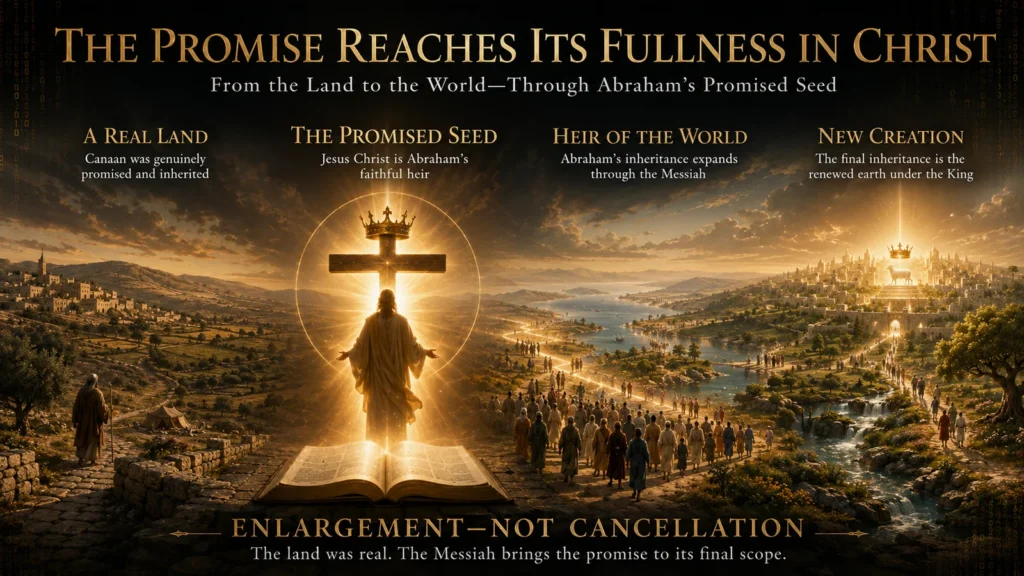
God genuinely promised land to Abraham and his offspring. Genesis names territory, marks boundaries, and calls it an everlasting possession (Genesis 17:1-14). A Christian reading should not turn Canaan into an unreal metaphor because later revelation broadens the promise. Abraham lived in a real place; Israel inherited real cities, fields, and borders. God’s fidelity includes what He actually said.
The strongest Christian Zionist argument begins here. The covenant is initiated and sworn by God. The land grant predates Sinai. Israel’s disobedience can interrupt enjoyment, but it cannot cancel God’s oath. The ICEJ’s case for the enduring land promise argues that modern return is consequently part of God’s ongoing covenant faithfulness and may precede national conversion.
That argument rightly guards the reality of the promise and God’s trustworthiness. Its weakness appears when it identifies a twentieth-century political development as covenant fulfillment without the New Testament’s controlling center: Abraham’s Seed, the Davidic King, cleansing from sin, and inheritance in the new creation.
The land remained God’s possession
Even within Torah, the land never becomes unconditional private property. God says, “the land is mine,” while Israelites are sojourners and tenants with Him (Leviticus 25:23). Sabbath years, Jubilee, laws of justice, care for the poor, and limits on permanent sale place possession under the divine Owner.
This excludes a theology in which election means immunity. Israel’s kings and landowners were judged precisely because the land was God’s. A promise could be permanent in God’s purpose while every generation’s enjoyment remained accountable to holiness and neighbor-love.
Mosaic obedience, exile, and return
Leviticus 26 and Deuteronomy 28-30 attach covenant blessings and curses to Israel’s life in the land. Idolatry, bloodshed, oppression, and covenant infidelity bring exile. Repentance and divine mercy frame return. The prophets do not flatter Israel’s government because Israel is chosen; they expose rulers who exploit the vulnerable and worshipers who separate ritual from justice.
Christian Zionists may answer that Mosaic conditions regulate residence while the Abrahamic title endures. That distinction has textual force, but it does not identify the modern state as restored covenant Israel. The promised prophetic return includes heart change, fidelity to God, Davidic rule, and divine dwelling. Extracting geographic relocation from that package and labeling it fulfillment leaves the covenant’s center behind.
Joshua’s genuine fulfillment
Joshua says the Lord gave Israel all the land He swore to their fathers, gave rest, and fulfilled every good promise (Joshua 21:43-45). Later territorial hopes do not prove Joshua was mistaken. Biblical fulfillment can be genuine and still lead forward: possession is followed by loss, return, and a larger eschatological hope.
That observation cuts against prophecy reasoning that treats the land promise as if no major biblical fulfillment occurred before 1948. It also cuts against a reduction that confines all fulfillment to Joshua. The canonical question is how the New Testament receives the promise after exile and in the arrival of the Messiah.
Christ and the enlarged inheritance
Paul describes Abraham not merely as heir of Canaan but as “heir of the world” (Romans 4:9-17). Hebrews says Abraham lived as a stranger in the promised land while awaiting the city God designs and builds; the faithful desired a better, heavenly country. Jesus calls the meek heirs of the earth. Revelation ends not with one people confined to one strip of land but with the nations healed in a renewed creation centered on the Lamb.
This is enlargement, not cancellation. Canaan was the historical arena and firstfruits of a promise that reaches the world under Abraham’s royal Seed. The trajectory moves from garden to land, from land to Messiah, and from Messiah to renewed creation. The promise’s final form is renewed creation under that King.
Christians Receive Abraham’s Promises Through Christ
Jesus is Abraham’s promised Seed
Matthew introduces Jesus as Son of David and Son of Abraham. Paul then focuses the promise on Christ: the “offspring” to whom it was spoken (Galatians 3:6-29). Paul knows that offspring can be collective; his argument concentrates the corporate promise in one representative. Jesus is the faithful heir in whom the family of promise is defined.
This Christological reading is not a Gentile theft of Jewish Scripture. Paul is a Jewish apostle proclaiming Israel’s Jewish Messiah. The promise reaches the nations because Israel’s promised Seed has come.
Those of faith are Abraham’s children
Paul calls those who share Abraham’s faith his sons. God announced the gospel beforehand in the promise that all nations would be blessed through Abraham. Physical descent retains historical meaning, but saving sonship follows the pattern of trusting God’s promise. That is why Gentiles can be included without inventing a second Abrahamic family.
Those belonging to Christ are heirs
Galatians reaches its explicit conclusion: those who belong to Christ are Abraham’s offspring and heirs according to promise. Their heirship comes through baptism into Christ and being clothed with Christ, rather than through a government, territorial program, or change of ethnicity.
Nor does this make Jewish believers disappear into a Gentile institution. Jewish and Gentile distinctions remain human realities, but neither supplies a superior standing before God. The Messiah is the heir; all other heirs inherit in Him.
Abraham inherits the world
The expanded inheritance explains why Christians can affirm Canaan’s historical reality without treating present sovereignty as the covenant’s climax. In Christ, Abraham’s family becomes multinational and his inheritance reaches the world. The final city is God’s gift; the final King is David’s Son; the final homeland is a renewed earth where righteousness dwells.
For a wider study of how biblical promises converge on Jesus, see Prophecies of Jesus Fulfilled in Scripture. The apostolic method does not match headlines to isolated phrases. It reads promise, covenant, Messiah, resurrection, and new creation as one story.
Geopolitical support does not create Abrahamic heirship
A Christian may support Israel’s security or particular policies for prudential reasons. Another may oppose those policies while affirming Jewish safety and dignity. Neither position makes a person Abraham’s child. Faith in Christ does.
This guards the gospel from political tests. Genesis 12 is not a mechanism by which nations purchase divine favor through foreign policy. Abraham’s blessing reaches the nations through his Seed, and those who belong to that Seed inherit. The next question is how Jesus embodies Israel’s calling and gathers that family around Himself.
Jesus Fulfills Israel’s Covenant Calling
Jesus as faithful Israel
Matthew presents Jesus inside Israel’s story, not beside it. He is Abraham’s and David’s descendant, comes out of Egypt as God’s Son, passes through the waters, enters the wilderness, and remains faithful under testing where Israel failed (Matthew 1:1-4:11). The pattern does not imply that Jesus replaces an unrelated people. He embodies Israel’s vocation from within Israel.
Israel was called God’s son and commissioned to be a priestly nation and light among the nations. The nation repeatedly fell under the same judgment it announced. Jesus, the obedient Son, fulfills that calling without sin. He gathers Israel, bears the covenant curse, and sends the good news to the nations. The story narrows to one faithful Israelite so that it can widen to a redeemed multinational people in Him.
David’s promised Son
Restoration in the prophets is inseparable from Davidic kingship. God promised David a son, house, throne, and kingdom. The New Testament identifies Jesus as that royal heir: conceived by the Spirit, given David’s throne, crucified as King of the Jews, raised from death, and exalted to reign.
This is why a parliament cannot constitute the restored Davidic kingdom. Israel’s promised government centers on the Messiah, not merely Jewish sovereignty. The claim that Jesus possesses divine and royal identity is developed further in Prophecies of Jesus’ Divine Identity. A political order that does not confess His kingship may have ordinary legitimacy, but it cannot be the covenant kingdom promised to David.
The Twelve and restored Israel
Jesus’ choice of twelve apostles is a deliberate sign. He promises that in the renewal they will sit on twelve thrones judging the twelve tribes of Israel (Matthew 19:27-30). Restored Israel forms around the Messiah and His appointed witnesses. The number twelve is neither nostalgia nor a plan for a purely Gentile institution.
At Pentecost, the Spirit falls on Jewish disciples in Jerusalem. Peter addresses “men of Israel,” proclaims the crucified and risen Davidic Messiah, and calls his hearers to repentance. Thousands of Jews believe before Gentile inclusion becomes a major controversy. The Church’s root is Israel’s Messiah, promises, Scriptures, and believing remnant.
The new covenant in His blood
Jeremiah promised a new covenant with the house of Israel and the house of Judah: God’s law written within, true knowledge of God, and sins remembered no more. At the Last Supper, Jesus identifies the cup as the new covenant in His blood (Luke 22:14-20). The promised covenant is established through His sacrificial death, not through a declaration of sovereignty.
Hebrews draws the conclusion. Jesus is the better covenant’s mediator, whose once-for-all sacrifice cleanses the conscience and opens access to God (Hebrews 8:6-13). The new covenant cannot be possessed while bypassing its mediator. Jew and Gentile alike need the blood He offers.
The true Temple and covenant mediator
Jesus also identifies His body as the temple that will be destroyed and raised (John 2:13-22). God’s presence, sacrifice, priesthood, and forgiveness converge in Him. The risen Christ becomes the meeting place between God and humanity; His people, joined to Him by the Spirit, become a living temple.
This does not make Jerusalem meaningless. It places the city’s deepest biblical institutions under their Messiah. The Christian hope is not a return to access mediated by an earthly sanctuary after the final priest has offered the final sacrifice. Jesus is Israel’s covenant Redeemer, the subject explored more fully in Messianic Prophecies: Jesus the Redeemer.
Is the Church the New Israel?
The Church begins with believing Jews
The phrase “the Church replaced Israel” starts the story in the wrong place. The ecclesia gathered by Jesus begins with Israelites who believe Israel’s Messiah. Mary, the Twelve, the women at the tomb, the Pentecost community, and the apostolic leadership are Jewish. Paul calls himself an Israelite and points to his own faith as evidence that God has not rejected His people.
The break is therefore not Jews discarded and Gentiles installed. It is Israel brought to its Messiah in a faithful remnant, then the nations welcomed into the same covenant blessing. Unbelieving Jews remain Paul’s beloved kinsmen with a real historical identity, while saving participation is found in Christ.
Gentiles are brought near—not installed as a superior replacement
Ephesians calls Gentiles formerly alienated from Israel’s commonwealth and strangers to the covenants of promise. They are brought near by Christ’s blood, not by taking Jewish ethnicity or displacing Jewish believers (Ephesians 2:11-22). Christ makes peace, reconciles both groups to God through the cross, and grants both access to the Father in one Spirit.
Gentile boasting is excluded at the foundation. Gentiles did not produce the Messiah, author Israel’s Scriptures, or earn a place. They were far off and received mercy. Any theology that turns fulfillment into racial superiority contradicts its own gospel.
One new humanity in Christ
Paul’s result is “one new man” or one new humanity. Believing Jews do not become Gentiles; believing Gentiles do not become ethnic Jews. Hostility dies at the cross, and both become members of God’s household and stones in one holy temple.
This unity is covenantal and ecclesial, not the claim that cultural difference has vanished. The New Testament can still speak of Jews and Gentiles while denying separate saving peoples. There is one body, one Spirit, one Lord, one faith, and one access to the Father.
A chosen people, holy nation, and royal priesthood
Peter addresses churches in language drawn from Sinai: chosen race, royal priesthood, holy nation, God’s own possession (1 Peter 2:4-10). He applies Israel’s vocation to people built on Christ, the rejected and chosen cornerstone. Revelation likewise sees the Lamb purchasing a kingdom and priests from every tribe, language, people, and nation.
The titles are not transferred because Gentiles proved better. They are fulfilled in the Messiah and shared by all united to Him. The priestly vocation reaches its intended multinational scope through the Lamb’s blood.
Fulfillment is not ethnic erasure
So is the Church the new Israel? The answer needs a definition before a slogan. The Church is the renewed covenant Israel gathered around Israel’s Messiah: the believing Jewish remnant and Gentiles brought into Abraham’s promises through Christ. “New Israel” is acceptable if it names that fulfillment. It becomes dangerous when it means a Gentile race inherited Jewish promises because Jews were discarded.
Ethnic Jews remain Jews. Their history and relation to the patriarchs remain real. Paul forbids Gentiles to boast over unbelieving Jewish branches and anticipates their possible restoration. What does not continue is an independent saving route or covenant membership detached from Jesus. Fulfillment preserves God’s promises by locating them where the apostles locate them: in the Messiah and the people joined to Him.
What Does Romans 9–11 Say About Israel?
Israel’s privileges remain historically real
Romans 9 begins in grief, not triumph. Paul names Israelites as his kinsmen according to the flesh and lists their adoption, glory, covenants, law, worship, promises, patriarchs, and the Messiah’s human descent (Romans 9-11). These are not imaginary privileges. Israel’s unbelief creates an agonizing theological problem precisely because God truly acted in that history.
Christians should imitate Paul’s posture. The subject is not an opponent to defeat. Paul would accept anguish for his kinsmen and later commands Gentiles to fear rather than boast. Centuries of Christian contempt, coercion, and violence against Jews are betrayals of that command, not evidence for Christian faithfulness.
Physical descent and saving Israel
Paul says not all who descend from Israel belong to Israel. In context, he first distinguishes within Abraham’s and Israel’s physical descendants according to promise and mercy. Later he identifies a remnant within ethnic Israel. Historical descent brings real privilege but does not automatically bring saving participation.
This distinction must not be used to deny Jewish peoplehood. Paul continues to call his unbelieving relatives Israel. Nor can it support the modern state as saving Israel, because Paul’s entire argument concerns promise, righteousness, faith, hardening, mercy, and salvation, not citizenship or sovereignty.
One gospel for Jew and Gentile
Romans 10 opens with Paul’s prayer that Israel may be saved. That prayer rules out the claim that Jews already possess salvation through a separate covenant. Christ is the culmination and goal of the law for righteousness to everyone who believes. The same Lord bestows riches on all who call on Him; faith comes through hearing the word of Christ.
Paul does not erase the Jew-Gentile distinction when he denies two gospels. He insists that both groups face the same human problem and receive the same saving Lord. Christian mission to Jews must therefore reject contempt and coercion while refusing to hide Jesus.
The remnant chosen by grace
Romans 11 answers whether God has rejected His people: “By no means.” Paul himself is an Israelite, and a remnant exists by grace. God’s faithfulness is already visible in Jewish believers. The remnant is not a later Gentile substitute; it is Israel within Israel receiving the Messiah.
Grace also prevents pride. The remnant did not earn election, and Gentiles did not earn grafting. Every saving claim rests on mercy.
Beloved for the fathers’ sake
Romans 11 describes Paul’s unbelieving Jewish kinsmen as beloved regarding election for the patriarchs’ sake, because God’s gifts and calling are irrevocable. Present opposition to the gospel has not defeated God’s historical purpose; the language grounds hope that disobedience will yield to mercy.
Paul holds beloved status and broken branches together. The first preserves patriarchal history and hope; the second places saving participation in faith. Isolating either can produce covenant membership without faith or Gentile contempt. The olive tree preserves history, judgment, humility, and hope at once.
One olive tree
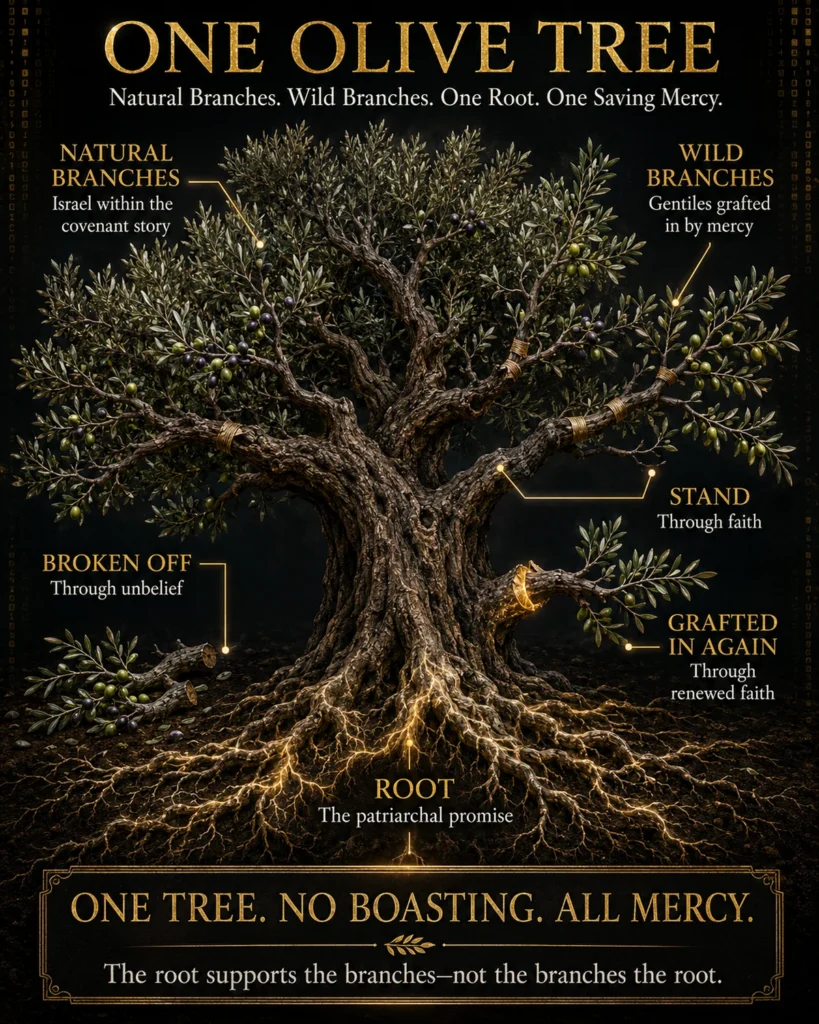
Paul describes one cultivated olive tree, not parallel covenant trees. Some natural branches are broken off; wild branches are grafted among the remaining branches and share the rich root. The image preserves continuity with patriarchal promise and continuity of the people of God while distinguishing Jewish and Gentile branches.
Gentiles do not become the root. They do not support it. They are warned that the God who judged natural branches will not indulge arrogant wild ones. This image is incompatible both with Gentile supremacy and with separate saving covenants.
Branches stand through faith
Paul locates broken branches in unbelief, standing branches in faith, and restored natural branches in renewed faith. Geographic return, national sovereignty, and political allegiance address different questions.
The criterion is Christ-facing faith. Statehood remains a political question, while Romans 11 answers a question of salvation and mercy. Its covenant hope concerns people receiving God’s mercy through the Messiah.
Future Jewish salvation—not state salvation
“All Israel will be saved” has generated several serious interpretations. Some read it as the total Jew-Gentile people saved through the gospel; some as the remnant across history; many understand it as a future substantial conversion of ethnic Jewish people after the fullness of the Gentiles. The last reading best fits the partial hardening, anticipated acceptance, natural branches, and distinction between Israel and Gentiles, though faithful scholars continue to debate details.
Current scholarship supports treating future mercy as a serious reading. Thomas P. Dixon’s New Testament Studies article “Judgement for Israel: The Marriage of Wrath and Mercy in Romans 9-11” traces Paul’s movement from provisional judgment toward mercy for currently hardened Israel. The multi-view volume Three Views on Israel and the Church shows why the exegetical question should not be treated as settled by slogan.
The larger systems sharpen the same dispute. Craig Blaising and Darrell Bock’s Progressive Dispensationalism preserves an Israel-Church distinction within a converging redemptive plan. Progressive Covenantalism, edited by Stephen Wellum and Brent Parker, places Israel, land, and covenant in Christological fulfillment. This article shares the first framework’s warning against collapsing Israel into an undifferentiated Church but follows the second trajectory: future mercy for ethnic Jews does not assign saving covenant status to a state before faith.
Hope for future Jewish conversion honors Paul’s argument only if it retains his means: deliverance from sin, divine mercy, and faith. A future movement of Jewish people to Jesus would vindicate grace; it would not make earlier citizenship equivalent to new-covenant membership. Details remain mysterious, but the saving center does not. Romans gives Christians hope for people rather than a doctrine of state salvation.
That hope confers no governmental immunity. Israel’s Scriptures judge rulers, and the gospel places every government under the risen Lord. Christians can anticipate Jewish mercy, oppose antisemitism, support political security, and still criticize state conduct. Jesus’ final kingdom is surveyed in Eschatological Prophecies of Jesus. Christ, not any present government, measures God’s fidelity.
Did 1948 Fulfill Biblical Prophecy?
What happened in 1948
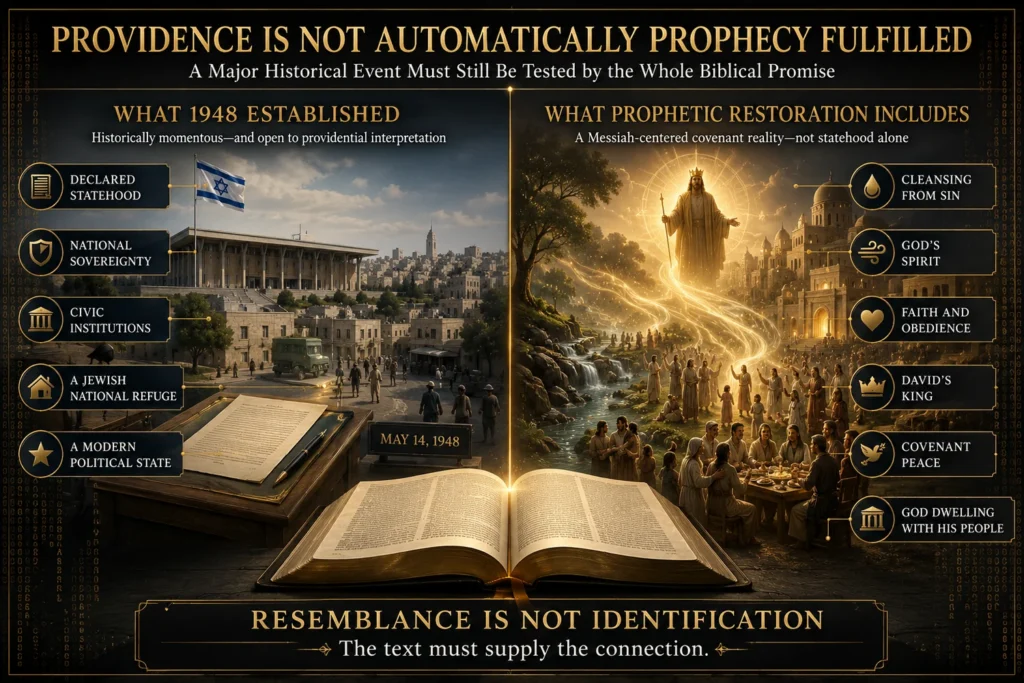
On May 14, 1948, Jewish leaders declared the establishment of the State of Israel as the British Mandate ended. The declaration was the culmination of a long process involving modern Jewish migration, Zionist institutions, diplomacy, the UN partition decision, conflict between Jewish and Arab communities, the Holocaust’s aftermath, and competing national claims. Statehood was historically momentous. It did not cause a covenant people, economy, government, and society to materialize in twenty-four hours.
Christians may see providence in such events. God rules the rise and fall of every nation and can use political developments for mercy, judgment, refuge, or purposes hidden from us. But providence is usually read from ordinary history with humility. Prophetic fulfillment claims more: that God identified this event beforehand as the realization of a particular biblical promise.
Providence is not prophetic fulfillment
The strongest Christian Zionist reading argues cumulatively rather than resting one date on one verse. The Abrahamic land covenant remains in force; Israel and the Church retain distinguishable roles; prophets expect national regathering; regathering may occur before spiritual renewal; Romans 11 anticipates ethnic Israel’s future. On that account, nineteenth- and twentieth-century return and 1948 statehood may be an initial stage rather than complete fulfillment.
This reading gets several things right. God is faithful. Land promises were concrete. Ethnic Israel remains a real subject in Romans 11. Prophetic restoration includes people and place, and some passages narrate movement toward renewal. Yet a possible sequence does not identify a modern event. The text must supply the connection, and the New Testament must govern Christian claims about where restoration centers.
The apostles consistently locate restoration in the Messiah, the Spirit, forgiveness, faith, and the gathering of one covenant people. The prophets likewise join land to cleansing, obedience, Davidic rule, sanctuary, and God’s presence. Assigning covenant restoration to statehood before faith reverses that apostolic order.
Isaiah 66 and a nation born in a day
Isaiah asks whether a land can be born in one day or a nation brought forth in a moment (Isaiah 66:5-24). The image conveys Zion’s astonishing, divinely accomplished birth before labor has fully arrived. The chapter also includes God’s judgment, comfort in Jerusalem, universal recognition of His glory, nations and languages gathered, worship, and the final fate of rebels.
Nothing in the passage names May 14, 1948, a declaration of independence, or a two-millennia interval. The phrase can provide an analogy for sudden statehood, but analogy is not demonstrated prediction. Nor was the modern society born in one day; its people and institutions developed over decades. A date claim built from one image while leaving the chapter’s universal and eschatological frame unfulfilled is prophecy by resemblance.
Ezekiel’s dry bones
Ezekiel 37’s valley of bones portrays the house of Israel as dead and hopeless, then restored by God’s word and breath (Ezekiel 36:22-37:28). The larger unit includes regathering, cleansing from uncleanness and idolatry, a new heart, God’s Spirit, obedience, reunification of Israel and Judah, one Davidic king, an everlasting covenant of peace, God’s sanctuary, and His dwelling among them.
Christian Zionists sometimes distinguish the bones assembling from breath entering them: physical regathering first, spiritual revival later. The vision permits a dramatic sequence, but it identifies the bones as the exiled house declaring its hope lost. More importantly, it never identifies a secular state in 1948 as stage one. Christian canonical interpretation connects new heart and Spirit with the new covenant, resurrection life, and the reign of David’s Son.
The complete vision has not been realized by present statehood. There is no reunited tribal kingdom under Jesus visibly dwelling in peace with God’s sanctuary forever among it. Modern return may remind readers of Ezekiel; reminder must not be promoted to fulfillment without textual warrant.
Jeremiah’s new covenant
Jeremiah’s restoration hope includes return, rebuilt life, a righteous Davidic Branch, justice, forgiveness, the law written on hearts, and universal covenant knowledge of God. The new covenant is explicitly made with Israel and Judah (Jeremiah 31:27-40). Jesus identifies that covenant with His blood, and Hebrews identifies Him as its mediator.
A state can pass laws, defend borders, receive immigrants, and build cities. Forgiveness and God’s law written on hearts belong to the crucified Messiah’s work of cleansing a people and giving covenant knowledge of God. Jeremiah locates the new covenant there, beyond the reach of political sovereignty.
Amos 9 and Acts 15
Amos promises the raising of David’s fallen booth and restoration after judgment. At the Jerusalem Council, James quotes that promise to explain the Messiah’s work and the inclusion of Gentiles who bear the Lord’s name (Acts 15:12-21). The apostolic application is striking: Davidic restoration is underway through Jesus and the multinational people gathered to Him.
Acts may leave further prophetic horizons, yet its inspired interpretation governs Christian use of Amos. David’s tent rises under David’s Son as the nations bearing His name are gathered.
Zechariah and the pierced Messiah
Zechariah 12-14 joins Jerusalem’s deliverance with mourning over the pierced one, cleansing from sin, the struck shepherd, the Lord’s kingship over all the earth, and universal worship (Zechariah 12-14). The New Testament applies the pierced one and struck shepherd to Jesus’ crucifixion. Those connections are explored further in Messianic Prophecies of Jesus’ Suffering and Crucifixion.
The full prophecy cannot be reduced to Jewish military sovereignty. It centers on the rejected Messiah, repentance, cleansing, and the universal reign of the Lord. The founding of a modern state was a major historical event. It was not the fulfillment of biblical Israel’s covenant identity, which is fulfilled in Christ.
Does Genesis 12:3 Require Christians to Support Israel?
The promise was spoken to Abraham
God tells Abraham that He will bless those who bless him, curse the one who dishonors him, and bless all families of the earth through him (Genesis 12:1-3). In Genesis, the promise concerns God’s chosen patriarch and the redemptive family and mission that proceed from him. Hostility to God’s promise will not prevail; Abraham will become a channel of worldwide blessing.
Popular applications often move without argument from Abraham, to every physical descendant, to the modern State of Israel, to whichever government policy is under debate. Each move requires proof. The verse itself does not mention a twentieth-century state or command Christians to endorse its rulers.
The nations are blessed through Abraham’s Seed
The New Testament identifies the worldwide blessing as justification by faith and reception of the Spirit through Christ. Galatians calls the promise “the gospel beforehand” and centers it in Abraham’s Seed. The ultimate way to bless Abraham is to honor Abraham’s God and receive Abraham’s Messiah.
This does not permit hatred of Abraham’s physical family. Christians owe Jewish neighbors love, truth, protection from antisemitism, and gratitude for the history through which the Messiah came. Those duties arise from God’s image, neighbor-love, justice, and the gospel, not from turning a patriarchal promise into a foreign-policy formula.
Blessing Abraham is not endorsing every descendant’s government
Scripture never treats support for every Israelite ruler as the meaning of covenant fidelity. Prophets confronted kings, priests, judges, landowners, and the nation itself. Elijah did not curse Abraham by opposing Ahab. Jeremiah did not betray Judah by warning Jerusalem. Jesus loved His people while pronouncing judgment on corrupt leadership.
No government inherits immunity through the ethnicity of many citizens. Supporting Jewish safety, opposing antisemitism, or defending a state’s political existence can be morally serious positions. They remain judgments about justice and prudence, not conditions for receiving Abraham’s blessing.
Criticism is not automatically a curse
Criticism can be dishonest, obsessive, or antisemitic. It can use double standards, blame Jews everywhere, invoke secret-control myths, or deny Jewish vulnerability. Such speech should be opposed. But evidence-based criticism of a government’s laws, leaders, military decisions, or treatment of neighbors is not automatically a curse against Abraham.
The prophets teach the opposite lesson: election intensifies accountability. Christians should test every government by truth and justice while remembering their own nation’s sins. Genesis 12:3 calls attention to God’s redemptive promise, not unconditional diplomatic alignment.
Does Denying Covenant Status Deny Israel’s Right to Exist?
Political legitimacy and covenant identity are separate
Political legitimacy rests on history, recognition, self-determination, security, law, justice, and the rights of those under a state’s power. It neither requires identity with Sinai’s Israel nor arrives through prophetic fulfillment.
Christians can disagree about policy or diplomatic recognition without changing the gospel. Jewish safety and self-determination carry unusual weight after centuries of expulsion, pogroms, and the Holocaust.
That separation improves Christian judgment. Israel’s legitimacy can rest on ordinary moral and prudential arguments, as the legitimacy of present states generally does. Supporters may defend Jewish safety without sanctifying every policy, while critics may seek justice without pretending theology has abolished a population’s civil rights.
Denying covenant status does not justify expulsion or violence
Nothing in Christ-centered fulfillment authorizes destruction, forced removal, terrorism, or harm to civilians. Jewish Israelis have homes, families, histories, fears, and rights. Palestinian people possess the same God-given dignity. Neither may be sacrificed to the other’s nationalist story.
Covenant theology becomes a grave abuse when used to make Jewish suffering seem deserved. Prophecy theology commits the same abuse when Palestinian suffering is treated as scenery.
Governments remain accountable to justice
Every government bears moral responsibility. Israel’s biblical prophets denounced Israelite injustice; Christian loyalty to those prophets cannot require silence toward any current state. The same standard applies to Palestinian authorities, surrounding governments, Western powers, armed movements, and our own rulers.
Accountability is not hostility. Love of neighbor may require defending a state’s citizens from attack and demanding that its government respect the lives and rights of others.
Can Christians Criticize Israel Without Being Antisemitic?
What antisemitism targets
Antisemitism targets Jews as Jews through hatred, discrimination, dehumanization, conspiracy, exclusion, or violence. The United States Holocaust Memorial Museum traces its major forms. Christians should confront that history, including church teaching and practice that made Jewish neighbors vulnerable.
Government criticism versus collective blame
The IHRA working definition explicitly says that criticism of Israel comparable to criticism of other countries is not antisemitic. It also identifies collective blame, loyalty accusations, and classic anti-Jewish myths as dangers. The definition and its application are debated, but the basic distinction is indispensable.
Name the responsible subject. “The Israeli cabinet decided” is not “the Jews decided.” Critique evidence, law, action, or policy. Do not make a synagogue, Jewish coworker, or diaspora community answer for a government they do not control.
Unequal standards and conspiracy
Criticism can cross into antisemitism when it revives myths that Jews secretly control media, banks, governments, or wars; imagines a coordinated worldwide Jewish will; celebrates violence against Jews; or assigns collective guilt. Obsessive scrutiny can also reveal prejudice, though unequal attention alone does not prove a critic’s motive.
The remedy is disciplined evidence and consistent moral standards. Condemn dehumanization wherever it occurs. Listen when Jewish people identify a familiar threat while preserving factual political disagreement.
Jewish people are not responsible for every Israeli action
Jews disagree vigorously about Zionism, governments, security, religion, and peace. Many do not live in Israel or vote in its elections. Even Israeli citizens do not act as one mind. Treating Jewish identity as automatic government agency repeats the very conflation this article rejects.
Christians have an added reason for humility: they are wild branches living from Israel’s root. The proper response is gratitude, gospel witness, and protection of neighbors, never boasting.
Palestinian dignity is not hostility toward Jews
Palestinian Christians have repeatedly challenged Western theology that turns their dispossession or suffering into evidence of prophecy. Kairos Palestine is one serious ecumenical voice making that argument; it does not represent every Palestinian Christian or settle every political claim. It deserves to be heard because these believers live with consequences outsiders often discuss abstractly.
Defending Palestinian civilians, churches, homes, and political rights is not inherently antisemitic. Neither is concern for Jewish civilians inherently hostility to Palestinians. Christian ethics refuses a choice between neighbors.
Modern Israel and Biblical Israel Compared
| Category | Biblical covenant Israel | Modern State of Israel |
|---|---|---|
| Origin | Jacob’s family, exodus, and divine covenant | State declared in 1948 after modern Zionist development |
| Constitution | Torah within the Mosaic covenant | Parliamentary government and Basic Laws |
| Government | Tribal judges and later Davidic monarchy | Elected Knesset, cabinet, courts, and civil institutions |
| Covenant mediator | Moses; ultimately fulfilled by Jesus | No national covenant mediator |
| Membership | Jacob’s descendants, with covenant provisions for outsiders | Citizens of multiple ethnic and religious identities |
| Worship | Priesthood, sanctuary, and sacrifice | Contemporary Jewish and non-Jewish institutions operating under civil law and contested religious arrangements |
| New covenant | Forgiveness, Spirit, and law on hearts through Jesus | Citizenship does not establish new-covenant membership |
| Moral status | Chosen and therefore accountable to prophetic judgment | Accountable to justice like every government |
| Final hope | David’s risen Son and God’s dwelling in renewed creation | Political life cannot supply biblical Israel’s final hope |
Frequently Asked Questions
Is the modern State of Israel mentioned in the Bible?
The Bible does not explicitly name the state founded in 1948. It speaks extensively about Jacob, Israel’s tribes and covenants, exile, return, and restoration. Christians debate whether modern events begin a prophetic stage, but resemblance is not identification. This article concludes that covenant restoration is centered in Jesus rather than a political state whose citizenship is not new-covenant membership.
Does God still care about Jewish people?
Yes. Romans 9-11 preserves their historical identity, privileges, beloved relation to the patriarchs, and hope of mercy. Christians must reject antisemitism and Gentile boasting. God’s care does not mean ethnicity saves or a government receives immunity; Paul prays for Jewish people to be saved through Jesus.
Are Christians now Abraham’s children?
All who belong to Christ, Jew or Gentile, are Abraham’s offspring and heirs according to promise. Gentiles do not become ethnic Jews, and Christians do not erase Jewish peoplehood. Abrahamic saving heirship comes through union with Abraham’s promised Seed.
Is the Church the new Israel?
The Church is the renewed covenant people gathered around Israel’s Messiah: a believing Jewish remnant with believing Gentiles brought near through Christ. The phrase is useful only with that definition. It must never mean that a superior Gentile race displaced Jews.
Does Romans 11 predict Jewish conversion?
Most likely, though details remain debated. “All Israel” plausibly anticipates a future substantial turning of ethnic Jewish people to Jesus after partial hardening. The chapter promises salvation and mercy through faith, not state restoration as a substitute for faith.
Was Israel’s founding in 1948 prophetic?
It was a major historical event that may be discussed under God’s providence. Scripture does not identify the date, declaration, or state as fulfillment. Prophetic restoration includes cleansing, the Spirit, David’s King, forgiveness, and divine dwelling, a package 1948 did not fulfill.
Is criticizing Israel antisemitic?
Not automatically. Evidence-based criticism of a government is legitimate. It becomes antisemitic when it targets Jews as Jews, assigns collective guilt, invokes conspiracies, demands loyalty tests from Jewish neighbors, dehumanizes, or supports violence against Jews.
Does rejecting Christian Zionism mean opposing Jewish safety?
No. A Christian can reject prophetic or covenant status for the state while strongly defending Jewish lives, security, religious freedom, and political rights. Denying covenant identity gives no permission for destruction, expulsion, or violence.
Can a Christian support Israel politically without calling it biblical Israel?
Yes. Political support can be based on security, alliances, self-determination, diplomacy, or judgments about justice. Those arguments should be evaluated on their merits. They do not require treating a present government as Mosaic Israel or prophetic fulfillment.
Are Jews saved through a separate covenant?
No. Paul prays for Israel’s salvation and proclaims the same Lord for Jew and Gentile. Jesus mediates the new covenant promised to Israel and Judah. Jewish and Gentile believers receive mercy through Him; no ethnicity or political state supplies another saving path.
Sources and Further Reading
- Primary texts and documents: the biblical passages linked throughout; Israel’s Declaration of Independence and Nation-State Basic Law; the World Zionist Organization’s Jerusalem Program.
- Zionism and the modern state: Michael Stanislawski, Zionism: A Very Short Introduction; Daniel Hummel, Covenant Brothers; Motti Inbari and Kirill Bumin, Christian Zionism in the Twenty-First Century.
- Major theological positions: Craig Blaising and Darrell Bock, Progressive Dispensationalism; Brent Parker and Stephen Wellum, eds., Progressive Covenantalism; Jared Compton and Andrew Naselli, eds., Three Views on Israel and the Church.
- Representative contemporary voices: the ICEJ Christian Zionist materials, Jewish Voice for Peace’s anti-Zionist statement, and the Kairos Palestine document linked above. Each establishes its own position, not a universal consensus.
Every Promise Finds Its Center in Jesus Christ
The modern Israel vs biblical Israel debate finally turns on Jesus. If He is only an addition to Israel’s story, land, ancestry, and sovereignty can be interpreted around Him. If He is Abraham’s Seed, David’s King, faithful Israel, true Temple, and mediator of the new covenant, every promise must be read through His death, resurrection, reign, and return.
God has not failed Israel. He kept His word from within Israel by sending Israel’s Messiah. Jesus obeyed where God’s son Israel failed, bore the covenant curse, poured out the promised Spirit, and opened Abraham’s blessing to the nations. Believing Jews were not replaced; they became the firstfruits of the restored people. Believing Gentiles were not installed above them; they were brought near by mercy.
The state founded in 1948 carries deep Jewish history and may be defended or criticized through ordinary political reasoning. Forgiveness, God’s law written on hearts, grafting into the olive tree, resurrection, and Davidic rule belong to the Messiah’s work. No state, Church institution, or ideology can take His place.
Jew and Gentile therefore stand before the same Savior. Every government stands before the same Judge. The Christian hope is not a sanctified nation-state but the return of the crucified and risen King, the resurrection of His people, and the holy city illuminated by the Lamb. Jesus in Revelation is the ruler of the kings of earth, the faithful witness who freed a people from every nation by His blood.
Modern Israel is not biblical covenant Israel. Biblical Israel’s calling reaches its goal in Jesus Christ and in the Jew-Gentile people united to Him. When the final Jerusalem descends, its gates will bear Israel’s tribal names, its foundations the apostles’ names, and its light will be the Lamb. No present government fulfills that glory. Jesus does.