
Who is the Holy Spirit? Christians speak about His presence, His power, and His gifts, but those words can leave a beginner unsure what they mean. Is the Spirit a person? Is He God? Does receiving Him require an unusual experience?
The Bible gives us a clear place to begin. The Holy Spirit is divine and personal. He gives life, bears witness to Jesus Christ, dwells in God’s people, and forms them in holiness. Knowing Him matters because Christian life depends on more than understanding the right ideas or finding enough willpower to change.
This study approaches the question from historic Trinitarian Christianity. We will examine the central biblical teaching, follow the Spirit’s work through Scripture, and distinguish that shared foundation from questions Christians answer differently.
GUIDED ARTICLE EXPERIENCE
Who Is the Holy Spirit and What Does He Do?
Read along as the narration moves through the article.
Browser narration · No stored audio or site tracking
CONTINUE GUIDED TOUR
Continue where you left off.
GUIDED TOUR COMPLETE
You have reached the end of this study.
Study record saved on this device.
GUIDED TOUR
Who Is the Holy Spirit and What Does He Do?
Narrator: Paranoid Prophet Recommended Voice Native device narration
Prepare to follow the article as it is narrated.
VOICE & TOUR OPTIONS
Voice & Listening
NARRATOR
Finding a narrator…
Checking the best narrator available on this device.
Restores the site recommendations available in this browser.
Our listening picks lead when available; other voices are ranked for narration. Known novelty voices are hidden. Browser-provided voices may use an online voice service.
Screen-awake support will be checked when narration starts.
Optional: improve your device voices
Listening works with the voices already available here. Your device may offer additional free voices through its own settings.
iPhone or iPad: Settings → Accessibility → Read & Speak (or Spoken Content) → Voices → English. Look for Premium or Enhanced choices, then return here.
If offered, preview Ava or Zoe for U.S. English, or Serena or Jamie for British English. An explicit Premium or Enhanced version can improve on its compact version.
Mac: System Settings → Accessibility → Read & Speak → System voice. Open the voice list to preview or download additional choices.
Windows: Settings → Accessibility → Narrator → Add natural voices. Browser availability varies; a Narrator voice may not appear on websites. Edge may also expose online Natural voices without a model download.
Android: Open Accessibility → Text-to-speech output (the location varies by device). In the preferred engine settings, look for voice data and English choices.
Download sizes vary; some enhanced voices exceed 100 MB. This website cannot install system voices, and an installed voice appears here only if your browser exposes it.
Apple voice guide · Windows voice guide · Android voice guide
CHOOSE A NARRATOR
Recommended on this device
Our listening picks: Aaron, Martha, then Daniel, when available here. Otherwise, automatic uses the highest-ranked suitable voice. Preview alternatives or save your own choice.
Preparing the guided article experience…
RESUME GUIDED TOUR?
Continue where you left off.
GUIDED TOUR COMPLETE
You have reached the end of this study.
Article Guide11 sections
Who Is the Holy Spirit? The Short Answer
The Holy Spirit is the third person of the Trinity, fully God with the Father and the Son. He brings people to faith in Christ, gives new life, dwells in believers, equips the church, and helps God’s people grow in love and holiness.
“Third person” describes the traditional order in which Christians name Father, Son, and Spirit. It does not make the Spirit third in importance, less divine, or younger than the Father and the Son. There is one God, eternally Father, Son, and Holy Spirit.
The persons are distinct without being separate gods. In God’s saving work, the Father sends the Son, and the Father and Son send the Spirit (John 3:17; 14:26; 15:26). Their saving work is united. Their distinct missions do not divide God’s being or power.
For a fuller account of this confession, see What Is the Trinity? One God, Father, Son, and Holy Spirit.
The next section follows His work in Scripture: pointing to Jesus, convicting of sin, giving new life, dwelling in believers, forming holy character, helping prayer, and equipping the church. For the question of receiving the Spirit and differing Christian teachings, you can go directly to that discussion.
What Does the Holy Spirit Do?
The New Testament describes His work in several connected ways. These belong together in the life of the church and the life of each believer.
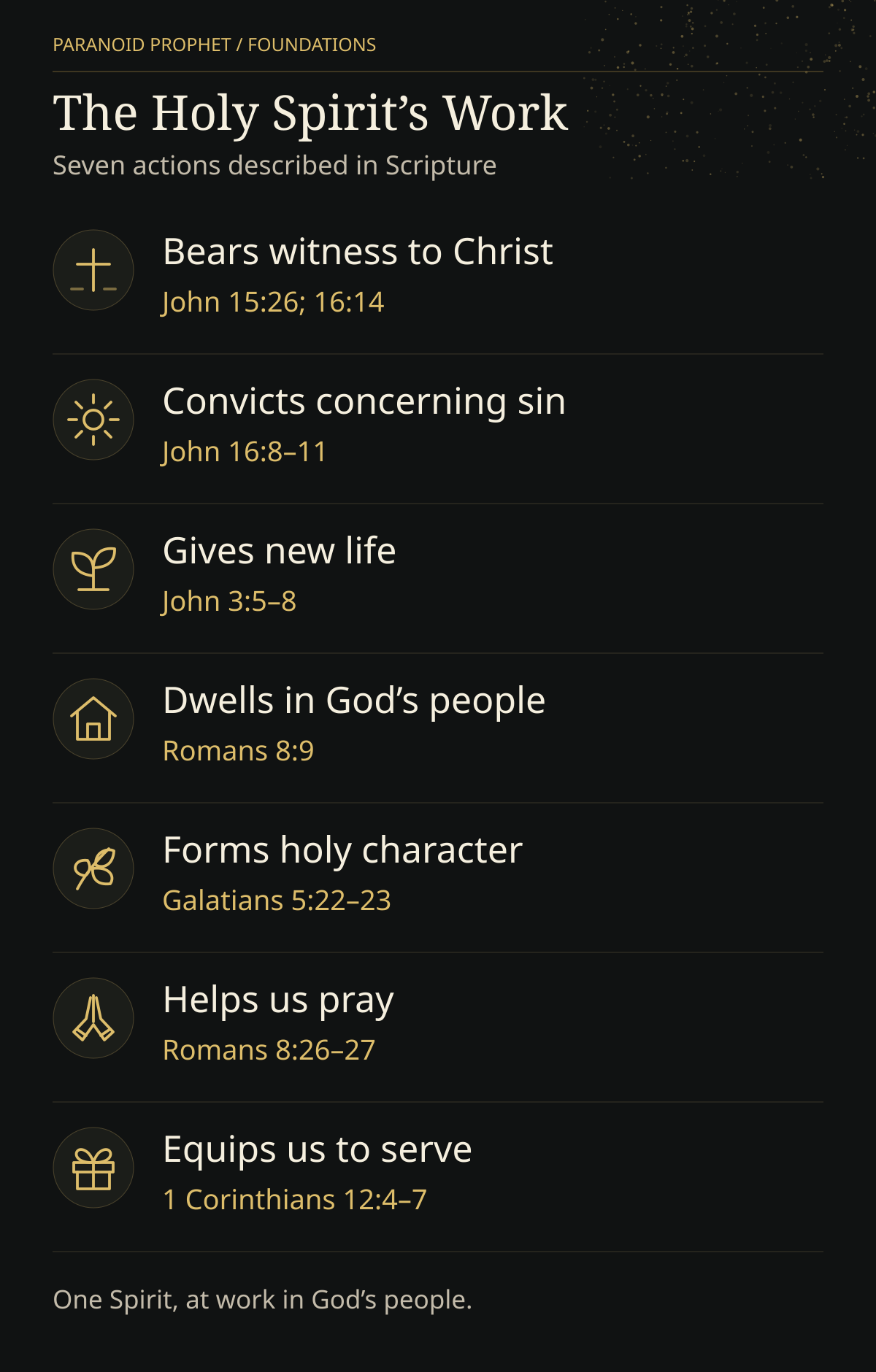
The Holy Spirit’s Work (image text)
Seven actions described in Scripture
- Bears witness to Christ
John 15:26; 16:14 - Convicts concerning sin
John 16:8–11 - Gives new life
John 3:5–8 - Dwells in God’s people
Romans 8:9 - Forms holy character
Galatians 5:22–23 - Helps us pray
Romans 8:26–27 - Equips us to serve
1 Corinthians 12:4–7
One Spirit, at work in God’s people.
PARANOID PROPHET / FOUNDATIONS
1. He bears witness to Jesus and glorifies Him
Jesus says of the Spirit, “He shall glorify me” (John 16:14, KJV). The Spirit makes Christ known and bears witness to the truth of who He is. Read John 16:7–15.
This gives Christians a central test for spiritual teaching. What does it do with Jesus? Does it honor the Son who came in the flesh, died for sinners, and rose again? Or does it gradually replace Him with a leader’s authority, a technique, or a promise of personal greatness?
The Spirit’s work draws us into the truth about Christ. That is why a study of the Holy Spirit belongs beside the gospel itself.
2. He convicts the world concerning sin, righteousness, and judgment
In John 16:8–11, Jesus promises that the Spirit will expose the world’s wrong judgment about sin, righteousness, and judgment. Jesus connects those themes with unbelief in Him, His return to the Father, and the judgment of the ruler of this world.
Conviction can be painful. It brings our excuses into the light. But we should be careful about treating every pang of guilt or anxious thought as a direct message from God. The passage describes the Spirit’s witness to the truth about Christ, not a method for interpreting every feeling.
Christian repentance responds to God’s truth by turning from sin and trusting His mercy. Our study of repentance and faith develops that response more fully.
3. He gives new life
Jesus tells Nicodemus that entering God’s kingdom requires birth by the Spirit. Human status, religious knowledge, and effort cannot produce that life on their own (John 3:1–8).
Paul likewise describes salvation through God’s mercy and the Spirit’s renewing work (Titus 3:4–7). Christians call this new birth or regeneration.
Churches differ over how to describe the relationship among regeneration, faith, and baptism. They should still take seriously the shared foundation: spiritual life comes from God’s grace. We do not make ourselves alive by collecting religious accomplishments. Read Jesus’ conversation with Nicodemus.
4. He dwells in believers and brings them into God’s family
Romans 8:9 makes the Spirit’s presence essential to belonging to Christ. Paul then describes believers as God’s children, led by the Spirit and able to call upon God as Father (Romans 8:14–17).
Ephesians 1:13–14 describes believers as sealed with the promised Holy Spirit, who is the pledge of their inheritance. The language emphasizes God’s claim upon His people and His promise of their future with Him.
This is a personal comfort, but it is also a communal truth. The Spirit joins believers into one body (1 Corinthians 12:13). Christian life involves belonging to other people in Christ, learning to love them, and receiving their care. The Spirit does not make each believer a self-sufficient church.
5. He helps Christians grow in holiness
Galatians 5 sets life by the Spirit against practices such as hatred, jealousy, sexual immorality, and destructive rivalry. The Spirit produces love, joy, peace, patience, kindness, goodness, faithfulness, gentleness, and self-control (Galatians 5:16–26).
That growth reaches ordinary life. It includes telling the truth when a lie would protect our reputation, refusing to feed resentment, caring for a difficult neighbor, and learning to control an angry response.
The passage also acknowledges conflict between sinful desires and the Spirit. Struggle does not by itself mean that God has abandoned a believer. Christians are called to keep walking by the Spirit, confessing sin and depending on His help.
This growth, often called sanctification, should never be turned into a way of purchasing salvation. It is the life God’s grace produces. See Salvation by Grace for the relationship between faith, grace, and good works.

6. He helps believers pray and endure suffering
Romans 8 speaks honestly about weakness, suffering, and groaning. Believers who have the Spirit still wait for the redemption of their bodies. They do not escape every experience of grief, confusion, or pain.
Within that suffering, the Spirit helps them pray and intercedes according to God’s will (Romans 8:26–27). The comfort is especially strong when a person has no polished words left. God’s care does not depend on our ability to give a confident speech about what we need.
The same chapter holds out resurrection hope. The Spirit’s presence is compatible with present suffering and points toward God’s final renewal. It is no basis for promising that a faithful Christian will never become ill or need practical help. Read Romans 8.
7. He equips the church for service and witness
Jesus promises the Spirit’s power for witness in Acts 1:8. Acts then follows that witness outward across geographic, social, and ethnic boundaries.
Paul describes gifts given for the good of the whole body. First Corinthians 12 includes teaching, helps, administration, healing, prophecy, tongues, and interpretation within its discussion of varied service. Members need one another, and less conspicuous members deserve care and honor.
Chapters 13 and 14 supply the setting in which gifts must function: love, intelligibility, and the building up of the church. Impressive ability cannot excuse cruelty. Spiritual language cannot make selfishness holy. Read 1 Corinthians 12–14.
Why Do Christians Believe the Holy Spirit Is God?
In Acts 5, Peter confronts Ananias about his deception. He describes it as lying to the Holy Spirit, then says that Ananias has lied to God. The passage treats dishonesty toward the Spirit as dishonesty toward God Himself. Read Acts 5:1–11.
That identification belongs within a larger pattern:
- God dwells among His people by the Spirit. Paul calls the church God’s temple because God’s Spirit dwells in it (1 Corinthians 3:16).
- The Spirit knows the depths of God. Paul describes His knowledge of God in a way that distinguishes Him from the limitations of human wisdom (1 Corinthians 2:10–12).
- The Spirit belongs with the Father and the Son in Christian baptism. Jesus commands baptism in their one name (Matthew 28:19).
- The Spirit gives life. Romans 8:11 connects His indwelling presence with God’s promise to raise believers’ mortal bodies.
Christians draw the doctrine from these passages together. No single reference needs to carry every part of the argument. Scripture maintains that God is one while speaking of the Spirit as divine and distinguishing Him from the Father and the Son.
Calling Him God also changes how we approach Him. He deserves worship, trust, and obedience. We cannot purchase His favor or direct His power as though it were ours to control. In Acts 8:18–24, Peter sharply rebukes Simon’s attempt to acquire spiritual authority with money.
Why Do Christians Call the Holy Spirit a Person?
When theology calls the Spirit a person, it means that He knows, wills, speaks, and relates. It does not mean He has a human body or a biological sex.
Scripture presents Him acting personally:
- He teaches and reminds the disciples of Jesus’ words (John 14:26).
- He directs the church to set apart Barnabas and Saul (Acts 13:2).
- He distributes spiritual gifts according to His will (1 Corinthians 12:11).
- He intercedes for believers (Romans 8:26–27).
- He can be grieved by the conduct of God’s people (Ephesians 4:30).
These are the actions of someone who knows and loves, rather than descriptions of impersonal energy. Christian belief in His personhood rests on that whole biblical witness, not on an isolated argument about the grammatical gender of a word.
Scripture also uses images such as wind, fire, water, and a dove when describing the Spirit’s work or manifestations. An image communicates something about Him without defining His nature. At Jesus’ baptism, the Spirit descends like a dove. That does not mean the Holy Spirit is a bird.
Was the Holy Spirit Active Before Pentecost?
Yes. Pentecost marks a decisive outpouring of the Spirit, not the beginning of His existence or activity.
The Bible opens with the Spirit of God over the waters of creation (Genesis 1:2). Later, the Spirit equips people for service, including Bezalel for the skilled work of constructing the tabernacle (Exodus 31:1–5). The prophets speak of the Spirit’s work and promise a coming renewal of God’s people.
Two promises are especially important. In Ezekiel 36:26–27, God promises a new heart and His Spirit within His people, enabling obedience. In Joel 2:28–29, God promises an outpouring that includes sons and daughters, young and old, and servants. His gift will reach beyond a small group of prominent leaders.
The Gospels then place the Spirit at the center of Jesus’ earthly mission. Jesus is conceived by the Holy Spirit (Luke 1:35), anointed at His baptism (Luke 3:21–22), and led into His public ministry in the Spirit’s power (Luke 4:1, 14–21).
In Acts 2, Peter explains Pentecost by quoting Joel and proclaiming Jesus’ resurrection and exaltation. The risen Lord has poured out the promised Spirit. The sound like wind, the appearance like fire, and the speech heard across languages serve that larger announcement: the crucified Jesus is Lord, and God’s promised gift has come. Read Acts 2.
Pentecost therefore belongs to the story of Jesus and His kingdom. Its meaning reaches beyond the remarkable experiences of that morning.
What Does It Mean to Be Filled With the Holy Spirit?
Paul commands believers to be filled with the Spirit in Ephesians 5:18. The following verses connect that command with worship, thanksgiving, and relationships shaped by reverence for Christ. Being filled has consequences for how people speak and live together. Read Ephesians 5:18–21.
Acts also describes people being filled with the Spirit for bold witness. In Acts 4:31, the praying community speaks God’s word with courage after being filled. Some participants had already experienced Pentecost.
These passages give reason to seek the Spirit’s continuing help. His presence at the beginning of Christian life does not remove the need for daily dependence, prayer, and obedience.
Christians use the terms indwelling, filling, and baptism in the Spirit in different ways. Asking what a teacher means by each term is more helpful than assuming that everyone uses the same vocabulary.
Why Do Christians Disagree About Receiving the Spirit and His Gifts?
Historic Trinitarian Christians agree about the Spirit’s divine identity while differing over important details of His work. Those differences deserve accurate descriptions.
Baptism in the Spirit and Christian initiation
Many evangelical Protestants understand baptism in the Spirit as incorporation into Christ’s body at conversion. The Southern Baptist Convention’s Baptist Faith and Message, for example, places this baptism at regeneration. Baptist Faith and Message, article II.C.
Classical Pentecostals such as the Assemblies of God distinguish regeneration from a subsequent baptism in the Spirit for empowerment. The Assemblies of God teaches speaking in tongues as the initial physical evidence of that baptism. It does not thereby teach that a Christian without this experience has no relationship with the Spirit at all. Assemblies of God: Baptism in the Holy Spirit.
Catholic and Orthodox teaching places the Spirit’s gift within sacramental initiation. The Catholic Catechism describes baptism as new life and indwelling grace, with confirmation strengthening baptismal grace. Orthodox teaching describes chrismation, normally administered with baptism, as the seal of the Spirit’s gift. Catholic Catechism: the grace of baptism, the effects of confirmation, and Orthodox Church in America: Chrismation.
These are genuine theological differences. They involve how Christians read the varied accounts in Acts alongside the letters, and how they understand baptism and the church. Understanding these disagreements requires comparing the relevant passages and each tradition’s account of baptism, conversion, and the church.
How do I receive the Holy Spirit? In the evangelical reading followed here, belonging to Christ and receiving the indwelling Spirit belong together (Romans 8:9; Ephesians 1:13–14). Turn to Christ in faith, receive instruction in a faithful church, and discuss baptism with its leaders. Do not treat a particular sensation or gift as a universal test of whether you belong to Him. The traditions described above differ over how conversion, baptism, confirmation or chrismation, and empowerment relate.
Do miraculous and revelatory gifts continue today?
Continuationists believe gifts such as prophecy, tongues, and healing remain available according to God’s will. Cessationists understand certain gifts, especially revelatory gifts, as belonging to the church’s apostolic foundation rather than its continuing ordinary life.
Neither label supplies every detail of a person’s position. Continuationists differ over the nature and authority of contemporary prophecy. Cessationists can affirm that God answers prayer and heals today while denying that particular apostolic gifts continue. Representative discussions include the Assemblies of God statement on modern-day prophecy and the Orthodox Presbyterian Church’s explanation of its cessationist position.
Whatever position a Christian takes, Scripture’s demands for truth, love, accountability, and the testing of claims remain. A claimed gift gives no one permission to deceive, exploit, or silence legitimate questions.
How Can Christians Recognize the Spirit’s Work?
The New Testament calls for discernment. First John 4:1–3 commands believers to test spiritual claims in relation to the truth about Jesus Christ. First Thessalonians 5:19–22 places openness to the Spirit beside the duty to test what is presented and hold to what is good.
That combination guards against both gullibility and dismissiveness. Christians can ask:
- What is being taught about Jesus? Read the claim beside the apostolic testimony rather than accepting familiar religious words as sufficient.
- Does it agree with Scripture read in context? An isolated phrase should not cancel the meaning of the surrounding passage.
- What kind of life is being encouraged? Look for truthfulness, love, patience, self-control, and a willingness to repent.
- Does it serve other people? The gifts are given for the body’s good, not to make a leader untouchable.
- Can the claim be examined? “The Spirit told me” does not place a person beyond correction or make their prediction reliable.
An intense feeling may accompany something good. It may also arise from music, expectation, fear, or excitement. Its intensity does not establish its source. Likewise, a quiet temperament does not mean the Spirit is absent.
For ordinary decisions, Christians can pray, study Scripture, consider the facts, and seek wise counsel without pretending that every preference is a revelation. Humility about our interpretation honors the God whose guidance we seek. Read 1 John 4:1–3 and 1 Thessalonians 5:19–22.
Frequently Asked Questions About the Holy Spirit
Are the Holy Spirit and the Holy Ghost the same?
Yes. “Holy Ghost” is the traditional wording used in many passages of the King James Version. “Holy Spirit” is the more familiar wording in contemporary English. They refer to the same divine person.
Does every Christian have the Holy Spirit?
Romans 8:9 teaches that belonging to Christ includes having His Spirit. Christians disagree over how to describe conversion, baptism, confirmation, and subsequent experiences of empowerment. The Spirit’s presence, however, is essential to life in Christ, not an optional accessory for especially advanced believers.
Must every Christian speak in tongues?
First Corinthians 12:29–30 expects a negative answer when Paul asks whether all members exercise the same gifts, including tongues. Classical Pentecostals distinguish that congregational gift from tongues as initial evidence of baptism in the Spirit. Other Christians do not accept that distinction. This dispute should be described honestly rather than using one tradition’s terminology as though all Christians share it.
Why do I sometimes feel nothing when I pray?
Scripture does not give a constant emotional sensation as the measure of the Spirit’s presence. Romans 8 describes His help in weakness and suffering. Continue bringing your concerns to God, receiving the church’s care, and taking ordinary steps of faithfulness. Persistent distress also deserves compassionate attention rather than an automatic judgment about someone’s spiritual condition.
Can Christians pray to the Holy Spirit?
Within Trinitarian Christianity, prayer to the Spirit is appropriate because He is God. The New Testament’s prominent pattern is prayer to the Father through the Son in the Spirit (Ephesians 2:18), which also helps Christians understand the unity of God’s saving work.
Living by the Spirit
The Holy Spirit makes the life of faith possible. He brings us to Christ, helps us call upon the Father, confronts our sin, and teaches us to love. His work reaches the congregation gathered for worship and the choices we make when nobody is watching.
Begin with the promises and commands Scripture gives. Trust the crucified and risen Jesus. Ask God for help. Confess what needs to change. Participate in the life of a faithful church. Use what you have received to serve someone else.
There is room here for gratitude, courage, and patient growth. The Spirit who helps God’s people in their present weakness is also the pledge of their future with Him.
Continue reading Who Is God?, What Is the Trinity?, and What Is the Gospel?.
Sources and Translation Note
Scripture is the primary basis of this study. The brief quotation from John 16:14 and the linked biblical reading passages use the King James Version (KJV). Other biblical descriptions are paraphrases, with references supplied so readers can examine the passages in context.
The linked denominational sources document representative teachings in those traditions. They help explain the differences fairly and should not be taken to imply that all Christians agree on every point.
Continue studying: Explore what happens when you become a Christian and the biblical grounds for assurance of salvation.