
Baptism can look simple from the back of a church. Water, a few spoken words, perhaps a wet sleeve and a congregation saying amen. Then someone asks whether babies should be baptized, whether immersion is required, or whether baptism saves. Suddenly a familiar act opens into some of Christianity’s deepest disagreements.
Christian baptism is the use of water in obedience to Jesus, identifying a person with Christ and marking entry into the life of His people. The New Testament connects it with repentance, forgiveness, death and resurrection, and new life. Christians differ over precisely how those connections work. Understanding them begins with reading the passages together and allowing each tradition to explain its own position.
GUIDED ARTICLE EXPERIENCE
What Is Baptism? Meaning, Purpose, and Why Christians Differ
Read along as the narration moves through the article.
Browser narration · No stored audio or site tracking
CONTINUE GUIDED TOUR
Continue where you left off.
GUIDED TOUR COMPLETE
You have reached the end of this study.
Study record saved on this device.
GUIDED TOUR
What Is Baptism? Meaning, Purpose, and Why Christians Differ
Narrator: Paranoid Prophet Recommended Voice Native device narration
Prepare to follow the article as it is narrated.
VOICE & TOUR OPTIONS
Voice & Listening
NARRATOR
Finding a narrator…
Checking the best narrator available on this device.
Restores the site recommendations available in this browser.
Our listening picks lead when available; other voices are ranked for narration. Known novelty voices are hidden. Browser-provided voices may use an online voice service.
Screen-awake support will be checked when narration starts.
Optional: improve your device voices
Listening works with the voices already available here. Your device may offer additional free voices through its own settings.
iPhone or iPad: Settings → Accessibility → Read & Speak (or Spoken Content) → Voices → English. Look for Premium or Enhanced choices, then return here.
If offered, preview Ava or Zoe for U.S. English, or Serena or Jamie for British English. An explicit Premium or Enhanced version can improve on its compact version.
Mac: System Settings → Accessibility → Read & Speak → System voice. Open the voice list to preview or download additional choices.
Windows: Settings → Accessibility → Narrator → Add natural voices. Browser availability varies; a Narrator voice may not appear on websites. Edge may also expose online Natural voices without a model download.
Android: Open Accessibility → Text-to-speech output (the location varies by device). In the preferred engine settings, look for voice data and English choices.
Download sizes vary; some enhanced voices exceed 100 MB. This website cannot install system voices, and an installed voice appears here only if your browser exposes it.
Apple voice guide · Windows voice guide · Android voice guide
CHOOSE A NARRATOR
Recommended on this device
Our listening picks: Aaron, Martha, then Daniel, when available here. Otherwise, automatic uses the highest-ranked suitable voice. Preview alternatives or save your own choice.
Preparing the guided article experience…
RESUME GUIDED TOUR?
Continue where you left off.
GUIDED TOUR COMPLETE
You have reached the end of this study.
If you are preparing for baptism, you can go straight to the practical next steps. If your question concerns salvation, start with the passages about baptism and salvation. If you were baptized as a child, see infant baptism and whether baptism should be repeated.
Article Guide9 sections
Why Does Jesus Command Baptism?
The risen Jesus sends His disciples to make disciples of all nations, baptizing them in the name of the Father, Son, and Holy Spirit and teaching them to obey Him. Baptism belongs inside that continuing work of teaching and discipleship. It is not presented as a ceremony for a specially committed minority. See Matthew 28:16–20.
This Trinitarian language identifies the God to whom Christians belong. It also keeps baptism connected to Jesus’ authority rather than a minister’s personality or a congregation’s brand. Our guide to the Trinity explains the relationship between the Father, Son, and Spirit in more detail.
Jesus Himself was baptized by John. Matthew records John’s hesitation and Jesus’ answer concerning the fulfillment of righteousness. The scene reveals the beloved Son and the Spirit’s descent; it does not depict Jesus confessing personal wrongdoing. His baptism has a distinctive place in His mission. We should be cautious about making every detail a direct explanation of what happens to every Christian. Read Matthew 3:13–17.
John’s baptism prepared people for the coming Messiah. Christian baptism is connected to the crucified and risen Jesus. That distinction matters in Acts 19:1–7, where people who had received John’s baptism are baptized in the name of the Lord Jesus. The passage describes a particular transition, not a general instruction to repeat baptism whenever faith matures.
What Does Baptism Mean in the New Testament?
Belonging to Christ in His death and resurrection
In Romans 6:1–14, Paul addresses whether grace gives believers permission to continue in sin. His answer draws on their baptism into Christ’s death and their calling to new life.
The practical force is easy to miss when the passage becomes only a debate about water. Paul is telling Christians that their life belongs to the risen Jesus. Their bodies, choices, and relationships must no longer be offered to sin’s rule. Baptism therefore points into the ordinary life that follows it, including choices made when nobody from church is watching.
God’s action and faith in His power
Colossians 2:11–15 brings together spiritual circumcision, burial with Christ in baptism, resurrection through faith in God’s power, and forgiveness accomplished through Christ. Churches disagree about the passage’s implications for infants and sacramental efficacy. Its emphasis on God’s action should remain visible whichever position we examine.
Faith is directed toward the God who raised Jesus. The passage gives no reason to treat a baptismal certificate as permission to ignore Him.
Repentance, forgiveness, and a people learning together
At Pentecost, Peter calls his hearers to repent and be baptized. Those who receive the message are baptized and join a community devoted to apostolic teaching, fellowship, shared meals, and prayer. Baptism and continuing life with believers belong close together in Acts 2:37–42.
That is why baptism should lead toward life in a congregation rather than an isolated spiritual milestone. The relationship between turning to God and trusting Christ is explored in Repentance and Faith.
Salvation through the risen Christ
First Peter 3:18–22 uses Noah’s deliverance in its explanation of baptism. Peter makes a striking connection between baptism and salvation, then immediately distinguishes it from physical dirt removal and grounds its saving significance in Jesus’ resurrection. The phrase concerning a good conscience is rendered as a pledge in the NIV text, with an appeal to God given as an alternative in its footnote.
A careful reading must hold that whole sentence together. We should neither erase Peter’s strong baptismal language nor turn it into a claim that ordinary washing, detached from Christ, has saving power.
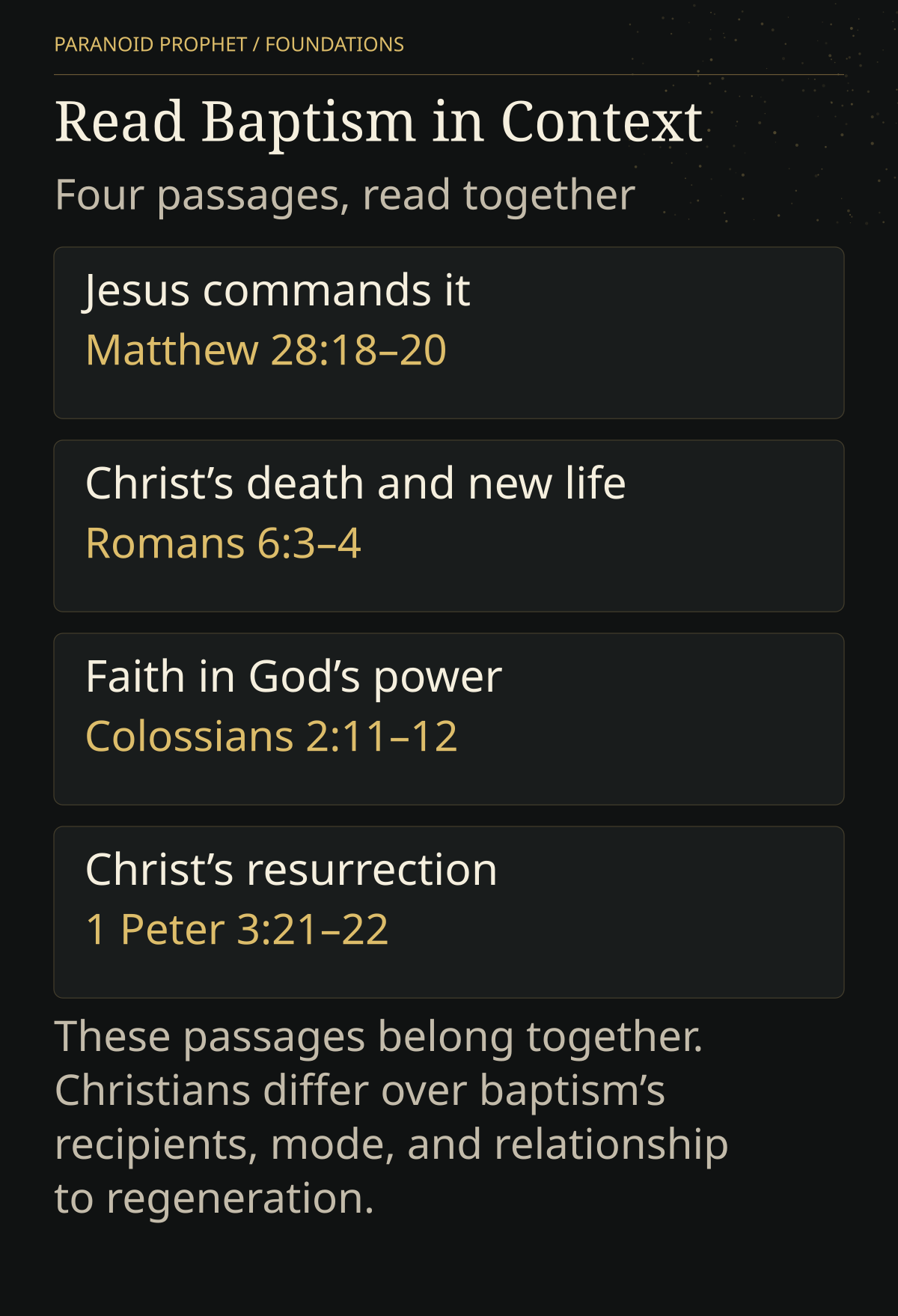
Read Baptism in Context (image text)
Four passages, read together
- Jesus commands it
Matthew 28:18–20 - Christ’s death and new life
Romans 6:3–4 - Faith in God’s power
Colossians 2:11–12 - Christ’s resurrection
1 Peter 3:21–22
These passages belong together. Christians differ over baptism’s recipients, mode, and relationship to regeneration.
PARANOID PROPHET / FOUNDATIONS
Does Baptism Save You?
Christians answer this differently because they understand the relationship between Christ, faith, water baptism, and new birth differently. The disagreement cannot be settled by saying one side believes in grace while the other believes people earn salvation with water. The sacramental traditions described below also understand salvation as God’s gift through Christ.
From this site’s Protestant, Scripture-first perspective, Christ’s saving work is the foundation of our acceptance before God. Baptism must be understood in relation to that work and to faith, never as something we purchase or perform to put God in our debt. Our Salvation by Grace article develops that foundation. The particular question of whether baptism is an instrument of regeneration divides Protestants as well as separating some Protestants from Catholic and Orthodox teaching.
Read the strong baptismal passages directly. Acts 2:38 connects repentance and baptism with forgiveness and the Spirit. First Peter 3:21 speaks of baptism in connection with salvation through Jesus’ resurrection. John 3:5 speaks of birth involving water and the Spirit; Titus 3:5 describes washing, new birth, and renewal by the Spirit. Sacramental readings see these as central to baptism’s role. Other readings understand the language differently, or distinguish the outward sign from the inward saving reality. See John 3:1–8 and Titus 3:3–7.
Also read Acts 10:44–48. The Gentile hearers receive the Spirit before their water baptism, and Peter still commands their baptism. This guards against making one chronological sequence an absolute limit on God’s action. It also prevents treating the prior gift of the Spirit as a reason to disregard water baptism.
The strongest question is not, “Which isolated verse defeats the other side?” It is, “Which explanation accounts for the whole body of teaching without weakening Christ’s command, God’s grace, or the passages that challenge it?”
How Do Christian Traditions Understand Baptism?
These are representative positions, not a list of every church or every variation within a tradition. The differences concern what God gives through baptism, who should receive it, and how it should be administered. They do not map neatly onto Catholic versus Protestant.
Catholic
Catholic teaching describes baptism as a sacrament through which sins are forgiven, a person is reborn in the Spirit, and the baptized person is incorporated into Christ and His Church. It includes infant baptism. The Catechism also says baptism leaves a lasting spiritual mark and is not repeated. These are claims about divine grace, not the water’s independent power. See the Catechism on baptismal grace, paragraphs 1262–1274.
Its teaching about necessity has important qualifications. The Catechism discusses martyrdom before baptism, the explicit desire of catechumens who die before receiving it, and the hope entrusted to God’s mercy for children who die without baptism. Saying simply that Catholicism consigns every unbaptized person to damnation would misrepresent its stated teaching. See paragraphs 1257–1261.
Orthodox
The Orthodox Church in America’s teaching describes baptism as participation in Christ’s death and resurrection and new birth through water and the Spirit. Its account includes infants, sponsors who profess the faith and support the child’s Christian life, and the traditional threefold immersion in the name of the Trinity. Baptism belongs to initiation into the Church and a life of communion with God. See The Orthodox Faith: Baptism.
This is a sacramental account. Calling Orthodox baptism only a public announcement of an earlier private decision would fail to describe it.
Lutheran
The Augsburg Confession, Article IX, teaches that grace is offered through baptism and affirms baptizing children. Luther’s Small Catechism on Baptism connects its benefits with God’s word and promise, and with faith that trusts that promise.
Lutheran teaching therefore resists the idea that baptism is merely human testimony. It also does not attribute the benefit to water separated from God’s word. This is an important Protestant sacramental position often missing from oversimplified comparisons.
Reformed and Presbyterian
The Westminster Confession, chapter 28, calls baptism a sign and seal of the covenant of grace and entrance into the visible church. It includes professing believers and the infants of believing parents, and accepts pouring or sprinkling without requiring immersion.
It explicitly denies that everyone baptized is necessarily regenerated or that nobody can be saved without baptism. Yet it also says the Spirit truly confers the promised grace on those to whom it belongs, in God’s appointed time. Its view is neither automatic regeneration at the moment of administration nor an empty sign with no divine promise.
Baptist
The Baptist Faith and Message, Article VII, describes baptism as a believer’s immersion in water in the name of the Father, Son, and Holy Spirit. It is an act of obedience portraying faith in the crucified and risen Savior, death to sin, and new life. This confession also connects baptism to church membership and the Lord’s Supper.
In this account, baptism expresses a believer’s response to Christ rather than producing regeneration. That does not make it unimportant. Its significance rests in Jesus’ command, its witness to the gospel, and its place in the church’s life. Other Baptist bodies may formulate some details differently.
Why Do Some Churches Baptize Infants and Others Baptize Believers?
Churches that baptize infants do not generally claim that babies can explain a conversion testimony. They appeal to God’s promise and initiative, the place of children within His people, their understanding of baptism’s gift, and the responsibility of parents and the congregation to nurture faith. Reformed arguments especially emphasize covenant continuity. Catholic, Orthodox, and Lutheran accounts also emphasize baptism’s sacramental gift, with meaningful differences among them.
Churches that practice believer’s baptism point to the recurring connection between hearing the gospel, receiving it, and being baptized. They require a credible profession of faith and distinguish that profession from a parent’s faith on a child’s behalf. This may include children old enough to understand and profess faith; “believer’s baptism” does not simply mean “adult baptism.”
Household passages are important but must be handled honestly. Acts describes Lydia’s household and the Philippian jailer’s household being baptized. The accounts do not give an age list. Readers should not silently insert infants to prove one position or claim the absence of infants has been demonstrated. They belong within the larger argument about faith, families, covenant, and the church. Read Acts 16, especially verses 14–15 and 30–34.
Parents can ask a church two straightforward questions: “Why does your understanding of Scripture lead you to baptize, or not baptize, infants?” and “How will you help us teach our child to trust and follow Christ?” A reassuring ceremony cannot carry the entire responsibility of raising a child in faith.
Must Baptism Be by Immersion?
Immersion provides a vivid picture of burial and rising, and it is required in Baptist teaching and central to the Orthodox rite described above. Catholic teaching also recognizes immersion, alongside pouring; see Catechism 1239. Presbyterian teaching permits pouring or sprinkling and does not regard immersion as necessary. The question therefore concerns the required mode, not whether water matters.
The New Testament links baptism with burial, cleansing, and new life. Christians disagree over whether particular narrative details and word usage establish immersion as the only valid mode. A brief English gloss of a Greek word is not a substitute for examining the relevant texts and the church’s full reasoning.
If disability, limited mobility, illness, or fear of water creates a practical obstacle, explain that before any ceremony. A responsible congregation should discuss what its teaching permits and make safe arrangements. Nobody should be pressured into a physically unsafe procedure or publicly embarrassed for needing help.
What If I Was Baptized Before?
Begin with what actually happened: the community involved, the words and water used, your age, and whether you professed faith. Then discuss those facts with a trustworthy pastor who can explain the church’s position from Scripture.
Churches that recognize your earlier baptism ordinarily will not repeat it merely because you understand more now. Baptist churches often do not recognize infant baptism as believer’s baptism; they understand a later baptism after a credible profession as receiving the commanded baptism, rather than repeating a valid one. These different judgments explain why the same personal history can produce different pastoral advice.
A season of doubt does not by itself establish that an earlier baptism was invalid. Neither does continued struggle require a cycle of being baptized again whenever you fear that your feelings were insufficient. If this is becoming an exhausting search for certainty, read Can a Christian Be Sure of Salvation? and seek patient pastoral care rather than making another urgent decision under pressure.

How Should I Prepare for Baptism?
You do not need to master every historical dispute before asking a church about baptism. You do need room to understand what you are doing and why.
- Begin with Jesus and the gospel. If you are unsure what Christians believe about His death and resurrection, start with What Is the Gospel?. Ask questions honestly rather than rehearsing an answer that sounds impressive.
- Speak with a congregation that will teach and care for you. Ask what it believes baptism does, whom it baptizes, how it administers it, and what preparation it expects. A good explanation should open Scripture, not merely point to a tradition’s reputation.
- Discuss your own history. Tell the pastor about any previous baptism, confusion about faith, or concerns about the ceremony. These details affect pastoral guidance.
- Make practical arrangements. Ask about access, clothing, physical assistance, privacy, photography, and what the service involves. Public testimony need not expose private trauma or other people’s personal information.
- Plan for the life that follows. Baptism belongs with worship, teaching, prayer, service, and relationships in Christ’s people. Our guide to what happens when you become a Christian explains the wider beginning of that life.
A baptism service should never become leverage to demand unquestioning loyalty to a leader. Christian obedience involves truthfulness and accountability, including accountability for those who teach.
What Comes After the Water?
The water dries. The congregation goes home. Then comes another ordinary week of work, family, temptation, worship, and opportunities to love people well.
That ordinary life matters to the meaning of baptism. Romans 6 directs believers toward living for God. Acts 2 places the baptized among people learning, praying, sharing, and worshiping together. The church’s responsibility continues after the photograph is taken.
Take Jesus’ command seriously. Read the difficult passages without editing away their force. Hear the traditions accurately enough to explain why they disagree. Then seek faithful, thoughtful participation in the life to which Christ calls His people.
Sources and Translation Note
Biblical teaching is chiefly paraphrased, with links to the NIV for reading passages in context. The linked confessions, catechisms, and Orthodox teaching represent their own communities; citing them describes their positions rather than declaring every position equally correct. This article distinguishes the clear command to baptize from disputed interpretations of its recipients, mode, and relation to regeneration. It is a foundation for study and pastoral conversation, not a judgment on the validity of an individual reader’s baptism.