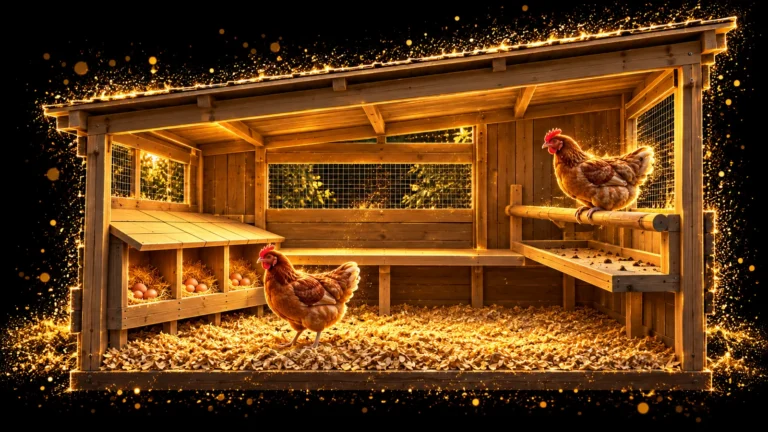
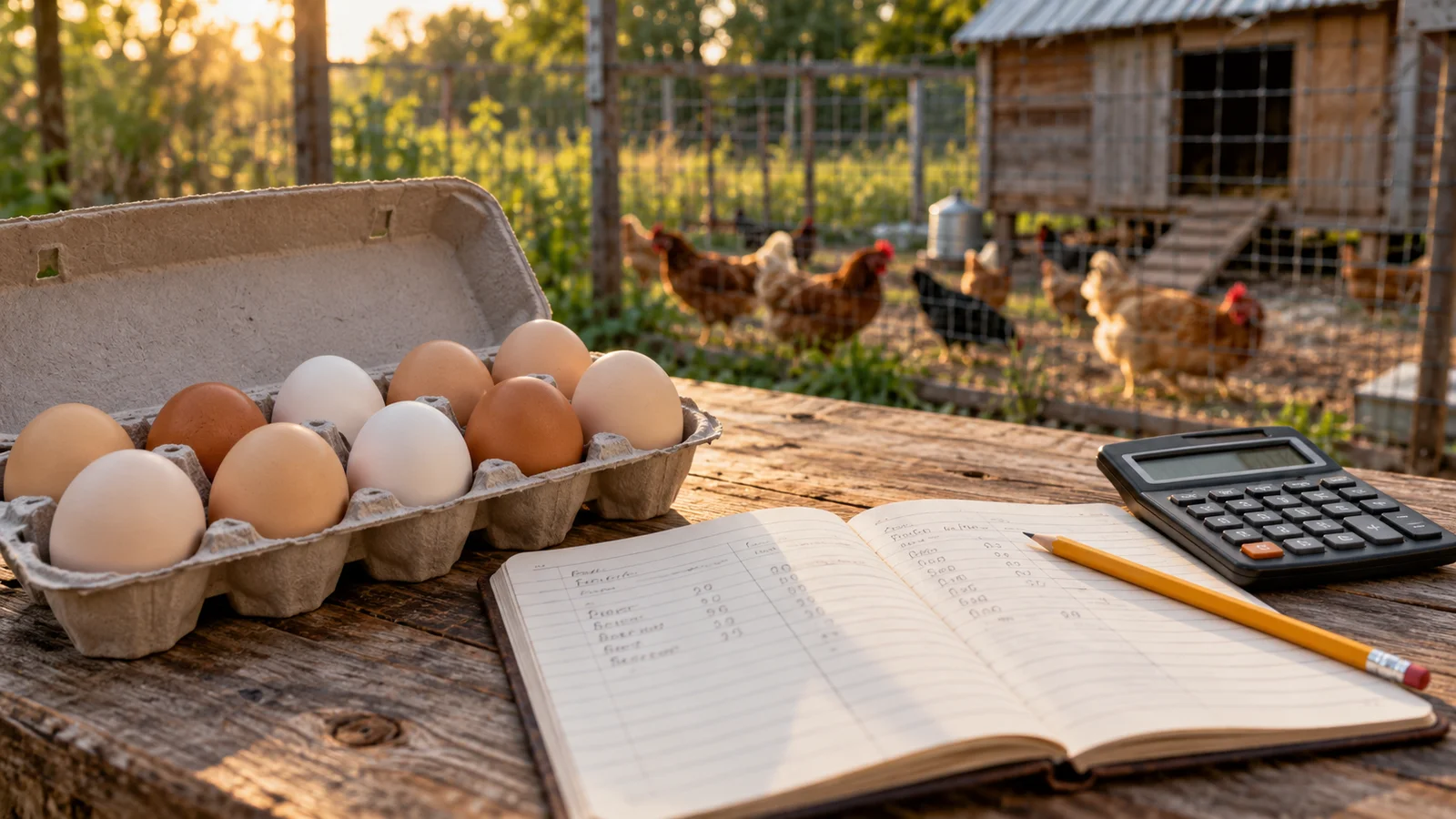

A flock that produces more eggs than your household uses can create a small opportunity: share the surplus, sell some legally, and learn whether the numbers actually work.
That is a better entrepreneurship lesson than pretending chickens are passive income.
Updated October 6, 2026. Sources checked for this remaster.
GUIDED ARTICLE EXPERIENCE
Backyard Chicken Entrepreneurship: Costs, Egg Sales & Teaching Real Business Skills
Read along as the narration moves through the article.
Private device narration · No hosted audio or tracking
CONTINUE GUIDED TOUR
Continue where you left off.
GUIDED TOUR COMPLETE
You have reached the end of this study.
Study record saved on this device.
GUIDED TOUR
Backyard Chicken Entrepreneurship: Costs, Egg Sales & Teaching Real Business Skills
Narrator: Paranoid Prophet Recommended Voice Native device narration
Prepare to follow the article as it is narrated.
VOICE & TOUR OPTIONS
Voice & Listening
NARRATOR
Finding a narrator…
Checking the best narrator available on this device.
Restores the best curated narrator available on this device.
Narrator choices are curated for clear, long-form listening on this device.
Screen-awake support will be checked when narration starts.
CHOOSE A NARRATOR
Curated for this device
Choose a verified narrator for this browser, or use System Narrator. Automatic mode uses the best reliable route exposed by this device; your chosen narrator is preserved even if this device needs a temporary fallback.
Preparing the guided article experience…
RESUME GUIDED TOUR?
Continue where you left off.
GUIDED TOUR COMPLETE
You have reached the end of this study.
Article Guide12 sections
Start with the question most side-hustle articles skip
What does a dozen eggs actually cost you to produce?
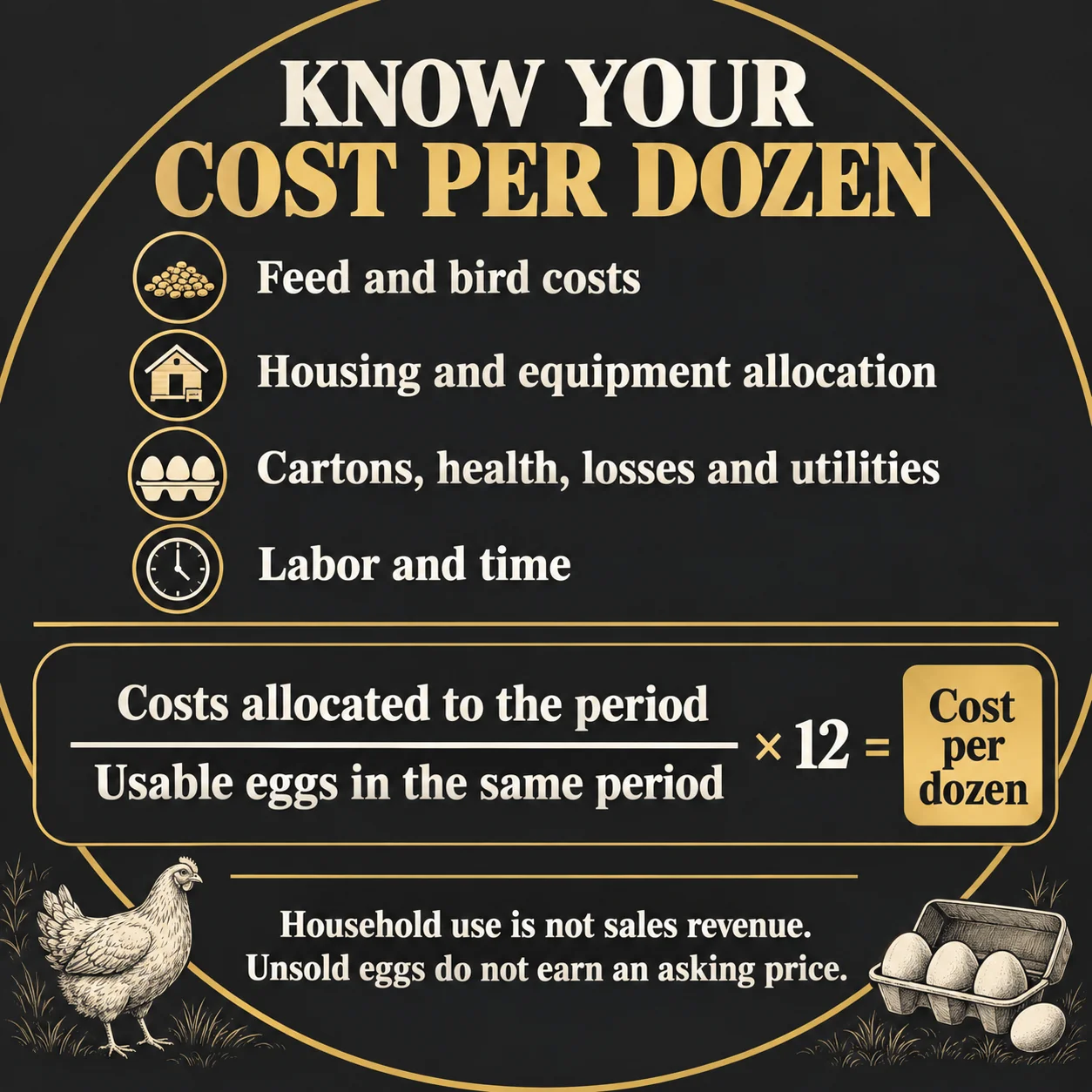
Before setting a price, count the inputs:
- feed
- chicks or pullets
- coop/run costs
- feeders and waterers
- bedding
- cartons
- electricity where used
- losses and replacement birds
- health expenses
- repairs
- your time
University of Maryland Extension’s August 2026 backyard-layer budget calculated about $3.37 per dozen before labor in a ten-layer, three-year example using its stated costs, mortality and egg-yield assumptions. The model includes supplemental winter lighting; it is not a forecast for every breed or management system.
That is not “the cost of backyard eggs.” It is a model showing how to do the math.
Your number may be higher or lower. For a reusable household production estimate: cost per dozen = costs allocated to the period divided by usable eggs produced in that period, multiplied by 12. Spread long-lived housing and equipment over a stated useful life, rather than charging the whole purchase every month. Keep the same accounting period for costs and eggs; distinguish household-use eggs from actual sales.
Revenue is not profit
In a hypothetical example, selling a dozen eggs for $6 creates $6 of revenue, not $6 of profit. This is arithmetic, not a current price recommendation.
Net result = sales revenue minus the costs allocated to those sales, including labor/time. Record household egg use separately so a household saving is not counted as cash income. Likewise, usable eggs left unsold cannot be assumed to earn your asking price.
A simple record can track:
- eggs collected
- dozens sold
- sales price
- feed purchased
- cartons purchased
- equipment/repair cost
- flock losses
- other expenses
University of Maryland Extension specifically recommends records for flock inventory, health, feed, egg production, sales/income and expenses.
For a kid or teenager learning business, that is the real lesson: measure instead of guessing.
Pricing eggs responsibly
A price should reflect:
- your cost of production
- the market you are serving
- the quality and presentation of the product
- local competition
- the value of your time if you are treating the operation as a business
Do not price from social media screenshots or assume grocery-store prices make your backyard operation profitable.
If the goal is family education rather than maximizing income, even a small break-even project can teach:
- arithmetic
- inventory
- customer communication
- reliability
- recordkeeping
- reinvestment
- ethical treatment of animals
Know the law before selling
Egg-sale rules vary by state and sometimes by sales channel.
CDC guidance for backyard keepers tells sellers to know local regulations and licensing requirements.
Rules can cover:
- refrigeration
- labeling
- pack dates
- grade/size claims
- reuse of cartons
- where eggs may be sold
- licensing or registration
- sanitation
Do not assume “cottage food” automatically covers shell eggs.
As one regional example, the Alabama Department of Agriculture direct-market guide lists package labeling and refrigeration at or below 45°F for farmers-market shell eggs, while distinguishing on-farm sales from the Shell Egg Law. Confirm current requirements with the department for your exact channel before selling; an exemption from one law is not an exemption from food-safety responsibility. This Alabama example is not permission to sell in another state.
Food safety is part of customer service
A small egg seller has responsibilities beyond collecting payment.
Use clean nest areas, frequent collection, safe egg handling, refrigeration and the rules that apply in your jurisdiction. FDA consumer guidance recommends refrigerator storage at 40°F or below. That household recommendation is a different context from the Alabama market limit, and meeting a legal maximum does not guarantee an egg is free of Salmonella.
If you cannot maintain the required cold chain or labeling, you are not ready to sell through that channel.
Cleaning guidance also depends on context: CDC advises dry-cleaning dirt from home-collected eggs rather than washing warm fresh eggs in colder water. Maryland’s seller-facing guide calls for cleaning and sanitizing before sale. Ask the regulator which approved commercial handling process applies; do not improvise a washing process or use the home-collection rule as a sales exemption. The backyard-versus-store egg guide explains the household safety distinctions.
Biosecurity protects the business too
A disease event can stop production, harm birds and create real financial loss.
Good biosecurity is not bureaucracy. It protects the flock that generates the product.
The University of Maryland economics guide emphasizes isolation, traffic control and sanitation. That means limiting unnecessary flock access, using dedicated footwear/equipment and being careful about bringing birds or equipment back from other poultry settings.
What else can a flock business sell?
Possible poultry-related products or services can include:
- eating eggs
- hatching eggs
- chicks
- started pullets
- composted manure products
- educational visits or classes where lawful and safe
Each category creates different questions.
For live birds, hatching eggs and animal movement, disease-control rules and buyer expectations become more important. USDA APHIS describes NPIP as a voluntary federal-state testing and certification program; it does not replace checking the destination state’s movement requirements. For compost/manure products, processing and local sales rules may differ. Do not add a product simply because someone online calls it profitable.
Research the rules and the real demand first.
The best family-business version is small enough to learn from
If the goal is teaching entrepreneurship, start with a flock size you can care for, keeping animal welfare ahead of revenue. Our roughly twelve-chicken flock regularly gives away extra eggs; sharing is not a sales record or evidence of profit. The cost guide helps build a budget, while the benefits guide covers nonfinancial reasons to keep birds.
A useful progression:
- Track household egg production for several weeks.
- Calculate actual cost per dozen.
- Identify genuine surplus.
- Check local sales rules.
- Test a small number of repeat customers.
- Record every sale and expense.
- Review whether the project earned money after costs.
- Decide whether growth would improve or damage the system.
That is a real business exercise.
What about “making the flock pay for itself”?
It can happen in some households, but it is not a promise.
A few egg sales may offset feed. They may not recover a predator-proof coop, fencing, repairs, veterinary costs or labor.
A business is healthier when the owner knows whether it is:
- profitable
- break-even
- partially subsidizing a hobby
- intentionally losing money because the nonfinancial benefits matter
All four can be valid choices if they are honest.
FAQ
Can I make money selling backyard eggs?
Possibly, but profit depends on your cost per dozen, legal requirements, local demand and how you value labor.
How should I set an egg price?
Know your cost first, then compare local market conditions and legal requirements.
Can kids run an egg business?
They can participate in age-appropriate recordkeeping, packing, customer service and supervised chores. Poultry hygiene and age-appropriate child-safety boundaries still apply. Customer contact and packing should be adult-supervised and consistent with the handling rules.
Can I sell eggs from home?
Rules vary. Check state and local requirements for the exact sales channel.
Should I sell chicks too?
Only after understanding breeder quality, animal-health/biosecurity expectations and applicable laws. It is not simply an add-on revenue stream.
Stewardship before scale
The flock is not inventory first and animals second.
If a business plan requires crowding birds, neglecting health care or treating every hen as a production unit, the business plan is wrong.
For a Christian family, entrepreneurship should make stewardship more disciplined: honest weights and prices, clean products, reliable commitments, accurate records and animals cared for even when production slows.