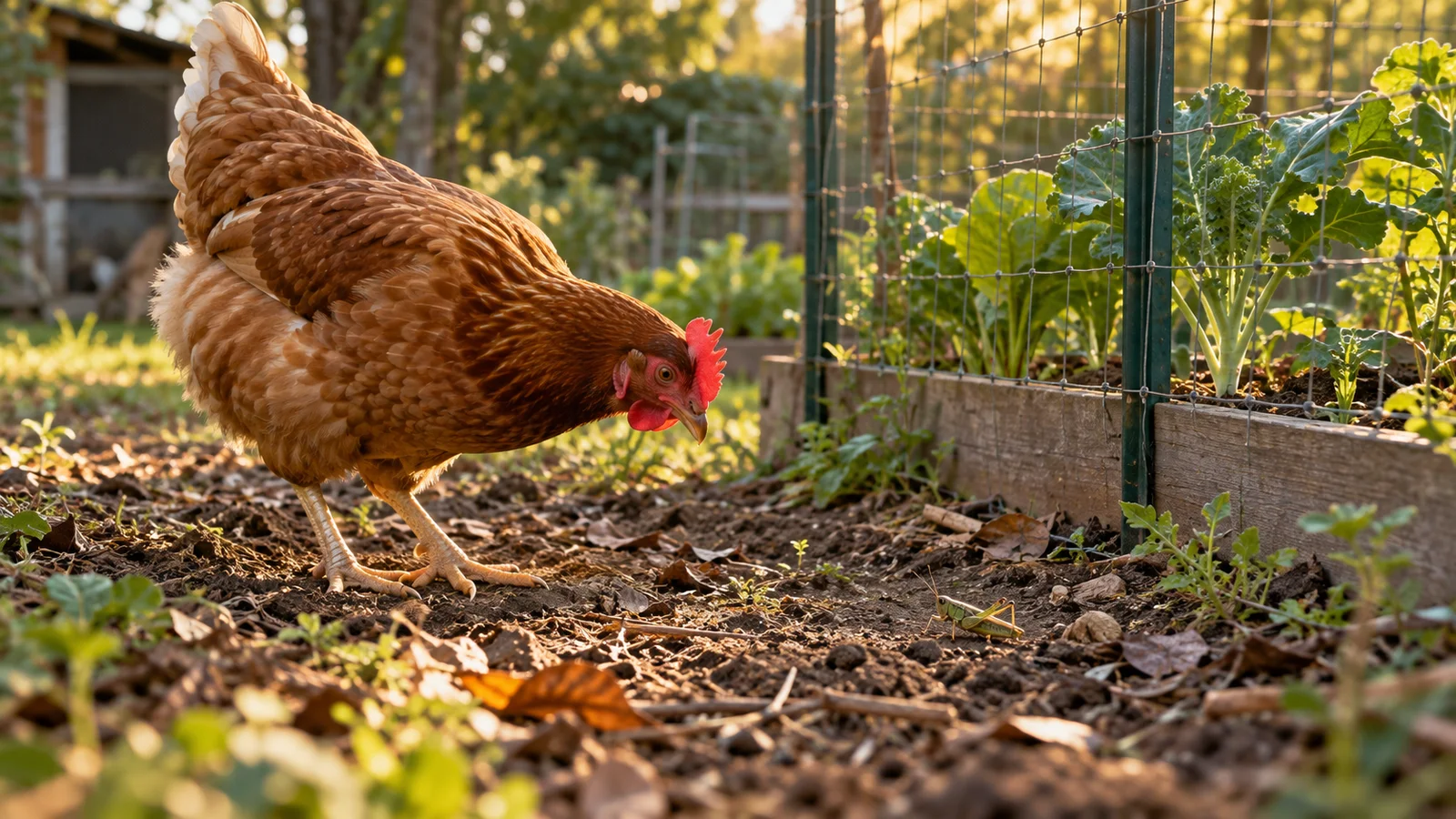

Chickens eat bugs. That part is easy to observe.
The harder question is whether a backyard flock controls pest populations enough to replace other pest-management methods. The evidence is much thinner than popular chicken blogs make it sound.
Updated October 6, 2026. Sources checked for this remaster.
GUIDED ARTICLE EXPERIENCE
Do Chickens Control Pests? What They Eat, What the Evidence Shows & Garden Tradeoffs
Read along as the narration moves through the article.
Private device narration · No hosted audio or tracking
CONTINUE GUIDED TOUR
Continue where you left off.
GUIDED TOUR COMPLETE
You have reached the end of this study.
Study record saved on this device.
GUIDED TOUR
Do Chickens Control Pests? What They Eat, What the Evidence Shows & Garden Tradeoffs
Narrator: Paranoid Prophet Recommended Voice Native device narration
Prepare to follow the article as it is narrated.
VOICE & TOUR OPTIONS
Voice & Listening
NARRATOR
Finding a narrator…
Checking the best narrator available on this device.
Restores the best curated narrator available on this device.
Narrator choices are curated for clear, long-form listening on this device.
Screen-awake support will be checked when narration starts.
CHOOSE A NARRATOR
Curated for this device
Choose a verified narrator for this browser, or use System Narrator. Automatic mode uses the best reliable route exposed by this device; your chosen narrator is preserved even if this device needs a temporary fallback.
Preparing the guided article experience…
RESUME GUIDED TOUR?
Continue where you left off.
GUIDED TOUR COMPLETE
You have reached the end of this study.
Article Guide12 sections
The short answer
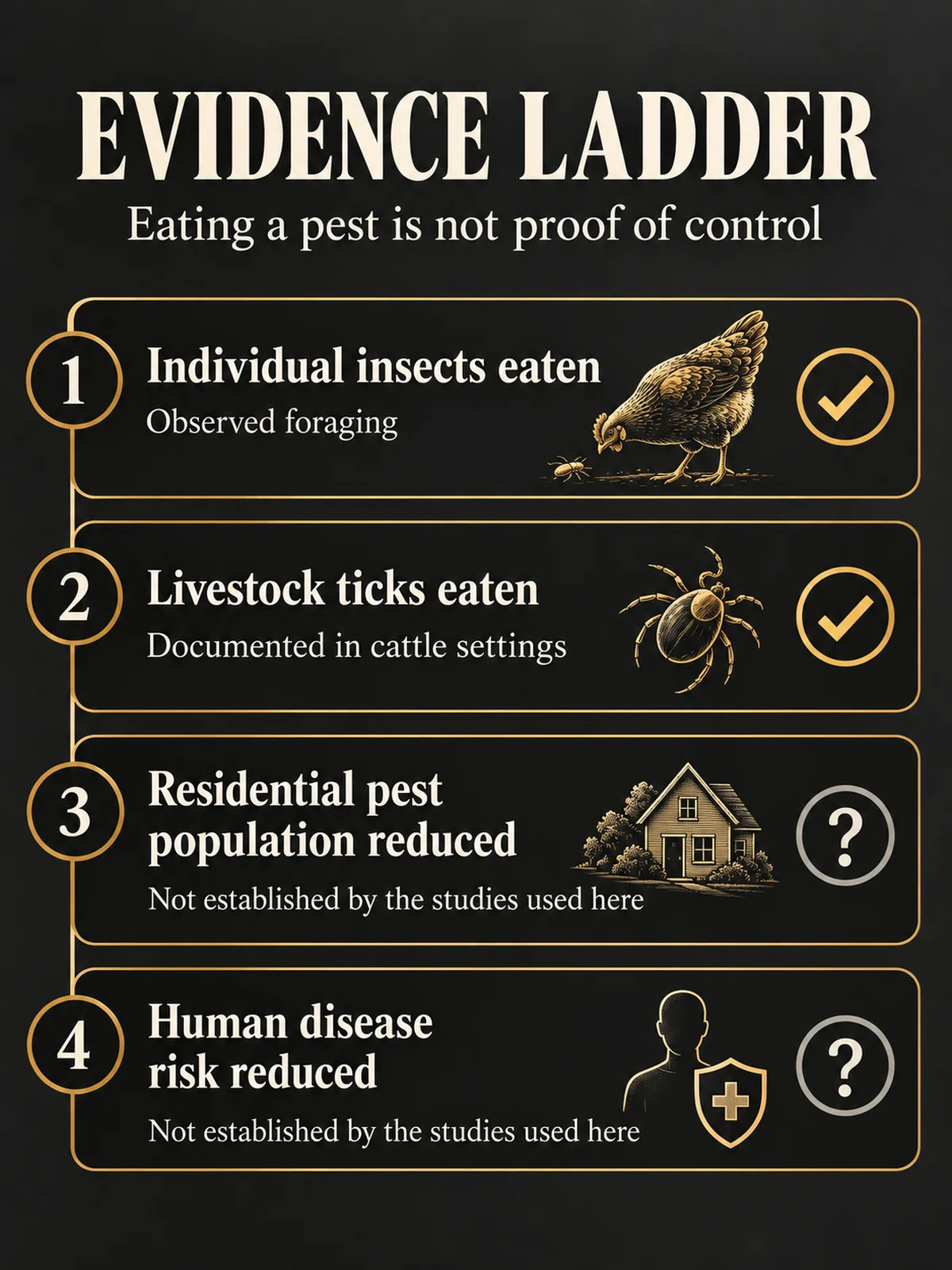
Chickens can consume insects and other small invertebrates while foraging. Research has directly documented chickens eating ticks in livestock settings.
That does not establish that a few hens will eliminate ticks from a suburban yard, prevent Lyme disease, control mosquitoes or keep a vegetable garden pest-free.
A useful way to think about chickens is:
foragers that may remove some individual pests, not a guaranteed biological pesticide.
What the tick studies actually found
A 1991 veterinary-parasitology study recovered multiple tick species from chickens that had scavenged around tick-infested cattle. A later South African study also found that chickens consumed ticks while foraging around cattle and discussed the birds as one possible component in an integrated tick-control program.
Those studies are legitimate evidence of predation.
They are not the same experiment as releasing a few hens into an American backyard and measuring whether the local tick population, human tick encounters or tick-borne disease risk declines.
The responsible claim is:
Supported: Chickens can eat ticks when they encounter them.
The unsupported leap is:
Not established by these studies: Chickens will make your yard tick-safe.
What else will chickens eat?
Chickens are opportunistic omnivores. In a normal yard, they may peck at:
- beetles
- grasshoppers
- crickets
- caterpillars
- larvae and grubs they expose while scratching
- other small invertebrates they can catch
How much they consume depends on what is present, how much access the birds have, the individual flock and what else is available to eat.
This is why a long internet list of “pests chickens control” is less useful than watching what your own flock actually forages.
Eating an insect is not the same as controlling a population
Population control requires more than proving predation.
You would need to know things such as:
- how many pests are present
- how quickly they reproduce
- whether chickens encounter the relevant life stage
- whether the birds reduce the population enough to matter
- whether other habitat conditions keep replacing the pests
A chicken can eat a beetle while the beetle population still grows.
Chickens can damage the same garden you want them to protect
A flock does not distinguish between a bed you want protected and one you want scratched.
Chickens may:
- uproot seedlings
- strip leaves
- scatter mulch
- expose roots
- compact or disturb heavily used areas
- eat beneficial or harmless invertebrates along with target pests
Our own flock stripped most of the grass from our backyard by about the end of its first year. That experience does not prove every flock will do the same, but it is a reminder that foraging pressure is real.
Use the site’s How to Grow Grass With Backyard Chickens and Chicken Space Requirements guides when planning access.
Use chickens as part of integrated pest management, not instead of it
EPA describes integrated pest management, or IPM, as a process that combines monitoring, identification, prevention and appropriate control methods.
Before choosing a control, decide how much damage or risk calls for action. Not every insect needs eliminating.
If birds are already part of your property, limited foraging can be one biological pressure among several. It belongs among the possible benefits of raising backyard chickens, with management limits attached. But an actual pest problem may also call for:
- identifying the pest correctly
- removing breeding habitat
- sanitation
- physical barriers
- trapping
- plant or landscape changes
- targeted treatment when warranted
The goal is not to use the most natural-sounding method. The goal is to solve the actual problem with the least unnecessary risk.
What about ticks and Lyme disease?
Do not rely on chickens as a Lyme-disease prevention strategy.
The published chicken-tick studies used cattle-associated tick systems outside the ordinary U.S. residential context. They show chickens can consume ticks. They do not establish protection from human tick-borne disease in a backyard.
Use CDC tick-prevention guidance for human risk reduction rather than treating poultry as a medical intervention.
What about mosquitoes?
Do not count on chickens to control mosquito breeding.
Chickens should have clean drinking water, and property owners should remove or manage unnecessary standing water according to CDC mosquito-control guidance. Do not create mosquito habitat hoping chickens will forage in it.
Where chicken foraging makes the most sense
Practical situations can include:
- post-harvest garden areas where scratching is acceptable and manure management fits the next food crop
- orchard or open-ground areas where birds can forage without destroying young plants
- compost-adjacent areas managed so birds cannot access unsafe material
- established runs with enough land recovery and predator protection
Protect tender beds and crops you do not want excavated. For food-growing areas, check Extension produce-safety guidance before deciding when poultry access is appropriate; an empty bed is not automatically a food-safe bed.
Foraging does not replace balanced feed or flock biosecurity. Keep birds away from unsafe waste and treated areas unless the pesticide label and poultry guidance permit access. Insects and rodents can also carry poultry pathogens or parasites; maintain clean feeding areas rather than attracting pests for the hens.
FAQ
Do chickens eat ticks?
Yes. Published studies have directly documented chickens consuming ticks in livestock-associated settings.
Will chickens get rid of ticks in my yard?
That has not been established by the evidence used here. Predation does not automatically equal meaningful residential population control.
Can chickens replace pesticides?
Not as a universal rule. Use integrated pest management and choose methods based on the actual pest and level of risk.
Do chickens protect pollinators?
Do not assume they selectively eat only harmful insects. Chickens are opportunistic foragers.
Will chickens damage a vegetable garden?
They can. Scratching and plant consumption can be substantial, especially in a small area.
Stewardship means resisting easy claims
There is nothing wrong with appreciating the fact that a hen will chase a grasshopper.
The problem begins when a true observation turns into a promise the evidence cannot support.
Responsible stewardship means using the flock for what it actually does well, while protecting the yard, beneficial organisms and the birds themselves from our own wishful thinking.
Sources and evidence limits
- Hassan et al. 1991, Predation on livestock ticks by chickens
- Dreyer et al. 1997, Predation of livestock ticks by chickens
- US EPA, Integrated Pest Management Principles
Garden tradeoffs: Oregon State Extension poultry specialist: chickens versus landscape plants. Flock protection: University of Kentucky poultry Extension: small-flock biosecurity. These support management cautions, not a quantified residential pest-control promise.