
GUIDED ARTICLE EXPERIENCE
How Did Stephen Die?
Read along as the narration moves through the article.
Private device narration · No hosted audio or tracking
CONTINUE GUIDED TOUR
Continue where you left off.
GUIDED TOUR COMPLETE
You have reached the end of this study.
Study record saved on this device.
GUIDED TOUR
How Did Stephen Die?
Narrator: Paranoid Prophet Recommended Voice Native device narration
Prepare to follow the article as it is narrated.
VOICE & TOUR OPTIONS
Voice & Listening
NARRATOR
Finding a narrator…
Checking the best narrator available on this device.
Restores the best curated narrator available on this device.
Narrator choices are curated for clear, long-form listening on this device.
Screen-awake support will be checked when narration starts.
CHOOSE A NARRATOR
Curated for this device
Choose a verified narrator for this browser, or use System Narrator. Automatic mode uses the best reliable route exposed by this device; your chosen narrator is preserved even if this device needs a temporary fallback.
Preparing the guided article experience…
RESUME GUIDED TOUR?
Continue where you left off.
GUIDED TOUR COMPLETE
You have reached the end of this study.
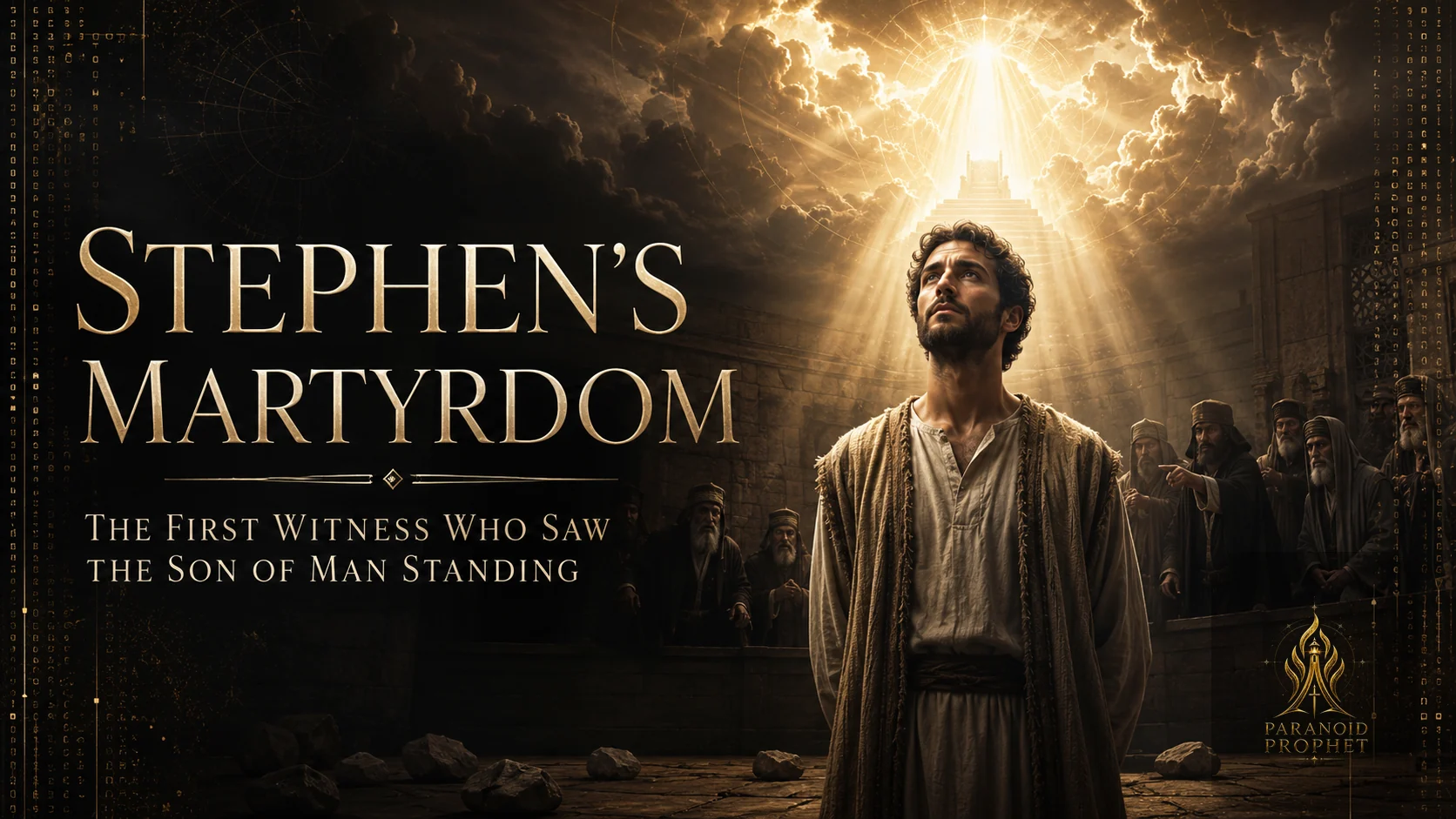
How did Stephen die? Stephen died by stoning after bearing witness before the council in Jerusalem. According to Acts 7:54–60, he saw Jesus standing at the right hand of God, was cast out of the city, and prayed to the Lord Jesus as he died.
Stephen’s martyrdom matters because it shows the early church publicly confessing Jesus as alive, exalted, and reigning at God’s right hand, even when that confession could cost them their lives. He did not die for vague religion, private spirituality, or moral inspiration. In Acts, he dies as a witness to the risen and exalted Christ.
Stephen was not one of the Twelve apostles. He was one of the seven men chosen in Acts 6:1–7 to serve the early church during a conflict over the daily distribution to widows. Luke presents him as a Spirit-filled servant, a public witness, and the first named Christian martyr after the resurrection and ascension.
That distinction keeps Stephen in the right lane. His death is different from later traditions about the deaths of Peter, Bartholomew, Philip, and other apostles. It is also different from the death of James, the brother of Jesus, whose execution is reported by Josephus outside the New Testament. Stephen’s death is not anchored by Josephus or Tacitus. The primary source is Acts.
The point is not to minimize Stephen. It is to use the evidence honestly. Acts 6–8 gives the biblical account. Later Christian writers such as Eusebius receive Stephen as the first martyr, but they do not replace Acts as the backbone of the story. In Acts, Stephen is chosen, opposed, accused, brought before the council, granted a vision of Christ, stoned, and connected to the beginning of Saul’s violent opposition to the church.
This article will not make the weak argument that Stephen’s death by itself proves the resurrection. Martyrdom can show sincerity, conviction, and cost, but it does not automatically prove truth. The stronger point is narrower and better: at the beginning of the church’s public witness, Christians were already proclaiming Jesus as the exalted Son of Man at the right hand of God, and that confession could get them killed.
For the broader pattern of apostolic witness, persecution, and death, see the main study on the martyrdom of Jesus’ disciples. Stephen belongs beside that larger witness, not because he was one of the Twelve, but because his death shows how early and how costly the public confession of Christ became.
Stephen’s death is not a random mob incident detached from theology. His final vision, his prayer to the Lord Jesus, and Saul’s presence near the execution make this one of the most important martyrdom accounts in the New Testament.
Source discipline: Acts 6–8 is the primary source for Stephen’s life, witness, and death. Later Christian writers such as Eusebius receive Stephen as the first martyr, but they do not give us a Josephus-style independent report. This article treats Acts as the biblical foundation, later tradition as reception history, and scholarship as help for reading Stephen’s speech carefully.
So the first question is simple: who was Stephen before the stones were thrown?
Article Guide13 sections
Who Was Stephen in Acts?
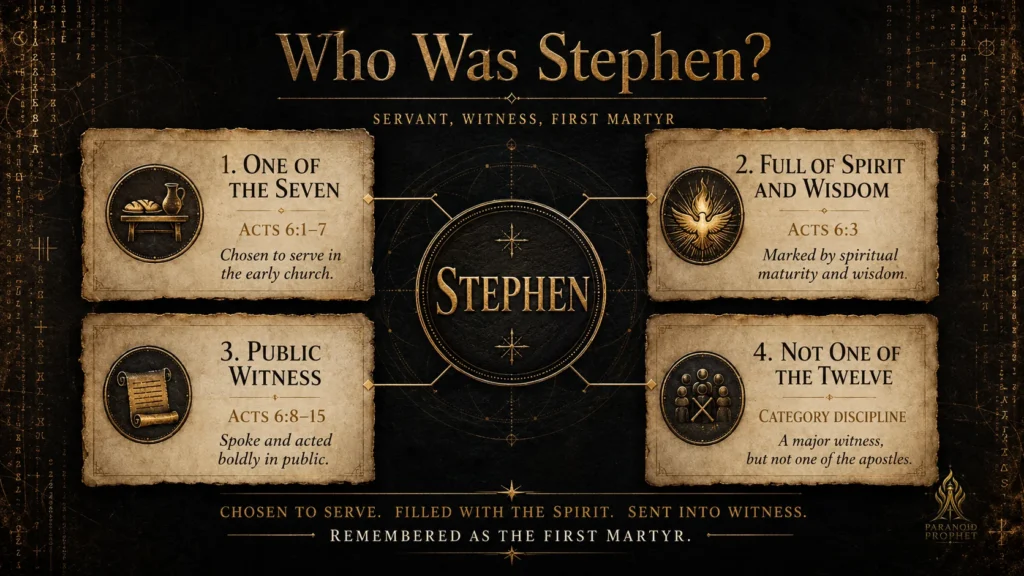
Stephen first appears during a moment of internal pressure in the early Jerusalem church. The number of disciples was increasing, but a complaint arose because the Hellenist widows were being neglected in the daily distribution. The Twelve responded by telling the church to choose seven men of good reputation, full of the Spirit and of wisdom, to serve in this need.
Stephen is named first among the seven. Acts describes him as “a man full of faith and of the Holy Spirit.” Luke’s introduction is deliberate. Stephen does not enter the story as a political agitator, a violent revolutionary, or a self-appointed prophet. He enters through service, reputation, wisdom, faith, and the Spirit.
That makes his death even more striking. Stephen is not looking for a fight. He is chosen to serve the church’s practical needs. Yet his faithfulness in service becomes joined to public witness, and his public witness provokes lethal opposition.
Stephen Was One of the Seven Chosen to Serve
Stephen is often called a deacon in later Christian language. That is understandable, because Acts 6 describes a ministry of service connected to the daily distribution. But Acts itself introduces him as one of the seven chosen to serve, not as one of the Twelve apostles.
This keeps the article in the right category. Stephen belongs in the martyrdom cluster, but not in the “deaths of the Twelve apostles” lane. He was an early Christian servant and witness, selected from the wider believing community because he had a trustworthy reputation and was full of the Spirit and wisdom.
His story also shows how quickly Christian witness moved beyond the apostolic circle. The apostles were not the only ones speaking publicly about Jesus. Stephen was not one of the Twelve, but his life shows that confession of Christ had already spread into the wider body of believers. Service and witness were not separated.
Stephen enters Acts through service, but he dies because of witness.
Stephen Was Full of Grace, Power, and Wisdom
Acts does not leave Stephen in the background. After introducing him among the seven, Acts 6:8–15 says Stephen was full of grace and power and was doing great wonders and signs among the people. Opposition arose from members of a synagogue connected with freedmen and Jews from several regions, but they could not withstand the wisdom and the Spirit with which he was speaking.
That description keeps Stephen from being reduced to a logistics helper. He served real needs in the church, but he also bore public witness. His opponents did not come after him because he distributed food too efficiently. They opposed him because his Spirit-filled testimony could not be easily answered.
The account then says false witnesses accused Stephen of speaking against the holy place and the law, claiming that Jesus of Nazareth would destroy the place and change the customs Moses delivered. Those accusations become the doorway into Stephen’s long speech before the council. But before Acts records that speech, Luke frames the man himself.
Stephen is not portrayed as bitter, reckless, or anti-God. He is full of grace. He is full of power. He speaks with wisdom and the Spirit. When the council looks at him, Acts says his face was like the face of an angel.
That line does not mean Stephen was soft. It means his witness carried holy weight. The council treated him as a threat, but Acts frames him as a faithful servant standing before hostile power with heaven’s approval upon him.
Stephen Was Not One of the Twelve Apostles
Stephen was not Peter. He was not John. He was not James the son of Zebedee. He was not one of the Twelve apostles appointed during Jesus’ earthly ministry. That distinction should be made clearly because many martyrdom articles blur apostles, disciples, church leaders, and early witnesses into one vague category.
Stephen’s importance does not depend on making him one of the Twelve. In some ways, his role becomes more striking because he was not one of them. His martyrdom shows that the public confession of Jesus had already moved beyond the central apostolic group into the wider life of the church.
Acts does not present Stephen as an eyewitness of Jesus’ earthly ministry. It presents him as a Spirit-filled witness to the risen and exalted Jesus. That makes his testimony different from the apostolic witness, but not disposable. His death shows the spread and cost of the church’s confession.
He does not replace the apostolic witness. He shows its spread.
Why Stephen Matters in Acts
Stephen matters because Acts places his death at a hinge point in the church’s story. Before Stephen’s martyrdom, the witness is concentrated in Jerusalem. After his death, persecution scatters the believers, and those scattered go about preaching the word.
In Acts 8:1–4, Stephen’s death becomes a turning point. Saul approves of the execution. A great persecution breaks out against the church in Jerusalem. Believers are scattered through Judea and Samaria. The gospel of the risen Christ moves outward.
Stephen also matters because of what he sees before he dies. Acts says he looked into heaven and saw the glory of God, and Jesus standing at the right hand of God. Then Stephen says he sees the Son of Man standing at the right hand of God. That vision is not a minor devotional detail. It is the Christological center of the story.
This early section should not carry the whole apologetic argument. Later sections will explain Stephen’s speech, vision, stoning, prayer, and connection to Saul more fully. For now, the point is simple: Stephen’s death connects service, witness, rejection, vision, persecution, and mission in one concentrated moment.
To understand why Stephen was stoned, we have to look at the accusations that brought him before the council: Moses, the law, the temple, and the claim that Jesus had been vindicated by God.
Why Was Stephen Accused?
Stephen’s martyrdom did not come out of nowhere. Acts places his death inside a public conflict over witness, Scripture, the temple, the law, and Jesus. After Stephen is described as full of grace and power, doing great wonders and signs among the people, opposition rises because his opponents cannot withstand the wisdom and the Spirit with which he is speaking.
Stephen was not killed because he was careless with words or hungry for provocation. Luke frames the conflict as a response to Spirit-filled testimony. When his opponents could not answer him, the conflict escalated into accusation.
The Opposition from the Synagogue of the Freedmen
Acts 6:8–15 says opposition arose from members of the synagogue of the Freedmen, including men from Cyrene, Alexandria, Cilicia, and Asia. We should not overbuild the geography, but the detail matters. Stephen’s witness was public enough, persuasive enough, and disruptive enough to draw serious resistance.
The issue was not merely personality. Stephen was speaking about God, Israel, the temple, the law, and Jesus in a way his opponents considered dangerous. The early church’s proclamation was not treated as a harmless moral message. It challenged the leaders’ interpretation of Israel’s story because it placed Jesus at the climax of that story.
Luke says Stephen’s opponents could not withstand the wisdom and the Spirit with which he was speaking. That line should shape how we read the accusation scene. The charges do not arise because Stephen has been defeated in debate. They arise because his witness could not be easily answered.
The Charges Against Stephen
Acts says men were secretly instigated to accuse Stephen of speaking blasphemous words against Moses and God. Stephen was seized and brought before the council. False witnesses then claimed that he never stopped speaking against “this holy place and the law.” They said he taught that Jesus of Nazareth would destroy the place and change the customs Moses delivered.
False accusation does not mean the charges were random. It means Stephen’s opponents twisted his Christ-centered message into an attack on Moses, the law, and the temple. In Jerusalem, that kind of accusation was explosive. The temple was not merely a building. It stood at the center of worship, sacrifice, priesthood, memory, and identity.
So when Stephen is accused of speaking against the holy place and the law, the stakes are enormous. His opponents are not treating him like a man with a private theological opinion. They are treating him as a threat to Israel’s sacred order.
That is why Acts 7 begins with the high priest asking, “Are these things so?” Stephen does not answer with a short denial. He gives the longest speech in Acts. He reaches back to Abraham, Joseph, Moses, the wilderness, the tabernacle, the temple, and the prophets. He does not merely defend himself. He puts the men judging him under the searching light of Israel’s own Scriptures.
Why the Temple and Law Accusations Matter
Stephen should not be flattened into a man who simply “hated the temple.” That is too careless. Acts presents a deeper argument. Stephen is not saying God never worked through Israel’s temple. He is saying the temple cannot contain God, and Israel’s leaders have often resisted the God they claimed to honor.
The temple was real, but it was not ultimate. The sanctuary could witness to God’s presence, but it could never imprison Him. God called Abraham before there was a temple. God was with Joseph in Egypt. God appeared to Moses in Midian. God led Israel in the wilderness before Solomon ever built the temple in Jerusalem.
Stephen’s speech forces his hearers to remember that the God of glory has never been confined to one building, one city, or one generation of leaders. God’s presence is sovereign. His word comes before the temple. His glory stands above the temple. And no leader can rightly defend holy things while resisting the Holy Spirit.
Stephen is not rejecting Israel’s Scriptures. He is arguing from them. He is not dismissing Moses. He is showing that Moses himself was resisted by the people God sent him to deliver. He is not saying the temple was meaningless. He is saying that the Most High does not dwell in houses made by hands.
The accusation opens the deeper question: what happens when leaders entrusted with holy things resist the Holy One those things were meant to serve?
Stephen’s Speech Before the Council
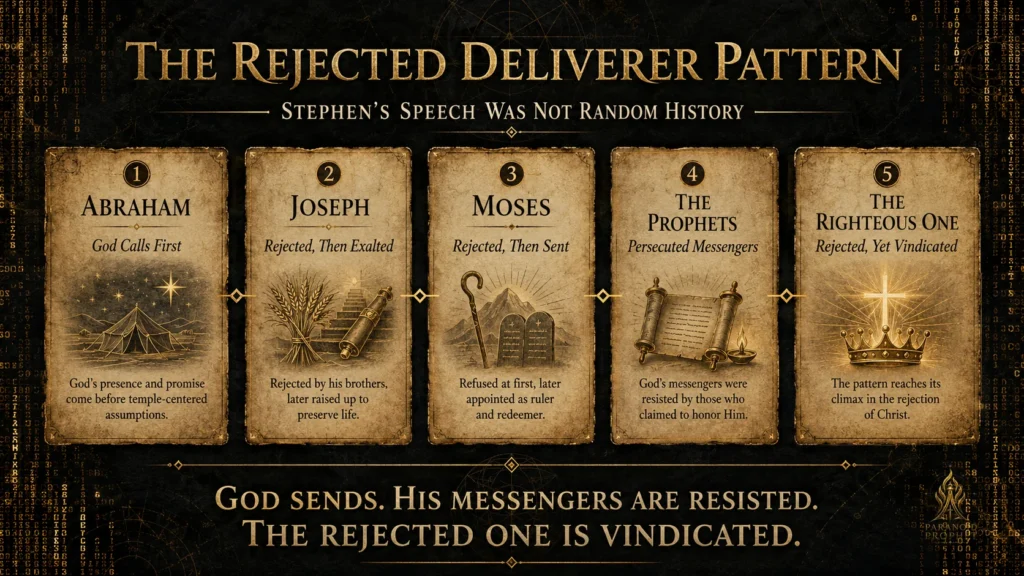
Stephen’s speech can feel strange on a first reading because it is long, dense, and filled with Old Testament history. But it is not random. Stephen is building an argument. He is showing a pattern in Israel’s story: God calls, God sends, God’s messengers are resisted, and the rejected servant is later vindicated by God.
That pattern prepares the reader for Jesus. Stephen is not merely giving a history lesson before he dies. He is telling Israel’s story in a way that exposes the rejection of the Righteous One.
Stephen Retells Israel’s Story
Acts 7:1–53 begins with Abraham. Stephen says the God of glory appeared to Abraham in Mesopotamia before he lived in Haran. That opening already matters. Stephen starts before the land, before the temple, before Jerusalem, and before Israel has a settled national life.
The God of glory appeared before there was a sanctuary in Jerusalem. That does not make the later sanctuary worthless. It makes God bigger than the sanctuary. Stephen’s point begins here: God’s presence and promise were never trapped inside one sacred location.
Stephen then moves through the patriarchs, the promise to Abraham, Israel’s future oppression, and God’s faithfulness. His speech is not an escape from the accusation. It is his answer to it. He is showing that faith in Jesus is not a rejection of Israel’s God. It is obedience to the God who has always called, sent, judged, rescued, and fulfilled His word.
That makes Stephen’s speech deeply biblical. His defense does not begin with personal feelings. It begins with Scripture, memory, covenant, and the God of glory.
Joseph and Moses: The Rejected Deliverer Pattern
Stephen gives special attention to Joseph and Moses because both reveal a pattern. Joseph was rejected by his brothers, sold into Egypt, and later exalted by God to preserve life. The one rejected by his own family became the means of rescue.
Moses follows a similar pattern. When Moses first tried to intervene between Israelites, he was rejected. One man asked who made him ruler and judge. Yet God later sent Moses as ruler and redeemer. The rejected deliverer became the chosen instrument of rescue.
Stephen’s history has a sharp point: the one God sends is often the one God’s people reject first. Joseph was rejected. Moses was rejected. The prophets were persecuted. Now the Righteous One has been betrayed and murdered.
This is where Stephen’s speech becomes sharper than a defense. He is not merely saying, “I respect Moses.” He is saying, “You are repeating the old pattern.” The council stands in the same stream as those who resisted Moses, persecuted the prophets, and failed to recognize the deliverer God sent.
Stephen is placing Jesus inside Israel’s long pattern of rejected and vindicated deliverers. That does not make Jesus merely another Joseph or Moses. It shows that Israel’s story was always moving toward the Righteous One, the true Deliverer, the One rejected by men and vindicated by God.
The Temple Cannot Contain God
After tracing Abraham, Joseph, Moses, and the wilderness generation, Stephen turns toward the tabernacle and the temple. He acknowledges the tabernacle of witness in the wilderness and the later temple associated with Solomon. He is not pretending Israel’s sanctuary history does not matter.
But then Stephen makes the decisive point: the Most High does not dwell in houses made by hands. He quotes the prophets to remind the council that heaven is God’s throne and the earth is His footstool. No temple, however holy, can contain the living God.
The temple was real, but it was not ultimate. The sanctuary was a witness, not a prison. It pointed to God’s presence, but it could not control Him. If the leaders honored the temple while resisting God’s Messiah, they had misunderstood the very holy place they claimed to defend.
This is where Stephen’s answer cuts directly into the accusation. He is not guilty of despising God’s presence. He is accusing the leaders of treating God’s presence like something they can manage while rejecting the One God has exalted.
That is why the temple issue matters for the case for Christ. Stephen’s witness is not anti-Scripture. It is not anti-Moses. It is not a shallow attack on Israel’s worship. It is a claim that the God of Abraham, Joseph, Moses, the prophets, and the temple has now vindicated Jesus.
Stephen’s Charge: You Resisted the Holy Spirit
Stephen’s speech ends with confrontation. In Acts 7:51–53, he calls the council stiff-necked and uncircumcised in heart and ears. He says they always resist the Holy Spirit, just as their fathers did. He asks which of the prophets their fathers did not persecute. Then he brings the charge to its climax: they betrayed and murdered the Righteous One.
At that moment, the speech becomes impossible to dismiss as a harmless history recap. Stephen has turned Israel’s story into an indictment. The high priest asked whether the charges against him were true. Stephen answers by exposing a deeper charge against them.
They have the law, but they have not kept it. They honor the prophets, but they stand in the tradition of persecuting them. They guard the temple, but they resist the God whose glory the temple could never contain. They claim to defend Moses, but they repeat the pattern of rejecting the deliverer God sends.
Stephen’s speech is long, but its point is sharp: the council is repeating the old pattern of resisting God’s messengers, and that pattern has reached its climax in their rejection of Jesus.
That charge detonated the room. The council did not hear Stephen as a harmless historian. They heard him as a witness accusing them of resisting God and rejecting the Righteous One. Then Stephen looked up, and the argument moved from earth to heaven.
Stephen’s Vision of Jesus
Stephen’s speech ended with accusation. His vision began with vindication.
The council had heard enough. Stephen had charged them with resisting the Holy Spirit, persecuting the prophets, and betraying and murdering the Righteous One. Acts says they were enraged and ground their teeth at him. But Stephen’s eyes were not fixed on their fury. Full of the Holy Spirit, he looked into heaven.
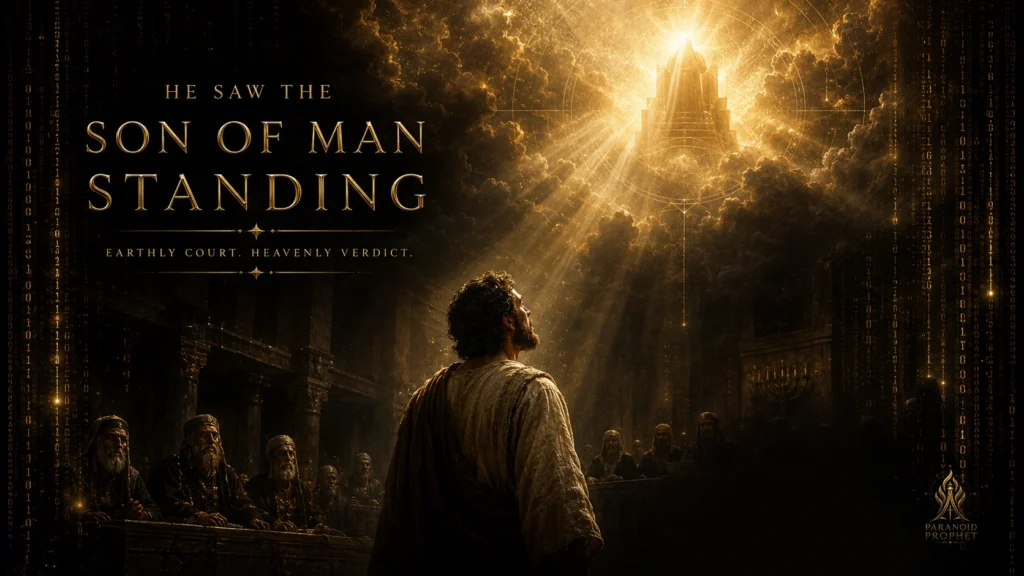
Acts 7:54–60 says Stephen saw the glory of God and Jesus standing at the right hand of God. Then Stephen declared that he saw the heavens opened and the Son of Man standing at the right hand of God.
This is the center of the martyrdom account. The council sees a condemned man. Stephen sees the enthroned Christ.
Stephen does not die clinging to a memory, a metaphor, or religious courage. In the hour of death, Acts shows Jesus alive, exalted, and vindicated in heaven. The rejected Jesus is not absent. He is not defeated. He is not merely remembered by grieving disciples. He stands at the right hand of God.
Jesus Standing at the Right Hand of God
The right hand of God is the place of honor, authority, and divine vindication. Stephen’s vision shows Jesus in the place of heavenly rule. The men judging Stephen had rejected his witness to Jesus. Heaven answers by revealing Jesus as exalted.
The New Testament often draws on right-hand enthronement language rooted in Psalm 110:1, where the Lord’s chosen one is invited to sit at God’s right hand. Stephen’s vision belongs in that world of royal vindication, heavenly authority, and divine rule.
Scripture does not pause to explain everything about why Jesus is standing rather than seated. Many Christian readers have seen in that detail the Lord rising to receive His witness. That is a beautiful reading, but the article should not make more of the detail than the text demands. At minimum, Acts wants us to see that Jesus is alive, exalted, present, and vindicated with Stephen in the hour of death.
Stephen’s vision also reverses the court scene. On earth, Stephen stands before the council. In heaven, Jesus stands at the right hand of God. The earthly court condemns Stephen, but heaven reveals the glory of the Christ Stephen confessed.
Stephen is not simply comforted before death. He is shown the reality behind his witness. The Jesus rejected by men is honored by God. The Righteous One accused and crucified on earth stands vindicated in heaven.
Why the Son of Man Language Matters
Stephen does not only say he sees Jesus. He says he sees the Son of Man standing at the right hand of God. That language is loaded with biblical meaning.
In Daniel 7:13–14, one like a son of man comes with the clouds of heaven and receives dominion, glory, and a kingdom. His dominion is everlasting, and his kingdom will not be destroyed. This is not disposable religious imagery. It is royal, heavenly, and kingdom-centered language.
The connection becomes even sharper when we remember Jesus’ own words before the council. In Mark 14:61–64, the high priest asks Jesus if He is the Christ, the Son of the Blessed. Jesus answers by speaking of the Son of Man seated at the right hand of Power and coming with the clouds of heaven. That answer leads to the charge of blasphemy.
Now in Acts 7, Stephen sees the reality Jesus confessed. The Son of Man is at the right hand of God. The One condemned by the council has been vindicated by heaven.
Stephen dies confessing not merely that Jesus was innocent, but that Jesus is the exalted Son of Man.
This makes Stephen’s martyrdom far more than a moral example. He is not dying for vague spirituality. He is not dying only because he was a kind man who served widows. He is dying as a witness to the living Christ, the Son of Man who stands in the place of divine honor and authority.
What Stephen’s Vision Reveals About Early Christology
Stephen’s vision belongs in the Jesus evidence cluster because it shows how high the early church’s view of Jesus already was in Acts. Jesus is not treated as a mere teacher whose influence survived. He is seen in heavenly glory, at the right hand of God, bearing the Son of Man identity from Daniel’s vision.
The scene also shows direct devotion to Jesus. As Stephen is being stoned, he calls upon the Lord Jesus and asks Him to receive his spirit. Stephen’s final words are not addressed to an idea, a memory, or a symbol. He calls on the Lord Jesus.
For Christian theology, this fits naturally with the New Testament’s larger witness to Jesus’ exalted divine identity. Historically, it shows that early devotion to Jesus was not low, distant, or merely symbolic. At the point of death, Stephen entrusts himself to Jesus.
This does not mean Stephen’s vision should be isolated from the rest of the case for Christ and made to carry more weight than Acts gives it. Acts is giving a theological narrative of witness, rejection, vision, and martyrdom. But within that narrative, the Christology is strikingly high: Jesus is the exalted Son of Man, standing at the right hand of God, receiving the prayer of His dying witness.
The Stoning of Stephen
After Stephen declares what he sees, the council erupts. Acts says they cried out with a loud voice, stopped their ears, rushed together at him, cast him out of the city, and stoned him. The scene is violent, but Luke does not linger over gore. He lingers over witness.
That should shape the way this article handles Stephen’s death. His martyrdom is not shock content. The power of the passage is not in graphic detail. The power is in what Stephen confesses, whom he sees, and how he dies.
Cast Out of the City and Stoned
Stephen is cast out of the city before he is stoned. That detail fits the seriousness of the accusation. He had been accused of blasphemy against Moses, God, the law, and the holy place. His opponents treat him as someone who must be removed.
Yet Acts frames the scene differently from Stephen’s opponents. They cast him out as guilty. Heaven has just revealed the Christ he confessed as exalted. They see Stephen as condemned. Stephen sees Jesus as enthroned.
The stoning is real, but it is not the deepest reality in the scene. The deepest reality is Christ. Stephen’s body is under attack, but his witness has moved from the council chamber into the open heavens. The earthly crowd is raging, but Jesus stands at the right hand of God.
Acts does not present Stephen as a man overcome by despair. It presents him as a witness whose final vision is filled with the glory of God and the living Christ.
Stephen’s Final Prayer
Stephen’s final prayer is one of the most powerful moments in Acts. In Acts 7:59–60, as the stones fall, he calls on the Lord Jesus and says, “Lord Jesus, receive my spirit.” Then he kneels and cries with a loud voice, “Lord, do not hold this sin against them.” After this, Acts says he fell asleep.
The language echoes Jesus’ own death. Jesus entrusted Himself to the Father. Stephen entrusts himself to Jesus. Jesus prayed for His killers. Stephen asks that this sin not be held against his killers.
This is not imitation in a shallow sense. Stephen is not performing religious theater. He is being conformed to the pattern of his Lord. The witness of Jesus has shaped the death of Jesus’ servant.
Stephen dies with Jesus on his lips and forgiveness in his heart.
The stones do not get the final word in Stephen’s death. Jesus does.
That is why Stephen’s martyrdom has carried such weight in Christian memory. He does not die cursing. He does not die grasping for revenge. He dies entrusting himself to the Lord Jesus and asking mercy for those killing him.
Stephen’s final prayer turns martyrdom into worship.
Saul at the Feet of the Witnesses
Acts adds a detail that will become enormous: the witnesses laid their garments at the feet of a young man named Saul. Then Acts 8:1–4 says Saul approved of Stephen’s execution and that a great persecution broke out against the church in Jerusalem.
Acts does not say Stephen’s death immediately converted Saul. It says the opposite: Saul approved. He stood at the edge of Stephen’s death as an enemy of the church. That makes the later reversal even more striking.
Later, when Paul tells his own story, he remembers the scene. In Acts 22:20, Paul recalls standing by, approving, and watching over the garments of those who killed Stephen. Stephen’s blood remained part of Paul’s remembered past.
This detail connects Stephen’s martyrdom to the wider mission of Acts. The man who stood near Stephen’s death would later preach the Christ Stephen saw. The persecutor would become an apostle. The witness Stephen gave under stones would be echoed by Paul before synagogues, rulers, Gentiles, and kings.
Stephen’s death is not only a tragedy. In Acts, it becomes a hinge. Saul approves. Persecution scatters the church. The word spreads. And the risen Christ continues to turn enemies into witnesses.
Why Stephen’s Martyrdom Matters for the Case for Christ
Stephen’s martyrdom matters because it stands near the beginning of the church’s public witness. Acts does not present early Christianity as safe private spirituality. It presents proclamation, opposition, martyrdom, persecution, scattering, and continued preaching.
Stephen’s death does not prove Christianity by itself. It does show what the early church was already confessing about Jesus at real cost: He is alive, exalted, worthy of prayer, and standing at the right hand of God.
The better question is not, “Can Stephen alone prove the resurrection?” The better question is, “What does Stephen reveal about the earliest public Christian witness?” The answer is powerful: from the beginning, the church’s confession of Jesus was not vague, safe, or merely moral. It was centered on the risen and exalted Christ.
It Shows Early Christian Witness Under Threat
Stephen’s death shows that the church’s public confession of Jesus was costly before Christianity had power, prestige, or cultural safety. This is not a story from a later church writing from a position of dominance. In Acts, this is the Jerusalem church under pressure, before the movement had political strength or social protection.
Stephen is not executed for vague kindness. He is killed after bearing witness before the council. His speech accuses the leaders of resisting the Holy Spirit and rejecting the Righteous One. His vision declares Jesus as the Son of Man standing at the right hand of God. His death shows that the early Christian message was already explosive because it claimed God had vindicated the crucified Jesus.
That matters for the case for Christ. Stephen’s martyrdom shows that the first Christian witnesses were not merely repeating ethical slogans. They were confessing a living Lord whose exaltation challenged earthly power. The message was not reduced to “be kind” or “remember Jesus fondly.” It proclaimed Jesus as the righteous, rejected, vindicated Son of Man.
Costly confession does not automatically prove the message true. But it does reveal the content and seriousness of the witness. Stephen was not dying for a vague tradition centuries removed from the events. In Acts, he dies at the front edge of the church’s public proclamation.
It Shows Early Devotion to Jesus
Stephen’s martyrdom also matters because of the way he relates to Jesus in his final moments. He sees Jesus at the right hand of God. He identifies Him as the Son of Man. Then, as he is being stoned, Stephen calls on the Lord Jesus and asks Him to receive his spirit.
Stephen does not die merely admiring Jesus. He dies calling upon Him.
That is a serious detail. Acts does not portray Jesus as a dead teacher whose influence remains useful. Jesus is alive, heavenly, exalted, and personally addressed by His dying witness. Stephen entrusts himself to Jesus at the moment when every shallow comfort has collapsed.
For Christian theology, this fits the New Testament’s larger witness to Jesus’ divine identity and authority. For historical and apologetic purposes, it shows that early devotion to Jesus was not low, symbolic, or distant. In this account, Jesus is not merely remembered. He is seen, confessed, and called upon.
This is why Stephen belongs in the Jesus evidence cluster. His martyrdom shows early Christian witness centered not merely on Jesus’ teachings, but on Jesus’ exalted identity. Stephen’s final hope is not an idea about Jesus. Stephen’s final hope is Jesus Himself.
It Connects Persecution to Mission
Stephen’s death is also a turning point in Acts. After his execution, Acts 8:1–4 says a great persecution arose against the church in Jerusalem. The believers were scattered throughout Judea and Samaria, and those who were scattered went about preaching the word.
The stones thrown at Stephen did not bury the witness. They scattered it.
This is one of the great reversals in Acts. The enemies of the church intend to crush the proclamation. Instead, the pressure pushes the message outward. Jerusalem is no longer the only center of public witness. The word moves into Judea and Samaria, echoing Acts 1:8, where Jesus says His witnesses will go from Jerusalem to Judea and Samaria and to the end of the earth.
That does not mean persecution is good in itself. It is evil to murder the righteous. It is evil to rage against the truth. But Acts shows Christ ruling even over the opposition of His enemies. The suffering of the church does not overthrow the mission of Christ. In Acts, persecution does not silence the word. It moves the word.
Stephen’s martyrdom therefore functions as more than a death scene. It becomes a mission hinge. One witness falls, but the witness spreads. The church is wounded, but the gospel moves. Saul approves, but Christ is not finished with Saul.
It Foreshadows Saul’s Conversion and Paul’s Mission
Saul’s presence at Stephen’s death is one of the most important details in the story. Acts first introduces Saul at the edge of the stoning, with the witnesses laying their garments at his feet. Then Acts says Saul approved of the execution.
Stephen’s death did not immediately convert Saul. Acts says Saul approved. That makes the later reversal even more striking.
Later, in Acts 22:20, Paul remembers Stephen’s blood. He says he was standing by, approving, and watching over the garments of those who killed him. Stephen’s martyrdom remained part of Paul’s remembered past.
This does not mean Stephen’s death caused Paul’s conversion in a simple one-step way. The risen Christ confronts Saul on the road to Damascus. But Stephen’s death becomes part of the dark backdrop against which Paul’s conversion shines. The persecutor who approved the death of Christ’s witness would become a witness to Christ before Jews, Gentiles, rulers, and kings.
Paul’s later witness becomes even more striking because he once tried to destroy the church. Saul was not looking for a religious movement to join. He was trying to crush it. In Acts, the man who stood near Stephen’s death later preaches the Christ Stephen saw.
Stephen’s blood does not save Paul. Christ does. But the story of Stephen makes Paul’s later transformation more severe, more public, and more difficult to reduce to religious convenience.
Objections and Cautions
Stephen’s martyrdom is powerful, but a serious Christian case should not treat every claim as equally certain. Acts gives the primary account. Later Christian memory receives Stephen as the first martyr. Scholarship helps us read the temple and law accusations carefully. But Stephen’s death does not have the same external-source profile as the death of James the brother of Jesus.
That does not weaken the article. It makes the article honest. Stephen’s story is strongest when we let Acts be Acts: a biblical-theological account of early Christian witness, opposition, vision, martyrdom, persecution, and mission.
Does Stephen’s Martyrdom Prove the Resurrection?
No. Stephen’s death does not prove the resurrection by itself. Martyrdom can show sincerity, conviction, and cost. It cannot automatically prove truth. People can die sincerely for false beliefs.
That is why weak apologetics should be avoided. The argument is not, “Stephen died, therefore Christianity is proven.” The better argument is more careful: Stephen reveals what the early church was publicly confessing when confession could cost them everything.
Stephen dies as a witness to Jesus, the exalted Son of Man at the right hand of God. He calls on the Lord Jesus as he dies. He asks forgiveness for those killing him. His death is followed by persecution, scattering, and continued preaching. That does not settle every historical debate, but it does show that the early Christian proclamation was not vague admiration for a dead teacher. It was witness to the risen and exalted Christ.
Stephen does not prove the whole Christian case by dying. He reveals what the early church was willing to confess when faithfulness could cost them everything.
Do We Have Non-Christian Sources for Stephen’s Death?
No, not in the same way we do for James, the brother of Jesus. James’ death is reported by Josephus outside the New Testament. Stephen’s martyrdom is primarily narrated in Acts 6–8.
Later Christian writers such as Eusebius receive Stephen as the first martyr after the Lord, but Eusebius is not giving us a Josephus-style independent first-century report. He helps show how Christian memory received Stephen’s death, but Acts remains the primary source.
That distinction matters. Stephen’s martyrdom is biblically narrated, not externally corroborated in the same way as James the brother of Jesus. The article should not hide that. It should state it clearly and then use Stephen’s story in the lane where it is strongest.
Stephen belongs in the Jesus evidence cluster not because Josephus mentions him, but because Acts places him at the beginning of public Christian witness to the exalted Christ under threat.
Was Stephen One of the Twelve Apostles?
No. Stephen was not one of the Twelve apostles. He was one of the seven chosen to serve in Acts 6:1–7.
This does not make his witness minor. It shows how quickly the confession of Jesus moved beyond the Twelve into the wider life of the church. Stephen was a Spirit-filled servant whose public witness became costly. He belongs in the martyrdom cluster, but not in the “deaths of the Twelve apostles” lane.
That category discipline is important. The article should not blur apostles, disciples, church servants, and early witnesses into one vague group. Stephen’s importance does not depend on making him an apostle. His importance is that he stands at the front edge of the church’s public suffering witness.
Was Stephen Anti-Temple?
Not simply. Acts says false witnesses accused Stephen of speaking against the holy place and the law. Stephen’s speech does challenge misplaced confidence in the temple, but he argues from Israel’s own Scriptures. He does not deny that God worked through Israel’s sanctuary history. He shows that the Most High is not contained by houses made with hands.
Stephen’s issue is not that the temple existed. His issue is that holy things can be used to resist the Holy One.
That is why Stephen retells Israel’s story from Abraham to Joseph, Moses, the tabernacle, the temple, and the prophets. God was active before the temple. God appeared outside the land. God sent deliverers who were rejected. God’s presence was never trapped inside a building. The temple could witness to God’s glory, but it could never control Him.
So Stephen should not be treated as a man who merely hated sacred space. His speech is deeper than that. He is exposing the danger of honoring holy symbols while resisting the God those symbols were meant to serve. The leaders claimed to defend Moses, the law, and the temple. Stephen charged them with resisting the Holy Spirit and rejecting the Righteous One.
Is Acts Writing Theology or History?
Acts is theological narrative. It is not written like a modern courtroom transcript or a neutral newspaper report. Luke tells the story with meaning, structure, and theological purpose.
But theological writing is not automatically fictional. Scripture often tells real events with theological interpretation because God’s acts in history are not spiritually neutral. Acts gives the church’s account of Stephen’s witness and death, ties that death to Saul’s persecution, and shows how persecution scattered the church into wider mission.
A careful article should avoid two opposite errors. It should not pretend Acts is a detached modern source with no theological shaping. It also should not dismiss Acts as “just theology” as if meaning cancels history. Acts is theological history. It tells the story with meaning, but the meaning does not replace the event.
Modern readers may debate exactly how Luke shaped Stephen’s speech, but the article does not need to solve every question about ancient historiography to see what Acts is claiming. Stephen speaks, the council rages, heaven opens, Jesus is seen exalted, Stephen is killed, Saul approves, persecution scatters the believers, and the word continues to spread.
Conclusion: Stephen Saw the Son of Man Standing
Stephen entered Acts through service. He was chosen as one of the seven because he had a good reputation and was full of the Spirit and wisdom. He served the church’s practical needs, but his faithfulness did not stay hidden. He became a public witness to Christ.
His opponents could not withstand the wisdom and the Spirit with which he spoke. False witnesses accused him of speaking against the holy place and the law. Before the council, Stephen retold Israel’s story as a pattern of God’s messengers being resisted and rejected. Then he brought the charge to its climax: they had betrayed and murdered the Righteous One.
Then heaven opened.
Stephen saw the glory of God and Jesus standing at the right hand of God. He saw the Son of Man standing. He saw the truth his killers refused to see: the rejected Jesus had been vindicated by God.
Stephen was cast out of the city and stoned. But Acts does not let the stones own the story. Stephen called on the Lord Jesus. He asked Jesus to receive his spirit. He prayed for mercy on those killing him. Saul stood nearby, approving. Persecution scattered the church. The word spread.
Stephen’s death does not prove the resurrection by itself. But it does show the early church’s public witness in the face of violence. It shows early devotion to Jesus. It shows the confession of the exalted Son of Man. It shows a church wounded but not silenced.
Stephen did not die for a vague spiritual memory. He died confessing the risen and exalted Jesus.
Stephen’s death matters because the Christ he saw is alive.
Seal the Witness File: Stephen Knowledge Check
Frequently Asked Questions About Stephen’s Martyrdom
How did Stephen die?
Stephen died by stoning after testifying before the council in Jerusalem. According to Acts 7:54–60, he saw Jesus standing at the right hand of God, was cast out of the city, and prayed to the Lord Jesus as he died.
Why was Stephen stoned?
Stephen was stoned after being accused of speaking against the holy place and the law. His speech before the council charged the leaders with resisting the Holy Spirit, persecuting the prophets, and betraying and murdering the Righteous One.
What did Stephen see before he died?
Stephen saw the glory of God and Jesus standing at the right hand of God. He described Jesus as the Son of Man standing at God’s right hand, language that connects Stephen’s final vision to Daniel 7 and Jesus’ own confession before the council.
Was Stephen the first Christian martyr?
Acts presents Stephen as the first named Christian martyr after the resurrection and ascension. Later Christian writers such as Eusebius receive Stephen as the first after the Lord to be stoned for Christ.
Was Stephen one of the apostles?
No. Stephen was not one of the Twelve apostles. He was one of the seven chosen to serve in Acts 6, a Spirit-filled servant whose witness became public and costly.
Who was Saul at Stephen’s death?
Saul was present at Stephen’s stoning. Acts says the witnesses laid their garments at Saul’s feet, and Acts 8 says Saul approved of Stephen’s execution. Later, in Acts 22:20, Paul remembered standing by, approving, and guarding the garments of those who killed Stephen.
Does Stephen’s death prove Christianity is true?
Not by itself. Martyrdom can show sincerity, conviction, and cost, but it does not automatically prove truth. Stephen’s death strengthens the cumulative case by showing early public witness to the risen and exalted Jesus under threat.
Read Next
- How Did James the Brother of Jesus Die?
- The Martyrdom of Jesus’ Disciples: What History Actually Says
- Peter’s Martyrdom: Evidence, Tradition, and the Cost of Witness
- How Did Paul Die?
Sources and Further Reading
This article uses Scripture as the foundation, with later church history, reference sources, and scholarship used only as supporting context. Acts 6–8 remains the primary source for Stephen’s witness and death.
Biblical Passages
- Acts 6:1–7 — Stephen among the seven chosen to serve.
- Acts 6:8–15 — Stephen’s witness, opposition, accusations, and face like an angel.
- Acts 7:1–53 — Stephen’s speech before the council.
- Acts 7:51–53 — Stephen’s charge that the council resisted the Holy Spirit and rejected the Righteous One.
- Acts 7:54–60 — Stephen’s vision, stoning, and final prayer.
- Acts 8:1–4 — Saul approves, persecution scatters the church, and the word spreads.
- Acts 22:20 — Paul remembers Stephen’s blood and his own approval.
- Acts 1:8 — Jesus’ witness pattern from Jerusalem to Judea, Samaria, and the ends of the earth.
- Psalm 110:1 — Right-hand enthronement background.
- Daniel 7:13–14 — Son of Man background.
- Mark 14:61–64 — Jesus’ Son of Man and right-hand confession before the council.
Ancient and Early Church Sources
- Eusebius, Church History, Book II — Later Christian reception of Stephen as the first after the Lord to be stoned for Christ.
Reference and Scholarship
- Britannica, “St. Stephen” — Reference summary of Stephen as the first Christian martyr.
- James P. Sweeney, “Stephen’s Speech (Acts 7:2–53): Is it as ‘Anti-temple’ As Is Frequently Alleged?” — Useful discussion of whether Stephen’s speech should be read as simply anti-temple.
- Nicholas J. Moore, “Supersessionism and the Cult Attitude of Stephen and Hebrews” — Scholarly context for Stephen’s temple argument and heavenly-presence theology.
- W. Gordon Shin, “Integrated Stories and Israel’s Contested Worship Space,” New Testament Studies — Scholarly context for Stephen’s retelling of Israel’s story and contested worship space.
CONTINUE THE INVESTIGATION
Recommended continuation
Did First Christians Suffer for the Resurrection?
Move from the scriptural account of Stephen’s death to the broader historical question of costly public Christian witness.