
Two churches can both say they believe in Jesus while meaning very different things by His name. One teaches that He is the eternal Son who became human. Another calls Him the greatest being God ever created. Before deciding whether those statements agree, we need to ask what the words mean. Christian creeds help make those meanings clear.
A Christian creed is a concise statement of the faith the church confesses, especially concerning God, Jesus Christ, salvation, and Christian hope. The Apostles’ Creed and Nicene Creed have helped generations of Christians learn, proclaim, and preserve that faith. Their value lies in directing attention to the God revealed in Scripture, explaining what Christians believe, and identifying teachings that change the gospel’s central claims.
GUIDED ARTICLE EXPERIENCE
What Are Christian Creeds, and Why Do They Matter?
Read along as the narration moves through the article.
Browser narration · No stored audio or site tracking
CONTINUE GUIDED TOUR
Continue where you left off.
GUIDED TOUR COMPLETE
You have reached the end of this study.
Study record saved on this device.
GUIDED TOUR
What Are Christian Creeds, and Why Do They Matter?
Narrator: Paranoid Prophet Recommended Voice Native device narration
Prepare to follow the article as it is narrated.
VOICE & TOUR OPTIONS
Voice & Listening
NARRATOR
Finding a narrator…
Checking the best narrator available on this device.
Restores the site recommendations available in this browser.
Our listening picks lead when available; other voices are ranked for narration. Known novelty voices are hidden. Browser-provided voices may use an online voice service.
Screen-awake support will be checked when narration starts.
Optional: improve your device voices
Listening works with the voices already available here. Your device may offer additional free voices through its own settings.
iPhone or iPad: Settings → Accessibility → Read & Speak (or Spoken Content) → Voices → English. Look for Premium or Enhanced choices, then return here.
If offered, preview Ava or Zoe for U.S. English, or Serena or Jamie for British English. An explicit Premium or Enhanced version can improve on its compact version.
Mac: System Settings → Accessibility → Read & Speak → System voice. Open the voice list to preview or download additional choices.
Windows: Settings → Accessibility → Narrator → Add natural voices. Browser availability varies; a Narrator voice may not appear on websites. Edge may also expose online Natural voices without a model download.
Android: Open Accessibility → Text-to-speech output (the location varies by device). In the preferred engine settings, look for voice data and English choices.
Download sizes vary; some enhanced voices exceed 100 MB. This website cannot install system voices, and an installed voice appears here only if your browser exposes it.
Apple voice guide · Windows voice guide · Android voice guide
CHOOSE A NARRATOR
Recommended on this device
Our listening picks: Aaron, Martha, then Daniel, when available here. Otherwise, automatic uses the highest-ranked suitable voice. Preview alternatives or save your own choice.
Preparing the guided article experience…
RESUME GUIDED TOUR?
Continue where you left off.
GUIDED TOUR COMPLETE
You have reached the end of this study.
Article Guide10 sections
What a Christian Creed Is For
The word creed comes from the Latin credo, “I believe.” A creed gives public words to a shared confession. It can help a person preparing for baptism understand the faith, help a congregation worship together, and give teachers a clear account of what they are responsible to teach.
Creeds usually concentrate on a small number of foundational beliefs. A confession of faith often develops doctrine more extensively, while a catechism teaches through questions and answers. These categories overlap, but they explain why a brief ancient creed and a lengthy denominational confession serve different purposes.
A creed also makes a church’s interpretation open to examination. Saying that a church follows the Bible leaves an important question unanswered: how does it understand what the Bible says? A written summary gives people something definite to read, question, and compare with Scripture.
That clarity has limits. A creed cannot provide the context of every biblical passage or explain every disagreement among Christians. Nor can saying the correct words establish that someone trusts Christ or treats others faithfully. Confession should lead into discipleship, worship, and love.
The New Testament Already Contains Confessions of Faith
The church confessed its faith long before the fourth-century councils. In Romans 10:9, Paul joins the confession “Jesus is Lord” to heartfelt belief that God raised Him from the dead. The surrounding argument concerns faith, righteousness, and salvation, rather than the ability to repeat a password.
In 1 Corinthians 15:1–8, Paul reminds the Corinthians of the gospel he preached and the message he received and passed on. Christ died for sins, was buried, was raised, and appeared to witnesses. The chapter then explains why resurrection matters for Christian faith and future hope. Its concentrated opening shows that summarizing the gospel belongs within apostolic teaching itself.
Philippians 2:5–11 presents Christ’s humiliation, obedient death, and exaltation in elevated language. Paul uses this account to shape the congregation’s humility toward one another. Doctrine here has a practical purpose.
Scholars often identify received formulas or hymnic material in these passages, but reconstructed origins need care. Paul explicitly speaks of receiving and transmitting tradition in 1 Corinthians 15. Whether Philippians 2 incorporates an earlier hymn, and how such a hymn might have been arranged, remain debated. Research on the passage’s form and authorship illustrates that discussion. These biblical texts support the practice of confession without being identical to the later creeds.
The Apostles’ Creed Summarizes the Christian Story
The Apostles’ Creed follows a threefold pattern: belief in God the Father, in Jesus Christ His Son, and in the Holy Spirit. It moves through creation, Christ’s birth, suffering, death, resurrection, ascension, and return, then confesses the church, forgiveness, bodily resurrection, and everlasting life. You can read a complete contemporary translation in the Church of England’s text of the Apostles’ Creed.
Its name does not mean that the twelve apostles sat together and each composed one sentence. That familiar story is a later legend, not an established account of its composition. The creed developed gradually within Western Christianity from earlier baptismal professions, including the Old Roman Symbol. Its received wording should not be assigned a single apostolic drafting session. Even the older Catholic Encyclopedia account rejects the literal authorship legend.
The creed is called apostolic because it claims to express the apostles’ faith. Its shape keeps salvation attached to Jesus’ real life and work. Mentioning Pontius Pilate places the crucifixion within public history. Confessing bodily resurrection gives Christian hope a concrete future.
The Apostles’ Creed is especially prominent in Western churches. Its broad influence should not be confused with identical liturgical use throughout Eastern Christianity.
Nicaea and Constantinople Clarified Who Christ Is
The Council of Nicaea in AD 325 addressed a controversy over the Son’s relationship to the Father. Its creed identifies the Son as “begotten, not made” and of the same divine substance as the Father. These expressions exclude the claim that the Son belongs among the things God created. The 325 text explicitly rejects the claim that there was a time when the Son did not exist.
The creed commonly recited as the Nicene Creed today is the longer Niceno-Constantinopolitan Creed, associated with Constantinople in AD 381 and received at Chalcedon in 451. It includes a fuller confession of the Holy Spirit, the church, baptism, and resurrection. The 381 form calls the Spirit the Lord and giver of life and confesses His worship with the Father and Son. The two texts are related but should not be treated as identical; D. H. Williams’s historical comparison explains the distinction.
Nicaea did not create the New Testament’s worship of Jesus. Its participants argued over how to understand inherited biblical claims about Him. John 1:1–3 and Colossians 1:15–17, for example, place the Son on the Creator’s side of the distinction between God and creation. The council’s terminology sought to make that confession explicit when familiar biblical words were being interpreted differently.
This is a Trinitarian claim: one God, with the Father, Son, and Holy Spirit personally distinct. For the underlying biblical teaching, see What Is the Trinity?.
Chalcedon Addressed Christ’s Two Natures
Another question required careful language: how can Jesus be truly divine and truly human? The Council of Chalcedon in AD 451 issued a definition confessing one and the same Christ in two natures, preserving His full divinity and humanity without dividing Him into two persons or blending the natures together. Read the Chalcedonian Definition within the council’s acts.
This definition is a distinct document, not another name for the Nicene Creed. The Trinity concerns the Father, Son, and Holy Spirit in the one divine being. Christ’s two natures concern the eternal Son, who became human. Mixing those questions can produce confusion even when someone remembers the right vocabulary.
Chalcedon is received by Catholic, Eastern Orthodox, and many Protestant churches. Oriental Orthodox churches do not receive it as an ecumenical council, yet they also affirm Christ’s full divinity and humanity. The 1973 Catholic–Coptic Orthodox declaration witnesses to that shared confession. Their position should not be reduced to the claim that His humanity disappeared into His divinity.
For a closer biblical explanation of the incarnation, see How Can Jesus Be Fully God and Fully Human?. These distinctions matter because Christian salvation centers on who Jesus actually is.
Some Creedal Words Need Careful Explanation
In the Apostles’ Creed, catholic means universal. Confessing the holy catholic church does not automatically identify the speaker as Roman Catholic. Different traditions disagree about the church’s visible unity and authority, but the word itself reaches beyond a single local congregation. The Westminster Confession, chapter 25, provides a Protestant example of this usage.
The descent clause also requires attention. Some versions say that Christ descended into hell; others say that He descended to the dead. Churches differ over its interpretation. Catholic teaching connects it with Christ’s descent to the realm of the dead, while the Heidelberg Catechism’s answer 44 emphasizes the anguish He endured, especially on the cross. Readers should ask what their church’s wording means rather than assume every tradition gives the same explanation.
The Nicene Creed presents another significant difference. Many Western versions say that the Holy Spirit proceeds from the Father “and the Son,” the Latin Filioque. Those additional words were not in the Greek creed of 381. Eastern Orthodox objections concern both Trinitarian theology and the authority to alter a creed received by the wider church. Western theology intends to preserve the Father’s relationship to the Son and Spirit, not teach two independent divine sources. The Orthodox-Catholic agreed statement on the Filioque explains why neither the disagreement nor the attempts at understanding should be reduced to a slogan.
How Much Authority Should a Creed Have?
Paranoid Prophet’s approach is to receive creeds as valuable witnesses that remain accountable to Scripture, as explained in What We Believe About the Bible. Historic Protestant confessions commonly treat church teaching as a subordinate standard. Westminster Confession 1.10, for example, places councils and human opinions under the judgment of the Holy Spirit speaking in Scripture.
Catholic and Orthodox Christians understand this relationship differently. The Catholic Catechism, paragraphs 96–100, describes Scripture and Sacred Tradition as one deposit of faith, authentically interpreted by the church’s teaching office. Orthodox teaching on Holy Tradition places Scripture within the church’s received life of faith, alongside the creed and ecumenical councils. Neither position is fairly represented by saying these Christians simply disregard the Bible.
Some communities decline binding creeds because they want to protect the authority of Scripture or emphasize obedient discipleship. The Church of the Brethren’s explanation of its beliefs illustrates such concerns. Noncreedal Christians are not necessarily uninformed or indifferent to doctrine. Their beliefs should be understood from what they actually teach.
Still, every church interprets Scripture, and those interpretations deserve examination. Written creeds can make that work more transparent. Respect for history and careful biblical testing can strengthen one another.
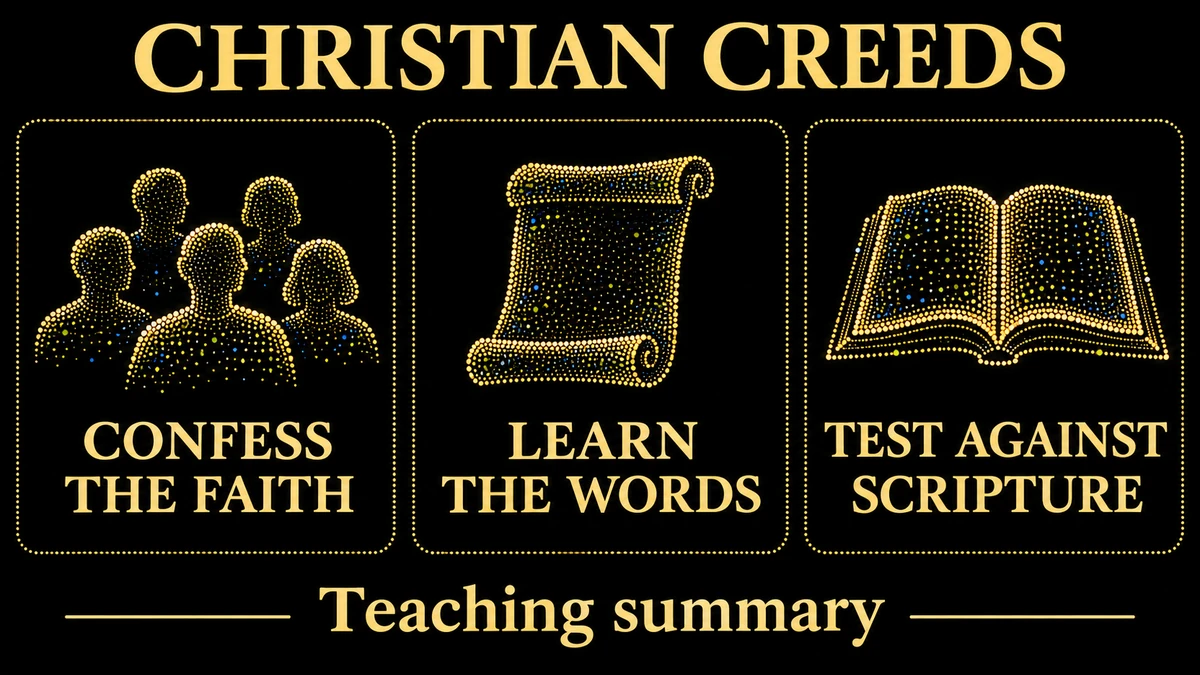
Christian creeds: confess the faith; learn the words; test against Scripture. Teaching summary reflecting this article’s Protestant approach; other traditions’ views are discussed above.
A Practical Case: Testing a Claim About Jesus
Imagine a Christian named Leah hearing a teacher say that Jesus was God’s first creation and then made everything else. The teacher quotes Colossians 1:15, which calls Christ the firstborn over all creation. Leah recognizes Christian vocabulary, but she is unsure whether the claim fits the passage.
Remembering “begotten, not made” gives her a precise question to investigate. She reads Colossians 1:15–20 together and notices that the following verses describe everything as created through Christ and for Him, with Christ existing before everything. She also reads John 1:1–3, where all created things come into being through the Word.
Leah then asks the teacher whether Jesus belongs within creation or is its divine Creator. She discusses the passages with a trusted pastor and checks how the creed summarizes them. She can identify the disagreement without attacking the teacher’s motives or pretending the wording is unimportant.
This is an illustrative scenario, not a reported event. It shows a useful order: identify the claim, read the biblical context, consult the historic confession, and discuss the actual disagreement. A creed can alert us to a serious question while encouraging deeper reading.
Studying with others also matters. As What Is the Church? explains, Christian faith is lived among Christ’s people. A memorized confession becomes more fruitful when joined to patient teaching, shared worship, and accountable relationships.
Common Questions About Christian Creeds
Are Christian creeds part of the Bible?
The Apostles’ and Nicene Creeds are later summaries, not biblical books. The New Testament contains confessions and summaries of faith, but it does not contain these later texts word for word. Their claims must be understood in relation to the Scriptures they seek to summarize.
Did the apostles write the Apostles’ Creed?
There is no sound historical basis for treating the received creed as a document jointly composed by the twelve apostles. Its wording developed through Western baptismal traditions. Its name expresses its claim to preserve apostolic teaching.
Must a Christian recite a creed to be saved?
The New Testament calls people to repent, believe the gospel, and confess Jesus as Lord. It does not prescribe reciting a later creed as a technique that secures salvation. Churches may require a confession of faith for baptism or membership, but verbal accuracy alone cannot replace faith in Christ.
Do the ancient creeds settle every Christian disagreement?
No. They establish central claims about God, Christ, and Christian hope while leaving many questions less fully developed. Christians who share them may still disagree about church government, the sacraments, and other doctrines. Shared confession is meaningful without making every difference disappear.
Let Confession Deepen Trust in Christ
Begin with one creed and read it slowly beside the Bible. Ask what each statement affirms, which passages support it, and how it should shape prayer, worship, or conduct. Bring unfamiliar words to a thoughtful teacher rather than repeating them without understanding.
The ancient creeds help Christians remember that the faith has been received and handed on. Their proper use draws us toward the Father who creates, the Son who saves, and the Spirit who gives life. We confess these truths so that we may know Christ more faithfully and live as His people.