The week fills itself. Work spills into the evening. A day off becomes the day for every job that would not fit anywhere else. Even worship can end up squeezed between errands. Then someone says Christians must keep the Sabbath, and a question about rest becomes an argument about Saturday, Sunday, and whether you are disobeying God.
Should Christians keep the Sabbath? Christians disagree about whether the Sabbath commandment binds believers to the seventh day, carries forward as a Sunday Christian Sabbath, or finds fulfillment in Christ without requiring a particular weekly day. Those differences deserve careful attention. They should not become an excuse to neglect worship, ignore our limits, or treat other believers with contempt.
GUIDED ARTICLE EXPERIENCE
Should Christians Keep the Sabbath? Rest, Worship, and Why Christians Differ
Read along as the narration moves through the article.
Browser narration · No stored audio or site tracking
CONTINUE GUIDED TOUR
Continue where you left off.
GUIDED TOUR COMPLETE
You have reached the end of this study.
Study record saved on this device.
GUIDED TOUR
Should Christians Keep the Sabbath? Rest, Worship, and Why Christians Differ
Narrator: Paranoid Prophet Recommended Voice Native device narration
Prepare to follow the article as it is narrated.
VOICE & TOUR OPTIONS
Voice & Listening
NARRATOR
Finding a narrator…
Checking the best narrator available on this device.
Restores the site recommendations available in this browser.
Our listening picks lead when available; other voices are ranked for narration. Known novelty voices are hidden. Browser-provided voices may use an online voice service.
Screen-awake support will be checked when narration starts.
Optional: improve your device voices
Listening works with the voices already available here. Your device may offer additional free voices through its own settings.
iPhone or iPad: Settings → Accessibility → Read & Speak (or Spoken Content) → Voices → English. Look for Premium or Enhanced choices, then return here.
If offered, preview Ava or Zoe for U.S. English, or Serena or Jamie for British English. An explicit Premium or Enhanced version can improve on its compact version.
Mac: System Settings → Accessibility → Read & Speak → System voice. Open the voice list to preview or download additional choices.
Windows: Settings → Accessibility → Narrator → Add natural voices. Browser availability varies; a Narrator voice may not appear on websites. Edge may also expose online Natural voices without a model download.
Android: Open Accessibility → Text-to-speech output (the location varies by device). In the preferred engine settings, look for voice data and English choices.
Download sizes vary; some enhanced voices exceed 100 MB. This website cannot install system voices, and an installed voice appears here only if your browser exposes it.
Apple voice guide · Windows voice guide · Android voice guide
CHOOSE A NARRATOR
Recommended on this device
Our listening picks: Aaron, Martha, then Daniel, when available here. Otherwise, automatic uses the highest-ranked suitable voice. Preview alternatives or save your own choice.
Preparing the guided article experience…
RESUME GUIDED TOUR?
Continue where you left off.
GUIDED TOUR COMPLETE
You have reached the end of this study.
Article Guide10 sections
Start with the question you actually need answered
For the biblical foundation, begin with creation and Israel’s deliverance. If someone has told you Sunday worship began with Constantine, read why Christians worship on Sunday. For shift work, caregiving, or a crowded household, go to practical rhythms of worship and rest.
Here is the central distinction: the Sabbath’s place in Israel’s covenant, the church’s gathering for worship, and a humane rhythm of rest are related questions, but they are not identical. Answering one does not automatically settle all three. A Christian can believe Sunday gathering matters without believing every Sabbath regulation has transferred to Sunday. A seventh-day Christian can observe Saturday as an act of faith without claiming that a calendar earns salvation.
We will follow the passages first, explain several established Christian readings, and then consider what faithful practice can look like. For the broader method behind this approach, see how to read the Bible in context.
What the Sabbath meant in Scripture
Creation: work has a stopping point
Genesis 2:1–3 describes God completing his creative work, resting on the seventh day, and blessing and sanctifying it. The scene presents completed work and a day set apart. It does not portray God collapsing from exhaustion.
The passage matters in the later commandment. It also requires precision: Genesis describes God’s seventh-day rest, but this paragraph does not record an explicit Sabbath command addressed to Adam. Christians disagree about whether the creation pattern itself establishes a binding weekly ordinance for everyone. That theological conclusion needs an argument beyond simply noticing that the seventh day appears here. Read Genesis 2.
Deliverance: rest reaches the people with less power
Exodus 20:8–11 commands Israel to remember the Sabbath and keep it holy, grounding the command in creation. The scope reaches beyond the person hearing it. Children, servants, livestock, and the foreigner within the community are included. Read Exodus 20.
Deuteronomy 5:12–15 repeats the command with an emphasis on deliverance from slavery. Israel must remember Egypt. The servant is to rest as the master does. A person could not honor this command merely by taking a comfortable afternoon while requiring everyone beneath him to keep producing. Read Deuteronomy 5.
Exodus 31:12–17 also identifies the Sabbath as a covenant sign between God and Israel. That context matters when Christians ask which aspects of the command apply to the church. The discussion concerns creation, covenant, and fulfillment. It cannot be reduced to whether a day off feels healthy. Read Exodus 31.
These passages also challenge a modern assumption: people do not exist only to generate output. That includes employees, caregivers, and the person cleaning up after everyone else has finished relaxing.
Jesus, the Sabbath, and the work of mercy
In Mark 2:23–28, a dispute arises when Jesus’ disciples pick grain on the Sabbath. Jesus appeals to David’s need and declares that the Sabbath was made for humanity and that the Son of Man is Lord of it. The next scene, in Mark 3:1–6, concerns healing a man with a disabled hand. Jesus confronts a use of Sabbath controversy that has become hostile to doing good. Read Mark 2 and Mark 3.
These scenes establish Jesus’ authority and expose a failure of mercy. They do not support indifference to God’s commands. Nor does every dispute with Jesus describe what all Jewish people believed or how all Jewish communities practiced Sabbath. We should resist turning particular opponents in a Gospel scene into a caricature of an entire people.
Jesus attended synagogue on the Sabbath, as Luke 4:16 records. Christians who observe the seventh day rightly take his example seriously. Christians who reach a different conclusion point to his life within Israel and ask how his death and resurrection shape the obligations of the new-covenant church. The historical fact of his observance and the theological question of its application should both be stated clearly. Read Luke 4.
For a caregiver reading this at the end of a difficult shift, mercy matters. Feeding a dependent person or responding to an emergency does not become a failure of love because the calendar says it is a day of rest.
Why do many Christians worship on Sunday?
The New Testament records believers meeting on the first day of the week to break bread in Acts 20:7. In 1 Corinthians 16:1–2, Paul instructs believers to set aside a contribution on the first day. Those texts belong in the discussion, though neither contains a sentence explicitly transferring every obligation of the Sabbath commandment to Sunday. Read Acts 20 and 1 Corinthians 16.
Sunday gathering also predates Constantine. In chapter 67 of his second-century First Apology, Justin Martyr describes Christians assembling on Sunday for readings, instruction, prayer, the eucharistic meal, and care for people in need. He connects the day with creation and Jesus’ resurrection. This is direct evidence of Sunday Christian worship long before Constantine’s reign. It does not prove that every early Christian community followed an identical calendar, or settle whether Sunday observance is divinely binding. Read Justin’s account.
The distinction matters. “Christians gathered on Sunday early” is a historical claim with evidence. “Therefore Sunday has precisely the same legal obligations as Israel’s Sabbath” is a further theological claim. Christians need to show how they reach it.
Whatever conclusion you reach about the day, the church’s life is more than private reflection. Worship includes belonging, instruction, prayer, and responsibility for one another. Our guide to what the church is develops that communal picture.
What about Romans 14 and Colossians 2?
Romans 14:5–6 describes one believer regarding a day as special while another regards days alike. Paul calls for conviction before the Lord rather than contempt or condemnation. Yet the passage does not name the weekly Sabbath. Christians differ over whether Paul includes it or addresses other disputed observances. We should acknowledge that interpretive question instead of presenting the reference as an uncontested answer. Read Romans 14.
Colossians 2:16–17 explicitly mentions festivals, new moons, and Sabbaths in a warning against judgment over such observances. Paul directs attention to Christ as the reality to which the shadow points. One major reading includes the weekly Sabbath in this sequence. Another distinguishes the ceremonial observances in view from the continuing weekly command, as explained in the Adventist encyclopedia’s discussion of annual Sabbaths. The disagreement turns on how the wording and context relate to the law, not simply whether readers have noticed the verse. Read Colossians 2.
Neither passage makes contempt a Christian virtue. If we are persuaded that another believer has misread the text, we can examine the interpretation without pretending we know that person’s motives or standing before God.
What is the Sabbath rest in Hebrews 4?
Hebrews 3–4 recalls Israel’s unbelief in the wilderness, draws on Psalm 95, and speaks of a promised rest that Joshua’s entry into the land did not finally exhaust. Hebrews 4:9 says a Sabbath rest remains for God’s people. The surrounding appeal concerns hearing God, believing, and persevering rather than hardening our hearts. Read Hebrews 4.
Christians disagree over how this relates to continuing weekly observance. Some see support for an enduring Sabbath pattern; others emphasize the rest believers receive in Christ and its final fulfillment. The chapter’s larger argument cannot be replaced by a single word study. It is also far richer than advice to take a relaxing weekend.
Read alongside Jesus’ invitation to the weary in Matthew 11:28–30, it directs us toward him. A well-organized schedule cannot give the reconciliation and hope that Christ gives. At the same time, trusting him does not turn us into creatures without bodies or limits. Read Matthew 11.
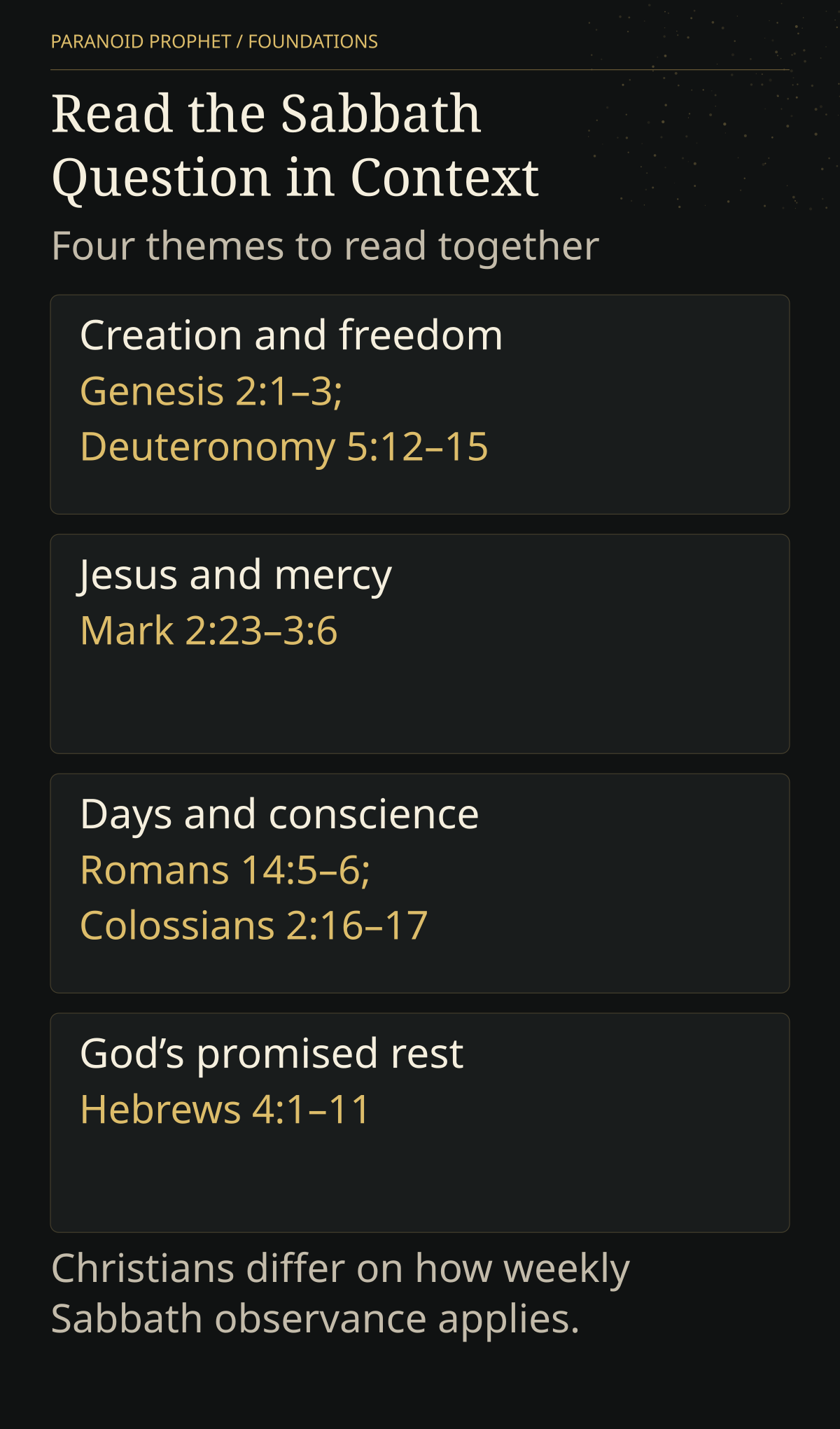
Read the Sabbath Question in Context (image text)
Four themes to read together
- Creation and freedom
Genesis 2:1–3;
Deuteronomy 5:12–15 - Jesus and mercy
Mark 2:23–3:6 - Days and conscience
Romans 14:5–6;
Colossians 2:16–17 - God’s promised rest
Hebrews 4:1–11
Christians differ on how weekly Sabbath observance applies.
PARANOID PROPHET / FOUNDATIONS
How different Christian traditions answer
The following are selected positions, not an exhaustive map of Christianity. Individual churches may explain or apply them differently. The linked documents allow each tradition to speak for itself.
Seventh-day observance
The Seventh-day Adventist Church’s official Sabbath belief identifies the seventh day as a continuing day of rest, worship, and ministry, observed from sunset to sunset. It connects Sabbath with creation, redemption, sanctification, and hope. This represents one influential seventh-day Christian position. It should not be used to assume that every seventh-day group holds identical theology. Read the official belief.
Sunday as the Christian Sabbath
The Westminster Confession of Faith, chapter 21, sections 7–8, teaches a continuing moral obligation to set apart one day in seven. It identifies Sunday after Christ’s resurrection as the Christian Sabbath and emphasizes worship and rest from ordinary work and recreation, with duties of necessity and mercy. This is a specific Reformed confessional position, not the view of every Protestant church. Read the confession.
Sunday gathering without a transferred Mosaic requirement
The Augsburg Confession, article XXVIII, presents Sunday observance as an ordered practice for the church’s common life rather than something necessary to earn grace. It rejects the claim that Christians must observe the Jewish Sabbath and describes Sunday gathering in connection with Christian liberty and church order. This helps explain why a Lutheran church can take Sunday worship seriously without describing it in Westminster’s terms. Read the confession.
The Catholic Lord’s Day
The Catholic Catechism distinguishes Sunday from the Sabbath while connecting Sunday with Christ’s resurrection and the Sabbath’s spiritual fulfillment. It teaches Sunday Eucharistic participation and rest, with provision for serious reasons that prevent attendance and for necessary responsibilities. This is not simply interchangeable with the Reformed Christian-Sabbath account. Read paragraphs 2174–2188.
The disagreement is real. A fair explanation does not require pretending all these claims mean the same thing. It does require describing them accurately before evaluating them.
Build a rhythm that includes worship, rest, and other people
Begin with your church’s teaching and the passages behind it. Ask your pastor how that teaching applies to your actual responsibilities. You do not need to resolve every historical dispute before making room to worship, share a meal, and stop answering nonessential work messages.
Try these concrete steps:
- Name what can wait. Choose one ordinary task you routinely let swallow the day. Decide in advance when it will be done instead. Rest becomes difficult when every unfinished job is treated as an emergency.
- Prepare together. Share necessary chores before and during a day set apart. One person should not become the household’s invisible servant so everyone else can announce that they rested.
- Make room for gathered worship. Plan around your congregation’s actual life, including how you can serve and receive care. Watching from home may be necessary in illness or disability. Isolation should not become the unnoticed default when participation is possible.
- Leave space for simple enjoyment. A meal, a walk, conversation, or quiet can make room for gratitude. Churches differ about which recreational activities fit their observance. Discuss those differences honestly rather than making a private preference into a universal command.
- Protect mercy. Necessary care does not stop. Arrange relief for caregivers where possible. Bringing a meal or sitting with someone’s dependent relative can help another person rest.
If you work rotating shifts, seek a sustainable pattern for worship and bodily rest with pastoral help. An alternate day off is not regarded as equivalent to a commanded day in every tradition, so do not pretend the disagreement vanishes. But neither should an online article push you into abruptly abandoning employment, neglecting patients, or placing your family at risk. Work through the real situation with wise counsel.
If you employ people or control schedules, your choices also matter. Look for ways to offer predictable time away and accommodate worship without simply passing the burden to someone with less power.

Questions that often come up
Is working on Sunday always a sin?
Christians answer the larger obligation differently, and traditions with strong Sunday obligations still recognize necessity and mercy. Caring for a sick child and casually accepting every optional work request are different situations. The kind of work, your responsibilities, your options, and your church’s teaching all matter.
Do I have to choose between trusting Jesus and resting?
No. Receiving salvation by grace and accepting creaturely limits belong together. A rest practice cannot purchase God’s favor, and dependence on grace does not require constant exhaustion. See salvation by grace for the foundation underneath Christian obedience.
What if my family disagrees about Saturday or Sunday?
Read the relevant passages together and explain what you believe they require. Avoid using meals, household tasks, or children as ways to punish one another. Seek pastoral guidance that takes both conviction and family responsibilities seriously. Agreement may take time. Honest disagreement does not excuse cruelty.
Receive the day with humility
The Sabbath question deserves more care than a slogan about Saturday, a defense of Sunday, or a productivity plan with Bible verses attached. It asks how creation, Israel’s covenant, Jesus’ authority, and the life of the church fit together.
Read carefully. Worship with other believers. Make room for mercy. Give the people around you a chance to rest, too. And keep your confidence in Christ rather than in how convincingly you can display your observance.
For the next step, explore Christian worship and how Christians should pray.