
GUIDED ARTICLE EXPERIENCE
How Did We Get the King James Bible? The English Bibles Before 1611
Read along as the narration moves through the article.
Private device narration · No hosted audio or tracking
CONTINUE GUIDED TOUR
Continue where you left off.
GUIDED TOUR COMPLETE
You have reached the end of this study.
Study record saved on this device.
GUIDED TOUR
How Did We Get the King James Bible? The English Bibles Before 1611
Narrator: Paranoid Prophet Recommended Voice Native device narration
Prepare to follow the article as it is narrated.
VOICE & TOUR OPTIONS
Voice & Listening
NARRATOR
Finding a narrator…
Checking the best narrator available on this device.
Restores the best curated narrator available on this device.
Narrator choices are curated for clear, long-form listening on this device.
Screen-awake support will be checked when narration starts.
CHOOSE A NARRATOR
Curated for this device
Choose a verified narrator for this browser, or use System Narrator. Automatic mode uses the best reliable route exposed by this device; your chosen narrator is preserved even if this device needs a temporary fallback.
Preparing the guided article experience…
RESUME GUIDED TOUR?
Continue where you left off.
GUIDED TOUR COMPLETE
You have reached the end of this study.
Few English books are loved as deeply as the King James Bible. Its cadences have carried Scripture through worship, preaching, private devotion, public speech, family memory, grief, and hope for more than four centuries. Many Christians learned the Lord’s Prayer, Psalm 23, or the words of Jesus from its pages. That inheritance deserves gratitude.
The history is even richer than the legends. The KJV was not the first Bible in English, and King James did not personally translate it. The scholars who produced it inherited Hebrew and Greek learning, ancient versions, continental scholarship, and generations of English biblical language. They revised a tradition already shaped by manuscript translators, martyrs, exiles, printers, bishops, Catholic scholars, and ordinary readers.
Learning the history of the King James Bible does not make Scripture less trustworthy. It shows how serious Christians labored to make the biblical Word understandable in English. It also protects reverence from claims the KJV translators themselves would not have recognized.
Article Guide15 sections
Short Answer: Where Did the King James Bible Come From?
The History of the King James Bible in One Answer
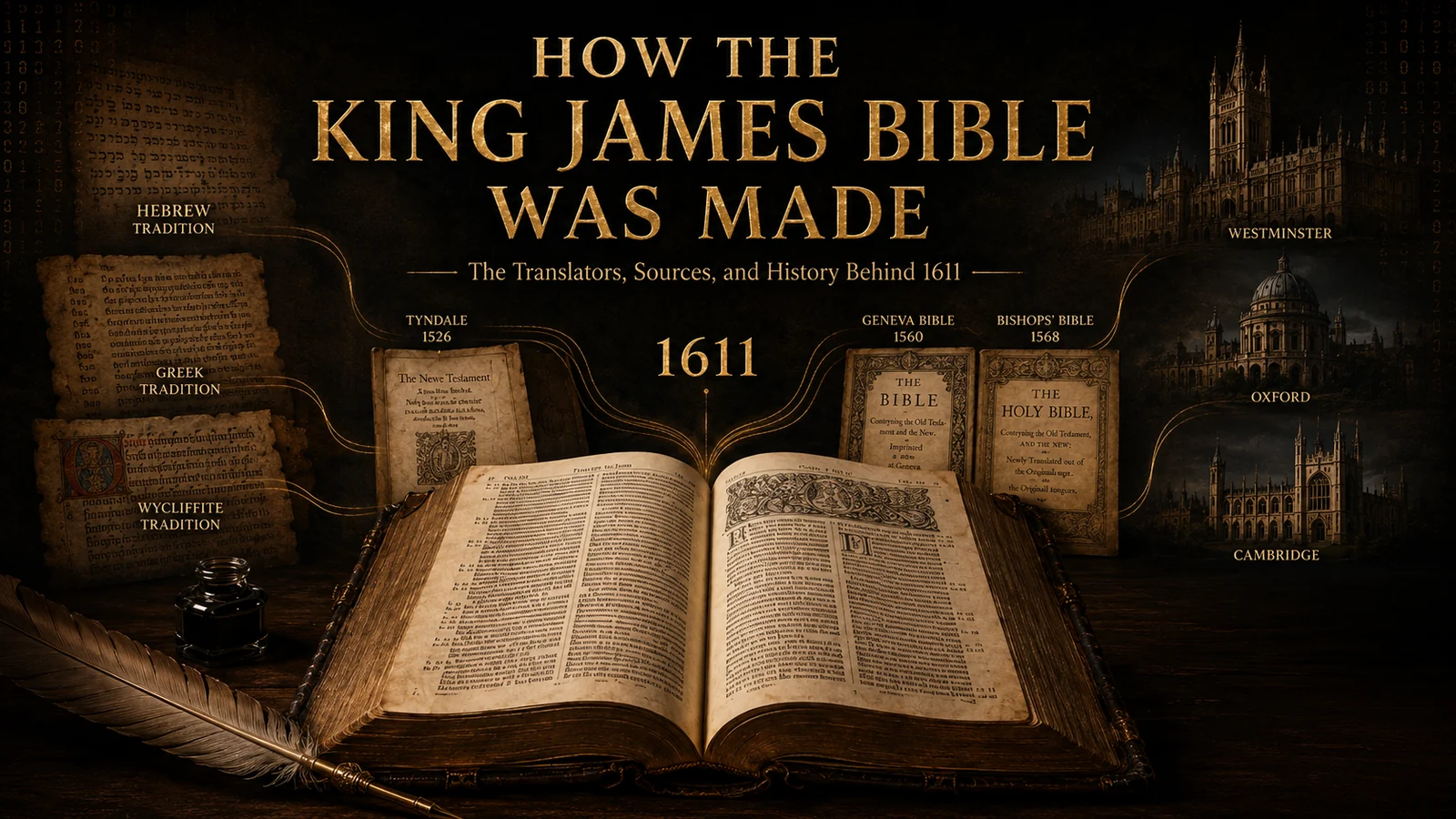
The King James Bible came from a royal translation project approved after the Hampton Court Conference of 1604. Fifty-four scholars were nominated, and about forty-seven are known to have participated. Working in six companies at Westminster, Oxford, and Cambridge, they revised assigned portions, compared their work, circulated completed books, and joined in final review. King James commissioned and supported the project, but he did not translate the Bible.
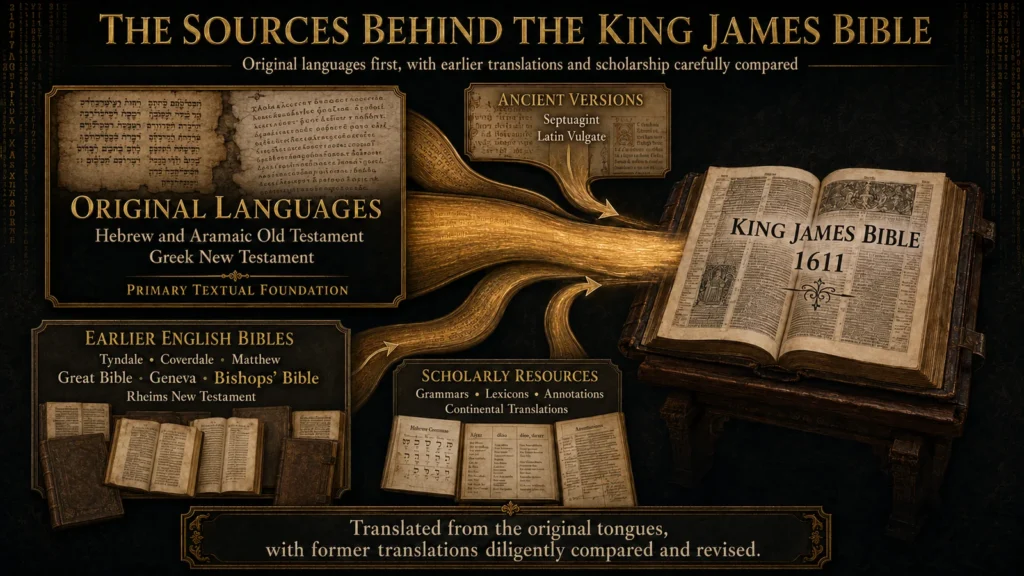
Their formal starting text was the Bishops’ Bible of 1568. The rules allowed earlier English translations when those translations better represented the original-language text. The companies worked with Hebrew and Greek, consulted the Septuagint and Latin Vulgate, used continental scholarship, and drew from the English tradition shaped especially by William Tyndale. The 1611 title page accurately described the result as both translation and revision: Scripture rendered from the original languages, with former translations “diligently compared and reuised.”
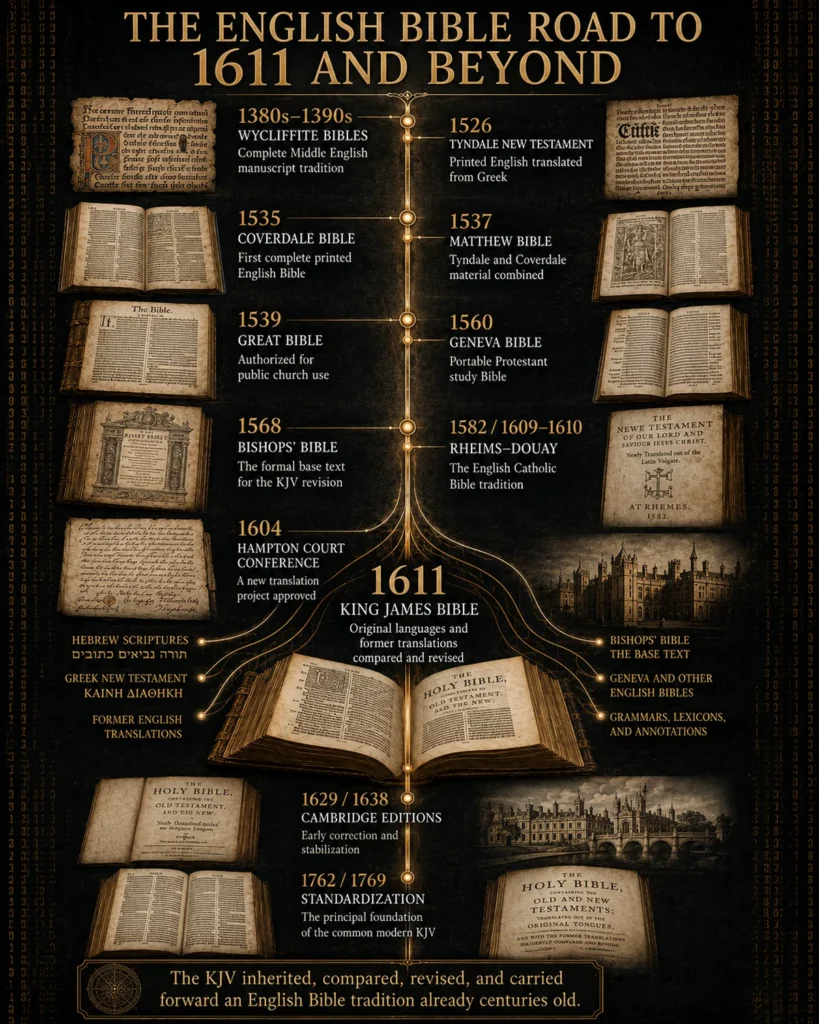
That work stood at the end of a long approach to 1611 and the beginning of another history after it. Wycliffite manuscripts had placed a complete Bible into Middle English. Tyndale translated the New Testament from Greek and portions of the Old Testament from Hebrew. Coverdale, Matthew, the Great Bible, Geneva, Bishops’, and the Rheims-Douay tradition, more commonly called the Douay-Rheims Bible today, carried English Scripture into different communities and institutions. After 1611, printers and editors corrected, modernized, and standardized the KJV through major editions in 1629, 1638, 1762, and 1769.
The KJV is therefore a monumental collective revision within a living translation tradition. Its achievement becomes clearer when the people, sources, books, conflicts, and printing history behind it are allowed to appear.
What Bible Did English Christians Have Before 1611?
There is no single answer because “English Christians” were not one uniform reading public. What people encountered depended on century, education, wealth, confession, geography, and whether Scripture was heard in church or read at home.
In medieval Western Christianity, the Latin Vulgate stood at the center of worship, theology, and scholarship. People also encountered biblical material through sermons, liturgy, songs, drama, art, quotations, and portions in the vernacular. Complete personal printed Bibles were not their normal experience, but describing the entire period as Bible-less erases the ways Scripture shaped Christian life.
By the late fourteenth century, handwritten Wycliffite Bibles offered complete Middle English translations from the Vulgate. After printing and original-language study transformed the landscape, English readers gained Tyndale’s New Testament, Coverdale and Matthew Bibles, the Great Bible in parish churches, the Geneva Bible in homes and Protestant communities, the Bishops’ Bible in Church of England use, and the Douay-Rheims tradition among English Catholics.
Even immediately before 1611, there was no single volume everyone used. A parish might hear the Bishops’ Bible, a Puritan household might read Geneva, and an English Catholic might turn to the Douay-Rheims tradition. The KJV entered this crowded world. It did not replace one universally used predecessor on publication day.
Before Printing: Latin Scripture and English Manuscripts
The Latin Vulgate in Western Christianity
Jerome’s Latin translation and the Vulgate tradition became the dominant Bible of Western Christianity. Latin united worship and scholarship across regions, preserving a common scriptural language for clergy, monasteries, universities, and theologians. It also placed complete biblical texts beyond the direct reading ability of many laypeople whose spoken language had changed far from Latin.
That tension should be described carefully. Scripture was present, but access was mediated differently from modern private reading. A person might hear a Gospel in liturgy, encounter a biblical story in a homily or window, sing a Psalm, or know a vernacular paraphrase without owning a complete Bible. Church control, limited literacy, manuscript cost, and disputes over translation all affected access. The medieval world contained both genuine scriptural formation and genuine restriction.
English biblical translation also existed before Wycliffe in the Old English period. Those earlier works matter, but the main direct path toward the KJV begins with the first complete Middle English Bible tradition.
Scripture in Worship, Art, and Vernacular Portions
Before a cheap printed book could move through households, Scripture traveled through voices and images. The church calendar brought recurring Gospel scenes before worshipers. Biblical phrases entered prayers and hymns. Clergy translated or paraphrased portions while preaching. Mystery plays dramatized creation, fall, flood, passion, and resurrection. Illustrated manuscripts and church art taught narratives to communities with limited literacy.
None of this was equivalent to giving every believer a complete searchable Bible in familiar English. It does show why the historical contrast cannot be “no Scripture” followed suddenly by “the Bible.” Translation history changed the form, reach, and independence of access, not the bare existence of biblical witness.
The Wycliffite Bibles of the Late Fourteenth Century
Complete Middle English Bibles associated with John Wycliffe and his followers appeared in the 1380s and 1390s. “Wycliffite” is the safer description because the work involved a movement and collaborators; no secure evidence makes Wycliffe the personal translator of every book. These Bibles were translated primarily from the Latin Vulgate, not from Hebrew and Greek.
They circulated as handwritten manuscripts before English printing. Surviving British Library records of Wycliffite manuscripts preserve physical evidence of this substantial tradition. Copying an entire Bible by hand required money, time, and trained labor, so access remained unlike the later print market. Still, the manuscripts demonstrate that complete English Scripture did not begin in 1526 or 1611.
Wycliffite translation became entangled with controversy over church authority, reform, preaching, and lay interpretation. The same Bible could be valued as access to God’s Word and feared as a vehicle for unauthorized teaching. That conflict anticipates a recurring fact of English Bible history: translation was never only about vocabulary. It also concerned who could read, who could teach, and which institutions would govern interpretation.
William Tyndale and the English Words That Survived
The 1526 Printed New Testament
Movable-type printing changed what translation could do. A manuscript might circulate among a limited network; a printed edition could produce many substantially similar copies and cross borders. William Tyndale entered that world determined to translate Scripture from the original languages into English ordinary people could understand.
His first printing attempt at Cologne in 1525 was interrupted. The 1526 New Testament, printed on the Continent and brought into England, became the first printed English New Testament translated from Greek. Authorities opposed and confiscated copies, but suppression could not erase the language already moving through readers and later editions. The Library of Congress account of Tyndale’s New Testament documents the importance of this surviving milestone.
Translation From Greek and Hebrew
Tyndale’s achievement was not merely that he wrote in English. He worked from Greek for the New Testament and Hebrew for his Old Testament translation, drawing on the best scholarship and continental resources available to him. His 1530 Pentateuch brought the first five Old Testament books into printed English from Hebrew. Other Old Testament work followed before his death.
His English was direct, rhythmic, and durable. He found phrases that could be understood aloud and remembered. Many later readers encountered those words without knowing their age because Coverdale, Matthew, the Great Bible, Geneva, Bishops’, and the KJV carried them forward through layers of revision.
Tyndale’s Pentateuch and Revised New Testament
Tyndale did not freeze his first attempt as untouchable. His 1534 New Testament was a major revision. He corrected earlier work, refined English expression, and continued using philological study. That willingness to revise became part of the inheritance that the KJV translators later defended.
This fact matters for translation theology. Revision does not imply that the earlier edition contained no Scripture. It means a translator can honor the biblical text by returning to the sources, reconsidering choices, and improving the English expression. The KJV’s own preface would make that principle explicit.
His Execution in 1536
Tyndale was captured, condemned for heresy, strangled, and burned in 1536. His death belongs to an age when translation, doctrine, royal policy, and church authority could carry lethal consequences. The facts are grave enough without romantic embellishment.
Tyndale did not live to see an official English church Bible shaped by his work. Yet within a year, a Bible containing extensive Tyndale material received royal license. His English survived the man who produced it.
Why Later English Bibles Inherited His Language
Tyndale’s influence was foundational because later editors repeatedly used, revised, and transmitted his work. That continuity can be heard in vocabulary, sentence shape, rhythm, and familiar biblical phrases. The Bodleian Libraries discussion of Tyndale and English offers institutional context for his linguistic legacy.
The precise percentage of KJV wording derived from Tyndale depends on which books, editions, and methods are compared. A confident number without a defined study sounds exact while hiding judgment calls. The visible evidence is strong enough without one: major passages and phrases show a direct English inheritance.
The English Bibles That Led to 1611
John 1:1 Across Tyndale, Geneva, and the KJV
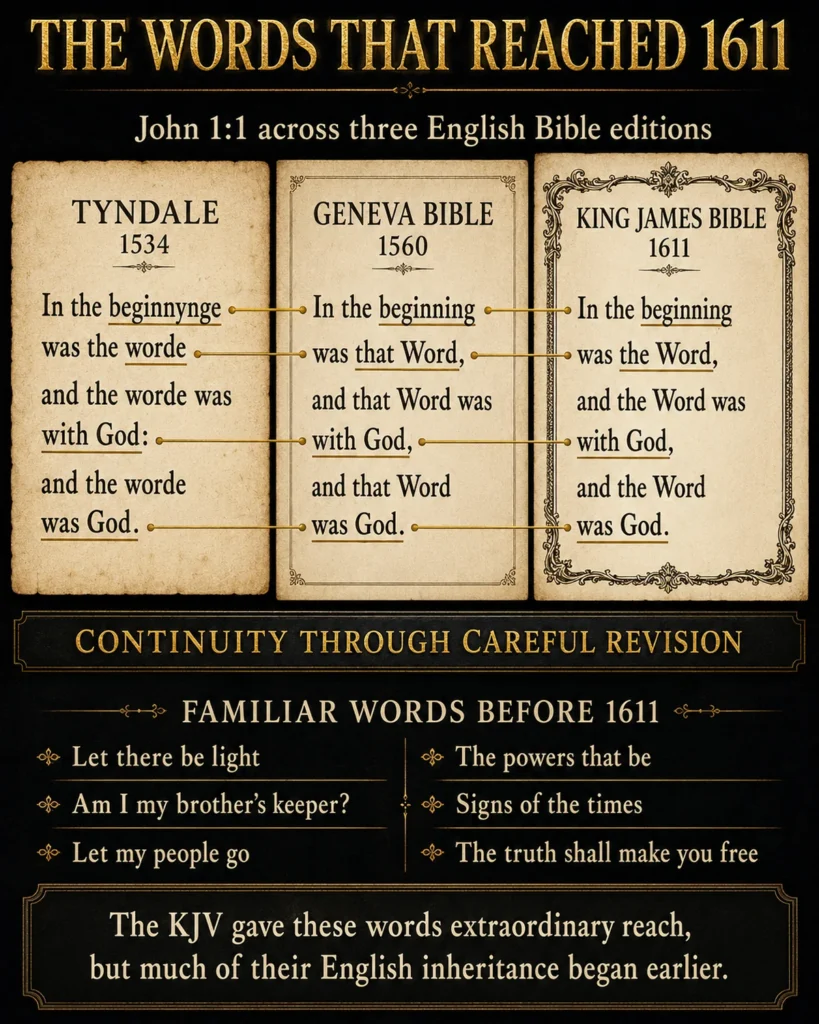
John 1:1 lets readers see the translation tradition rather than merely accept a claim about it. Spelling and punctuation vary, but the central English wording and rhythm remain recognizable:
- Tyndale New Testament, revised 1534: “In the beginnynge was the worde and the worde was with God: and the worde was God.”
- Geneva Bible, 1560: “In the beginning was that Word, and that Word was with God, and that Word was God.”
- King James Bible, 1611, typography normalized: “In the beginning was the Word, and the Word was with God, and the Word was God.”
The comparison uses the revised 1534 Tyndale wording rather than his distinctive 1526 first-edition phrasing, which repeated “that word.” The Geneva line follows the scan-backed 1560 text, while the KJV line normalizes typography for modern readability. The Cambridge University Library KJV exhibition places the 1611 translation inside this longer English history. The KJV preserves the main structure inherited from Tyndale while reflecting the influence of later English Bibles and the revisers’ own decisions. Continuity does not mean mechanical copying. The companies still compared English wording with the original-language text and other sources.
Familiar Phrases That Reached 1611
Readers often associate memorable phrases exclusively with the KJV even when Tyndale had already given them influential English form. The Library of Congress Tyndale exhibit highlights expressions that continued through later Bibles:
- “Let there be light”
- “Am I my brother’s keeper?”
- “Let my people go”
- “the powers that be”
- “signs of the times”
- “the truth shall make you free”
The KJV helped make such phrases culturally enduring, but it did not create all of them in 1611. They carried the labor of earlier translators into a Bible that would give them even wider reach.
Continuity, Revision, and the Danger of Unsupported Percentages
English Bible inheritance works like a manuscript family, editorial tradition, and public vocabulary at once. A phrase could begin with one translator, be reshaped by another edition, be tested against Hebrew or Greek, and finally enter the KJV in a form that sounded both old and newly refined.
Unsupported percentages flatten that process. They also risk treating influence as if every retained article, conjunction, and common English word carried equal significance. The better conclusion is concrete: Tyndale’s influence was immense, Geneva and Bishops’ usage mattered, and the KJV translators made real revisions within an already mature English biblical language.
From Tyndale to a Complete Printed English Bible
Coverdale Bible, 1535
Miles Coverdale’s Bible was the first complete printed Bible in English. He used Tyndale where Tyndale’s work was available. For remaining portions, Coverdale relied on Latin and German sources rather than translating every book directly from Hebrew and Greek. Calling it “the first complete printed English Bible” is therefore accurate without making its method identical to Tyndale’s.
Coverdale’s strength included sensitivity to English worship and sound. His Psalter entered the Book of Common Prayer tradition and continued shaping Anglican prayer even after later Bible translations appeared. The Coverdale Bible became an essential bridge between Tyndale’s incomplete English output and later complete official revisions.
Matthew Bible, 1537
The Matthew Bible appeared under the name “Thomas Matthew,” commonly connected with John Rogers. It combined substantial Tyndale material with Coverdale and other work. Its composite character makes it a revealing ancestor of the KJV: English Bible publication advanced through preservation, editing, and completion as well as fresh translation.
The Matthew Bible received royal license. That fact is striking so soon after Tyndale’s execution. Material associated with a condemned translator moved toward public legitimacy through a new editorial and political setting.
Great Bible, 1539
The Great Bible became the first English Bible officially authorized for public church use in England. Large folio copies were intended for parish settings, where people could hear or gather around English Scripture. Its production arose through royal and ecclesiastical sponsorship and drew heavily from the Tyndale-Coverdale inheritance.
Authorization did not settle every conflict over access or interpretation. It did establish English Scripture visibly within official worship. The Great Bible also transmitted a Psalter that remained deeply influential through the Book of Common Prayer.
Revision and Inheritance, Not Isolated Invention
Coverdale, Matthew, and the Great Bible were not three unrelated attempts beginning from empty pages. Each received and reshaped prior work under new conditions. Translation, compilation, editing, patronage, printing, and church use interacted.
That same pattern would continue. Geneva revisers worked amid exile and Protestant scholarship. Church of England bishops produced an institutional alternative. Catholic translators rendered the Vulgate into English. The KJV companies later compared this accumulated inheritance rather than pretending the sixteenth century had produced nothing trustworthy.
The Geneva Bible: The People’s Study Bible
English Protestant Exiles
Under Mary I, Protestant scholars and leaders fled England. Geneva became one center of exile, reform, biblical study, and publication. The complete Geneva Bible appeared in 1560, produced by English Protestant exiles working within continental scholarship and an intense culture of scriptural teaching.
This context explains both its strengths and its controversies. The Geneva Bible was designed to help readers understand and apply Scripture, but its notes also reflected a distinct Protestant theological and political perspective.
Portable Format, Verse Divisions, and Notes
Many Geneva editions were practical for household and personal use. Verse divisions, maps, tables, cross-references, and extensive annotations made the Bible function as a study Bible. The notes helped readers navigate difficult passages and promoted a robust reading culture beyond the parish lectern.
These aids were human commentary, not part of the biblical text. Their influence demonstrates why the design and notes surrounding Scripture can shape interpretation even when the translated words remain central.
Popularity in Homes and Among Puritans
Geneva became enormously popular among English Protestants, especially in households and Puritan circles. It traveled with readers, shaped preaching and devotion, and later crossed the Atlantic with English settlers. Its usefulness and familiarity meant that a newly printed royal Bible could not simply erase it.
Why It Remained Influential After 1611
Geneva continued circulating after the KJV appeared. Readers already owned copies, printers still supplied editions, and families trusted its familiar notes and portable form. Its persistence is one reason the history of KJV dominance must be told gradually.
Some Geneva annotations troubled James I because they seemed hostile to royal authority. That concern mattered at Hampton Court, but it does not explain the entire KJV project. Translation quality, public worship, church unity, scholarship, and royal politics worked together.
The Bishops’ Bible: The Official Starting Text
Church of England Context
The Bishops’ Bible appeared in 1568 as a Church of England revision intended to provide an institutional alternative to Geneva. It served official church needs more than it won household affection. Its importance to KJV history is not that it surpassed every predecessor in style. It became the base text the 1604 translation rules formally assigned.
Why the KJV Translators Were Instructed to Revise It
Rule 1 directed that the Bishops’ Bible be followed and altered as little as the truth of the original permitted. The rule balanced continuity in public worship with correction from Hebrew and Greek. It also makes the nature of the project unmistakable: the KJV was institutionally designed as a revision.
Other rules allowed Tyndale, Matthew, Coverdale, the Great Bible, and Geneva when they agreed better with the text. The base was official, but it was not untouchable.
The Annotated 1602 Bishops’ Bible
An annotated 1602 Bishops’ Bible survives as physical evidence of the work. The British Library catalog for the translation-rules manuscript and related archival evidence show that the process was not a legend invented later. Translators marked, compared, and revised an existing English text.
The surviving material is incomplete. It cannot reconstruct every conversation or identify the person responsible for every phrase. Its value lies precisely in what it can establish: planned revision, collaborative scrutiny, and a real documentary trail.
The Douay-Rheims Bible and the Catholic English Tradition
Rheims New Testament, 1582
English Bible history before the KJV was not exclusively Protestant. Catholic scholars in exile produced the Rheims New Testament in 1582, translating from the Latin Vulgate within a Catholic theological and polemical setting. Its vocabulary could be more Latinate than Protestant English Bibles, partly because translators wanted to preserve perceived precision and continuity with church usage.
Douay Old Testament, 1609 to 1610
The Douay Old Testament appeared in 1609 and 1610, completing the English Catholic Bible tradition commonly called Douay-Rheims. Its publication immediately before the KJV shows that competing English confessions were both engaged in vernacular Bible work.
Translation From the Latin Vulgate
Rheims-Douay used the Vulgate as its primary textual base. That method differed from the Protestant emphasis on direct translation from Hebrew and Greek, but it did not amount to indifference toward Scripture. Catholic translators sought to provide English readers with the biblical text received in their church tradition and to answer Protestant translations and interpretation.
Why English Bible History Is Not Exclusively Protestant
The Rheims New Testament was known to the KJV translators and influenced some English choices. A fair account can acknowledge borrowing or consultation without making the KJV secretly Catholic or treating shared vocabulary as compromise.
The Protestant and Catholic projects emerged from intense conflict, and their prefaces could speak sharply about one another. Modern history should not repeat every polemical caricature. Both traditions believed English biblical language mattered, both worked within inherited authorities, and both contributed to the world in which the KJV appeared.
Why King James Approved a New Translation
James VI and I
James VI of Scotland became James I of England in 1603. He brought learning, strong views of monarchy, experience with Scottish church conflict, and an interest in theology to an English church already marked by tension. Puritans sought further reform. Bishops defended the established order. Questions of worship, governance, clerical practice, and royal authority were inseparable from religious life.
James did not invent the desire for improved English Scripture. He occupied a position from which he could authorize a large, coordinated project and give it access to church and university scholarship.
Hampton Court Conference, 1604
The Hampton Court Conference met in January 1604 to address church grievances. Bible translation was one proposal within a wider discussion, not the conference’s sole purpose. John Rainolds, a prominent Puritan-leaning scholar, is closely associated with proposing a new translation.
James supported the idea. A fresh Bible could answer complaints about existing translations, serve public worship, reduce dependence on partisan notes, and become a shared text for the Church of England. The proposal aligned scholarship, pastoral use, ecclesiastical settlement, and royal authority.
Church Unity, Worship, Scholarship, and Politics
The motives should remain together. Translators and church leaders cared about accurate wording and intelligible proclamation. An authorized project could use the best available Hebrew and Greek scholarship. A common church Bible promised liturgical consistency. James also understood that Bibles and their notes could shape political imagination.
Calling the project pure spiritual devotion ignores institutions and power. Calling it only population control ignores the scholars, sources, review procedures, and stated concern for Scripture. Early modern Bible translation took place where faith, scholarship, patronage, coercion, pastoral care, and politics met.
The Geneva Notes as a Royal Concern
James objected to some Geneva annotations that seemed to justify resistance to kings. A Bible without Geneva’s polemical marginal theology suited his understanding of monarchy and church order. The translation rules consequently prohibited contentious doctrinal notes while allowing cross-references, explanations of Hebrew or Greek, and alternate renderings.
The royal concern influenced the project’s form, but it did not erase the Geneva Bible’s textual contribution. Rule 14 permitted Geneva among the earlier English translations to consult when it better agreed with the text.
Who Translated the King James Bible and How Did They Work?
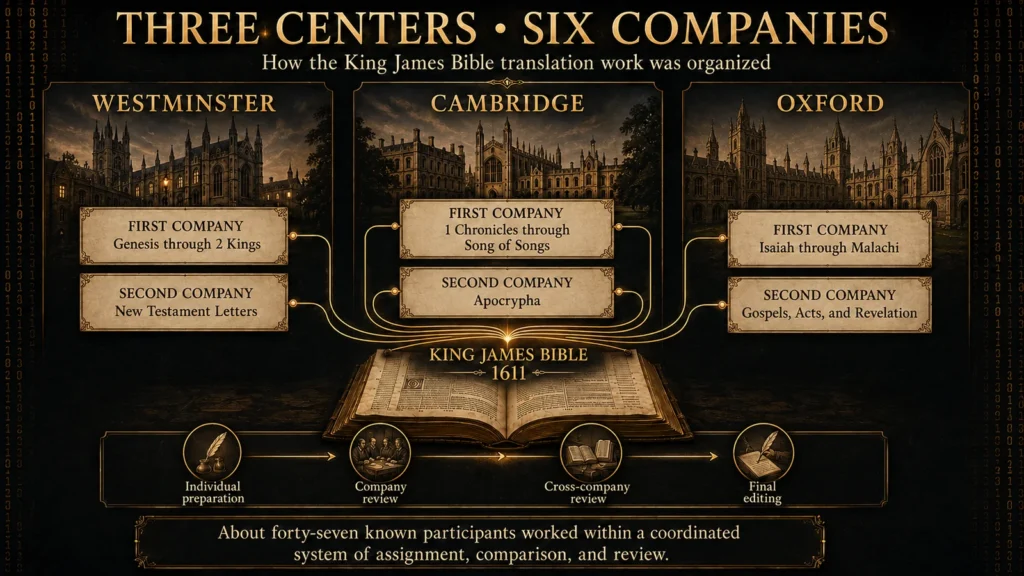
Fifty-four scholars were nominated, and about forty-seven are known to have participated. They were organized into six companies, two each at Westminster, Oxford, and Cambridge. The group included linguists, theologians, clergy, university scholars, and church leaders. Their education and convictions varied within the boundaries of the Church of England.
The familiar image of one inspired translator in a royal chamber is false. James supplied commission and patronage. Companies performed the work through individual preparation, collective discussion, circulation, and review.
Lancelot Andrewes: Senior Leadership at Westminster
Lancelot Andrewes led the First Westminster Company, which worked from Genesis through 2 Kings. He served as Dean of Westminster during the project’s opening period and later became a bishop. His company met in the Jerusalem Chamber at Westminster, placing some of the Bible’s foundational narratives and laws under the care of senior church scholars.
Andrewes was renowned as a linguist, preacher, and devotional writer. Popular retellings assign him dazzling totals of languages, but the exact numbers vary and add little. His importance is secure without arithmetic. He represents learned ecclesiastical leadership joined to close attention to Hebrew and to the sound of Scripture in public proclamation. The Westminster Abbey account of Andrewes and the company helps locate that work in its historical setting.
John Rainolds: A Reforming Scholar Behind the Proposal
John Rainolds was president of Corpus Christi College, Oxford, a respected scholar, and a figure associated with Puritan reform concerns. His role at Hampton Court complicates the idea that the KJV was imposed entirely from above. A scholar seeking reform helped propose the translation that a king and bishops would sponsor.
Rainolds joined the Oxford company working on the Prophets. Severe gout probably made his lodgings a practical meeting place. He died in 1607 before the project was complete, a reminder that the translation outlasted some who began it. The surviving reports of Hampton Court do not provide a perfect transcript of every word he said, so his proposal should be described without theatrical reconstruction. Magdalen College’s translator history supplies Oxford context for Rainolds and the company.
Miles Smith: The Public Voice of the Translators
Miles Smith served in the First Oxford Company on the Prophets and participated with Thomas Bilson in final editorial work. He is traditionally and widely credited with writing “The Translators to the Reader,” the long preface that explains the project’s philosophy more fully than later legends do.
The preface defends vernacular translation, respects earlier English Bibles, explains why revision is legitimate, allows varied English renderings, and insists that Scripture should be understandable. Smith’s importance is therefore not merely biographical. Through the preface, readers hear the public argument the translation presented for itself. Attribution details are not documented at every drafting stage, so “widely credited” remains more accurate than absolute certainty.
John Bois: Surviving Notes From the Review
John Bois was a Cambridge Greek scholar initially assigned to the Second Cambridge Company, which worked on the Apocrypha. He later participated in final review. His surviving notes offer rare evidence of scholarly discussion and revision, though they do not preserve every stage or conversation.
Bois represents the specialists whose service crossed assignment boundaries. His story also teaches historical humility. Much of the committee’s daily work is lost, making surviving notebooks, marked Bibles, and draft fragments especially valuable. The Cambridge KJV exhibition connects Bois with the documentary traces of translation and review.
These men were neither interchangeable technicians nor apostles receiving new revelation. They were scholars revising a translated text through preparation, debate, comparison, and review.
Six Companies at Three Centers
The broad assignments were:
- Westminster First Company: Genesis through 2 Kings.
- Cambridge First Company: 1 Chronicles through Song of Songs.
- Oxford First Company: Isaiah through Malachi.
- Oxford Second Company: Gospels, Acts, and Revelation.
- Westminster Second Company: New Testament letters.
- Cambridge Second Company: Apocrypha.
Assignments distributed the workload while review rules sought coherence across companies. The surviving boundaries are clear enough for orientation, but the record does not justify inventing a precise calendar or a named author for every final reading.
How the Translation Process Worked
Individual Preparation
The rules required each translator in a company to work on the assigned chapter or chapters. This first stage prevented discussion from beginning with no prepared judgment. A scholar could compare the base text, original languages, earlier versions, and reference works before the company met.
Company Review
Company members then compared their work and agreed on wording. That process placed individual expertise under collective examination. A proposal had to survive questions about language, theology, English usage, established terminology, and consistency.
No complete set of meeting minutes survives. Readers should imagine disciplined collaborative revision without pretending to overhear debates whose words are lost. A surviving early draft associated with Samuel Ward provides a rare glimpse of work in progress; Cambridge University Library describes that manuscript evidence.
Cross-Company Review
Completed books were sent to the other companies for serious and judicious consideration. Objections could return with reasons. This gave scholars working on one biblical section an opportunity to test work from another and made the final Bible more than six disconnected products.
Consultation Beyond the Companies
Difficult passages could be referred to other learned people. The rules thus recognized that expertise was distributed. The commissioned translators held responsibility, but they did not assume all useful knowledge existed inside their formal membership.
Final General Review
A smaller group participated in final review and reconciliation, with John Bois, Miles Smith, and Thomas Bilson among names connected to the closing stages. The exact sequence is less fully documented than popular stories imply. What survives supports layered review: individual work, company judgment, circulation, consultation, and final editing.
Rules That Shaped the English
The rules instructed the companies to retain familiar names and established ecclesiastical terms such as “church.” They limited polemical notes while allowing language explanations and cross-references. They made the Bishops’ Bible the base but allowed earlier English Bibles when those better agreed with the original.
These controls encouraged continuity in public worship without making existing wording absolute. They also show why committee work could produce recognizable traditional English while still revising thousands of details.
Which Sources Did the Translators Use?
Hebrew and Greek Texts
The 1611 title page says the Bible was newly translated from the original tongues. The companies worked with printed Hebrew Old Testaments and Greek New Testaments available in their period, along with grammars, lexicons, annotations, and scholarly discussion.
They did not receive the biblical canon from King James or create ancient Scripture in English. The larger history of how the Hebrew, Aramaic, and Greek writings were composed, recognized, copied, and preserved belongs in How Did We Get the Bible?. Here the key fact is narrower: the KJV project received ancient biblical texts and sought to translate them faithfully.
The phrase “Textus Receptus” is often used in later debates about the Greek New Testament, but it can make the KJV process sound more singular and uniform than the surviving evidence. The detailed printed editions, variant readings, and comparison with modern critical texts belong in the separate accuracy article.
Septuagint and Latin Vulgate
The Septuagint, the ancient Greek translation tradition of Jewish Scripture, and the Latin Vulgate remained important witnesses. The KJV translators did not treat consultation of ancient versions as betrayal of Hebrew and Greek. Such versions could preserve interpretive history, illuminate difficult wording, and show how earlier readers understood a passage.
Continental Translations and Scholarship
The companies worked within a European scholarly world. Latin translations and annotations, Reformation-era German and other vernacular Bibles, and contemporary language studies informed their decisions. English Protestant scholarship was connected to continental humanism and reform rather than isolated on an island.
Bishops’ Bible as the Base Text
The Bishops’ Bible was the document the companies formally revised. Rule 1 joined institutional continuity with a textual limit: alter it as little as the truth of the original allowed. That wording made loyalty to Scripture higher than loyalty to the base edition.
Tyndale, Matthew, Coverdale, Great, and Geneva
Rule 14 named Tyndale, Matthew, Coverdale, the Great Bible, and Geneva as earlier translations to use when they represented the text better. Those names map a century of English experimentation, correction, and remembered phrasing.
The translators inherited a river of English Scripture already flowing before they began. Their contribution was to compare and refine that inheritance through broader learning and coordinated review.
Rheims New Testament
The Catholic Rheims New Testament also stood within the available English landscape. Scholars identify places where its language contributed to KJV choices. Consultation did not erase confessional differences. It shows that translators could recognize useful English expression even across sharp religious boundaries.
Comparison Without Isolated Inspiration
The sources converged without becoming equal in authority. Hebrew and Greek controlled translation. Ancient versions, scholarship, and English predecessors supplied evidence, interpretation, vocabulary, and alternatives. The companies were learned and devout, but they were not inspired prophets producing a new revelation.
That distinction honors the KJV. Its excellence came through disciplined human stewardship of the inspired Word, not through a mythology in which comparison and revision were unnecessary.
What Was in the First King James Bible of 1611?
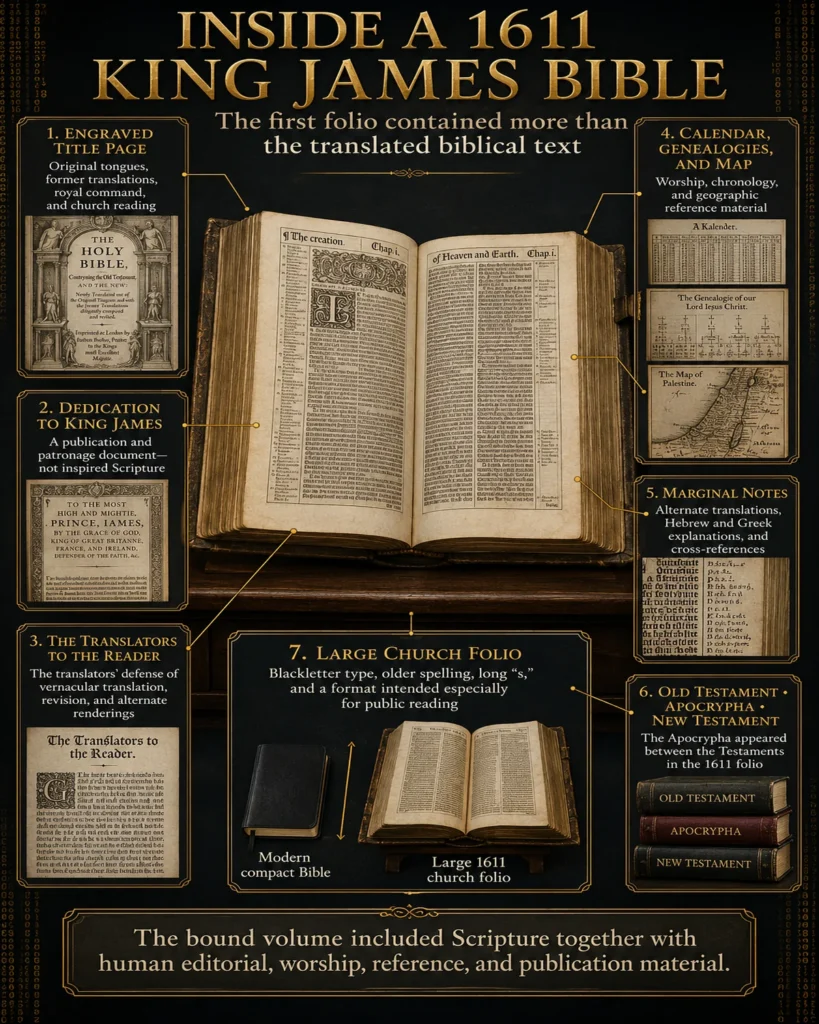
The first KJV was printed in London by Robert Barker, the King’s Printer. It was a large folio designed especially for public church use, not a compact personal leather Bible. Opening it meant encountering a whole publishing and worship environment around the biblical text. The Library of Congress Bible exhibition preserves institutional descriptions of this physical world.
A Physical Tour of the 1611 Folio
- Engraved title page: The title announced the Old and New Testaments, translation from original tongues, comparison with former translations, royal command, and appointment for church reading. Its design included biblical and Christian figures, but not a portrait of King James translating the book.
- Dedication to King James: A formal dedication praised and thanked the king. It belongs to early modern patronage and publication, not to inspired Scripture.
- “The Translators to the Reader”: The long preface defended vernacular translation, honored earlier English Bibles, justified revision, explained alternate renderings, and sought understandable English. Many modern KJV editions omit it.
- Calendar and church material: The volume included a church-year calendar and informational material used within its worship setting.
- Genealogies: Elaborate charts traced biblical history from Adam toward Christ. John Speed produced this visual material in collaboration with the Hebraist and chronologer Hugh Broughton.
- Map: A Holy Land map oriented readers geographically within the biblical story.
- Marginal notes: The KJV avoided Geneva-style doctrinal polemics but included alternate translations, explanations of Hebrew or Greek, and cross-references. The original was not a bare-text edition hostile to all marginal alternatives.
- Old Testament: The books appeared within the wider front matter and reference system of the folio.
- Apocrypha: These books stood between the Old and New Testaments. Their physical inclusion does not by itself settle how different Christian traditions define the canon.
- New Testament: The Gospel and apostolic writings completed the biblical sequence.
The 1611 Bible’s use of blackletter type, long “s,” older spelling, and unfamiliar punctuation can challenge modern readers. Roman type appeared in supporting material and for some textual functions. The physical book looked and behaved differently from a common modern KJV even while carrying the same translation tradition.
Readers who need a clear map of the Protestant sixty-six-book arrangement can use Books of the Bible Explained. That map and the physical contents of a 1611 folio answer different questions; one describes a canonical organization, while the other describes what printers placed within a particular historical volume.
The Cambridge exhibition on the genealogy of Christ gives one example of how paratext and visual aids framed early reading. These materials were not inspired additions to Scripture, but they shaped how readers navigated chronology, worship, geography, and interpretation.
The Title Page and “Appointed to Be Read in Churches”
The title page called the Bible “Newly Translated out of the Originall tongues” and said former translations were “diligently compared and reuised.” It also said the work was produced by royal command and appointed for church reading.
Those statements establish royal sponsorship, public-church purpose, original-language work, and continuity with predecessor Bibles. They do not prove that every earlier translation was corrupt or that one English form became newly inspired.
Robert Barker and Early Printing Variation
Robert Barker held the role of King’s Printer. The exact release date and size of the first print run are not securely known. Early copies also display printing variation. The famous “He” and “She” forms at Ruth 3:15 identify settings of the first edition; they are bibliographical markers rather than rival KJV translations.
Printer errors and setting differences are normal evidence of human book production. They distinguish the inspired biblical message from the fallible labor required to typeset, proof, bind, and distribute a translated volume.
Was It Really Officially “Authorized”?
The KJV became widely known as the Authorized Version. That name reflects real official features. James approved the project. The title page says it was produced by royal command and appointed for reading in churches. The King’s Printer published it within a market regulated by royal privilege.
The caution concerns the documentary record. Scholars have not identified a surviving formal act of authorization comparable to what the conventional title might lead modern readers to expect. That absence does not prove the Bible was illicit, unofficial, or ignored by authorities. It means the title “Authorized Version” is clearer than the surviving administrative instrument behind it.
The safest conclusion holds both sides: the KJV had royal sponsorship and church appointment, while the precise legal mechanism of authorization remains less explicit than the later label.
Is Today’s KJV Exactly the 1611 Printing?
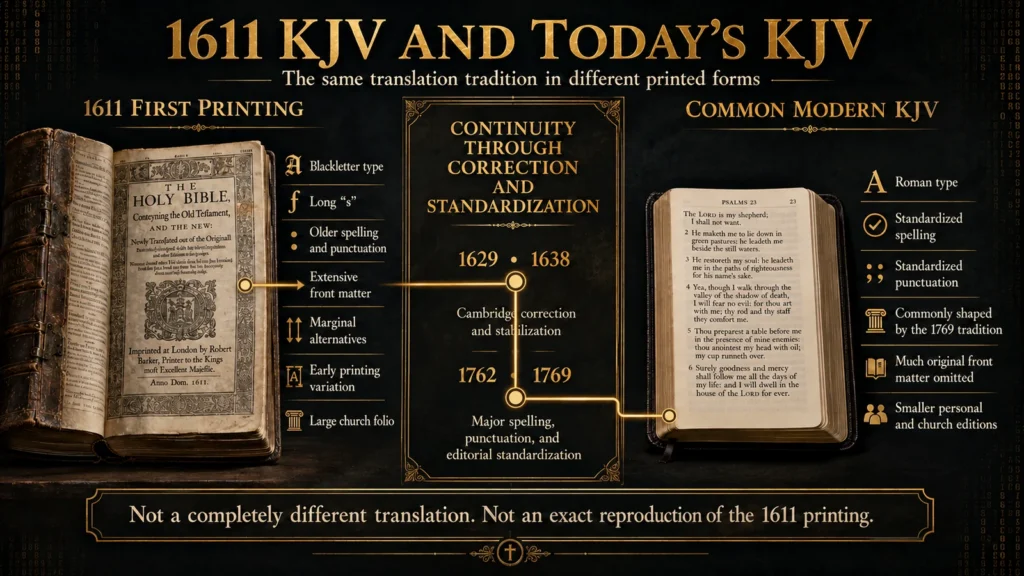
Today’s commonly printed KJV belongs to the 1611 translation tradition, but it is not usually a photographic reproduction of the first printing. Spelling, punctuation, type, capitalization, and some editorial readings changed through repeated publication.
Printing Variation in 1611
The first edition itself was not typographically uniform in every copy. Compositors set type by hand, sheets could be corrected during a print run, and different settings introduced variation. The “He” and “She” Bibles show why “the 1611 printing” needs bibliographical precision even before later editions enter the story.
Corrections and Accidental Changes
Printers corrected obvious errors and sometimes introduced new ones. A notorious 1631 printing omitted “not” from the command against adultery, earning the label “Wicked Bible.” The episode is dramatic, but its lesson is ordinary: printing Scripture does not make typesetters incapable of error.
Correction of a printer’s mistake is not revision of divine revelation. It is responsible stewardship of the printed form through which a translation reaches readers.
Cambridge Editions of 1629 and 1638
Cambridge editions in 1629 and 1638 became important early efforts to correct and stabilize the KJV text. Editors consulted earlier materials and made choices about errors, spelling, punctuation, and readings. This was not evidence that the original translation had vanished. It was the continuation of textual care after publication.
Cambridge 1762 and Oxford 1769
F. S. Parris’s Cambridge edition of 1762 and Benjamin Blayney’s Oxford edition of 1769 contributed heavily to the standardized form familiar today. The 1769 tradition is especially important for common modern spelling, punctuation, and editorial presentation.
Most readers who say “the 1611 KJV” mean the translation first published in 1611, not every original typeface, spelling, marginal note, front-matter item, or printer’s setting. That conventional use is understandable if continuity and physical difference are both acknowledged.
How the KJV Gradually Became Dominant
It Arrived Quietly
The KJV’s first publication did not produce a documented national celebration equal to its later reputation. The exact release date and print run remain uncertain. The translation entered use through institutional channels and a competitive market rather than becoming a literary monument overnight.
Geneva Remained Popular
The Geneva Bible continued in household, private, and some church use. Readers valued its notes, familiar wording, and portable editions. Existing copies did not disappear, and later printings remained available. A new official translation had to accumulate trust and habit.
Church and Printing Structures Favored the KJV
Appointment for public church reading gave the KJV repeated exposure. Royal printing privileges and the position of the King’s Printer shaped supply. Pressure against imported or newly printed Geneva editions reduced competition. These mechanisms mattered without proving a centrally scripted plot to erase all rival Bibles.
Smaller Formats Expanded Use
The large 1611 folio suited lecterns. Later smaller KJV formats made the translation practical for households and individuals. Portability allowed public familiarity to become private habit. A translation heard in church could increasingly be read, taught, and memorized at home.
Familiarity Accumulated
Repeated worship, preaching, education, family reading, and memorization gave KJV phrasing cultural authority. Writers quoted it. Ministers preached it. Children learned it. Its rhythms became associated with biblical speech itself across generations.
Influence Expanded Beyond England
British political expansion, migration, missions, schools, churches, and publishing carried the KJV across the English-speaking world and beyond. This spread included sincere evangelism and education within histories also marked by empire and coercion. The Bible’s spiritual influence should not be confused with a moral endorsement of every system that transported it.
Later Reputation Exceeded First Reception
The KJV became dominant through scholarship, church use, printing structures, reduced competition, portability, familiarity, literary power, education, and generations of worship. No single cause explains its later place. The quiet entry of 1611 and the monumental reputation of later centuries belong to one gradual history.
What the KJV Translators Believed About Translation
The translators left no modern interview archive, and their surviving records do not reveal every private conviction. The preface traditionally credited to Miles Smith nevertheless gives the fullest public explanation of the project’s translation philosophy. “The Translators to the Reader” deserves attention because many claims made in the KJV’s name sit uneasily beside it.
They Understood Their Work as Revision
The preface says their purpose was “not to make of a bad one a good one” but “to make a good one better.” That sentence does not declare every earlier choice correct. It establishes respect for the English Bible tradition they were revising.
The 1611 title page and the translation rules agree. Former translations were compared and revised. The Bishops’ Bible supplied the base. Named predecessors could be preferred where they better represented the text. The project joined continuity with correction.
This outlook differs from the idea that faithful Scripture in English first came into existence when the companies finished. They believed revision could improve a translation without implying that God had withheld His Word from earlier English readers.
They Said Even Imperfect Protestant English Translations Could Be God’s Word
In one of its strongest statements, the translators’ preface says that even “the very meanest translation” produced by “men of our profession” contains, and can rightly be called, the Word of God. In context, the translators were speaking specifically about English Bibles produced within their Protestant tradition, not offering a neutral endorsement of every English version then in circulation. The same section spoke polemically about the Catholic Rheims translation. “Meanest” here means humblest or least distinguished, not maliciously corrupt.
The broader principle remains important. The preface compares translation to a king’s speech rendered into another language: it remains the king’s speech even when one translator expresses it with greater grace or precision than another. The translators did not claim that all renderings were equally exact. They distinguished imperfect human translation from the false conclusion that only a flawless English wording could communicate Scripture.
That distinction allows Christians to call the KJV Holy Scripture while recognizing its translators as fallible servants. The authority belongs to God’s inspired Word faithfully communicated through translation, not to a second act of inspiration conferred on one English edition.
They Wanted Understandable English
The preface defends translation so Scripture “may be understood even of the very vulgar,” meaning ordinary people. Early modern wording can sound archaic now, but the translators’ stated principle was intelligibility, not obscurity as a mark of holiness.
They also resisted a wooden rule requiring one English word every time a Hebrew or Greek term recurred. Context, sense, and English expression could justify variety. That choice did not make precision unimportant. It recognized that languages do not align in perfect one-to-one correspondence.
They Preserved Alternate Renderings
The 1611 margins included alternate translations and language notes. The preface defended such alternatives because difficult words and passages may not yield absolute certainty to one rendering. A marginal option invited readers to see the evidence instead of pretending no judgment had occurred.
That practice is especially important because some modern presentations of the KJV imply that footnotes or alternate renderings betray trust. The first edition shows the opposite. The translators could commit to a main text while admitting another English expression deserved notice.
Their Preface Should Inform, Not Become a Weapon
The preface emerged from a polemical age and does not answer every later controversy. It should not be used to mock readers who hold a stronger exclusivist view of the KJV, nor should it be ignored when describing what the project claimed about itself.
The full public-domain preface reveals translators who valued original languages, understandable English, inherited work, correction, variety, and humility. Honoring the King James Bible does not require inventing a history its own translators would not have recognized.
What This History Means for Christians Today
Gratitude Does Not Require Mythology
The KJV deserves gratitude. It gave generations memorable English for creation, covenant, prophecy, Gospel, apostolic teaching, worship, lament, resurrection, judgment, and hope. Its words have steadied believers at gravesides, filled churches with Scripture, shaped preaching, and carried the name of Christ across continents.
That honor does not depend on saying King James translated it, that no Bible existed before 1611, or that every modern KJV reproduces the first folio exactly. False historical claims are weak foundations for faith because evidence can overturn them. Truthful history leaves the KJV’s real achievement standing.
Human Stewardship Does Not Cancel Divine Authority
Translation companies, printers, proofreaders, editors, paper makers, binders, and publishers are human. They compare, choose, revise, and sometimes err. Scripture’s divine authority does not require those processes to disappear.
Paul wrote that the sacred writings make people wise for salvation through faith in Christ and that Scripture equips God’s servants for faithful life (2 Timothy 3:14-17). A faithful translation serves that purpose by communicating the biblical Word. Correcting type or clarifying spelling protects access to the text rather than creating a new revelation.
The KJV translators modeled serious comparison, committee review, willingness to revise, and openness about alternatives. Their history invites confidence joined to humility, not fear of every footnote or correction.
God’s Word Is Greater Than a Translation Committee
Paranoid Prophet’s statement of belief about the Bible receives Holy Scripture as true and authoritative while recognizing faithful translations as genuine communication of God’s Word. That conviction honors the KJV without placing commentary, tradition, publishers, or one English form above Scripture.
Christians who love the KJV need not abandon it to tell the truth about its making. Christians who prefer another translation need not belittle the faith, memory, or literary inheritance formed through it. The history gives both groups a better basis for conversation.
The Accuracy Debate Belongs in Its Own Article
The history explains how the KJV was made. It does not by itself settle whether it is the most accurate English translation for every reader and every purpose.
A separate specialist analysis can examine printed Greek texts, later manuscript discoveries, archaic English, disputed verses, translation philosophy, and KJV-only claims. Opening those debates here would bury the historical story under questions that require their own evidence and definitions.
What history can establish is already substantial: the KJV was a learned revision of a deep English tradition, produced through original-language work and broad comparison, shaped by faith and politics, printed with human variation, standardized over time, and gradually received through church and culture.
Sources and Further Reading
The article draws on primary evidence, university-press scholarship, and institutional collections. The following sources provide focused entry points:
- “The Translators to the Reader”, the KJV translators’ public argument for vernacular translation, revision, and alternate renderings.
- David Norton, The King James Bible: A Short History from Tyndale to Today, Cambridge University Press.
- David Norton, A Textual History of the King James Bible, Cambridge University Press.
- Library of Congress, “The English Bible”, with Great, Geneva, and King James collection material.
- Library of Congress on Tyndale, including his printed New Testament and durable English phrases.
- British Library manuscript catalog, describing evidence connected with the companies and translation rules.
- Bodleian Libraries on William Tyndale and English.
- Cambridge University Library KJV exhibition, including translators, early editions, and inheritance evidence.
- Cambridge University Library on an early KJV draft.
- Westminster Abbey on Lancelot Andrewes and the First Westminster Company.
- Magdalen College on the Oxford translators.

The Word of God Is Greater Than One English Edition
The King James Bible brought the witness of prophets and apostles to generations in memorable English. Its makers received Scripture from before their age, studied ancient languages, inherited the courage and labor of earlier translators, and worked together to serve church and reader. Printers and editors then carried that work through centuries of correction, standardization, worship, and use.
Bible history should deepen gratitude without redirecting worship toward an edition. Jesus warned that people can search the Scriptures and still refuse to come to Him (John 5:39-40). The purpose of faithful translation is to let readers hear the divine witness clearly enough to know, trust, obey, and proclaim the One of whom it speaks.
Jesus Christ is the eternal Word made flesh, the crucified Savior, the risen Lord, and the coming King. The KJV served generations by proclaiming Him with beauty and power, but the authority of Scripture does not originate in one English edition. It comes from the God who speaks through His Word and calls every reader, in every faithful tongue, to hear and answer His Son.