
No figure in history can be safely reduced the way Jesus often is.
People call Him a moral teacher, a prophet, a revolutionary, a religious genius, or a symbol of compassion. Each description may recognize something true, but none is large enough for the Jesus presented in Scripture. He does not merely teach a path to God. He makes Himself central to that path.
Jesus forgives sins, receives worship, claims authority over the Sabbath, identifies Himself with Daniel’s exalted Son of Man, speaks as the final judge, gives His life for sinners, rises from the dead, and sends His followers to make disciples of the nations.
The question is therefore not whether Jesus is admirable. The question is whether He is who He said and showed Himself to be.
Christianity makes a claim about a real person in public history. Jesus of Nazareth lived in first-century Judea and Galilee. He was crucified under Roman authority. His followers proclaimed very early that God had raised Him from the dead. They worshiped Him as Lord while remaining committed to the one God of Israel. Long before the Council of Nicaea, the earliest Christian writings placed Jesus within the identity, authority, honor, and saving work of God.
History can investigate those public claims, but history is not the final authority for the identity of Christ. Scripture is. The Bible reveals Jesus as the eternal Son, the Word made flesh, the promised Messiah, the suffering Servant, the Lamb of God, the risen Lord, and the King who will come again. Historical evidence can clear away shallow dismissals. Prophecy can show that Jesus did not appear without preparation. The resurrection evidence can force the question of divine vindication. But Scripture gives the decisive interpretation of the whole.
The Central Claim
Core claim: Jesus of Nazareth was a real man in history, crucified under Pontius Pilate, anticipated by Scripture, proclaimed risen by the earliest witnesses, worshiped as Lord before Nicaea, and revealed in the Bible as the divine Son of God who gave Himself to save sinners.
This article builds that cumulative case. No isolated archaeological artifact, ancient historian, prophecy, or philosophical argument carries the whole conclusion. The power lies in convergence: history, Jesus’ own words and actions, the unified witness of Scripture, the cross, the resurrection proclamation, transformed witnesses, early worship, and the gospel’s explanation of why the Son came.
GUIDED ARTICLE EXPERIENCE
Is Jesus the Son of God? Evidence from History, Prophecy, Resurrection, and Scripture
Read along as the narration moves through the article.
Private device narration · No hosted audio or tracking
CONTINUE GUIDED TOUR
Continue where you left off.
GUIDED TOUR COMPLETE
You have reached the end of this study.
Study record saved on this device.
GUIDED TOUR
Is Jesus the Son of God? Evidence from History, Prophecy, Resurrection, and Scripture
Narrator: Paranoid Prophet Recommended Voice Native device narration
Prepare to follow the article as it is narrated.
VOICE & TOUR OPTIONS
Voice & Listening
NARRATOR
Finding a narrator…
Checking the best narrator available on this device.
Restores the best curated narrator available on this device.
Narrator choices are curated for clear, long-form listening on this device.
Screen-awake support will be checked when narration starts.
CHOOSE A NARRATOR
Curated for this device
Choose a verified narrator for this browser, or use System Narrator. Automatic mode uses the best reliable route exposed by this device; your chosen narrator is preserved even if this device needs a temporary fallback.
Preparing the guided article experience…
RESUME GUIDED TOUR?
Continue where you left off.
GUIDED TOUR COMPLETE
You have reached the end of this study.
Article Guide15 sections
The Short Answer and Case at a Glance
Is Jesus the Son of God? Yes. Scripture identifies Him as the eternal Son who shares the Father’s glory, reveals the Father, exercises divine authority, receives worship, creates and sustains all things, bears sin, defeats death, and reigns forever. The historical case does not replace that revelation. It supports the public setting in which the Christian claim arose and tests whether later-invention theories fit the evidence.
The case begins with what is most publicly accessible. Jesus was not a myth placed in an undefined past. His life belongs to the world of first-century Judaism and Roman rule. His crucifixion is among the strongest historical facts connected to Him. His followers did not wait centuries to announce His resurrection or divine status. Paul’s undisputed letters already preserve a crucified, risen, exalted, and worshiped Christ.
From there, the question becomes theological as well as historical. Why did this Jewish teacher speak and act with authority belonging to God? Why did His followers include Him within their worship of the one God? Why did the earliest Christian message center on His death for sins and resurrection? Why does the Old Testament’s developing pattern of King, Servant, Son, Shepherd, Lamb, and Lord converge on Him?
| Evidence Lane | What It Establishes | Proper Confidence |
|---|---|---|
| Scripture | Reveals Jesus as Messiah, eternal Son, Lord, Savior, Lamb, risen King, and final Judge. | Doctrinally decisive |
| Historical existence | Places Jesus in first-century Judea and Galilee as a real Jewish teacher whose movement began around identifiable people and places. | Very strong historical support |
| Crucifixion | Shows that Jesus was publicly executed under Pontius Pilate and did not merely disappear or survive as an inspirational teacher. | Very strong historical support |
| Gospel witness | Provides theological biography rooted in the remembered world of Jesus, His ministry, death, and proclaimed resurrection. | Historically valuable and requiring careful reading |
| Prophecy and biblical pattern | Shows that the Messiah’s identity and mission were prepared through covenant promise, direct prophecy, typology, and apostolic fulfillment. | Strong cumulative biblical case |
| Early resurrection proclamation | Shows that death, burial, resurrection, and appearances belonged to Christianity’s earliest message rather than a medieval development. | Very strong evidence for an early claim |
| Burial and empty tomb | Connects Jesus’ death to the Gospel claim that His tomb was found empty. | Meaningful but more debated than crucifixion |
| Named witnesses | Connects resurrection proclamation to Cephas, James, Paul, the Twelve, and other claimed recipients. | Strong for early testimony; experiences require interpretation |
| Costly public witness | Supports the sincerity of leading proclaimers and weakens deliberate-fraud explanations. | Relevant but not proof of resurrection |
| Early worship of Jesus | Shows that devotion to Jesus as Lord and divine did not begin with Nicaea. | Very strong early Christian evidence |
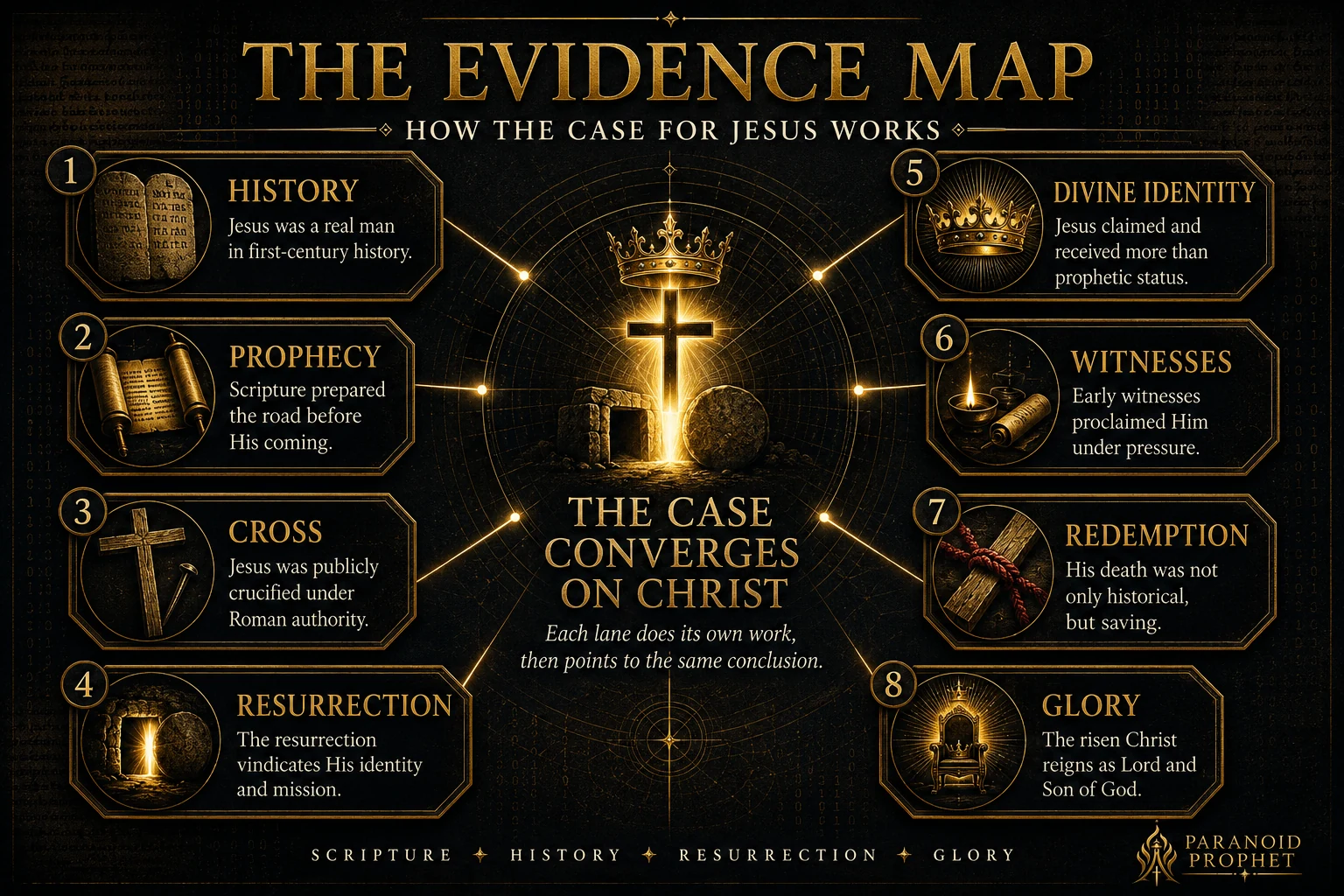
The conclusion is not that every detail is equally certain. It is that the major lines reinforce one another. A real Jesus was crucified. Scripture had prepared for a suffering and reigning Messiah. Jesus acted with divine authority. Resurrection proclamation arose at the beginning of the movement. The earliest Christians worshiped the crucified Jesus as risen Lord. Scripture explains the convergence: the Father sent the Son, the Son gave His life, and God raised Him from the dead.
How the Evidence Works
A serious Christian case should not ask one kind of evidence to perform another kind of evidence’s job. Confusion begins when archaeology is asked to prove the Trinity, when martyrdom is asked to prove resurrection, or when a disputed historical detail is treated as though the gospel depends on it.
Scripture
Role: Reveals who Jesus is.
Limit: It is not subject to a higher human court.
History
Role: Tests public claims.
Limit: It cannot define doctrine or compel faith.
Prophecy
Role: Shows promise and fulfillment.
Limit: It must distinguish prediction, pattern, and typology.
Scholarship
Role: Clarifies context and disputes.
Limit: It serves the evidence; it does not rule Scripture.
Scripture Is the Final Authority
Scripture does more than report that Christians believed certain things about Jesus. It reveals who He truly is. The church does not confess Jesus as the Son because Tacitus, Josephus, Pliny, archaeology, or modern scholarship grants permission. Christians confess Him because the Father has made Him known in the Word and because the apostolic witness proclaims the incarnate, crucified, and risen Christ.
This also means evidence must serve Christ rather than become a substitute for Him. The end of investigation is not admiration for a clever argument. It is recognition of the Son, repentance from sin, trust in His saving work, and worship of the living Lord.
History Tests Public Claims
Historical investigation asks narrower questions. What do the earliest sources say? How close are they to the events? Which claims appear across different streams of evidence? What did the first witnesses proclaim? What can external sources confirm? Which conclusions are strong, and which remain contested?
History can strongly support Jesus’ existence, His crucifixion, the early rise of resurrection proclamation, and the presence of devotion to Christ before Nicaea. It can examine burial traditions, the empty tomb, appearance claims, conversion accounts, and rival explanations. It cannot place God’s action in a laboratory or compel spiritual submission. The statement “God raised Jesus” is both a claim about an event and a theological declaration about the One who acted.
Prophecy Is a Layered Biblical Case
Biblical fulfillment is richer than a list of isolated predictions. Some passages are direct messianic promises. Some establish covenants and offices the Messiah fulfills. Some describe a righteous sufferer or faithful servant whose pattern reaches its fullness in Christ. Some are applied to Jesus explicitly by the New Testament. Some concern His future return and reign. Honest interpretation distinguishes those categories instead of claiming that every resemblance is an independent prediction.
Scholarship Clarifies but Does Not Rule Scripture
Serious scholarship helps examine ancient biography, textual transmission, first-century Judaism, Roman history, resurrection belief, and early Christology. Christian and skeptical scholars often agree on some historical anchors while disagreeing sharply about interpretation. Their work should be represented accurately. It should neither be invoked as an unnamed authority nor ignored when it exposes an exaggerated apologetic claim.
This article follows the site’s Sources and Verification standard: Scripture first, primary ancient sources second, responsible scholarship third, and apologetic synthesis last.
Jesus in Real History and the Gospel Witness
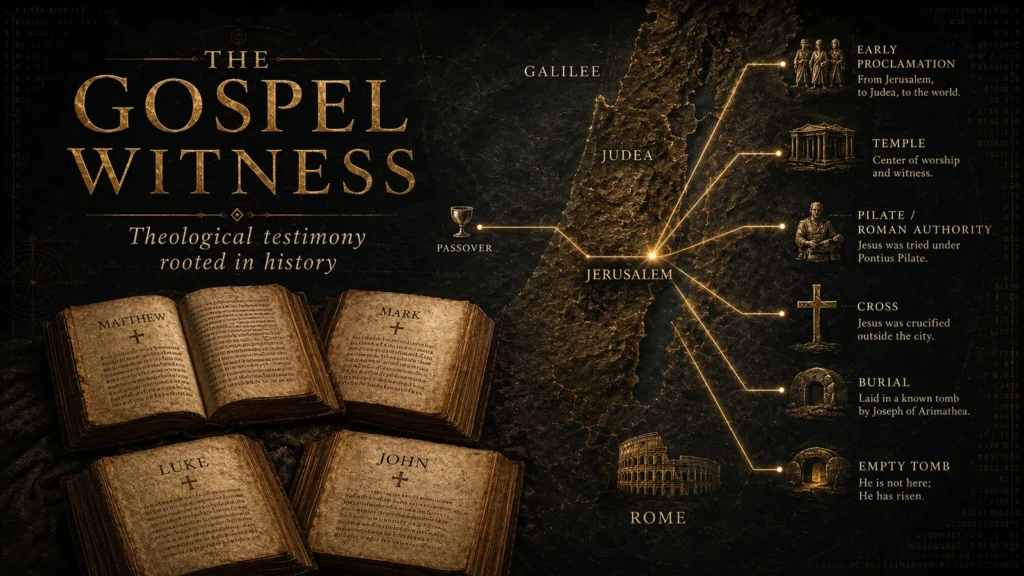
Christian faith does not begin with a timeless moral symbol. It begins with Jesus of Nazareth in the world of Herod, Caiaphas, Pontius Pilate, the Jerusalem temple, Galilean villages, Jewish feasts, Roman occupation, public teaching, conflict, crucifixion, and resurrection proclamation.

The New Testament Is the Central Historical Witness
The New Testament should not be discarded merely because Christians regard it as Scripture. Paul’s letters, the Gospels, and Acts are ancient sources that must be evaluated according to their genre, date, claims, relationship to earlier tradition, and historical setting. Their theological purpose is open, not hidden. John says he writes so that readers may believe Jesus is the Christ, the Son of God. Luke presents his work as an ordered account connected to earlier reports and eyewitness tradition.
A source can intend to persuade and still communicate history. Ancient historians and biographers regularly wrote with moral, political, or theological purposes. The proper question is not whether the Gospel writers cared about the conclusion. They did. The question is whether their witness belongs to the right world, preserves early material, names public figures and places, and coheres with the earliest Christian proclamation.
The Gospels Are Theological Biography
The four Gospels are not detached modern reporting, but neither are they myths set in an imaginary age. They narrate the life of Jesus within ancient biographical forms. They organize material selectively, emphasize different themes, and openly interpret events. That is compatible with a real historical subject.
Their world is recognizably Jewish and Roman. The temple, synagogues, purity debates, Sabbath, Passover, Pharisees, Sadducees, Herodian rulers, Pilate, crucifixion, and burial customs are not decorative scenery. They are part of the social and political world in which the story unfolds. Archaeology cannot prove Jesus’ divine identity, but it repeatedly confirms that the Gospels speak from within a concrete first-century environment.
Paul Anchors the Message Earlier Than the Written Gospels
Even before the Gospels reached their final written forms, Paul’s letters show that the central proclamation was already established. In 1 Corinthians 15:1-8, Paul reminds the church of what he had received and delivered: Christ died for sins according to the Scriptures, was buried, was raised, and appeared. He names Cephas, the Twelve, James, the apostles, and himself among the claimed recipients of appearances.
Paul does not tell us exactly when every line of that summary took its present form. Claims that assign it a precise year can outrun the text. What the passage establishes securely is that Paul received resurrection tradition rather than inventing the message in Corinth. His letter dates from within the first Christian generation, and the material he transmitted was earlier than the letter.
Galatians 1:18-2:10 further connects Paul to Cephas, James the Lord’s brother, and recognized Jerusalem leaders. Paul could disagree sharply with Peter about conduct, as Galatians itself records, yet the letters do not present rival Christianities in which Jerusalem had no crucified and risen Christ. The shared center was already there.
External Sources Add Narrow Confirmation
Non-Christian ancient sources do not give us a second Gospel, and they should not be advertised as though they do. Their value is limited but real. The Jewish historian Josephus refers to James as the brother of Jesus who was called Christ. That passing reference in Antiquities 20 is generally less disputed than the longer description of Jesus in Book 18, whose present wording shows signs of Christian alteration.
The Roman historian Tacitus reports that Christus suffered the extreme penalty under Pontius Pilate during the reign of Tiberius and that the movement later reached Rome. Tacitus writes decades after the crucifixion and does not reveal his source. He remains useful as a hostile Roman witness to the movement’s known founder and execution, not as an authority on resurrection or theology.
Taken together, the New Testament and these narrower external references make the claim that Jesus never existed historically unreasonable. The deeper question is not whether there was a Jesus. It is what best explains the words, actions, death, resurrection proclamation, and worship attached to Him. For a fuller investigation, see Historical Evidence of Jesus.
Differences Do Not Erase the Stable Core
The Gospel accounts do not reproduce one another mechanically. They arrange some events differently, select different sayings, emphasize distinct themes, and vary in resurrection details. Christians should not answer every difference with forced harmonization. Neither should differences be treated as though nothing remains stable.
Across the fourfold witness, Jesus ministers publicly in Israel, announces God’s kingdom, gathers disciples, performs works understood as signs of divine authority, confronts opposition, goes to Jerusalem, is condemned under Pilate, is crucified, dies, is buried, and is proclaimed risen. The narratives agree that the tomb and appearances matter, even while they do not narrate every scene identically.
The Gospels also preserve memories that do not flatter their future leaders. The disciples misunderstand Jesus, compete for status, sleep in Gethsemane, scatter at His arrest, and initially struggle to believe. That feature is not automatic proof of every detail, but it resists the idea that the accounts are simple hero propaganda. Their central human figures are weak until the crucified and risen Christ restores and commissions them.
Transmission Did Not Begin When the Gospels Were Written
A common picture imagines several silent decades after Jesus, followed by anonymous authors inventing stories from a distant past. The surviving evidence does not fit that picture. Jesus’ followers taught, preached, worshiped, argued, remembered His words, interpreted His death, and announced His resurrection before the Gospels reached their final forms. Paul refers to traditions he received, recalls sayings of Jesus, and assumes a network of churches already confessing Christ.
Oral transmission is not automatically exact, and memory is not a recording device. Communities can shape how events are retold. The same caution applies to ancient history generally. Yet transmission within living communities is not equivalent to uncontrolled folklore drifting for centuries. Named leaders, repeated teaching, public worship, letters, travel between churches, and contact with Jerusalem placed boundaries around the developing tradition.
Christians need not claim that scholars agree on every Gospel’s authorship, source relationship, or date. The stronger conclusion is more modest: the Jesus tradition existed before the completed books, remained connected to the first Christian generation, and carried a stable center that appears in both Paul and the Gospels. The writings arose from an active witness community, not from a historical vacuum.
Jesus Cannot Be Reduced to a Moral Teacher
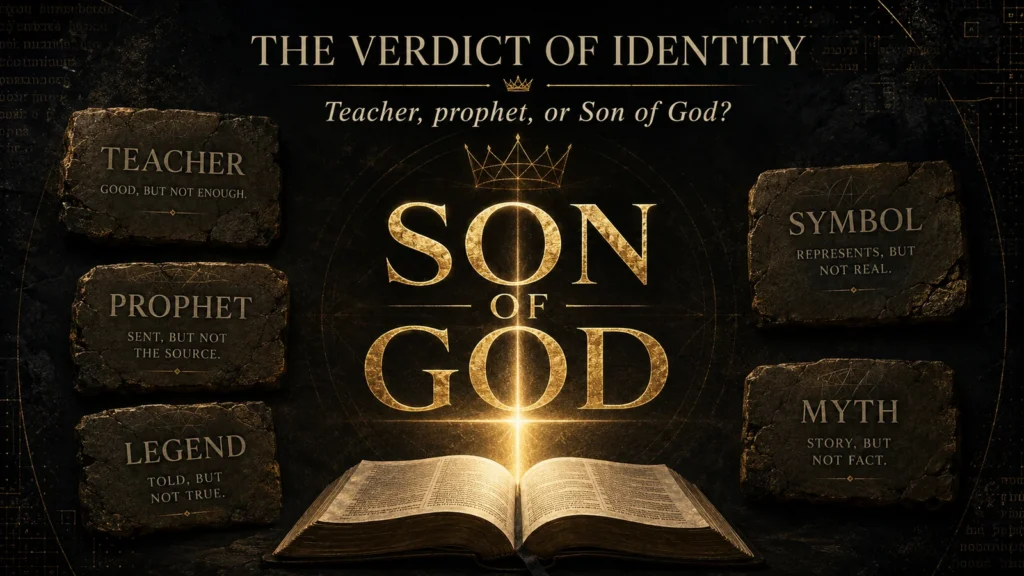
Calling Jesus a good teacher can sound respectful while avoiding the force of His identity. The category works only if the most demanding features of the Gospel portrait are removed.
Jesus teaches with moral beauty, but He does not stand beside His teaching as one wise interpreter among many. He places Himself at the center of God’s kingdom, forgiveness, judgment, Sabbath, discipleship, life, and salvation. He does not merely direct attention toward abstract truth. In John’s Gospel, He says He is the truth. He does not only show a road to the Father. He says access to the Father is through Him.
Jesus Forgives Sins With Personal Authority
In Mark 2:1-12, Jesus tells a paralyzed man that his sins are forgiven. The scribes recognize the theological problem: forgiveness ultimately belongs to God. Jesus does not retreat or explain that He merely announced what God had decided elsewhere. He heals the man so that His hearers may know the Son of Man has authority on earth to forgive sins.
A prophet may announce divine forgiveness. Jesus makes the announcement rest on His own authority and validates it through an act of healing. Mark’s narrative is not yet using all the language John will use about the eternal Word, but it is already pressing beyond the category of an ordinary teacher.
Jesus Places the Sabbath Under the Son of Man
When controversy arises over the Sabbath, Jesus does more than debate one interpretation against another. He declares that the Son of Man is lord even of the Sabbath. The Sabbath belongs to Israel’s covenant life and God’s own rest. Claiming lordship over it is not a small adjustment to religious custom.
Jesus also heals on the Sabbath and frames His work as the restoration of what bondage has disfigured. In John’s Gospel, the controversy becomes even more direct: Jesus speaks of His Father working and of His own corresponding work. His opponents understand Him to be making Himself equal with God. The narrative then presents the Son as giving life and exercising judgment, works Scripture assigns to God.
The Son of Man Receives Dominion
“Son of Man” can simply mean a human being, and readers should not treat every use as an automatic divine title. Yet Jesus repeatedly uses the expression in ways shaped by Daniel 7:9-14. Daniel sees one like a son of man coming with the clouds, approaching the Ancient of Days, and receiving everlasting dominion over all peoples.
At His trial, Jesus joins Daniel’s cloud-coming figure with Psalm 110’s enthroned Lord. He tells the high priest that the Son of Man will be seen seated at the right hand of Power and coming with the clouds. The response is a charge of blasphemy. The scene cannot be reduced to Jesus saying He is an ordinary human representative. He claims heavenly vindication, enthronement, and universal authority.
Jesus Receives Worship and Demands Ultimate Allegiance
The Gospels portray people bowing before Jesus, appealing to Him in faith, and worshiping Him after the resurrection. Jesus does not redirect that honor as angels do elsewhere in Scripture. Matthew ends with the risen Jesus declaring that all authority in heaven and on earth has been given to Him and commanding baptism into the singular name of the Father, Son, and Holy Spirit.
Jesus also demands allegiance above family, security, reputation, and life itself. Response to Him determines response before the Father. He speaks as the one who will return in glory, gather the nations, and render final judgment. A moral teacher may instruct people about God. Jesus makes their eternal relation to God turn on their relation to Him.
These features do not settle every historical debate by themselves, but they establish what must be explained. The Gospel portrait is not of a modest teacher later misunderstood by everyone around Him. Jesus’ authority, self-reference, death, resurrection, and worship belong together. The focused studies Was Jesus a Liar?, Was Jesus a Madman?, and the larger Liar, Lunatic, Legend, or Lord? investigation examine the competing identity explanations in more depth.
Scripture Reveals the Divine Son
The title “Son of God” must be understood biblically. It does not mean that God physically produced Jesus, that the Son was created at Bethlehem, or that He is a lesser deity. Scripture uses sonship language in several ways: Israel is called God’s son, the Davidic king is God’s royal son, angels can be called sons of God, and believers are adopted as God’s children. Jesus fulfills and exceeds those categories.
He is Israel’s faithful representative and David’s promised heir, but He is not merely one more adopted king. The New Testament reveals an eternal relation between Father and Son. The Son shares divine glory, makes the Father known, creates and sustains all things, receives the honor due to God, and yet is personally distinguished from the Father. Christian confession is not that Jesus replaced the Father. It is that the one God has made Himself known as Father, Son, and Holy Spirit.
The Old Testament Prepared the Categories
Christian belief in Jesus’ divine identity did not arise by abandoning the Old Testament. It emerged through the conviction that Israel’s Scriptures had reached their fulfillment. Psalm 2 presents God’s anointed Son receiving the nations. Psalm 45 addresses the royal figure with divine language while distinguishing Him from God who anoints Him. Psalm 110 places David’s Lord at God’s right hand. Isaiah 9 speaks of the promised child with names including Mighty God. Daniel 7 presents the humanlike figure who shares in heavenly rule and receives universal service.
These passages are not interchangeable, and their original settings matter. Together they create categories for a Messiah who is Davidic and greater than David, human and heavenly, sent by God and sharing God’s rule. The New Testament does not flatten the distinctions. It identifies Jesus as the one in whom they converge.
John Reveals the Eternal Word Made Flesh
John 1:1-18 begins before Bethlehem. The Word already is in the beginning, is with God, and is God. All things come into being through Him. The Word then becomes flesh and dwells among us. John does not describe a human teacher promoted into deity. He describes the eternal Word entering the human condition without ceasing to be who He is.
The rest of the Gospel develops that claim. The Son does what He sees the Father doing, gives life, receives honor corresponding to the Father, speaks of glory shared before the world existed, and makes the Father known. Thomas addresses the risen Jesus as his Lord and his God. John’s purpose statement then names Jesus as the Christ and Son of God, joining messianic identity to the life found in His name.
Paul Includes Jesus Within Divine Identity
Paul’s letters are especially important because they are early. In 1 Corinthians 8:4-6, Paul reworks Israel’s confession of the one God around the Father and the one Lord, Jesus Christ. All things are from the Father and through the Lord Jesus. Paul does not present Jesus as a rival god added to Jewish monotheism. He includes Jesus within the confession of God’s unique creative rule.
Philippians 2:5-11 presents Christ in the form of God, freely taking the form of a servant, humbling Himself to death on a cross, and then being exalted. The passage applies Isaiah’s language about every knee bowing and every tongue confessing to Jesus as Lord. The movement is not from ordinary humanity to invented divinity. It is from divine glory through self-humbling obedience to public exaltation.
Romans says salvation is bound to confessing Jesus as Lord and applies Joel’s promise about calling on the Lord’s name to Him. First Corinthians preserves the Aramaic prayer “Maranatha,” asking the Lord to come. These are not fourth-century formulations. They belong to the earliest surviving Christian letters.
Hebrews and Revelation Display the Son’s Glory
Hebrews 1 describes the Son as the radiance of God’s glory, the exact imprint of His nature, the one through whom the world was made, and the one who sustains all things. Angels worship Him. Old Testament texts about God’s throne, creative work, and eternal rule are applied to the Son while the Son remains personally related to the Father.
Revelation completes the picture in worship. In Revelation 5, the Lamb who was slain shares the throne-room praise given to the One seated on the throne. Every creature honors both. Jesus is not worshiped because the church forgot monotheism. He is worshiped because the church believed the identity of Israel’s God had been revealed through the Father and the Lamb.
The deeper prophecy study, Prophecies About Jesus’ Divine Identity, follows these Old and New Testament connections in detail. The central conclusion here is enough: Scripture does not present Jesus as a created helper standing near God. It reveals the Son sharing God’s glory, works, name, throne, honor, and everlasting rule.
Prophecy Prepared the Identity and Mission of Christ
Jesus did not appear in a scriptural vacuum. The Old Testament develops a story of promise that narrows and deepens: the offspring who defeats the serpent, Abraham’s seed through whom the nations are blessed, Judah’s ruler, David’s royal heir, the prophet like Moses, the suffering Servant, the pierced and rejected shepherd, the righteous sufferer, the Son of Man, and the Lord seated at God’s right hand.
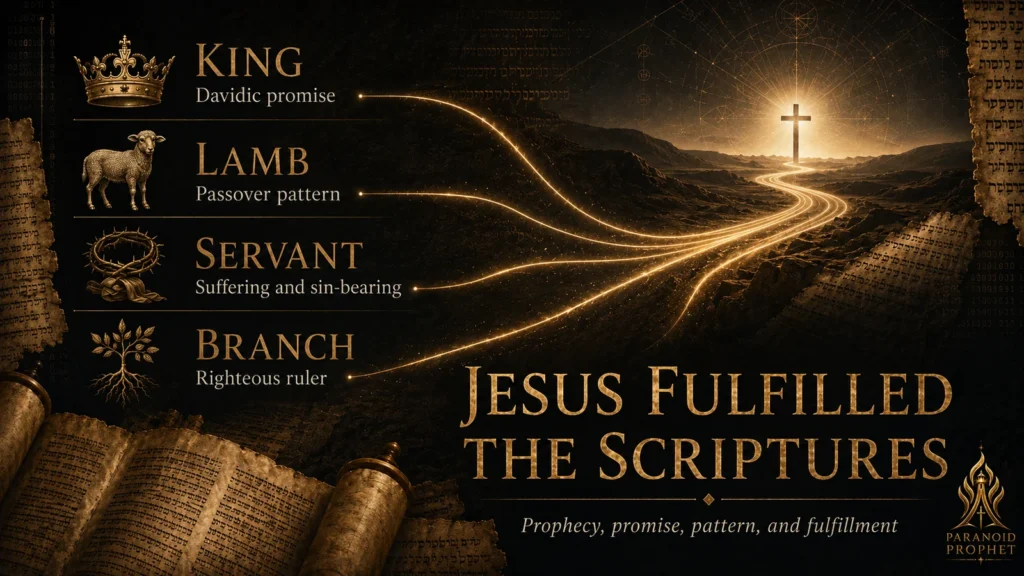
Promise, Pattern, and Fulfillment Are Not Identical
A careful prophecy case distinguishes how each text works. Micah’s ruler from Bethlehem and Isaiah’s royal child are not used in precisely the same way as Israel’s exodus from Egypt. Isaiah 53’s Servant song is not the same literary form as David’s lament in Psalm 22. Passover is a sacrificial and redemptive pattern rather than a verbal prediction that names Jesus of Nazareth.
The New Testament itself teaches this layered fulfillment. Matthew can describe Jesus as recapitulating Israel’s history. John presents Him as the true temple and Passover Lamb. Hebrews interprets priesthood and sacrifice as shadows fulfilled by Christ. Jesus reads Moses, the Prophets, and the Psalms as a unified witness to His suffering and glory.
The Strongest Texts Carry the Case
The argument should not depend on weak verbal coincidences. Isaiah 52:13-53:12 brings together an innocent Servant, rejection, sin-bearing suffering, death, burial, justification, and vindication. Psalm 22 moves from abandonment, mockery, physical agony, and divided garments to deliverance and worldwide worship. Daniel 7 gives the Son of Man universal dominion. Psalm 110 joins David’s Lord to God’s right hand. Zechariah contributes the humble king, pierced figure, and struck shepherd.
Some individual questions remain debated. Psalm 22:16 has a genuine textual issue. Daniel 9’s chronology is interpreted in different ways. Matthew’s fulfillment formulas sometimes employ typology rather than simple one-to-one prediction. A defensible Christian case states those matters openly and lets clearer texts carry greater weight.
The Key Scriptures Predate Christianity
The Dead Sea Scrolls matter because they close one escape route from the prophecy discussion. The Great Isaiah Scroll preserves Isaiah, including the suffering Servant passage, in a manuscript copied before Jesus’ ministry. Other manuscripts from the Judean desert preserve portions of the Psalms, Daniel, and additional biblical books. Christians did not compose those Old Testament texts after the crucifixion and place them into Israel’s Scriptures.
Manuscript age does not prove Christian interpretation. A pre-Christian copy of Isaiah 53 establishes that the text existed; it does not by itself establish that the Servant is Jesus. Interpretation must still consider Isaiah’s context, Jewish readings, Jesus’ teaching, and apostolic application. That narrower manuscript conclusion is valuable precisely because it does not pretend to settle more than the evidence can carry. The Great Isaiah Scroll can be examined through the Israel Museum’s digital project.
The Messiah Suffers Before He Reigns Openly
One reason Jesus disappointed many expectations was that messianic hope could emphasize visible victory while neglecting the path of suffering. Jesus taught that the Son of Man must be rejected, killed, and raised. After the resurrection, He explained that the Christ had to suffer before entering glory. The apostles preached the same pattern: the rejected Jesus had been vindicated and exalted by God.
Fulfillment is therefore not exhausted at the first coming. Jesus has fulfilled the promises appointed for His incarnation, ministry, death, resurrection, and exaltation. Scripture also promises His return, judgment, visible reign, and the renewal of creation. The suffering Servant and reigning King are not competing messiahs. They are the two horizons of one mission.
For the organized case, see the Prophecies of Jesus Fulfilled hub, the study of Jesus’ crucifixion prophecies, and the guide to Jesus’ return, reign, and new creation.
The Cross: Historical Execution and Saving Mission
The cross is where the public historical case and Scripture’s saving interpretation meet.
Jesus Was Crucified Under Pontius Pilate
All four Gospels narrate Jesus’ crucifixion. Paul’s letters place the cross at the center of the message he received and preached. Tacitus later connects Christus’s execution with Pontius Pilate during Tiberius’s reign. The broad conclusion is historically secure: Jesus was subjected to Roman execution and died.
Roman crucifixion was designed to inflict pain, shame, helplessness, and death. It was not a symbolic warning from which a severely injured Jesus would naturally recover and then inspire belief that He had conquered death. The swoon theory must explain scourging, crucifixion, the judgment of executioners, burial, and the transformation of a barely surviving victim into the source of resurrection faith. It explains the evidence poorly.
The focused historical case is developed in Was Jesus Crucified?. The flagship conclusion can remain direct: the cross is not one of Christianity’s fragile claims.
History Cannot Tell Us the Whole Meaning of the Cross
A historian can conclude that Jesus died by Roman crucifixion. Historical method alone cannot conclude that He bore sin, reconciled humanity to God, fulfilled the sacrificial system, defeated the powers, or established the new covenant. Those are truths God reveals in Scripture.
Jesus interpreted His own death as willing and saving. The Son of Man gives His life as a ransom for many. At the Last Supper, Jesus identifies the cup with covenant blood poured out for many. John’s Gospel portrays Him as the Lamb of God and emphasizes that no one finally takes His life from Him; He lays it down and takes it up again according to the Father’s command.
The Son Died for Sinners
Scripture’s diagnosis of humanity is deeper than ignorance or lack of self-esteem. Sin alienates people from God, corrupts worship and desire, brings guilt, and ends in death. A teacher can instruct sinners. A prophet can warn sinners. Neither instruction nor warning can erase guilt or create reconciliation.
The gospel announces that the eternal Son took on flesh and gave Himself. Isaiah’s Servant bears the sins of others. Jesus gives His life as a ransom. Paul says Christ died for our sins according to the Scriptures. Peter says He bore sins in His body on the tree. Hebrews presents His sacrifice as once for all. The cross reveals both the seriousness of sin and the depth of God’s love.
The cross is therefore not evidence that Jesus failed to be the Son. It is the mission of the Son revealed in sacrificial love and obedient submission to the Father. The resurrection does not cancel the cross; it declares that the crucified Jesus has been vindicated and that His saving work was not defeated. For the full theological study, see Why Did Jesus Die? and Prophecies of Jesus the Redeemer.
The Resurrection Is the Hinge of the Case
If Jesus remained dead, Christian claims about His identity collapse. A crucified teacher may be remembered. A failed messianic claimant may inspire a few loyal followers. Neither should be confessed as the living Lord who defeated death and will judge the world.
If God raised Jesus, however, the cross receives a different verdict. Rome condemned Him, but God vindicated Him. His claims cannot be filed away as religious exaggeration. His death is not the end of a mistaken mission. The resurrection identifies the crucified Jesus as Messiah and Lord and confirms that death could not hold the Son.
- 01DiedFor our sins
- 02BuriedDeath was real
- 03RaisedGod vindicated the Son
- 04AppearedNamed witnesses proclaimed Him
The First Christians Proclaimed an Event
The earliest Christian message was not that Jesus lived on through His moral influence. It was that God had acted: Jesus died, was buried, was raised, and appeared. The claim included theology from the beginning – Christ died for sins according to the Scriptures – but it was not only theology. It was attached to a death, a burial, a raised Jesus, and people who said they encountered Him.
This distinction rules out the idea that resurrection originally meant nothing more than spiritual inspiration. The apostles did not preach that Jesus’ cause survived or that His soul had gone to be with God like any righteous dead person. Within Jewish expectation, resurrection concerned God’s victory over death. The claim that one crucified man had been raised ahead of the general resurrection was startling and specific.
Resurrection Was Not a Convenient Synonym for Life After Death
Ancient people held many beliefs about the dead. Some imagined shades in the underworld, the immortality of the soul, heavenly exaltation, or the continuing presence of a revered teacher. Jewish resurrection hope was more concrete. Texts such as Daniel 12 anticipate God raising the dead at the end of the age, bringing judgment and vindication. Resurrection meant that death’s claim on embodied human life would be overturned by God.
That background makes the Christian proclamation unusual. The disciples did not merely say Jesus had entered heaven while the world continued unchanged. They said the end-time resurrection had begun with the Messiah in the middle of history. Jesus was the firstfruits, and His resurrection guaranteed the future resurrection of His people. Paul argues this explicitly in the rest of 1 Corinthians 15.
This does not prove that the claim was true, but it clarifies what needs explaining. A theory must account for why Jewish followers of a crucified claimant came to believe not only that He was alive with God, but that God had bodily raised and enthroned Him as the beginning of the promised new creation.
First Corinthians 15 Preserves Received Tradition
First Corinthians 15 is the central early source. Paul tells the Corinthians that he delivered what he also received. The sequence names Christ’s death for sins, burial, resurrection on the third day, and appearances. Paul then lists Cephas, the Twelve, more than five hundred believers, James, all the apostles, and finally himself.
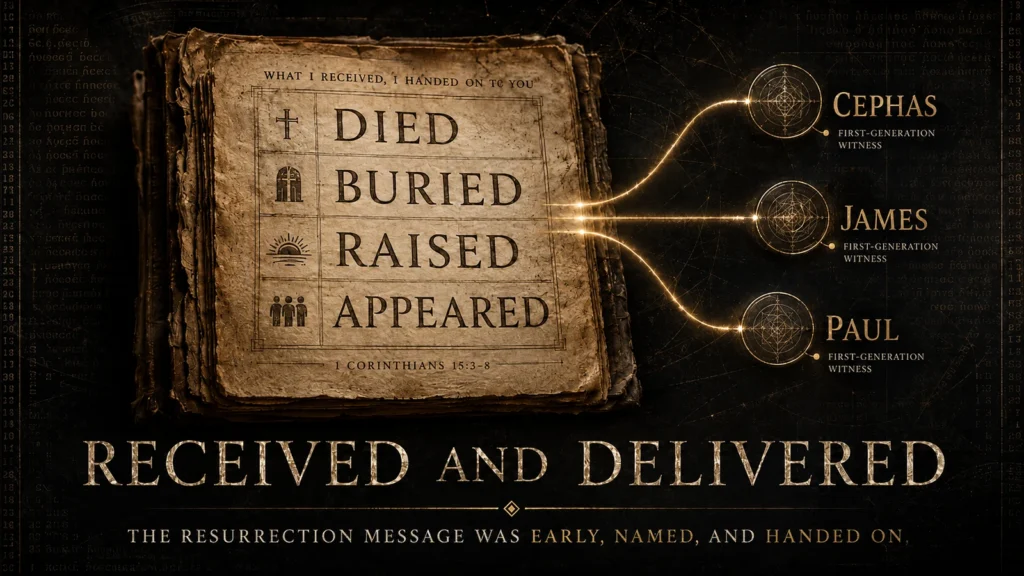
Several conclusions are secure. Paul did not create the whole message for this letter. He had taught it to the Corinthians earlier and describes himself as a recipient of tradition. The summary belongs within the first Christian generation. It connects resurrection proclamation to named figures near the movement’s beginning. It also places death, resurrection, Scripture, and saving meaning together rather than showing a bare historical claim that later acquired theology.
Other claims require restraint. The passage does not tell us exactly when Paul received every element or whether every line came from one fixed creed. The appearance to more than five hundred is significant because Paul knew the claim and said many were still alive, but no second surviving narrative identifies the group, location, or occasion. It should not carry more weight than the named and better-connected figures.
The article How Early Is the Resurrection Claim? examines the chronology and wording without pretending to date the tradition with mathematical precision.
Cephas, James, and Paul Connect the Claim to Identifiable People
Cephas matters because he belonged to Jesus’ inner circle and became a leading Jerusalem witness. James matters because he was Jesus’ brother and later a recognized leader of the Jerusalem church. Paul matters because his own letters identify him as a former persecutor who became an apostle of the Christ he had opposed.
The sources do not describe their experiences with equal detail. Paul gives the most direct surviving first-person testimony concerning his own encounter. The Gospels narrate appearances to the disciples. First Corinthians names James without narrating the scene. Responsible argument does not invent missing details. It observes that resurrection belief was tied to people with different prior relationships to Jesus, including a leading disciple, a family member, and a former persecutor.
Galatians prevents Paul from floating free of Jerusalem. He met Cephas and James and later recognized them as pillars. That contact does not prove they discussed every point modern readers would ask, but it makes a theory in which Paul independently invented a resurrection religion difficult to sustain. The fuller witness map appears in What Did the First Witnesses Claim About the Risen Jesus?.
The Burial Is Plausible; the Empty Tomb Is Important and Debated
All four Gospels report Jesus’ burial and an empty tomb. Mark identifies Joseph of Arimathea as the council member who requested the body, wrapped it, and placed it in a tomb. Women observe the burial and later find the tomb empty. The narratives differ over the number and identity of visitors, angelic messengers, and the sequence of appearances, but the empty-tomb claim is not absent from the earliest Gospel.
The burial should not be rated as highly as crucifixion. Historians debate Roman burial practices, the role of Joseph, and whether the tradition developed apologetically. Yet burial by Joseph is not inherently implausible. Jewish concern for burial, Passover timing, Pilate’s authority over the body, and known first-century tomb practices fit the setting. Naming a council member who could be associated with the burial also creates a more concrete claim than an anonymous disposal story.
The empty tomb carries real evidential weight but should not be advertised as an uncontested fact accepted by every scholar. Paul does not narrate the women’s discovery in 1 Corinthians 15. Grief experiences could produce sincere appearance claims without an empty tomb. The Christian case is strongest when it presents the empty tomb as early and meaningful evidence within the Gospel witness while acknowledging that historical confidence is less uniform than it is for crucifixion.
The Disciples Were Transformed, but Transformation Needs Explanation
The passion narratives portray the disciples as confused, frightened, and scattered. Jesus’ death did not look like the victory they expected. A crucified Messiah appeared cursed and defeated. Yet the same movement soon proclaimed the crucified Jesus as raised and exalted.
Transformation alone does not prove what caused it. People can undergo radical change through visions, grief, group reinforcement, or religious experience. The historical pressure comes from the whole pattern: early proclamation, named witnesses, bodily resurrection language, an empty-tomb tradition, the restoration of the disciple group, James, Paul, and the public formation of communities centered on the risen Lord.
Costly Witness Supports Sincerity, Not Automatic Truth
People can suffer and die for false beliefs. Later believers may sacrifice themselves for claims they inherited and cannot personally verify. Martyrdom is therefore not a shortcut that proves the resurrection.
The narrower argument remains relevant. Acts connects public resurrection proclamation with arrest, threats, flogging, and imprisonment. Paul’s own letters describe beatings, danger, deprivation, and repeated hardship in gospel ministry. Specific apostolic death traditions vary considerably in source quality, so they must be assessed one by one.
Cost does not transform belief into fact. It does make deliberate conspiracy less natural. The leading proclaimers do not look like people advancing a story only while it offered safety, wealth, or status. Their suffering supports sincerity and belongs inside the cumulative case. The dedicated articles Did First Christians Suffer for the Resurrection? and Did the Apostles Die for the Resurrection? preserve the distinction between strong evidence and later tradition.
The resurrection case does not rest on any one disputed plank. Its strongest form is cumulative: Jesus truly died; resurrection proclamation appears early; Paul received and transmitted prior tradition; the claim is connected to identifiable people; Gospel traditions report burial, an empty tomb, and appearances; former doubters and opponents became proclaimers; and the movement worshiped the risen Jesus as Lord.
Scripture then gives the final verdict: God raised His Son from the dead. The companion study on prophecies of Jesus’ resurrection shows how vindication and victory over death fit the biblical story.
Jesus Was Worshiped Before Nicaea
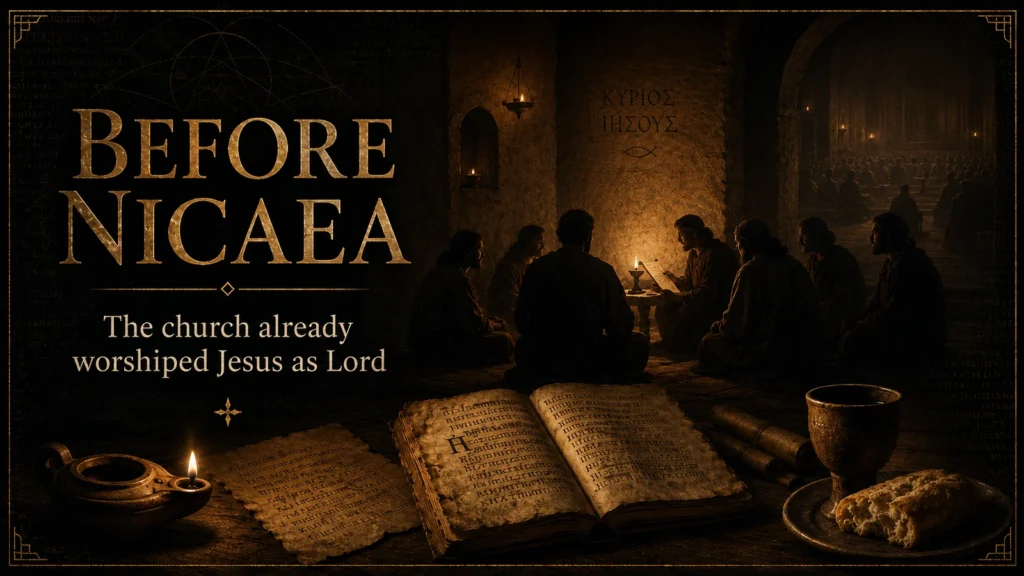
The claim that Jesus became divine at the Council of Nicaea in AD 325 is historically untenable. Nicaea addressed how Christians should speak about the relation of the Father and Son amid controversy. It did not introduce prayer to Jesus, confession of Jesus as Lord, baptism in His name, hymns about His divine status, or worship of the Lamb.
The Earliest Letters Already Confess an Exalted Christ
Paul’s letters predate Nicaea by more than two centuries. They invoke Jesus as Lord, identify Him as the agent of creation, apply Old Testament texts about the Lord to Him, associate Him with grace and salvation, and preserve worship shaped around His death and resurrection. Philippians 2, 1 Corinthians 8, Romans 10, and the Aramaic prayer in 1 Corinthians 16 are not fourth-century additions to the argument. They belong to the first Christian generation.
The historical question is therefore not whether high devotion to Jesus existed before Nicaea. It plainly did. Scholars debate how that devotion developed, how Jesus’ own claims relate to later formulations, and which terms best describe the earliest Christology. They do not need to pretend the Council invented worship of Christ in order to raise those questions.
A Roman Governor Observed Christian Devotion
Early in the second century, Pliny the Younger wrote to Emperor Trajan about people accused of being Christians. He reports that they gathered before dawn and sang responsively to Christ as to a god. Pliny is not reporting events from Jesus’ ministry, confirming the resurrection, or explaining Christian theology. He is describing a devotional practice he encountered in his province.
That limited conclusion is enough. Worship of Christ was public enough for a Roman governor to notice long before Nicaea. Pliny’s testimony fits the trajectory already visible in the New Testament and early Christian writings such as Ignatius: Jesus was confessed not merely as a dead founder but as living Lord.
Alternative Explanations and Serious Objections
A cumulative case should face alternatives at their strongest reasonable form. Skeptical explanations often identify something real: memory can change, religious experiences happen, ancient authors write with theological aims, and later traditions can grow. The question is whether one alternative explains the whole pattern better than the Christian claim.
| Alternative | What It May Explain | Where It Struggles |
|---|---|---|
| Jesus became legendary over time | Some later embellishment, harmonization, or legendary growth around remembered events. | Paul’s early letters already contain crucifixion, resurrection, divine lordship, and contact with Jerusalem leaders. |
| The disciples committed deliberate fraud | A coordinated public message if leaders knowingly invented appearances. | Provides weak motive, fits costly witness poorly, and does not naturally explain Paul or James. |
| Grief visions or religious experiences | Sincere individual experiences after bereavement and some appearance traditions. | Must account for varied claimants, group traditions, bodily resurrection language, empty-tomb tradition, and the movement’s specific Jewish claim. |
| Jesus survived crucifixion | An apparent later encounter without a miracle. | Conflicts with Roman execution, the passion evidence, burial, and the difference between survival and victorious resurrection. |
| Paul invented Christianity | Paul’s enormous influence on Gentile mission and theological expression. | Paul says he received core tradition, knew Cephas and James, and joined a movement he had persecuted. |
| Nicaea made Jesus divine | The council’s role in clarifying later doctrinal language. | Cannot explain first-century worship, prayer, divine titles, or New Testament Christology. |
Aren’t the Gospels Biased and Too Late?
The Gospels are written by believers and should not be misrepresented as neutral transcripts. Bias, however, is not a synonym for fabrication. Every source has perspective. Historians ask whether a source is connected to the events, preserves early material, fits its setting, names checkable people and places, and can be compared with other evidence.
Dates proposed for the Gospels vary, but the core Christian proclamation is demonstrably earlier than their final forms. Paul’s letters already know Jesus as crucified, buried, raised, and Lord. The gap between Jesus’ ministry and the Gospels deserves historical analysis; it cannot simply be turned into centuries of silence that did not exist.
Did Jesus Actually Claim to Be God?
Jesus does not walk through the Synoptic Gospels repeating one modern doctrinal sentence. That observation should lead to careful reading, not the conclusion that divine identity is absent. He forgives sins, claims authority over the Sabbath, identifies Himself with Daniel’s enthroned Son of Man, receives worship, demands ultimate allegiance, and speaks as final judge.
John uses more explicit language about the eternal Word, shared glory, unity of action, and the Son’s relation to the Father. The Synoptics and John have different emphases, but they do not give us one merely human Jesus and another divine Jesus. Together they reveal the Messiah whose authority and identity exceed the category of prophet.
Were the Prophecies Taken Out of Context?
Some popular prophecy arguments do take verses out of context. Christians should reject careless lists that classify every pattern as a direct prediction or hide textual disputes. Correcting a weak argument does not remove the larger biblical case.
Jesus and the apostles read fulfillment through covenant, promise, typology, representative figures, repeated patterns, and direct prophecy. Isaiah’s Servant, David’s Lord, Daniel’s Son of Man, the Passover Lamb, and the Davidic covenant contribute different parts of the portrait. The argument is strongest in the convergence of the whole canon, not in inflated counting.
Could Resurrection Experiences Have Been Visions?
Bereavement visions and powerful religious experiences occur. A Christian response should not deny that reality. Such experiences could account for some sincere individual claims and therefore deserve more respect than a simple fraud theory.
The remaining question is explanatory scope. The sources present multiple claimed recipients, group appearances, an empty-tomb tradition, bodily resurrection language, James, Paul, public proclamation, and worship of the risen Jesus. Vision theories must explain why these experiences produced the specific conviction that the crucified Messiah had been raised bodily ahead of the general resurrection. The Christian conclusion is that the witnesses believed they encountered Jesus because He truly rose.
Can Historical Evidence Prove the Son of God?
Historical method can establish context, test sources, compare explanations, and show that Christianity is not built on a myth detached from the ancient world. It can make some objections much harder to maintain. It cannot become a higher court over God’s Word or produce faith by technique.
The identity of Jesus is finally a revealed truth. Evidence removes excuses for shallow dismissal and points toward the coherence of the Christian claim. The Holy Spirit opens the heart to confess what Scripture proclaims: Jesus is Lord. Faith is not belief without evidence, but neither is it mere agreement with a historical probability. It is trust in the Son of God.
The Cumulative Verdict
No single line in this case stands alone. History establishes the real first-century setting. The Gospels give theological witness to Jesus’ ministry and identity. His words and actions exceed the role of a moral teacher. Scripture reveals the eternal Son and prepares His mission through promise and pattern.
The cross anchors His death in public history while Scripture unveils its saving purpose. The resurrection proclamation appears at the movement’s beginning. Named witnesses and costly public testimony resist easy fraud and late-legend theories. Early worship shows that devotion to Jesus did not wait for imperial councils.
Each lane has limits. Together they form a coherent web centered on one person. The same Jesus who claims divine authority is the one Scripture anticipated. The same Messiah who was crucified is the one proclaimed risen. The same risen Lord appears in the earliest prayers, hymns, confessions, and worship of the church. The historical and biblical lines are not random facts collected after the conclusion. They converge on Jesus Christ.
A web is not the same as a chain whose entire case fails if one debated link is weakened. A reader may remain unconvinced by the appearance to the five hundred and still face Paul’s received tradition. A reader may debate the historical confidence of the empty tomb and still face Jesus’ crucifixion, the early resurrection proclamation, and the transformation of named proclaimers.
A reader may challenge one proposed prophecy and still confront Isaiah’s Servant, Daniel’s Son of Man, Psalm 110’s enthroned Lord, and the New Testament’s sustained reading of Christ.
The case also has an order. Public history establishes that Christianity concerns a real crucified Jesus. The earliest sources establish what His followers proclaimed. Jesus’ words and actions sharpen the identity question. Scripture interprets the person and events, revealing why the Son came and what His death accomplished. The resurrection vindicates the crucified Messiah, and early worship shows how quickly the church understood the implications. Removing one secondary argument does not erase that structure.
This is why intellectual honesty strengthens Christian witness. The gospel does not require every tradition to be equally early, every harmonization to be certain, or every apologetic slogan to survive scrutiny. The center is stronger than those exaggerations: Jesus Christ truly came, truly died, was truly raised, and is revealed by God as Lord.
The verdict: History makes mythic dismissal unreasonable. The resurrection makes every merely human verdict inadequate. Scripture gives the final answer: Jesus is the Christ, the eternal Son of God, the crucified Savior, and the risen Lord.
Continue Through the Jesus Evidence Web
This page is the front door. The focused studies let each evidence lane receive the space and caution it deserves.
The order is not a ladder that makes Scripture wait for permission from history. It is a reading path for people asking different questions. Begin where the obstacle is strongest, follow the evidence honestly, and keep moving toward the identity and saving work of Christ.
Frequently Asked Questions About Jesus as the Son of God
Is Jesus the Son of God?
Yes. Scripture reveals Jesus as the eternal Son, the Word made flesh, the promised Messiah, the crucified Savior, and the risen Lord. History supports the public setting of His life, death, early resurrection proclamation, and worship, but Scripture provides the decisive verdict about His identity.
What Is the Strongest Historical Evidence for Jesus?
The New Testament is the central evidence, especially Paul’s early letters and the four Gospels. Josephus’s reference to James, Tacitus’s reference to Christus’s execution under Pilate, and the first-century setting of the Gospel narratives add external and contextual support. Jesus’ existence and crucifixion are historically much stronger than many debated details.
Did Jesus Say He Was God?
Jesus’ claim appears through both direct language and divine actions. He forgives sins, rules the Sabbath, receives worship, identifies Himself with Daniel’s heavenly Son of Man, gives life, judges the nations, and makes response to Himself central to salvation. John also presents Him as the eternal Word who was with God and was God.
Why Is the Resurrection Central to Jesus’ Identity?
The resurrection is God’s vindication of the crucified Son. Without it, Christianity loses its foundation. With it, Jesus’ claims, cross, authority, and promises demand a new verdict. The earliest Christian message centered on Christ dying, being buried, being raised, appearing, and reigning as Lord.
Is Belief in Jesus Based on Blind Faith?
No. Christian faith is grounded in God’s self-revelation in Scripture and connected to public claims about Jesus in history. Evidence can be examined, objections can be tested, and weak arguments should be corrected. Saving faith, however, is more than intellectual agreement. It is personal trust in the crucified and risen Son.
Sources and Further Reading
Scripture is the final authority for the identity and saving work of Jesus. The ancient and modern sources below are used for narrower questions of historical context, source transmission, Gospel genre, resurrection claims, and early devotion to Christ.
Primary Ancient Sources
- Matthew, Mark, Luke, and John – the canonical Gospel witness to Jesus’ ministry, death, resurrection, and identity.
- First Corinthians 15, Galatians 1-2, and Philippians 2 – early Pauline evidence for received resurrection tradition, Jerusalem contacts, and exalted Christology.
- Flavius Josephus, Jewish Antiquities 20.200 – the passage identifying James as the brother of Jesus who was called Christ; used more confidently than the disputed wording of Antiquities 18.63-64.
- Tacitus, Annals 15.44 – Roman reference to Christus’s execution under Pontius Pilate and the later presence of Christians in Rome.
- Pliny the Younger, Letters 10.96-97 – early second-century evidence that Christians sang to Christ as to a god and faced official questioning.
- Ignatius of Antioch, Letter to the Smyrnaeans – early second-century Christian insistence on Jesus’ real suffering and resurrection.
Historical Jesus and Gospel Studies
- Richard Bauckham, Jesus and the Eyewitnesses, 2nd ed. Grand Rapids: Eerdmans, 2017.
- James D. G. Dunn, Jesus Remembered. Christianity in the Making, vol. 1. Grand Rapids: Eerdmans, 2003.
- Craig S. Keener, Christobiography: Memory, History, and the Reliability of the Gospels. Grand Rapids: Eerdmans, 2019.
- Raymond E. Brown, The Death of the Messiah, 2 vols. New Haven: Yale University Press, 1994.
Resurrection and Early Christology
- Dale C. Allison Jr., The Resurrection of Jesus: Apologetics, Polemics, History. London: T&T Clark, 2021.
- N. T. Wright, The Resurrection of the Son of God. Christian Origins and the Question of God, vol. 3. Minneapolis: Fortress Press, 2003.
- Larry W. Hurtado, Lord Jesus Christ: Devotion to Jesus in Earliest Christianity. Grand Rapids: Eerdmans, 2003.
- Richard Bauckham, Jesus and the God of Israel: God Crucified and Other Studies on the New Testament’s Christology of Divine Identity. Grand Rapids: Eerdmans, 2008.
- James D. G. Dunn, Beginning from Jerusalem. Christianity in the Making, vol. 2. Grand Rapids: Eerdmans, 2009.
These works do not all reach identical conclusions. That is part of their value. They help distinguish what the sources state, what historians commonly infer, and where interpretation remains contested. None replaces Scripture’s final testimony to Christ.
The Final Question: Who Do You Say Jesus Is?
Evidence can be studied at a distance. Jesus cannot.
A person can compare sources, examine prophecy, debate resurrection theories, and learn the language of Christology while never answering the question Jesus places before every reader. He asked His disciples who they said He was. Peter answered that He is the Christ, the Son of the living God.
If Jesus is only a teacher, His words may be selected when convenient. If He is only a prophet, He may be respected without being worshiped. If He is merely a tragic martyr, His courage may be admired while His authority is ignored.
But if Jesus is the Son of God, neutrality is not a stable position. The Son came from the Father, entered the world He made, bore sin at the cross, rose in victory, and reigns as Lord. He does not call people merely to acknowledge that the evidence is interesting. He calls them to repent, believe the gospel, receive forgiveness, and follow Him.
The evidence points beyond an argument. It points to Jesus Christ: the promised Messiah, the crucified Savior, the risen Lord, the eternal Son, and the King who will come again.
CONTINUE THE INVESTIGATION
Recommended continuation
Historical Evidence for Jesus: Why Jesus Was Not a Myth or Legend
Move from the cumulative case to the historical foundation: Jesus’ existence, sources, and place in first-century history.