


Christians speak often about what Jesus did: he taught, healed, died, and rose again. They also look forward to his return. But what about today, when a prayer feels unanswered, a failure weighs on your conscience, or the world’s cruelty makes his authority difficult to see?
The New Testament presents Jesus as actively caring for his people now. Having ascended to the Father, he intercedes for those who come to God through him, reigns as Lord, and gives the Holy Spirit. His present ministry connects the saving work he has accomplished with the future he has promised.
GUIDED ARTICLE EXPERIENCE
What Is Jesus Doing Now? His Ascension, Intercession, and Reign
Read along as the narration moves through the article.
Browser narration · No stored audio or site tracking
CONTINUE GUIDED TOUR
Continue where you left off.
GUIDED TOUR COMPLETE
You have reached the end of this study.
Study record saved on this device.
GUIDED TOUR
What Is Jesus Doing Now? His Ascension, Intercession, and Reign
Narrator: Paranoid Prophet Recommended Voice Native device narration
Prepare to follow the article as it is narrated.
VOICE & TOUR OPTIONS
Voice & Listening
NARRATOR
Finding a narrator…
Checking the best narrator available on this device.
Restores the site recommendations available in this browser.
Our listening picks lead when available; other voices are ranked for narration. Known novelty voices are hidden. Browser-provided voices may use an online voice service.
Screen-awake support will be checked when narration starts.
Optional: improve your device voices
Listening works with the voices already available here. Your device may offer additional free voices through its own settings.
iPhone or iPad: Settings → Accessibility → Read & Speak (or Spoken Content) → Voices → English. Look for Premium or Enhanced choices, then return here.
If offered, preview Ava or Zoe for U.S. English, or Serena or Jamie for British English. An explicit Premium or Enhanced version can improve on its compact version.
Mac: System Settings → Accessibility → Read & Speak → System voice. Open the voice list to preview or download additional choices.
Windows: Settings → Accessibility → Narrator → Add natural voices. Browser availability varies; a Narrator voice may not appear on websites. Edge may also expose online Natural voices without a model download.
Android: Open Accessibility → Text-to-speech output (the location varies by device). In the preferred engine settings, look for voice data and English choices.
Download sizes vary; some enhanced voices exceed 100 MB. This website cannot install system voices, and an installed voice appears here only if your browser exposes it.
Apple voice guide · Windows voice guide · Android voice guide
CHOOSE A NARRATOR
Recommended on this device
Our listening picks: Aaron, Martha, then Daniel, when available here. Otherwise, automatic uses the highest-ranked suitable voice. Preview alternatives or save your own choice.
Preparing the guided article experience…
RESUME GUIDED TOUR?
Continue where you left off.
GUIDED TOUR COMPLETE
You have reached the end of this study.
Article Guide10 sections
What happened at Jesus’ ascension?
In Luke 24:44–53, the risen Jesus explains the Scriptures, commissions his followers as witnesses, and promises power from God. He then leads them toward Bethany, blesses them, and is taken into heaven. They return to Jerusalem worshiping and rejoicing.
Acts 1:1–11 supplies further detail. Jesus appears to his followers over forty days after his suffering. He directs them to await the Holy Spirit, commissions their witness, and is taken from their sight in a cloud. Two heavenly messengers promise his return.
The resurrection and ascension belong together but describe different events. Resurrection concerns Jesus rising from death. Ascension concerns the risen Jesus being received into heaven and entering his exalted ministry with the Father. Christian teaching understands him to remain truly human; he does not discard humanity after saving human beings.
These accounts are the New Testament’s testimony to the ascension. Their meaning for Jesus’ heavenly authority is a Christian theological claim. Reading or citing them establishes what these texts teach; it does not by itself supply independent historical demonstration of events beyond ordinary observation.
The imagery also carries biblical meaning. BibleProject’s explanation of the ascension explores its connections with priesthood and entering God’s presence. Heaven should not be imagined simply as a distant address somewhere beyond the atmosphere. The accounts direct our attention to Jesus’ relationship with the Father and his work for us.

What does sitting at God’s right hand mean?
In biblical royal language, the right hand is a place of honor and authority. Psalm 110:1–4 brings together a ruler seated at God’s right hand and a priest whose service endures. The New Testament repeatedly draws on this psalm to explain Jesus’ exaltation.
Ephesians 1:20–23 describes the risen Christ as above every rule and power and as head over all things for the church. His authority is connected with care for the people who belong to him.
The traditional theological word session means his being seated. It can sound inactive to modern ears, but the picture is of enthronement and accomplished work. A king seated on a throne still governs. As Hebrews explains, the seated Christ also continues his priestly ministry.
Nor does this language mean the Father has a physical body with Jesus positioned beside one arm. It expresses the Son’s exalted honor and authority while preserving his personal relationship with the Father.
Jesus intercedes for his people
To intercede is to act on another person’s behalf. Priesthood gives that idea a biblical setting. Hebrews 9 describes Israel’s high priest entering the inner sanctuary on the annual Day of Atonement, representing the people before God. Its account of Jesus draws on that setting while emphasizing the greater and lasting access he provides. We should read the comparison within the letter’s argument rather than import every detail of an earthly priest’s activity into heaven.
Hebrews 7:23–25 contrasts priests whose service ends in death with Jesus, whose life and priesthood continue. His ability to save those who approach God through him rests on this enduring ministry.
Hebrews 9:24 describes him appearing in God’s presence for us. Christians therefore speak of Jesus as their representative and advocate. The one who gave himself for sinners remains committed to their salvation.
This should not become a picture of a compassionate Son persuading an unwilling Father to show mercy. In Romans 8:31–34, the Father gives his Son, God justifies, and Christ intercedes. Their action expresses a shared purpose of grace. Robert Letham’s discussion of Christ’s intercession emphasizes this unity and the significance of Christ’s continuing presence with the Father on our behalf.
Scripture does not give us a transcript of every heavenly exchange. We should resist inventing conversations or treating intercession as a negotiation whose outcome remains in doubt. The passages give assurance about the living Savior, not details we can use to reconstruct heaven’s daily activity.
That assurance matters when you have failed. You can confess honestly and return to God because your hope rests in Christ’s faithfulness. His advocacy offers no excuse for protecting a cherished sin, concealing harm, or refusing to repair what you can.
His sacrifice does not need repeating
Jesus’ continuing work raises an understandable question: was his saving sacrifice unfinished?
Hebrews 10:11–14 answers by contrasting repeated sacrifices with Christ’s single offering. After offering himself, he sits at God’s right hand. Hebrews 9:24–26 likewise joins his heavenly appearance for us with the insistence that he does not offer himself repeatedly.
His ongoing intercession rests on the enduring effectiveness of that completed self-offering. Christians need a living Savior throughout their lives, but Jesus does not suffer another crucifixion whenever someone sins. The distinction helps us trust both the sufficiency of his sacrifice and the reality of his present care.
Christian traditions explain participation in Christ’s sacrifice and the Lord’s Supper differently. Those discussions deserve careful treatment. The foundational point here is the one Hebrews makes: his self-offering is once for all, and his priestly ministry continues.
Jesus gives the Spirit and remains present
Jesus’ ascension does not leave his followers spiritually abandoned. In John 14:16–18, he promises the Spirit of truth and assures the disciples that he will not leave them as orphans.
At Pentecost, Peter connects the Spirit’s coming directly with Jesus’ exaltation. Acts 2:32–33 says that the risen Jesus, exalted to God’s right hand, has poured out the promised Spirit. His heavenly ministry has consequences in the life of the church on earth.
Christians understand the Spirit as personally distinct from the Son, sharing the one divine life with the Father and Son. Jesus has not turned into the Holy Spirit. Through the Spirit, his people receive God’s presence, help, and power for faithful witness.
Acts 2:42–47 also describes teaching, fellowship, prayer, shared meals, and care for people in need. These ordinary communal practices belong alongside its extraordinary events. Seeking Christ’s presence should draw us into attentive worship and faithful relationships rather than make us dependent on a particular emotional intensity. A difficult week or a distracted prayer does not establish that Jesus has stopped caring for us.
Jesus reigns while enemies remain
If Jesus reigns now, why do injustice and death continue? 1 Corinthians 15:20–28 connects his present reign with a future completion: he reigns until his enemies are subdued, and death is the last enemy to be destroyed.
Paul’s argument allows us to affirm Christ’s authority while admitting how unfinished the world remains. Death is still an enemy, not something grieving people must pretend to welcome. Its continued presence does not overturn the promised outcome of Jesus’ resurrection.
This gives Christians grounds for hope without permission to promise immediate success. Illness, persecution, and loss do not prove that a believer has fallen outside Christ’s care. Nor can we infer that every powerful institution or successful leader represents his rule faithfully.
Our guide to the kingdom of God explores the wider meaning of God’s reign and its future fulfillment. Here the focus is personal and present: the crucified and risen Jesus is the Lord whose authority Christians trust today.
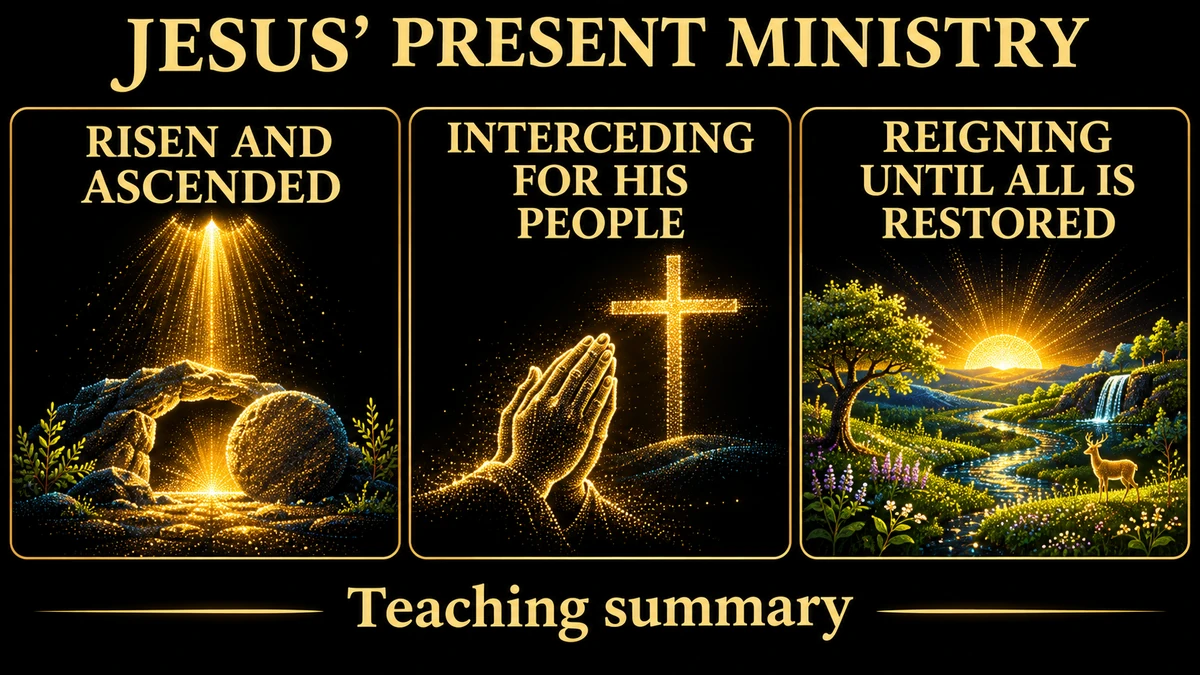
Jesus’ present ministry: risen and ascended; interceding for his people; reigning until all is restored. This is a teaching summary, not a quotation of Scripture. “All is restored” refers to the promised renewal of creation (Acts 3:21), not a claim that every person will necessarily be saved.
What this changes in prayer, suffering, and mission
Pray with confidence rather than performance
Hebrews 4:14–16 joins Jesus’ heavenly priesthood with his sympathy for human weakness. He has faced temptation without sin, and his people are invited to approach God for mercy and timely help.
You do not need an impressive vocabulary or perfectly settled emotions. Name the need, confess the wrong, and ask for help. Confidence concerns God’s welcome through Christ; it does not give us control over the timing or form of every answer. When words are hard to find, a brief request for mercy is still a real prayer. Other Christians can pray with you and help you remain attentive to God’s promises. Our guide to Christian prayer offers a practical starting point.
Allow hope and grief to remain honest
Romans 8:35–39 follows its description of Christ’s intercession with anguish, persecution, danger, and death. Its assurance is that these cannot separate believers from God’s love in Christ.
That promise leaves room for tears, questions, medical care, practical assistance, and the companionship of other people. Avoid telling someone that Christ’s reign makes their pain unreal or that sufficient confidence would guarantee recovery. Christian hope can sustain a person while the suffering continues. Our article on suffering and Christian hope explores that tension further.
Carry the witness entrusted to you
In Acts 1, Jesus redirects his disciples from speculation about the timetable toward Spirit-enabled witness. His authority sends them into the world with good news.
For ordinary Christians, that can mean explaining why you trust Jesus, inviting an honest question, supporting your church’s service, or remaining truthful when deception would be convenient. We should act diligently while remembering that conversion and spiritual growth cannot be forced. The mission belongs to the living Lord, and our responsibility is faithful participation. For practical guidance, see how to share your faith.
His promised return gives waiting a purpose
The messengers in Acts 1 promise that the Jesus who departed will return. Christian expectation therefore reaches beyond preserving his memory or keeping his ideals alive. The church awaits the Lord himself.
Jesus’ warning in Matthew 24:36–44 rules out confidence that we can identify the day and hour. Christians disagree about how various passages describe the sequence of final events, but confident date-setting exceeds what Jesus authorizes.
Readiness takes practical shape in continued faithfulness. Care for the people entrusted to you. Keep promises, seek reconciliation where possible, and resist indifference to wrongdoing. Future hope should deepen present responsibility rather than become a reason to abandon it.
Waiting can be hard, especially across prolonged suffering. The promise directs our confidence toward the one returning. It does not require us to manufacture certainty about a timetable he has not given.
A practical example: returning after a costly mistake
Imagine Elena, who discovers that an error in her work caused her employer to underestimate a project’s costs. Afraid of the consequences, she initially gives her manager an incomplete explanation. After admitting the full mistake, she feels too ashamed to pray and is tempted to leave other inconvenient details uncorrected.
Christ’s intercession gives her reason to come honestly to God. She can confess both the original concealment and her desire to protect herself. Jesus’ advocacy does not turn a misleading explanation into an acceptable one. It gives her hope that facing the truth need not end in despair.
Elena provides the missing information, separates confirmed facts from estimates, and cooperates with the people responsible for deciding what repair is possible. She asks for help putting a checking process in place. She cannot promise to recover every loss or control how her employer responds.
She prays for courage, wisdom, and the welfare of the colleagues affected. A trusted Christian friend listens and helps her keep repentance connected with concrete action. Elena continues working carefully while accepting that consequences may remain.
The assurance is that she can return to God through Christ, even with an uncomfortable meeting ahead. Forgiveness is no guarantee of escaping discipline or immediately restoring others’ trust. This illustration shows how confidence in a living advocate can support truthful repair and patient faithfulness.
Questions about Jesus’ present ministry
Where is Jesus now?
The New Testament describes the risen Jesus as in heaven at the Father’s right hand. This affirms his glorified life, authority, and presence with the Father. Scripture does not provide geographical coordinates or explain heaven in terms of ordinary physical distance.
Does Jesus still understand human weakness?
Yes. Hebrews 4:14–16 grounds confidence in his sympathetic priesthood. His exaltation does not erase his genuine humanity or make his earthly suffering irrelevant. Christians approach a Savior who knows human trials and remained faithful through them.
Why pray if Jesus already intercedes?
His intercession gives us reason to approach God. Hebrews invites people to pray because they have a great high priest. Prayer expresses dependence, gratitude, confession, and love for others; it is part of life with God rather than an effort to inform an inattentive Savior.
Is Jesus preparing a place for believers?
In John 14:1–3, Jesus promises to prepare a place and receive his disciples to himself. The emphasis is their future life with him. The passage offers assurance of belonging without describing a heavenly construction schedule.
What is a useful first step this week?
Read Hebrews 4:14–16 and 7:23–25. Bring one specific need to God, remembering who represents you. Then take one faithful action connected with that prayer: seek help, confess a wrong, care for someone, or speak truthfully about your hope.
Scripture note: Biblical passages are discussed mainly through paraphrase; links use the World English Bible. This article explains Christian theological teaching. Practical applications are commentary, and Elena’s story is an illustrative example.