

You can pray for God’s kingdom to come and still wonder what you are asking for. Is it heaven after death? A better society? The church? When Christians use the same phrase for so many things, a central part of Jesus’ teaching can begin to feel strangely distant from ordinary life.
The kingdom of God is God’s saving reign, made known and brought near through Jesus Christ. It includes the people who belong to him and the life that flourishes under his rule. That reign is already at work, while its complete fulfillment still lies ahead. Understanding both truths changes how we pray, handle power, care for neighbors, and face an unfinished world.
GUIDED ARTICLE EXPERIENCE
What Is the Kingdom of God? Living Under the Reign of Jesus
Read along as the narration moves through the article.
Browser narration · No stored audio or site tracking
CONTINUE GUIDED TOUR
Continue where you left off.
GUIDED TOUR COMPLETE
You have reached the end of this study.
Study record saved on this device.
GUIDED TOUR
What Is the Kingdom of God? Living Under the Reign of Jesus
Narrator: Paranoid Prophet Recommended Voice Native device narration
Prepare to follow the article as it is narrated.
VOICE & TOUR OPTIONS
Voice & Listening
NARRATOR
Finding a narrator…
Checking the best narrator available on this device.
Restores the site recommendations available in this browser.
Our listening picks lead when available; other voices are ranked for narration. Known novelty voices are hidden. Browser-provided voices may use an online voice service.
Screen-awake support will be checked when narration starts.
Optional: improve your device voices
Listening works with the voices already available here. Your device may offer additional free voices through its own settings.
iPhone or iPad: Settings → Accessibility → Read & Speak (or Spoken Content) → Voices → English. Look for Premium or Enhanced choices, then return here.
If offered, preview Ava or Zoe for U.S. English, or Serena or Jamie for British English. An explicit Premium or Enhanced version can improve on its compact version.
Mac: System Settings → Accessibility → Read & Speak → System voice. Open the voice list to preview or download additional choices.
Windows: Settings → Accessibility → Narrator → Add natural voices. Browser availability varies; a Narrator voice may not appear on websites. Edge may also expose online Natural voices without a model download.
Android: Open Accessibility → Text-to-speech output (the location varies by device). In the preferred engine settings, look for voice data and English choices.
Download sizes vary; some enhanced voices exceed 100 MB. This website cannot install system voices, and an installed voice appears here only if your browser exposes it.
Apple voice guide · Windows voice guide · Android voice guide
CHOOSE A NARRATOR
Recommended on this device
Our listening picks: Aaron, Martha, then Daniel, when available here. Otherwise, automatic uses the highest-ranked suitable voice. Preview alternatives or save your own choice.
Preparing the guided article experience…
RESUME GUIDED TOUR?
Continue where you left off.
GUIDED TOUR COMPLETE
You have reached the end of this study.
Article Guide10 sections
What does kingdom mean in the Bible?
A kingdom involves a king, his authority, and those who live under his rule. When Jesus announces God’s kingdom, the emphasis falls on God acting as King to rescue and restore. The phrase carries more than a location on a map or a private feeling of peace.
God did not become sovereign when Jesus began preaching. Psalm 103:19 already celebrates his rule over everything. The Old Testament also looks toward a decisive establishment of his righteous reign. In Daniel 7:13–14, a figure like a son of man receives enduring authority over peoples and nations.
Against that background, Jesus announces that God’s promised saving action is arriving through him. The Creator’s universal authority and the kingdom Jesus brings are closely related, but the announcement concerns something happening in history. God is confronting evil, calling people back to himself, and fulfilling his promises.
This also explains why the kingdom cannot be reduced to improving your mood. Personal transformation matters deeply, but God’s purpose reaches beyond an individual heart. It concerns communities, justice, embodied life, and ultimately creation itself.
Jesus announces and demonstrates the kingdom
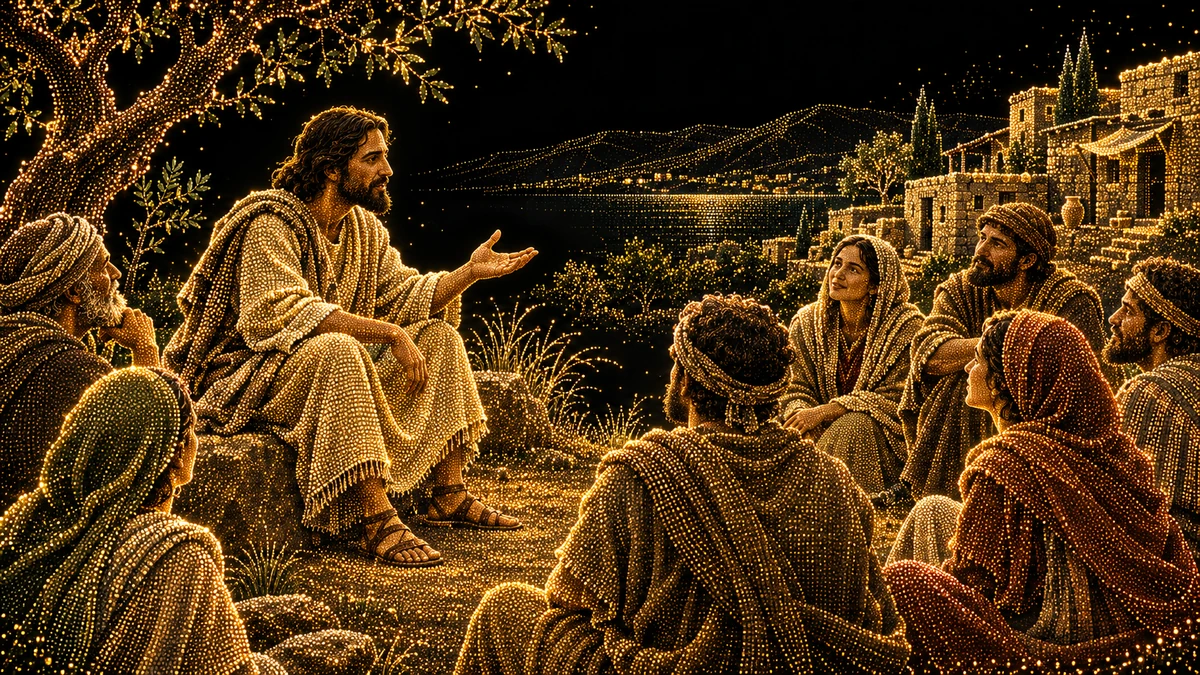
Mark 1:14–15 places Jesus’ announcement after John the Baptist’s imprisonment. Jesus proclaims the arrival of the promised time, the nearness of God’s kingdom, and the call to repent and believe the good news. The setting matters: God’s reign is being announced while injustice remains painfully visible.
Repentance means turning toward God, including a changed response to sin. Faith means trusting the good news and the one who brings it. Jesus invites more than admiration for an inspiring teacher. He calls people to entrust themselves to him and follow.
His actions give substance to his announcement. In Luke 11:14–23, opponents attribute his deliverance of a suffering man to demonic power. Jesus answers that his victory over demons by God’s power shows the kingdom has reached them. Verse 20 describes a present intervention, not simply a distant possibility.
The kingdom’s King also overturns expectations about greatness. In Mark 10:42–45, Jesus rejects domination among his disciples and connects his service with giving his life to ransom others. His death and resurrection are central to the good news about his reign.
Already present, not yet complete
Christians often describe the kingdom as “already and not yet.” This expresses the relationship between Jesus’ present victory and the future completion of God’s purposes. It does not mean that Jesus is partly King or that God is uncertain how the story will end.
You may also hear that Jesus inaugurated the kingdom. Inaugurated simply means that he brought its promised beginning into history. The word points to a real arrival whose full outcome still lies ahead. It helps distinguish the decisive work of Jesus from the ongoing response of those who follow him.
Already, Jesus has come, died, and risen. People receive forgiveness, are brought into life with God, and learn to obey him through the Holy Spirit. Jesus’ ministry makes clear that the kingdom has genuinely entered the present. Christian hope rests on something God has done.
Not yet, sin and suffering have not disappeared. Christians still grieve, become ill, and struggle to love well. In 1 Corinthians 15:20–28, Paul connects Christ’s resurrection with the future resurrection of those who belong to him and the final defeat of death. Christ reigns while that final victory awaits its completion.
Keeping both truths together protects us from two harmful conclusions. We need not assume that nothing can change until the end of history. We also should not promise that strong faith guarantees uninterrupted health, prosperity, or success today. A suffering believer has not thereby proved that the kingdom is absent from their life.
Christian traditions differ about the sequence of end-time events. This basic explanation does not require settling those disagreements. It asks us to take seriously both the present work of Christ and the promised future that remains God’s gift.
Jesus’ parables also challenge assumptions about how impressive that beginning must look. In Mark 4:26–32, seed grows beyond the farmer’s understanding, and a tiny mustard seed becomes a large plant. The farmer has work to do, but the growing life is not his invention. These pictures encourage trust in God’s work through small beginnings. They do not promise that every Christian organization will expand or that human effort can engineer the kingdom’s arrival.
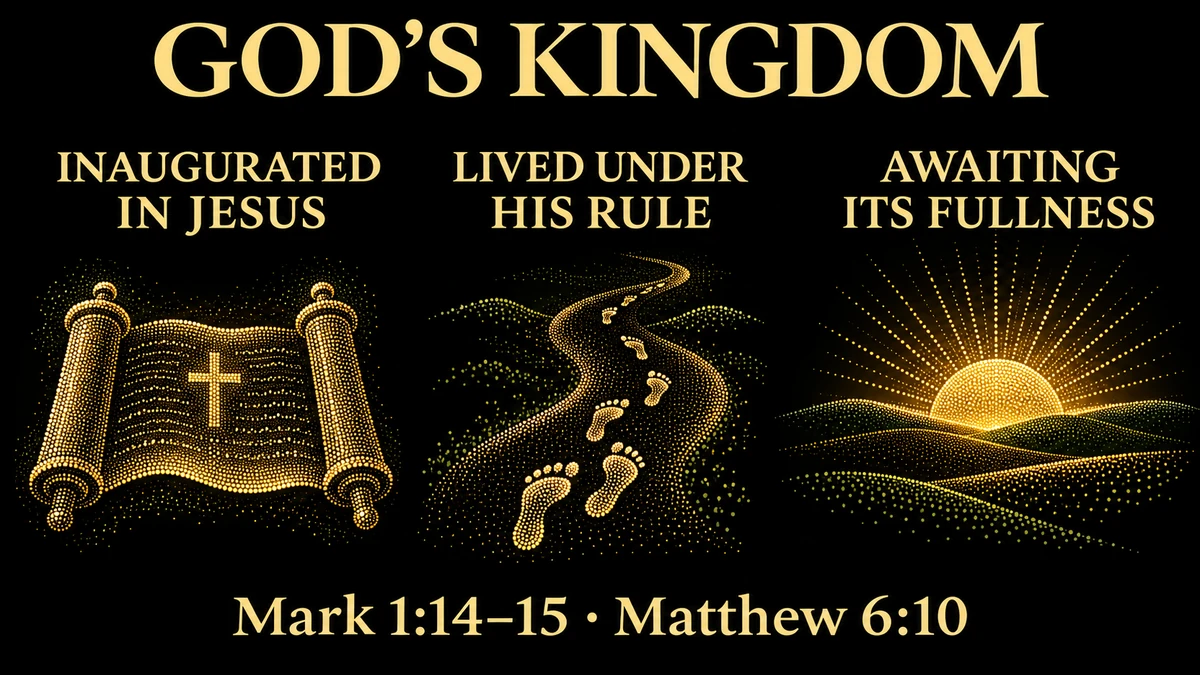
God’s kingdom: inaugurated in Jesus; lived under his rule; awaiting its fullness. Mark 1:14–15; Matthew 6:10. This is a summary of the teaching, not a quotation of those verses.
How the kingdom relates to the church
The church and the kingdom belong closely together. Jesus connects the building of his church with the keys of the kingdom in Matthew 16:13–20. Christians differ about aspects of that passage, but it prevents us from treating the gathered people of Jesus as irrelevant to his reign.
The church is the community called to receive, proclaim, and live under Christ’s rule. Through worship, teaching, baptism, the Lord’s Supper, and shared care, Christians learn a life shaped by their King. The church can become a visible sign of his mercy and reconciliation.
At the same time, God’s kingdom cannot be contained within a congregation’s programs, a denomination’s boundaries, or an institution’s success. God’s final purpose reaches to the renewal of creation. No church leader possesses the King’s unlimited authority, and no institution’s decisions should be treated as beyond correction.
These distinctions carry practical weight. A growing ministry may still need serious repentance. A small, overlooked congregation may faithfully serve Christ. Numbers, money, and influence tell us something about an organization; they cannot by themselves establish its faithfulness to God’s reign.
God’s kingdom and earthly power
Before Pilate, Jesus explains that his kingdom has a different source from the world’s kingdoms. In John 18:33–38, he points to the fact that his servants are not fighting to prevent his arrest. His kingship does not depend on the kind of force Pilate understands.
That difference does not make earthly life unimportant. Allegiance to Jesus affects how Christians speak, work, use money, protect vulnerable people, and exercise authority. Public responsibility deserves serious thought. But no political party, nation, or human institution can claim to be the kingdom of God.
This matters most when a cause we support seems urgent. Christian conviction does not excuse dishonest claims, contempt for opponents, or treating people as expendable. We should assess both the goals we pursue and the means we use. Loyalty to Jesus must remain capable of questioning our own side.
Disagreements about policy often require careful judgment rather than a claim that God endorses every detail of our preferred program. Christians can participate responsibly in civic life while refusing to give any earthly movement the trust that belongs to Christ.
What it means to seek first the kingdom
In Matthew 6:25–34, Jesus speaks about anxiety over food, drink, and clothing. His instruction in verse 33 to seek God’s kingdom and righteousness first comes within that discussion of everyday need. The Father knows that his children need material provision.
Seeking first the kingdom means letting God’s rule guide your priorities and choices. You still have work to do and bills to pay. But fear of losing status, security, or approval need not have the final say over what you are willing to do.
At work, that might mean reporting a mistake rather than hiding it to protect your reputation. In a household, it might mean giving someone an honest hearing before defending yourself. With money, it may involve responsible planning and generosity instead of treating accumulation as your only protection.
Jesus’ promise of provision is not a bargain guaranteeing wealth in exchange for religious effort. The passage ends by acknowledging tomorrow’s troubles. Seeking the kingdom includes trusting God within real responsibilities, receiving help, and responding to others’ needs. Our guide to Christian contentment explores that daily trust.
Prayer brings those priorities before God. In Matthew 6:9–10, Jesus teaches us to ask for the Father’s kingdom to come and his will to be done on earth. We are asking God to fulfill his purposes while placing our own lives at his disposal. Read more about how Christians can pray when words feel difficult.
Righteousness, peace, and joy in the Spirit
Romans 14 addresses Christians divided over foods and the observance of days. Paul challenges both contempt and judgment. In verse 17, he directs attention to righteousness, peace, and joy in the Holy Spirit as defining features of kingdom life.
His point is practical. Winning an argument over a disputed practice is a poor victory if we carelessly harm someone Christ loves. In verses 19–23, Paul urges conduct that builds others up and takes conscience seriously.
This does not turn every moral question into a matter of personal preference. It teaches Christians to handle the particular disagreements in view without pride or disregard for one another. Kingdom life has a recognizable character, including patience with people whose growth and understanding differ from ours.
Joy here is deeper than maintaining an upbeat appearance. The Spirit enables a shared life in which trust, gratitude, and reconciliation can grow. Our article on the fruit of the Spirit considers how that character develops through ordinary choices.
The future God promises
Revelation 21–22 gives the kingdom’s hope a sweeping horizon: new creation, God dwelling with his people, and the removal of death, grief, and pain. The final vision concerns restored life with God, reaching beyond the idea of souls escaping earthly existence.
Revelation 22:1–5 places God’s throne and the Lamb at the center. Its images of life, healing, and the end of the curse show the goodness of that reign. Evil does not receive an endless right to damage God’s creation.
Christians read some details of these visions differently. Their central promise nevertheless gives suffering people reason to hope: God will complete what we cannot complete. We can seek justice and offer care today without pretending our efforts will remove every wound. Our discussion of suffering and Christian hope explores living with that unfinished reality.
A practical example
Imagine Miriam, who helps organize a church food collection. A disagreement develops about how the project should run. She believes her approach would serve more families, but she begins describing another volunteer as selfish without checking his reasons.
Seeking God’s kingdom does not require Miriam to abandon her concern for effective help. It does require her to examine the way she is pursuing it. She apologizes for the accusation, asks what the other volunteer is worried about, and brings the practical options back to the group.
They may still disagree. They can compare costs, listen to families receiving help, and choose a workable plan without making personal humiliation part of the process. Miriam’s first responsibility is faithful service, not proving that every suggestion she makes carries God’s authority.
The food collection will not end hunger in their town. It can still offer real care and bear witness to their King. Its limits invite continued prayer and cooperation rather than despair. Its success gives them reason for gratitude rather than permission to congratulate themselves as if the kingdom depended on them.
Questions about the kingdom of God
Is the kingdom of heaven different from the kingdom of God?
Matthew commonly uses kingdom of heaven where other Gospels use kingdom of God. Matthew 19:23–24 uses both expressions in the same discussion. The wording should not automatically be taken to describe two separate kingdoms.
How does a person enter God’s kingdom?
Jesus calls people to repent and believe the good news. In John 3:1–8, he tells Nicodemus that entering the kingdom requires new birth through the Spirit. Religious status and personal achievement cannot manufacture that life. We depend on God’s grace and respond in faith.
Can Christians build the kingdom of God?
Christians sometimes use that phrase for sharing the gospel and serving others. It needs care: God establishes his reign, and we depend on his action. We can faithfully participate in his work, but no campaign, ministry strategy, or social achievement brings the kingdom to completion by human power.
Where should I begin this week?
Read Mark 1:14–15 and Matthew 6:25–34 slowly. Name one decision where fear or pride is directing you. Ask what trusting Jesus would change, then take one concrete step. Pray for God’s kingdom to come, remembering that the King you follow is faithful even when the results remain small.
Scripture note: Biblical passages are linked in the New International Version (NIV) and discussed mainly through paraphrase. Practical applications are commentary, and Miriam’s story is an illustrative example.