


A résumé tells people what you can do. A bank balance measures what you have. A social feed suggests how much attention you attract. None of them can tell you what a human life is worth. When those measures change, or when someone cannot meet them, Christians need a firmer answer than an encouraging slogan.
To be made in the image of God means that human beings receive their dignity from their Creator and are called to reflect his character and represent his good rule within creation. This identity belongs to humanity, including people whose abilities or circumstances differ greatly from ours. Sin distorts how we live out that calling, and Jesus Christ brings the renewal we need.
GUIDED ARTICLE EXPERIENCE
What Does It Mean to Be Made in the Image of God?
Read along as the narration moves through the article.
Browser narration · No stored audio or site tracking
CONTINUE GUIDED TOUR
Continue where you left off.
GUIDED TOUR COMPLETE
You have reached the end of this study.
Study record saved on this device.
GUIDED TOUR
What Does It Mean to Be Made in the Image of God?
Narrator: Paranoid Prophet Recommended Voice Native device narration
Prepare to follow the article as it is narrated.
VOICE & TOUR OPTIONS
Voice & Listening
NARRATOR
Finding a narrator…
Checking the best narrator available on this device.
Restores the site recommendations available in this browser.
Our listening picks lead when available; other voices are ranked for narration. Known novelty voices are hidden. Browser-provided voices may use an online voice service.
Screen-awake support will be checked when narration starts.
Optional: improve your device voices
Listening works with the voices already available here. Your device may offer additional free voices through its own settings.
iPhone or iPad: Settings → Accessibility → Read & Speak (or Spoken Content) → Voices → English. Look for Premium or Enhanced choices, then return here.
If offered, preview Ava or Zoe for U.S. English, or Serena or Jamie for British English. An explicit Premium or Enhanced version can improve on its compact version.
Mac: System Settings → Accessibility → Read & Speak → System voice. Open the voice list to preview or download additional choices.
Windows: Settings → Accessibility → Narrator → Add natural voices. Browser availability varies; a Narrator voice may not appear on websites. Edge may also expose online Natural voices without a model download.
Android: Open Accessibility → Text-to-speech output (the location varies by device). In the preferred engine settings, look for voice data and English choices.
Download sizes vary; some enhanced voices exceed 100 MB. This website cannot install system voices, and an installed voice appears here only if your browser exposes it.
Apple voice guide · Windows voice guide · Android voice guide
CHOOSE A NARRATOR
Recommended on this device
Our listening picks: Aaron, Martha, then Daniel, when available here. Otherwise, automatic uses the highest-ranked suitable voice. Preview alternatives or save your own choice.
Preparing the guided article experience…
RESUME GUIDED TOUR?
Continue where you left off.
GUIDED TOUR COMPLETE
You have reached the end of this study.
Article Guide10 sections
What Genesis actually says about God’s image
Genesis 1:26–28 connects three things: God creates humanity in his image, creates male and female, and entrusts them with responsibility for life on earth. The passage places human identity within a relationship to God before it describes anything people achieve.
The Latin expression imago Dei simply means image of God. It names a teaching whose starting point is God’s action. Human beings do not award themselves this status, and no government, employer, or religious leader can legitimately reserve it for a favored group.
Men and women share this dignity. So do people across ethnic backgrounds, social classes, and national borders. Genesis does not make image-bearing a privilege for rulers, the wealthy, or the especially talented. The calling belongs to humanity together.
Bearing God’s image does not make us divine or give us his unlimited knowledge and power. We remain creatures. Reflecting his goodness means living truthfully, exercising care, and responding to him within human limits. We honor the Creator when we acknowledge those limits rather than claiming authority that belongs to him alone.
Psalm 8 holds human smallness and human honor side by side. Under a vast sky, the psalmist wonders at God’s care for people and at the responsibility God gives them. Our significance leads toward gratitude and accountable service. It gives us no reason to imagine that we are self-sufficient.
Why Christians explain the image in different ways
Christians agree that the image matters deeply while differing about its precise meaning. Genesis connects identity and responsibility without supplying a complete philosophical definition. Three common approaches receive attention in the Lausanne Movement’s overview of the human person.
The substantive approach emphasizes what human beings are, often discussing capacities such as reasoning, moral awareness, and love. The relational approach emphasizes life in relationship with God and other people. The functional approach emphasizes humanity’s calling to represent God and exercise responsibility within creation.
Some Christians combine these approaches. Others distinguish the image itself from the relationships and responsibilities that follow from it. A foundational account need not settle every disagreement to recognize the biblical connections among human identity, fellowship, moral life, and vocation.
These categories must never become admission tests for humanity. Someone who cannot speak, reason in familiar ways, sustain social relationships, or perform productive work remains fully human. Descriptions of human capacities do not authorize ranking people’s worth by their current ability to display them.
Human dignity does not depend on usefulness
An infant does not earn dignity by becoming independent. A person living with profound disability does not receive a smaller share of it. Someone with dementia does not gradually become less human as memory changes. The source of their worth is God’s creative gift, which does not rise and fall with performance.
That conviction challenges more than openly cruel behavior. It questions the habit of listening only to influential people, treating assistance as an inconvenience, or describing someone chiefly by what their care costs. Practical decisions can be difficult without making the person disposable.
Christian communities should therefore ask concrete questions. Can people enter the building? Can they participate using accessible communication? Are decisions being made with people whenever possible, rather than merely about them? Are caregivers supported without allowing the person receiving care to disappear from the conversation?
Receiving help is an ordinary part of human life. Dependence does not place someone outside God’s purpose, and accepting necessary care is no reason for shame. Our bodies and circumstances make that dependence visible in different ways.
This applies to your own life too. Losing employment, needing support, or failing to reach a milestone can be painful. None of those experiences revokes your humanity or grants others permission to treat you with contempt.

A calling to care for God’s world
Genesis connects the image with responsibility for the earth and its creatures. Read alongside Genesis 2:15, where the human is placed in the garden to cultivate and care for it, dominion involves accountable stewardship. God remains the owner and giver of life.
The creation mandate therefore cannot reasonably serve as a blank check for waste, cruelty, or destruction. Decisions about land, animals, resources, and work should consider what faithful care requires. Christians may disagree about particular policies while sharing responsibility to take those questions seriously.
BibleProject’s treatment of the image of God highlights the connection between humanity’s representative calling and Jesus’ way of exercising authority. That connection helps keep power from becoming the measure of success. A representative answers to the character and purposes of the one represented.
Daily work can participate in this calling: growing food, teaching a skill, repairing something, organizing fair systems, or caring for a household. Paid employment is only one setting for service. Being temporarily or permanently unable to work does not cancel a person’s place in the human family. Our responsibility also includes making room for others’ contributions without demanding that everyone contribute in the same way.
Our guide to what the Bible teaches about work explores that connection between ordinary responsibilities and service to God.
Sin distorts the image without erasing it
The Bible describes human rebellion with seriousness. We use intelligence to deceive, relationships to control, and authority to exploit. The gifts associated with our calling can become instruments of harm. Christians often describe this as the image being marred or distorted.
That language concerns sin. Disability, illness, and dependence must never be confused with moral failure or treated as evidence that someone bears less of God’s image.
Yet Scripture continues to identify fallen human beings with God’s image. After the flood, Genesis 9:1–7 grounds the gravity of taking human life in the fact that God made humanity in his image. The passage addresses a world already marked by violence. Human sin has not removed the reason human life must be treated seriously.
James 3:7–12 brings the same conviction into speech. James condemns using the tongue to praise God while cursing people made in God’s likeness. His argument depends on those people continuing to bear that likeness.
Even a person who does great wrong remains human and must be held accountable as a human being. We can name an offense, protect those harmed, and pursue justice without treating the offender as an animal or an object. Respect for dignity strengthens the demand for truthful accountability because the people affected by wrongdoing also bear God’s image.
Jesus reveals the image and renews his people
Colossians 1:15–20 identifies the Son as the image of the invisible God. The passage also describes creation through him, his supremacy, and reconciliation through his death. Jesus is no ordinary example of a morally impressive person. He reveals God and accomplishes the rescue his people need.
His way of using authority shows what faithful human life looks like. In Matthew 20:25–28, Jesus contrasts the disciples’ calling with domination and directs them toward service. His own giving of his life stands at the center. Faithful representation of God cannot be separated from the character of this King.
Renewal also becomes concrete. Colossians 3:1–14 describes the new self being renewed according to the Creator’s image. Around that statement, Paul addresses lying, destructive anger, compassion, patience, forgiveness, and love. Renewal changes how people live together.
Ephesians 4:17–32 similarly joins new life in God’s likeness with truthfulness, honest labor, generous sharing, and words that help others. Spiritual growth reaches the conversation, the paycheck, and the unresolved grievance.
Christians depend on God’s grace throughout this process. 2 Corinthians 3:17–18 attributes transformation into the Lord’s image to the Spirit. Growth involves repentance and faithful practice, but it is not a private project of manufacturing perfection. Our guide to the fruit of the Spirit explores the character this life produces.
Renewal also has a future horizon. In 1 Corinthians 15:42–49, Paul connects resurrection with bearing the image of the heavenly man, Christ. Christian hope includes God’s victory over bodily decay and death. We do not have to pretend that present life already displays that completed future. We can care faithfully for people now while trusting that God will finish his work.
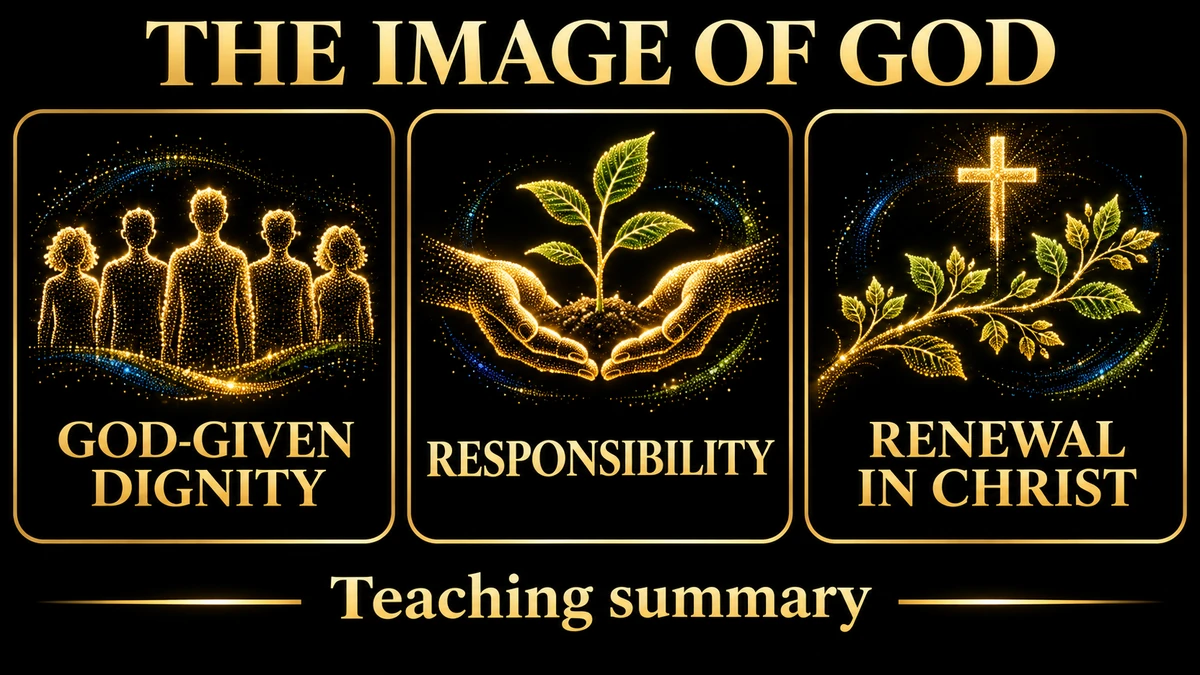
Image-bearing: God-given dignity; responsibility; renewal in Christ. This is a teaching summary, not a quotation of Scripture.
How image-bearing changes everyday relationships
Start with the person you find easiest to dismiss. That might be a difficult customer, a political opponent, an unfamiliar neighbor, or someone who needs more time to answer. Their dignity does not depend on making your day convenient.
In conversation, let people describe their experience before you decide what they need. In disagreement, address the actual claim instead of attacking appearance, disability, background, or intelligence. Online, check allegations before passing them along. A person’s humiliation should not become entertainment simply because your friends approve.
Within a church, friendship should extend beyond people who can help a ministry look successful. Shared meals, accessible gatherings, reliable visits, and willingness to receive another person’s help make belonging tangible. Christian friendship involves mutual care rather than treating one group as perpetual helpers and another as perpetual projects.
Dignity also shapes boundaries. You do not have to permit mistreatment to demonstrate another person’s worth. Protecting yourself or someone else can be a faithful response to the value of human life. Accountability should seek safety and truth without adding unnecessary humiliation.
For difficult relationships, our article on loving neighbors and enemies considers practical mercy alongside honest accountability and wise limits.
A practical example: whose voice gets heard?
Imagine Daniel helping his church arrange a community meal. Ruth, a longtime member who uses a communication device, wants to help plan the event. When the group discusses assignments, someone answers for her and assumes she will simply attend as a guest.
Daniel realizes that the planning process has confused needing an accommodation with having nothing to contribute. He asks Ruth directly what she would enjoy doing and gives her time to respond. She wants to coordinate the welcome messages and suggests a clearer arrival plan.
The group checks what tools and support would make that possible. They also review access to the room and seating rather than leaving those details until the day of the meal. Ruth’s participation helps improve the event, but her value was never waiting for that useful result.
If she later needs to step back, she still belongs. The same is true for the tired volunteer, the guest who cannot donate, and the newcomer who has little to say. The meal succeeds as an act of hospitality when people are received as people, including those who cannot repay the welcome.
The example is ordinary on purpose. Belief in God’s image becomes visible through who gets addressed, who gets heard, and whether help preserves another person’s agency.
A practice for the coming week
Read Genesis 1:26–28, James 3:7–12, and Colossians 3:1–14 together. Notice the movement from creation, to responsibility for our words, to renewal in Christ. Ask where your behavior has begun to measure people mainly by convenience, usefulness, or agreement.
Choose one change you can carry out: correct a demeaning comment, make a gathering more accessible, ask someone’s preference before helping, or apologize without defending the insult. If you have been measuring yourself by output, receive one necessary form of help without describing yourself as a burden.
Pray for the Spirit to make your treatment of people more consistent with what you confess about their Creator. Then return to that concrete change when the week becomes busy.
Questions about being made in God’s image
Does God’s image mean we physically look like God?
The teaching cannot be reduced to matching God’s physical appearance. John 4:24 describes God as spirit. Christians also confess that the eternal Son truly became human. Our embodied lives matter, but no particular appearance, body type, or physical ability is the standard for bearing God’s image.
Are people who do not believe in God still image-bearers?
Yes. Genesis speaks about humanity, and James bases respect for people on God’s likeness rather than their religious agreement with us. Christians should recognize this dignity in believers and unbelievers alike. Disagreement about faith never grants permission for contempt, coercion, or degrading treatment.
Is being God’s image the same as being saved?
No. The image describes humanity’s created identity and calling. Salvation concerns reconciliation with God through Christ. John 1:12–14 connects becoming God’s children with receiving and believing in Christ. Christians can affirm everyone’s created dignity while proclaiming the need for redemption and new life.
Does having dignity mean every choice is good?
No. Human worth and moral approval are different judgments. Our choices can seriously harm people and require repentance, restitution, or protective consequences. The image of God gives us a reason to care about what people do, because their actions affect other people who also deserve truthful and humane treatment.
Scripture note: Biblical passages are linked in the New International Version (NIV) and discussed through paraphrase. Interpretive approaches are summarized rather than presented as universally agreed definitions. Practical guidance is application, and Daniel and Ruth’s story is an illustrative example.