
You can know people at church, recognize everyone in the group chat, and still wonder who you could call when life falls apart. Christian friendship grows when familiar faces become people who listen, tell the truth with care, and show up when helping costs them something.
Scripture gives that friendship a shape: sincere love, patient presence, shared burdens, gentle correction, and mutual encouragement toward Christ. These practices take time. They also require wisdom about trust, responsibility, and limits. A friend can walk beside you without taking control of your life.
GUIDED ARTICLE EXPERIENCE
Christian Friendship: Encouragement, Honesty, and Carrying Burdens
Read along as the narration moves through the article.
Browser narration · No stored audio or site tracking
CONTINUE GUIDED TOUR
Continue where you left off.
GUIDED TOUR COMPLETE
You have reached the end of this study.
Study record saved on this device.
GUIDED TOUR
Christian Friendship: Encouragement, Honesty, and Carrying Burdens
Narrator: Paranoid Prophet Recommended Voice Native device narration
Prepare to follow the article as it is narrated.
VOICE & TOUR OPTIONS
Voice & Listening
NARRATOR
Finding a narrator…
Checking the best narrator available on this device.
Restores the site recommendations available in this browser.
Our listening picks lead when available; other voices are ranked for narration. Known novelty voices are hidden. Browser-provided voices may use an online voice service.
Screen-awake support will be checked when narration starts.
Optional: improve your device voices
Listening works with the voices already available here. Your device may offer additional free voices through its own settings.
iPhone or iPad: Settings → Accessibility → Read & Speak (or Spoken Content) → Voices → English. Look for Premium or Enhanced choices, then return here.
If offered, preview Ava or Zoe for U.S. English, or Serena or Jamie for British English. An explicit Premium or Enhanced version can improve on its compact version.
Mac: System Settings → Accessibility → Read & Speak → System voice. Open the voice list to preview or download additional choices.
Windows: Settings → Accessibility → Narrator → Add natural voices. Browser availability varies; a Narrator voice may not appear on websites. Edge may also expose online Natural voices without a model download.
Android: Open Accessibility → Text-to-speech output (the location varies by device). In the preferred engine settings, look for voice data and English choices.
Download sizes vary; some enhanced voices exceed 100 MB. This website cannot install system voices, and an installed voice appears here only if your browser exposes it.
Apple voice guide · Windows voice guide · Android voice guide
CHOOSE A NARRATOR
Recommended on this device
Our listening picks: Aaron, Martha, then Daniel, when available here. Otherwise, automatic uses the highest-ranked suitable voice. Preview alternatives or save your own choice.
Preparing the guided article experience…
RESUME GUIDED TOUR?
Continue where you left off.
GUIDED TOUR COMPLETE
You have reached the end of this study.
In this article: What makes friendship Christian? · Carrying burdens · Honesty and accountability · Loneliness and beginnings · A practical example · Questions
Article Guide9 sections
What makes friendship Christian?
Christian friendship is a relationship shaped by love for Christ and a desire for another person’s good. Shared interests may start the conversation. Faith gives friends a reason to keep caring when convenience, agreement, or easy enjoyment runs out.
In Romans 12, Paul moves from presenting our lives to God into the ordinary responsibilities of life together. He describes sincere love, honoring others, meeting needs, hospitality, and sharing both joy and grief. The passage concerns the wider Christian community. Close friendships are one setting where that teaching becomes personal.
A friend who celebrates your good news without making it a competition is practicing that love. So is the person who sits with you after a difficult diagnosis instead of searching for a quick explanation. The command to weep with those who weep leaves room for tears before advice.
Jesus gives Christian love its deepest pattern in John 15:12–17. Speaking to his disciples before his death, he connects love with his own self-giving and calls them friends. This passage directs our attention first to Jesus and his mission. His love then teaches his followers how to love one another. It does not authorize a friend to claim Christ’s authority over your decisions.
Friendship also belongs within a larger life of worship and community. A close friend cannot provide everything a congregation, family, counselor, or wider network might provide. Our article on what the church is explores that broader belonging. Here the question is more personal: how do we become faithful companions within it?
Carrying burdens without taking over
Galatians 6:1–5 holds two responsibilities together. Christians should help carry one another’s burdens, and each person should examine their own actions and carry their own responsibility. Paul places these instructions alongside gentle restoration and a warning against pride.
It is easy to use one half of that passage against the other. We can tell struggling people to handle everything themselves. We can also become so involved in another person’s problems that we begin directing their life. The passage calls for mutual help and personal responsibility together.
The immediate context includes someone caught in wrongdoing. Those who help should restore gently and watch themselves. They are fellow people who need grace, rather than superior people who have graduated beyond temptation. That posture matters when a friend admits a failure they are ashamed of.
The wider call to care also gives us a way to approach grief, exhaustion, illness, and practical need. Ask what would help instead of assuming you know. A meal, a ride, an hour of childcare when appropriate, or company during a difficult afternoon may be more useful than another long message.
Make the offer specific and realistic: “I can bring dinner Thursday. Would that help?” A promise you can keep builds trust. An impressive promise that disappears can deepen disappointment.
Receiving care matters too. Some people are comfortable helping everyone else but feel ashamed when they need support. Galatians describes a community in which burdens are shared. You do not have to earn permission to need someone by staying useful all the time.
There are limits to what friendship can carry alone. A friend can accompany you while you seek qualified care, help you prepare questions, or listen afterward. Medical, legal, or serious mental health needs may require trained help. Friendship remains valuable alongside that help. Our guide to suffering and Christian hope explores how Christians can face pain without pretending it is easy.

Honesty that helps rather than humiliates
Proverbs 27:5–6 commends faithful correction over concealed love and deceptive affection. Read within biblical wisdom, this teaches us to value a friend’s truthful concern. It gives no license for cruelty. A person who enjoys embarrassing you cannot make the behavior loving by quoting a verse about correction.
Start with what you actually know. “You interrupted her several times, and she seemed hurt” is more responsible than “You always need to control everyone.” The first describes an observable concern. The second claims access to motives and turns a moment into a verdict on character.
A helpful conversation usually includes four things: a specific concern, a willingness to hear the other person, a clear reason the issue matters, and a practical next step. Choose a private setting when possible. Public performance rarely helps a friend face something difficult honestly.
You might say, “Can we talk about what happened at dinner? I may be missing something, but the joke seemed to hurt him. What was going on?” Then listen. You may learn that your understanding was incomplete. You may also need to remain clear that a harmful action needs to be addressed.
Receiving correction requires humility as well. You can ask for examples, take time to think, and acknowledge what is true without accepting every accusation. A friend’s confidence does not make every judgment correct.
Accountability works best when people understand what they are agreeing to. Discuss what support you want, how often to check in, and what information is appropriate to share. An invitation to ask about a struggle does not grant unrestricted access to private messages, passwords, finances, or every relationship.
Trust also needs clear limits around confidentiality. Do not spread a friend’s vulnerability as entertainment or a prayer request without their permission. At the same time, never promise to hide abuse, credible threats, or immediate danger. Seek appropriate help when safety requires it, and share only what is necessary with people who can respond responsibly.
Can good friends disagree?
Yes. Faithful friends can reach different judgments about many decisions and disputed questions. The task is to understand what kind of disagreement you are having.
An explicit moral concern, an interpretation that Christians debate, and a personal preference deserve different conversations. Before correcting someone, ask whether you can show the issue in context from Scripture or whether you are mostly defending what feels familiar to you.
You might prefer different schooling arrangements, worship music, or ways of organizing family schedules. Friendship does not require identical choices. Where a disagreement involves real harm, honesty and protection may be necessary. Where it concerns a matter of conscience, patient discussion may leave room for different conclusions.
Try asking, “Which passage is shaping your view?” or “What do you think I am overlooking?” Those questions make space for understanding without requiring either person to pretend the issue does not matter.
Romans 12:18 recognizes limits: peace should be pursued as far as it depends on us. You can speak respectfully and still be unable to secure another person’s cooperation. Repeated threats, manipulation, or demands for unquestioning loyalty are reasons to seek help and reconsider access, not evidence that you have failed at friendship.
When someone has caused harm, forgiveness, reconciliation, and restored trust need careful attention. That is the focus of our article on Christian forgiveness and reconciliation. Forgiveness does not mean you must stay close regardless of what happens.
Loneliness and the slow work of beginning
Loneliness can persist even when you are making an effort. Moving, bereavement, disability, demanding work, caregiving, and changes in family life can make companionship harder to build. Having few close friends is not proof of weak faith or defective character.
There is no biblical formula guaranteeing that one invitation produces a lasting friendship. Wisdom gives us practices we can try while being honest about that uncertainty.
Begin with repeated, manageable contact. A regular conversation after church, a shared walk, a small group, or a practical service activity can create opportunities to know someone over time. Choose something that fits your actual capacity. For someone who is housebound, a regular phone call or accessible online gathering may be more realistic than another instruction to attend an event.
Invite one person to one ordinary thing. “Would you like to get coffee after church next week?” is easier to answer than an undefined request to become closer. If they decline, you can respect the answer without treating it as a verdict on your worth.
Let trust develop gradually. Share something real without feeling required to disclose your most painful history immediately. Notice whether the other person listens, respects a no, keeps appropriate confidence, and follows through. Be willing to practice those same habits yourself.
Hebrews 10:19–25 connects gathering and mutual encouragement with confidence in Christ and perseverance in hope. It urges believers to consider how to encourage one another toward love and good works. Applying that passage well means noticing people and helping them participate, including those whose circumstances make attendance difficult. Shame is a poor substitute for care.
Christians can also enjoy genuine friendships with people who do not share their faith. Treat those friends as people worthy of love, attention, and honesty. Do not make kindness depend on winning an argument or securing a conversion. Close Christian friendships add the particular gift of shared prayer, worship, and encouragement in following Jesus.
A practical example: when a friend starts withdrawing
Suppose a friend who recently lost a job stops joining your usual Saturday breakfast. You notice shorter replies and assume they are embarrassed. That explanation might be right, but you have not asked.
You send a simple message: “I have missed seeing you. Would company help this week?” They explain that money is tight and they do not want another conversation about applications.
Now you know more. You could offer a walk instead of breakfast, listen without turning the time into a job-search review, and ask whether there is one practical task they would welcome help with. If they want advice, you can offer it. If they want an hour of ordinary company, you can respect that too.
A week later, follow up without demanding a report. Keep inviting them in ways they can comfortably accept or decline. If their needs exceed what you can offer, talk together about other support rather than silently assuming you must become their only source of help.
This example is a practical application of Romans 12:9–18 and Galatians 6:1–5. The steps below are a guide, not a biblical formula or a guarantee of a particular outcome.
Friendship that carries burdens
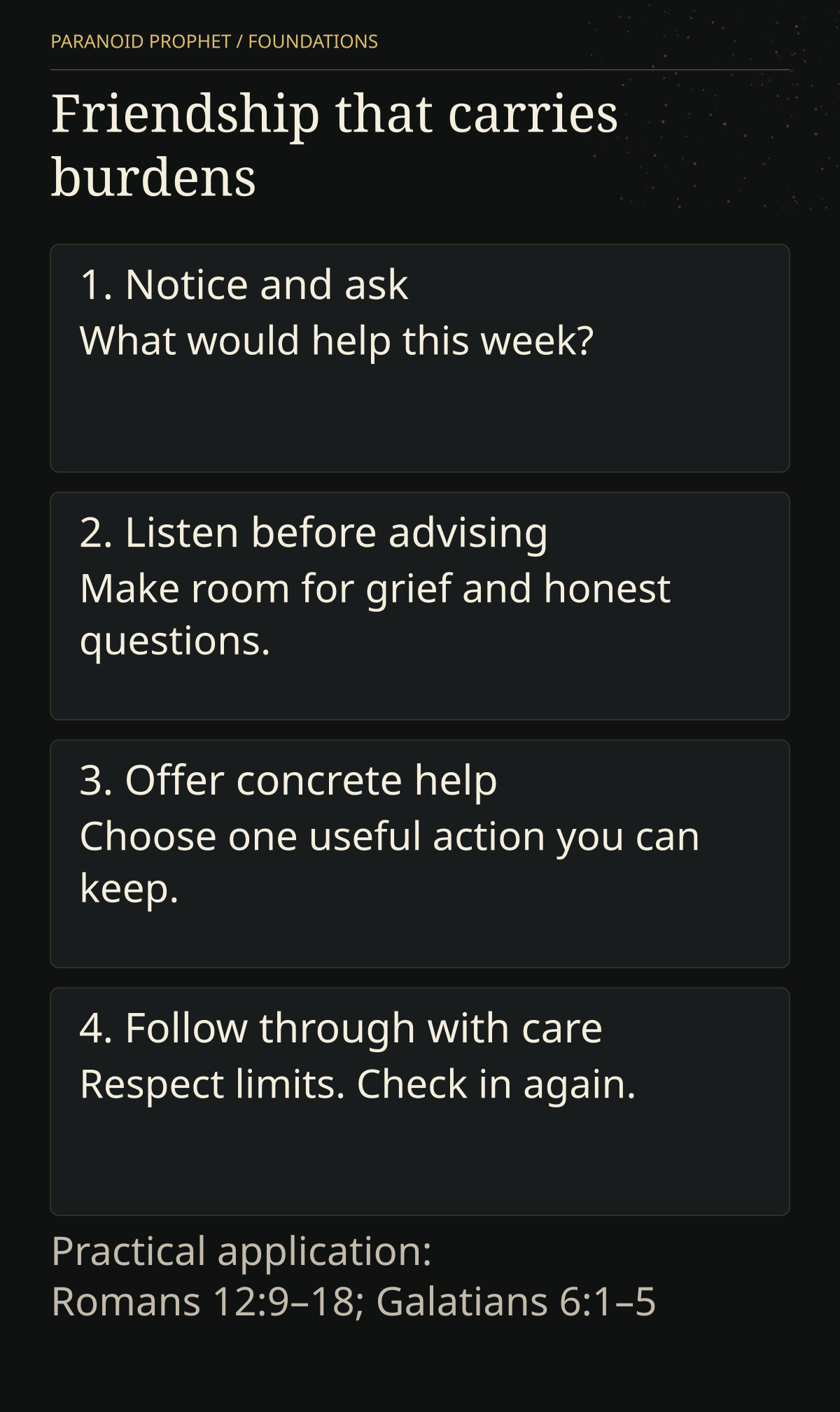
- Notice and ask. What would help this week?
- Listen before advising. Make room for grief and honest questions.
- Offer concrete help. Choose one useful action you can keep.
- Follow through with care. Respect limits. Check in again.
Questions about Christian friendship
What if I am always the one reaching out?
Some seasons are uneven. Illness, grief, or caregiving may limit what a friend can give. Look at the wider pattern before deciding what it means. You can ask honestly about the relationship and adjust your expectations. Mutual care matters, but friendship is not a weekly accounting exercise. You are also allowed to stop pursuing a level of closeness the other person does not want.
Does loyalty mean agreeing with my friend?
Loyalty can require a gentle challenge. It also requires fairness: hearing their account, admitting what you do not know, and refusing to use private information against them. You can care deeply about someone while declining to participate in wrongdoing or defend a false claim.
How often should Christian friends pray together?
Scripture encourages prayer, but it gives no required schedule for a friendship. Ask whether the other person would welcome prayer. Keep requests private unless they agree to share them. A brief, sincere prayer can accompany practical help without becoming a test of how spiritual either of you is.
Can I step back from a harmful friendship?
Yes. Threats, coercion, repeated humiliation, or pressure to conceal harm deserve serious attention. Seek trusted, appropriate support and prioritize safety. Christian love does not require giving someone unlimited access to you. In ordinary conflict, a clear conversation may help; in an unsafe situation, direct confrontation may be unwise.
One faithful step this week
Think of one person whose life you know well enough to notice a need. Ask a real question. Make an invitation you can keep. If you are the one carrying a heavy burden, consider telling a trustworthy person what kind of help would matter.
Christian friendship usually grows through these ordinary acts. Over time, truthful words, patient listening, and dependable care give people room to be known. That is meaningful work in a world where many people are surrounded by contact and still short of companionship.
Scripture and further reading
- Romans 12:9–18: sincere love, hospitality, shared joy and grief, and the limits of peacemaking.
- Galatians 6:1–10: gentle restoration, bearing burdens, personal responsibility, and doing good.
- Proverbs 27:5–10: truthful counsel and the value of a faithful friend.
- John 15:12–17: Jesus’ self-giving love and his words to the disciples about friendship.
- Hebrews 10:19–25: confidence in Christ, gathering, and mutual encouragement.
Biblical passages are summarized in this article rather than quoted at length. Practical examples and suggested questions are applications of the passages, not additional biblical commands.