


You can finish a Bible study and still lose your temper before dinner. You can mean to speak kindly and hear yourself deliver the same cutting remark again. The distance between what you believe and how you behave can be discouraging, especially when you assumed Christian growth would become easier by now.
The fruit of the Spirit describes the character God grows in his people as they follow Christ. It reaches ordinary places: your response to an interruption, the way you handle disagreement, and what you do after you hurt someone. Understanding it begins with grace and leads into practical obedience. Our guide to who the Holy Spirit is introduces the Spirit who gives this life.
GUIDED ARTICLE EXPERIENCE
What Is the Fruit of the Spirit? Growing in Christian Character
Read along as the narration moves through the article.
Browser narration · No stored audio or site tracking
CONTINUE GUIDED TOUR
Continue where you left off.
GUIDED TOUR COMPLETE
You have reached the end of this study.
Study record saved on this device.
GUIDED TOUR
What Is the Fruit of the Spirit? Growing in Christian Character
Narrator: Paranoid Prophet Recommended Voice Native device narration
Prepare to follow the article as it is narrated.
VOICE & TOUR OPTIONS
Voice & Listening
NARRATOR
Finding a narrator…
Checking the best narrator available on this device.
Restores the site recommendations available in this browser.
Our listening picks lead when available; other voices are ranked for narration. Known novelty voices are hidden. Browser-provided voices may use an online voice service.
Screen-awake support will be checked when narration starts.
Optional: improve your device voices
Listening works with the voices already available here. Your device may offer additional free voices through its own settings.
iPhone or iPad: Settings → Accessibility → Read & Speak (or Spoken Content) → Voices → English. Look for Premium or Enhanced choices, then return here.
If offered, preview Ava or Zoe for U.S. English, or Serena or Jamie for British English. An explicit Premium or Enhanced version can improve on its compact version.
Mac: System Settings → Accessibility → Read & Speak → System voice. Open the voice list to preview or download additional choices.
Windows: Settings → Accessibility → Narrator → Add natural voices. Browser availability varies; a Narrator voice may not appear on websites. Edge may also expose online Natural voices without a model download.
Android: Open Accessibility → Text-to-speech output (the location varies by device). In the preferred engine settings, look for voice data and English choices.
Download sizes vary; some enhanced voices exceed 100 MB. This website cannot install system voices, and an installed voice appears here only if your browser exposes it.
Apple voice guide · Windows voice guide · Android voice guide
CHOOSE A NARRATOR
Recommended on this device
Our listening picks: Aaron, Martha, then Daniel, when available here. Otherwise, automatic uses the highest-ranked suitable voice. Preview alternatives or save your own choice.
Preparing the guided article experience…
RESUME GUIDED TOUR?
Continue where you left off.
GUIDED TOUR COMPLETE
You have reached the end of this study.
Article Guide7 sections
Galatians 5 in context
Paul names the fruit of the Spirit in a letter defending the freedom believers have through Christ. In Galatians 5:1–6, he challenges reliance on circumcision and law-keeping as the basis of being right with God. The Christian life begins with dependence on Christ rather than a successful record of religious achievement.
That freedom carries a responsibility toward other people. Paul warns against using it for self-indulgence and directs believers toward loving service. His discussion of the flesh and the Spirit follows an urgent warning about Christians tearing one another apart. Character matters within a community already experiencing conflict. Read Galatians 5 in the NIV.
Here, flesh refers to sinful human life in opposition to God. It does not mean that having a body, feeling tired, or needing food is sinful. Paul includes jealousy, hostility, and divisiveness alongside other destructive behavior. Religious communities can become deeply unhealthy while overlooking the sins that damage their relationships.
Paul then names love, joy, peace, forbearance, kindness, goodness, faithfulness, gentleness, and self-control. The NIV uses forbearance where many readers are familiar with patience. These qualities describe the life the Spirit produces. Paul closes by warning against pride, provocation, and envy.
That context should change the questions we ask. We may wonder whether we sound knowledgeable or appear spiritually impressive. A more searching question is whether people encounter honesty, patience, and care when they deal with us, especially when they cannot offer us anything in return.
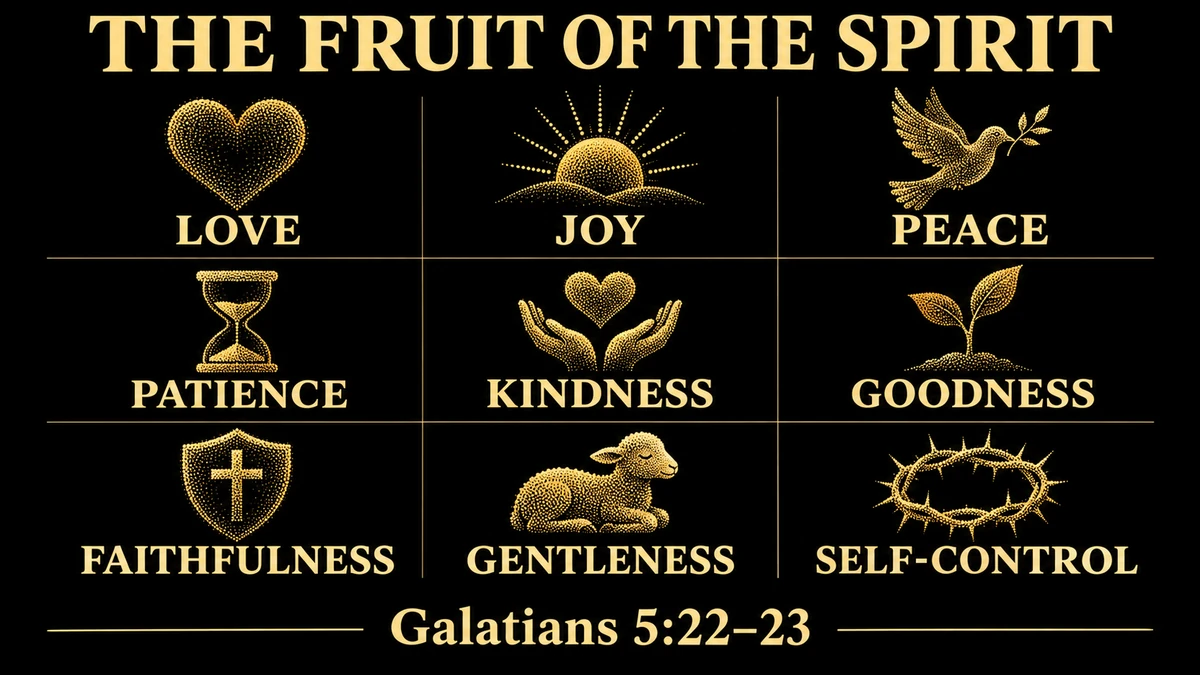
The fruit of the Spirit: love, joy, peace, patience, kindness, goodness, faithfulness, gentleness, and self-control. The NIV uses forbearance where the illustration uses patience.
The nine qualities
These descriptions are practical applications of Paul's list, rather than nine separate personality types. Some situations require several qualities at once. An honest apology, for example, may require love, gentleness, faithfulness, and self-control together.
Love: seeking another person's good
Love pays attention to what will actually help someone. It may mean giving time, telling an uncomfortable truth, or letting another person finish speaking without planning your defense. Warm feelings can accompany love, but the responsibility to care remains when those feelings are absent.
Ask yourself: am I trying to help this person, or am I trying to win their approval? Those aims can produce different choices. Saying yes to every request may preserve your reputation while leaving you unable to keep the commitments you already made.
Joy: receiving God's goodness honestly
Joy can include delight, gratitude, and confidence in God. It does not require a cheerful performance through every painful season. A grieving Christian may receive a small kindness with gratitude while still crying through the afternoon.
Avoid using joy as a test that people must pass before they can describe their suffering. Making room for sorrow allows gratitude to be truthful. You can notice what is good without claiming that everything is good.
Peace: refusing to feed needless hostility
Peace takes practical shape when we stop escalating conflict, listen carefully, and pursue honest reconciliation where possible. It does not require pretending an unresolved problem has disappeared. Sometimes peace begins with a difficult conversation conducted without threats or contempt.
You cannot control another person's response. Setting a boundary or seeking protection from abuse can be consistent with pursuing peace. A quiet room is not necessarily a safe room, and silencing the person being harmed does not resolve the harm.
Forbearance: making room for another person's limits
Patience becomes visible when a child repeats a question, a colleague learns slowly, or a friend needs time to explain something painful. It gives people room without treating their limits as personal insults.
Patience also leaves room for clear expectations. You can calmly explain a deadline or address a repeated problem. Waiting indefinitely while someone refuses responsibility is not the only faithful option.
Kindness: making care concrete
Kindness notices the person who is easy to overlook. It may look like explaining a confusing process without making someone feel foolish, checking whether a neighbor needs help, or speaking respectfully to a person whose mistake inconvenienced you.
A useful question is simple: what would make this moment less burdensome for someone else? The answer may be small enough to act on immediately.
Goodness: choosing what is right when it costs
Goodness includes moral integrity. It matters when a misleading explanation would protect your image, when an unfair arrangement benefits you, or when you could let someone else receive the blame.
Practice naming the truthful action before calculating how it will make you look. Return what you owe. Correct the inaccurate statement. Give credit to the person who did the work. Ordinary integrity often becomes costly before it becomes visible.
Faithfulness: becoming dependable
Faithfulness takes shape in loyalty, reliability, and honest commitment. People should not have to wonder whether your promises will survive a change in mood or a more attractive invitation.
When circumstances prevent you from following through, tell the person promptly. Explain what happened, acknowledge the inconvenience, and offer a realistic repair. Dependability includes how you handle a promise you can no longer keep.
Gentleness: handling people with care
Gentleness matters especially when you have power: as a parent, employer, teacher, ministry leader, or knowledgeable friend. You can be clear about wrongdoing without humiliating the person in front of you.
Consider your volume, timing, and choice of setting. A necessary correction offered privately may help someone change. The same correction delivered as a public performance may primarily display your authority.
Self-control: taking responsibility for your response
Self-control helps you resist an impulse rather than making other people absorb it. You can feel angry without sending the message, feel envy without undermining someone, and feel tempted without arranging an opportunity to act on it.
Practical limits can help: leave the argument briefly, put the phone down, change an unhealthy routine, or ask someone trustworthy for support. Needing structure does not make obedience less sincere.
Fruit and spiritual gifts
Spiritual gifts concern the different ways the Spirit equips believers to serve. Paul describes their variety and their purpose of benefiting the community in 1 Corinthians 12. Christians have different responsibilities and capacities. No individual supplies everything the church needs.
The fruit of the Spirit concerns character that belongs throughout Christian life. Patience is not reserved for people with quiet personalities. Gentleness is not optional for gifted teachers. A person's usefulness in one setting does not excuse cruelty in another.
Paul makes the importance of love especially clear in 1 Corinthians 13. Impressive speech, knowledge, and sacrifice lose their spiritual value when love is absent. Read that chapter alongside the discussion of gifts, rather than treating it only as a wedding reading.
This distinction matters when choosing whom to trust. A compelling platform, confident answers, or a successful ministry cannot settle every question about someone's character. Look at how they respond to correction and how they treat people with little influence. Accountability remains necessary even when a person has helped many people.
How growth happens
Jesus describes his disciples as branches dependent on him in John 15. Fruitfulness belongs to remaining in Christ, with his teaching shaping their lives. The image gives us a way to understand dependence: Christian growth draws its life from a relationship we cannot replace with willpower.
This growth belongs to sanctification, the ongoing work of becoming more like Christ. That dependence includes real action. Read a manageable passage carefully. Pray about the specific situation you are avoiding. Join other believers in worship and service. Confess the wrong you can name, and take the next responsible step. These practices make room for attention and obedience; they do not place God in your debt.
Choose one repeated situation rather than attempting a complete personal overhaul by Monday. Perhaps you interrupt people when you feel criticized. Before the next conversation, ask God for patience, decide to let the person finish, and prepare one clarifying question. Afterward, review what happened honestly.
Christian friendship can provide a setting for honest encouragement. Invite help from someone who knows you well enough to notice a pattern. Ask a concrete question: “Have I become more willing to listen when we disagree?” That is easier to answer than “Am I a better Christian?” Listen without demanding reassurance.
In Galatians 6:1–10, Paul moves into gentle restoration, shared burdens, personal responsibility, and perseverance in doing good. Growth belongs in that kind of community. People need help without being treated as projects, and correction without contempt.

A practical example
Imagine a coworker sends a group message blaming you for a missed deadline. You believe the accusation leaves out important facts. Your first draft is sharp, detailed, and designed to embarrass them in front of everyone.
Begin by stopping before you send it. Take time to settle enough to think clearly. Pray specifically: “Help me tell the truth without trying to wound them.” Self-control creates room to choose your response while the concern is still real.
Next, separate the facts from your assumptions. What was the deadline? What did you agree to deliver? Which part did you miss? Which facts need correction? Faithfulness and goodness require owning your responsibility even if the coworker also behaved badly.
Then write something proportionate: “I missed the Tuesday update, and I am sorry for that. The delivery date we agreed on was Friday. I can send the current draft this afternoon. Could we talk directly about the remaining concerns?”
This response does several things at once. It acknowledges an actual failure, corrects the record, offers a concrete next step, and makes room for a less public conversation. Gentleness guides the delivery while truthfulness guides the content.
If public blaming becomes a repeated pattern, document the relevant facts and use appropriate workplace support. Patience does not require accepting ongoing mistreatment. The goal is responsible conduct, including reasonable protection, rather than unlimited access for someone who keeps causing harm.
Finally, consider what repair remains. Send the promised draft. Ask whether your communication contributed to confusion. You may still feel angry afterward. A faithful action does not always bring immediate emotional relief.
Questions
Does struggling mean I do not have the Spirit?
A difficult struggle or a serious failure cannot by itself settle the question of your relationship with God. Take sin seriously without turning every setback into a final verdict. Look for a willingness to repent, receive help, and change direction. If this question becomes a recurring source of fear, talk with a trustworthy pastor who can listen to your circumstances.
Can I choose the qualities that fit my personality?
The whole list belongs to Christian character. You may naturally find some practices easier than others, but personality does not excuse harshness, dishonesty, or indifference. A direct person can learn gentleness. A quiet person can learn the courage to speak truthfully.
Why does growth feel so slow?
Habits have histories, and circumstances affect what change requires. Fatigue, grief, illness, and heavy responsibilities can make ordinary tasks harder. Those realities deserve care alongside moral responsibility. Look for specific changes over time rather than demanding constant improvement or comparing yourself with someone whose circumstances you do not know.
What should I do after failing again?
Name the wrong without excuses, seek God's forgiveness, and repair what you can. If you harmed someone, apologize specifically rather than asking them to reassure you. Then change something practical about the pattern. Repeated apologies without changed behavior leave other people carrying the same burden.
Is patience a reason to stay in an unsafe situation?
No. Seek appropriate help and protection when there is abuse, coercion, or danger. The language of spiritual growth must never become a tool for requiring someone to endure harm in silence. A trusted professional or responsible safeguarding contact may be needed alongside pastoral support.
Begin with the next faithful response
You do not have to manufacture a convincing spiritual image today. Bring one real situation before God: the conversation you dread, the apology you owe, or the person you keep dismissing. Ask what love and truth require there, and take a concrete step.
Over time, growth becomes visible in ordinary relationships. Someone is heard more patiently. A promise is kept. A wrong is admitted sooner. Keep returning to Christ, receiving help, and practicing the good that is within reach today.