

Jesus grows tired beside a well, prays to his Father, and weeps with grieving friends. The same New Testament describes him as the eternal Word through whom everything was made. If you have wondered how those descriptions belong to one person, you are asking a question at the center of Christian faith.
The historic Christian confession is that Jesus Christ is fully God and fully human: one person with a complete divine nature and a complete human nature. The eternal Son became human without ceasing to be God. This teaching, called the incarnation, helps explain who Jesus is, why his life and death matter, and why we can bring our weakness to him.
GUIDED ARTICLE EXPERIENCE
How Can Jesus Be Fully God and Fully Human?
Read along as the narration moves through the article.
Browser narration · No stored audio or site tracking
CONTINUE GUIDED TOUR
Continue where you left off.
GUIDED TOUR COMPLETE
You have reached the end of this study.
Study record saved on this device.
GUIDED TOUR
How Can Jesus Be Fully God and Fully Human?
Narrator: Paranoid Prophet Recommended Voice Native device narration
Prepare to follow the article as it is narrated.
VOICE & TOUR OPTIONS
Voice & Listening
NARRATOR
Finding a narrator…
Checking the best narrator available on this device.
Restores the site recommendations available in this browser.
Our listening picks lead when available; other voices are ranked for narration. Known novelty voices are hidden. Browser-provided voices may use an online voice service.
Screen-awake support will be checked when narration starts.
Optional: improve your device voices
Listening works with the voices already available here. Your device may offer additional free voices through its own settings.
iPhone or iPad: Settings → Accessibility → Read & Speak (or Spoken Content) → Voices → English. Look for Premium or Enhanced choices, then return here.
If offered, preview Ava or Zoe for U.S. English, or Serena or Jamie for British English. An explicit Premium or Enhanced version can improve on its compact version.
Mac: System Settings → Accessibility → Read & Speak → System voice. Open the voice list to preview or download additional choices.
Windows: Settings → Accessibility → Narrator → Add natural voices. Browser availability varies; a Narrator voice may not appear on websites. Edge may also expose online Natural voices without a model download.
Android: Open Accessibility → Text-to-speech output (the location varies by device). In the preferred engine settings, look for voice data and English choices.
Download sizes vary; some enhanced voices exceed 100 MB. This website cannot install system voices, and an installed voice appears here only if your browser exposes it.
Apple voice guide · Windows voice guide · Android voice guide
CHOOSE A NARRATOR
Recommended on this device
Our listening picks: Aaron, Martha, then Daniel, when available here. Otherwise, automatic uses the highest-ranked suitable voice. Preview alternatives or save your own choice.
Preparing the guided article experience…
RESUME GUIDED TOUR?
Continue where you left off.
GUIDED TOUR COMPLETE
You have reached the end of this study.
Article Guide10 sections
What does incarnation mean?
Incarnation means becoming flesh. In Christian teaching, it describes the eternal Son of God taking on our humanity, including a human body and rational soul. His human life begins through conception and birth; his existence as the divine Son does not begin there.
John 1:1–14 provides the foundation. John first identifies the Word as existing in the beginning, being with God, and being God. Everything created comes into being through him. John then says that this same Word became flesh and lived among us.
Luke 1:30–35 locates this coming among us in the life of Mary: she will bear a son through the power of the Holy Spirit. The child belongs to a real human family and history. Christian belief in his extraordinary conception does not make his humanity less complete.
The movement is from eternal divine life into a genuinely human life. Jesus is not a human being who gradually earns divine status. His humanity is not a costume or an appearance without a real human inner life. The Son truly shares our humanity while remaining who he eternally is.
That gives the word became a careful meaning. The divine nature did not turn into human nature, as water changes into ice. The Son assumed a human nature. Familiar comparisons can help briefly, but none gives us an exact model of the incarnation.
Why Christians confess that Jesus is God
The claim rests on the New Testament’s larger witness, not merely on Jesus performing miracles. Scripture also describes prophets and apostles doing extraordinary works through God’s power. The question concerns Jesus’ identity, including his relationship to creation, the Father, and the worship given to God.
John’s opening places the Word on the Creator’s side of the distinction between Creator and creation. Near the Gospel’s conclusion, Thomas addresses the risen Jesus as his Lord and God in John 20:24–29. Jesus responds by speaking about belief.
Colossians 2:9 says that the fullness of deity dwells bodily in Christ. The wording brings deity and embodied life together. Paul does not describe Jesus as carrying a small share of divine power.
Christians read these passages together when confessing Jesus’ full divinity. The later vocabulary of person and nature gives a structured explanation of that reading. We should distinguish the biblical passages themselves from the theological language developed to explain their relationship.
Jesus’ humanity is complete and real
The Gospels also insist on the details of an ordinary human life. Jesus is born, grows, eats, travels, forms relationships, and suffers. Luke 2:40–52 describes his growth and concludes by saying that he increased in wisdom and stature. Those words deserve to be taken seriously.
At the well in John 4:1–7, Jesus is tired from his journey. At Lazarus’s tomb, John 11:32–36 shows him weeping. His fatigue and grief are genuine experiences, not performances staged for observers.
Complete humanity includes a human mind, will, emotions, and body. Christian teaching therefore resists imagining a human body operated by divinity in place of a human inner life. The Son’s humanity is as real inwardly as outwardly.
Sinlessness does not make him less human. Sin damages human life; it is not a feature we must possess to count as human. Hebrews 4:14–16 holds together Jesus’ solidarity with our weakness, his experience of temptation, and his freedom from sin.
One person, two natures: what Chalcedon clarified
The Council of Chalcedon in AD 451 supplied an influential formulation: the same Jesus Christ is fully divine and fully human, acknowledged in two natures without confusion, change, division, or separation. Its Definition of Faith, preserved in Fordham University’s historical source collection, is a later doctrinal statement rather than a biblical passage.
A useful starting distinction is that person answers who Jesus is, while nature concerns what he is. The one who acts is the eternal Son. He possesses everything belonging to true divinity and everything belonging to true humanity. This personal union is often called the hypostatic union. These terms are careful theological tools, not a complete explanation of his inner experience.
Without confusion or change means the natures do not blend into a third kind of being. Without division or separation means Jesus is not two persons cooperating. His human experiences genuinely belong to the Son who became human.
This Chalcedonian framework is received in Catholic, Eastern Orthodox, and many Protestant traditions. It should not be presented as a formulation every Christian church accepts. The Oriental Orthodox churches do not receive Chalcedon and use a different Christological formulation. Their rejection of the council should not be equated with simply denying Christ’s real humanity or divinity.

How could Jesus learn or become tired?
If Jesus is divine, why does Luke describe growth in wisdom? Why does he need rest? These are serious questions, and repeating the phrase two natures does not answer every detail.
The basic Christian answer is that the Son lives a genuinely human life through the humanity he has assumed. Human tiredness does not mean the divine nature has become exhausted. Human learning does not mean that the eternal Son has stopped being divine. Both belong to the confession of the same person living according to two distinct natures.
Mark 13:32 raises an especially difficult question: Jesus says that the Son does not know the day or hour. Christians have offered different accounts of how his human knowledge relates to his divine knowledge. The Gospel does not provide a diagram of that relationship. We should neither dismiss the statement as pretending nor confidently invent a mechanism Scripture never explains.
Similarly, Hebrews 5:7–9 describes Jesus learning obedience through suffering. Read alongside his sinlessness, this means experiencing the costly reality of obedience, rather than correcting a previously rebellious character.
We can confess what the texts affirm while acknowledging questions that remain. Reverence makes room for patient study without making our understanding the measure of what God can do.
Did Jesus stop being God when he emptied himself?
Philippians 2:5–11 describes Christ’s self-emptying as he takes the form of a servant and becomes obedient even to death. Paul places this account within a call for believers to reject rivalry and care about one another.
In the classical Christian reading, Jesus’ self-emptying does not mean surrendering deity or becoming a lesser god. The passage describes his humility through taking a servant’s condition and embracing the path to the cross. His divine identity and his costly self-giving belong together.
Christians discuss precisely how to describe the exercise of Christ’s divine attributes during his earthly ministry. Those discussions should not lead us to say that Jesus ceased to be God. Nor should they turn his suffering into something effortless because he was divine.
Paul’s practical purpose matters too. Knowledge of Christ should cultivate humble service rather than make us eager to display superior theological vocabulary. His self-giving challenges the assumption that status entitles us to avoid other people’s needs.
Was Jesus really tempted if he was sinless?
Matthew 4:1–11 presents Jesus hungry in the wilderness and confronted with temptations involving bread, testing God, and gaining authority through false worship. The narrative describes a real confrontation and a faithful response.
Being tempted and committing sin are different. Pressure toward wrongdoing does not itself establish that someone has consented to it. Jesus’ faithfulness does not make the testing imaginary or the suffering painless.
The further question, whether Jesus could have sinned, has generated detailed theological debate. Many classical theologians answer no because the person being tempted is the divine Son. Explaining how that conviction relates to genuinely human testing requires care. We need not settle every philosophical issue to hold together Scripture’s clear claims: he was tested, suffered, and did not sin.
Hebrews 2:14–18 connects his suffering under temptation with his ability to help those who are tempted. His sympathy does not depend on having surrendered to evil. He knows the cost of faithfulness and meets struggling people with mercy and help.
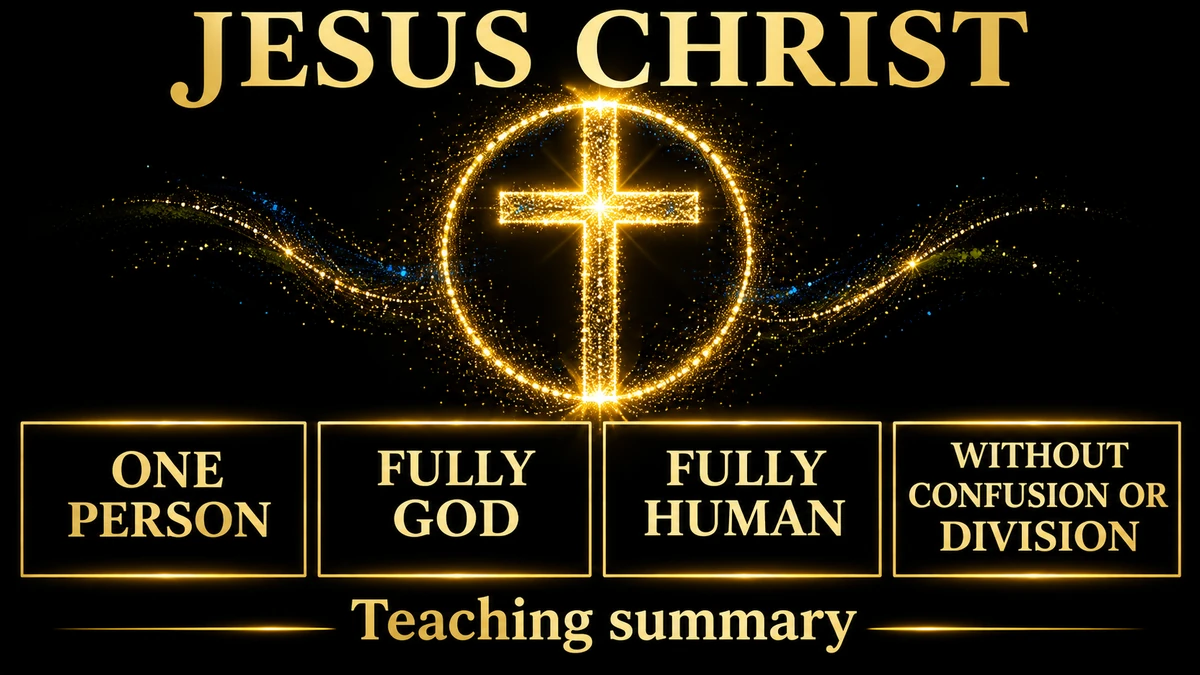
The incarnation: one person; fully God; fully human; without confusion or division. This summarizes the Chalcedonian confession, rather than quoting a Bible verse.
Why the identity of our Savior matters
The incarnation concerns the identity of our Savior. Hebrews 2 connects Jesus’ sharing our flesh and blood with his death, deliverance from bondage, and work as a merciful high priest. He truly enters the condition of the people he comes to rescue.
His divinity means that salvation is God’s own action among us. His humanity means that his obedience, suffering, and death are genuinely human. Christians explain aspects of the atonement differently, but this foundation keeps the cross from becoming either a divine appearance of suffering or merely the tragedy of an admirable teacher.
1 Timothy 2:5–6 identifies the human Christ Jesus as the mediator between God and humanity and connects that mediation with his self-giving. Calling him mediator does not mean that he occupies a middle category between God and human beings. The one who reconciles us truly belongs to our humanity while remaining the divine Son.
The incarnation must also be distinguished from the Trinity. The Trinity concerns the one God eternally existing as Father, Son, and Holy Spirit. The incarnation concerns the Son becoming human. Three divine persons does not mean three natures in Jesus, and two natures does not mean two persons in Jesus.
The Father did not become the Son, and the whole Trinity did not become incarnate. At Jesus’ baptism, Matthew 3:16–17 presents the Son being baptized, the Spirit descending, and the Father speaking. This is one biblical scene Christians consider when articulating those distinctions. Jesus’ prayers to the Father express a real relationship as well as his human life of trust. Our guide to how Christians can pray explores that dependent life in everyday practice.
What difference does this make on a difficult day?
Imagine Michael caring for his father after surgery. He is sleeping badly, snapping at people, and ashamed that he cannot handle everything. He assumes that feeling tired means he is failing spiritually, so he avoids prayer until he can sound more composed.
Jesus’ real humanity challenges that assumption. Fatigue is not automatically a moral failure. Michael can acknowledge his limits, ask relatives for help, and arrange rest. He also needs to apologize for unkind words. Recognizing weakness and taking responsibility for sin can happen together.
Jesus’ divinity gives Michael reason to bring more than admiration to this relationship. He can ask for mercy and strength from the Lord who saves. Hebrews 4 invites people in need to approach God’s grace, rather than waiting until their lives look impressive.
This confession also shapes how Michael receives care from others. A meal, a ride, or someone staying with his father meets a real bodily need. Such help does not compete with prayer. Taking human life seriously gives Christians reasons to offer practical mercy as well as speak words of encouragement.
The situation may remain exhausting. Faith does not promise immediate recovery or remove every practical burden. It does mean Michael need not hide his embodied life from Christ. The Lord he trusts has entered human life and remains worthy of his hope. Read more about suffering and Christian hope when answers arrive slowly.
Questions about Jesus’ divinity and humanity
Is Jesus half God and half human?
No. Fully God and fully human means complete divinity and complete humanity united in one person. Neither nature supplies a missing half of the other. Percentages treat the doctrine as a mixture and obscure its meaning.
Is Jesus still human after the resurrection?
Yes. In Luke 24:36–43, the risen Jesus shows his hands and feet and eats before his disciples. Christian teaching understands his risen humanity as glorified, not discarded. The incarnation is not a temporary costume he removes after Easter. Our Living Christ animation offers a visual reflection on that continuity through his incarnation, death, resurrection, and glory.
If Jesus is God, did God die on the cross?
The person who died is the divine Son, and his death is real. Classical Christian teaching says that he died according to his human nature. It does not mean that the divine nature ceased to exist or that the Father and Spirit died. Distinguishing the natures protects both his genuine death and his enduring divinity.
Where should I begin reading?
Read John 1:1–18 and Hebrews 2:14–18 together. Ask who the Word is and why the Son shares our humanity. Then read Hebrews 4:14–16 as an invitation to prayer. Bring one honest need to Christ, even while you continue learning how to speak about the mystery of who he is.
Scripture note: Biblical passages are linked in the World English Bible and explained mainly through paraphrase. Chalcedon’s formulation is identified as a later doctrinal statement. Michael’s story is an illustrative example, and practical applications are pastoral commentary.